Scholarship at UWindsor
Scholarship at UWindsor
Electronic Theses and Dissertations
Theses, Dissertations, and Major Papers
2014
A Virtual Shaker Table for Predicting Loads in Automotive
A Virtual Shaker Table for Predicting Loads in Automotive
Powertrain Mounts
Powertrain Mounts
Xiaowu Yang
University of WindsorFollow this and additional works at: https://scholar.uwindsor.ca/etd
Recommended Citation
Recommended Citation
Yang, Xiaowu, "A Virtual Shaker Table for Predicting Loads in Automotive Powertrain Mounts" (2014). Electronic Theses and Dissertations. 5185.
https://scholar.uwindsor.ca/etd/5185
This online database contains the full-text of PhD dissertations and Masters’ theses of University of Windsor students from 1954 forward. These documents are made available for personal study and research purposes only, in accordance with the Canadian Copyright Act and the Creative Commons license—CC BY-NC-ND (Attribution, Non-Commercial, No Derivative Works). Under this license, works must always be attributed to the copyright holder (original author), cannot be used for any commercial purposes, and may not be altered. Any other use would require the permission of the copyright holder. Students may inquire about withdrawing their dissertation and/or thesis from this database. For additional inquiries, please contact the repository administrator via email
IN
A
UTOMOTIVEP
OWERTRAINM
OUNTSby
Xiaowu Yang
A Thesis
Submitted to the Faculty of Graduate Studies
through the Department of
Mechanical, Automotive, & Materials Engineering
in Partial Fulfilment of the Requirements for
the Degree of Master of Applied Science at the
University of Windsor
Windsor, Ontario, Canada
2014
by
Xiaowu Yang
APPROVED BY
Dr. X. Chen
Department of Electrical & Computer Engineering
Dr. J. Johrendt
Department of Mechanical, Automotive, & Materials Engineering
Dr. B. Minaker, Advisor
Department of Mechanical, Automotive, & Materials Engineering
Declaration of Co-Authorship
I hereby declare that this thesis incorporates material that is result of joint research, as follows:
This thesis also incorporates the outcome of a joint research undertaken in collaboration with Sida
Li under the supervision of Dr. Bruce Minaker. The collaboration is covered in Chapter 6 of the thesis. In
all cases, the key ideas, primary contributions, experimental designs, data analysis and interpretation,
were performed by the author, and the contribution of co-authors was primarily through the provision
of modeling configuration and data exchange.
I am aware of the University of Windsor Senate Policy on Authorship and I certify that I have properly
acknowledged the contribution of other researchers to my thesis, and have obtained written permission
from each of the co-author(s) to include the above material(s) in my thesis.
I certify that, with the above qualification, this thesis, and the research to which it refers, is the
Abstract
In the automotive industry, multi-axis shaker tables are often used to study the damage caused by
motion-induced inertia loads to components such as engine mounts or fuel tank strips. To assess the
component durability characteristics using this approach, prototype parts must be built and a test rig
must be installed. This process is both time and budget consuming, so there is an incentive to reduce
the number of physical shaking tests. To that end, this thesis introduces a set of software tools that are
capable of conducting virtual shaking simulations with quality output results, i.e., a virtual multi-axial
shaker table (VMAST). By refining and reproducing vehicle body acceleration signals collected from the
proving grounds, the VMAST is able to replay the body motion of a vehicle. The reproduced motion
(drive file) can then be used to drive the virtual dynamic shaking. With the additional consideration of
vehicle body local flexibility, the flexible motion can be added to the rigid body motion to improve the
simulation accuracy. The dynamic shaking simulation can be done natively in MATLAB®, or the drive files derived from MATLAB® can be used by other commercial software, such as Altair® MotionView®. The virtual load data acquisition of the engine bushing mount is implemented during the simulation to
predict the fatigue index, which can be referenced in the design procedure. This VMAST provides the
automotive engineer with a cost effective tool for analysis, and optimizes the testing process, allowing
Acknowledgements
First, I would like to thank my supervisor Dr. Bruce Minaker for his guidance and patience over the last
two years. His encouragement and extensive knowledge when the project proved to be the most difficult
allowed me to overcome the difficulties and accomplish my goals.
Furthermore, I would like to thank the Chrysler Group LLC, Connect Canada, the Ontario Centres
of Excellence, and the University of Windsor–Chrysler Canada Automotive Research and Development
Centre for the funding and research facility that allowed me to pursue my research goals.
I would also like to express my thanks to my colleague Sida Li, who I have shared many theoretical
thoughts and laughs with over the years.
Contents
Declaration of Co-Authorship iii
Abstract iv
Dedication v
Acknowledgements vi
List of Tables x
List of Figures xi
List of Abbreviations xiii
Nomenclature xiv
1 Introduction 1
1.1 Motivation . . . 1
1.2 Virtual Multi-Axis Shaker Table . . . 2
1.3 Virtual Dynamic Shaking . . . 3
1.4 Research Objectives . . . 3
1.5 Structure of the Thesis . . . 4
2 Literature Review 5 2.1 Multi-Body Dynamics . . . 5
2.2 Virtual Simulation . . . 6
2.2.1 Modeling Techniques . . . 6
2.2.2 Solving Algorithm . . . 7
2.2.3 Data Processing . . . 11
2.3 Previous Work . . . 12
2.3.2 Full Vehicle Test Rig . . . 13
3 Theory 16 3.1 Rigid Body Kinematics . . . 16
3.2 Coordinate Transformation . . . 18
3.3 Equations of Motion . . . 20
4 Drive File Development 22 4.1 Displacement Driven Simulation . . . 22
4.2 Drive File Development . . . 22
4.3 Validation . . . 36
4.3.1 Validation Against Artificial Data . . . 36
4.3.2 Validation Against Test Data . . . 40
4.4 Discussion . . . 40
4.4.1 Filtering . . . 41
4.4.2 Reproduced Chassis Orientations . . . 41
4.4.3 Flexibility Recovery . . . 42
4.4.4 Drive File . . . 42
4.5 Software Application . . . 43
5 Dynamic Shaking Model 47 5.1 MATLAB Dynamic Shaking Model . . . 47
5.1.1 Limitation . . . 50
5.1.2 Software Application . . . 50
5.2 MotionView Shaking Model . . . 51
6 Dynamic Simulation Result Validation and Discussion 55 6.1 Simulating the Models . . . 55
6.2 Validation . . . 57
6.2.1 MATLAB®Simulation Result Validation . . . . 57
6.2.2 MotionView®Simulation Result Validation . . . 65
6.3 Discussion . . . 70
6.3.1 Bushing Modeling†. . . 70
6.3.2 Powertrain Modeling . . . 72
6.3.3 Data Collection and Solving . . . 72
6.3.4 Design Application . . . 72
7 Conclusions and Recommendations 74
7.1 Conclusions . . . 74
7.2 Recommendations . . . 75
References 77
Appendix A Permission to Include Joint Research Results 80
Appendix B Fatigue Data Comparison 81
Appendix C Hydro Mount 83
List of Tables
4.1 Vehicle chassis parameters. . . 23
4.2 Road test parameters. . . 24
4.3 Rigid motion velocity scale factors for event CPG010. . . 30
4.4 Artificial motions. . . 36
4.5 Body CM and virtual accelerometer locations. . . 36
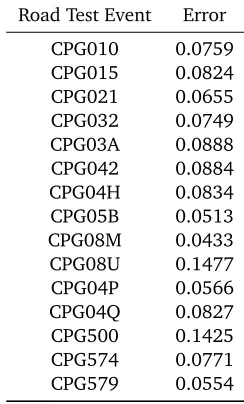
4.6 Drive file corresponding accelerations error for 15 events. . . 40
4.7 Drive file generation inputs. . . 44
4.8 Drive file generation outputs. . . 46
5.1 MATLAB®dynamic shaking inputs. . . 51
5.2 MATLAB®dynamic shaking outputs. . . 51
5.3 Powertrain-side accelerometer locations. . . 52
5.4 Powertrain inertia. . . 53
6.1 Linear bushing parameters. . . 56
6.2 Bushing rotational stiffnesses, MotionView®advanced model. . . . 56
6.3 Bushing damping coefficients, MotionView®advanced model. . . . 56
6.4 MotionView®DSTIFF Solver parameters. . . . 56
6.5 Fatigue numbers of the six road test events, MotionView®and test. . . . 69
6.6 Fatigue numbers of the front bushing vertical forces with ABM. . . 72
List of Figures
1.1 Multi-Axis Shaker Table. . . 2
1.2 Virtual Multi-Axis Shaker Table. . . 3
2.1 Vehicle simulated by Minaker and Rieveley[2]using their proposed method. . . 5
2.2 Virtual prototyping process by SBEL[5]. . . 6
2.3 Full vehicle test rig and basic test rig mechanics[23]. . . 15
3.1 Yaw, pitch and roll angles. . . 18
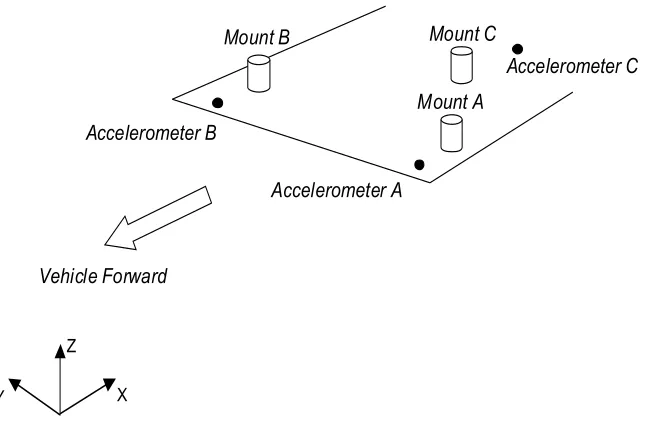
4.1 Schematic of chassis-side mount and accelerometer locations. . . 23
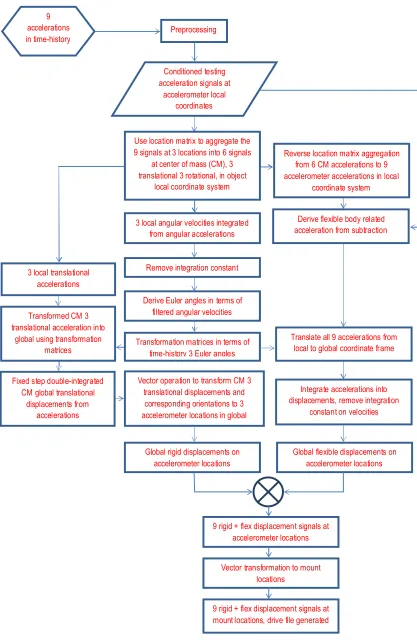
4.2 Drive file generation procedure. . . 25
4.3 Comparison between rigid and measured accelerations. . . 28
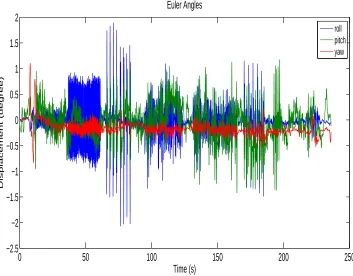
4.4 Euler angles of vehicle chassis derived for event CPG010. . . 31
4.5 Flexible displacements on accelerometerAlocation. . . 32
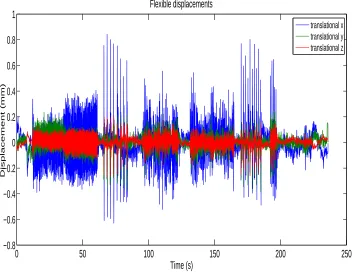
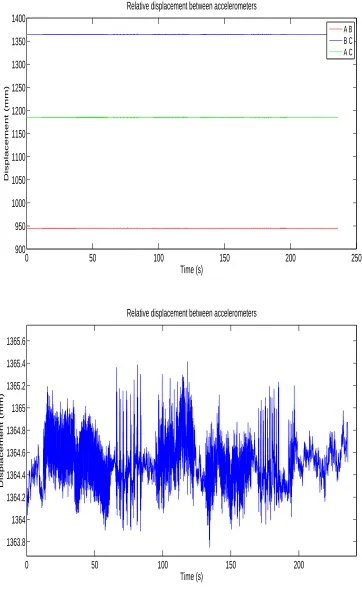
4.6 Relative displacements between accelerometers (above) and partial magnification (below). 33 4.7 Comparison between flexibility-considered and measured accelerations. . . 35
4.8 Comparison between simulated and artificial accelerations. . . 38
4.9 Comparison between flexibility-considered and measured displacements. . . 39
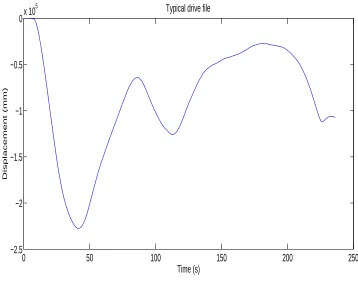
4.10 Typical drive file. . . 43
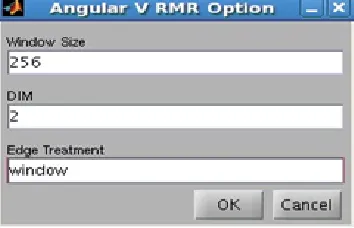
4.11 Angular velocity running mean removal dialog box. . . 44
4.12 RMS recovery dialog box. . . 45
5.1 Schematic of the VMAST and powertrain dynamic shaking model. . . 47
5.2 Side views and isometric view of the MotionView®model. . . 52
6.1 Roll angles of the powertrain, MATLAB®and MotionView®. . . . 58
6.2 Pitch angles of the powertrain and chassis from MATLAB®. . . . 59
6.3 Powertrain CM translationalxacceleration, MATLAB®and MotionView®. . . . 60
6.5 Translationalx, yandzaccelerations on accelerometerA, MATLAB®and MotionView®. . 61
6.6 zaxis deflection of left front bushing, MATLAB®and MotionView®. . . . 62
6.7 zaxis deflection of right front bushing, MATLAB®and MotionView®. . . 63
6.8 zaxis load of left front bushing, MATLAB®and MotionView®. . . 64
6.9 zaxis load of right front bushing, MATLAB®and MotionView®. . . 64
6.10 Powertrain-side accelerations, MotionView®and test. . . 66
6.11 Left front bushingzaxial force, MotionView®and test. . . 67
6.12 Right front bushingzaxial force, MotionView®and test. . . . 67
6.13 Rear bushingxaxial force, MotionView®and test. . . . 68
6.14 Bushing forces fatigue data comparison for six events. . . 69
6.15 Left frontzaxial bushing force, ABM and test. . . 71
B.1 Bushing forces fatigue data comparison for nine events. . . 82
List of Abbreviations
All abbreviations used in this work are described in this section.
Abbreviation Meaning
ABM Advanced Bushing Model
ARDC Automotive Research and Development Center
BDF Backward Differentiation Formula
CM Center of Mass
DAE Differential Algebraic Equation
DOE Design of Experiments
DOF A Degree of Freedom
EOM Equation of Motion
FE Finite Element
FEA Finite Element Analysis
FWD Front Wheel Drive
GA Genetic Algorithm
GUI Graphical User Interface
LHS Left Hand Side
MAST Multi-Axis Shaker Table
MBD Multi-Body Dynamics
MBS Multi-Body System
NVH Noise Vibration Harshness
ODE Ordinary Differential Equation
RHS Right Hand Side
RMS Root Mean Square
VMAST Virtual Multi-Axis Shaker Table
Nomenclature
Mathematical nomenclature throughout this work is listed below, separated by the chapter in which it
first appears.
Literature Review
Label Description
f Vector of applied forces in global reference frame
h step size
K Kinetic energy
m Running mean removal window size
n number of points defined for running mean removal
~
n Applied torque vector in global frame
p0 First data point in running mean removal
q Generalized coordinates
Q Generalized forces
t time
u Translational velocity
vp Velocity of the point of application of the external force F
x x coordinate
y ycoordinate
∆ Correction factor
Φ Constraint equations
λ Lagrange multiplier
~
ω Angular velocity vector
Theory
Label Description
~
aA Acceleration vector at locationA
~
aB Acceleration vector at locationB
~
aB/A Relative acceleration vector fromAtoB
~
aG Translational acceleration vector at the center of mass
axA,aAy,azA Translationalx, y,zacceleration at locationA
~
F Total force vector acting on the center of mass
~
HG Angular momentum vector
Ix x Moment of inertia aroundx
Iy y Moment of inertia around y
Izz Moment of inertia aroundz
Ix y Product of inertia aroundxandy
Ixz Product of inertia aroundxandz
Iyz Product of inertia aroundyandz
IG Inertia tensor
m Mass of the rigid body, a three by three diagonal matrix
~
MG Total torque vector acting about the center of mass
~r Coordinate vector of the global frame
~rB/A Distance vector fromAtoB
~r3 Coordinate vector of the rotating frame aroundx, yandz rx Distance alongx
ry Distance along y
rz Distance alongz
R Transformation matrix from global to rotating frame
R1 Transformation matrix from global to rotating frame (xonly) R2 Transformation matrix from global to rotating frame (xandy) R3 Transformation matrix from global to rotating frame (x, yandz)
~vA Velocity vector at locationA
~vB Velocity vector at locationB
~vB/A Relative velocity vector fromAtoB
~vG Translational velocity vector at the center of mass
vx Translationalxvelocity in the rotating frame
vy Translational yvelocity in the rotating frame
x,y,z Coordinates of the global frame
x1,y1,z1 Coordinates of the rotating frame aroundx only
x2,y2,z2 Coordinates of the rotating frame aroundx andy x3,y3,z3 Coordinates of the rotating frame aroundx,yandz
~α Angular acceleration vector in the body reference frame
αA x,α
A y,α
A
z Rotationalx,y,zacceleration at locationA
φ Euler angle aroundxaxis
θ Euler angle aroundy axis
~
ω Angular velocity vector of the body reference frame
ωx Euler angle rates aroundxaxis
ωy Euler angle rates around yaxis
ωz Euler angle rates aroundzaxis
ψ Euler angle aroundzaxis
Drive File Development
Label Description
~aA Acceleration vector at accelerometerA
~aB Acceleration vector at accelerometerB
~aC Acceleration vector at accelerometerC I 3×3 identity matrix
˜
rA/G Skew-symmetric matrix representing distance from CM toA
˜
rB/G Skew-symmetric matrix representing distance from CM toB
˜
rC/G Skew-symmetric matrix representing distance from CM toC
vC Ms Filtered and scaled velocities at center of mass
vC M Filtered velocities at center of mass
aC M Accelerations at center of mass
vr x Rotational velocity aroundx
vr y Rotational velocity around y
vrz Rotational velocity aroundz
am Measured accelerations
ar Reproduced accelerations
Dynamic Shaking Model
Label Description
~a Powertrain translational acceleration vector at CM
C Bushing damping coefficient
E Euler angles
~
F Total force vector at powertrain CM
~
FB Bushing force vector
g Gravitational constant
K Bushing stiffness
~
MG Total moment vector at powertrain CM
~
MH Half-shaft torque vector
~r Distance vector from powertrain CM to powertrain-side mount loca-tions
~v Powertrain translational velocity vector at CM
~ve Powertrain-side mount location velocity vector in the local frame
~vf Chassis-side mount location velocity vector in the global frame
~
x Powertrain CM location vector in the global frame
~
xe Powertrain-side mount location vector in the global frame
~xf Chassis-side mount location vector in the global frame
~α Powertrain angular acceleration vector at CM
~
Chapter 1
Introduction
1.1
Motivation
The multi-axis shaker table (MAST) (Figure 1.1), has been widely used in the automotive industry in
order to test vehicles or vehicle components specifically under high frequency excitation for various
purposes, such as fatigue analysis, ride quality and noise vibration harshness (NVH). As one of the major
tasks of the MAST, the fatigue test is vital for vehicle design engineers in carrying out quality products
while maintaining minimum cost. One common example is the powertrain (engine and transmission
assembly) mount durability test, in which the powertrain is mounted on the vehicle frame through
bushings; the whole assembly is then fastened to the shaker table platform, which is driven by hydraulic
cylinders. Acceleration data collected on the vehicle frame during the road test is used as the target
output for the shaker to match, and the feedback loop control algorithm is implemented to automatically
adjust the actuation force. However, conducting such a test requires both hardware and time: prototype
vehicles have to be built, the test rig must be set up, and the test cycle lasts for hours and hours.
To this end, the Chrysler Automotive Research and Development Center (ARDC) and University of
Windsor have worked together in a research project to develop a virtual simulation tool that could
numerically simulate the shaking process of a vehicle powertrain and predict the powertrain mount
loads. The ultimate goal of this project is to replace the physical shaking test with virtual shaking
simulation that could precisely predict the vehicle chassis and powertrain motion, as well as mount
loads. By virtually changing the powertrain and mount parameters, new simulation results would be
Figure 1.1:Multi-Axis Shaker Table.
1.2
Virtual Multi-Axis Shaker Table
The virtual multi-axis shaker table (VMAST) is a simulation tool developed to numerically simulate the
vehicle powertrain behavior under real road input profiles in order to acquire powertrain mount load
data. The simulation result can be used to predict the fatigue of the bushing mount. It is a user friendly
software package, and it has the advantage of changing the physical properties with ease, which allows
rapid design iterations.
Designed to function the same as the physical shaker table, the VMAST is able to cover full six
de-grees of freedom (DOF) rigid motions of the shaker platform (three translational and three rotational).
In addition, it has the capability to recover local deformation on the vehicle frame by introducing extra
translational degrees of freedom. The VMAST reads in acceleration data of the vehicle frame collected
from the proving ground, and transfers it to displacement for the purpose of driving the dynamic
shak-ing. Mathematically, the total number of degrees of freedom that the virtual shaker can produce is
identical to the number of input accelerations. For example, a vehicle frame that has three
accelerom-eters on distinct locations will give nine translational accelerations. The shaker can then solve for nine
displacements. The combined motion of the nine displacements contains the chassis rigid motion and
the local deformation. A schematic of the VMAST is shown in Figure 1.2; the red arrows represent the
rigid motion that the shaker could produce, and the yellow arrows demonstrate the overall degrees of
freedom the shaker generates, which consist of rigid and flexible.
The VMAST reproduced time history coordinate data is called the ‘drive file’, as it is used to drive the
dynamic shaking. The generation of the drive file will be explained in detail later in the thesis, and is
Figure 1.2:Virtual Multi-Axis Shaker Table.
1.3
Virtual Dynamic Shaking
After the drive files are developed, the next step is to conduct the dynamic shaking and collect the
result. There are two components to make up the dynamic shaking model: the powertrain and bushing
mounts. This model treats the powertrain as a single rigid body with moments and products of inertia,
that is connected to the bushing mounts. The model can be built and simulated using MATLAB®. In
case a more complex powertrain model is needed, commercial software such as MSC® Adams® or Altair®MotionView®can be used to construct the advanced model where, for example, the powertrain model may be equipped with additional linkages. Both simple and complex models are able to generate
simulation results such as the powertrain local acceleration, velocity and displacement, as well as the
bushing travel for powertrain motion study, and the bushing force for fatigue analysis.
Depending on the requirements of the simulation, either a simple or sophisticated bushing model can
be used. The simplest bushing model uses linear stiffness and damping based on a reasonable estimation,
which is computationally fast. The advanced bushing model (ABM) can be applied in the simulation
where the most accuracy is needed. It is a virtual bushing model with a parameter identification tool,
which identifies the virtual bushing parameters based on real bushing test data. However, it is relatively
time consuming.
1.4
Research Objectives
The first objective is to develop a set of MATLAB®codes that generate the desired motion to drive the
powertrain. The codes must be able to read the acceleration data collected on the vehicle frame during
the road test and reproduce the motion of the vehicle frame. The process should virtually replay the
vehicle frame motion due to excitation from the road in the real case.
of the powertrain. The model reads in the motion produced in the first step, simulates and generates the
time history output. This numerical model is compiled to be a user friendly design tool in cases where
the powertrain mechanism is simple. It is easy to implement and is capable of running in batch mode.
The last objective is to use MBD software for complex powertrain mechanism modeling and
simula-tion. In this case, the shaker and powertrain models need to be built with commercial software.
1.5
Structure of the Thesis
The thesis consists of seven chapters. The first chapter introduces and describes the motivations and
goals of the research, as well as the research product and its function. The second chapter is a review
of the literature, which includes a review of the virtual simulation tools and their corresponding solving
algorithms, as well as the previous research in the relevant area. In Chapter 3, the theory used to develop
the virtual shaker will be addressed.
In Chapter 4, the drive file development approach is introduced, which includes five detailed steps
of the numerical approach to reproduce the vehicle frame motion from accelerations in order to drive
the dynamic shaking. The chapter will focus on the application of relevant mathematical algorithms,
as well as the data processing method, e.g., the data filtering. In addition, a validation is included,
and the assumptions and limitations are also discussed. Lastly, the software application of the drive file
development process is described.
In the first half of Chapter 5, the MATLAB®dynamic shaking model is presented. The kinematic and dynamic equations used to solve the model are introduced. The limitation of the MATLAB®model is also discussed. In addition, the software application of the MATLAB® model is described. The second half of this chapter is focused on the model built using MBD commercial software. An Altair®MotionView® shaker and powertrain model is presented. The physical parameters of the vehicle and powertrain model
are from the Chrysler PF platform with a 2.4L engine.
In Chapter 6, the simulation and results of both MATLAB® and MotionView®models are discussed.
The validation of the simulation results is done through the following: a check on the plausibility of the
simulation results in the real world; comparison of the simulation results between the virtual models;
comparison of the simulation results against test data.
In Chapter 7, conclusions on the development and application of the VMAST are presented. Potential
Chapter 2
Literature Review
2.1
Multi-Body Dynamics
The use of multi-body dynamics (MBD) is essential in vehicle design and testing. According to Schwerin[1],
multi-body systems (MBS) play an important role in computer aided technical mechanics, and vehicle
dynamics is the major area of application. The ability to design and optimize such technical multi-body
systems gives a company working in this area the competitive edge on the market. The equations of
motion (EOM) are well known to describe the behavior of a multi-body system as a set of mathematical
functions in terms of dynamic variables. Much work has been done on studying multi-body systems for
automatic generation of the equations of motion, for example, see Minaker and Rieveley[2]. A method
was developed for automatic generation of linearised equations of motion that allows for easy
inclu-sion of nonholonomic constraints, and the method presents equations of motion well suited for vehicle
stability analysis. They stated that the use of mathematical models in vehicle system design has grown
immensely in recent history, leading to the development of models with increasing size and complexity.
2.2
Virtual Simulation
As Grote and Sharp[3]stated, the past decades have seen a rapid advance in computer based prediction
and analysis tools. These tools allow for parts and assemblies to be constructed and their behavior
predicted in the virtual world of computer simulation. Becker, Salvatore and Zirpoli[4]pointed out that
virtual simulation tools now play a very important role in new product development. They have been
widely hailed to significantly cut development time and costs. They argued that the contribution of
virtual tools to experimentation goes well beyond the incremental improvement of the results obtained
with physical experimentation. “Virtual simulation techniques can do much more than just reduce the
cost and increase the speed of problem solving,” they mentioned.
2.2.1
Modeling Techniques
ADAMS
The Automated Dynamic Analysis of Mechanical Systems (ADAMS) software marketed by MSC® Soft-ware has been proven as very beneficial to virtual prototype development (VPD) by reducing product
time to market and product development costs.
As proposed by the Simulation Based Engineering Lab (SBEL)[5], the virtual prototyping process of
ADAMS®includes four steps. The first step is building a model using bodies, joints, contacts and forces.
The next step is testing the design using measures, simulations, animations and plots; the simulation
result can be validated by importing test data and superimposing it. Next, one should review the design
by adding friction, forcing functions, flexible parts and control systems, and iterate it through parameters
and design variables. Lastly, the design is improved using DOEs (Design of Experiments) or optimization.
The design process can be automated by using custom menus, macros or custom dialog boxes. This
modeling strategy is not only valid in ADAMS®, but also in other multi-body codes as well.
Figure 2.2:Virtual prototyping process by SBEL[5].
MotionView
has the advantage of a particularly user friendly GUI (Graphical User Interface), and better graphical
representation when comparing with ADAMS®. Its capability in handling nonlinear elements, such as
flexible beams or bushings, as well as modeling complex multi-body system, like a vehicle chassis
as-sembly is competitive with ADAMS®. It has been gaining popularity among engineering companies and academic institutions, especially for those who want to model and simulate multi-body systems
with-out much proficiency or experience. The modeling technique described above is well suited for the
MotionView®application.
The MotionView® default solver—MotionSolve®, is a system level, multi-body solver that is based
on the principles of mechanics[7]. Using a multi-body system built in MotionView®, MotionSolve®
automatically formulates the equations of motion and numerically solves them. MotionSolve®provides
four types of simulation: transient, static, quasi-static and linear, among which transient is used to
dynamically simulate the system with more than zero degrees of freedom. The names of the solvers
used for solving differential algebraic equations (DAEs) in transient simulation are: ABAM, VSTIFF,
MSTIFF and DSTIFF. The default solver is DSTIFF. It is claimed in the research that the DSTIFF solver
is more robust than the solvers in ADAMS® in dealing with high frequency excitation as an input to multi-body systems.
MATLAB
According to Hanselman and Littlefield[8], MATLAB®was initially developed by a lecturer in the 1970’s to help students learn linear algebra. Later, it was marketed and further developed under MathWorks® Inc. MATLAB® is a software package that can be used to perform analysis and solve mathematical and engineering problems. It has excellent programming features and graphics capability that are easy to
learn and provide the user with great flexibility. SIMULINK®—a data flow graphical programming tool, is used for modeling, simulating and analyzing dynamic systems. It has a comprehensive library that can
be used to simulate linear, non-linear or discrete systems. The programming features and comprehensive
mathematical functions enable the modeling of complex MBS in the MATLAB®environment.
Other commercial software such as MapleSim® and CarSim® might be applicable for the research
presented in this thesis. However, due to the adequate number of approaches already available, the
software is not further studied.
2.2.2
Solving Algorithm
After the MBS is built in the pre-processor, the next step is to simulate the system. Once the simulation is
initiated, the MBD software will analyze the information that the user imports, such as the generalized
coordinates, constraints, motions and initial conditions. Depending on the simulation type chosen, the
next step is to formulate the corresponding equations of motion of the system. In terms of dynamic
Negrut and Dyer[9]. According to them, the Lagrange formulation of the equations of motion is shown
as the following second order differential equations
d d t
∂K
∂˙q T
− ∂K
∂q T
+ ΦT
qλ=Q (2.1)
where:
K=kinetic energy
q=generalized coordinates
Φ =constraint equations
λ=Lagrange multiplier
Q=generalized forces
The second order equations can be further reduced to first order considering the choice of the
gen-eralized coordinates q= p " (2.2)
wherepis the positon and"is the orientation (Euler angles). The first order equations are shown as:
d d t
∂K
∂u T ∂ K ∂ ζ T − ∂K ∂p T
∂K
∂ " T + ΦT pλ ΦT "λ = (Q p)Tf (Q
R)T¯n
(2.3)
The projection operators in the generalized forces term are computed as:
Y p=∂v
p
∂u (2.4)
Y
R= ∂ ~ω
∂ ζ (2.5)
where:
u=translational velocity
ζ=Euler angle rates
f =vector of applied forces in global reference frame
n=applied torque in global frame
vp=velocity of the point of applicationPof the external forceF
~
Since d d t ∂K ∂u T
=Mu˙ (2.6)
∂K
∂p T
=0 (2.7)
with the angular momentum defined as:
Γ =∂∂ ζK =BT~J Bζ˙ (2.8)
the EOM of Eq. (2.3) are reformulated as:
Mu˙+ ΦTpλ=Yp T
f (2.9)
Γ−∂K
∂ " + Φ
T
"λ=
Y R
T
¯
n (2.10)
The first order differential equations above are called in what follows kinetic differential equations,
and they indicate how external forces determine the time variation of the translational and angular
momentum.
At last, the time variation of the generalized coordinates is related to the translational and angular
momentum by means of thekinematic differential equations. By assembling the kinetic and kinematic
differential equations, a set of equations for each rigid body in the MBS are derived as follows:
Mu˙+ ΦTpλ−Yp T
f =0 (2.11)
Γ−BT~J Bζ=0 (2.12)
Γ−∂K
∂ " + Φ
T
"λ−
Y R
T
¯
n=0 (2.13)
˙
p−u=0 (2.14)
˙
"−ζ=0 (2.15)
It is notable that the solution to the above differential equations must also satisfy the kinematic constraint
equations of the system. The equations are:
Φ q,t
=0 (2.16)
Φq q,t ˙
q=−Φt q,t
(2.17)
Φq q,t ¨
q=−Φq˙q
q˙q−2Φqtq˙−Φt t q,t
This set of differential and constraint equations from Eq. (2.11) to Eq. (2.18) are called the
Differ-ential Algebraic Equations (DAEs). In many cases, the DAEs of the MBS cannot be solved symbolically.
Therefore, a numerical solution is used find a close approximation. As Negrut and Dyer stated[9], the
most common DAE solver that ADAMS®uses is the GSTIFF-I3. Here the GSTIFF stands for the solution of stiff differential equations, and I3 means the index of the DAEs is three, which means the number
of times the constraints in the system must be differentiated to get the system into ODEs is three. It is
always index three for a mechanical system. In mathematics, a stiff equation is a differential equation
for which certain numerical methods for solving the equation are numerically unstable, unless the step
size is taken to be extremely small. Lambert[10]described stiffness as: “If a numerical method with a
finite region of absolute stability, applied to a system with any initial conditions, is forced to use in a
cer-tain interval of integration a step length which is excessively small in relation to the smoothness of the
exact solution in that interval, then the system is said to be stiff in that interval.” According to Gear and
Skeel[11], the earliest paper on stiff differential equations was given by Curtiss and Hirschfelder[12],
in which they developed the method using backward differentiation formula (BDF) in solving
differ-ential equations that failed to come up with stable numerical solutions with other methods. The next
significant development was the definition of A-stability by Dahlquist[13]. The theory was extended
by Daniel and Moore[14], mentioning that the order of an A-stable method cannot exceed twice its
number of derivatives involved implicitly in each step. Later approaches including Widlund[15]and
Gear[16][17] focused on breaking through the order limitation implied by A-stability. Both of them
explored non-A-stable methods, which were realized to be most effective for general stiff problems.
When solving the DAEs, GSTIFF-I3 will first apply an order one implicit integration formula, in order
to convert the DAEs into a set of algebraic equations. The one step, A-stable BDF replaces the derivative
˙
y1at timet1with
˙y1=1 hy1−
1
hy0 (2.19)
Then the derivative in the above equation can be ‘discretized’ by replacing ˙y1with a nonlinear function
g(y,t). The equation becomes:
1
hy1−
1
hy0−g(t1,y1) =0 (2.20)
To retrieve y1, this ‘discretization equation’ is solved using a Newton-Raphson type iterative algorithm as follows:
x(1)=x(0)− f(x
(0))
f0(x(0)) (2.21)
The algorithm continues by settingx(0)withx(1).
By applying the discretization approach to Eq. 2.11 to 2.15 and the position constraint equation form
At this stage, the unknowns in the nonlinear equations are defined as:
yT=h u Γ ζ p " λ f n¯ iT
(2.22)
the nonlinear system is rewritten as:
Ψ(y) =0 (2.23)
The Newton-Raphson method is then used to solve the system. Once the initial value of y(0)is predicted, the iteration runs as:
Ψy(y0)∆(j)=−Ψ(y(j)) (2.24)
y(j+1)= y(j)+ ∆(j) (2.25)
until the correction∆(j)are small enough (the value of∆is set by the user).
Competitive with the ADAMS® solver, MotionSolve® dynamic simulation accounts for all inertia effects, all applied forces and internal constraints. In dynamic simulations, the MotionSolve® solver analyzes the MBS and generates a set of DAEs. It solves the equations of motion in their most general
form, including nonlinear effects[7]. The default DAE solver that MotionSolve®uses is DSTIFF, and the default setting for the DAE index is 3, which means the position constraint is included. According to
the MotionSolve®reference guide[18], it solves a system of differential/algebraic equations of the form
G(t,y,y0) =0, using a combination of BDF methods. This method is based on the available integrator DASPK, which is developed by Brown, Hindmarsh and Petzold[19].
2.2.3
Data Processing
Virtual simulation uses the data collected externally to reproduce the real case. However, as mentioned
by Pyle[20], the data-gathering methods are often loosely controlled, resulting in out-of-range values,
impossible data combinations, missing values, etc. Analyzing data that has not been carefully screened
for such problems can produce misleading results. Thus, the representation and quality of data is
im-portant.
The acceleration data that VMAST reads in is a high frequency, time-history signal collected from
tests in the proving grounds. The data sometimes has undesired high frequency content that could
lead to a nonsensical outcome if further processed. Another source of data error faced in the shaker
developing process is the integration constant, which is an ambiguity inherent in the construction of
antiderivatives. It is an arbitrary constant that affects the accuracy of the integration result.
In order to obtain accurate and meaningful simulation results, the input data and intermediate results
must be properly processed. Two methods are studied and found effective in eliminating the numerical
Butterworth Filter
The Butterworth filter is a type of signal processing filter designed to have as flat a response as possible
in the passband. It is also referred to as a maximum flat magnitude filter. The filter was first described
by Butterworth[21] stating: “An ideal electrical filter should not only completely reject the unwanted
frequencies but should also have uniform sensitivity for the wanted frequencies.”
The frequency response of the Butterworth filter is maximally flat in the passband and rolls off
towards zero in the stopband. The advantage of the Butterworth filter is that it is very good at simulating
the passband of an ideal filter. In other words, it gives the minimum distortion in the passband. However,
as it goes to zero gradually, some parts of the stopband are still kept. As the design characteristic of the
Butterworth filter, the filter order, which is defined as the maximum delay (in samples) used in creating
each output sample, can be increased to enable a better filtering performance.
As a result, the low pass Butterworth filter is a good choice for eliminating the high frequency content
buried in the acceleration data while preserving the desired frequencies in order to gain maximum
accuracy in the simulation.
Running Mean Removal
The running mean is a calculation to analyze data points by creating a series of averages of different
subsets of the full data set. Commercial software, such as nCode GlyphWorks®[22] and MATLAB® provide the function of auto generation of the running mean on each data point. It works based on
the user selected number of pointsn. Starting from the first data point p0, this function calculates the average of a ‘window size’m, wherem=2n+1, and the length of the window being calculated ranges
fromp0−ntop0+n. Then the calculation proceeds to the next data point until it reaches the last one. When calculating the first or the last group ofndata points, the size of the window exceeds the size of
the data points available. Thus, there are several options of padding the edge of the data. They are:
‘edge’, which pads the data with the first and last values; ‘zero’, which pads the data with zeros; ‘mean’,
which pads the data with the mean of the subset; ‘window’, which pads the data with the first half and
last half window.
Once the mean is obtained, the next step is to subtract it from each data point. This function is to
remove the trend from the signal, which appears as the integration constant on the intermediate result
during the ‘drive file’ generation procedure.
2.3
Previous Work
As Dressler, Speckert and Bitsch mentioned[23], in recent years so-called ‘virtual test rigs’ have become
more and more important in the development of cars and trucks. Originally, the idea was to substitute
cooperative usage of numerical and laboratory rig simulation. In the early development stages, when no
physical prototypes are available yet, numerical simulation is used to analyze and optimize the design.
2.3.1
Quarter-Car Test Rig
Many papers have been published on the development of virtual test rigs for vehicle component tests.
One of them was by Sandu, Andersen and Southward[24], in which they developed a multi-body
dy-namics model of a quarter-car test rig equipped with a McPherson strut suspension. Both linear and
nonlinear models were developed in order to predict the dynamic response of a quarter car suspension.
The linear model consists of a sprung mass, an unsprung mass, and wheelpan actuator plate bodies.
The sprung mass is supported by the primary-ride spring and included mass from the sprung mass plate
and strut tower. The assumptions made for the linear model is that the motion of the masses could be
approximated as linear translational. Also, the springs used in the system are assumed to have linear
behavior. The equations of motion of the model are formulated by using the Lagrange multiplier to
assemble the constraint forces with the inertia forces.
The major difference between the linear and nonlinear models is that the nonlinear model accounts
for the kinematic joint constraints. Instead of positioning the sprung and unsprung mass in the uniform
vertical direction, the unsprung mass is connected to the sprung mass through control arms, which
breaks the geometrical linearity. The structure is assumed to be rigid. The same algorithm was used to
formulate the nonlinear system equations.
The HHT method integrator was used to solve the DAEs of both the linear and nonlinear models,
and the simulation results were compared against experimental data. The performance metric chosen
to judge how well the mathematical model predicts reality is the ratio of the root-mean-square (RMS)
of the error between simulation and experimental results to the experimental RMS. It is shown in the
paper that both linear and nonlinear models predict the dynamic response of the quarter car model,
such as the accelerations of both the sprung and unsprung masses, and the nonlinear model has better
performance. The simulation result can be further implemented in studying the dynamic behavior of
other nonlinear components, like dampers and bushings.
2.3.2
Full Vehicle Test Rig
The virtual test rig brought by Mántaras and Luque[25]focused on investigating the three-dimensional
position of the vehicle body (i.e., roll, pitch and height of the center of gravity) and the main parameters
(e.g., caster, camber, steer angle, kingpin inclination, toe in/out, roll axis, bump steer, Ackerman angle),
that influence the handling of the vehicle. They proposed a three-dimensional kinematic model of the
front and rear suspension and the steering system, in order to predict the vehicle positions as well as the
First of all, the coordinate frames are determined. One reference frame is attached to each wheel,
plus a reference frame for the vehicle and a global reference frame (non-moving or inertial). The
orientation of the vehicle is defined using Cardan angles. The next step is to determine the kinematic
equations of each component. The kinematic equations of each wheel are determined using the
three-dimensional constraint equations for the point of origin of the reference frame. The movement of the
rear axle, in spite of being a three-dimensional movement, is considered as a combination of two plain
movements. The vehicle kinematic model is built based on the assumption that the road is a plane, so
the calculation of a plane tangent to the wheels can be used. At this stage, the full vehicle model is
developed and ready for a virtual test.
The virtual test rig was set up using MATLAB® and Simulink®. The geometric parameters of the
vehicle components are pre-defined by the user. The inputs to the test rig are, as a function of time, the
roll angle and pitch angle of the vehicle body, the vehicle center of gravity height and the steering angle.
The outputs of the simulation are the vehicle camber, caster, etc., which can be fed back to the system to
optimize the vehicle geometry.
The author validated the virtual test rig simulation result against a measured result, where a small
difference can be anticipated in the comparison, this being essentially a function of errors of
measure-ment associated with the instrumeasure-ments used. Also, a MBS vehicle model was built in ADAMS®to validate the virtual test rig.
Another full vehicle virtual test rig was introduced by Dressler, Speckert and Bitsch[23]. In their
paper, the numerical simulation models of complex servo-hydraulic test systems and their test specimen
were demonstrated. The full vehicle test rig is composed of four hexapod-based suspension test rigs.
The hexapod technology was illustrated by driving a platform that is connected to the wheel hub using
six actuators; thus, the platform supports all six DOF of the hub. At a closer look, the hexapod consists
of a base and a top platform, which are connected via six identical actuators. The joints between the
actuators and the platforms have two rotational DOF. One actuator contains the piston and the cylinder,
which in turn are connected using a cylindrical joint. This construction contains six DOFs. The force
and torque balance equations of the construction are listed and imported into MATLAB®to calculate the actuator forces for certain suspension tests. The full vehicle model has one hexapod test rig connected to
each wheel hub. Besides, each individual test rig is upgraded to have an additional six DOF, representing
the tire model.
The research team also carried out physical test track simulations to compare with virtual
simula-tion in results on forces, accelerasimula-tions and displacements, as well as damage-related histograms, e.g.,
rainflow counting, range pair counting and damage values.
As a conclusion, current virtual test rigs are capable of producing quality simulation results that
can be used in accelerating the design process and to contribute to a more cost and time efficient test
Figure 2.3:Full vehicle test rig and basic test rig mechanics[23].
behavior, and virtual simulation studies of the vehicle powertrain’s (engine and transmission assembly)
dynamic behavior under external excitation have been sparse. The research presented in this paper
aimed to build a virtual test rig to simulate the vehicle powertain dynamic response under road input
Chapter 3
Theory
A series of kinematic and dynamic theories used in the drive file generation procedures and virtual
shaker model development are introduced in this chapter, including the rigid body kinematics,
coordi-nate transformation and equations of motion.
3.1
Rigid Body Kinematics
In physics, a rigid body is an idealization of a solid body in which deformation is neglected. In other
words, the distance between any two given points of a rigid body remains constant in time regardless
of external forces exerted on it. In this way, the kinematic relationships between any two points are
studied.
There are two important relationships. First, the relationship of translational velocity between two
points is formulated as:
~vB=~vA+~vB/A (3.1)
where~vB/Ais the is the relative velocity, and it can be represented as:
~vB/A=ω~×~rB/A+~˙rB/A (3.2)
where:
~
ω=angular velocity of the body reference frame
~rB/A=distance vector fromAtoB
It is worth pointing out that the angular velocity is the same for any point fixed to the body. If pointA
and pointBare both fixed to the same body, then~˙rB/A=0.
The equation of acceleration between two points is:
~
aB=~aA+~aB/A (3.3)
where~aB/Ais the is the relative acceleration, and it can be represented as:
~
aB/A=~α×~rB/A+ω~×ω~×~rB/A+2ω~×~˙rB/A+~¨rB/A (3.4)
where:
~α=angular acceleration of the body reference frame
~
ω=angular velocity of the body reference frame
~rB/A=distance vector fromAtoB
~˙rB/A=rate of change of~rB/Ain the rotating frame
~¨rB/A=rate of change of~˙rB/Ain the rotating frame
The four terms in the RHS following the sequence are called the tangential acceleration, the centripetal
acceleration, the Coriolis acceleration and the radial acceleration. For a rigid body whose angular
veloc-ity is very small, the centripetal acceleration term can be neglected as the square product of the angular
velocity approximately equals to zero. The Coriolis acceleration is generated by the Coriolis effect, which
is a deflection of moving objects when they are viewed in a rotating reference frame. So if observed from
the rigid body local frame, the point on the rigid body has no Coriolis effect and the Coriolis acceleration
term can be neglected. Also, the last term is zero for a rigid body. Thus, Eq. (3.3) can be rewritten as:
~
aB=~aA+~α×~rB/A (3.5)
In the three dimensional coordinate system, the acceleration of point A forms the vector as:
~aAT= [ aAx aAy aAz ]T (3.6)
Also, the angular acceleration is written as:
~αT
A = [ αAx α A y α
A z ]
T
(3.7)
Similarly, the acceleration at pointB can also be written as a vector form. If the LHS of Eq. (3.5) is
third point on the rigid body is known, then there are six known value against six unknowns. The number
of knowns is equal to the number of unknowns, and the system seems determined. However, there is
redundancy in the equations. Thus, the accelerations of at least one additional point are required to solve
the system, but there will be nine knowns against six unknowns, and the system is overdetermined. The
least squares method is then used to approximate the solutions.
3.2
Coordinate Transformation
The rotation of a rigid body is often described using an angular parameter such as angular displacement,
velocity and acceleration, with respect to the body reference frame. Yet, the pure translational motion
is described with respect to a coordinate frame that is fixed. So when there is both translational and
rotational motion, a method is applied to transfer the coordinates from a rotating frame into a fixed
frame. In order to describe the method, the concept of Euler angles is first introduced. The Euler angles
Roll
Yaw Pitch
Figure 3.1:Yaw, pitch and roll angles.
are three angles introduced by Leonhard Euler to describe the orientation of a rigid body. They are
typically denoted asψ, θ andφ. The three angles represent a sequence of three elemental rotations, i.e., rotations about the axes of a coordinate system. In the automotive industry, the yaw-pitch-roll angles
are often used to describe vehicle orientation (Figure 3.1). When calculating the orientation, the Euler
angles work in the selected sequence. In a three dimensional coordinate system, the yaw-pitch-roll (also
called 3-2-1) sequence transforms the coordinate in the following way: first, the frame rotates aroundx
axis with an angleφ. The geometric relationship between the new coordinates and the old ones is:
x1 y1 z1 =
1 0 0
0 cosφ sinφ 0 −sinφ cosφ
wherex1, y1andz1are the new coordinates. The next step is to rotate around y axis with an angleθ. The coordinates derived in the last step are used as the datum in this rotation, and the formulation is:
x2 y2 z2 =
cosθ 0 −sinθ
0 1 0
sinθ 0 cosθ x1 y1 z1 (3.9)
In the last step, the reference frame rotates aroundzaxis with an angleψ, whose equation is as follow-ing: x3 y3 z3 =
cosψ sinψ 0
−sinψ cosψ 0
0 0 1
x2 y2 z2 (3.10)
The equations above can be written in the form:
~r3=R3R2R1~r (3.11)
where R1,R2 and R3 are the transformation matrix in Eq. (3.8), (3.9) and (3.10) respectively. The product of the three matrices formulates the final transformation matrix. It describes the rotations
regarding a rotating frame. If the rotations are about space fixed axes, the order of the rotations is
reversed and the transformation matrix becomes the following; see Baruh[26].
R=R1R2R3=
cψcθ sψcθ −sθ −sψcθ+cψsinθsφ cψcφ+sψsθsφ cθsφ
sψsφ+cψsθcφ −cψsφ+sψsθcφ cθcφ (3.12)
wheres=sinandc=cos.
Similarly, the Euler angle rates (first derivative of Euler angles) have the following relationship with
the angular velocity:
ωx=φ˙−ψ˙sinθ (3.13)
ωy=θ˙cosφ+ψ˙cosθsinφ (3.14)
ωz=−θ˙sinφ+ψ˙cosθcosφ (3.15)
where:
~
ω=angular velocity expressed in the body fixed frame
˙ ψ ˙ θ ˙ φ =
0 sinφ/cosθ cosφ/cosθ 0 cosφ −sinφ 1 sinφtanθ cosφtanθ
ωx ωy ωz (3.16)
If the angular velocities of the rigid body are known, the above equations become ODEs and the Euler
angle rates and Euler angles can be solved using an ODE solver.
3.3
Equations of Motion
The equations of motion are equations that describe the behavior of a MBS in terms of its motion as a
function of time. The equations for translation
X
~
F=m~aG (3.17)
where the subscriptG stands for the center of mass, work equally well in two dimensional and three
dimensional coordinate systems. However, the rotational equations are not so simple. First, the moments
of inertia are defined as:
Ix x = Z
r2y+rz2d m (3.18)
Iy y= Z
r2x+rz2d m (3.19)
Izz= Z
r2x+r2yd m (3.20)
whereri(i=x,y,z)is the length along the coordinate axes, andmis the mass of the object. Also, the
cross-products of inertia are defined as:
Ix y= Z
rxryd m (3.21)
Ixz= Z
rxrzd m (3.22)
Iyz= Z
ryrzd m (3.23)
Now the inertia can be written into a matrix from as:
I=
Ix x −Ix y −Ixz
−Iy x Iy y −Iyz
whereI is called the inertia tensor. The angular momentum is expressed as:
~
HG=IGω~ (3.25)
The combined translational and rotational dynamics of a rigid body can be expressed by the
Newton-Euler equations:
X
~
F=m~˙vG+ω~ ×m~vG (3.26)
X
~
MG=IG~α+ω~×IGω~ (3.27)
where:
~
F=total force acting on the center of mass
m=mass of the rigid body, a three by three diagonal matrix
~vG=translational velocity of the center of mass
~˙vG=translational acceleration of the center of mass
~
MG=total torque acting about the center of mass
IG=inertia tensor
~α=angular acceleration
~
ω=angular velocity
The second term on the RHS of Eq. (3.26) is considered if a rotating frame is used for~v. The total torque is the derivative of the angular momentum, and the second term in the RHS is called the gyroscopic
moments. ˙ x ˙ y ˙ z =R vx vy vz (3.28)
Note thatP~FandPM~ are functions ofx,y,z,ψ,θ,φand their derivatives, thus an ODE solver is also required. In addition, the velocity in the body fixed frame has the relationship with the displacement
in the global frame shown in Eq. (3.28), whereRis the transformation matrix which transforms the
Chapter 4
Drive File Development
4.1
Displacement Driven Simulation
The VMAST resembles the real shaker by matching the test accelerations. However, instead of adjusting
the acceleration magnitude with a feedback loop, it uses time-history displacement signals which are
recovered from the test accelerations, and their corresponding accelerations closely match those from
the test, which promises the accuracy of the simulated inertia load.
It seems more time efficient to drive the dynamic simulation with accelerations directly, as the
dis-placement conversion is omitted. In fact, the experimental results showed that the test acceleration is
not suitable for driving the simulation. First of all, the test accelerations can not be used unprocessed,
as the numerical errors buried in the data are destined to cause faulty results. However, the numerical
processing on the acceleration data is not easily done because there is no criterion as a reference. Unlike
displacements, which represent some physical relationships, such as the chassis rigidity and orientations
that can be easily observed and controlled, the accelerations don’t obviously reveal such relationships.
Thus, it is very challenging to control the numerical processing on the acceleration data, and this is why
the accelerations have to be converted.
The number of driving displacement signals depends on the number of accelerometers that were
used to collect the test accelerations. The accelerometer records data in its own coordinate frame on the
three axial directions (x, yandz). If the vehicle chassis motion was recorded by three accelerometers,
the driving displacement should correspondingly have nine signals.
4.2
Drive File Development
This section describes the details of the conversion from acceleration to displacement. The powertrain
indoor road test data, collected on Chelsea Proving Grounds). This transverse powertrain has three
mounts (each labeled asA, B andC), two of which are in the front, supporting the engine. The left
and right side are defined by the driver’s view while sitting in the driver’s seat. The last one holds the
transmission. The accelerometers are installed on the vehicle chassis right beside the mount locations,
and labeled asA,B andC; see Figure 4.1. The road profile contains nine pieces of acceleration data.
Each three describe the axial translational accelerations of one accelerometer in its local coordinate
frame. The input parameters were measured in a global fixed frame, see Table 4.1 and 4.2 for details.
It is worth pointing out that although the initial location of the accelerometers were measured in a
different coordinate frame than accelerations, there is no conflict as the locations are only used to find
out the relative distance.
$
$
$
$
$
$
$
$ $ $
!!"#"$%&"'"$()$
($
)$ *$
!!"#"$%&"'"$( $ *%+,'()$
*%+,'( $ *%+,'(-$
!!"#"$%&"'"$(-$
."/0!#"(1%$23$4$
Figure 4.1:Schematic of chassis-side mount and accelerometer locations.
Table 4.1:Vehicle chassis parameters.
Item Name Location[x,y,z] [mm] Item Name Location[x,y,z] [mm]
Left Front Mount A [-182,-453,370] Left Front Accelerometer A [-590, -455, 280] Right Front Mount B [-200, 492, 391] Right Front Accelerometer B [-590, 490, 280]
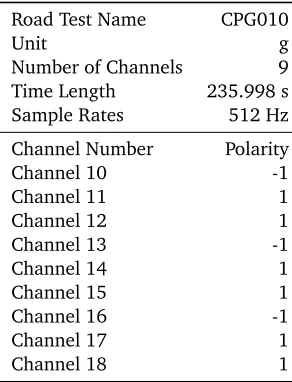
Table 4.2:Road test parameters.
Road Test Name CPG010
Unit g
Number of Channels 9 Time Length 235.998 s Sample Rates 512 Hz
Channel Number Polarity
Channel 10 -1
Channel 11 1
Channel 12 1
Channel 13 -1
Channel 14 1
Channel 15 1
Channel 16 -1
Channel 17 1
Channel 18 1
The drive file development process can be outlined using a flowchart, see Figure 4.2. A five-step
pro-cess describes the generation of the final displacement signals (drive file). This algorithm is programmed