An Analytical Approach for Unsteady MHD
Dusty Viscoelastic Fluid Couette Flow in a
Vertical Wavy Channel with Varying Mass
Diffusion
Uma M., Dinesh.P.A, A.Sreevallabha Reddy, G.Neeraja
Department of Mathematics, Ramaiah Institute of Technology, Bengaluru, India
ABSTRACT: The present work finds the effects of Forchheimer and MHD on unsteady dusty viscoelastic fluid couette flow with heat absorbing chemical reaction, viscous dissipation, ohmic effect, Joule effect with varying mass diffusion over a vertical wavy channel. The governing equations of the physical problem are solved using double perturbation technique. The numerical computation for the solution of velocity, temperature & concentration are carried out for various non-dimensional parameters of the problem. For the industrial applications, the expressions of skin friction, rate of heat and mass transfer at the boundary of the vertical wavy channel are obtained and found a good agreement with earlier works for the particular cases of the problem for fluid flow.
KEYWORDS:MHD, wavy channel, varying mass diffusion, couette flow.
I. INTRODUCTION
considered in the earlier studies. The main objective of this work is to study an analytical solution for unsteady MHD dusty viscoelastic fluid couette flow in a vertical wavy channel with varying mass diffusion for the Forchheimer model due to its importance in many above applications. In this model, we examine the influence of MHD, heat absorption, radiation, viscous dissipation, joule effect, chemical reaction and thermal diffusion on couette flow of a viscoelastic fluid in vertical irregular porous channel with convective varying mass diffusion.
.
II. MATHEMATICALFORMULATION
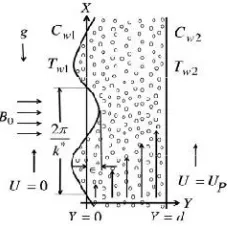
A unsteady two-dimensional flow of an incompressible, electrically conducting, dusty viscoelastic fluid (Walter’s liquid-B model) Couette flow in an vertical irregular porous channel with convective cooling and varying mass diffusion for Forchheimer model is shown in Fig. 1
Fig. 1: Flow geometry of the problem.
The X-axis is taken in the direction along the channel which is set to motion and the Y-axis is taken perpendicular to it. The flow field is exposed the influence of an external, transversely applied, uniform magnetic field of strength B0 and
buoyancy effect. The magnetic Reynolds number is assumed to be very small so that both the Hall effects and the induced magnetic field are negligible. The heat equation includes the terms involving heat absorption, radiative heat flux, Joule heating and viscous dissipation whereas the mass transfer equation includes the effects of first-order chemically reactive species and thermal diffusion. The wavy wall
Y
*
K
2X
cos
maintain a temperature Tw1which represent the convective boundary
h
T
1T
T
2T
1
At
*
Y
T
k
f
and concentration
C
C
At
at
Y
K
X
C
C
w 2* *
1 2 1
1
cos
lower than the flat wall (Y = d) temperature Tw2 which representthe convective boundary condition
h
T
2T
T
2T
1
At
*
Y
T
k
f
and concentration
*1 2 2
2
C
C
C
At
C
w
respectively. It is assumed that the convective heat exchange with the wall temperatures at the channel surface follows Newton’s law of cooling. The viscosity, density, thermal conductivity, molecular diffusivity of the fluid and the pressure with negligible body forces are considered as constant. Taking into consideration of these assumptions, the equations that describe the physical situation can be written in Cartesian frame of references, as follows.
* 2
1 1
2 0 *
0 1 2 2
* 0
*
1
K
U
C
C
C
g
T
T
g
U
B
U
K
U
V
N
K
Y
U
t
K
t
U
bc T
e
(1)V
2 2 21
q
U
B
Q
T
k
T
1
2 2 2 2 *Y
T
T
DK
C
C
K
Y
C
D
t
C
T R
(4)The appropriate boundary conditions of the problem are
*
t =0 : U=0=V, T=T1,
C
=C1 for Y
cos(K2X),d
*
(5)
*
t >0 : U=0=V,
h
T
1T
T
2T
1
At
*
Y
T
k
f
C
C
At
at
Y
K
X
C
C
1
2
1 *
*cos
2 (6)U=Up =V, h
T2 T
T2 T1
At*
Y T
k f
C
C
At
at
Y
d
C
C
*
1 2
2 (7)
The radiative heat flux is given by
10 ' ' 1 1 1 ,
4 d
T e K I I T T Y q b W r
(8) Introducing the following non-dimensional quantities,
,
,
,
1 2 10
T
T
T
T
U
V
v
d
Y
y
d
X
x
1 2 1 C C C C , 2 * d tt , 02
d
K
E
, 0,
mN
2,
1
d
K
m
W
,
0 2 1 2U
d
T
T
g
G
T r
,
0 2 1 2U
d
C
C
g
G
c c
,
2 2 0 2
B
d
M
e
1
*,
2
K
d
K
k
C
P
r
p ,,
2 p T T
C
d
Q
,
4
2 pC
d
I
F
2 1
2 0
T
T
C
U
E
p c
, , dSc
,2
d K Kr R
2 1
, 1 2 2 C C T T T d DK S T r
, 2 0 UA ,
k d h Bi f
,
0
U U
up p K2d,
d
*
,hcos
x ,(9)
In view of the equation (9) the basic field of equations (1)-(4)can be expressed in non dimensional form as
2 22 2
1
1
u
G
G
u
k
M
u
v
w
y
u
t
E
t
u
c r
(10)
v
u
t
v
w
(11)
2 22 2
1
u
M
E
F
y
p
t
r
T
c
(12) 2
2 2 2
1
y
S
K
y
S
t
c r r
(13)The corresponding boundary conditions (5)-(7) in dimensionless form are
,
1
0
,
0
,
0
:
0
u
v
for
y
h
t
(14)
t
t
at
y
h
B
y
v
u
t
i
0
:
0
,
,
(15)
1
,
1
1
,
B
t
t
at
y
y
v
u
u
p
i
III.METHODOFSOLUTION
To solve the eqs.(10)-(16),according to prakash et al [5],we assume
21 0
,
t
u
y
e
u
y
o
y
u
nt (17)
1
20
,
t
v
y
e
v
y
o
y
v
nt (18)
21 0
,
t
y
e
y
o
y
nt
(19)
1
20
,
t
y
e
y
o
y
nt
(20) The shear stress for dusty fluid coefficient of rate of heat and mass transfer at any point in the fluid can be characterized in order by
C
D
Sh
T
k
Nu
U
f
** *
,
,
(21) In dimensionless form
)
(
,
)
(
,
0 1
*
0 1
*
0 *
C
C
D
d
Sh
Sh
T
T
k
d
Nu
Nu
u
U
d
f
f (22)
IV. RESULTSANDDISCUSSION
The analytical expressions for velocity, temperature and concentration for unsteady MHD dusty viscoelastic fluid couette flow in a vertical wavy channel with varying mass diffusion for forchhiemer model has been derived which is a
function of many non dimensional parameters involved in the physical model αT, Bi, E, F, t, M, K, Gr, Gc, Sc, Kr, up,
Pr, W, Sr .
A numerical computation has been carried out to study the effect of these non dimensional parameters on velocity,
temperature and concentration by fixing some of the parameters as λ= 2π, x=1, Gr=10, Gc=10, Pr=5, Sc=.96, Kr=1,
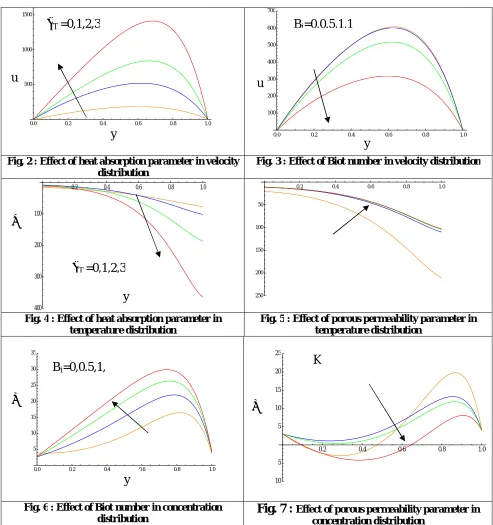
W=3. The graphical representations of the velocity profile for the various parameters are observed and due space constraints, only a few results are displayed. In Fig. 2 velocity enhances for the increase in effect of heat absorption and similar characteristics are observed for a thermal radiation parameter. Due to rate of heat transfer and radiative heat flux of the viscoelastic fluid. An opposite behavior of velocity characteristic is observed for the effect of Biot number, viscoelastic, time parameter and magnetic field parameter . Due to an adiabatic heat transfer maintained at the boundary, higher viscosity of the fluid and increase in time variation and enhancement with magnetic effect.
The effect of temperature of the fluid flow increases the magnitude or decrease in the negative direction for increasing effects of heat absorption. Similar characteristics are observed in Biot number, thermal radiation and Hartmann number . An opposite behavior of temperature characteristics is observed in the case of porous permeability and time parameter.
The concentration profiles increase with the enhancement of heat absorption and thermal radiation parameters, but for lower values behaves oppositely for the higher values of the parameters because concentration dominates over the temperature for lower values. Once the temperature overcomes the barrier of heat transfer, concentration diminishes. The concentration profile enhancement with increase in Biot number is displayed and similar behaviour is seen in Soret number also. The effect of concentration decreases with enhancement of porous permeability and time parameter which is shown in Fig. 7
Fig, 2 : Effect of heat absorption parameter in velocity distribution
Fig. 3 : Effect of Biot number in velocity distribution
Fig. 4 : Effect of heat absorption parameter in temperature distribution
Fig. 5 : Effect of porous permeability parameter in temperature distribution
Fig. 6 : Effect of Biot number in concentration
distribution
Fig. 7 :
Effect of porous permeability parameter in concentration distribution0.0 0.2 0.4 0.6 0.8 1.0
500 1000 1500
0.0 0.2 0.4 0.6 0.8 1.0
100 200 300 400 500 600 700
0.2 0.4 0.6 0.8 1.0
400 300 200 100
0.2 0.4 0.6 0.8 1.0
250 200 150 100 50
0.0 0.2 0.4 0.6 0.8 1.0 5
10 15 20 25 30 35
0.2 0.4 0.6 0.8 1.0
10 5 5 10 15 20 25
α
T=0,1,2,3
y
u
B
i=0,0.5,1,
φ
y
K
φ
α
T=0,1,2,3
θ
y
B
i=0,0.5,1,1
u
Acknowledgement
The authors are grateful to the research centre of Ramaiah Institute of Technology for their constant support and encouragement to pursue our research work.
REFERENCES
[1] D. W. Beard and K. Walters, “Elastico-viscous boundary layer flows I.Two dimensional flow near a stagnation point”, Mathematical proceeding of the Cambridge philosophical society, vol. 60, pp. 667-674, 1964.
[2] K. R. Rajagopal and T. Y. Na, “On stokes’ problem for a nonnewtonian fluid,” Acta Mechanica, vol.48, no. 3-4, pp. 233-239, 1983.
[3] C. C. Chang and T. S. Lundgren, “Duct flow in magnetohydro dynamics,” Zeitschrift fur angevandte Mathematik and physic, vol.12, no. 2, pp.100-114, 1961.
[4] M. E. Sayed-Ahmed and H. A. Attia, “MHD flow and heat transfer in a rectangular duct with temperature dependent viscosity and Hall effect” International Communications in Heat and Mass Transfer, vol.27, no. 8, pp.1177-1187, 2000.
[5] H. A. Attia, “Hall Effect on Couette flow with heat transfer of a dusty conducting fluid between parallel porous plates under exponential decaying pressure gradient,” Journal of Mechanical science and technology, vol.20, no. 4, pp.569-579, 2006.
[6] Kh. S.Mekheimer and M. A. El Kot, “Influence of magnetic field and Hall current on blood flow through a stenotic artery” Applied Mathematics and mechanics, vol.29, no. 8, pp.1093-1104, 2008.
[7] L.N.Tao, “Magnetohydrodyanamic effects on the formation of Couette flow,” J. Aerospace Sci., Vol.27, pp.334 - 340, 1960.
[8] T.Hayat, A.H.Kara, “Couette flow of athird-grade with variable magnetic field,” Math. Comput. Model. Vol.43, pp. 132-137, 2015.2006.
[9] D.Pal,H.Mondal. “MHD non-Darcian mixed convection heat and mass transfer reaction,” Int. Commun. Heat Mass Transfer Vol.38 no.4, pp. 463-467, 2011.
[10] S. Srinivas, and R. Muthuraj, “Effects of chemical reaction and space porosity on MHD mixed convective flow in a vertical asymmetric channel with peristalsis” Math. Comput. Model. Vol.54, no.5-6, pp. 1213-1227, 2011.
[11] P. M. Patil and P. S. Kulkarni: “The effect of chemical reaction on free convective flow of a polar fluid through porous medium in the presence of internal heat generation.” Int. J. of thermal Sci., vol.47, pp. 1040-1054, 2008.
[12] Dinesh P. A., N. Nalinakshi and N. Sandeep “Double Diffusive Mixed Convection in a Couple Stress Fluids with Variable Fluid Properties” Advances in Physics Theories and Applications, Vol.41, pp. 30-42, 2015.
[13] A. Mahdy, “MHD non Darcian free convection from a vertical wavy surface embedded in porous media in the presence of Soret and Dufour effect,” Int. Commun. Heat Mass Transfer Vol.36, no. 10, pp. 1067-1074, 2009.