ISSN(Online): 2319-8753 ISSN (Print): 2347-6710
International Journal of Innovative Research in Science,
Engineering and Technology
(A High Impact Factor, Monthly, Peer Reviewed Journal)
Visit: www.ijirset.com
Vol. 7, Issue 7, July 2018
Analysis of a Novel Non-Parametric Approach
in Traffic Classification Using Correlation
(TCC) Information Framework
Dheeraj S. Sadawarte1, Shital Y. Gaikwad2
M. E. (IInd Year Student), Department of CSE, MPGI College of Engineering, Kupsurwadi, Nanded. (M.S.), India1
Asst. Professor, Department of CSE, MPGI MPGI College of Engineering, Kupsurwadi, Nanded. (M.S.), India2
ABSTRACT: Traffic classification is widely used for network management, from security supervising to the quality of service judgment. Recent studies, as a rule, apply machine learning methods to classification method based on statistical properties. The nearest neighbor method (NN) shows excellent classification performance. There are some relevant advantages like, it does not require a training method, excessive use of parameters and, of course, there is adequate to handle many classes. Though, if the size of training data has been compromised, then the performance of the NN classification can be greatly reduced. This paper proposes an innovative non-parametric method of traffic classification, which excellently increases the performance of classification, corresponds to the relevant information in the classification process. Analysis of the new classification method and its effectiveness gain from the theoretical and experimental approach.The contribution work is to implement the combination of K-means and Expectation Maximization (EM) unsupervised clustering algorithm. The list of experiments is working on the real-time traffic datasets to verify the proposed method with TCC. The results show that the performance of traffic classification will be increased according to challenging prospects of very few training samples.
KEYWORDS: Traffic Classification, Network Operations, Security, Correlation, Bag of Flows
I. INTRODUCTION
Classifying network traffic flows by their generation applicationsassumes critical part in network security and management,such as quality of service (QoS) control, legal capture and intrusion detection. There is a need to identify drifts and classify network traffic into various classes and after that to investigate the behavior of traffic to detect attacks. The greater part of the network administrators are stimulated on catching client's information and anticipate about clients conduct for getting network resources by investigating this information. In this procedure network administrators focus on the end purposes of the network yet they nearly disregard the overallbehavior of their networks. Network classification is required to discover the networkfeatures and the overall behavior. By evaluatingthe networktraffic numerous attacks can be caught.
ISSN(Online): 2319-8753 ISSN (Print): 2347-6710
International Journal of Innovative Research in Science,
Engineering and Technology
(A High Impact Factor, Monthly, Peer Reviewed Journal)
Visit: www.ijirset.com
Vol. 7, Issue 7, July 2018
This paper proposes a new framework, Traffic Classification using Correlation (TCC) information, to address the problem of very few training samples. The correlation information in network traffic can be used to effectively improve the classification accuracy. The major contributions of this work are summarized as follows:
Proposes a novel nonparametric approach which incorporates correlation of traffic flows to improve the classification performance.
Provides a detailed analysis on the novel classification approach and its performance benefit from both theoretical and empirical aspects.
The performance evaluation shows that the traffic classification using very few training samples can be significantly improved by our approach.
Motivation:
1. The Detection accuracy of anomaly system should maximize. 2. The false positive rate should minimum.
3. The detector generation time should less. Objectives:
1. To effectively improve the network traffic classification accuracy in a robust way. 2. To correlate information in the traffic flows using flow correlation analysis.
3. To discover correlation information in the traffic flows and incorporates it into the classification process.
4. To measure the efficiency of the BoF discovery method by calculating some statistics of five real-worlds traffic data sets.
5. To compare the NN classifiers with the proposed algorithm this can effectively improve the overall performance of network traffic classification.
II. REVIEW OF LITERATURE
The paper [1] proposes a new analytical model evaluates the performance of communication networks based on the m-port n-tree topology in multi-cluster systems in the presence of the spatio-temporal bursty traffic. The spatial traffic burstiness is caught by the communication locality and the transient traffic burstiness is displayed by the Markov-modulated Poisson process (MMPP) which can capture the properties of bursty message arrivals while remaining systematically tractable. Advantages are: The communication locality can decrease the degrading effects of bursty message arrivals on the network performance of multicluster systems. The proposed model is utilized to research the effect of bursty message arrivals and communication locality on network performance. Disadvantages are: The proposed analytical model does not handle Mesh-of-Tree (MoT) topology.
The paper [2] reveals the three sources of the discriminative power in classifying the Internet application traffic: (i) ports, (ii) the sizes of the first one-two (for UDP flows) or four-five (for TCP flows) packets, and (iii) discretization of those features. First preprocess the dataset with the Entropy-based discretization method with the Minimum Description Length criterion (Ent-MDL), after apply machine learning algorithms on the discretized dataset, and then compare their performance with those of the same algorithms with the original non-discretized data. Advantages are: The entropy-based discretization is the essential technique for accurate traffic classification achieves high and similar accuracy 93%. The entropy-based discretization is more effective on ports than packet size information. Disadvantages are: The classification accuracy decreases when the first few packets are missed; thus, for accurate classification, application traffic flows should be captured from the beginning, not in the midst.
ISSN(Online): 2319-8753 ISSN (Print): 2347-6710
International Journal of Innovative Research in Science,
Engineering and Technology
(A High Impact Factor, Monthly, Peer Reviewed Journal)
Visit: www.ijirset.com
Vol. 7, Issue 7, July 2018
The paper [4] represents a simple but effective procedure for the optimization of the working parameters of a statistical network traffic classifier. The proposed classification method is based on statistical pattern recognition from which derived the definitions of features, patterns and classes. The optimization process on one hand can avoid the network administrator a manual and imprecise tuning procedure of the classification engine. Advantages are:Improves the precision of the classifier.
The [5] paper describes an approach to traffic classification based on SVM. Apply one of the approaches to solving multi-class problems with SVMs to the task of statistical traffic classification, and describe a simple optimization algorithm that allows the classifier to perform correctly with as little training as a few hundred samples. SVM-based traffic classifier integrates the SVM ‘‘one-against-all” approach to solve multi-class problems when needed. Advantages are: The accuracy of the classifier is very good with 90%. Disadvantages are: Needs to deal with out-of-order packets, packet loss, and fragmentation in a robust way.
The paper [6] looks at emerging research into the application of Machine Learning (ML) techniques to IP traffic classification - an inter-disciplinary blend of IP networking and data mining techniques. It provides the rationale for IP traffic classification in IP networks, review the state-of-the-art approaches to traffic classification, and then review and critique emerging ML-based techniques for IP traffic classification. Advantages are: Efficient use of memory and processors for the classification. A model may be considered portable if it can be used in a variety of network locations and robust if it provides consistent accuracy in the face of network layer perturbations such as packet loss, traffic shaping, packet fragmentation, and jitter.
The paper [7] works on critically revisit traffic classification by conducting a thorough evaluation of three classification approaches, based on transport layer ports, host behavior, and flow features. The effectiveness of port-based classification in identifying legacy applications is still impressive, further strengthened by the use of packet size and TCP flag information. The host behavior-based methods such as BLINC can be augmented with per-flow based classification process to increase byte accuracy. The SVM consistently achieved the highest accuracy. Advantages are: 1. CoralReef: Fast, easy-to-use, and scalable. Good at identifying conventional applications (except Passive FTP). 2. BLINC: Good at identifying P2P flows. Detects new as well as encrypted applications. 3. Flow features based learning: Automatic learning. Highly accurate and robust to link and traffic conditions. Disadvantages are: 1. CoralReef: Port-masquerading applications 2. BLINC: Tuning overheads. Strongly depends on the topological locations and traffic mixes. Low bytes accuracy. 3. Flow features based learning: High computational overheads (SVM, Neural Net., and k-NN) and memory requirements (C4.5).
The [8] paper proposes a methodology that classifies (or equivalently, identifies) network flows by application using only flow statistics. Our methodology, based on machine learning principles, consists of two components: a learner and a classifier. It proposes a semi-supervised framework for classifying network traffic using only flow statistics. Advantages are: Achieves high flow and byte accuracy. A variety of applications, including P2P, HTTP, FTP, and email can be successfully classified. Robust classifiers can be built that are immune to transient changes in network conditions.
The paper [9] represents the Bayesian framework using a neural network model that allows identification of traffic without using any port or host [Internet protocol (IP) address] information; Though this technique uses training data with categories derived from packet content, training and testing were done using features derived from packet streams consisting of one or more packet headers. Advantages are: Bayesian trained neural network is able to classify flows, based on header-derived statistics and no port or host (IP address) information, with from 95% to 99% accuracy. A small number of features carry high significance regardless of this classification scheme. Disadvantages are: Some issues are the selection of optimum features.
ISSN(Online): 2319-8753 ISSN (Print): 2347-6710
International Journal of Innovative Research in Science,
Engineering and Technology
(A High Impact Factor, Monthly, Peer Reviewed Journal)
Visit: www.ijirset.com
Vol. 7, Issue 7, July 2018
III. PROPOSED SYSTEM
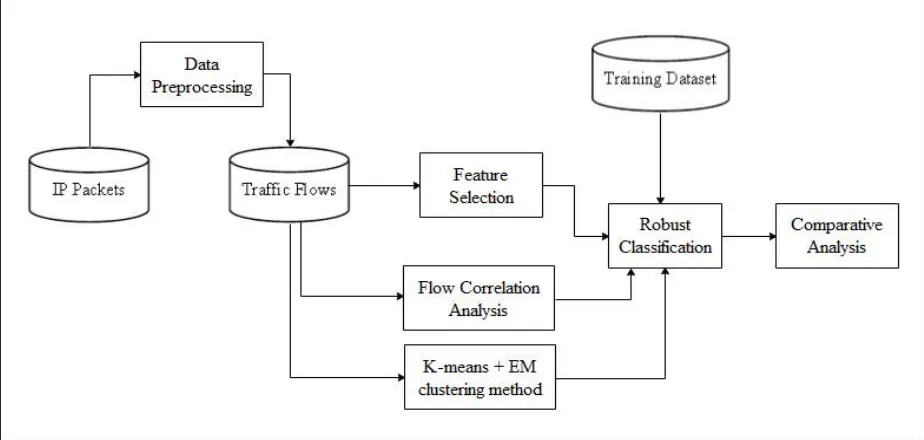
Network traffic Classification is an important task in operational large-scale informatics networks. The Network should be able make sure that the network is ready to transfer traffic properly altogether with conditions of the security levels of the organization. Machine learning methods try attempts to solve intelligence problems without the needs of human expertise, however they are not perfect. This paper proposed a novel technique for classifying network traffic using machine learning approaches.This novel technique presents a new framework which calls Traffic Classification using Correlation information or TCC for short. A novel nonparametric approach is also proposed to effectively incorporate flow correlation information into the classification process. Fig. 1 shows the proposed system model. In the preprocessing, the system catches IP packets crossing a computer network and develops traffic flows by IP header examination. A flow consists of successive IP packets having the same five-tuple: {src_ip, src_port, dst_ip, dst_port, protocol}. After that, a set of statistical features are extracted to represent each flow. In this paper, we use “bag of flows” (BoF) to model correlation information in traffic flows. The BoF model-based classification approach describes that a BoF can be classified by aggregating the prediction values of flows produced by the NN classifier. The proposed classification approach can apply different aggregation strategies, which have different meanings.
AVG-NN: combines multiple flow distances to make a decision for a BoF
MIN-NN: selects a minimum flow distance to make a decision for a BoF
MVT-NN: combines multiple decisions on flows to make a final decision for a BoF.
AVG-NN shows better performance than MIN-NN and MVT-NN in terms of overall performance, perexperiment performance, and per-class performance. TCC is better thanthe existing traffic classification methods since it shows the capacity of applying flow correlation to effectively enhance traffic classification performance.
The contribution work is to implement K-means + Expectation Maximization unsupervised clustering algorithm. In the training phase it randomly generate K cluster. In the classification phase these randomly generated clusters further classify the unknown traffic using Euclidean distance formula. The Expectation Maximization (EM) follows an iterative approach, sub-optimal, which tries to find the parameters of the probability distribution that has the maximum likelihood of its attributes. This approach gives good accuracy and overcome the drawback of the NN-classifier.
ISSN(Online): 2319-8753 ISSN (Print): 2347-6710
International Journal of Innovative Research in Science,
Engineering and Technology
(A High Impact Factor, Monthly, Peer Reviewed Journal)
Visit: www.ijirset.com
Vol. 7, Issue 7, July 2018
Advantages:
1. According to the proposed methods of the overall performance of traffic classification is better than the NN classifier.
2. The proposed methods can improve the classification accuracy in a robust way and consistent improvement is achieved.
3. The proposed methods can improve the F-measure of every class and significant improvements are obtained in most classes.
4. AVG-NN shows better performance than MIN-NN and MVT-NN in terms of overall performance, per experiment performance, and per-class performance.
5. TCC is superior to the existing traffic classification methods since it demonstrates the ability of applying flow correlation to effectively improve traffic classification performance.
6. The combination of K-means and Expectation Maximization unsupervised clustering method gives higher accuracy than the TCC.
7. K-means and EM produces good quality of clusters for various traffic applications.
IV. MATHEMATICAL MODEL
1. BoF:
A “Bag-of-flows” (BoF) consists of some correlated traffic flows which are generated by the same application. A BoF can be described by
a. = { , , … , } (1)
Where is a feature vector representing the ith flow in the BoF Q. Q denotes the correlation among n flows.
2. NN Classifier:
The prediction value of a flow x produced by the NN classifier is defined using its minimum distance to the training samples of class .
= ‖ − ‖ (2)
3. AVG-NN Classifier:
The distance of a query BoF Q to class is obtained by aggregating the flow distances with the “average” operation as follows:
=
‖ ‖∑ (3)
Finally, the flows in Q are classified into the class with the minimum distance of Q.
4. MIN-NN Classifier:
∗= ‖ − ‖ (4)
5. MVT-NN Classifier:
The binary prediction values produced by the NN classifier to conduct classification of BoFs.
∗= ‖ − ‖ (5)
We define the vote of a flow x for class as
( ) = 1, ∗
, (6)
∗= ∑ ( )
ISSN(Online): 2319-8753 ISSN (Print): 2347-6710
International Journal of Innovative Research in Science,
Engineering and Technology
(A High Impact Factor, Monthly, Peer Reviewed Journal)
Visit: www.ijirset.com
Vol. 7, Issue 7, July 2018
Algorithms:
Proposed Algorithm (K-means + EM)
Steps:
1. Initially, randomly assigns k cluster centers 2. Iteratively refine the clusters based on two steps
3. Expectation step: Assign each data point to cluster with the following probability
( ) = = ( ) ( )/ ( )
4. Maximization step: Use the probability estimates from above to re-estimate (or refine) the model parameter.
=1 ( )
∑ ( )
V. EXPERIMENTAL RESULT
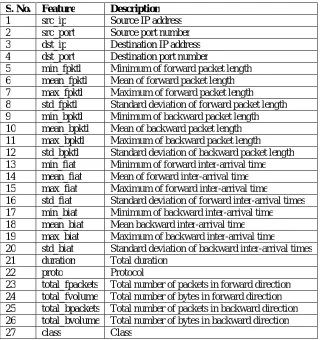
In this section, we measure the performance analysis usingthe NIMS dataset for traffic classification. The performance measure using the overall accuracy, F-measure and execution time of existing system like MIN-NN classifier, AVG-NN classifier and MVT-NN classifiers. Also compare performance with the proposed K-means + EM classifier. The NIMS dataset features are shown below:
TABLE I NMIS Dataset Features
S. No. Feature Description
1 src_ip Source IP address 2 src_port Source port number 3 dst_ip Destination IP address 4 dst_port Destination port number
5 min_fpktl Minimum of forward packet length 6 mean_fpktl Mean of forward packet length 7 max_fpktl Maximum of forward packet length 8 std_fpktl Standard deviation of forward packet length 9 min_bpktl Minimum of backward packet length 10 mean_bpktl Mean of backward packet length 11 max_bpktl Maximum of backward packet length 12 std_bpktl Standard deviation of backward packet length 13 min_fiat Minimum of forward inter-arrival time 14 mean_fiat Mean of forward inter-arrival time 15 max_fiat Maximum of forward inter-arrival time
16 std_fiat Standard deviation of forward inter-arrival times 17 min_biat Minimum of backward inter-arrival time 18 mean_biat Mean backward inter-arrival time 19 max_biat Maximum of backward inter-arrival time
20 std_biat Standard deviation of backward inter-arrival times 21 duration Total duration
22 proto Protocol
23 total_fpackets Total number of packets in forward direction 24 total_fvolume Total number of bytes in forward direction 25 total_bpackets Total number of packets in backward direction 26 total_bvolume Total number of bytes in backward direction
ISSN(Online): 2319-8753 ISSN (Print): 2347-6710
International Journal of Innovative Research in Science,
Engineering and Technology
(A High Impact Factor, Monthly, Peer Reviewed Journal)
Visit: www.ijirset.com
Vol. 7, Issue 7, July 2018
For experimental set up, use Windows 7 operating system, Intel i5 processor, 4 GB RAM, 200GB Hard disk, Eclipse Luna JDK 7 tool. To calculate the results, NIMS data set is used. In training dataset, there are 11 types of are included.For performance comparison, four classification methods are implementedusing the NMIS dataset, MIN-NN, AVG-NN, MVT-NN and proposed K-means + Expectation Maximization unsupervised clustering algorithm. The 1st three methods can incorporatecorrelation information into the classification process whereas the proposed method does not take into account correlation information in traffic flows.
Fig.2 Comparison analysis on overall accuracy and f-measure
The Fig. 2 shows the AVG-NN classifier’s accuracy is greater than MIN-NN and MVT-NN classifiers. The K-means + EM classifier’s overall accuracy is greater than AVG-NN classifier.
Fig.3 Comparison analysis on execution time of traffic classification
ISSN(Online): 2319-8753 ISSN (Print): 2347-6710
International Journal of Innovative Research in Science,
Engineering and Technology
(A High Impact Factor, Monthly, Peer Reviewed Journal)
Visit: www.ijirset.com
Vol. 7, Issue 7, July 2018
less than MIN-NN and MVT-NN classifiers. The proposed classifier algorithm requires execution time is very less than other classifiers.
V. CONCLUSION AND FUTURE WORK
A novel nonparametric technique, TCC proposes to research correlation data in real traffic data and incorporate it into traffic classification. It represents a comprehensive analysis on the system framework and performance benefit from both theoretical and experimental approaches, which strongly support the proposed approach. There are three new classification methods, AVG-NN, MIN-NN, and MVT-NN, are proposed for interpretation, which can incorporate correlation information into the class prediction for improving classification performance. The combination of K-means and Expectation Maximization (EM) unsupervised clustering algorithm gives higher accuracy than the TCC. K-means and EM produces good quality of clusters for various traffic applications.The proposed approach can be used in a wide range of applications, such as automatic recognition of unknown applications from captured network traffic and semi-supervised data mining for processing network packets.
REFERENCES
[1] Y. Wu, G. Min, K. Li, and B. Javadi, “Modelling and Analysis of Communication Networks in Multi-Cluster Systems Under Spatio-Temporal Bursty Traffic,” IEEE Trans. Parallel Distributed Systems, vol. 23, no. 5, pp. 902-912, May 2012, http://dx.doi.org/10.1109/TPDS.2011.198. [2] Y.-s. Lim, H.-c. Kim, J. Jeong, C.-k. Kim, T.T. Kwon, and Y. Choi, “Internet Traffic Classification Demystified: on the Sources of the
Discriminative Power,” Proc. Sixth Int’l Conf. (Co-NEXT ’10), pp. 9:1-9:12, 2010.
[3] Y. Xiang, W. Zhou, and M. Guo, “Flexible Deterministic Packet Marking: An IP Traceback System to Find the Real Source of Attacks,” IEEE Trans. Parallel Distributed Systems, vol. 20, no. 4, pp. 567-580, Apr. 2009.
[4] M. Crotti, F. Gringoli, and L. Salgarelli, “Optimizing Statistical Classifiers of Network Traffic,” Proc. Sixth Int’l Wireless Comm. And Mobile Computing Conf., pp. 758-763, 2010.
[5] A. Este, F. Gringoli, and L. Salgarelli, “Support Vector Machines for TCP Traffic Classification,” Computer Networks, vol. 53, no. 14, pp. 2476-2490, Sept. 2009.
[6] T.T. Nguyen and G. Armitage, “A Survey Of Techniques for Internet Traffic Classification Using Machine Learning,” IEEE Comm. Surveys Tutorials, vol. 10, no. 4, pp. 56-76, Oct.-Dec. 2008.
[7] H. Kim, K. Claffy, M. Fomenkov, D. Barman, M. Faloutsos, and K. Lee, “Internet Traffic Classification Demystified: Myths, Caveats, and the Best Practices,” Proc. ACM CoNEXT Conf., pp. 1-12, 2008.
[8] J. Erman, A. Mahanti, M. Arlitt, I. Cohen, and C. Williamson, “Offline/Realtime Traffic Classification Using Semi-Supervised Learning,” Performance Evaluation, vol. 64, nos. 9-12, pp. 1194-1213, Oct. 2007.
[9] T. Auld, A.W. Moore, and S.F. Gull, “Bayesian Neural Networks for Internet Traffic Classification,” IEEE Trans. Neural Networks, vol. 18, no. 1, pp. 223-239, Jan. 2007.