R E S E A R C H A R T I C L E
Open Access
Care-
‘
less
’
: exploring the interface between
child care and parental control in the
context of child rights for workers in
children
’
s homes in Ghana
Ernest Darkwah
1*, Marguerite Daniel
1and Joana Salifu Yendork
2Abstract
Background:This study explored how employed caregivers experience the interface between child care, parental control and child rights in the context of Children’s Homes in Ghana. The focus was on investigating caregiver perceptions of proper child care, their experiences with having to work with child rights principles and the implication of these for their relationships with the children and the care services they deliver.
Methods:Adopting a qualitative approach with phenomenological design, data were collected from 41 caregivers in two children’s homes in Ghana using focus group discussions and in-depth interviews.
Results:It emerged that caregivers experienced frustrations with perceived limitations that child rights principles place on their control over the children describing it as lessening and, at the same time, complicating the care services they provide.
Conclusions:The findings suggest a need for a review of the implementation strategies of the child rights approach in that context. A re-organization of the children’s homes environment and re-orientation of caregivers and children regarding their relationship is also suggested.
Keywords:Child rights, Children’s homes, Caregivers, Caregiving work, Parental control
Background
Institutional spaces for the care and control of chil-dren in Ghana fall within an elaborate legal frame-work. In February, 1990, Ghana ratified the United Nations Convention on the Rights of the Child (UNCRC) and became the first country to do so. Soon afterwards, the government of Ghana followed this step with the formulation of the Children’s Act [1] and a plethora of other legislative and policy ac-tions including the establishment in 2001 of a Women and Children’s Ministry, now Ministry of Gender, Children and Social Protection. The Child Reforms Initiative (CRI) was also introduced in 2005. According to the Department of Social Welfare
(DSW), these were actions intended to demonstrate the commitment of the government of Ghana towards fulfilling its obligation of safeguarding the rights, safety and wellbeing of all Ghanaian children in what-ever context they are found. Over the years, succes-sive governments together with their international partners have continued in these efforts and designed child-rights oriented programmes seeking to imple-ment these in all social spaces where children live their lives. Children’s Homes (CHs) - residential insti-tutions that provide alternative care for children who have lost the care of their parents, are one example of such social spaces in Ghanaian society.
Described by the DSW as a ‘last resort’ for providing alternative care for children without parental care (CWPC) [2], CHs in Ghana take CWPC into residence and employ caregivers to act as their ‘parents’. The job of ‘care’ in this context implies that these caregivers * Correspondence:[email protected]
1Department of Health Promotion and Development, University of Bergen,
P.O. Box 7807, 5020 Bergen, Norway
Full list of author information is available at the end of the article
assume ‘parental responsibilities’ for the children, pro-viding emotional and psychological support, disciplinary training and overseeing their general wellbeing and de-velopment with material and financial support from their institutions and external donors. In performing their work roles as “parents”, caregivers are required by law and as a strict condition for funding from external, often western donors, to follow international child rights provisions backed by local legislations [2]. In particular, the provisions of the UNCRC are emphasized and used as the main guidelines for raising the children in this context.
The UNCRC in the Ghanaian cultural context
As successful as the UNCRC has been regarding its usefulness in getting governments and policy makers to give more attention to children as a group of people who need special care and protection in all contexts, critics point out weaknesses in the conven-tion’s ability to achieve positive impacts in different cultures. For example, Harris-Short [3] describes it as having been conceptualized on a legal system that is “founded on a ‘society of states’ in which the voices of the local and particular are effectively si-lenced”. In this sense, the argument has been that it does not proportionately reflect non-western ideolo-gies of parenting and parent-child relations and therefore holds the potential to cause social tensions and confusions [4–6]. This is witnessed in Ghanaian society where the socio-cultural context is replete with parenting and child rearing norms, some of which are observed to be at odds with some of the provisions in the UNCRC. Twum-Danso [7] notes that socialization goals in local Ghanaian society re-quire that children submit to the control of their parents or adult caregivers and certainly do as they are told without any questions. Parental Control -defined as the amount of supervision parents exer-cise, the decisions parents make about their chil-dren’s activities and friends, and the rules parents hold for their children [8] is a key ingredient in good parenting in Ghana and adults performing par-ental roles in whatever contexts within the society expect and are expected to maintain this form of control. Forms of child discipline such as corporal punishment are important characteristics of this traditional ideology of ‘good parental control’ [7, 9] and ‘proper child care’ is strongly associated with good ‘parental control’. This means that certain pro-visions in the UNCRC which, for example, seek to protect children from abuse by prohibiting actions like ‘beating to discipline’ have been a source of ten-sion between local Ghanaian communities and child rights advocates [10]. Consequently, there have been
difficulties implementing the international child rights provisions, or at least parts of it, in local Ghanaian communities where cultural and religious norms urge parents and guardians not to “spare the rod and spoil the child” [7, 9]. Thus, despite re-ported successes since child rights principles were introduced in Ghana, there have also been some challenges with researchers reporting tensions be-tween parents and children over parents’ authority and children’s rights, separation of children from their parents in instances where authorities deem that such children’s rights have been significantly vi-olated and, sometimes, alienation of children from their caregivers in instances where caregivers per-ceive the children they raise with UNCRC guidelines as belonging to foreigners [9, 11–13].
Child rights in the Ghanaian Children’s home context
While the observed challenges with the implementa-tion of child rights may be problematic for family so-cial life in general Ghanaian society, its ramifications may be even more profound in specific social spaces like CHs where ‘hired parents’ provide care to vulner-able children. This is because there are already exist-ing challenges in bondexist-ing between caregivers and residential children attributed to their natural non-blood relations and the socio-professional nature of the interaction between them [14–16]. The outcomes of these challenges have been reported to include caregiver-child relational problems, caregiver ambiva-lence, caregiver stress and burnout as well as general developmental deficiencies in residential children compared to their cohorts in normal family homes [17–21]. The observed negativities about the potential impacts of child rights provisions on adult-child rela-tions in the Ghanaian context, therefore, raise ques-tions about how the already existing challenges might be impacted by the introduction and subsequent dominance of these provisions in CHs. With trad-itional Ghanaian parenting ideology believing in parental control as central to the concept of ‘good care’, the question then becomes how caregivers perceive to provide adequate care or ‘good parenting’ for the children without having to exercise that kind of traditional control over them. Given that recent revelations from the institutional care environment for CWPC in Ghana have alleged relational tensions between the various players in that environment, [13,22,23], there is the need to investigate how the nexus between ‘Child care’and ‘parental control’ plays out for workers in this occupational context where the UNCRC reigns supreme.
environment dominated by child rights. The overall objective was to explore the interface between care-giver perceptions of proper child care, their experi-ences with having to work under the control of child rights and the implication of these for their relation-ships with the children and the care services they deliver. The purpose is to provide important scientific insights into the complexities of the residential care environment, and, perhaps, encourage debate about possible ways of engendering harmony in order to provide care workers with a healthy work environ-ment that is supportive of their growth and service delivery.
Research questions
Specific research questions were:
1. What are caregivers’perceptions of proper‘parental care’?
2. How do caregivers experience having to work with child rights principles?
3. What are caregiver’s perceptions of the impact of child rights on their ability to provide care?
Methods Setting
The study was conducted in two regions of Ghana, West Africa. The regions have some of the country’s largest Children’s Homes with some run and funded by the gov-ernment and others run and funded by private organiza-tions. The CHs in these regions also differ in terms of organizational forms. Some are organized in forms rem-iniscent of boarding schools with children sleeping in large dormitory-style rooms and have shift-working caregivers, while others are organized in family home units with children living permanently with one care-giver in a small family home. CHs in these two regions were therefore purposefully selected in consideration of the differences in organizational form and funding sources as these would have implications for their oper-ational practices. While the idea was not to compare understandings of child rights between government and private institutions, we sought to capture lived experi-ences of caregivers across the different contexts in order to generate a more balanced insight into the care work in CHs.
Participants
Forty-one caregivers recruited from two Children’s Homes participated in the study. Caregivers were recruited for participation by first contacting them through visits to their institutions and directly asking for their participation after a thorough explanation of the research had been given. Only caregivers who
volunteered and signed informed consent forms par-ticipated in the study. Participants consisted of ‘mothers’ and ‘fathers’ (core caregivers who had day-to-day contact with the children playing the role of ‘parents’). Although the primary purpose was to cap-ture the experiences and perceptions of these core caregivers, it was also important to incorporate views and experiences of other workers in the residential care environment in order to develop deeper insights and better understand the totality of the context within which the phenomenon of care occurs. In this sense, institutional gatekeepers (directors and admin-istrative staff ), social workers, educational workers, former institutional children now working as volun-teers and resident nurses were also contacted and subsequently recruited for participation. Table 1 pre-sents demographic details of the participants:
Table 1Detailed demographics of participants
Item Category Number
Sex Male 8
Female 33
Age Range 25–35 5
36–45 5
46–55 22
56–58 9
Education Post -Graduate 1
Bachelor level 3
Professional/Voc/Dip 11
Middle school 26
Work Role Manager/Director 2
Mother 22
Assistant Mother/Auntie 8
Former institutional child/ Volunteer
3
Resident Nurse 2
Teacher 2
Social Worker 2
Length of Service (in years) 0–10 6
11–20 14
21–30 13
31–40 8
Marital status Single 8
Married 14
Divorced 12
Widowed 7
Research approach and data procedures
Given that the main focus of the study was on exploring subjective experiences of caregivers who work with CWPC in institutional environments, the general approach adopted here was qualitative. The epistemological and ontological grounds of relative truth and multiple realities upon which qualitative research approaches are founded see, [24, 25], made it imperative that this study adopts the approach in order to adequately address the research questions. Specifically, the Phenomenological design (both descriptive and interpretive) was used in order to be able to adequately capture the lived experiences of the participants regarding the phenomenon of care under child rights in the unique context where they
work. Techniques for data collection therefore
included focus group discussions and individual in-depth interviews.
Focus group discussions
Two focus group discussions were conducted (one in each institution) with 14 participants in total (8 in one and 6 in the other). Discussants were all mothers and ‘aunties’ aged between 45 and 58 years old with work experiences ranging from 3 years to 36 years. The mothers were caregivers in charge of home units within the institutional compounds while the aunties worked as assistants to the mothers. The first focus group discussion lasted 2 h and 3 min while the sec-ond lasted 2 h and 13 min.The focus group discus-sions allowed caregivers to express subjective as well as shared experiences, meaning making and percep-tions about the phenomenon of care and the com-plexities of the care work in which they are involved.
Themes that were put forward for discussion
included: “What are your perceptions of proper par-ental care?”, “How does it feel having to work with child rights regulations in caring for these children?”, “How do child rights principles impact your care responsibilities?” and “How do child rights principles that dominate this environment affect your
relation-ship with the children in your care?” (See
Additional file 1). The lead author played the role of facilitator during the focus group discussions.
In-depth interviews
Individual, one-on-one interviews were conducted after the focus groups at times and locations convenient to each participant. The interviews were conducted to col-lect additional data to complement the data colcol-lected in the Focus groups. In all, 32 interviews involving mostly caregivers who did not participate in the focus groups were conducted across the two institutions. Eight (8) Focus group discussants however also took part in the
interviews. These were individuals who the facilitator felt possibly had more to say but were held back in some way by the public situation in the focus groups. Themes put forward for discussion during the focus groups also formed the main questions during the interviews with the interviewer taking the opportunity to probe further into participant perceptions and experiences (See Additional file 1). The interviews lasted an average of one hour twenty-five minutes and were conducted in either English or Twi (local Ghanaian language) depend-ing on the preference of the participant.
Ethics
Ethical clearance was obtained from the Norwegian Social Sciences Data Services (NSD) in Norway where the lead author is a PhD student. The Department of Social Welfare of the Government of Ghana reviewed the research proposal and ethical clearance provided by our affiliated institution and deemed them sufficient enough for the research to be conducted. Permissions were also sought from the administrative offices of the institutions involved. All participants were individually approached and recruited after thorough explanations of the research had been given and informed consent obtained. For purposes of confidentiality, all interviews and focus group discussions were audio-recorded and the files kept in password-secured folders on the per-sonal computer of the lead author.
Data analysis
Results
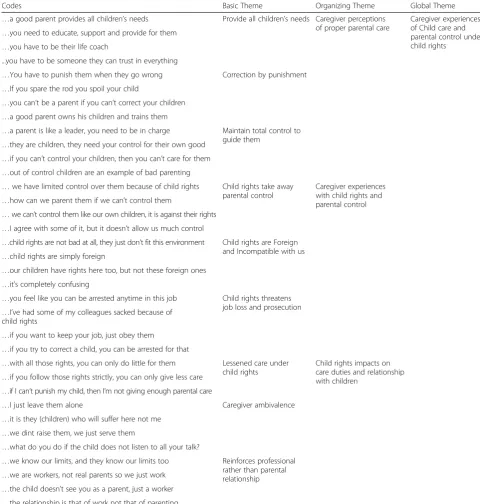
Nine basic themes regarding the interplay between care and control within the framework of child rights for caregivers and how this influences their care responsibilities and relationships with the chil-dren in their care emerged from the data analysis. These were synthesized into three organizing themes and one global theme. In order to allow for clear
and systematic presentation of our results, we
arranged them in accordance with the organizing themes that emerged:
Caregiver perceptions of proper parental care
In many regards, caregiver descriptions of what they per-ceived to be‘proper’parental care tended to be in tan-dem with global standards of parenting and seemed to concur with child rights advocates’ principles of how adults should handle children. Caregivers believed that a
Table 2Thematic Network Analysis (TNA) of collected data
Codes Basic Theme Organizing Theme Global Theme
…a good parent provides all children’s needs Provide all children’s needs Caregiver perceptions of proper parental care
Caregiver experiences of Child care and parental control under child rights
…you need to educate, support and provide for them …you have to be their life coach
...you have to be someone they can trust in everything
…You have to punish them when they go wrong Correction by punishment …If you spare the rod you spoil your child
…you can’t be a parent if you can’t correct your children …a good parent owns his children and trains them
…a parent is like a leader, you need to be in charge Maintain total control to guide them
…they are children, they need your control for their own good …if you can’t control your children, then you can’t care for them …out of control children are an example of bad parenting
…we have limited control over them because of child rights Child rights take away parental control
Caregiver experiences with child rights and parental control …how can we parent them if we can’t control them
…we can’t control them like our own children, it is against their rights …I agree with some of it, but it doesn’t allow us much control
…child rights are not bad at all, they just don’t fit this environment Child rights are Foreign and Incompatible with us …child rights are simply foreign
…our children have rights here too, but not these foreign ones …it’s completely confusing
…you feel like you can be arrested anytime in this job Child rights threatens job loss and prosecution …I’ve had some of my colleagues sacked because of
child rights
…if you want to keep your job, just obey them
…if you try to correct a child, you can be arrested for that
…with all those rights, you can only do little for them Lessened care under child rights
Child rights impacts on care duties and relationship with children
…if you follow those rights strictly, you can only give less care …if I can’t punish my child, then I’m not giving enough parental care
…I just leave them alone Caregiver ambivalence
…it is they (children) who will suffer here not me …we dint raise them, we just serve them
…what do you do if the child does not listen to all your talk?
…we know our limits, and they know our limits too Reinforces professional rather than parental relationship …we are workers, not real parents so we just work
good parent should provide all resources including pro-tection and guidance for children and be a beacon of trust for them:
“…in my opinion, a good parent takes total responsibility for their children and provides everything they need…”(Mother, 51 years old)
Another said:
“..as a parent, you need to be someone your children can trust to both protect them and support them…you need to educate them, and provide for their needs…if you fail in these, you can’t call yourself a good parent”(Aunty, 38 years old)
However, there were other perceptions that would be at odds or not in total agreement with child rights positions especially regarding control and punishment. For example, beliefs in control were persistent with some perceiving that control, punishment and care were inseparable in proper parenting. Some were of the view that ‘care’ is not possible without strong parental control:
“…if you can’t control them, then how can you care for them?…they are children, they need your direction and care and you achieve that by guiding and correcting them, sometimes by necessary punishment…”(mother, 53 years old)
A teacher said:
“…You can’t be a parent if you can’t correct your children…you should be in control and punish them when they go wrong even if it means beating them because if you don’t beat them, they spoil…”(Teacher, 31 years old)
At focus group discussions, belief in these forms of
correction in parenting seemed unanimous and
entrenched despite participants admitting to being trained to realize that such forms of correction might go against child rights.
“…you might go against child rights if you hit them, but if that will correct them, then why not do it…”(Aunty, 43 years old)
This raised the question of how they experienced child rights in their line of work and were coping with work-ing under rules that were against their beliefs. It also brought up how they perceived themselves as “parents” of the children in their care.
Experiences with child rights and parental control
Recounted experiences of working with child rights were mostly negative. Most caregivers felt that child rights were foreign and limited their ability to give‘proper’care to the children as they saw fit. This, to some brought a sense of guilt of failing in the duties that they signed up to perform:
“…I feel that we should not allow foreigners to tell us how to raise our own children because we don’t have a say in how they raise theirs…those rules just don’t fit our environment…”(Aunty, 41 years old)
“…I came here to be a parent, but I can’t
confidently say I am parenting these children…the child rights rules just tie your hands…”(Mother, 58 years old)
“…You can’t control them like your own children…it’s against their rights…you feel guilty when they do something wrong and all you do is just talk…they can listen or just ignore you…”(Mother, 55 years old)
Some felt following the child rights rules that guide their work roles meant that they could only provide less care, while others recounted feeling threatened with prosecution and job loss by the child rights principles:
“…Well, I do my best under the circumstances…I could do more for them, but thanks to those rules I can only do less care…I can’t train them like I do my own children…”(Mother, 47 year old)
“…You know, you could lose your job or even go to prison if you mess with those rules…and you were only trying to help the children…you just don’t feel
comfortable at your workplace…”(Mother, 53 years old)
Interestingly, higher institutional officers tended to hold positive perceptions of child rights and felt it was necessary to implement them. There was the acceptance that the principles are necessary for protecting children against abuse and giving them the best care:
“…In my experience, I have come to see that those who made the rules had good reasons for making them, because things like beating could easily turn to abuse…it’s just unfortunate that over here it rather confuses people…”(Director, 54 years old)
“…I confronted one of them (core caregivers) on why she was making a child cook while the child should be sleeping after school. She told me that she has parented children some of who are older than me, so I’m not the one to tell her how to do her job…”(Social worker, 35 years old)
During focus group discussion, this friction was highlighted when a caregiver quipped to the agreement of fellow discussants:
“..All those officers know about parenting is from books they learnt at school, and those books are written by foreigners so all they know is foreign
parenting…”(Aunty, 43 years old)
Interviews with former institutional children who were now working as volunteers for their institutions indicated that they were unsure about their position on child rights:
“…I don’t know really…sometimes it’s good, sometimes it’s bad….as a child I thought it was good, but now I feel our local ways should be allowed more because the children are getting spoilt…”(former inst. Child, 31 years old)
Child rights impacts on care duties and relationship with the children
Caregivers also recounted some positive and negative ex-periences regarding how child rights impacted their care duties and relationship with the children. For some, child rights made it possible for them to learn new ways of parenting and accept their work duties while others thought their workload is heavy because of child rights:
“…I would say I have learnt new ways of parenting and I have accepted it and managed to calm down…I now carry out my work duties without
complaint…”(Mother, 52 years old)
“…well, because we are afraid of breaking those child right things, we can’t ask the children to help us too much. You do much of the work yourself so the workload is heavy…In my own house, my children would help”(Mother, 54 years old)
Caregiver accounts of how adherence to child rights principles affects their relationship with the children al-luded to ambivalence, some selective attention and a sense of helplessness regarding how to handle the chil-dren. Others felt that the relationship was more of master-servant than parent-child:
“…I don’t complaint at all. I just leave them alone. It is they who will spoil and suffer in the future, not me or my own children…”(Aunty, 43 years old)
“…Well, those child rights help…you can see that some of the children are happy and respond to you
positively when you use the rights approach. But there are others who you need our local approach to get them to behave…but since we can’t do that, we just pay attention to those who listen to us and leave the rest alone…”(Mother, 56 years old)
“…(laughs) I don’t believe we parent them even though that is supposed to be our job…we just serve them. They are the masters, we are the servants and they know that so they don’t respect us…”(Mother, 55 years old)
Thus our results show that caregivers perceived proper parenting to significantly include high parental control the lack of which made them experience the CWPC care job in the CH context negatively. Perceptions were that parenting roles in the CH context were complicated by the use of child rights approaches. There were reports of tensions between core caregivers and institutional offi-cers as a result of child rights and a negative impact of child rights on caregiver-child relationships.
Discussion
The present study explored caregivers’conceptualization of children’s rights and the impact on their care respon-sibilities in two residential settings in Ghana. To achieve this broad goal, three research questions were explored. The first was to examine caregivers’perceptions of what constitute good parental care. Participants’ reports re-vealed two diverse views that support and contradict the international principles and goals of children’s rights. Some participants reported that good parental care con-sists of the provision of material resources, guidance and protection for children. These findings are consistent with previous research in Ghana [27] and global percep-tions of good parental care [28,29] which highlights the need for parents to be dependable and provide for chil-dren’s needs in order to ensure survival. The emergence of these perceptions suggests that although the care-givers might not fully understand or accept aspects of the UNCRC principles, their perceptions of parental role align with the core aims of UNCRC, which is to enhance children’s welfare.
Ghanaian cultural notion of parenting in which parents assume control over all affairs pertaining to children and children are expected to yield to the demands and authority of parents [8, 10]. Additionally, the emphasis on corporal/physical punishment also aligns with accept-able cultural methods of child-rearing processes by both caregivers and children in Ghana [9, 10]. Participants’ notion of the constituent of good parenting thus high-lights the influence of the broader socio-cultural context in shaping individuals’views of parenting roles [30]. The endorsement of physical punishement as constituent of good parenting corresponds with the group differences hypothesis of parenting effects on child outcomes [31]. This hypothesis proposes that development occurs within a cultural context and the individual’s develop-mental processes reflect an adaptive response to envir-onmental demands. Thus, although the use of physical punishement is associated with negative outcomes in some cultures, especially where its use is frowned upon (e.g., European, American culture), its use is not associ-ated with adverse outcomes in other contexts where such practices are normative (e.g., African-American and African cultures) [31, 32]. Indeed our findings, as shown in caregivers responses, confirm suggestions by Deater-Deckard et al. [31] that not using physical pun-ishment is seen in some cultures as neglect on the part of the parent or parenting figure.
The disparity between principles of children’s rights and notions of“proper parenting”in the present sample therefore underscore the concerns raised by critics of the provisions in UNCRC [4–6] and supports previous research that has highlighted similar challenges of imple-menting the UNCRC in the Ghanaian socio-cultural context [33]. It confirms that there are aspects of the children’s rights principles that do not match with the Ghanaian cultural processes of child rearing. Such dis-parity is likely to create internal tension in caregivers over what should take precedence in their caregiving practices, their socialized beliefs or job-required rules of parenting. The internal tensions in turn could also pre-cipitate work role confusion as the caregivers complain about being confused regarding how they are expected to parent under such foreign rules. The bigger problem is that, in situations where individuals are only acting in loco parentis of children, as in the case of children’s home, there is the potential for neglect of parenting du-ties, especially with discipline (in fear of not violating child right rules) and emotional support (due to conflicts in child-caregiver relationship). Hence, parent-child rela-tionship could become mechanistic in nature.
Our second research question was to explore care-givers’ experiences of working with child rights princi-ples. Overall, we found conflicting accounts when core caregivers’ reports were compared with that of the
higher institutional personnel. Core caregivers mostly re-ported negative experiences working with child rights principles with many reporting that child rights were in-compatible with known cultural methods of parental care and further limited their ability to offer good par-enting to children. These perceptions confirm earlier re-ports in which researchers have found that the notion of child rights are not easily accepted in Sub-Saharan Afri-can cultures and seen as an instrument that distorts the way their society cares for its children [34,35]. The find-ings suggest lack of understanding and appreciation for the essence of children’s right principles. For these care-givers, incorporation of children’s rights principles seems to be an invasion of their cultural socialization processes of parenting by foreign principles. Given their percep-tions, it appears that children’s rights principles were not perceived as tools for improving children’s well-being, but a means of control by foreign agencies. Feelings of apprehension over prosecution and job loss also show that these caregivers have attempted to adapt children’s rights principles into their caregiving practices only to avoid personal adverse consequences (such as job loss) but have no faith in the essence of child rights principles in caregiving. Instead, the emotional attachment that should accompany caregiving is lost for these caregivers. The goal of improving children’s welfare with children’s rights is replaced with saving their career.
core caregivers and higher institutional officers due to differences in perception about the relevance of chil-dren’s rights policies. This tension could harm co-operation and employee relations inside the children’s home and could negatively impact on caregiving.
The third research question focused on exploring care-givers’ perceptions of the impact of child rights on their ability to provide care. Both negative and positive ac-counts were given. On the positive side, some partici-pants reported that child rights principles provided new parenting skills. On the other hand, others perceived child rights as a burden that increased workload and negatively affected the caregiver-children relationship. Due to the perceived limitations and burden that come with child rights, caregivers reported feeling helpless and unable to properly offer care but rather being forced to neglect their responsibilities of discipline. This confirms previous research [35–37] that has questioned the ability of the children’s rights convention to improve children’s welfare across different cultures. Participants’ reports show that caregivers who are tasked to practically exe-cute the principles of children rights are rather express-ing more harmful effects. Instead of improvexpress-ing children’s welfare, it is rather impeding child care, thus, highlight-ing a gap between the intent and practical applications of UNCRC.
Our findings support Ame, Apt and Agbenyega (2011) and Porter et al., (2011) in arguing that there is the need for intensification of education on child rights in Ghana. Particularly, our findings imply that calls made by re-searchers such as Embleton et al., (2014) regarding in-creasing need for education of staff in residential institutions on the principles of children’s rights in order to enhance their understanding and acceptance are in the right order. Improved understanding may increase acceptance, reduce anxieties and promote pleasant rela-tionships between caregivers and children. There is also the need for training aimed at equipping caregivers with practical skills essential for incorporating children’s rights principles into caregiving practices. Such training should entail skills for problem solving, behavior modifi-cation techniques, improving communimodifi-cation, and stress management. These techniques would improve care-givers’ ability to handle relationship problems between themselves and the children as well as appropriate strat-egies for handling children’s behavioural problems rather than resorting to use of physical punishment. Addition-ally, guidelines for building positive relationships as well as teaching life skills, autonomy and independence to children will help promote understanding and cordial re-lationship between caregivers and children. Engagement with local caregivers for their views, conceptualization of, and experiences with, children’s rights is also encour-aged. Such engagement would provide an entry point for
discussion on ways to develop policies and programmes that would be culturally relevant for promoting chil-dren’s welfare. Furthermore, there is the need for review of UNCRC in terms of its applicability in the Ghanaian context in conjunction with infrastructure and social-cultural norms and practices that impede the successful implementation of children’s right.
The above implication accepts that UNCRC is univer-sally applicable and that people (i.e. caregivers) have to change to accept children’s rights and ensure they are ap-propriately operationalized. However, it is worth question-ing whether it might be possible to reformulate some children’s rights to be more culturally inclusive. The Afri-can Charter on the Rights and Welfare of the Child (ACRWC) [38], published the year after the UNCRC, gives possible leads on this question. Many of the articles in ACRWC are very similar to those in UNCRC, however, two significant differences will be highlighted here. Firstly, in the UNCRC it is not stated who has primary responsi-bility for the child whereas the ACRWC states clearly in Article 20.1 that parents shall have the primary responsi-bility for the upbringing of the child and in Article 20.2 that the State shall assist parents in case of need. Secondly, UNCRC has nothing about the responsibilities of the child, whereas Article 31 of the ACRWC it states that it is the responsibility of the child, among others, to respect his/her parents and assist them in case of need, and to preserve and strengthen African cultural values. Including these two aspects in the UNCRC might make children’s rights more acceptable to caregivers such as those in our study. It is interesting that although Ghana was the first country to ratify the UNCRC, it was only in 1997 that it signed the ACRWC and only in 2005 that it ratified it(A-frican Commission on Human and People’s Rights, 2017), much later than many other African countries. The ex-planation for this may be found in Magesan [39] argument that simply ratifying human rights treaties (as opposed to real changes in human rights behaviours) increases aid re-ceived per person both in the short and the long run.
Relexivity
a welcoming, non-authoritarian, non-threatening and open environment as a way to encourage openness and authenticity. Prior to data collection the lead author paid frequent visits to the institutions to interact informally with caregivers and children, and through this, build rap-port with them to try to reduce the potential power dis-tance before the actual focus groups and interviews began. Over the course of the two months of data collection, the lead author was careful to explain himself as ignorant in that field of work seeking to listen to and understand the experiences of caregivers who are experts in the care work in that context. It was observed that over time, the care-givers had become used to the researcher with some who had previously declined participation turning round to ask if they could participate, in which case they were included. We also left participants to decide times and places that would be convenient for them for the focus group discus-sions and individual interviews with the interviews in par-ticular taking place in participants’ homes inside their organizations. Nontheless the lead author was present during focus group discussions acting as a facilitator. It is therefore possible that his presence could have influenced the nature of participant responses. In order to reduce the impact that such possible influence could have on the data gathered, we held all interviews after focus group discus-sions with some of the focus group participants also tak-ing part in the interviews. This was intended to provide a second chance to participants to confirm their stories, provide more detail or make modification in a private environment.
Limitations and directions for future research
First, the present study used large residential institutions in Ghana. Hence the findings might not fully reflect ex-periences of caregivers in smaller residential care set-tings. Future research should consider including caregivers in smaller children’s homes and those in the rural areas in order to broaden information on care-givers’ experiences of children’s rights in residential
set-tings. Second, our study purposefully explored
caregivers’ experiences of their jobs and the rules gov-erning work in the workplace. Thus only views of care-givers but not children were explored in the present study. Exploring residential children’s perceptions and experiences with child rights could provide relevant insight into the direct impact of the application of UNCRC on children’s well-being in settings such as the children’s homes. It could also shed light on areas of di-vergence in experiences of caregivers and children as well as provide ideas on ways to amend the challenges with implementation of child rights. Hence, future re-search should explore children’s experiences with child rights. Third, only residential care settings were used for the present study. However, children’s rights are applied
in other child-related professions in other settings. An-other area of research would be to explore the views of caregivers in non-residential setting such as families, schools and hospitals in order to generate a basis for comparison with residential settings to ascertain how child rights are conceptualized and applied in these set-tings. Fourth, in children’s homes, caregivers are ex-pected to go beyond the provision of professional care to include parental care to children. This expectation disregards professional issues relating to staff regulation, pay, recruitment, conditions of service and worker’s rights that may interfere with caregivers’ability to act as parents. Such expectations also neglect potential trauma caused by parental loss and substitution of parents by caregivers on children’s well-being. Future research could explore issues of professional care versus parent-ing and how they impact on caregivers and children in chilren’s homes. Lastly, given the disparity between child rights principles and Ghanaian cultural norms of parent-ing that led to tensions in the children’s homes care en-vironment, the field would benefit from studies that explore the tensions between management expectations and realities of caregivers where the joint from child rights to real care work take place. Despite the limita-tions of the present study, the findings have shed light on how children’s rights are perceived, the experiences of professionals working with the principles as well as the impact of the UNCRC on caregiving and children’s welfare in a residential setting.
Conclusion
We set out to explore employed caregivers’ experiences regarding the interface between child care, parental con-trol and child rights in residential care institutions for children without parental care in Ghana. We found that some caregivers perceived child rights principles as a form of control that limits their ability to deliver quality care services due to its prohibition of absolute parental control. This perception stems from the wide deviation of the child rights principles from Ghanaian cultural norms of child care. Hence, children’s rights principles are viewed as ir-relevant and a hindrance to “proper” child care. On the other hand, other caregivers perceived child rights to offer an opportunity to gain new parenting skills that are differ-ent from the cultural norms of child rearing. To these caregivers, the new skills have helped enhanced their care-giving role to the children in their care. In this regard, views on child rights was congruent with participants’ per-ception of ‘proper’parenting.
policies is not fully understood and not well accepted by employed caregivers tasked to execute the principles in children’s homes. As a result, rather than improving children’s well-fare, negative impacts have been reported. Additionally, for some caregivers, the presence of the UNCRC appears to have reduced the emotional compo-nent and spontaneity that naturally goes with child care and replaced with a ‘mechanistic’ version where care-givers see child care as a job and where rules are obeyed to prevent job loss. The convention which was estab-lished to frame the good care of children is thus per-ceived as doing the opposite in the context of children’s homes in Ghana.
Additional file
Additional file 1:Thematic Interview Guide. This document contains the specific thematic questions put forward for discussion during Focus Group Discussions and Individual in-depth interviews for this study. (DOCX 15 kb)
Abbreviations
CH:Children’s Home; CRI: Child Reforms Initiative; CWPC: Children without
parental care; DSW: Department of Social Welfare; TNA: Thematic Network Analysis; UNCRC: United Nations Convention on the rights of the Child
Funding
The study is a part of the PhD project of the corresponding author and did not receive separate funding.
Availability of data and materials
All data generated or analysed during this study are included in this published article.
Authors’contributions
ED: Is the lead author and made substantial contributions to conception, design, acquisition of data and analysis of data. MD: Is the second author and has been involved in designing the study, drafting the manuscript and revising it critically for important intellectual content. JSY: Is the third author and made substantial contributions to analyzing, interpreting and discussing the data generated for its implications. All authors read and approved the final manuscript.
Ethics approval and consent to participate
Ethical clearance was obtained from the Norwegian Social Sciences Data Services (NSD) in Norway where the Lead author is a PhD student. The Department of Social Welfare of the Government of Ghana reviewed the research proposal and ethical clearance provided by our affiliated institution and deemed them sufficient enough for the research to be conducted. All participants voluntarily signed informed consent forms.
Consent for publication
Not applicable.
Competing interests
The authors declare that they have no competing or financial interests.
Publisher’s Note
Springer Nature remains neutral with regard to jurisdictional claims in published maps and institutional affiliations.
Author details
1Department of Health Promotion and Development, University of Bergen,
P.O. Box 7807, 5020 Bergen, Norway.2Department of Psychology, University
of Ghana, P.O. Box LG84, Legon-Accra, Ghana.
Received: 29 June 2017 Accepted: 29 January 2018
References
1. Government of Ghana. The Children's act 560. Accra: Government of Ghana;
1998.
2. Department of Social Welfare (DSW) Ghana: Standards for operation of
residential care settings in Ghana. Ghana DoSW ed. Accra: Governmnet of Ghana; 2007.
3. Harris-Short S. International human rights law: imperialist, inept and
ineffective? Cultural relativism and the UN convention on the rights of the
child. Human Rights Q. 2003;25:130–81.
4. McMillin MJ. The road to implementing the UNCRC: maintaining parental
authority in the religious education of children. Oklahoma City University
Law Review. 2010;35:853–84.
5. Secker E. Witchcraft stigmatization in Nigeria: challenges and successes in
the implementation of child rights. Int Soc Work. 2013;56:22–36.
6. Shuchita S. Children in the socio-cultural context of Bangladesh. OIDA
International Journal of Sustainable Development. 2010;1:40–6.
7. Twum-Danso A.“This is how we do it here”: the persistence of the physical
punishment of children in Ghana in the face of globalization ideals. In: Imoh AT-D, Ame RK, editors. Childhoods at the intersection of the local and the global. United Kingdom: Palgrave Macmillan; 2012.
8. Amato P. Dimensions of the family environment as perceived by children: a
multidimensional scaling study. J Marriage Fam. 1990;52:613–20.
9. Kyei-Gyamfi S. Corporal punishment in Ghana. In: Ame RK, Agbenyiga DL,
Apt NA, editors. Children's rights in Ghana: reality or rhetoric. Plymoyth: Lexington Books; 2011.
10. Twum-Danso Imoh A. Children’s perceptions of physical punishment in
Ghana and the implications for children’s right. Childhood. 2013;20:472–86.
11. Adongo ST. Realising the rights of children in Ghana: towards homes
without walls. In: Way forward project second working groups convening. Addis Ababa; 2011.
12. Twum-Danso A. Reciprocity, respect and responsibility: the 3Rs underlying
parent-child relationships in Ghana and the implications for children's rights. Int J Child Rights. 2009;17:415–32.
13. Darkwah E, Daniel M, Asumeng M. Caregiver Perceptions of Children in
their Care and Motivations for the Care Work in Children's Homes in Ghana: Children of God or Children of Whitemen? Children and Youth Services
Review. 2016;66(C):161–9.
14. Browne K. The risk of harm to young children in institutional care. London:
Save the Children Fund; 2009.
15. Bullock R, Courtney M, Parker RS, Thoburn J. Can the corporate state parent?
Child Youth Serv Rev. 2006;28:1344–58.
16. World Health Organization (WHO): The importance of caregiver-child
interactions for the survival and healthy development of young children: a review. World Health Organization; 2004.
17. Bettmann JE, Mortensen JM, Akuoko KO. Orphanage caregivers' perceptions
of children's emotional needs. Child Youth Serv Rev. 2015;49:71–9.
18. Castillo JT, Sarver CM, Bettmann JE, Mortensen J, Akuoko K. Orphanage
caregivers' perceptions: the impact of organizational factors on the provision of services to orphans in the Ashanti region of Ghana. J Child Poverty. 2012;18:141–60.
19. Gunnar M, Bruce J, Grotevant HD. International adoption of institutionally
reared children: research and policy. Dev Psychopathol. 2000;12:677–693.
20. Johnson D, Guthrie D, Smyke AT, Koga SF, Fox NA, Zeanah CH, et al.
Growth and associations between auxology, caregiving environment, and cognition in socially deprived Romanian children randomized to foster vs
ongoing institutional care. Arch Pediatr Adolesc Med. 2010;164:507–16.
21. MacLean K. The impact of institutionalization on child development. Dev
Psychopathol. 2003;15:853–84.
22. Anas, A. A. Orphan's Home of Hell. 2010. Retrieved 1st February, 2016, from
https://www.youtube.com/watch?v=KP-__gjW4vc.
23. Anas, A. A. 'CARE'less - The devil and the orphanage. 2015. Retrieved 20th
February, 2015, fromhttps://www.youtube.com/watch?v=6-vEmlFhhsc.
24. Creswell JW. Research design: qualitative, quantitative and mixed methods
approaches. London, UK: Sage; 2014.
25. Green J, Thorogood N. Qualitative methods for Health Research. London:
Sage; 2014.
26. Attride-Stirling J. Thematic networks: an analytic tool for qualitative research.
27. Manful E, Manful SE. Child welfare in Ghana: the relevance of child’s right in
practice. J Soc Work. 2014;14:313–28.
28. Geary DC, Flinn MV. Evolution of human parental behavior and the human
family. Parenting: Science and Practice. 2001;1:5–61.
29. Pedersen DE. The good mother, the good father, and the good parent:
gendered definition of parenting. J Fem Fam Ther. 2012;24:230–46.
30. LeVine RA. Childhood socialization: comparative studies of parenting,
learning and educational change. Hong Kong: Comparative Education Research Centre, The University of Hong Kong; 2003.
31. Deater-Deckard K, Dodge KA, Bates JE, Pettit GS. Physical discipline among
African American and European American mothers: links to children's
externalising behaviours. Dev Psychol. 1996;32:1065–1072.
32. Lansford JE, Chang L, Dodge KA, Malone PS, Oburu P, Palmérus K, Quinn N.
Physical discipline and children’s adjustment: cultural normativeness as a
moderator. Child Dev. 2005;76:1234–1246.
33. Kuyini AB, Mahama FK: Implementing child rights and protection law in
Ghana: Case Study. nd.
34. Burman S. The best interests of the south African child. Int J Law, Policy,
Fam. 2003;17:28–40.
35. Snipstad MB, Lie GT, Winje D. Child rights or wrongs: dilemmas in
implementing support for children in the Kilimanjaro region, Tanzania, in the era of globalized AIDS approaches. In: Thelen T, Haukanes H, editors. Parenting after the century of the child. UK: Ashgate Publishing Limited; 2010. 36. O’Neill O. Children’s rights and children’s lives. Ethics. 1988;98:445–63.
37. Tisdall EKM. Children’s wellbeing and Children’s rights in tension? Int J Child
Rights. 2015;23:769–89.
38. African Union. African charter on the rights and welfare of the child. African
Union: Addis Ababa; 1990.
39. Magesan A. Human rights treaty ratification of aid receiving countries.
World Dev. 2013;45:175–88.
40. Råheim M, Magnussen H, Ragnhild JTS, Lunde Å, Jacobsen T, Blystad A.
Researcher–researched relationship in qualitative research: shifts in positions
and researcher vulnerability. Int J Qual Stud Health Well-being. 2016;11
• We accept pre-submission inquiries
• Our selector tool helps you to find the most relevant journal • We provide round the clock customer support
• Convenient online submission • Thorough peer review
• Inclusion in PubMed and all major indexing services • Maximum visibility for your research
Submit your manuscript at www.biomedcentral.com/submit