ISSN (Print) : 2320 – 3765 ISSN (Online): 2278 – 8875
I
nternational
J
ournal of
A
dvanced
R
esearch in
E
lectrical,
E
lectronics and
I
nstrumentation
E
ngineering
(A High Impact Factor, Monthly, Peer Reviewed Journal)
Website: www.ijareeie.com
Vol. 7, Issue 4, April 2018
To Study the Performance Analysis of Solar
Water Pumping System in Different Losses
Condition
Nandita Pakhmode1, Amit Agrawal2, Pragya Patel3
Dr. C V Raman Institute of Science and Technology, Chhattisgarh, India
Asst. Professor, Department of EE, Dr. C V Raman Institute of Science and Technology, Chhattisgarh, India
Asst. Professor, Department E.E., Dr. C V Raman Institute of Science and Technology, Chhattisgarh, India
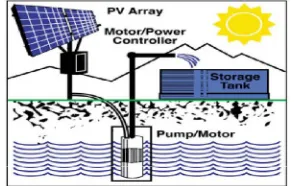
ABSTRACT: Agricultural technology is changing rapidly. Farm machinery, farm building and production facilities are constantly being improved. Agricultural applications suitable for photovoltaic (PV) solutions are numerous. These applications are a mix of individual installations and systems installed by utility companies when they have found that a PV solution is the best solution for remote agricultural need such as water pumping for crops or livestock. A solar powered water pumping system is made up of two basic components. These are PV panels and pumps. The smallest element of a PV panel is the solar cell. Each solar cell has two or more specially prepared layers of semiconductor material that produce direct current (DC) electricity when exposed to light. This DC current is collected by the wiring in the panel. It is then supplied either to a DC pump, which in turn pumps water whenever the sun shines, or stored in batteries for later use by the pump..The theoretical design, performance and simulation analysis of PV based water pumping system with the use of the computer software PVsyst is carried out. According to the analysis, the solar water pumping system has a different type of losses conditions .Therefore SWPS is strongly recommended for both urban as well as rural water supply system.
KEYWORDS: Solar water Pump, Losses Analysis, PV Syst 6.4.3 Softwares
I. INTRODUCTION
Photovoltaic (PV) panels are often used for agricultural operations, especially in remote areas or where the use of an alternative energy source is desired. In particular, they have been demonstrated time and time again to reliably produce sufficient electricity directly from solar radiation (sunlight) to power livestock and irrigation watering systems.
ISSN (Print) : 2320 – 3765 ISSN (Online): 2278 – 8875
I
nternational
J
ournal of
A
dvanced
R
esearch in
E
lectrical,
E
lectronics and
I
nstrumentation
E
ngineering
(A High Impact Factor, Monthly, Peer Reviewed Journal)
Website: www.ijareeie.com
Vol. 7, Issue 4, April 2018
The more intensively the sun is shining the higher is the power to supply irrigation water while on the other hand on rainy days irrigation is neither possible nor needed. In recent years, one of the suitable solar photovoltaic (PV) applications is a water pumping system. The simplest solar PV pumping system consists of PV array, DC-DC converter, DC motor, and water pump.
II. PROBLEM IDENTIFICATION
With the increasing acuity of water supply problems especially in developing countries, solar pumping systems are taking a great importance, which will still increase in the next years.
However, Solar pumping system sizing and optimization is a rather complex task, involving a lot of variables, which mix together in a way that is not intuitive. Most pump manufacturers do indeed propose their own "standard" system configurations, valid for given typical conditions (usually based on one standard clear day). Their specifications or sizing tools don't allow to estimate the net water yield during a specified meteo time series.
To our knowledge, there is no general tool available on the market, able to size and simulate such systems with sufficient generality and accuracy, in order to compare the performance of different system configurations in a given situation.
Therefore the engineer doesn't avail of any tool for optimizing a photovoltaic pumping system, exactly suited for a specific situation (meteo, levels, available flows, etc) and well-defined needs. The aim of this study is to offer the required computing basis, either for the sizing or for the detailed performance comparison of different technological options, as well as their economical evaluation. This tool should of course avail of a real components database, including the newest devices available on the market.
This facility should be integrated in the software PVsyst, a widely used general software for the detailed study and simulation of other PV systems (Grid-connected, stand-alone or hybrid).
A solar irrigation pump system methods needs to take account of the fact that demand for irrigationsystem water will vary throughout the year. Peak demand during the irrigation system seasons is often more than twice the average demand. This means that solar pumps for irrigation are under-utilized for most of the year. Attention should be paid to the system of irrigation water distribution and application to the crops. The irrigation pump system should minimize water losses, without imposing significant additional head on the irrigation pumping system and be of low cost
In the "System" definition panel, you can modify the "Detailed losses"(soiling, IAM, module temperature parameters, wiring resistance, module quality, mismatch, unavailability, etc).eventually define a Horizon profile (far shadings),Module Layout for a description of the PV modules in the system, for the detailed calculation of the electrical shading losses.
III. PROJECT DESIGN OF SOLAR WATER PUMPING
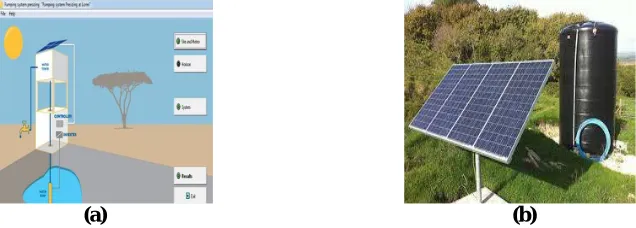
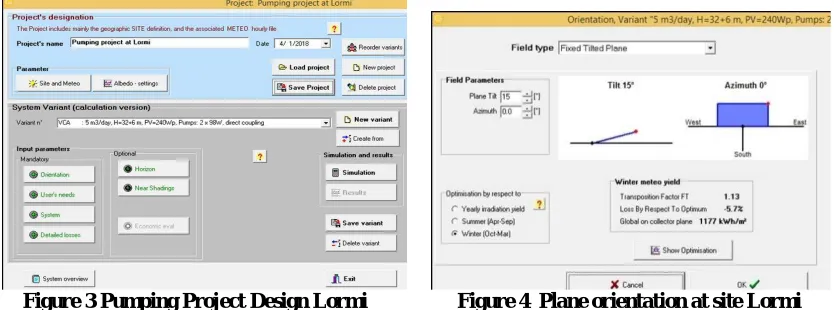
This part aims to perform a thorough PV-system design and performance analysis using detailed hourly simulations.These are organised in the framework of a Project, which essentially holds the geographical situation and meteorological hourly data. Optimisations and parameter analysis can be performed through different simulation runs, called variants.
(a) (b)
ISSN (Print) : 2320 – 3765 ISSN (Online): 2278 – 8875
I
nternational
J
ournal of
A
dvanced
R
esearch in
E
lectrical,
E
lectronics and
I
nstrumentation
E
ngineering
(A High Impact Factor, Monthly, Peer Reviewed Journal)
Website: www.ijareeie.com
Vol. 7, Issue 4, April 2018
(i)Project Design
Figure 3 Pumping Project Design Lormi Figure 4 Plane orientation at site Lormi
(ii) Water needs and Hydraulic Pressure/Head, Variant As shown in figure 4
Figure 5 Pumping Hydraulic Circuit Figure 6 Water needs and Head definitions
(iii) System properties.
Figure 7 Pumping System Definition
For a given project, you are advised to first construct a rough variant keeping all parameters to their proposed default values.
ISSN (Print) : 2320 – 3765 ISSN (Online): 2278 – 8875
I
nternational
J
ournal of
A
dvanced
R
esearch in
E
lectrical,
E
lectronics and
I
nstrumentation
E
ngineering
(A High Impact Factor, Monthly, Peer Reviewed Journal)
Website: www.ijareeie.com
Vol. 7, Issue 4, April 2018
the system, for the detailed calculation of the electrical shading losses. The following diagram shows an outline of the project's organization and simulation process.
Thermal Losses
The parameters of the Thermal behaviour of the field are defined in the "Array Losses”. The thermal behaviour of the field - which strongly influences the electrical performances - is determined by an energy balance between ambient temperature and cell's heating up due to incident irradiance.
Figure 8 Thermal Losses Figure 9 Ohmic Losses
Ohmic Losses
The ohmic resistance of the wiring circuit induces losses between the power available from the modules and the power at the terminals of the sub-array.
Soiling Losses
Accumulation of dirt and its effect on the system performance is an uncertainty which strongly depends on the environment of the system, raining conditions, etc. In medium-rainy climates (like middle of Europe) and in residential zones, this is usually low and may be neglected (less than 1%).In rural environments with agricultural activity, it may be important during some seasonal activities.
Figure 10 Soiling Losses Figure 11 IAM (Incidence Angle Modifier)losses
Incidence Angle Modifier losses
ISSN (Print) : 2320 – 3765 ISSN (Online): 2278 – 8875
I
nternational
J
ournal of
A
dvanced
R
esearch in
E
lectrical,
E
lectronics and
I
nstrumentation
E
ngineering
(A High Impact Factor, Monthly, Peer Reviewed Journal)
Website: www.ijareeie.com
Vol. 7, Issue 4, April 2018
IV. RESULT AND DISCUSSION
Fig 12Pumping PV system Losses Diagram Fig 13 Pumping : Basic Sim. Parameter
Fig14 Pumping Detailed Sim. Parameter Fig 15 Pumping : Main Result
When the simulation is completed, you will enter the "Results" dialog, and consult the main results on the "Report" document. After simulation, each variant may be saved for further comparisons (please use "Save as" to avoid overwriting your previous variants). You are advised to define a significant description for each variant, in order to easily retrieve them in the list and to obtain a suited title in your final report
V. SOFTWARE SIMULATION
ISSN (Print) : 2320 – 3765 ISSN (Online): 2278 – 8875
I
nternational
J
ournal of
A
dvanced
R
esearch in
E
lectrical,
E
lectronics and
I
nstrumentation
E
ngineering
(A High Impact Factor, Monthly, Peer Reviewed Journal)
Website: www.ijareeie.com
Vol. 7, Issue 4, April 2018
PVSyst V6.43 offers 3 levels of PV System study, roughly corresponding to the different stages in the development of the real projects.
REFERENCES
[1] Ozan AKI Aydın GÜLLÜ Trakya University “ Solar Pump Project Feasibility Study For The Village Kumdere” 2016
[2] Oyefolahan Ahmed Oyedokun1 Design and Simulation of Solar Powered Water Pumping System for Irrigation Purpose in Kaduna, Nigeria 2016
[3]Misrak Girma 1,*, Abebayehu Assefa 1 and Marta Molinas 2 1 School of Mechanical and Industrial Engineering, Addis Ababa Institute of Technology, Addis Ababa, Ethiopia Feasibility study of a solar photovoltaic water pumping system for rural Ethiopia 2015
[4] Naveen Kumar Lodha1, K. Sudhakar2 1, 2Energy Centre, Maulana Azad National Institute of Technology, Bhopal, M.P., India Theoretical
Design and Simulation Analysis of PV Based Pumping System for Domestic Applications in Bhopal, M.P, India 2013
[6] M. Alonso-Abella, E. Lorenzo, F. Chenlo,PV Water Pumping Systems based on Standard Frequency Converters.Progress in Photovoltaic Research and Applications 2003, 11:1-13.
[7] M. Alonso-Abella, F. Chenlo, J. Blanco, D. Manso,Use of Standard Frequency Converters in PV pumping systems.2nd World Conf. and Exhibition on PVSEC, Vienna, 1998.
[8] M. Alonso-Abella,Pump's detailed measurements, private communication.CIEMAT, Madrid (2004)
[9] André Mermoud,Pump behaviour modelling for use in a general PV simulation software.19th European PVSEC, Paris, France, June 7–11, 2004.
[10] André Mermoud,Pumping System Sizing and Modelling Tool.19th European PVSEC, Paris, France, June 7-11, 2004.
[11] Moraes-Duzat, Rejane Mércia de Siquiera,Analytical and experimental investigation of photovoltaic pumpingsystemsThesis, University of Oldenburg, 2000www.bis.uni-oldenburg.de/dissertation/2000/morana00/inhalt.html