Tanaffos (2002) 1(3), 13-18
2002 NRITLD, National Research Institute of Tuberculosis and Lung Disease, Iran
Techniques in Interventional Bronchoscopy
Amir Hassan Nassiri
Department of Internal Medicine, Cardio-pneumologic Hospital, Lyon-FRANCE
ABSTRACT
Interventional bronchoscopy is a new and non-surgical diagnostic, therapeutic and palliative approach to patient with bronchial pathologies. It consists mostly of rigid endobronchial broncoscopy under general anesthesia, with the use of (1)Nd-YAG or KTP laser (2)Cryotherapy (3)Endobronchial prostheses (4)Photodynamic therapy (5)Brachytherapy and, (6)Thermocoagulation. The idea is to treat by non-surgical measures, most of the early stage tracheobronchial cancer (insitu or microinvasive). The other utility is to associate this technique as an adjuvant treatment with chemo-radiotherapy in advance lung carcinoma. Treatment of benign structural or endobronchial pathologies as well as control of hemoptysis and foreign body removal are the other indications. In the future, interventional bronchoscopy will be a leader to diagnose and treat bronchial diseases. (Tanaffos 2002; 1(3): 13-18)
Keywords: Interventional pneumology, Bronchoscopy, Laser thearpy, Endobronchial carcinoma.
INTRODUCTION
Since 1980, multiple methods of therapeutics endobronchial bronchoscopy have been developed. The principles are as follows:
- Laser therapy: essentially the use of Nd- YAG and KTP laser to coagulate malignant lesions. - Cryotherapy: based on the cellular cytotoxicity
of low temperature.
- Endobronchial prostheses: expandable (covered/ non-covered) or silicon stent, developed for benign situation like tracheobronchial dyskinesia, post intubation stenosis and as a palliative treatment for malignant endobronchial pathologies.
- Photodynamic therapy: a new modality based on the interaction of light and a photosensitizing agent located in the tumor, specially in early stage
Correspondence to: Nassiri AH Tel.: +33-478720512
E-mail address: [email protected]
of lung cancer.
- Endobronchial brachytherapy: developed following the miniaturization of radioactive sources, enabling the use of fiberoptics to deliver treatment at high dose.
- Thermocoagulation: selection of the thermal effect of electrical current whilst avoiding the electrolytic and faradic effects on nerve and muscle stimulation.
Each of these methods had its own interrelation with the target tissue and it is important to know them as long as the best therapeutic is required.
INDICATIONS OF DIFFERENT TECHNIQUES
14 Interventional Bronchoscopy
Tanaffos 2002;1(3):13-18 action and are reserved only for less urgent
situations. (1)
Some of them (cryotherapy, photodynamic therapy and endobronchial brachytherapy) had selective cytotoxic effects and was beneficial only in very cellular and /or malignant pathology. This specificity gives us a good safety to use them in limited malignant lesions.
Endobronchial laser, thermocoagulation, and prostheses are also indicated in benign pathologies
(i.e: tracheal dilatation and stenting in post-intubation stenosis or tracheobronchial dyskinesia).
Most of these methods are only effective on endoluminal lesions, but occasionally endobronchial prostheses, and rarely brachytherapy had also some efficacy on compressive extrinsic pathology.
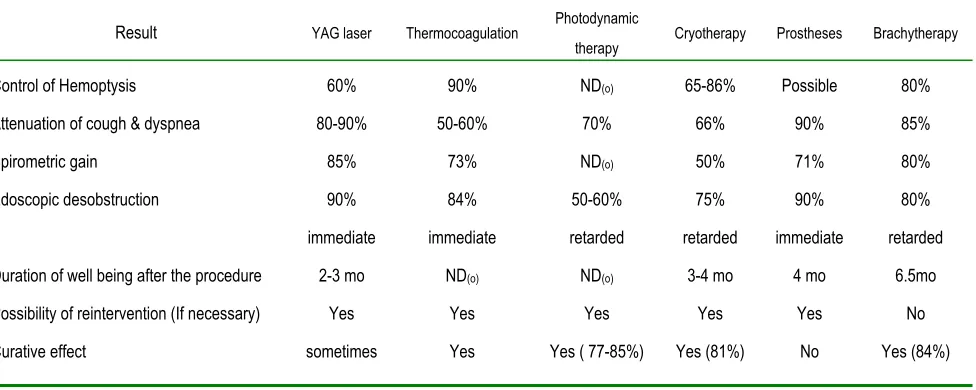
Tables 1 and 2 show the indications and therapeutics results of each method in neoplasic lung diseases. It is not so difficult to feel the interest to use the combination of them, to get the best therapeutic result. (1)
Table 1. Therapeutic indications of different methods of interventional bronchoscopy in malignant endobronchial diseases.(1)
Indication YAG laser Thermocoagulation Photodynamic
therapy Cryotherapy Prostheses Brachytherapy
Tracheal tumor with dyspnea ++++ ++++ No No No No
Tracheal or bronchial tumor without dyspnea ++++ ++++ + +++ No +++
Distal tumor + +++ ++ +++ No +++
Infiltrating tumor with limited borderline No +++ +++ ++++ No +++
In situ & microinvasive + ++ +++ +++ No +++
Coagulation +++ +++ ND(o) ++++ possible ++++
Extrinsic compression No No No No ++++ ++
Table 2. Therapeutic results of different interventional bronchioscopic techniques in pulmonary cancerology. (1)
Result YAG laser Thermocoagulation Photodynamic
therapy Cryotherapy Prostheses Brachytherapy
Control of Hemoptysis 60% 90% ND(o) 65-86% Possible 80%
Attenuation of cough & dyspnea 80-90% 50-60% 70% 66% 90% 85%
Spirometric gain 85% 73% ND(o) 50% 71% 80%
Edoscopic desobstruction 90% 84% 50-60% 75% 90% 80%
immediate immediate retarded retarded immediate retarded
Duration of well being after the procedure 2-3 mo ND(o) ND(o) 3-4 mo 4 mo 6.5mo
Possibility of reintervention (If necessary) Yes Yes Yes Yes Yes No
In palliative situations, choices between these methods seem to be simple; however, we still don’t have any comparative study to show that one is better than the others.
In therapeutic cases (in situ or micro-invasive lesions), problems are different. Early detection is still a dilemma (partially resolved by LIFE system), and the spontaneous evolution of dysplastic or in situ lesions to invasive lesions is not well known. The consequence is that we cannot justify our therapeutic endobronchial acts. The other problem is the same as in palliative situation: the lack of any comparative studies or consensus.
In benign pathology, especially in tracheal stenosis, the place of interventional bronchoscopy is better defined. A French study showed that in tracheal stenosis, the first therapeutic step could be the use of rigid endobronchial endoscopy (dilatation, laser therapy, and prosthesis)(2).
DIFFERENT ASSOCIATIONS OF ENDOBRONCHIAL BRONCHOSCOPIC TECHNIQUES
Classic associations are as follows: the use of laser or thermocoagulation on pediculated tumors with complementary cryotherapy on the implantation site, laser destruction for endoluminal tumors, combined with endobronchial stenting to retard the reobstruction, and/or fight against extrinsic tumoral invasion.The use of cryotherapy prolonged at least one month, which was benefited of desobstruction by laser therapy. (3)
Another association is the combination of laser beam and endobronchial brachytherapy. The laser has an immediate effect on the bronchial caliber and facilitates the passage of the vector catheter and brachytherapy, treat the peribronchical components. This association gives better results than laser therapy alone (4,5,6).
ASSOCIATION WITH OTHER THERAPEUTIC MEASURES
The most important associations are the combination of interventional bronchoscopy with radiotherapy and chemotherapy (in pulmonary cancerology).
Usually these patients are referred to therapeutic bronchoscopic centers after radio-chemotherapy in a final stage and with major bronchial problems (3-7). The use of interventional bronchoscopy is rarely beneficial in these cases although French study shows that, the use of interventional bronchoscopy before radio-chemotherapy is a better solution (8). Endobronchial desobstruction before external or internal irradiation, reduce the risks of post irradiation stenosis and pneumonia, besides removing the atelectasia, helps the radiotherapist to focus the target lesion. The duration of endoluminal brachytherapy will be shorter than usual, with better results and less complications (especially wall necrosis) (1).
Chemotherapy is better tolerated after desobstruction and complications like obstructive pneumonia in leucopenic phases is less frequent (removal of atelectasia), instead the therapeutic response is logically better (reduction of tumor volume) (1).
16 Interventional Bronchoscopy
Tanaffos 2002;1(3):13-18 The combination of endoluminal prostheses and
external irradiation seems to reduce both the risk of tumoral overgrowth in the upper extremity of the prostheses and the need of reintervention (12). The association of high dose brachytherapy and external radiotherapy had also good results. Some studies show that the use of brachytherapy before external radiotherapy spares 47% of lung volume to be irradiated (14,15,16).
DISCUSSION
This brief review of endobronchial therapeutic methods shows the multiplicity of our problems to choose the best technique in different endobronchial pathologies. We feel the need of more randomized studies to prove the efficacy of each ones in palliative and curative situation.
The role of an interventional endoscopist is to diagnose and cure with the most appropriate or a combination of these methods, the early stage of bronchial carcinoma. Furthermore, he must use them as an adjuvant or palliative treatment in pulmonary cancerology. The advantage of interventional bronchoscopy is the ability to practice this technique among patients whose respiratory reserve is precarious. But it is not all ! Many benign diseases such as post intubation or corrosive gaze inhalation tracheal stenosis, trcheobronchial dyskinesia, inhalation of foreign body; and so on, need the help of an interventional endoscopist. Another important utility of interventional bronchoscopy is to obtain by deep biopsy, a histological certitude of lesions that are not histologically diagnosed by fiberoptic bronchoscopy. Something is clear; in the following years, interventional bronchoscopy will be the main stem in curative therapeutics of early stage of endobronchial neoplasia and it will also be a potent arm in palliative treatment in advance lung cancer as well as benign endobronchial lesions. The surgical
treatment will be no more the therapeutic choice in this kind of diseases.
REFERENCES
1. Vegnon JM. Theraputic endoscopy. Synthesis pnemologie interventionnelle. Rev Mal Respir
1999;16(4pt2): 699-702.
2. Brichet A, Verkindre C, Ramon P, et al. Post-intubation tracheal stenosis. Rev Mal Respir
1999; 16: (4pt2): 685-92.
3. Vergnon JM. How I do it: bronchoscopic crytherapy. J Bronchology 1995; 2: 323-7. 4. Hetzel MR, Smith SG. Endoscopic palliation of
tracheobronchiol malignancies. Thorax 1991; 46(5): 325-33.
5. Macha HN, Koch K, Stadler M, et al. New technique for treating occlusive and stenosing tumors of the trachea and main bronchi: endobronchial irradiation by high Iridium 192 combined with laser canalisation. Thorax 1987; 42(7): 511-5.
6. Schray MF, McDugall JC, Martine ZA, et al. Management of malignant airway compromises with laser and low dose rate brachytherapy. The Mayo Clinic experience. Chest 1988; 93(2): 264-9. 7. Becker KO, Kemmer HP, Macha HN. Pattern of
failure and survival in endobronchial laser resection. A matched pair study. Chest 1994; 105(6): 1668-72.
8. Vergnon JM. Palliative treatment of bronchial obstruction by tumor. For whom? Why? How?
Rev Mal Respir 1995; 12(4): 331-4.
9. Eichenhorm MS, Kvale PA, Miks VA, et al. Initial combination therapy with YAG laser photoresection and irradiation for inoperable non-small cell carcinoma of the lung. Chest 1986; 89(6):782-5.
unresectable non-small cell cancer. Preliminary results Chest 1992; 102 (5): 1436-40.
11. Maiwand MO, Homasson JP. Cryotherapy for tracheobronchial disorders. Clinic Chest Med
1995; 16(3): 427-43.
12. Bolliger CT, Probst R, Tschopp K, et al. Silicone stents in the management of inoperable tracheabronchial stenosis. Indications and limitations. Chest 1993; 104(6): 1653-9.
13. Hommasson JP, Pecking A, Roden S, et al. Tumor fixation bleomycin labled with 57 Cobalt before and after cryotherapy of bronchial carcinoma.
Cryobiology 1992; 29(5): 543-8.
14. Tredaniel J, Hennequin C, Zalcman G, et al. Intrabronchial curietherapy. Experience at Hospital Saint-Louis after the treatment of 149 patients. Rev Mal Respire 1997; 14(6): 465-72.
15. Bedwinek J, Petty A, Bruton C, et al. The use of high dose rate endobronchial brachytherapy to palliate symptomatic endobronchial recurrence of previously irradiated bronchogenic carcinoma. Int J Radiat Oncol Biol Phys 1992; 22(1): 23-30. 16. Bastin KT Mehta MP, Kinsella TJ. Thoracic