OPTIMIZING ENERGY OF ROUTING PROTOCOLS
IN WIRELESS SENSOR NETWORK (WSN) WITH
SECURE HOPING
Mr. Om Narayan Parashar
1, Mr. Deepak Agarwal
21,2
Takhshila Institute of Engineering and Technology, Jabalpur
ABSTRACT
Through this research we are trying to design an energy efficient survivable path routing protocol for Wireless
Sensor Networks which is efficient in term of the energy usage of the whole network such that the network will
not get disconnected because of the energy depletion of its nodes. Still there are so many routing algorithms in
this field. We are trying for a protocol in the real time network where the traffic is more and also congested by
so many data sources sending their packets to the base station at the same time. We are proposing a protocol
which selects the path with a high survivability factor at the same time it should try to select the one which has
less interference from the other nodes as well as the environment. For selecting the next hop node, our
algorithm uses a criterion which is a function of the signal-to-interference-noise-ratio of the link between those
two, the survivability factor the path from that node to the destination, and the geographic distance from that
node to the destination.
Keywords: WSN, Routing Protocol, Energy Efficiency, Network Survivability, Path Survivability
Factor.
I.
INTRODUCTION
Sensors are the devices that capture the real-world phenomena and convert their captured information into the
digital format which can be saved, transmitted, and processed [1]. Sensors will give an enormous societal
benefit when it is integrated into numerous devices, environments, and machines. They can be used in the
applications like, to avoid catastrophic failure of buildings, to preserve important resources, to increase
productivity, for security enhancement, and for smart house keeping technologies, etc. The sensor nodes in
WSNs have got only limited amount energy source and restricted computing power. The energy consumption
amount is the main design constraint in these networks. The lifetime of a Wireless Sensor Network is depending
on the residual energy level of its nodes. In the case of most sensor networks it is impossible to recharge node’s
battery because of its unattended nature; hence effective utilization of the available energy sources of the node is
vital. There are various routing schemes in sensor networks that utilize the available restricted resources at
sensor nodes more efficient manner.Continually utilizing least energy paths may not be ideal from the network
lifetime perspective and for long-term connectivity [2]. Network survivability is a metric that is more useful for
improving the performance routing protocol. That is, the protocol should make sure that, the connectivity is
equal range. This is a situation which is opposed to the energy optimization protocols which will find the
optimal paths between source and destination and then decrease the nodes energy along that path, leave the
topology with wide difference in the energy health of the sensors, and by and by leads to situation that network
is disconnected into subnets. If the power level of nodes in the network burns comparably, then the sensors
located at the center of the network will be continuing for providing the connectivity for an extended duration of
time, and the delay to get the network partitioned increases. This will lead to the situation that the network
degrades more gracefully which is the idea of network survivability [3]. So through our research we are trying to
design an energy efficient survivable path routing protocol for Wireless Sensor Networks which is efficient in
term of the energy usage of the whole network such that the network will not get disconnected because of the
energy depletion of its nodes.As the well-known routing protocols are using the optimized path, it may degrade
the energy level of the nodes in that particular path which may lead to the network disconnection. Therefore to
find an energy-efficient routing algorithm is one of the main design criteria in the field of Wireless Sensor
Networks which is our research topic.
Figure 1: Single Hop and Multi Hop Communication.[5]
In our research we are trying to modify the protocol proposed by Dayang. S et al in [3] in such a way that, it
suits for the real time communication in WSN. In the real time traffic there should be multiple sensors sending
their sensed data to the base station. Sometimes more than one sensor node may transfer the data packet to the
base station at the same time. Since the nodes in the sensor networks are using the wireless communication
medium, and radio transceivers to send and receive packet, it is contingent to make interference. That means the
routing protocol should consider the link quality and the possible interference and the noise level of the link
before selecting a next hop node for communication. The algorithm proposed in [4] keeps silence about these
factors in its routing choice selection. So we are trying for a modification which will decide a routing choice at
every hop by also considering the congestion in the link.
II.
PROPOSED PROTOCOL: ENERGY EFFICIENT SURVIVABLE PATH ROUTING
The proposed routing algorithm and its working are explained in this section. As stated earlier the algorithm
designed is an attempt to have a routing protocol in Wireless Sensor Network which will burn the energy of the
sensor nodes gracefully and hence increase the lifetime of the network. It is considering the scenario in which
there are multiple source nodes which send their sensed data to the base station simultaneously, and hence may
and to route the data packet through the path that have interference and noise as minimum as possible. The
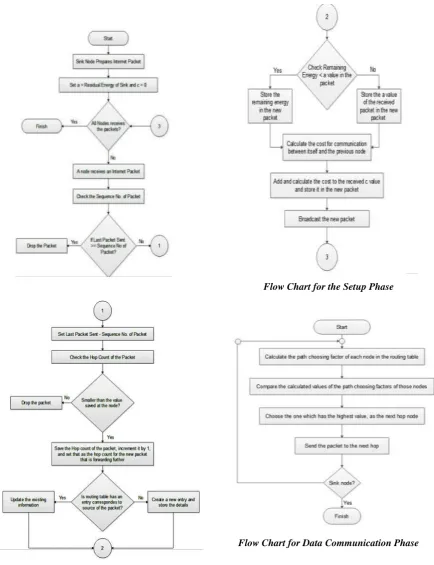
proposed protocol is a reactive routing protocol. It is a destination initiated query driven algorithm. Destination
node will initiate the process by sending the interest message. The protocol works in three phases.
Flow Chart for the Setup Phase
Flow Chart for Data Communication Phase
III.
RESULTS AND DISCUSSIONS
The simulation is carried out in Castalia simulator along with the OMNet++ framework. In each simulation the
proposed protocol is compared with the existing Sub-Game Energy Aware Routing protocol in [3]. In all
simulation the base station i.e., the sink node is placed at (0,0) and the other nodes are placed evenly in the
simulation area. The simulation will last for 10,000 s. The simulation is carried out by changing the transmission
power of the nodes in order to check the working of the proposed model in different interference levels. There
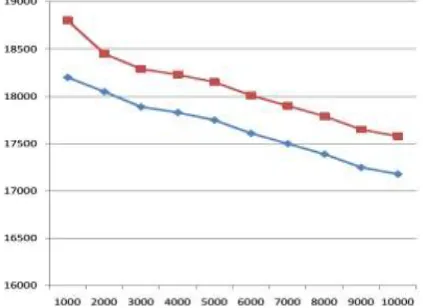
are multiple source nodes placed randomly. The Fig 3.1 shows the average energy consumption. From the figure
it can be seen that the proposed protocol consumes less energy as compared to the existing SGEAR protocol.
The figures, Fig 3.2, Fig 3.3, Fig 3.4 and Fig 3.5 show the number of application packets received at the
destination in both the protocols. Simulation is carried out with different transmission powers for the nodes in
order to evaluate the change in interference and to check how the protocol will work in different scenarios. From
the above figures it can be concluded that the proposed protocol outperforms than the existing protocol. In all
the cases the packet reception rate for the new protocol is higher than the existing protocol. This is because there
are multiple source nodes in the network, which will create interference on the other nodes. Since the existing
protocol only consider the energy factor for the selection of the route, it may select the paths which are
congested enough to drop the packet. And hence it is not able to reach the packet at the destination. So in the
SGEAR protocol the number of received packets at the destination is less. On the other hand the proposed
survivable path routing protocol will also consider the congestion in the communication medium for selecting
the routing choice. It is more focused to select a path which has as less interference as possible. So the proposed
algorithm can reach more packets at the destination. Number of packet drops is less in the new protocol. The
figure given below Fig 3.6 shows the consumed energy of nodes in both the cases. It shows that the proposed
protocol consumes less energy as compared to the existing one. This is happening because interference in the
link will impose the node to use more power in order to maintain the signal quality. In the equation of SINR, the
power is in the numerator and the interference in the denominator. So if the interference increases in order to
keep the signal strength the power has to be increased. So if the packet routed through the less interference path,
the power consumption will also get reduced. So the proposed protocol has the less energy consumption. The
Figure 4.7 shows the remaining energy at a particular node for a particular simulation. The graph is plotted for
the remaining energy present at the node against the simulation time. From the figure it can be seen that the
proposed protocol leaves more energy in the node than the existing one. That means the energy consumption at
node level is also less in the case of new algorithm. The new algorithm gains the advantage in
3.1: Average Energy consumption.
3.2: Number of Application packets
received. Transmission power is
50.69mW, and 5
source nodes in the network
3.3: Number of Application packets received. Transmission
power is 50.69mW, and 10
source nodes in the network
3.4: Number of Application packets
received. Transmission power is
42.24mW, and 5
source nodes in the network
3.5: Number of Application packets received. Transmission
power is 42.24mW, and 10
source nodes in the network
3.7: Remaining Energy of a particular node
Figure 3: Simulation Results
IV.
CONCLUSION
The sensor nodes in WSNs have got only limited sources of energy and computing. The main constraint of these
networks is the amount of energy consumption. The lifetime of a Wireless Sensor Network depends on its
node’s energy level. In most of sensor networks there is no way to recharge node’s battery because of its
unattended nature; therefore efficient use of the available energy sources of the node is essential. Since the
nodes in the sensor networks are using the wireless communication medium, and radio transceivers to send and
receive packet, it is contingent to make interference. That means the routing protocol should consider the link
quality and the possible interference and the noise level of the link before selecting a next hop node for
communication. So the interference on the link and hence the SINR value is an important factor to be
considered. So we are using this factor in the routing choice selection process of our proposed energy efficient
routing protocol. This is an extension of the existing SGEAR algorithm. The new algorithm is designed to suit
in the environment where the congestion is more and hence the interference on the link. The simulated results
showing that the new protocol works well in the networks when the traffic is high, which imposes interference
on the other links, than the existing algorithm. Our protocol has more packet reception rate, less end-to-end
delay, as well as it consumes less energy.
REFERENCE
[1] Perkins, E.Charles., and Elizabeth M. Royer. ”Ad-hoc on-demand distance vector routing.” Mobile
Computing Systems and Applications, 1999. Proceedings.WMCSA’99. Second IEEE Workshop on.
IEEE, 1999.
[2] R.Shah, . C., & Rabaey, J. M. (2002, March). “Energy aware routing for low energy ad hoc sensor
networks”. In Wireless Communications and Networking Conference, 2002. WCNC2002. 2002 IEEE
(Vol. 1, pp. 350-355).IEEE.
networks.” Computers & Electrical Engineering 39.6 (2013): 1601 -1608.
[4] Ankita “A Survey on Wireless Sensor Network based Approaches” International Journal of Advanced
Research in Computer Science and Software Engineering ISSN: 2277 128X Volume 4, Issue 4, April
2014
[5] T.Thua Huynh, A.Vu Dinh-Duc, C.Tran. “Balancing Latency And Energy Efficiency In Wireless Sensor
Networks” A comparative Study. IEEE 978-1-4673-2088-7-2013
[6] Y. K.Fulara “Some Aspects Of Wireless Sensor Networks” International Journal on AdHoc Networking
![Figure 1: Single Hop and Multi Hop Communication.[5]](https://thumb-us.123doks.com/thumbv2/123dok_us/7763906.1275638/2.595.174.425.331.442/figure-single-hop-and-multi-hop-communication.webp)