Scholarship@Western
Scholarship@Western
Electronic Thesis and Dissertation Repository
11-24-2014 12:00 AM
A Collaborative Access Control Model for Shared Items in Online
A Collaborative Access Control Model for Shared Items in Online
Social Networks
Social Networks
Hanaa Al Shareef
The University of Western Ontario
Supervisor Sylvia Osborn
The University of Western Ontario Graduate Program in Computer Science
A thesis submitted in partial fulfillment of the requirements for the degree in Master of Science © Hanaa Al Shareef 2014
Follow this and additional works at: https://ir.lib.uwo.ca/etd
Part of the Computer Engineering Commons, and the Systems and Communications Commons
Recommended Citation Recommended Citation
Al Shareef, Hanaa, "A Collaborative Access Control Model for Shared Items in Online Social Networks" (2014). Electronic Thesis and Dissertation Repository. 2535.
https://ir.lib.uwo.ca/etd/2535
This Dissertation/Thesis is brought to you for free and open access by Scholarship@Western. It has been accepted for inclusion in Electronic Thesis and Dissertation Repository by an authorized administrator of
(Monograph)
by
Hanaa Alshareef
Graduate Program in Computer Science
A thesis submitted in partial fulfillment of the requirements for the degree of
Master
The School of Graduate and Postdoctoral Studies The University of Western Ontario
London, Ontario, Canada
© Hanaa Alshareef 2014
ii
Abstract
The recent emergence of online social networks (OSNs) has changed the
communication behaviors of thousand of millions of users. OSNs have become significant platforms for connecting users, sharing information, and a valuable source of private and sensitive data about individuals. While OSNs insert constantly new social features to increase the interaction between users, they, unfortunately, offer primitive access control mechanisms that place the burden of privacy policy configuration solely on the holder who has shared data in her/his profile regardless of other associated users, who may have different privacy preferences. Therefore, current OSN privacy mechanisms violate the privacy of all
stakeholders by giving one user full authority over another’s privacy settings, which is extremely ineffective. Based on such considerations, it is essential to develop an effective and flexible access control model for OSNs, accommodating the special administration requirements coming from multiple users having a variety of privacy policies over shared items.
In order to solve the identified problems, we begin by analyzing OSN scenarios where at least two users should be involved in the access control process. Afterward, we propose collaborative access control framework that enables multiple controllers of the shared item to collaboratively specify their privacy settings and to resolve the conflicts among co-controllers with different requirements and desires. We establish our conflict resolution strategy’s rules to achieve the desired equilibrium between the privacy of online users and the utility of sharing data in OSNs. We present a policy specification scheme for collaborative access control and authorization administration. Based on these considerations, we devise algorithms to achieve a collaborative access control policy over who can access or disseminate the shared item and who cannot. In our dissertation, we also present the
iii
Acknowledgments
I thank Allah first and foremost for his blessings, reconciling me and enabling my thesis to come to light.
I would like to start by thanking the people without whom I would not have been able to write my thesis. My parents, Zana and Amer Alshareef, I sincerely thank you for your unconditional love and countless support throughout my life and especially during my master. From each of you, I learned to always seek knowledge, break my limits and your supportive words and prayers helped me to overcome the challenges I encountered and gave me the strength to succeed. To you both I dedicate this thesis.
I would like to express my deepest gratitude to my supervisor, Dr. Sylvia Osborn, for her unwavering support and encouragement over the years. Her guidance, thoughtful advice, insightful comments, continuous understanding and kind patience helped me to improve myself, advance my knowledge and achieve my goals successfully.
My sisters and brothers: I thank you all for your kind wishes, supportive words and providing such a loving environment. You were a source of inspiration to me throughout the years. A big thanks goes to my friends, especially Wafaa Alshareef, Hussein, Amal and Tagreed who were closest to me, forgave much, put up with much and loved much.
iv
Table of Contents
Abstract ... ii
Acknowledgments ... iii
Table of Contents ... iv
List of Tables ... vii
List of Figures ... viii
Chapter 1 ... 1
1 Introduction ... 1
Chapter 2 ... 6
2 Literature Review ... 6
2.1 Online Social Networks ... 6
2.2 Privacy Threats in Online Social Networks ... 10
2.3 Access Control Models ... 19
2.3.1 Access Control Models in Data Management Systems ... 20
2.3.2 Access Control Models in Online Social Networks ... 28
2.4 Trust in Online Social Networks ... 45
Chapter 3 ... 50
3 Collaborative Access Control Scenarios ... 50
3.1 Profile Sharing ... 50
3.2 Relationship Sharing ... 51
3.3 Content Sharing ... 52
3.3.1 Tagging ... 53
3.3.2 Posting ... 54
3.3.3 Sharing ... 55
v
4 A Collaborative Access Control model ... 67
4.1 Representation of OSNs ... 68
4.1.1 Controllers’ definitions ... 69
4.1.2 The formal definition of the model ... 70
4.1.3 Privacy policy specification ... 72
4.2 Requirements for a conflict resolution strategy ... 78
4.2.1 Principle 1. (Controllers’ Weight Scheme) ... 79
4.2.2 Principle 2. (Accessors’ Weight Scheme) ... 83
4.2.3 Principle 3. (Inferring Fuzzy Trust) ... 84
4.3 Algorithms for Collaborative Privacy Decisions ... 87
4.3.1 PermittedandDeniedAccessors Algorithm ... 87
4.3.2 AccessorSharing Algorithm ... 93
4.3.3 ControllerSharing Algorithm ... 98
4.4 Summary ... 103
Chapter 5 ... 104
5 Implementation and Evaluation ... 104
5.1 Dataset ... 105
5.2 Multiple Controllers’ Scenarios and Policy Specification ... 106
5.2.1 Multiple Controllers’ Scenarios ... 106
5.2.2 Privacy policy specification ... 113
5.3 Experiments and Analysis of Results ... 114
5.3.1 Sharing a new item Experiment ... 115
5.3.2 Sharing shared item Experiment ... 117
Chapter 6 ... 121
6 Conclusion and Future Work ... 121
vi
vii
List of Tables
Table 1: Sensitivity levels ... 76
Table 2: Controllers' Weights. ... 83
viii
List of Figures
Figure 1: The main components of access control and their interactions. ... 24
Figure 2: Trust Inference from node A to node E. ... 47
Figure 3: Pattern of profile sharing. ... 51
Figure 4: Pattern of relationship sharing. ... 52
Figure 5: Tagging scenario. ... 54
Figure 6: Posting -Tagging scenario. ... 55
Figure 7: Simple sharing users’ contents with other user scenario. ... 56
Figure 8: Tagging-sharing users’ contents with other user scenario. ... 58
Figure 9: Posting-tagging-sharing users’ contents with other user scenario. ... 59
Figure 10: Simple sharing others users’ contents scenario. ... 60
Figure 11: Tagging- Sharing others users’ contents scenario. ... 61
Figure 12: Posting-Tagging-Sharing others users’ contents scenario. ... 62
Figure 13: Simple sharing other users’ content and posts it in someone else’s space scenario. ... 63
Figure 14: Tagging-sharing other users’ content and posts it in someone else’s space scenario. ... 64
Figure 15: Posting-tagging-sharing other users’ content and posts it in someone else’s space scenario. ... 65
Figure 16: Representations of the social network structure. ... 71
ix
Figure 18: Trust Graph. ... 85
Figure 19: Inferring trust values. ... 92
Figure 20: Accessor sharing policies and Inferring trust values. ... 97
Figure 21: The Voting Matrix of Controllers Sharing. ... 98
Figure 22: The voting matrix (left), a directed trust graph, and an undirected relationship graph (right). ... 102
Figure 23: Interface of creating scenarios. ... 106
Figure 24: Tagging scenario ... 107
Figure 25: Co-controllers in Tagging scenario. ... 108
Figure 26: Posting-Tagging scenario. ... 108
Figure 27: Co-controllers in Posting-Tagging scenario. ... 109
Figure 28: Simple Sharing scenario. ... 110
Figure 29: Co-controllers in Simple Sharing scenario. ... 110
Figure 30: Simple sharing of another users' item and posting it in someone else's space scenario. ... 111
Figure 31: Co-controllers in a sharing scenario created by an intermediate user. ... 111
Figure 32: The final simulated scenario. ... 112
Figure 33: Co-controllers of final simulated scenario. ... 113
Figure 34: Privacy policy specification interface. ... 114
Figure 35: The execution flow of sharing new item. ... 115
x
Figure 37: The execution flow of sharing a shared item. ... 118
Figure 38: A comparison of the collaborative model and Facebook achievements for co-controllers privacy polices requirements in re-shared item scenarios. ... 119
Chapter 1
1
Introduction
Online Social Networks (OSNs), a very popular application on the Internet, have attracted almost one billion users, many of whom have incorporated these applications into their daily practices [Deep Nishar. April 18, 2014, Twitter Inc. June 2014,
Socialbakers. 2014, Google Official Blog. April 11, 2012]. Nowadays, there are hundreds of OSN sites which facilitate and enable the users to interact and collaborate with each other in a virtual community. The rapid rise of a large variety of OSN sites, with the massive amount of available information, obviously raises new, serious concerns about the security and privacy of their users and requires insights into security and privacy issues. Researchers from different computer science disciplines have investigated some of the privacy and security problems which arise in OSNs, from different viewpoints (e.g., [Raad and Chbeir. 2013, Pesce, et al. 2012, Hu and Ahn. 2011, Gurses and Diaz. 2013, Hongyu Gao, et al. 2011, Mahmood. 2013]). As a shared platform, the lack of collaborative policy for access control and authorization management has become one of the most important and crucial issues in OSNs. Currently, OSNs have limited access control where the privacy settings of shared content is solely defined and regulated by the uploader of the shard content, regardless of other involved users. Hence, because of the limited and poor access control mechanisms for shared data in OSNs, the concerns of information disclosure are increased. We believe improving OSN access control models by devising a collaborative policy and management for it emerges as the first step toward tackling the existing security and privacy concerns related to online social networks.
The recent emergence of online social networks (OSNs) has transformed the World Wide Web from an information pool to a platform for communication and social interaction. OSN sites (e.g., Facebook, LinkedIn, Flickr, Twitter, etc.) provide an environment and massive types of services to clearly encourage users to socialize and interact with each other both on the Web and in the real world. These applications offer massive types of tools for their users (e.g., posting, tagging, uploading, commenting, re-sharing, etc.) to share information (e.g., photos, contacts, interests, activities,
relationships with each other for a variety of purposes (e.g., business, entertainment,
dating etc.). As a result, OSNs have become the most successful and most widely used
services on the Web. According to a report by Socialbakers.com, Facebook has almost 1
billion users [Socialbakers. 2014 ]. In April 2014 LinkedIn reports on its website they have 300 million members from more than 200 countries and territories[Deep Nishar. April 18, 2014]. Additionally, Twitter has 230 million active users (as of June 2014), tweeting an average of 500 million tweets every day[Twitter Inc. June 2014]. Moreover, Google+ has 170 million active users (as of April 2012) [Google Official Blog. April 11, 2012]. Several statistics reveal that OSNs have become one of the highest used web applications in our lives all over the world [Goel, et al. 2012]. A Nielsen study shows that online users often are willing to spend their web time on social networks and
blogs[Nielsen. 2012].
The recent popularity and adoption of OSN sites produce more and more information that is publicly available on the Web and easily accessible from anywhere.
The availability of these vast amounts of personal information within OSNs obviously
raises security and privacy concerns and issues. Actually, it is clear that sharing personal
information, photos and other contents are the main purpose of OSNs. Therefore, as a shared platform, data in OSNs may be co-controlled by a number of users, just as books can be co-authored. Such co-control occurs by using different tools in OSNs such as posting, tagging or re-sharing. OSNs’ users have an unclear idea about who can view their shared information and whose privacy policies govern the sharing of their
information. Let us discuses the activity of photo sharing and tagging that is one of the most popular features of OSNs and has often become part of personal identity
management [Besmer and Richter Lipford. 2010]. For example, assume Alice took pictures with people at a party, and then she uploaded the pictures to an OSN like Facebook, making them available to everyone. Later, she tagged Bob and Carol who are co-workers (i.e. added hyperlinks to indicate Bob and Carol). They have many common friends and co-workers with Alice, and might find the pictures particularly shaming. Existing access control mechanisms in most developed OSNs place the burden of
Alice who is the uploader and owns the photo in her profile, regardless of the privacy requirements of the users who are explicitly recognized through tags. One study shows that 75% of their participants were aware of the photos that have been posted of them by other people via email when being tagged in a photo [Facebook, et al. 2013]. So, even if they are aware of the fact that their picture is displayed and controlled by other users, they cannot impact the privacy preferences applied to this photo. Although a tagged user can detag her/himself to remove the explicit hyperlinks, the photo still exists in the OSN site and the user cannot stop other tagged users from sharing the photo with the people they have relationships with.
While OSNs are clearly considered to be a collaborative environment where the
majority of activities involve at least two parties, current access control mechanisms and
authorization administration suffer from collaborative policy limitations. This lack of collaborative policies for access control and co-administration violates the privacy of all stakeholders who share a particular content with the uploader by letting her/him take full responsibility over their privacy settings, which is extremely ineffective. Designing a
suitable approach to address such a problem is the objective of this thesis.
Our work can be seen as a new step towards an access control model for OSNs.
We first introduce and analyze scenarios, where more than one user should be involved in
the process of making a collective access control policy. Those analyses and
model we propose a strategy to resolve the conflicts. Our principles for the conflict resolution strategy are essentially chosen to achieve the desired equilibrium between the privacy protection of online users and the value of sharing in OSNs’ sites. Next, by taking into account those principles, policies that are individually regulated by each associated controller and our multiple controllers’ scenarios, we develop a flexible and lightweight framework to achieve the collaborative privacy polices governing who can access and share the shared items in OSNs.
Our proposed approach includes three algorithms to address the problem of collaborative privacy polices .The first algorithm, called PermittedandDeniedAccessors, produces the final lists of accessors who are permitted to view the shared data and those who are denied. Based on our evaluation and determination for relationships between controllers and shared items and the type of activates applied to items, we have seen that dividing accessors into viewers and disseminators is an effective security practice. Moreover, according to our investigation of shared data situations, shared data
dissemination comes in two varieties. Consequently, we introduce the AccessorSharing and ControllerSharing algorithms to reach collaborative decisions about who can disseminate the shared item. The AccessorSharing algorithm produces list of accessors, who are allowed to disseminate the shared item with their social networks (e.g., friends, family members, classmates, etc.). Because we have several associated controllers and they can disseminate the shared item with users who originally could be unauthorized to access the shared item, we come up with a ControllerSharing algorithm. We have
formalized the ControllerSharing algorithm to enable controllers to regulate their privacy and protect their items from being used against them in some way.
To demonstrate the efficacy of the approach, we have implemented our
PermittedandDeniedAccessors algorithm. A proof-of- concept prototype is to show the usability and feasibility of such an approach to achieve a collaborative access control policy over who can access a shared item. Our prototype application simulates all multiple controllers’ scenarios, where contents are related with multiple users who are explicitly identified through posts, shares, tags or other metadata, as a first step.
produce the final lists of accessors who are permitted to view the shared data and those who are denied. In order to validate our approach, we conduct experiments using our prototype and discuss the results obtained in detail.
The organization of the remainder of this dissertation is as follows. We begin by reviewing the fundamental, relevant concepts in Chapter 2. It covers the four dominant themes of the research that are online social networks (OSNs), which is the platform of our problem, and several privacy issues and concerns in OSNs. In Chapter 2, we also review the access control models of data management systems and investigate and discuss the crucial requirements that an access control model for social network services should have. We end this chapter by presenting the related works that propose access control solutions for OSNs. In Chapter 3, we analyze and explore a number of OSN’s scenarios where items are linked to numerous users who are explicitly recognized and have the right to participate in the shared item’s privacy setting. Afterward, in Chapter 4, we formulate an access control model that determines the essence of the collaborative authorization requirement. Furthermore, we present a collaborative policy specification scheme for access control and authorization administration. We also explain the
Chapter 2
2
Literature Review
This literature review explores the four dominant themes of the research. First, we offer a brief overview of online social networks, which is the platform of our problem. Second, we discuss some privacy issues and concerns in OSNs that we address in this thesis. Understanding these risks and challenges helps to design a suitable approach to address them. In the next section, we provide overview of access control models in data management systems (DMS). Furthermore, we investigate and discuss the critical access control challenges in OSNs; then, we present the key requirements that an access control model for social network services should have. This section ends with review the main access control solutions for OSN. We categorize existing related works into two types based on type of administration policies. We discuss access control models for OSNs that do not consider collaborative authorization administration of shared data in OSNs.
Furthermore, we review and discuss in detail the approaches that have been proposed to provide a collaborative policy for OSN access control models. Finally, we provide a brief discussion of the trust notions in social network because we combine trust values
between individuals in our algorithms.
2.1 Online Social Networks
Networks have been used in many systems such as computer networks, the World
Wide Web, biochemical networks and social networks. Each of these networks consists
of a set of nodes or actors representing, for instance, web pages on the World Wide Web,
connected together by edges or relations, representing links between web pages. Our
focus in this thesis is on social networks on the Internet. However, we start by describing
some basic ideas related to social networks in general. Primarily, a social network can be
compared to the concept of society where individual actors (nodes) are connected with
each other by relationships (edges). Thus, actors and relations represent the building
blocks of social networks; first of all, an actor is a social entity that socializes with other
1997]. Furthermore, a relation symbolizes a linking between two actors. On social
networks, the concept of relationship is important when studying the structure of social
networks, and is described by numerous features such as its type, direction, strength, and
weight.
Since the World Wide Web and the Internet are continuously increasing in their
popularity, massive types of services are available through them. In this context, a virtual
community has been created for users to interact and collaborate with each other on the
Internet, known as an online social network (OSN) [Chiu, et al. 2008, Howard. 2008].
They can also be called social network sites [Boyd and Ellison. 2007], social web sites
[Kim, et al. 2010], or online networking sites [Gross and Acquisti. 2005]. From this
moment on, and in the rest of the thesis, for simplicity purposes, we refer to these web
services using the simple and extensive term of online social networks (OSNs). An OSN
is “a web based site that allows individuals to construct a public or semi-public profile
within a bounded system, articulate a list of other users with whom they share a
connection, and view and traverse their list of connections and those made by others
within the system. The nature and nomenclature of these connections may vary from site
to site”, as said by Boyd and Ellison [Boyd and Ellison. 2007]. As the area of OSNs has
become a development part of the online activities on the web and various online services
insert constantly new social features to their offerings, the classification of OSN services broadens. OSN services range from social interaction-focused sites such as Facebook, Friendster, or MySpace, to data dissemination-centered services as Twitter, to
professional expertise and accomplishments -centric networks such as LinkedIn, to social communication features added to existing sites and services such as Flickr, YouTube, or
Amazon [Pallis, et al. 2011, Musiał and Kazienko. 2013]. These services are generated
and maintained by commercial companies. Although each of these services has different
characteristics of social interaction, using the previous definition, let us try to generally
specify some basic properties of an OSN’s service. First, it is an online site, platform, or
service that provides environment and tools to build the social network or social relations among people. Furthermore, OSNs offer a wide range of tools for their users (e.g.
tagging, uploading, commenting, re-sharing, etc.) to share interests, activities,
representation, often a profile, that contains the list of her/his connections (e.g. friends, colleagues, family members) and a variety of additional services; for example, they can participate in group or community activities and receive notifications on the activities of her/ his connections.
For the sake of clarity, we briefly explain the concepts of social network users, user profiles and social links precisely in the context of OSNs. Firstly, the user is the core of an OSN; the majority of existing definitions of social networks are centered around
users [Boyd and Ellison. 2007, Schneider, et al. 2009]. When these users join social
networking sites, they have to create a personal profile to upload and post their items
such as photos,opinions, etc. Then, the user makes connections to entities/individuals
already members on these sites. Also, she/he socializes by interacting with other users by a wide variety of communication tools provided by these sites. Second, an OSN’s user is virtually represented by a profile where identifying information (e.g. name, age, gender, photos and online status) and user’s interests and preferences (e.g. joining groups, rating movies, books or music and liking brands) are shown. Consequently, user profiles shape
users’ personalities, identities, and behaviors on social networks you [Mislove, et al.
2010]. Finally, a user usually socializes with other network members who are already
known to her/him. Additionally, a new member can establish new connections to
individuals who are often suggested by the site upon the shared personal information
such as name, location, photographs, birthday, personal interests, etc. Although users
actually get linked to different types of contacts such as friends, family members,
colleagues, co-workers, and strangers, current OSNs rarely discriminate between social
relationship types. Indeed, OSNs often provide only a default relationship type that
connects users of particular OSN site to each other. For example, social links are known
as friends, regardless of its veracity or trust level.
Nowadays there are hundreds of OSN applications available in the World Wide
Web, supporting a vast range of interests and practices. As a result, OSNs have become
one of the highest used Web applications in our lives, so they dominate the time that
users spend on the web [Goel, et al. 2012]. Many statistics indicate that OSNs have
become a fundamental part of the online activities on the World Wide Web all over the
their web time on social networks and blogs. According to a report by Socialbakers.com,
which shows how much the number of OSNs users rapidly increases, Facebook has
almost 1 billion users. Thus, currently it is considered to be the largest OSN with more or
less 1 out of 7 people in the world having a Facebook account [Hampton, et al. 2011,
Socialbakers. 2014 ]. Moreover, Twitter, which is under the scope of business and
entertainment social networks, has 230 million active users (as of June 2014), tweeting an
average of 500 million tweets every day [Twitter Inc. June 2014].
Due to the large size of OSNs, graphs are the most appropriate and common way
to represent these networks. Consequently, the platform of OSNs is the social graph,
where G = (V,E), with vertices 𝑉 = {𝑣!,. . .,𝑣!} corresponding to individuals and edges 𝐸 = {(𝑣! ,𝑣!)/ 𝑣! 𝑣! ∈𝑉, 𝑖 ≠𝑗 ,1 ≤ 𝑖,𝑗 ≤𝑛} modeling the relationships among
vertices [Mislove, et al. 2007]. Under the umbrella of social networks are many different types of graphs to represent different forms of data and to pattern the structural properties of social networks. Graphs can have their edges directed or undirected, weighted or un-weighted, labeled or unlabeled. In OSNs, both directed and undirected graphs can be used depending on the nature of the relationship. For instance, Facebook is a typical example of social network formed as an undirected graph, where friendships between users are symmetric. In other words, 𝑅!" or 𝑅!" both indicate a friendship link between user 𝑖 and user 𝑗. By contrast, Twitter is an example of a directed social network where relationships are not bidirectional. An edge between two nodes represents the followee-follower
relationship, thus 𝑅!" denotes user 𝑖 is following user 𝑗.
OSNs (e.g. [Chi Zhang, et al. 2010, Lewis, et al. 2008, Carminati, et al. 2014, Gail-Joon, et al. 2011, Hongyu Gao, et al. 2011, Mahmood. 2013]). Indeed, the privacy issue within the context of OSNs opens a new interesting challenge in the research community and has received a lot of attention.
2.2 Privacy Threats in Online Social Networks
Nowadays more and more information is publicly available in OSNs. These networks are increasingly attracting the attention of users who are interested in preserving existing relationships, making new connections, and using the numerous social networks’ services for example, sharing photos, ideas, interests, events, and activities within their individual networks. Although massive amounts of private and personal information could be delivered through different Web sites such as medical information, taxes or social networks, the data delivered by OSNs is especially important because they have been gaining popularity among Internet users. Also, OSNs are expanding rapidly and providing more personal information than we could ever expect. For example, Google+ has 170 million active users (as of April 2012) and Pinterest, which is the third most popular online social network in the U.S., had collected 10.4 million users as of February 2012 [Google Official Blog. April 11, 2012, Experian Marketing Services. 2012].
Moreover, LinkedIn boasts on its web site that it has added more than 23 million members since December 31, so in April 2014, it has reached 300 million members in more than 200 countries and territories [Deep Nishar. April 18, 2014]. Although
Facebook was only launched eight years ago, at the time of writing this thesis the total
number of daily active users is closing in on 1 billion [Facebook. September 2014]. Hence, the availability of these vast amounts of information within OSNs obviously
raises privacy and confidentiality issues.
and the user population’s lack of awareness are addressed and described by several studies and recent news reports (e.g. [Carminati and Ferrari. 2008, Gates. 2007, Joshi and Kuo. 2011, Gurses and Diaz. 2013, Gail-Joon, et al. 2011, Hongyu Gao, et al. 2011, Mahmood. 2013, Raad and Chbeir. 2013, Loukides and Gkoulalas-Divanis. 2009, Gross and Acquisti. 2005, Becker. 2009]), OSNs’ security and privacy requirements still are not well understood or completely expressed. Indeed, there are explicit differences between the privacy issues in databases and in OSNs, especially in the way they are shaped, maintained, and in their use. Classic databases are created by an entity with the objective of keeping track of individuals according to diverse principles and with a specific
purpose. The major objective of database security is to provide data security from unauthorized access and use. In other words, individual entities whose information is stored in a database have no access to each other’s records. This privacy issue occurs when the owner of databases is asked for some data and needs to transfer some of the data to accomplish this request. On the contrary, in OSNs Internet users join voluntarily to share their personal information, which are represented by different types of data, with one another. It is clear that sharing personal information, news and other contents are the main purpose of OSNs. Therefore, OSNs allow Internet users to access other network user’s information, thus an attack on user privacy often comes from another user in the same social network. Though security and privacy issues arising in OSNs are different from those in databases, the definition and treatment of privacy in these social networks is inspired by the corresponding concepts and philosophies in databases.
In this section we discuss the main privacy threats to OSNs, then in the following
section, we present the access control model as solution to address the existing security
and privacy concerns and issues related to OSNs. When this is discussed in the context of
OSNs, the word privacy is used. Traditionally, in the computing field, people have talked
about access control. Privacy in databases often involves statistical inference of specific
facts about people whose information is stored in a database. Access control in
computing systems determines who can perform operations on (or just read) specific
pieces of data, or files. Since most of the data stored in OSNs is discrete, i.e. facts about
users’ backgrounds, date of birth, etc., or involves discrete items like a photograph or a
would be considered access control. However, since much of the information on OSNs
deals with people, or their opinions of posts by reposting something or liking something,
deciding who can access this data is usually referred to as a privacy issue. We will use
both terms in what follows, and in the context of this work, both privacy and access
control concerns refer to the same thing – who can see something on someone else’s
profile.
Researchers from different computer science disciplines have investigated some
of the privacy and security problems that arise in OSNs (e.g. [Pesce, et al. 2012, Gurses
and Diaz. 2013, Squicciarini, et al. 2009, Hongyu Gao, et al. 2011, Mahmood. 2013,
Raad and Chbeir. 2013]). Data privacy is defined as "freedom from unauthorized
intrusion"[Vaidya, et al. 2006]. However, what are the fundamental assumptions about an
unauthorized intrusion in OSNs is an open question because the concern about the
security and privacy of OSNs’ users and resources is a young field.
several privacy issues. Our objective is to discuss several problems that lead to our specific issue that we address in this thesis. Subsequently, because institutional privacy does not specifically belong to our problem, we have chosen to leave it out of this dissertation's scope.
Social privacy (disclosure) issues have become a major concern for both OSN
site’s users and providers. We distinguish the four types of social privacy problems where
information acquisition is based on privacy disclosure: users lack awareness, design flaws
and limitations, breaches from other users and collective privacy management limitations.
These issues are not new by themselves, but they are unique to OSNs and are worth reexamining.
• Users limitation:
User awareness is an aspect that the literature has repeatedly emphasized (e.g. [Ngeno, et al. 2010, Becker. 2009, Li, et al. 2013, Acquisti and Gross. 2006]). While revealing information on the web is a voluntary activity on the part of the users, most users are not aware of who is able to access their data and how their data can possibly be used and redisseminated. Vorakulpipat et al. find that while 52% of the respondents claimed to have a sufficient level of information privacy awareness, 75% of the users could not identify basic information systems security threats such as phishing, identity theft or attribute disclosure [Vorakulpipat, et al. 2011]. Due to the lack of awareness among Internet users, huge amounts of user’s personal information such as pictures, contacts, and videos, are quickly falling into the hands of authorities, strangers,
adversaries, recruiters and the public at large [Aimeur, et al. 2009]. Indeed, users’ lack of awareness can lead to identity and attribute disclosure, which arises when an
shared sensitive information on Facebook. Despite this, it seems nowadays that Internet users are becoming more and more aware of privacy risks connected to OSNs. In fact, for the majority of privacy threats, if users do not take the initiative to protect their data, most defense mechanisms would fail disastrously.
• Breaches from other users:
One of the main types of attacks on OSNs is attacks from other users. OSNs offer
Internet users new and interesting means to interact, communicate, and socialize. As a
result, a huge amount of information, which could contain political views, a link they
want to share, thoughts, sexual orientation, etc., expose a lot about the user. So, she/he
will be of interest to various groups including friends, friends of friends and strangers to
attack. All major OSNs allow a user’s friends to view the personal information the user
has uploaded to her/his space by default, but prevent others from doing so. However, in
OSNs the notion of friendship is merely a social link that the two users have arranged to
establish in that OSN, regardless of their actual offline relationship. Consequently, this contradiction causes a possible stealing of personal information by authorized users in OSNs. Several studies present potential attacks and risks from friends in OSNs
[Mahmood and Desmedt. 2012, Mislove, et al. 2010, Akcora, et al. 2012]. In [Mahmood
and Desmedt. 2012]the authors familiarize the targeted friend attack by creating a
pseudonymous profile. Their single pseudonymous profile had access to the private
information of 4,339 users. Beyond user-to-user relationships, most OSNs offer friend
recommending systems to recommend a list of other users whom this user may know,
have mutual friends or have common attributes. This feature leads to social link
disclosure, which happens when an adversary is able to find out about the existence of a
relationship between two users. Furthermore, a social link disclosure could lead to a
cross-site profile cloning attack. Work by Jin, et al.[2013] demonstrates that an attacker
using just one attacker node (2-hops) can identify more than 60% of a user’s friends.
Indeed, threats from the mutual friend feature are potentially more dangerous than
breaches from friends because it’s less likely to arouse suspicion. On many occasions, we
accept a lot of friendship requests on OSNs without thinking about the short-term or
• Design flaws and limitations:
Regrettably, current OSN applications indirectly necessitate the users to become
system and policy administrators and experts to protect their online information. Another
major problem that causes personal information disclosure is that users face great
difficulties and complexities in effectively configuring their privacy settings.
Furthermore, the risk from limitations and flaws of privacy setting design is greatly
increased by OSNs’ rapid growth as well as their continual adoption of new services. The
design limitations and flaws refer to the weak privacy controls offered by current OSNs and the possibility of explicit attacks. One of the major design flaws that might abuse or misuse such critical and sensitive information is the default or ‘recommended’ privacy setting. While social network sites provide five different granularities for their users: only me, specific friends, friends only, friends of friends, and everyone, the default setting for most pieces of content is public (everyone) meaning the user shares her/his content with all one billion Facebook users if they do not change or modify their privacy settings. The results of Liu, et al.’s [2011]work reveals that 36 % of Facebook items still remain shared with the default privacy settings, general. Only 37 % of users have expectations which correspond to the default privacy settings; thus when these are incorrect, pieces of information are exposed to more users than expected. Another design weakness is the limitation in the granularity of photo privacy settings. Pictures are categorized into
albums, and privacy settings are specified on album granularity, hence all pictures in a
particular album have the same privacy preference.
To successfully use OSNs’ privacy settings, users must first find them and
understand their terminology. Additionally, they need to understand the privacy-related
consequences of their behaviors and decisions. However, privacy policies in existing
OSNs are too complex for most ordinary users to manipulate and understand [Johnson, et
al. 2012, Raad and Chbeir. 2013, Anderson and Stajano. 2013]. In fact, most users have
no experience to articulate their privacy preferences effectively. Further complicating this
issue is the frequent changing these settings have over time, so the complexity of
elucidating privacy settings is greatly increased. Also, the privacy tools are not
meaningful enough to express users’ disclosure preferences. According to a recent study
the privacy settings on their account. In all, current OSNs privacy mechanisms skip
significant metrics such as risk, trust, humanization design, and some social metrics.
• Collective privacy management limitations:
In spite of the fact that collaboration and sharing represent the main building
blocks of existing OSN sites, OSNs yet do not support any mechanism for collaborative
management of privacy settings for shared data. While owning photos and posting
comments to users’ profiles are considered as the general purpose of social network
services, users can be tagged in photos and reply (comment) to or re-share an existing
post. Since multiple controllers’ scenarios are raised by using different tools in OSNs
such as posting, tagging and re-sharing, collaborative administration policies are
becoming more and more important in many OSNs scenarios. Let us discuses the
activities of photo sharing and tagging that are an integral and exceedingly popular part
of profiles on most OSNs like Facebook. For example, Facebook hosts 250 billion photos
(as of September 2013) [Facebook, et al. 2013]. On an average day, more than 350
million photos are uploaded. Besides photo sharing, tagging represents one of the
prominent features of OSNs; it has often become part of personal identity
management[Besmer and Richter Lipford. 2010], instead of merely sharing activities
with friends. The first limitation of photo sharing activity in current OSNs is that when
uploading photos, the request for permissions from other users appearing in the photo is
not demanded, even if they are explicitly recognized through tags or other metadata.
In[Facebook, et al. 2013], researchers show that being tagged in shared photos is the most
prevalent way that participants know about photos they were depicted in. 75% of their
participants were aware of the photos that have been posted of them by other people via
email when being tagged in a photo. Consequently, the tagging feature enables internet
users to review all photos of them that exist, which leads us to the hypothesis that being
tagged in shared photos is seen to have some privacy benefits. However, existing access
control mechanisms in OSNs choose to place the burden of privacy policy solely on the
owner who has shared data in her/his profile, raising serious privacy concerns. For
example, suppose Alice took pictures with people at a party, and then she uploaded the
tagged Bob who is one of the people in the pictures (i.e. add hyperlinks to indicate Bob).
He shares many friends and colleagues with Alice, and might find the pictures
particularly shaming. Indeed, existing access control mechanisms in OSNs offer
individual (rather than group) processes to regulate the decisions of accessing shared
data. In our example, pictures are solely controlled and managed by Alice who has them
in her profile, even though he is aware of the fact that their pictures are displayed and
controlled by other users, Bob has no control over them and cannot impact the privacy
preferences applied to these photos. Even if tagged users can detag themselves to remove
the explicit hyperlinks from the photo to their profile, the photo still exists in the social
network site. Also, they cannot stop other tagged users from sharing the photo in their
social networks. As a result, current access control mechanisms and authorization
administration suffer from collaborative policy limitations. In fact, shared pictures have
an impact on the privacy of all users who appear in a picture and are mentioned in
metadata like tags and comments. Henne, et al. [2014] report on how well their
participants feel informed about two dissimilar types of photos of themselves on social
network sites. 56% of their participants claimed that their level of information about
acceptable photos is worse than neutral. In contrast, in the case of inappropriate photos,
70% of them selected a level worse than neutral to totally unsatisfactory. Therefore,
current OSN privacy mechanisms violate the privacy of all stakeholders who share a
particular photo with the uploader by letting her/him take full responsibility over their
privacy settings, which is extremely ineffective.
The significant privacy threat of information disclosure is increased by limited and poor access control mechanisms for shared data in OSNs. They are clearly
considered to be a collaborative environment; the majority of OSN scenarios involve at least two parts. Designing a suitable approach to address this problem is the objective of this thesis. In this regard, more insight into scenarios where contents are associated with multipleusers who are explicitly identified through posts, shares, tags or other metadata is presented in Chapter 3. Finally, in spite of the fact that a lack of a joint administration policy raises a number of important issues (e.g. [Li, et al. 2013, Vorakulpipat, et al. 2011, Acquisti and Gross. 2006]), this problem has only been explored in few studies
Xiao and Tan. 2012], which we will review in Section 2.3.2.2.2 .
Although these privacy issues are addressed and discussed as if they are
independent phenomena, they are closely intertwined and are sometimes combined. For instance, because users are generally unaware about who can access their profile and specifically which parts of their profiles are accessible and to whom precisely, other users can easily violate these users’ privacy. Moreover, the issues of design flaws and
limitations, and users’ lack of awareness differ in the way they are tackled, but they are explicitly and implicitly entangled. For example, users still create threats to their own privacy by using inappropriate and limited access control settings. Similarly, the problem of poor access control for shared content is not independent of the attacks from other users problems. The lack of a collaborative administration policy might have
consequences for the effectiveness of maintaining the associated users’ privacy
boundaries by not allowing them to participate in shared data privacy settings. Indeed, all these issues refer to major gaps and limits in the architecture of access control
mechanisms.
2.3 Access Control Models
As we discussed above, recently we have seen unprecedented growth in the popularity of OSNs for sharing data such as pictures, videos, audio, etc. between people. It comes with scientifically challenging problems and concerns about protecting the information of online users. In OSNs, users are encouraged to broaden their social network and to share their content with others; consequently, those activities obviously raise user’s privacy and content confidentiality issues. Online users usually want to selectively share their content in OSNs; thus, an access control mechanism is what gives users more control on the spread of their information. Access control techniques are intuitively introduced to protect users’ privacy, prevent unauthorized access and to selectively share contents in social networks. While access control mechanisms are simple and may only require comparison of credentials, OSNs have specific access control requirements, due to their particular characteristics. They require more fine-grained control and new controlled data sharing solutions that respect what has been proposed so far in the field of database management systems (DBMSs) and operating systems. Theoretical work on access control has led to several frameworks for achieving the desirable access control requirements for social networks and representing access control mechanisms in a flexible and fine-grained way, (e.g. [Carminati, et al. 2009a, Xiao and Tan. 2012, Hu, et al. 2013, Fong. 2011b, Cheng, et al. 2012a, Anwar, et al. 2010]. Nowadays, these access control frameworks, which are proposed for OSNs, replace a particular policy model such as discretionary access control (DAC), mandatory access control (MAC), or role-based access control (RBAC) paradigms, which are used in traditional systems. DAC is a means of restricting the access of subjects to objects
based on the identity of subjects and a set of authorizations. DAC provides discretion to
individual users over who is allowed to access the data they create or own. Also, in this
type of access control pattern, a user has comprehensive control over all system resources
that are owned and executed by her/him. In contrast, MAC utilizes security classification
labels that represent security domains. Thus, the subject’s and object’s security
classification determines the accesses that subjects can execute on the objects in the
system [Ferrari and Thuraisingham. 2000]. The security classes associated with subjects
labels defined as a clearance level [Ferrari. 2010]. The sensitivity of data is measured by
object security levels that are enforced by the system. Consequently, in a MAC paradigm, user privileges cannot be passed from one user to another and there is no concept of ownership. In addition to DAC and MAC, in 1996 Sandhu et al. proposed the RBAC approach where restricting resources or system access to authorized objects is regulated according to their role (job descriptions) [Sandhu, et al. 1996]. In RBAC, privileges are associated with roles instead of being resource-owner centric as in DAC or security classification labels as in MAC.
In this section, we first briefly present the basic concepts of access control and give a brief history of the main research in the field of access control.
2.3.1 Access Control Models in Data Management Systems
Access control is one of the most important features of today’s systems to protect data stored into Data Management System (DMS) [Ferrari. 2009, Bertino and Sandhu. 2005] . The technical ability to do something with a computer resource such as view, modify, create or delete is what we mean by access. Access control usually determines whether the ability is explicitly enabled or restricted in some way [Bertino and Sandhu. 2005]. Its overall goal is the protection of DMSs resources (i.e., data and services). Indeed, DMS access control focuses on addressing three main issues [Samarati and de Vimercati. 2001, Bertino and Sandhu. 2005]:
• Data confidentiality or secrecy refers to preventing improper or unauthorized access and to limiting data access and disclosure to authorized users.
• Data integrity that is protecting data from intentional or accidental unauthorized modifications or deletions by restricting the number of users with access
• Data availability ensures that authorized users have access to information resources. Also, it refers to preventing hardware and software errors that could make some of the data unavailable to authorized users.
corrective and detective. Access control mechanisms are a central element of computer security, since they are the basis of implementing both information confidentiality and integrity. ITU-T Recommendation X.800 defines access control as follows:
“The prevention of unauthorized use of a resource, including the prevention of use of a resource in an unauthorized manner.”
Access control mechanisms are used to enforce a policy, which is specified by Security Administrators (SAs) or users, of restricting access to a data object to only those users (subjects) who are authorized [ISO. 1989].
2.3.1.1 Basic components of access control
According to the aforementioned definitions of access control, the basic concepts of access control are access control policies and authorizations. The policies are
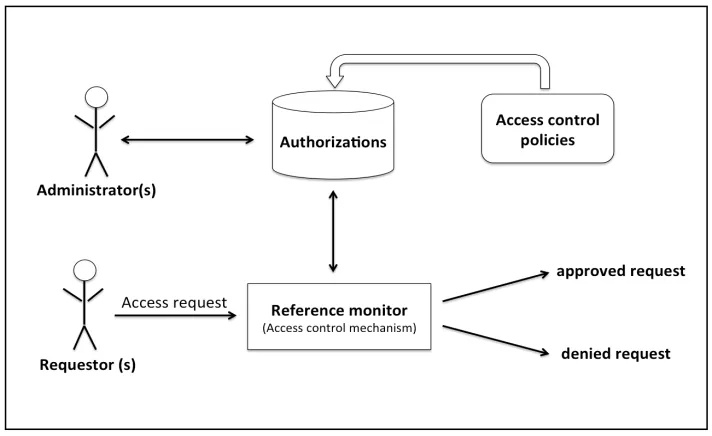
considered as inputs for access control and as high-level rules according to which access control must be regulated. Indeed, policies, which may be made by a management official responsible (e.g., security administrators, users, etc.) for particular systems, applications, or resources, articulate who can access which objects and in which manner (e.g., read, write, execute, delete, etc.), and, optionally, under what conditions (e.g., time, location, history, etc.) [Stallings. 2008, Benantar. 2006]. The rules may depend on many varied factors such as roles, permissions, dynamically deduced rights, or the specific user requirements. A simple example of access control polices is granting authorization to managers to read the psychological evaluations of employees only during their work shift. In order to enforce polices automatically, they should be translated into a set of authorizations. So, whenever a subject requests to access an object, the access control mechanism verifies the rights of subject against the set of identified authorizations.
and their enforcement. Then, by the access control mechanism that works as a reference monitor, a decision is made whether a subject’s request can be granted totally or partially or should be denied. Indeed, the reference monitor is the basis of access control
mechanisms and the trusted computing base (TCB) component of a computing system. Its concept, presented by Lampson in the early 1970s [Lampson. 1974], defines a set of design requirements on a reference validation mechanism that intercepts every access request (e.g., read, write, etc.) from a subject to perform on an object to determine whether a subject can be partially or totally granted or it must be denied [Benantar. 2006]. Thus, reference monitors have two main aspects: access control enforcement, and the computation of an access control decision. The development of the reference monitor must have some essential properties such as: it must unbypassable, that is, it must
mediate all access requests to the systems and their resources. The second property is that it must be tamper-proof, to protect the reference validation from any alteration that could result from a malicious user. In the worst case, we must be sure the reference monitor is
qualified to detect any improper modification. As we previously mentioned,
authorizations are the second basic building component for access control that declares, in a basic format, who can access which object and under which mode or condition. However, this function may require further components to determine an access control decision that may not be accurately captured by the basic format. Consequently, extending the authorization format has been addressed by several researchers to offer more an inclusive authorization language [Jajodia, et al. 2001, Bonatti and Olmedilla. 2007, Bonatti, et al. 2009, Bertino, et al. 2000].
2.3.1.2 Administration of access controls
Additionally to the main two components of access control, administration is one of the most involved and challenging aspects and functions in access control. Access control administration deals with collection of duties, responsibilities and tasks that are appointed to administrators to grant or revoke authorizations. The access control administration function collectively involves monitoring, modifying, testing, and
administrative operations such as creation, modification and deletion of roles [Sandhu and Samarati. 1994]. Although this is one of the most significant aspects of access
control, it is probably the least understood and most complicated aspect of access control. In order to understand access control administration, we introduce the three basic
approaches to administering access controls that are centralized, decentralized or a combination of these, which often is adopted by hybrid environments. In fact, the appropriate decision to choose an access control administration method depends on the needs and circumstances of a particular organization and the sensitivity of its information [Ferrari. 2010, Guttman and Roback. 1995, Stallings. 2008, Sandhu and Samarati. 1994]. In a centralized administration approach, only one (or few) trusted entities is responsible for configuring access controls. The security administrator(s) is typically the central office where all access control design is done. Using centralized administration is very simple because policies are maintained and modified only in one central location. However, it is a very strict approach because the ability to grant or revoke the
authorizations resides with very few individuals. Also, one of the main disadvantages in a centralized administration model is that if changes need to be done quickly, going
Figure 1: The main components of access control and their interactions.
The main components of access control and their interactions and coexistences between each other and with other security services are illustrated in Figure 1.
2.3.1.3 Access control paradigms
Many real world domains such as government, the military, enterprises, etc. have complex policies and various privacy anxieties, where evaluating access requests is based on the application of different requirements and rules. Access control techniques dictate how the administrator grants an access permission to a subject to perform her/his duties on a particular object. Access control models are frameworks for implementing
components, deploying mechanisms and ensuring the integrity of security policies that facilitate authorized access to protected resources. There are several methods of limiting access to authorized subjects that have been devoted to improving access control. Three main types of access control models have emerged:
Mandatory Access Control (MAC):
The policies of mandatory control access (MAC) are based on mandated
independent of user operations as mandatory access control. Thus, in MAC, the end user has no ability to override the policies or provide any privileges to any subject. Indeed, the concept of owner administration does not exist in MAC; however, its policies regulate accesses to data by subjects based on policies that are defined by prearranged subject attributes (e.g. security clearances) and object security levels that are enforced by the system [Brand. 1985]. MAC is associated with two security models: the first is the Bell-LaPadula model, which was published in 1973 and focused on the confidentiality (secrecy) of data[Bell and La Padula. 1976], whereas the second associated model, the Biba model is focused on the integrity of information [Biba. 1977]. MAC models are used as a response to the security requirements of the military and other governmental organizations where the system administrator takes charge of the full access control and keeping secrets is the primary goal.
Discretionary Access Control (DAC):
capabilities (e.g. has been issued to the requestor, hasn't been revoked or expired) to access the data object[Levy. 1984]. Furthermore, DAC can include and implement
transaction controls, time-based controls and other fundamental systems of identity-based access control (IBAC). DAC permits a wide and common range of administrative
policies, which represent important aspects of an access control model in general and discretionary access control in particular. Centralized, cooperative, ownership,
hierarchical and decentralized are some of administrative policy approaches supported by DAC[Ferrari. 2010]. The bottom line is that using DAC provides flexibility and enabling of fine-grained control over system objects. These are the reasons why many application environments, especially commercial DBMSs, adopt DAC.
Role-Based Access Control (RBAC):
The need to specify and enforce enterprise-specific security policies in a way that satisfies and covers the requirements of most commercial enterprises and to simplify authorization administration have been the motivation for many researchers and
practitioners to develop a new access control approach which captures real-world access control requirements. Hence, the role-based access control model (RBAC) has been invented for large enterprise solutions where a role represents a particular function within an organization and can be seen as a set of responsibilities that the user in this role can perform. Like a position in the real world, an RBAC role connects to a set of permissions to perform some operations or duties on some objects. The early references of using roles can be found in Baldwin’s paper [Baldwin. 1990] where they are called protection
domains. Then, in the early and middle of 1990s RBAC was introduced by Ferraiolo and Kuhn [Ferraiolo and Kuhn. 2009], Sandhu, et al. [1996] and Nyanchama and Osborn [1994, 1999], as a way to simplify authorization administration within companies and organizations. The standard for RBAC was proposed by Ferraiolo, et al. [2001]as one of the new generation of access control mechanisms.
In contrast to Access Control Matrices (AM) and Access Control Lists (ACL) a user, under an RBAC model, is not directly authorized to any right, but has to activate a role that has already been assigned to her/him. Indeed, roles raise the access control to a coarse-grained level to manage accesses, so a user can be assigned to more than one role, which can be activated on different occasions. Moreover, different users can
simultaneously play the same role. On the other hand, the role concept puts access control in a more granular manner that can specify what types of activities can be performed within an object, not just on the object as a whole. Furthermore, Sandhu, et al. in[1996] presented the family of RBAC models which includes sessions as a supplementary feature. A session represents what a user has activated at run time, and distinguishes RBAC from traditional group mechanisms. As a result, by session management we can easily restrict a user to not activate conflicting roles at the same time. The RBAC standard was proposed by National Institute of Standards and Technology (NIST) [Ferraiolo, et al. 2001], and is now an ANSI standard [INCITS. 2004]. Most studies confirm that roles are a useful and suitable approach for many commercial enterprises and government organizations. First of all, because roles signify a specific function within an organization and the number of roles of related authorizations is usually much fewer than the number of users or individual permissions, knowing what a user’s
organizational accountabilities are is easier to manage than assigning individual permissions to single users. Moreover, roles can also be simply used to manage and control the administrative mechanisms because the concept of role is more stable than individual user ownership in a large number of business activities. For instance, when user changes or deletes her/his function within organization, the security administrator only needs to cancel or change the roles corresponding to the user’s job; when a new user joins the organization, the administrator simply needs to grant the appropriate role
2.3.2 Access Control Models in Online Social Networks
In this section, we discuss the requirements for access control in OSNs. However, we will present the privacy settings that are implemented and used in current OSNs. Most OSNs provide only the most basic access control policies. For example, most social networks (e.g. Facebook, Google+, MySpace, Friendster, etc.) focus on profile privacy rather than settings for contents. Also, even though a few of them support grouping of users, the process of grouping users into lists as in Facebook or into circles as in Google+ is troublesome and time-consuming task for the end-user. Although access control in most current OSNs is essentially based on relationships among users and resources, the user is offered a limited number of privacy setting options by choosing options such as public, private, set of users whom she/he has a direct relationship or simple alternatives to these basic settings such as “friend of friend”. By these limited options, users may grant access to unauthorized users; nevertheless, they are restricted and inflexible in signifying authorized users. Even though most OSNs provide fine-grained control on profile
elements such as personal photos, status or other basic information, they only offer one binary type of relationship that is friend or not. Consequently, this limitation violates a significant security principle which is keeping consistency between online and offline social networks [Chi Zhang, et al. 2010]. Various studies expose the complex and unfriendly access control interfaces of OSNs (e.g., [Lewis, et al. 2008, Boyd and Hargittai. 2010, Johnson, et al. 2012, Gross and Acquisti. 2005]); moreover, in some OSNs, the access control interfaces are very hard to find. Gross and Acquisti in [2005]measure and analyze users’ behaviors towards privacy policy and their
participation with available privacy policies in Facebook. Their study shows that only a small fraction of users were conscious of the availability of the privacy settings. As a result, the users have to be experts to control portions of their data in OSNs.
mandatory and role-based access control (MAC and RBAC), policy is typically specified by the security administrator. Access control policy in DAC is defined by the resource owner. These ways of specifying policies are working properly if users know their accessors because they are able to put up a set of permissions to accurately grant the access only to intended subset of their friends. However, in OSNs scenarios where users mostly do not know a priori all their possible indirect accessors (friends), a traditional access control policy is not enough because in such situations users will have to specify a huge number of policies. Similarly to DAC, owner-based administration is adopted by OSNs. In OSNs the administrator of data is a user who may desire to regulate access to her/his resources and activities related to herself/himself, therefore user-specified policies should be the access model for OSNs. Other than the content owner, some associated users (e.g. users tagged in photos owned or uploaded by another user or parent) may also desire to participate in the content’s privacy setting to regulate how the content or user can be exposed. As we previously mentioned, a reference monitor is the fundamental component in access control, which scrutinizes each access request to the system based on the specified access control policies to determine whether the access request can be authorized or denied. Thus, to enforce the privacy policy in OSNs we need a suitable architecture for access control enforcement. Several studies have demonstrated semi-decentralized and fully semi-decentralized solutions are more suitable to Web-based Social Network (WBSN) than a traditional, centralized approach (e.g., [Yeung, et al. 2009, Carminati, et al. 2009b]).
2.3.2.1 Access control model requirements for OSNs
Furthermore, defining the structure of each social network and the nature of their data is not a simple task, because most OSNs combine different elements and more than one type of network (e.g., relationship network, trust network and group network). Also, OSNs may change their focus and provided services over time. In 2007, Gates identifies a set of requirements in order to successfully develop access control in Web 2.0, which includes OSNs [Gates. 2007]. Relationship-based, fine-grained, interoperable, data exposure minimization and sticky-policies are the necessary requirements to establish access control systems for Web 2.0, as identified by Gates [2007]. Truly, there is not a clear path that directs researchers and developers in the duty of developing an access control model for OSNs that tackles the limitations of the privacy settings and addresses the whole set of requirements. Although online social networks’ security and privacy requests still are not comprehensively recognized or fully defined, some research has investigated requirements for access control systems for OSNs (e.g., [Carminati, et al. 2009a, Cheng, et al. 2012b, Cheng, et al. 2012a, Carminati, et al. 2014, Gates. 2007]). Based on Gates’ [2007]considerations, and according to [Carminati, et al. 2009a, Cheng, et al. 2012b, Cheng, et al. 2012a, Carminati, et al. 2014], next we summarize the key requirements that a future access control model for OSNs should have.
• User-friendly: Providing a natural and user-friendly way of defining access control rules. Although social networking capabilities provided by Web 2.0 have increased, most of the access control interfaces are complex and not flexible. Some are very hard to find and use. An ideal access control model must be effective and flexible to use, matching real world scenarios.
• Flexibility with data: Social networks with different interests offer diverse access control mechanisms. However, an ideal access control model should have the ability to work with all types of data regardless of where they are stored.
Also, allowing fine-grained control for data and accessors should be offered by a future access control model for OSNs.
• Relationship based: Recently, there is consensus that an access control model for OSNs should be relationship-based because it is very intuitive for users to adopt their social relationships to define authorized members for their information (e.g., [Masoumzadeh and Joshi. 2011, Fong, et al. 2009, Carminati, et al. 2009b,
Carminati, et al. 2011, Fong and Siahaan. 2011, Cheng, et al. 2012b, Cheng, et al. 2012a, Hu, et al. 2013]). In OSNs, user-to-user (U2U) relationships between the accessing user and the resource owner is a common characteristic that