M E T H O D O L O G Y
Open Access
A systematic review of the use of an
expertise-based randomised controlled
trial design
Jonathan A. Cook
1*, Andrew Elders
2, Charles Boachie
2, Ted Bassinga
2, Cynthia Fraser
2, Doug G. Altman
1,
Isabelle Boutron
3, Craig R. Ramsay
2and Graeme S. MacLennan
2Abstract
Background:Under a conventional two-arm randomised trial design, participants are allocated to an intervention and participating health professionals are expected to deliver both interventions. However, health professionals often have differing levels of expertise in a skill-based interventions such as surgery or psychotherapy. An expertise-based approach to trial design, where health professionals only deliver an intervention in which they have expertise, has been proposed as an alternative. The aim of this project was to systematically review the use of an expertise-based trial design in the medical literature.
Methods:We carried out a comprehensive search of nine databases—AMED, BIOSIS, CENTRAL, CINAHL, Cochrane Methodology Register, EMBASE, MEDLINE, Science Citation Index, and PsycINFO—from 1966 to 2012 and performed citation searches using the ISI Citation Indexes and Scopus. Studies that used an expertise-based trial design were included. Two review authors independently screened the titles and abstracts and assessed full-text reports. Data were extracted and summarised on the study characteristics, general and expertise-specific study methodology, and conduct.
Results:In total, 7476 titles and abstracts were identified, leading to 43 included studies (54 articles). The vast majority (88 %) used a pure expertise-based design; three (7 %) adopted a hybrid design, and two (5 %) used a design that was unclear. Most studies compared substantially different interventions (79 %). In many cases, key information relating to the expertise-based design was absent; only 12 (28 %) reported criteria for delivering both interventions. Most studies recruited the target sample size or very close to it (median of 101, interquartile range of 94 to 118), although the target was reported for only 40 % of studies. The proportion of participants who received the allocated intervention was high (92 %, interquartile range of 82 to 99 %).
Conclusions:While use of an expertise-based trial design is growing, it remains uncommon. Reporting of study methodology and, particularly, expertise-related methodology was poor. Empirical evidence provided some support for purported benefits such as high levels of recruitment and compliance with allocation. An expertise-based trial design should be considered but its value seems context-specific, particularly when interventions differ substantially or interventions are typically delivered by different health professionals.
Keywords:Expertise-based, Expertise, Systematic review, Learning, Randomised controlled trial, Trial design, Non-pharmacological interventions, Surgery
* Correspondence:[email protected] 1
Centre for Statistics in Medicine, Nuffield Department of Orthopaedics, Rheumatology and Musculoskeletal Sciences, Botnar Research Centre, University of Oxford, Nuffield Orthopaedic Centre, Windmill Road, Oxford OX3 7LD, UK
Full list of author information is available at the end of the article
Background
Under a conventional two-arm randomised controlled trial (RCT) (within-health professional) design, partici-pants are randomly allocated to one of the two interven-tions and all participating health professionals are expected to deliver both interventions. However, if the interventions are skill-based, and particularly when those under evaluation differ substantially, health professionals may (for example, surgeons or therapists) may have dif-fering levels of expertise in the interventions, conduct only one routinely, or have a preference for one over another. These potential obstacles to the conduct of an RCT have been noted particularly in surgery; many surgeons may accept the need in principle for an RCT but may struggle to reconcile their personal involvement with their surgical experience and routine practice [1]. As a result, some may be reluctant to participate in a standard, individually randomised RCT. An expertise-based approach to trial design, in which participating surgeons provide only the intervention in which they have expertise, has been proposed to overcome this problem [2]. As with the within-health professional design, a patient is randomly allocated to an interven-tion, the difference being that there are two sets of par-ticipating health professionals, one for each intervention, who will perform the allocated intervention. Purported benefits of this design include increased surgical partici-pation, recruitment, and compliance with randomisation, addressing the learning curve effect as well as the desir-ability from the perspective of the patient [2]. Although such a design is not new [3], the profile of the design has been raised and its use appears to becoming more common. For some comparisons such as surgery versus medical management, it has become the default design. However, expertise-based designs have been criticized on a number of grounds [4], including a number of methodological considerations (for example, impact on sample size). In particular, how‘expertise’should be de-fined is uncertain but clearly is of critical importance. The optimal approach to implementation is also unclear [1, 5]. It may be that the expertise-based design is most suited to certain research questions [6–12].
Although an expertise-based design has recently re-ceived the most attention for surgical evaluation [1, 2], it has been used in other areas (for example, psychother-apy) [12]. The same issues exist for the delivery of other interventions which are substantially skill-based and in which individual practitioners may be familiar with only a particular approach or have a strong preference for one intervention over another. However, there is uncer-tainty regarding under which circumstances an expertise-based trial design is appropriate, how such studies are im-plemented in practice, and whether the purported benefits have been realised (for example, achieving recruitment
and high compliance with intervention). No comprehen-sive review of expertise-based trials has been previously carried out. A limited search was conducted previously (160 citations) [2] but was restricted to surgery and ex-tended only up to October 2003. Within the small number of studies identified in that search, variation in reporting and practice highlighted the need for both a comprehen-sive search strategy and an evaluation of differences in how such studies were carried out. For example, different terms have been used to represent the same design (for example, randomised-surgeon design). Beyond the surgical area, other terms (for example, hierarchical and nested) have been used to describe the same design [12]. Within those that might be characterised as an expertise-based design, there are variations in how‘expertise’was defined (for example, surgeon self-certification versus objective requirements) and how health professionals were assigned to a treatment group (health professional preference or randomisation). The aim of this review was to systematic-ally review the use of an expertise-based trial design in the medical literature in order to improve understanding of the applicability, implementation, and implications of using such a design so as to aid the design of future trials. To achieve this, the objectives of the review were (i) to identify the contexts in which an expertise-based trial design has been used, (ii) to assess the methodological variation in expertise-based trial design implementation both in general and those aspects specifically related to the expertise-based design, and (iii) to summarise the reported experience of using such a design.
Methods
The study protocol is available from the authors. Ethical approval was not required for this research given its focus and given that only publically available information was used.
Inclusion criteria
Search
It was anticipated, from reviewing the results of a scop-ing search, that it would be difficult to identify all rele-vant studies from searching bibliographic databases alone given the poor reporting of methods in the titles and abstracts and the paucity of specific controlled vocabulary terms in the major bibliographic databases. To address this, a range of methods were used to re-trieve reports of relevant trials. The databases searched included Medical Literature Analysis and Retrieval System Online (MEDLINE), Excerpta Medica dataBASE (EMBASE), Cumulative Index to Nursing and Allied Health Literature (CINAHL), BioSciences Information Service of Biological Abstracts (BIOSIS), Cochrane Central Register of Controlled Trials (CENTRAL), Cochrane Methodology Register, Science Citation Index, The Allied and Complementary Medicine Database (AMED), and PsycINFO. In addition, cited reference searches (using Institute for Scientific Information Cit-ation Indexes and Scopus), references of included arti-cles, and key author searches were undertaken. If a study had been referred to as an expertise-based trial in another report but the design was unclear in the related published literature, an investigator was contacted to confirm. Searches were undertaken from 1966 onwards or, from the start of database coverage if after 1966. The MEDLINE and EMBASE multi-file search strategy, which was used to search these databases concurrently, was developed first and translated for other databases. The search strategies are provided in Additional file 1.
Selection of studies
Two review authors (JC and CB, AE, GSM, or TB) inde-pendently screened the titles and abstracts of all reports identified by the search strategy. The full versions of ar-ticles not definitely excluded at that stage were obtained for full-text assessment, which will be carried out by two reviewers as before. Where they occurred, differences of opinion were discussed; if necessary, a blinded third re-view author acted as arbitrator. If appropriate, a clinical area expert was consulted. Methods articles were not in-cluded but were set aside for future reference and, if appropriate to do so, were considered in the discussion.
Data collection and analysis
Data on the trial characteristics and context (year of publication, funding [13], clinical area, interventions under evaluation, and type of comparison), expertise-based design methodology and related reporting (type of design, reporting including stated advantages and disad-vantages, interventionalist mechanism of allocation, eli-gibility criteria, and number), general study methodology and conduct (randomisation, blinding, and study size and compliance regarding allocation), and details on the
primary outcome and statistical analyses were extracted. One reviewer (JC) carried out data extraction of in-cluded articles (using a pro forma specifically designed for the purpose). A second reviewer (AE or GM) inde-pendently assessed a random sample of 25 % of included studies. Data were summarised. Owing to the relatively small number of included studies, a planned statistical analysis to compare factors across trial types was not carried out.
Results
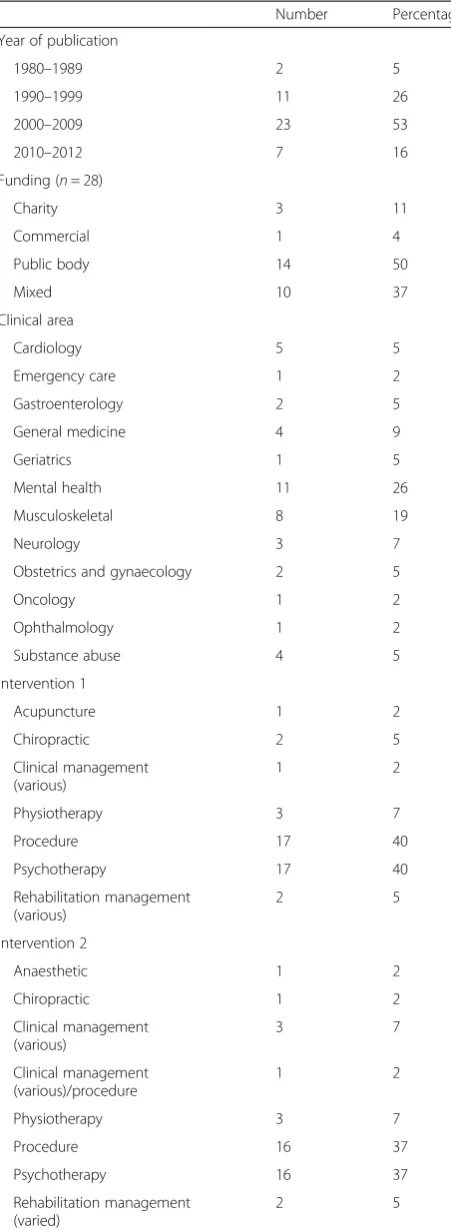
In total, 7476 titles and abstracts were identified from the search of 9 databases (Fig. 1); after removal of dupli-cates, 3247 were screened for inclusion. Of these, 3092 were excluded and 155 articles were selected for full-text assessment. A further 19 articles were identified from the references of included studies, leading to a total of 157 studies (174 articles) that were full-text-assessed. Of these, 117 studies (125 articles) were excluded, leaving 40 studies (49 articles) that, combined with three studies (five articles) identified from a published review, led to 43 studies (54 articles) in total. The list of included stud-ies is provided in Additional file 2. Table 1 shows the study characteristics and context of the included studies. The earliest publication was in 1982; most (69 %) were published from 2000 onwards. The vast majority re-ceived funding from public bodies in whole or part, whereas partial or full funding was received less com-monly from a charity or a commercial source. The clin-ical areas represented varied, and mental health (26 %) and musculoskeletal (19 %) were the most common. The most common intervention types were a procedure and psychotherapy (40 and 37 % for interventions 1 and 2 for both). The comparisons overwhelmingly focussed on substantial differences between interventions (79 %).
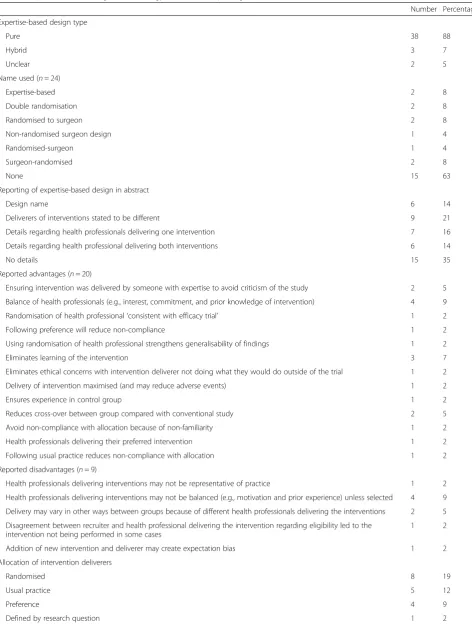
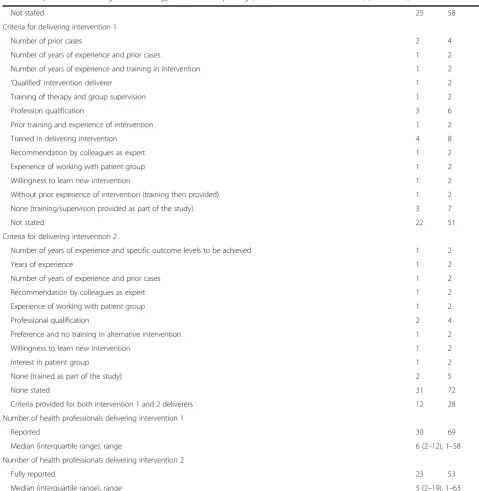
not be balanced between groups unless selected (9 %) and that the delivery of interventions may vary between groups beyond the allocated intervention (5 %). Under half re-ported the method of allocation of health professoinal to intervention group; eight (19 %) interestingly used ran-domisation, five (12 %) followed usual practice, four followed interventionalist preference (9 %), and in one case (2 %) the type of health professional was defined as part of the research question. Criteria for delivering an intervention varied between groups and involved one or more of health professional training/grades, years of ex-perience in and/or number of cases of delivering the inter-vention, prior training and/or supervision in using the
intervention, specified outcome performance level, recom-mendation by colleague, experience of working with pa-tient group, and willingness to learn a new procedure. Only 12 (28 %) stated the criteria for delivering both inter-ventions. A substantial number (21,49 %) did not give the number of health professionals delivering the interven-tions for both groups. The number of health profes-sionals was similar for the two arms (medians of 6 and 5, respectively).
Details regarding general study methodology and con-duct are shown in Table 3. Reporting of participant ran-domisation methodology was adequate for the majority of studies (58 and 60 % for sequence generation and
3092 titles and abstracts excluded at abstract screening stage
Fulltext assessment:
155 articles selected from screening 19 further articles identified from references
174 articles (157 studies) assessed in TOTAL
117 studies (125 articles) excluded
50 interventions delivered by the same individual 6 three or more arms
19 expertise not required to deliver both interventions 14 additive study
8 cluster RCT 7 not at primary report 6 quasi-randomised 4 non-randomised study 4 placebo
3 health professional trial 1 animal trial
1 duplicate 1 commentary 1 pilot
43 studies (54 articles) included 3 studies (5 articles)
identified from review not identified by the search strategy
7476 titles and abstracts identified from primary search:
AMED 172
BIOSIS 614
Central 949
CINAHL 770
CMR 293
MEDLINE/Medline In-Process/EMBASE 1903
PsycINFO 782
SCI 1513
Web of Science citation search 421 Scopus citation search 59
3247 titles and abstracts screened after duplicates
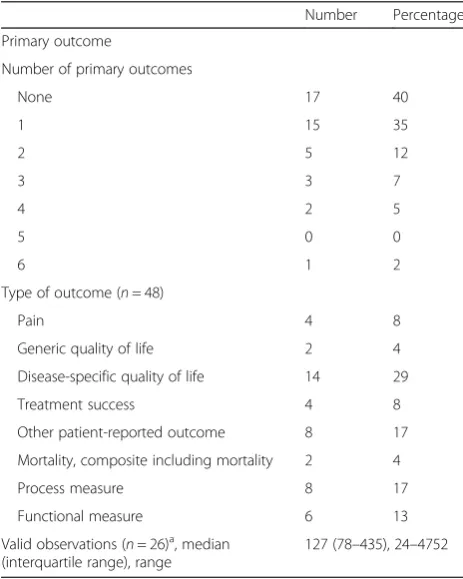
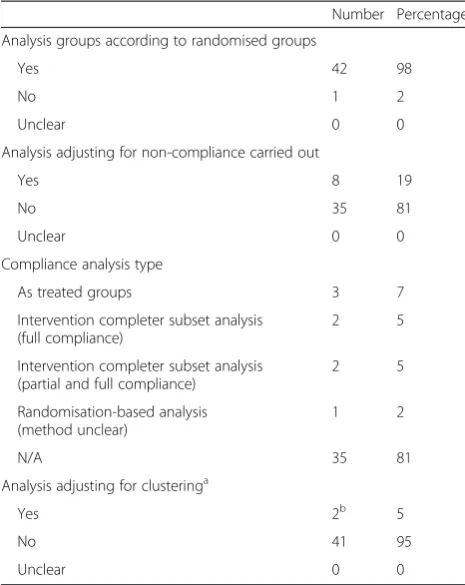
[image:4.595.61.536.86.523.2]allocation concealment, respectively). Blinding of the outcome assessment was known to be performed in 12 (28 %) studies, but blinding of participants was known to be performed in only one (2 %). Most studies were single-centre RCTs (median of 1, interquartile range (IQR) of 1 to 5). Study size was typically moderate (111, IQR of 62 to 226). Most studies recruited the target number or very close to it (101, IQR of 94 to 118), al-though the target size was reported for only 40 % of studies. The proportion of participants who received the allocated intervention was high (92 %, IQR of 82 to 99 %). For those that reported this aspect, occurrences of cross-over between interventions or receiving a‘third’ (non-trial) intervention were rare. Table 4 reports details on the primary outcome. The most common outcomes were type of disease and specific quality of life (29 %) followed by other patient-reported outcomes and process measure (17 % for both). The number of obser-vations available to analyse was poorly reported (26 studies, or 60 %). Details regarding the statistical analysis carried out are provided in Table 5. Almost all studies (98 %) carried out an analysis by randomised groups. Eight (19 %) studies had a compliance analysis, and only two (5 %) adjusted for clustering of outcome by interventionalists.
Discussion
This systematic review identified from across the med-ical literature a number of RCTs that used an expertise-based trial design. An expertise-expertise-based design differs from the conventional (within-health professional) design by allowing different groups of health profes-sionals to deliverer the interventions under evaluation as opposed to requiring participating health professionals to deliver both of (or all, where there are three or more) the interventions. It has been suggested that the design is able to address [2, 3] some of the challenges of con-ducting an RCT of skill-based interventions which a conventional design is not. Although the design has been in use for over 30 years and use has been growing in recent years, it remains uncommon.
[image:5.595.58.284.111.727.2] [image:5.595.303.539.113.171.2]Previous limited reviews [2, 14] had identified fewer than 10 studies using an expertise-based design and fo-cussed only on surgery. Uniquely, this review had a full and comprehensive systematic search with information on the context of the study, the methodology of the trial
Table 1General study characteristics and context (n= 43 unless otherwise stated)
Number Percentage
Year of publication
1980–1989 2 5
1990–1999 11 26
2000–2009 23 53
2010–2012 7 16
Funding (n= 28)
Charity 3 11
Commercial 1 4
Public body 14 50
Mixed 10 37
Clinical area
Cardiology 5 5
Emergency care 1 2
Gastroenterology 2 5
General medicine 4 9
Geriatrics 1 5
Mental health 11 26
Musculoskeletal 8 19
Neurology 3 7
Obstetrics and gynaecology 2 5
Oncology 1 2
Ophthalmology 1 2
Substance abuse 4 5
Intervention 1
Acupuncture 1 2
Chiropractic 2 5
Clinical management (various)
1 2
Physiotherapy 3 7
Procedure 17 40
Psychotherapy 17 40
Rehabilitation management (various)
2 5
Intervention 2
Anaesthetic 1 2
Chiropractic 1 2
Clinical management (various)
3 7
Clinical management (various)/procedure
1 2
Physiotherapy 3 7
Procedure 16 37
Psychotherapy 16 37
Rehabilitation management (varied)
2 5
Table 1General study characteristics and context (n= 43 unless otherwise stated)(Continued)
Difference between interventions
Minor 8 19
Substantial 34 79
Table 2Expertise-based design methodology and related reporting (n= 43 unless otherwise stated)
Number Percentage
Expertise-based design type
Pure 38 88
Hybrid 3 7
Unclear 2 5
Name used (n= 24)
Expertise-based 2 8
Double randomisation 2 8
Randomised to surgeon 2 8
Non-randomised surgeon design 1 4
Randomised-surgeon 1 4
Surgeon-randomised 2 8
None 15 63
Reporting of expertise-based design in abstract
Design name 6 14
Deliverers of interventions stated to be different 9 21
Details regarding health professionals delivering one intervention 7 16
Details regarding health professional delivering both interventions 6 14
No details 15 35
Reported advantages (n= 20)
Ensuring intervention was delivered by someone with expertise to avoid criticism of the study 2 5
Balance of health professionals (e.g., interest, commitment, and prior knowledge of intervention) 4 9
Randomisation of health professional‘consistent with efficacy trial’ 1 2
Following preference will reduce non-compliance 1 2
Using randomisation of health professional strengthens generalisability of findings 1 2
Eliminates learning of the intervention 3 7
Eliminates ethical concerns with intervention deliverer not doing what they would do outside of the trial 1 2
Delivery of intervention maximised (and may reduce adverse events) 1 2
Ensures experience in control group 1 2
Reduces cross-over between group compared with conventional study 2 5
Avoid non-compliance with allocation because of non-familiarity 1 2
Health professionals delivering their preferred intervention 1 2
Following usual practice reduces non-compliance with allocation 1 2
Reported disadvantages (n= 9)
Health professionals delivering interventions may not be representative of practice 1 2
Health professionals delivering interventions may not be balanced (e.g., motivation and prior experience) unless selected 4 9
Delivery may vary in other ways between groups because of different health professionals delivering the interventions 2 5
Disagreement between recruiter and health professional delivering the intervention regarding eligibility led to the intervention not being performed in some cases
1 2
Addition of new intervention and deliverer may create expectation bias 1 2
Allocation of intervention deliverers
Randomised 8 19
Usual practice 5 12
Preference 4 9
(both expertise-related and generic), and the reported views of the trialists collected and summarised. It shows that the design has been used beyond surgical interven-tions where its use has been previously proposed [2, 3, 15] and covers many clinical areas and evaluations of non-pharmacological interventions. The potential value over a conventional design appears to be case-specific and is clear in two main circumstances. One is where two skill-based interventions that are substantially different from one another are to be compared (for example, cognitive behavioural therapy and limited professional support); this
[image:7.595.54.534.97.589.2]is the situation where they have most commonly been used. Another setting where they have been used and seem particularly appropriate (or perhaps natural to use) is when the interventions are typically delivered by an-other type of health professional (for example, a compari-son of coronary artery bypass graft and stenting for the treatment of coronary artery disease where they are deliv-ered by a surgeon and a cardiologist respectively, as is the case in some countries). Two surveys of preferences re-garding trial design showed differing levels of support for an expertise-based design, suggesting that it merits
Table 2Expertise-based design methodology and related reporting (n= 43 unless otherwise stated)(Continued)
Not stated 25 58
Criteria for delivering intervention 1
Number of prior cases 2 4
Number of years of experience and prior cases 1 2
Number of years of experience and training in intervention 1 2
‘Qualified’intervention deliverer 1 2
Training of therapy and group supervision 1 2
Profession qualification 3 6
Prior training and experience of intervention 1 2
Trained in delivering intervention 4 8
Recommendation by colleagues as expert 1 2
Experience of working with patient group 1 2
Willingness to learn new intervention 1 2
Without prior experience of intervention (training then provided) 1 2
None (training/supervision provided as part of the study) 3 7
Not stated 22 51
Criteria for delivering intervention 2
Number of years of experience and specific outcome levels to be achieved 1 2
Years of experience 1 2
Number of years of experience and prior cases 1 2
Recommendation by colleagues as expert 1 2
Experience of working with patient group 1 2
Professional qualification 2 4
Preference and no training in alternative intervention 1 2
Willingness to learn new intervention 1 2
Interest in patient group 1 2
None (trained as part of the study) 2 5
None stated 31 72
Criteria provided for both intervention 1 and 2 deliverers 12 28
Number of health professionals delivering intervention 1
Reported 30 69
Median (interquartile range), range 6 (2–12), 1–58
Number of health professionals delivering intervention 2
Fully reported 23 53
consideration with regard to the specific context in which it would be used [6, 9].
[image:8.595.59.290.114.709.2]Reporting of the use of the expertise-based design methodology in the abstract was highly variable, and in-sufficient details regarding key methodological features of expertise-based trials were provided. Around half failed to provide details on the interventionalists deliver-ing the interventions, a key piece of information for interpreting and assessing the applicability of the find-ings. Furthermore, we identified the use of a hybrid approach in a small number of studies, although it is possible that more studies adopted this design, but this information was not provided in the trial reports [5, 16]. Expertise-based trials were typically single-centre studies of moderate size with around 10 interventionalists involved in the study with a patient-reported primary outcome. Two of the main purported benefits appeared to be supported by the empirical evidence. Achievement of the target recruitment was very high, although the target size was often not reported, leading to some un-certainty regarding this finding. However, compliance with the allocated intervention was generally very high (median of at least 90 %), and occurrences of cross-over between intervention groups or receiving a third non-trial intervention were rare.
Table 3Study methodology and conduct (n= 43 unless otherwise stated)
Number Percentage
Intervention deliverers–randomisation sequence generation
Adequate 1 10
Inadequate 0 0
Unclear 9 90
Intervention deliverers–randomisation allocation concealment
Adequate 1 10
Inadequate 0 0
Unclear 9 90
Participants–randomisation sequence generation
Adequate 25 58
Inadequate 0 0
Unclear 18 42
Participants–randomisation allocation concealment
Adequate 26 60
Inadequate 2 5
Unclear 15 35
Blinding–primary outcome assessment
Yes 12 28
No 27 63
Unclear 4 9
Blinding–participants
Yes 1 2
No 34 79
Unclear 8 19
Number of centres
Reported 42 98
Median (IQR) 1 (1–5)
Study size
Reported 42 98
Median (IQR) 111 (62–226)
Percentage of target size recruited
Reported target size 17 40
Median (IQR) 101 (94–118)
Percentage received full intervention
Reported 31 74
Median (IQR) 92 (82–99)
Cross-over to other study intervention
Reported 18 42
Median (IQR) 0 (0–2)
“Third”intervention
Reported 15 35
Median (IQR) 0 (0–0)
[image:8.595.304.536.427.717.2]IQRinterquartile range
Table 4Primary outcome(s) (n= 43 unless otherwise stated) Number Percentage
Primary outcome
Number of primary outcomes
None 17 40
1 15 35
2 5 12
3 3 7
4 2 5
5 0 0
6 1 2
Type of outcome (n= 48)
Pain 4 8
Generic quality of life 2 4
Disease-specific quality of life 14 29
Treatment success 4 8
Other patient-reported outcome 8 17
Mortality, composite including mortality 2 4
Process measure 8 17
Functional measure 6 13
Valid observations (n= 26)a, median (interquartile range), range
127 (78–435), 24–4752
a
Reporting of general study methodology such as randomisation was suboptimal, as has been repeatedly shown for RCTs of both pharmacological and non-pharmacological interventions [17]. Blinding of the primary outcome assessment and of participation was not typically performed, perhaps reflecting the nature of the trial comparison and the types of interventions under evaluation. Studies appeared to adopt a more pragmatic approach to study design [2]. Only two studies adjusted the analysis for clustering of outcome by interventionalist, even though failure to do this could lead to an overly precise estimate, and no stud-ies provided justification for why this was not done [7, 18].
A number of potential advantages have been pro-posed to support the use of an expertise-based trial design, including addressing the learning curve and possible differences in expertise among health profes-sionals between interventions (sometimes referred to as differential expertise bias, which is particularly likely if
a new intervention is compared with an older one), ethical concerns of intervention deliverers about per-forming a procedure they are not experienced or comfortable with, reassurance for patients that their intervention will be delivered by someone with appro-priate ‘expertise’, improved compliance, avoidance of systematic bias introduced unconsciously if a prefer-ence for one intervention exists, and increased partici-pation of interventionalists [2, 3]. However, a number of potential drawbacks have also been noted: the feasi-bility of two different interventionalists being available, imbalances between interventionalist groups in terms of ability and experience, the need for third-party re-cruitment, and reduced applicability of the study results [2, 4, 6, 15, 19]. This review generally reinforced the proposed advantages and disadvantages but highlighted that some of the advantages are conditional on the im-plementation of the expertise-based design regarding definition of“expertise”(for example, elimination learn-ing). Additional disadvantages were identified, such as the possibility of an expectation bias being created if a new intervention is delivered by a different individual [20], having different individuals recruiting and deliver-ing the intervention which can lead to disagreement regarding suitability for receiving the intervention [21], and the possibility that the intervention may differ in ways beyond the treatment allocation [20, 22].
There were a number of limitations to this review. Owing to the inconsistency of reporting highlighted in included studies, it seems likely that some eligible expertise-based trials were not identified, as reference to this aspect of the design was not made in the title or ab-stracts or possibly anywhere in the text. Inclusion was restricted to two-arm individually randomised parallel group trials, although a form of expertise-based design could be used in other settings (for example, three-arm or cluster RCT). Additionally, the search was conducted only up to 2012. Owing to the small numbers of in-cluded studies, it was not possible to formally compare subtypes of trials as planned. Finally, no formal compari-son has been made with conventional (within-health professional) trials.
This review expands the current understanding of expertise-based trials. Further work exploring the view and experience of health professionals and those volved in trial design should be carried out to further in-crease understanding of the decision-making process regarding design choice. We recommend improved and more consistent reporting, and reports should state ex-plicitly who delivered the interventions; the term ‘ ex-pertise-based’ could be used in the title or abstract of trial reports with explicit details regarding the number of interventionalists in each arm with any criteria for eligibility reported in the trial report.
Table 5Statistical analysis methodology (n= 43 unless otherwise stated)
Number Percentage
Analysis groups according to randomised groups
Yes 42 98
No 1 2
Unclear 0 0
Analysis adjusting for non-compliance carried out
Yes 8 19
No 35 81
Unclear 0 0
Compliance analysis type
As treated groups 3 7
Intervention completer subset analysis (full compliance)
2 5
Intervention completer subset analysis (partial and full compliance)
2 5
Randomisation-based analysis (method unclear)
1 2
N/A 35 81
Analysis adjusting for clusteringa
Yes 2b 5
No 41 95
Unclear 0 0
N/Anot available
a
Analyses carried out were mixed-effect models: one with two levels (intervention deliverer and) and one with three (site, intervention deliverer, and participant).b
Conclusions
Although the use of an expertise-based trial design is growing, it remains uncommon. An expertise-based trial design is an option that should be considered by trials, particularly in light of the high level of recruitment to tar-get and compliance with allocation observed [23]. Its value appears to be context-specific, particularly where interven-tions differ substantially or interveninterven-tions are typically de-livered by different health professionals. Reporting of expertise-based trials is suboptimal in providing details re-lating to the expertise design and requires improvement.
Additional files
Additional file 1:‘Additional file 1–Search Strategies.docx’, Search strategies, Database search strategies.
Additional file 2:‘Additional file 1–Search Strategies.docx’, Included studies, List of included studies.
Abbreviations
EMBASE:Excerpta Medica dataBASE; IQR: interquartile range; MEDLINE: Medical Literature Analysis and Retrieval System Online; RCT: randomised controlled trial.
Competing interests
The authors declare that they have no competing interests.
Authors’contributions
JAC had the original idea, wrote the first draft of this article, and helped to devise the search strategy and to undertake the abstract screening, full-text assessment, and data abstraction. CRR also contributed to the original idea and also to the design of the study. DGA and IB contributed to the design of the study. GSM contributed to the design of the study and helped to undertake the abstract screening, full-text assessment, and data abstraction. CF helped to devise the search strategy. AE, CB, and TB helped to undertake the abstract screening, full-text assessment, and data abstraction. All authors read and approved the final manuscript.
Acknowledgements
JAC held a Medical Research Council UK methodology (G1002292) fellowship, which supported this research. The Health Services Research Unit, Institute of Applied Health Sciences (University of Aberdeen), is core-funded by the Chief Scientist Office of the Scottish Government Health and Social Care Directorates. Views express are those of the authors and do not necessarily reflect the views of the funders.
Author details 1
Centre for Statistics in Medicine, Nuffield Department of Orthopaedics, Rheumatology and Musculoskeletal Sciences, Botnar Research Centre, University of Oxford, Nuffield Orthopaedic Centre, Windmill Road, Oxford OX3 7LD, UK.2Health Services Research Unit, University of Aberdeen, Health Sciences Building, Foresterhill, Aberdeen AB25 2ZD, UK.3Centre
d’Epidémiologie Clinique, Université Descartes, Hôpital Hôtel Dieu, 1 Place du Parvis Notre Dame, Paris, 75004, France.
Received: 12 January 2015 Accepted: 5 May 2015
References
1. Cook JA. The challenges faced in the design, conduct and analysis of surgical randomised controlled trials. Trials. 2009;10:9.
2. Devereaux PJ, Bhandari M, Clarke M, Montori VM, Cook DJ, Yusuf S, et al. Need for expertise based randomised controlled trials. BMJ. 2005;330:88. 3. van der Linden W. Pitfalls in randomized surgical trials. Surgery.
1980;87:258–62.
4. Biau DJ, Porcher R. Letter to the editor re: Orthopaedic surgeons prefer to participate in expertise-based randomized trials. Orthopaedic surgeons prefer to participate in expertise-based randomized trials. Clin Orthop Relat Res. 2009;467:298–300.
5. Walter SD, Ismaila AS, Devereaux PJ, SPRINT Study Investigators. Statistical issues in the design and analysis of expertise-based randomized clinical trials. Stat Med. 2008;27:6583–96.
6. Bednarska E, Bryant D, Devereaux PJ, Expertise-Based Working Group. Orthopaedic surgeons prefer to participate in expertise-based randomized trials. Clin Orthopaed Rel Res. 2008;466:1734–44.
7. Cook JA, Bruckner T, MacLennan GS, Seiler CM. Clustering in surgical trials—database of intracluster correlations. Trials. 2012;13:2. 8. Ergina PL, Cook JA, Blazeby JM, Boutron I, Clavien PA, Reeves BC, et al.
Challenges in evaluating surgical innovation. Lancet. 2009;374:1097–104. 9. Mastracci TM, Clase CM, Devereaux PJ, Cinà CS. Open versus endovascular
repair of abdominal aortic aneurysm: a survey of Canadian vascular surgeons. Can J Surg. 2008;51:142–8.
10. Roberts C, Roberts SA. Design and analysis of clinical trials with clustering effects due to treatment. Clin Trials. 2005;2:152–62.
11. Vierron E, Giraudeau B. Design effect in multicenter studies: gain or loss of power? BMC Med Res Methodol. 2009;9:39.
12. Walwyn R, Roberts C. Therapist variation within randomised trials of psychotherapy: implications for precision, internal and external validity. Stat Methods Med Res. 2010;19:291–315.
13. Cook JA, Ramsay CR, Norrie J. Recruitment to publicly funded trials–are surgical trials really different? Contemporary Clin Trials. 2008;29:631–4. 14. Scholtes VA, Nijman TH, van Beers L, Devereaux PJ, Poolman RW. Emerging
designs in orthopaedics: expertise-based randomized controlled trials. J Bone Joint Surg Am. 2012;94:8.
15. Rudicel S, Esdaile J. The randomized clinical trial in orthopaedics: obligation or option? J Bon Joint Surg Am. 1985;67:1284–93.
16. Beard D, Price A, Cook J, Fitzpatrick R, Carr A, Campbell M, et al. Total or partial knee arthroplasty trial–TOPKAT: study protocol for a randomised controlled trial. Trials. 2013;14:292.
17. Boutron I, Tubach F, Giraudeau B, Ravaud P. Methodological differences in clinical trials evaluating nonpharmacological and pharmacological treatments of hip and knee osteoarthritis. JAMA. 2003;290:1062–70. 18. Kahan BC, Morris TP. Assessing potential sources of clustering in individually
randomised trials. BMC Med Res Methodol. 2013;13:58.
19. Pike K, Angelinin G, Reeves BC, Taggart D, Rogers C. Recruitment challenges in surgical trials: lessons from the crisp trial. Trials. 2013;14 Suppl 1:27. 20. Wilkey A, Gregory M, Byfield D, McCarthy PW. A comparison between
chiropractic management and pain clinic management for chronic low-back pain in a national health service outpatient clinic. J Altern Complement Med. 2008;14:465–73.
21. Grant AM, Wileman SM, Ramsay CR, Mowat NA, Krukowski ZH, Heading RC, et al. Minimal access surgery compared with medical management for chronic gastro-oesophageal reflux disease: UK collaborative randomised trial. BMJ. 2009;338:81–3.
22. Alobaid A, Harvey EJ, Elder GM, Lander P, Guy P, Reindl R. Minimally invasive dynamic hip screw. Prospective randomized trial of two techniques of insertion of a standard dynamic fixation device. J Orthop Trauma. 2007;18:207–12.