The Cherenkov Telescope Array
1Science Goals and Current Status
2The CTA Consortium1,a, represented by Rene A. Ong2,b 3
1See https://www.cta-observatory.org/consortium_authors/authors_2018_09.html 4
2Department of Physics and Astronomy, University of California, Los Angeles CA, 90095, USA 5
6
Abstract.The Cherenkov Telescope Array (CTA) is the major ground-based gamma-ray
7
observatory planned for the next decade and beyond. Consisting of two large atmospheric
8
Cherenkov telescope arrays (one in the southern hemisphere and one in the northern
9
hemisphere), CTA will have superior angular resolution, a much wider energy range, and
10
approximately an order of magnitude improvement in sensitivity, as compared to existing
11
instruments. The CTA science programme will be rich and diverse, covering cosmic
12
particle acceleration, the astrophysics of extreme environments, and physics frontiers
13
beyond the Standard Model. This paper outlines the science goals for CTA and covers
14
the current status of the project.
15
1 Introduction
16The field of very high-energy gamma-ray (VHE, E>20 GeV) astronomy has come of age in recent 17
years, due to a wealth of information from both ground-based and space-borne telescopes. Prior to 18
2000, the general expectation for the field was to detect the accelerators of the high-energy cosmic 19
rays, most likely supernova remnants (SNRs). However, the reality over the last two decades has 20
been the discovery of an astonishing variety of VHE gamma-ray sources, both within the Milky Way, 21
e.g. SNRs, pulsars, pulsar wind nebulae (PWNe), cosmic ray bombarded molecular clouds, stellar 22
binaries, massive stellar clusters, and the supermassive black hole Sgr A*, and outside, e.g. BL 23
Lac objects, flat-spectrum radio quasars, radio galaxies, starburst galaxies, Milky Way satellites, and 24
gamma-ray bursts (GRBs), see [1]. Most of these discoveries have been made by the major ground-25
based imaging atmospheric Cherenkov telescopes (IACTs), H.E.S.S., MAGIC, and VERITAS, that 26
have been joined in recent years by the air shower array HAWC. Important contributions have also 27
come from the space instruments Fermi-LAT and AGILE. 28
The recent results have been exciting and have established the field, but there are indications that 29
they represent the tip of the iceberg and that more source classes and many more sources remain to be 30
discovered. In addition, we know that the potential of the imaging atmopsheric Cherenkov technique 31
has not yet been fully exploited and that significant improvements in sensitivity and resolution over 32
existing instruments can be achieved with an array of Cherenkov telescopes that is both larger (to 33
provide more views of the shower) and more capable (e.g. with wider field-of-view and higher res-34
olution cameras). Thus, there is both strong scientific and technical motivation for a next-generation 35
observatory that further develops the imaging atmospheric Cherenkov technique. 36
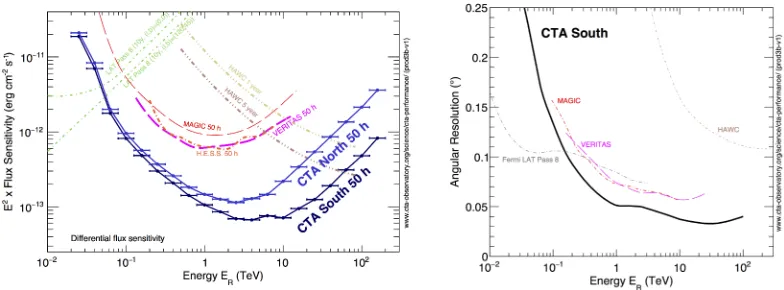
Figure 1. Left: Di↵erential gamma-ray flux sensitivity (multiplied by E2) for CTA-South and CTA-North as
a function of energy. Also shown are curves for the existing IACTs (H.E.S.S., MAGIC and VERITAS), the air-shower experiment HAWC, and the Fermi-LAT space telescope. Right:Gamma-ray angular resolution for CTA-South as a function of energy, compared to existing instruments. For details on the sensitivity and angular resolution calculations and comparisons, see [2].
The Cherenkov Telescope Array (CTA) will transform our understanding of the VHE universe and 37
will address important questions in fundamental physics, such as the nature of dark matter. It will also 38
be an important member of the suite of experiments and observatories participating in the expanding 39
areas of multi-wavelength and multi-messenger astronomy. Compared to the existing IACTs, CTA 40
will: 1) cover a wider energy range, 2) have a significantly larger field-of-view, and 3) achieve up 41
to an order of magnitude improvement in sensitivity (see Figure 1). Angular resolution and energy 42
resolution will also be improved and full-sky coverage will be ensured by arrays in both the southern 43
and northern hemispheres. CTA will also be the first open observatory to operate in the VHE wave-44
band, with approximately 50% of the observing time set aside for guest observer proposals and all 45
high-level data available to the public after a proprietary period (typically one year). 46
CTA has been in development for more than a decade. The concept was originated by the CTA 47
Consortium, currently consisting of around 1,400 scientists from 31 countries. The Consortium has 48
also developed the core science programme and has led the prototyping of telescope hardware. The 49
CTA Observatory (CTAO) has also been established; it is the legal entity that will oversee the con-50
struction and operation of the observatory. Given a project the size and scope of CTA, international 51
partnerships and good cooperation between the di↵erent stakeholders involved in the project (e.g. 52
funding agencies, national laboratories, and scientific communities) are required. 53
2 CTA Key Science
54The core programme of science for CTA consists of major legacy studies, called Key Science Projects 55
(KSPs), to be carried out by the Consortium using guaranteed time (comprising approximately 40% 56
of the observing time during the first ten-year period). The KSPs have been developed and refined by 57
be refined further as the observatory moves closer to its operational phase. The currently proposed 59
KSPs are described in an extensive document that has been published as a book [3]. 60
The core programme comprises three main scientific themes: 1) Cosmic Particle Acceleration: 61
How and where are particles accelerated, how do they propagate and what is their impact on the 62
environment? 2) Probing Extreme Environments: Understanding the physical processes close to 63
neutron stars and black holes, characterizing relativistic jets, winds and explosions, and exploring 64
radiation fields and magnetic fields in cosmic voids. 3) Physics Frontiers: What is the nature of 65
dark matter and how is it distributed? Do axion-like particles exist? Is the speed of light a constant 66
for high-energy photons? These themes are developed fully within nine KSPs and the Dark Matter 67
Programme. Given space limitations, only highlights of a few KSPs are discussed here; see [3] for 68
more complete information. 69
2.1 Dark Matter Programme 70
The existence of dark matter is well established from a variety of astrophysical and cosmological mea-71
surements. CTA will search for dark matter via the indirect detection technique, looking for gamma-72
ray signatures from the annihilation or decay of weakly interacting massive particles (WIMPs). The 73
astrophysical targets for CTA are the Galactic centre halo, dwarf spheroidal galaxies, the Large Mag-74
ellanic Cloud and galaxy clusters. The programme strategy focuses on maximizing the possibility of 75
a detection. Accordingly, the primary target will be the Galactic centre halo that houses the largest 76
concentration of dark matter in our Galaxy, with secondary data taken on the other targets. With a 77
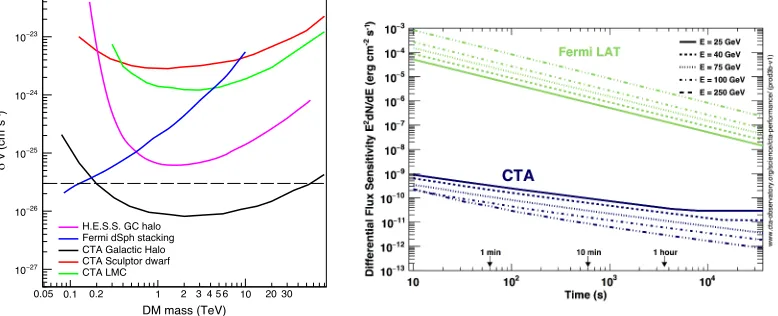
deep 500 h observation of the Galactic centre halo, CTA will achieve a sensitivity level below the 78
benchmark relic cross-section over a wide WIMP mass range that extends into the multi-TeV region 79
(see Figure 2). Thus, CTA will be an important player in the world-wide search for dark matter, pro-80
viding unique and complementary information to direct-detection experiments and the Large Hadron 81
Collider. 82
DM mass (TeV)
0.05 0.1 0.2 1 2 3 4 5 6 10 20 30
)
-1s
3
v (cm
σ
27
− 10
26
− 10
25
− 10
24
− 10
23
− 10
H.E.S.S. GC halo Fermi dSph stacking CTA Galactic Halo CTA Sculptor dwarf CTA LMC
2.2 Transients KSP 83
CTA is a powerful instrument for exploring the transient universe. With its very large collection area 84
and high signal to noise, CTA has outstanding instantaneous sensitivity over a broad energy range, 85
giving it a distinct advantage over Fermi-LAT at lower energies and HAWC at higher energies. For 86
transient time scales of a day or less, CTA is at least several orders of magnitude more sensitive 87
than Fermi-LAT (see Figure 2). CTA’s disadvantage is that it has a limited field-of-view compared to 88
Fermi-LAT or HAWC; hence, reaction time for CTA is critical and its transients programme is focused 89
on follow-up observations. The Transients KSP is an integrated programme that encompasses a vari-90
ety of multi-wavelength and multi-messenger alerts, including explosive transients such as GRBs and 91
gravitational wave events, active galactic nuclei (AGN) flares, Galactic transients, and high-energy 92
neutrino alerts. Rapid dissemination to the wider community of the VHE properties of transients 93
observed by CTA is an important component of the KSP. 94
2.3 Galactic Plane Survey KSP and Cosmic Ray PeVatrons KSP 95
Surveys of the Galactic plane are key legacy programmes for all major observatories. Previous sur-96
veys in the VHE gamma-ray band have been carried out by both ground-based and space-borne instru-97
ments. The CTA Galactic Plane Survey (GPS) will be the first high sensitivity, high angular resolution 98
survey carried out at TeV energies. Using 1600 h of observing time, the GPS KSP will cover the en-99
tire Galactic plane with a graded-exposure strategy, emphasizing key regions of the Galaxy in both the 100
southern and northern hemispheres. From simulations and our (incomplete) knowledge of the VHE 101
source population, we expect the GPS to discover many hundreds of new sources, especially PWNe, 102
SNRs, and binaries. The GPS will also have great potential for the discovery of new, unexpected 103
phenomena and will provide a detailed view of di↵use VHE gamma-ray emission. Figure 3 shows a 104
simulated image of the GPS results. 105
Figure 3.Simulated results from the CTA Galactic Plane Survey in very high-energy gamma rays for half of the plane. The simulation incorporates the proposed GPS observation strategy and a source model containing SNR and PWN populations, as well as di↵use emission.
A long-standing issue in high-energy astrophysics is to understand what sources accelerate cosmic 106
shock acceleration in SNRs, but so far only a handful of SNRs provide good evidence for hadronic 108
acceleration and their energy spectra reach only to⇠10 TeV. The goal of the Cosmic Ray Pevatrons 109
KSP is to determine the sources capable of accelerating hadrons to PeV energies. For this, the GPS 110
will be used as a finder and the five brightest sources with spectral extension out to⇠100 TeV will 111
be targeted for deep follow-up observations. For any PeVatrons detected, correlation with data from 112
other wavebands will be crucial for clear identification of the physical sources. 113
2.4 Extragalactic Survey KSP 114
The motivation for a survey of the extragalactic sky is similar to that for the GPS; we wish to observe 115
a large portion of the sky in an uniform manner to get an understanding of the dominant source 116
population (in this case AGN) and to have sensitivity to completely unexpected phenomena. In the 117
Extragalactic Survey KSP, one-quarter of the sky will be surveyed to a limiting sensitivity of 0.6% of 118
the (standard candle) Crab nebula flux. The survey will be carried out by both South and CTA-119
North and will connect to the GPS and cover the important regions of Coma, Virgo, Cen A, and the 120
northern Fermi Bubble. The key science targeted by the survey includes the unbiased determination 121
of the luminosity function for AGN, the discovery of VHE emission from as yet undetected source 122
classes such as Seyfert galaxies and ultraluminous infrared galaxies, and the detection of GRBs in 123
the prompt phase. Studies are ongoing to understand the potential of carrying out the survey using 124
a divergent pointing strategy (in which various telescopes are pointed to sky positions slightly o↵set 125
from the target position), which would allow for larger instantaneous field-of-view. 126
3 CTA Design and Current Status
1273.1 CTA Design 128
CTA will consist of two large arrays of imaging atmospheric Cherenkov telescopes. The larger south-129
ern array, CTA-South, will be constructed in the Atacama Desert of Chile at an elevation of 2,100 m, 130
close to the existing Paranal Observatory of the European Southern Observatory. CTA-North, will 131
be built at an elevation of 2,200 m on the island of La Palma, Spain, located within the existing Ob-132
servatorio del Roque de los Muchachos of the Instituto de Astrofisica de Canarias. Two important 133
administrative/scientific centers will be located in Europe: the CTA Headquarters in Bologna, Italy
134
and the CTA Science Data Management Center in Zeuthen, Germany. 135
In order to optimize the scientific capability within a constrained funding envelope, CTA will 136
employ three di↵erent sizes of telescopes [6]. Four Large-Sized Telescopes (LSTs), with mirror 137
diameters of 23 m, will provide the sensitivity in the lowest energies of the CTA waveband (down to 138
20 GeV), where the Cherenkov photon density in gamma-ray air showers is low (⇠1/m2).
Medium-139
Sized Telescopes (MSTs), with mirror diameters of 9-12 m, will be distributed around the LSTs to 140
provide sensitivity in the core energy range of 100 GeV - 10 TeV. Small-Sized Telescopes (SSTs), 141
with mirror diameters of⇠4 m, will extend the size of CTA-South and provide sensitivity to energies 142
of 300 TeV and above. SSTs are only envisioned for the southern array for which the entire inner 143
regions of the Galactic plane will be visible. For both the MSTs and the SSTs, prototypes are being 144
developed that use either the conventional single-mirror Davies-Cotton optical design or the newly 145
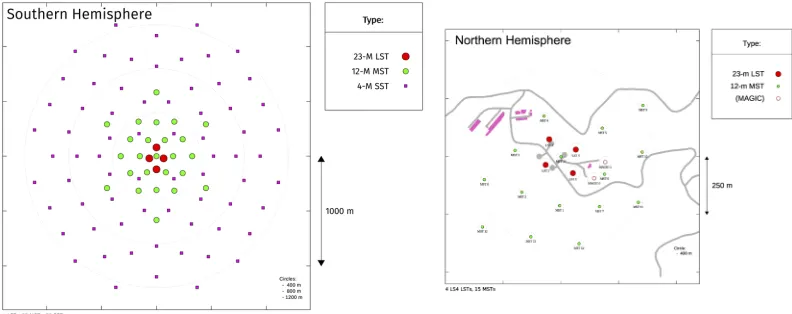
developed dual-mirror Schwarzschild-Couder optical design. In the baseline CTA design, CTA-South 146
will comprise 4 LSTs, 25 MSTs, and 70 SSTs, covering an area of⇠ 5 km2, and CTA-North will 147
comprise 4 LSTs and 15 MSTs, covering an area of⇠0.5 km2. The proposed telescope array layouts, 148
Figure 4. Left: Proposed layout for the three sizes of telescopes (LSTs, MSTs, and SSTs) in CTA-South (Paranal, Chile). Right: Proposed layout for the two sizes of telescopes (LSTs and MSTs) in CTA-North (La Palma, Spain). The roads are shown in grey and the buildings in purple. The current MAGIC telescopes are indicated by the open red circles.
3.2 CTA Status 150
Initial planning for CTA started as early as 2005, when the community came together at Palaiseau, 151
France to discuss the future of ground-based gamma-ray astronomy [8]. Since then, an enormous 152
amount of development work has been carried out and CTA has been heavily reviewed and endorsed 153
by the major roadmap committees in particle physics, astroparticle physics, and astronomy (see, e.g., 154
[9–11]). Most recently, CTA was promoted to Landmark status in the European Strategy Forum 155
on Research Infrastructure (ESFRI) 2018 Roadmap [12]. The management of CTAO has been es-156
tablished. The CTA Council takes care of overall governance and the Project Office manages the 157
construction project. An interim legal entity (CTAO gGmbH), composed of shareholders from eleven 158
countries and associate members from two countries, has been established for the preparation of the 159
implementation of CTA. 160
The development of telescope hardware is being carried out by the Consortium institutes, as in-161
kind contributions to the observatory. Substantial software development has also started, both at the 162
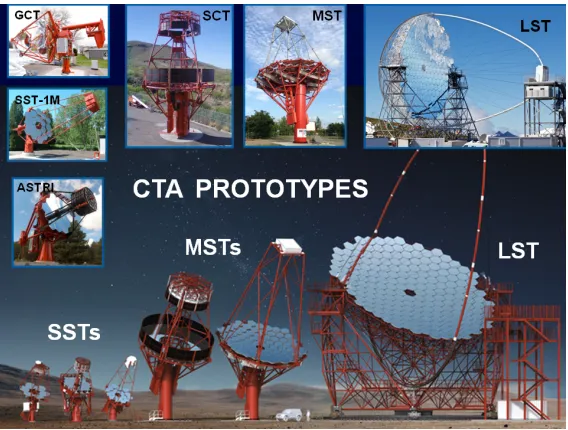
Project Office and within Consortium institutes. As shown in Figure 5, six full prototype telescopes 163
exist and are being actively tested. Work is now focused on design optimization, with the goal to 164
reduce the number of telescope and camera options. Site hosting agreements for both CTA sites have 165
been signed and site preparatory work is ongoing. In this context, CTA-North is more advanced since 166
much of the necessary infrastructure already exists. The first telescope to be located at a CTA site is 167
the prototype LST that was inaugurated at the CTA-North site in October 2018 and is now undergoing 168
commissioning. Current plans are: start of construction in 2019, first pre-production telescopes on 169
site in 2020 and completion of construction in 2025. Since the CTA design is quite modular, initial 170
operations can start as early as 2023, using a portion of the array available at either site. 171
References
172[1] TeVCAT: http://tevcat.uchicago.edu/
Figure 5. Concept drawings and photographs of CTA protoype telescopes, as of 2018. Clockwise (from lower left): SST-ASTRI at Mt. Etna, Italy, SST-1M at Krakow, Poland, SST-GCT at Meudon, France, SCT at Whipple Observatory, AZ, USA, MST at Adlershof, Germany and LST-1 at La Palma, Spain.
[2] https://www.cta-observatory.org/science/cta-performance/
174
[3] The CTA Consortium,Science with the Cherenkov Telescope Array(World Scientific Publishing, 175
2019), ISBN 978-981-3270-08-4, arXiv: 1709.07997, DOI: 10.1142/10986
176
[4] H. Abdallah, A. Abramowski, F. Aharonian, F. Ait Benkhali, A.G. Akhperjanian, E. Angüner, 177
M. Arrieta, P. Aubert, M. Backes, A. Balzer et al., Physical Review Letters117, 111301 (2016), 178
1607.08142 179
[5] M. Ackermann, A. Albert, B. Anderson, W.B. Atwood, L. Baldini, G. Barbiellini, D. Bastieri, 180
K. Bechtol, R. Bellazzini, E. Bissaldi et al., Physical Review Letters 115, 231301 (2015), 181
1503.02641 182
[6] B.S. Acharya, M. Actis, T. Aghajani, G. Agnetta, J. Aguilar, F. Aharonian, M. Ajello, A. Akh-183
perjanian, M. Alcubierre, J. Aleksi´c et al., Astroparticle Physics43, 3 (2013) 184
[7] The CTA Consortium, Astroparticle Physics (2019), submitted 185
[8] B. Degrange, G. Fontaine, eds., Proceedings, 7th Workshop on Towards a Network of At-186
mospheric Cherenkov Detectors 2005, Ecole Polytechnique (Ecole Polytechnique, Palaiseau, 187
France, 2005) 188
[9] The AStroParticle ERAnet (ASPERA) roadmap: http://www.aspera-eu.org/
189
[10] The U.S. Astronomy and Astrophysics Decadal Survey (ASTRO2010): http://www.
190
nationalacademies.org/astro2010
191
[11] The U.S. HEPAP P5 Panel: http://usaparticlephysics.org/p5/
192
[12] The ESFRI 2018 Roadmap: http://roadmap2018.esfri.eu/