Electronic Thesis and Dissertation Repository
12-6-2010 12:00 AM
The Evolution of the Retail Landscape
The Evolution of the Retail Landscape
Mathew Novak
University of Western Ontario
Supervisor Jason Gilliland
The University of Western Ontario
Graduate Program in Geography
A thesis submitted in partial fulfillment of the requirements for the degree in Doctor of Philosophy
© Mathew Novak 2010
Follow this and additional works at: https://ir.lib.uwo.ca/etd
Part of the Human Geography Commons
Recommended Citation Recommended Citation
Novak, Mathew, "The Evolution of the Retail Landscape" (2010). Electronic Thesis and Dissertation Repository. 53.
https://ir.lib.uwo.ca/etd/53
This Dissertation/Thesis is brought to you for free and open access by Scholarship@Western. It has been accepted for inclusion in Electronic Thesis and Dissertation Repository by an authorized administrator of
THE EVOLUTION OF THE RETAIL LANDSCAPE
Monograph
by
Mathew J. Novak
Graduate Program in Geography
A thesis submitted in partial fulfillment
of the requirements for the degree of
Doctor of Philosophy
The School of Graduate and Postdoctoral Studies
The University of Western Ontario
London, Ontario, Canada
ii
CERTIFICATE OF EXAMINATION
Supervisor
______________________________
Dr. Jason Gilliland
Supervisory Committee
______________________________
Dr. Mike Buzzelli
______________________________
Dr. Jacek Malczewski
Examiners
______________________________
Dr. Godwin Arku
______________________________
Dr. Tony Hernandez
______________________________
Dr. Jeff Hopkins
______________________________
Dr. Robert MacDougall
The thesis by
Mathew John Novak
entitled:
The Evolution of the Retail Landscape
is accepted in partial fulfillment of the
requirements for the degree of
Doctor of Philosophy
iii
ABSTRACT
If the city is a theatre of social interaction (Mumford 1996), then one of the principle stage sets is the retail landscape. Retail districts are generally where people
congregate, making places of shopping among the liveliest areas the city. In
addition to being social settings, retail areas are also where a large component of the city’s economy is transacted, and they are implicated in the political dramas of the city, particularly those dealing with issues of growth and development. Retail shops are highly visible elements of the urban landscape, lining principle arteries and clustering at major transit nodes. Retailing is woven throughout the economic, social, political, and built fabrics of the city.
The evolution of the retail landscape was studied throughout the development of London, Ontario, a typical mid-sized North American city. The functional and spatial composition of the retail sector was documented from the first settlement, thru the era of rapid industrialization, to today’s consumption-based city. Over time, the retail landscape exhibited much dynamism, reflecting changing socio-economic conditions, as well as technological innovation. Both the retailers
themselves, and the environments in which their businesses were conducted, have evolved. From the primitive general store, thru the grand emporia lining
‘mainstreet’, to the contemporary planned shopping centres.
Comparisons were made between the physical characteristics of the built environments constructed in various eras which make up the retail landscape. Drawing from the urban morphology literature (notably Conzen 1960), analysis was conducted of the town-plan, building forms, and land-uses of the various retail environments. In addition to documenting the general changes in these town-scape elements over time, further analysis was conducted on the form and function of the archetypical retail environments, the traditional ‘mainstreet’ district and
iv
describing the character of urban environments. A trialectic is proposed, taking into account how each of these elements simultaneously shapes and is shaped by the other two.
Keywords:
v
ACKNOWLEDGEMENTS
I wish to thank my Ph.D. supervisor Jason Gilliland and the rest of the advisory committee: Jeff Hopkins, Jacek Malczewki, and Mike Buzzelli. Gratitude is also due to the UWO Geography Department Staff, Faculty, and Graduate Students,
especially Lori Johnson and Godwin Arku. Fellow lab mates David Stubbs, Don Lafreniere, Martin Healy, Dick Sadler, Kristian Larsen, and Kevin Van Lierop are acknowledged for their intellectual and social contributions. A thank you to the numerous work-study and undergraduate students who assisted with the data collection for this project. Many thanks also go to the staff of the UWO Map Library, the UWO Archives, the London Regional Art & Historical Museum and The London Room at the London Public Library. My research was made possible with the financial support of the Ontario Graduate Scholarship, The Social Sciences and Humanities Research Council of Canada (through a Standard Research Grant to supervisor Dr Jason Gilliland), and The Department of Geography at Western.
vi
Chapter Page
Certificate of Exam ii Abstract iii Acknowledgements v
Table of Contents vi List of Figures viii List of Tables xi
1 Introduction 3
Research Outline 6 Overview of Retail History 13 Guiding Theory 25 Morphological Analysis of Retail Landscapes 36
2 Sources and Methods 41
Viewing History Using GIS 44 Sources used and their integration in an HGIS 55 Analysis using the HGIS 67 3 Retailing and early settlement 70 A Settlement in the Forest 72 Bumpy Roads 75 The Public Market and Surrounding Retail District 78 Railways Bring Increased Supply & Demand 82 Arrival of New Products 86 Discussion 93 4 Retail’s changing face and place 95 Functional Composition of Retailers 100 Spatial Composition of Retailing 106 Morphology of Retailing 129
Case Study: Comparing Morphologies of Mainstreet, an
Early Retail Strip and a Contemporary Shopping Centre 144 Discussion 163 5 The Apex of Mainstreet Retailing 171
vii
6 Planned Shopping Centres 253
Timing and Location of Shopping Centre Development 260
Ownership Regimes 273 Town-plan 278 Building Forms 293 Land-uses 306
Change Within the Shopping Centres 320 Discussion
7 Conclusions 340
Comparing retail landscapes 345 An Underlying Logic in Retail Forms 353 Uniting Town-scape elements 355 Implications, Limitations and Future Research 362 List of Primary Data Sources 370
viii
1.1 Taxonomy of urban retail areas 23 1.2 Model of how retail forms are created 28 2.1 Representation of GIS structure 64 3.1 Map of London: 1839 81 3.2 Advertisement for the J. Beattie dry goods store 87 3.3 Advertisement for trainload sale at A. Chisholm’s Dry Good
emporium 89 3.4 Grocery advertisement shows preserved goods before the arrival of
the train 91 3.5 Grocery advertisement shows the availability of fresh produce exotic
produce after the rail link is established. 92 4.1 Locations of retailers and urban growth (1844, 1863, 1881, 1916) 108 4.2 Boundaries of the districts used for the analysis 114 4.3 Numbers of food, fashion and other retailers in the core and
periphery (1863, 1881, 1916) 115 4.4 Locations of butchers and dry goods merchants in 1881 and 1916 116 4.5 Directional ellipses produced from locations of butchers and dry
goods merchants in 1881 and 1916 117 4.6 Locations of retailers in 1958 and 2004 120 4.7 Location of bakeries in 1881, 1916, 1958 and 2004 125 4.8 Location of department stores in 1881, 1916, 1958 and 2004 126 4.9 Location of jewellers in 1881, 1916, 1958 and 2004 127 4.10 Location of shoe stores in 1881, 1916, 1958 and 2004 128 4.11 Map showing retail parcels in 2004 133 4.12 Graph of the size of retail parcels in relation to their distance from
the core 135 4.13 Graph of the size of retail buildings' footprints in relation to their
distance from the core 138 4.14 Graph showing frequency of retail buildings' footprints 139 4.15 Graph of building coverage on the lot plotted against distance from
ix
5.4 Representation of land values per linear foot in 1916 and 1927 187 5.5 Land-uses in the core between 1880 and 1930 for each block-face 190 5.6 Graph of annual land-uses in the core between 1880 and 1930 192 5.7 Map of retail and other land-uses in the core between 1880 and 1930 194 5.8 Retail types by block-face between 1880 and 1930 196 5.9 Graph of annual retail types between 1880 and 1930 198 5.10 Graph of annual number of apparel retailers on each block-face
between 1880 and 1930 200 5.11 Representation of the average tenure of retailers by block-face 204 5.12 Photograph of Dundas Street showing unimproved state of the roads 208 5.13 Lot fabric in 1844, 1916 and 2004 213 5.14 Average lot width by blockface in 1916 216 5.15 Overlays of lot fabric (1844-1916 and 1916-2004) 219 5.16 Map showing building block-plans and percentage coverage by block 221 5.17 Representation of changes in building coverage between 1888 and
1915 222 5.18 Lot boundaries superimposed on the 1915 fire insurance plan 224 5.19 Advertisement for the Smallman & Ingram's Dry Goods Store 230 5.20 Advertisements for the Gothic Hall Drug Store 231 5.21 Photograph showing the Gothic Hall in the Georgian streetscape 233 5.22 Photograph of the Dundas streetscape 234 5.23 Photograph of the Richmond streetscape 236 5.24 Photograph of the Woolworth Store 237 5.25 Photograph of the skylights 238 5.26 Photograph showing recessed doors and large display windows 239 5.27 Photograph of the buildings at the intersection of Richmond and Dundas
showing differing heights in the streetscape 242 5.28 Photograph of the hanging advertisements littering the streetscape 243 5.29 Photograph of the interior of the typical store 245 5.30 Photograph of store interior, showing merchandise display and storage 246 6.1 Illustration of the three iterations of the Covent Garden Market 259 6.2 Map of the parcels for two early shopping centres 263 6.3 Timeline of shopping centre openings 266 6.4 Graph of the number of shopping centres per year in Canada 1956-1973 267 6.5 Graph of the annual shopping centre sales in Canada 1956-1973 268 6.6 Map of London's shopping centres, indicating year of opening 270 6.7 Graph of year of shopping centre opening plotted against its distance from
x
6.13 Shopping centre parcels-buildings interaction 290 6.14 Typology of shopping centre layout 292 6.15 Photographs of Cherryhill mall in the 1960s and 2000s 295 6.16 Typical shopping centre layout 300 6.17 Layout of White Oaks Mall 305 6.18 Graph of percentage of annual shopping centre sales by store type in Canada
(1956-1973) 308 6.19 Fire insurance plans (1915 and 1958) of the site of Wellington Square
(Galleria Mall) 324 7.1 Representation of the trialectic of town-plan, land-use and building form 356 7.2 Aerial photographs of the CBDs of Windsor, London and Kitchener and
xi
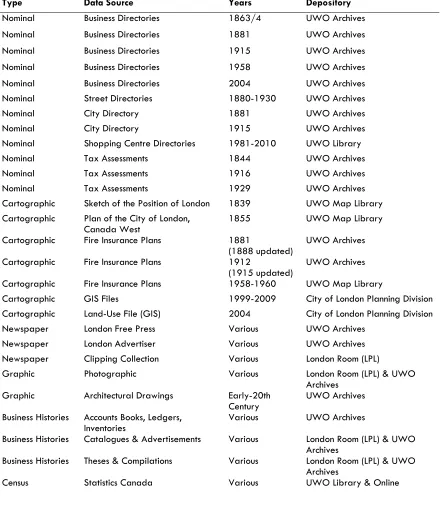
2.1 Sources used 45 2.2 Attributes used from various sources in retail database 58 4.1 Population of London and number of retailers in 1863, 1881, 1916,
1958 and 2004 101 4.2 Number of retailers in each district in 1844, 1881, 1916, 1958 and
2004 121 4.3 Land-use characteristics in 2004 131
THE
EVOLUTION
OF THE
RETAIL
City Centre (Lot fabric)
CHAPTER 1
INTRODUCTION
Tracing the imprint of retailing
CHAPTER 1
INTRODUCTION
Kingsmill’s Department Store is a fixture in London, Canada’s retail landscape. Unlike most other retail establishments, it has resisted the lure of relocating to the urban fringe and remains along Dundas Street, the city’s
traditional ‘mainstreet’1 shopping district. The store has occupied the same location since it opened in 1865, making it a rare example of a steadfast element in the retail landscape2. Change is pervasive throughout the retail landscape of most North American cities; retailers evolve at exceptional speed to keep pace with the market and their competitors.
Kingsmill’s is a remnant of an earlier time. While other retailers have changed their marketing positions and business practices, store environments and locations, Kingsmill’s remains committed to its original location, and maintains many of the hallmarks of retailing from an earlier era. The structure still has wooden floors and tin ceilings and its façade was last updated when Art Deco architecture was in vogue. It has been able to use its history and traditional retail methods to maintain a loyal clientele. An elevator operator still guides customers to the appropriate floor and customer service is widely available and personal. It is among the last independent department stores in Canada, most others having either shuttered or bought by the larger chains as was the fate of London’s other grand emporium, Smallman & Ingram’s Department Store, which was purchased in 1944 by the Simpson’s chain of department stores from Toronto.
Despite its obduracy, Kingsmill’s store does reflect many of the changes which have taken place in retailing. The current structure is the third occupied by the store, the previous having been destroyed by fire in the early-twentieth century.
1 Mainstreet is the term used throughout this thesis when talking about the retail landscape
of the downtown core along the city’s primary shopping street. It is used as the generic term since London, among many other cities, does not have a Main Street.
2 Nash Jewellers, like Kingsmill’s, is a long-established retailer which remains committed to
Each new structure employed the modern technologies and styles of the day. In the last decade, two expansions have been undertaken, reflecting the purchasing desires of the contemporary shopper; a gourmet kitchenware department and a
contemporary apartment/condominium furniture department are now part of the traditional selections of clothing and house wares3. The types of products on the shelves have also changed, as have their fashions as seen in the progression of styles in the clothing departments. Technology has also impacted the store’s operation. Today, bar-code scanners assist in the logistics of product checkout and
inventorying.
RESEARCH OUTLINE
Kingsmill’s is but one small piece of the overall retail landscape, the entirety of which is a complex milieu of retailers competing for customers and sales while adapting to changing market environments. This thesis examines this retail landscape, tracing its origins and evolution over time, and situating it within the wider urban context4. Using London, Canada as a case study, the following
chapters detail the retail landscape in successive eras of development including: the founding and first settlement in 1826, the linkages with the surrounding region in 1864, the industrializing city of 1881, the apex of the downtown in 1916, the early stages of suburbanization in 1958, and the contemporary situation in 2004. These specific years were chosen not only for their representational nature, but also due to the availability of detailed and robust data sources which document these
landscapes.
The retail landscape in each era is analyzed by mapping the location of retailers contained in a large database created from the city directory listings. The
3 London’s downtown core, the immediate market area of Kingsmill’s, has seen many new
apartment and condominium projects due to incentives by the city which attempt to bring residents back to the core as part of downtown revitalization (Department 2009).
4 For the purposes of this research, retailing is defined as the sale of physical goods to
urban forms constructed by the many retailers are studied using both historical maps, notably the fire insurance plans, and contemporary digital datasets
representing the city. Other contemporary and historical sources are drawn from to enrich the depiction of the landscape and explain how it changes over time. A
Historical Geographic Information System (HGIS) is used to manage these disparate data sets and to conduct much of the analysis. The various data sources, as well as the process of spatially and temporally referencing them in the HGIS are discussed in the second chapter.
Four results chapters document the retail landscape in each era, looking at its functional, spatial and morphological composition. The first of these results chapters discusses the link between retailing and the early settlement of the city. In addition to giving a history of the settlement of London, it shows how retailing is integral with the urban development process. It demonstrates the impact that improved transportation linkages had on product selection in the early city. The second results chapter, Chapter 4 of the monograph, maps retail landscapes throughout the development of the city. It looks at the types of retailing in each of the aforementioned eras of interest, and their locations within the urban landscape. It also analyses the changes in retail morphologies over time throughout the entire city in general, and in three case-study areas specifically.
The general overview of retailing found in Chapters 3 and 4 provides a
framework on which to detail two different retail landscapes. The downtown core, or the central retail district, is examined for the period of 1880 to 1930, the pinnacle era of mainstreet retailing. Micro-scale analysis shows the relationships between location, land values, land-uses, and town-plan characteristics. Since the analysis is conducted on an annual basis, changes within the form and function of the central retail district are shown over the fifty year period. The last results chapter (Chapter 6) switches focus from the traditional retail area to the contemporary planned
shopping centres. This chapter traces the rise to dominance of the planned shopping centres in the contemporary landscape, and shows the many forms they take.
shopping centres, their morphology and their functioning in terms of revenue generation and how people interact with their stringent environments.
The final chapter of this monograph discusses the changes and similarities found within the retail landscape as it evolves over time. Conclusions are made about the similarities found in many retail landscapes due to an inherent logic implemented by the retailers in their striving for profit maximization. Despite their radically different appearances, shopping malls and traditional downtowns share many functional and morphological characteristics. The aesthetics of the landscapes are then questioned. By looking at all three elements of the townscape, this
research makes it clear that urban morphological examinations of the landscape must consider the town-plan, building forms and land-uses as they form a trialectic; each shaping the others while simultaneously being shaped itself. Finally, by looking at the traditional mainstreet when it was successful, a critique of the current downtown revitalization efforts is offered and suggestions are made to reinvigorate the heart of the city.
The remaining sections of this introductory chapter present the context, motivation and guiding theory for analysing the evolution of the retail landscape in London. A brief history is provided of retailing around the world, with attention paid to the environments in which it was conducted and the conditions which
OBJECTIVES & MOTIVATION
This research results in a narrative with several objectives. First and foremost it strives to show the functional, spatial and morphological composition of the landscape at various times in the city’s history. The findings attempt to
elucidate the conditions surrounding the creation of each of these landscapes. This adds to the understanding of both historical and contemporary urban systems in general and the retail structure of cities specifically. Secondly, by comparing and contrasting the various environments it reveals change over time in the retail landscape. These changes to the physical forms of retailing are manifestations of changing market conditions, including social and economic circumstances as well as technological innovations. Changes are not solely sought; the research also looks for conformity in the landscapes, threads of similarity which are maintained over time which result from retailers sharing the similar goal of profit maximization. A third objective is to show how the various retail landscapes functioned. This is done in detail for the two most important landscapes: the downtown core at its height of importance in the urban system between 1880 and 1930, and for the planned
shopping centres which account for much of the post-war retail sales and significant components of the contemporary landscape. A fourth objective is to devise a model, found later in this chapter, detailing how retailers shape urban forms which make up the landscape. This model should provide useful for understanding the complex milieu that both creates and causes changes to the retail landscape. Using the model to interpret the results of the research on the retail landscape demonstrates the need for an interdisciplinary approach to retail research, drawing from the numerous fields that retailing can be situated within. A fifth objective is to
demonstrate how to fully read an urban landscape using the methods and theories of urban morphology. It is necessary to acknowledging all of the landscape components for a complete picture of both past and present cities. Doing so allows for the
management of future growth and change.
A further objective relates to the technical side of conducting this research, and the utility of the techniques for understanding past and present urban
large amount of data collected to detail the retail landscapes. It is hoped that historians and morphologists will see the value of implementing GIS in their research, despite the initial labour and financial costs. Doing so allows for
simultaneous analysis of time and space in great detail and opens up new avenues of research. GIS also makes possible the examination of entire urban areas, rather than select case-studies that were done using traditional manual methods. This methodological objective is also met by shifting the lens at which the landscape is examined, from the micro thru the macro scale made possible by the GIS. The following pages look at the city, from within the walls of individual stores to the entire London area.
In answering these objectives, this research adds to our current understand of retailing in urban areas. It shows retail’s weave within the city’s fabric, and makes clear that retailing is an essential and valuable part of the city’s functioning and character. Although an importance urban function, retailing is an often overlooked phenomenon, especially in historical contexts. Retailing was present from the first years of development, and formed characteristically urban landscapes when the rest of the settlement was rural. Academic understanding of retail history is sparse, notably in North America (Benson and Shaw 1992), so this work attempts to fill part of this void. It does so by providing an expansive overview of retailing throughout the spatial and temporal extents of a typical North American city.
Retailing is pervasive throughout contemporary life. One need only mention Wal-Mart to realize that the retail enterprise has expanded beyond the realm of economics. Wal-Mart has political, social and environmental associations (see
Spotts 2005; Bianco 2006). It is also representative of technological change; from the products on the shelves, to the logistics in stocking them (Birkin, Clarke, and Clarke 2002; Angeles 2005), to the automobile which most customers use to take them home.
It is said that we are now living in a consumer society (Goodwin, Ackerman, and Kiron 1997; Baudrillard 1999), and may have been for quite some time
There is growing awareness of consumption research within the social sciences (see Miller 1995 for a review of consumption in various disciplines).
Consumption is “a bridge that links the individual to the urban environment” (Jayne 2006, 12). In terms of retail environments, consumption brings citizens into the public realm in order to procure goods. More broadly, residents of the city consume spaces, not just goods. Thus, the act of shopping consumes not just for the goods themselves, but also the spaces in which the goods are purchased.
Many of the leading social theorists have studied consumption and highlight retail environments in their discussion; the drugstore by Baudrillard (1999), the department store by Harvey (2003) and the shops found in a gentrifying
neighbourhood by Ley (1996). The study of the retail landscape helps shed light on these practices of consumption, and thus society in general, by describing in detail the environments in which retailing occurs.
Much existing consumption research looks at the contemporary situation, using abstract research. There have been calls for the rematerializing of this and other research in the social sciences (Lees 2002; Jackson 2000). By looking at the concrete forms of retailing as imbedded in the retail landscape over time this
research certainly provides material results rather than abstract arguments derived from subjective interpretation or semiotic readings in the tradition of Barthes (1986) which have been applied in the aforementioned work. It also answers the call for more historical studies of consumption (Glennie and Thrift 1992; Glennie 1998; Jackson and Thrift 1995). One of the primary goals of this study is to contextualize the current retail landscape in terms of its origins and development.
Other motivation for this research stems from the importance of retailing within the economy. In 2009, retail sales in Canada were over $415 billion; consumer spending accounting for 60 percent of the Gross Domestic Product of Canada. Retail trade directly produced over $74 billion in GDP (Statistics Canada 2009b, 2009c)and employed over 1.8 million people in 2009 (Statistics Canada 2009a).
et al. 2004; Lowe 2005; Robertson 1997; Southworth 2005; Filion and Hammond 2006; Bromley, Tallon, and Thomas 2005; Walker 2009); however, most of these studies ignore the history of downtowns, and instead focus on its current state and ways to fix it. By understanding the downtown when it was a vibrant retail hub which serviced the entire region, this research provides substantial indicators of how a successful downtown will function in the future and strategies to guide its
development. This is not, however, normative or prescriptive research; rather, primarily a substantive and descriptive study of retail landscapes which can then be used by planners and other professionals and academics in their efforts to help spur success in these traditional areas.
The substantive descriptions of the retail landscape found in the following chapters add to the current understanding of retail’s place in the development of cities. By tracing retailing from first settlement to the current metropolis, the interaction between retailing and the development of the city is detailed. A
comprehensive description of the retail landscape is provided, documenting all retail establishments in each era, rather than isolated case study areas. GIS facilitates the creation and management of the large datasets which are then analysed using the tools offered by the software. This approach of documenting the entire city using digital representations advances urban morphological and historical research. Both fields have typically examined only specific areas usually using manual rather than digital tools.
for a sufficiently detailed, interesting, and lengthy history that is suitable to illustrate the retail landscape of the general Canadian city.
With the research outlined and the motivation demonstrated, this chapter continues with a concise history of retailing over the last six thousand years. It is but a brief overview owing to the complexity of this varied activity and its lengthy duration; proper descriptions of this history itself would fill volumes. It does show, however, that retailing has been an important activity in cities throughout history, as well the continuity in retail morphologies that are found over time. Next is a summary of geographical research on retailing, tracing both traditional and
contemporary approaches. This leads to a discussion of the theory which guides the research, uniting the traditional and contemporary approaches to subject. Theory is also drawn from evolutionary economics, using the idea that retailers compete to maximize profits while adapting to changing environments. Finally, the tools and theories found in the interdisciplinary field of urban morphology are explored; they will be used to examine the landscapes of retailing.
A SHORT SUMMARY OF RETAILING’S LONG HISTORY
Retailing is an ancient practice. In Mesopotamia, the cradle of civilization, markets were held thousands of years before Christ (Van de Mieroop 1999). Buyers and sellers came together in the marketplace which contained a variety of goods. There is debate over the functioning of the marketplace, such as whether the price mechanism was in place, and generally the role of the market in the overall economy (Silver 1983; Mayhew, Neale, and Tandy 1985; Silver 2009; Polyani 1944), although it appears now that market prices were in fact functioning in early Babylon (Temin 2002). Thus, in humanity’s first cities was found an active retail marketplace, which demonstrated many characteristics which would define the practices of buying and selling for thousands of years.
district due to its various functional aspects being in close proximity, allowing for multiple purpose trips (Vance 1990, 53).
Two thousand years after the Greek Agorae, the Grand Bazaar in Istanbul was opened in the mid-fifteenth century containing thousands of shops fronting both covered and exposed corridors. Its plethora of food stalls grouped together can be looked at as the “the oldest and largest supermarket in the world” (Wolfe 1963, 25). This colossal structure contained clusters of speciality stores such as furniture and jewellery (Wolfe 1963). The lineage of the shopping mall can be traced back to these two covered marketplaces (Jackson 1996).
While the Grand Bazaar was bustling with customers in the Ottoman Empire, two thousand kilometres west, Europe was in the first stages of
industrialisation in the second-half of the eighteenth-century. The dark ages were over, and no longer did the vast majority of the population subsist on farming with little occupational specialization as they did prior to the mid-eighteenth century (Deane 1979, 18). Instead, they began to toil in the mills and factories, or in extracting the raw resources which would be refined. Industrialization produced goods to be sold in the retail outlets. Wages also increased during this time as employment was found in the factories (Lindert and Williamson 1983).
Supply and demand sides of consumption were both stimulated by the industrial revolution. This is an undeniable statement; more debatable is whether supply was stimulated first, or vice versa (Gilboy 1932). Notable in consumption research that attempts to solve this question is McKendrick’s (1982) application of Veblen’s (2007) theory of emulative consumption. Using the example of the many domestics employed by the bourgeoisie, McKendrick assumes that fashions and desires for goods trickled down from master to servant, spurring demand amongst all classes; wages and a fluid social structure were also instrumental in spurring demand. Although Campbell (1987) agrees with McKendrick on the demand side spurring consumption, he argues that it was the hedonic longing for goods espoused by the protestant ethic that was the underlying factor. Campbell discusses the unquenchable desire and immediate gratification which can be seen as hallmarks of the consumer society (see Goodwin, Ackerman, and Kiron 1997). Fine and
they were mutually constitutive processes and the consumer society could not be a result of one or the other entirely.
Also debatable is the timing of the advent of the consumer society in general and modern retail practices specifically. Entangled in this debate is the
differentiation between mass consumption, consumer society, and retail practices; each not necessarily accompanying the others. Shammas (1993) looks at the mass consumption5 of grocery products such as tobacco and sugar which both occurred in the seventeenth-century England, suggesting that mass consumption was occurring before mass production; the American colonies were slightly behind. In terms of the stores themselves, Davis (1966) discusses how some sixteenth-century London shops had large glass windows and a varied selection, but in general were still dark and muddled. Cox (2000) counters Davis’ and others` supposition that there is a distinct divide between pre- and post-industrialized shops, with convincing descriptions of the shops and their keepers in the early modern period being anything but
primitive. The tradesmen were aware of advanced marketing, designed suitable environments for their outlets and were meeting the needs of the consumer who had already discerning tastes (Cox 2000).
Although Cox and others have argued that there was no revolution in retailing, but rather an evolution, the department store has come to symbolize for many the start of modern retailing (Miller 1981). “The increasing power of the commodity itself as spectacle was nowhere better expressed than in the new
department stores” (Harvey 2003, 213). The first and arguably most famous of these stores is the Bon Marche, which opened in Paris in 1852. It sold articles with fixed prices and enticed buyers with piles of elaborately displayed goods (Miller 1981). Zola, the French writer who documented much of nineteenth-century Parisian life in his stories, vividly describes the practices of this ‘machine for selling’ in his story Au Bonheur des Dames or The Ladies Paradise (Zola 1995).
Department stores are not just continental phenomena; they were also well-established elements in the North American retail landscape. If Europe was their origin, then America was where they metamorphosed into the grand palaces of
5 Shammas defines mass consumption as products being available to one-quarter of the adult
consumption. No expense was spared, as is witnessed in Chicago’s State Street palaces: Louis Comfort Tiffany was commissioned to design the ceiling in Marshall Field’s behemoth flagship (Pridmore, Marshall Field's Department Store, and Chicago Architecture Foundation. 2002), and Schlesinger and Mayer (later Carson Pirie Scott) hired the leading architect of the day, Louis Sullivan, to create their emporium which today remains a masterpiece of early modern architecture (Siry 1988).
Department stores were influential in the retail landscape. Their power so pervasive that they became synonymous with the city in which they were built: Wanamaker’s in Philadelphia, Bloomingdales and Macys’ in New York, Marshall Fields in Chicago, and Neiman-Marcus in Dallas6. Canada too had its famous stores with Woodward’s7 in Vancouver and Eaton’s in Toronto and Winnipeg, although Canada’s department stores were typical of the lagging of Canadian retail practices behind those found south of the border (Burns and Rayman 1995). The fall of the Eaton’s empire was lamented as a loss of Canadian culture when it filed for bankruptcy in 1997 (Star 1997).
The ascent to dominance by department stores is demonstrative of the shift from a production-oriented to consumption-oriented society (Benson 1988, 75). Furthermore, they shaped modern consumer culture, and taught people how to consume through their selling practices (Laermans 1993).
In North America the department stores located in the downtown, it being the centre of retailing and commerce for the entire region. Downtown was a
uniquely North American word, referring to the central business district; it was also a uniquely American place (Fogelson 2001, 12). Although it was not separate
politically and hard to delineate (see Bowden 1971; Murphy and Vance 1954b),
6 Public pride in the old grand dames of retailing is still persistent. When Macy’s bought the
failing Marshall Fields chain they rebranded the State Street flagship store in Chicago under much protest from the local citizenry. Some still refuse to shop at the rebranded store and there are numerous websites and public protests calling for the reinstating of the former moniker.
7 Charles Woodward’s first retail foray was on Manitoulin Island in 1875. His first store was
functionally and morphologically, downtown was very different from the rest of the city. It was the centre of commerce, but also contained residential, industrial, and institutional uses. Downtown was the most densely developed area of the city, and witnessed the greatest activity levels as well.
Although the skyscrapers and their office functions were impressive fixtures of the North American downtown at the turn of the twentieth century, it is the retail stores that brought most people to the core, these being most characteristic of the central retail district’s intense activity and development. Despite their height and impressiveness, the office towers did not occupy the prime sites (Murphy, Vance, and Epstein 1955). Rather it was the retailers who took the most valuable land, building stores which were much lower, but also much more profitable (Alonso 1964; Murphy, Vance, and Epstein 1955). Retailers occupied the most valuable lots since they were also those with the highest traffic, and thus the greatest potential to attract customers (Hurd 1911, 93). One need only look to the location of Woolworth’s discount store to find the greatest land values in the early-twentieth century city.
The downtown was not a static environment, its function changing over time as did its spatial extent and focus (Murphy, Vance, and Epstein 1955; Bowden 1971). One example of this is the relocation of the department stores in New York City, which moved northwards into the wealthy residential neighbourhoods in order to service this desirable high-end market as well as to be associated with the wealth of the Astors and the Vanderbilts (Domosh 1990). That they were even able to displace the elite who did not want these stores in their neighbourhoods demonstrates the power of the retailers, and the culture of capitalism in New York. Domosh (1990) contrasts this situation in New York with that of Boston where there was less regard for the market practices and the wealthy were able to resist the encroachment of retailers.
Beginning in the early-twentieth century, the downtown retail districts of cities throughout North America were being increasingly challenged by planned shopping centres. In the early stages, growth of the new shopping centres was modest (Gillette 1985), and did not significantly erode the businesses in the core. After the Second World War, shopping centres proliferated and downtowns began to suffer (Cohen 1996). At the same time, the mass adoption of the automobile caused issues for the downtown since their urban forms did not facilitate the expansive parking and road networks required to smoothly operate the automobile. Even before World War II, parking became an issue downtown (Jakle and Sculle 2004, 61). Shopping centres offered the automobile bound customers ample parking and ease of access from the major auto routes.
Baltimore’s Roland Park which opened in 1908 is the first example of a planned shopping centre (McKeever et al. 1977). The Country Club Plaza which opened in Kansas City in 1922 was a notable example of a planned shopping centre forming the heart of a new residential community (Gillette 1985). J.C. Nichols, the developer of the Country Club District, “fully understood the American suburb as it came into being before World War II” (Vance 1990, 490), integrating his plaza at the heart of a large new residential development. He was also aware that the
automobile would be the preferred method of transit for many shoppers, and purposely built his centre away from streetcar lines (Vance 1990).
The architect Victor Gruen is the most famous mall designer, responsible for many notable developments in shopping centre design (Hardwick 2003). His
Southdale Mall which opened in Edina, Minnesota in 1956 was the first enclosed corridor centre with climate control and other features now common in large
shopping malls (Kowinski 1985). It was a radical departure from the strip malls and other exterior access centres which predated its opening. Wellington Square, which opened in London, Ontario’s core in 1960, was the first enclosed shopping centre built in a North American downtown (Fry 1961). In the 1980s and 1990s many downtown shopping centres were built in an effort to save the core, nearly all of which were unsuccessful, using the very instrument which had bludgeoned it thirty years earlier.
had already begun to open branch stores to service new suburban communities with the hopes of expanding sales; however, it was never their point to compete directly with flagship downtown locations (Longstreth 1997). Seeing both the success of their suburban branches, and the increasing draw of shopping centres, department stores entered into these new retail environments. Further irony is that Gruen, the developer of the Southdale Mall, saw it as an antidote to suburban sprawl (Kowinski 1985). He thought of his centres not just as shopping centres, but also centres of community and cultural activity (Hardwick 2003, 1). Gruen ( 1973 ) aimed to “restore the lost sense of commitment and belonging…[to] counteract the
phenomenon of alienation, isolation and loneliness and achieve a sense of identity” (after, Mayhew 2009).
Among the first of the department stores to open branches in suburban shopping centres were Hudson’s of Detroit and Broadway of Los Angeles (Longstreth 1997). The department stores themselves were often pursing the development of the centres as a source of profit, as were insurance companies and other investors
(Cohen 1996). Dayton-Hudons, an agglomerate of the department stores, operated a property division creating shopping centres (Kowinski 1985). Their Northland Mall in suburban Detroit was the first to be the centre of other developments controlled by the same owner such as offices and apartment buildings (Kowinski 1985).
Today, shopping centres remain a dominant component of the retail landscape, accounting for $280 billion, or over 65% of all retail sales in Canada (International Council on Shopping Centers 2010). They are also pervasive cultural phenomena, serving as the setting for popular films (Mall Rats, Paul Blart Mall Cop) and are used as leisure centres for a wide demographic (Miller et al. 1998). Downtowns are typically suffering in most cities, save for the largest metropolitan areas or those with an active tourist program. Retailing remains strong on Fifth Avenue in New York City, but Dundas Street in London is marred by empty storefronts and stores selling low-quality goods, such as novelties shops.
Planning Department 2009), and planning journals such as The Journal of American Planning Association and Plan Canada contain numerous articles outlining
strategies for revitalisation (Walker 2009; Ken 1997; Weisbrod and Pollakowski 1984).
Many lament the loss of the traditional downtown retailing. It is often the same people who decry the sterility and homogeneity of the planned shopping centres. The masses, however, seem to prefer the convenience, comfort, and control of the planned shopping centres, as demonstrated by the busy corridors on most Saturday afternoons. This switch from city center to shopping centre is
demonstrative of the constant flux that the retail landscape has undergone in its long evolutionary trajectory.
As indicated in the title of this monograph, the supposition of this work is that an evolution in retailing has occurred; revolution was deliberately not chosen to describe these changes. Cox (2000) and Henderson-Smith (2002) argue that
advanced retail practices can be found before industrialization and evolution is the proper term to describe these changes. Most retail concepts are not new; their roots can be found in previous eras. The lineage of fixed stores can be traced to the stalls of the marketplaces of ancient civilization, and today’s stores still share common characteristics. The present shopping malls and supermarkets share much with the Grand Bazaar built four hundred years ago. Retailing has a long history, and yet it is tied together through an underlying logic; that is, to sell as much as possible.
RETAIL GEOGRAPHY
TRADITIONAL APPROACH
Traditional retail geography takes an economic perspective; many such studies map retail locations and determine their market areas. It roots are in the famous works of Christaller (1966) and Losch (1967), who although working independently in the early-twentieth century, came up with similar descriptive models of the structure of the settlement system. Each proposes a hierarchy of settlements based on their size and the services they offered. Their models are based on the services offered in various sized settlements; as settlement size
increases, there are fewer centres, but each offers more services, including retailing, and as such draws from a larger market. The primary difference is that
Christaller’s hierarchy is nested while Losch’s is not; in the nested system each larger settlement not only has additional services, but contained all of the services of the smaller. In both models, potential customers would visit the nearest centre that offered the service.
Reilly’s law of retail gravitation is another fundamental concept in the traditional retail geography literature (Reilly 1931). The law delineates market areas by the pull (gravity) of each retail cluster which is a function of its size. This deterministic law was modified by Huff into a probabilistic equation where the customer may visit any of the retail clusters (Huff 1964, 1963). Huff’s advancement is that it acknowledges that customers choose between a variety of acceptable retail options.
This hierarchy is still in use to describe planned shopping centres (International Council on Shopping Centers 2009).
Continuing his work, Berry’s students have looked at retailing in various other cities. Notable in this group is Jim Simmons, who has thoroughly examined Canada’s retail landscape in general (Simmons 2007, 1991) with a particular emphasis on Toronto (Simmons and Yeates 1998; Simmons 1966). He and colleagues at The Centre for the Study of Commercial Activity based at Ryerson University have produced numerous reports on Canadian Retailing, with a focus on its geographical patterns (see http://www.csca.ryerson.ca/Publications.html). They have compiled a comprehensive database pertaining to retail activities for the
Greater Toronto Area. These spatially referenced databases have been instrumental in their research which exploit the power of GIS (Yeates 2001; Hernandez et al. 1999).
FIGURE 1.1 Taxonomy of urban retail areas.
Source: Berry et al. 1963
THE CULTURAL TURN
consumption buoyed retail geography research. Due to its status as an essential element of the act of consumption, retail geography became vogue as a critical aspect of the new consumption mandate of the social sciences.
The growing importance of retail geography and its increasingly vocal detractors of the traditional underpinnings paralleled broad changes in the
discipline, and the social sciences in general. As the discipline of geography left the quantitative revolution and took the ‘cultural turn’(Crang 1997), the interest in retailing shifted from economically driven analysis of retail locations and their
market areas, to that of the interaction between retail environments and their users. Barnes contrasted the differences as: “The new retail geography emphasizing
cultural identity and bodily performance (e.g., Miller et al. 1998) with the old kind based upon versions of the gravity model and distance minimizing behaviour (e.g., Berry 1967)” (Barnes 2001, 557). “Spaces, places and practices of consumption, circulation and exchange lie at the very heart of a reconstructed economic geography” argues Crang (1997).
Miller et al.’s (1998) Shopping, Place and Identity provides a noteworthy example of this new retail geography. The authors studied the interaction of identity formation among various social groups with differing shopping mall
environments, both the successful and unsuccessful. Interest in consumption is not limited to the retail outlet. In a review paper, Crewe acknowledges that
consumption happens beyond the traditional retail outlets, eroding the barrier between public and private consumption sites (Crewe 2000). In addition to the traditional shopping streets and malls, she argues that the other sites of
consumption are relevant for study, such as car boot sales and the home, where catalogues, parties and now the internet are all active venues for consumption.
shopping malls, drawing millions of mostly middle-class customers have become new public spaces, however, they differ in that they are privately controlled and
exclusionary (Shields 1989; Voyce 2006; Staeheli and Mitchell 2006; Cohen 1996). The homogeneity in shopping centres is a result of the ‘calculus of objects’ (Baudrillard 2001, 34), the centres solving the equation in order to spur sales. Each centre is designed to direct as many customers as possible through their doors, and keep them there as long as possible in order that they have the opportunity to spend as much money as possible inside. This highly rationalized design calculus driven by the goal of profit maximization results in similar environments between most shopping malls.
Some argue that the centres are actively influencing the public into spending money on goods they do not really need through clever tricks and other devices. Hopkins (1992) coined the term ‘elsewhereness’ to describe the result of the series of signs and symbols that shopping mall designers combine in their landscapes,
creating a confused, dream-like place that the customers are transported to. One feels ‘elsewhereness’ upon seeing the two-thirds scale recreation of the Champs d’Eylsees juxtaposed next to Bourbon Street in The West Edmonton Mall.
Baudrillard’s concept of simulacra is similar; the environments being fakes but more real than the originals (Baudrillard 1994). Goss (1993) thoroughly examines the landscape of the mall, detailing the devices that are implemented such as the lack of clocks, inclusion of tropical foliage and placement of stores and escalators, all with the intention of enhancing sales. He argues that shopping mall designers are actively manipulating their clientele, who have little resistance. Although his analysis is insightful, this paper is hampered by an ending which advocates for active forms of resistance against these hegemonic devices, such as the throwing of soap into the centres’ fountains in an act of Marxist revolt.
GUIDING THEORY
geography, marketing, urban studies, economics and sociology; the model is truly interdisciplinary, sitting at the intersection of these fields. As such, it is impossible for the model, and the following chapters which apply it, to follow any one of the disciplinary structures. Rather, the model, as well as the subsequent analysis and interpretation which apply it, are situated in the field of urban morphology which presents a highly interdisciplinary way to examine processes of urban change and growth (Whitehand 1994; Moudon 1992, 1995). Urban morphology offers the tools and theories for understanding and analyzing the urban landscapes8 which retailers form and reform over time.
The primary relationship in the model is between the consumer and the retailer (Figure 1.2). Consumers wish to satiate their needs and desires by buying goods from retailers, while the retailers are driven by the goal of maximization, which they attempt to achieve by selling goods to consumers. Retailers can increase profits by selling more goods, selling them at higher profit margins, or lowering their costs of operation, such as dealing directly with the manufacturer. Retailers may also lower their costs and increase their sales through manipulating the built environment.
Retailers actively shape the built environment in striving for profit
maximization (Figure 1.2). This process has existed for centuries and can be traced back to the stores of pre-industrial Britain(Cox 2000), through the grand department stores at the turn of the twentieth-century (Leach 1993), to contemporary shopping malls (Goss 1993). In each case retailers try to make highly enticing environments to spur sales. Retailers choose their location within the city to be accessible and create facades which are highly visible to draw people in. Once inside, they attempt to keep customers on site as long as possible by providing engaging, comfortable, and often luxurious shopping spaces. Retailers are not given free reign, however, in shaping the landscape. Urban planning, especially in the contemporary era, regulates acceptable uses for every parcel of land in the city through land-use
zoning, and morphological limits are placed on the buildings through density and set-back limits9.
Although the retailers actively create the built environment, it in turn shapes the retail practices. The retailers must adapt to the spaces they inhabit. This is especially true for retailers who do not create their own space, but rather occupy spaces built for another purpose or time. They must then adapt their practices to the confines of the structure and its location. For example, the downtown retail landscape was mostly constructed around 125 years ago, and today’s retailers who locate their must work within the confines of a landscape that was built for a different time, with its different socio-economic and technological conditions.
The urban forms also shape the consumers. The built environments created by retailers modify consumer behaviour for those reasons of profit maximization. The buildings, for example, are pleasant places to be for many, and keep people inside as long as possible. They also structure the behaviour in terms of social gathering spaces (Miller et al. 1998). The consumers, however, do not directly shape the physical environments they use since they have no control over these spaces. Retailers have sole domain over shaping the retail landscape, although usually they do so in response to the demands of the market, which is comprised of individual consumers.
Technology also plays a large role in this model describing the creation of, and changes to the retail landscape (Figure 1.2). Consumers and retailers are increasingly interacting through technology. Consumers can now purchase goods from retailers over the internet. Retailers influence customer’s buying through various media, such as advertisements found on the television. These relationships then are manifested in the built environment as retailers adapt to the changes in the market spurred by technology. Retailers also incorporate technology into the environments they construct. This includes new building techniques, such as the
9 Although an important structure shaping retail landscapes, planning is a broad issue with
many implications beyond the scope of this research. Also, much of the landscape predates planning regulations, and as such planning does not play a role in the forming of these areas. Like many North American cities, urban planning is largely a post-war issue and is
steel framed expanses of the big box stores. Technological innovations that retailers adapt, such as just-in-time delivery and moving goods by pallets in bulk shipments, further shape the environments.
Transportation advancements are important technologies which dramatically shape the retail landscapes. New transportation devices change the mobility of customers. Over time, consumers have typically been able to move more freely throughout the city with advances in transportation; from walking to the streetcar to the automobile. These shifts in mobility dramatically alter the landscape, notably the placement of stores, but also through the provisioning of parking, and the
allowance of larger lots.
All of these interactions are taking place in a complex milieu of social and economic conditions. It is at the crossing of these two broad structures where the model is situated since many are now seeing that they are not mutually exclusive. For example, there are social and economic results of the rise of women in the workplace in the second half of the twentieth-century.
The relationships are dynamic, with changes in any one agent or structure rippling throughout the system. These changes are then manifest in the urban forms constructed by the retailers which make up the retail landscape. If the consumers change, for example through a rise in household income, the retailers respond by building more stores, or reappointing their stores with higher quality finishes.
The remaining sections of this chapter give more detail about the aforementioned, agents, structures and relationships used in this model. The chapter concludes with a discussion pertaining to the ways of analysing the urban landscape drawing from the field of urban morphology.
A SYNTHESIS OF CULTURE AND ECONOMICS
This monograph accepts both the traditional and contemporary retail geographies, using a synthesis of the approaches to guide the research. This
comprehensive approach to understanding the retail landscape. Simply mapping the stores is no longer sufficient. And producing a cultural study of the malls
without a substantive basis of understanding the underlying economic and historical conditions of their development would leave this analysis floating in its subjective interpretations.
From the traditional approach, this research draws upon the basic
understandings of economically constructed customer and retailer behaviours. As Christaller and Losch posit, customers travel to the nearest centre to obtain their goods. Using Berry’s model (Figure 1.1), the centres form a hierarchy in the intraurban environment. This model is also useful to show that centres with different functions and forms emerge. The thesis also acknowledges the intense pressures that retailers face by their competitors, who are constantly judging the market and acting on any advantages they might see. For example, if an area is underserviced, retailers will quickly locate there in order to attract customers who are having to travel elsewhere for their goods.
From the contemporary approach, this research is framed by the ways in which people use the retail environments, and the deliberate ways they are created. This allows for a critical reading of retail landscapes informed by the knowledge that they are deliberately crafted in order to spur sales. For example, the facades of the downtown streetscape act as advertisements for the building, drawing the attention, and the pocketbook, of the passerby. The cultural interpretation also reveals how important retail environments are to their sales success, and the interplay between producer and consumer of these environments in their design.
Considering both the economic and the cultural is needed since in modern consumption they are not so easily divided. As Jackson (2002) argues, culture is increasingly commodified, used in advertising and marketing to sell products. Likewise, “the rational calculus of the market is embedded in a range of cultural practices” (Jackson 2002). The economics is wrapped in culture as the search for identities is solidified through the act of purchasing goods, especially fashions. Likewise, “the economy is increasingly culturally inflected….culture is more and more economically inflected” (Lash and Urry 1994, 64).
shopping mall, for example, is an economic entity, a device for making money. Within its confines there is a complex culture of identity formation and socializing that goes on. Shopping mall designers understand the importance of culture in the economics of their bottom line. Centres are designed to foster desirable aspects of this culture, encouraging people to stay and linger with the expectation that they will also spend more. Likewise, the cultures of the mall are economically
stimulated; the drive to consume is both economically limited, yet economically fuelled, as retailers actively market their products to customers who must spend within their limits.
PROFIT MAXIMIZATION
Capitalist enterprises are unrelenting in their seeking of increased profits. For most enterprises, this is their sole purpose, and as incontrovertibly capitalist entities, most retailers exhibit this behaviour. Retailers constantly try to spur sales and lower costs in order to achieve the goal of profit maximization. There are some exceptions, for example, the small ‘ma and pa’ shop, which are content in
maintaining a comfortable level of profit and not actively seeking to expand their business. These typically family affairs are the exception, rather than the rule; especially as large chain retailers take a bigger piece of the marketplace.
In addition to choosing sites, there are strategies and decisions pertaining to the retail buildings themselves. Retailers have increasingly become aware that the atmosphere of their stores can be used as a marketing tool. Kotler was among the first to synthesize this information, coining the term ‘atmospherics’: ‘‘the effort to design buying environments to produce specific emotional effects in the buyer that enhance his purchase probability’’ (Kotler 1973, 50). His ideas have spawned a host of research since (see International Review of Retail, Distribution and Consumer Research, Journal of Retailing and Consumer Services10). This differs from the research on the social habits of retail spaces, and is usually intended to be used to understand what retailers can employ to spur sales.
Numerous papers have since documented customers experiences in different retail environments, for example the shopping mall (Michon, Chebat, and Turley 2005), and even virtual atmospheres in online shopping are shown to be important (Wu, Cheng, and Yen 2008). In addition to marketing goals, the environments of the shops can be used to achieve managerial goals through the utility of their employees (Bitner 1992).
The early retailers were also cognizant of the effect of store atmosphere in their strategies, and actively fashioned stores that suit their marketing needs. Walsh (1995) discusses merchandise display methods and store design in the shops of eighteenth-century London (England). Leach (1993), looks at the methods of enticing desires in the late-nineteenth century department stores.
It is shown that pleasure and arousal are the two emotional states which are stimulated by these environments, and the degree of each impacts shopping
behaviour (Donovan and Rossiter 1982). By increasing the pleasure and arousal of their customers, stores are able to maximize their sales and subsequently their profits (Donovan and Rossiter 1982). Arousal is first encountered at the exterior of the store. Store facades are usually striking, arousing desires through their
elaborate ornamentation and bright colours. This also increases their visibility, so that customers know exactly where the store is located. Arousal is used through other cues, such as the store windows (Leach 1993). Once inside, arousal is
10 An online search of the latter journal’s index found 827 hits for the term ‘atmospherics’ in
continued through the display of goods, creating desires in the customers through elaborate vignettes. Arousal can also be stimulated through the quality of the stores. A notable example is the spartan interiors of the modern big boxes, which imply that the goods are also a good value, creating arousal to spend and take advantage.
Pleasure is also created in the environments. In contrast to the bare bones big box stores, others stores spend large sums on their interiors to make pleasurable environments. The traditional department store included lounges for men and women to relax and socialize. This heightened the pleasure of shopping, and thus drove sales. Similarly, the regional and super regional shopping malls which are important aspects of the contemporary retail landscape contain many pleasurable features, from seating and lush environments, to Ferris Wheels and other amenities. Although costly, these features add pleasure to the shopping experience, thus
spurring sales and recouping any costs they incur.
EVOLUTIONARY PRINCIPLES
“In dealing with capitalism we are dealing with an evolutionary process”; Schumpeter declares “capitalism is by nature a form or method of economic change and not only never is but never can be stationary” (Schumpeter 1975, 82).
Furthermore, “The fundamental impulse that sets and keeps the capitalist engine in motion comes from the new consumers, goods, the new methods of production or transportation, the new markets, the new forms of industrial organization that capitalist enterprise creates” (Schumpeter 1975, 82). Capitalism is constantly changing, and in so doing it is forming and reforming geographical landscapes (Harvey 1985, 150).
There is one major difference between how organisms and retailers evolve. The former, barring humans (and beavers), generally do not have direct control of their environments while the later can manipulate their environments to suit their current needs. Retailers can choose locations that are accessible to as many
customers as possible, and create environments that heighten emotions and spur sales. In fact, it is through these environmental influences that many retailers evolve.
Davies proposes to use evolutionary principles in describing retail change; however, she uses the common misconception that evolution connotes progress: “the march of retail progress supplanting more ‘primitive’ retail forms” (Davies 2002, 279). Evolution is not about progress, but rather, adaptation; progress being a more subjective term. Arguably there are aspects of previous retail landscapes which were actually more advanced, such as the manipulation of desires through elaborate store window displays which have been largely supplanted by cheap advertisement signs and basic mannequins found in contemporary store windows. It is quite easy to see these earlier windows as more advanced, and the newer windows more
primitive; however, in order to explain these changes it must be understood that the earlier windows became outdated, while the newer ones are better suited to the contemporary retail environment.
Retail change has drawn quite a lot of attention (Brown 1987). The evolutionary approach to retail change is mostly concerned with institutional changes in retail practice, such as chaining, store size and marketing techniques (Roth and Klein 1993; Davies 2002). Rather than looking at the institutional change in retailing, this research applies evolutionary theory to describe change in the retail landscape composed of the individual stores that retailers fashion to adapt to the changing market.
ongoing fierce competition between retailers, much like animals compete for scarce resources in the wild. At times retailers find it advantageous to cooperate, as do animals which live communally and cooperate to secure the resources. Much like honeybees, stores typically cluster together, forming a colony. This strategy produces a significant cluster to attract potential customers.
An outcome of this evolutionary dynamic which sees retailers adapting
practices to best suit their environments is the loss of some elements. The process of creative destruction is at play, whereby through advancements some elements are lost. The portable cassette player has vanished, for example, due to the advances in Mp3 players. Although the Mp3 player is arguably a better device, some qualities of the cassette players were desirable, but have been lost as the technology has been replaced.
Although not explicitly using the term, the ideas behind creative destruction were put forth by Marx, who describes a tactic used by the bourgeoisie to manipulate the economy by destroying values amid crises to better their own profits and patch the sinking ship of capitalism (Marx and Engels 1955). Schumpeter elaborated on the concept and brought the term to wider-use, relating the advancements to the long-range business cycles (Schumpeter 1975). Page (1999) shows how the creative destruction process is active in New York, a city where the old is quickly replaced with the new due to its limited land availability and intense demand for space.