Graphical User Interface for Numerical
Protection Relay
Revati C Rathi1, V. G. Raut2
Research Scholar, Dept. of E&TC, College of Engineering, Savitribai Phule Pune University, M.S.,India1
Assistant Professor, Dept. of E&TC, College of Engineering, Savitribai Phule Pune University, M.S.,India2
ABSTRACT:This project describes how to provide standardized, current based, numerical protection for any three-phase power transformer, including three-phase-shifting transformers with variable three-phase angle shift and transformers of all construction types and internal on-load tap-changer configurations. First we review the concept of numerical protection. Numerical protection is a unit-type protection for a specified zone or piece of equipment. It is based on the fact that it is only in the case of faults internal to the zone that the differential current (difference between input and output currents) will be high.
Graphical User Interface is a type of user interface that allows users to interact with electronic devices through graphical icons and visual indicators such as secondary notation as opposed to text based interfaces, typed command labels or text navigation. The actions in GUIs are usually performed through direct manipulation of the graphical elements. GUIs stand in sharp contrast to command line interfaces (CLIs), which use only text and are accessed solely by a keyboard. A GUI may be designed for the requirements of a vertical market as application-specific graphical user interface. Two of the most popular operating systems, Windows and the Mac OS, are GUI-based. Commands are issued in the GUI by using a mouse, trackball or touchpad to first move a pointer on the screen to, or on top of, the icon, menu item or window of interest in order to select the object. Then for example, icons and windows can be moved by dragging (moving the mouse with the held down) and objects or programs can be opened by clicking on their icons.
KEYWORDS: Numerical Protection Relay, GUI, phase-shifting transformer.
I.INTRODUCTION
off, the armature is returned by a force, approximately half as strong as the magnetic force, to its relaxed position.Usually this force is provided by a spring, but gravity is also used commonly in industrial motor starters. Most relays are manufactured to operate quickly. In a low-voltage application this reduces noise; in a high voltage or current application it reduces arcing.
Objectives:GUI (Graphical User Interface)Graphical User Interface is a type of user interface that allows users to interact with electronic devices through graphical icons and visual indicators such as secondary notation as opposed to text based interfaces, typed command labels or text navigation. The actions in GUIs are usually performed through direct manipulation of the graphical elements. GUIs stand in sharp contrast to command line interfaces (CLIs), which use only text and are accessed solely by a keyboard. A GUI may be designed for the requirements of a vertical market as application-specific graphical user interface. Two of the most popular operating systems, Windows and the Mac OS, are GUI-based. Commands are issued in the GUI by using a mouse, trackball or touchpad to first move a pointer on the screen to, or on top of, the icon, menu item or window of interest in order to select the object. Then for example, icons and windows can be moved by dragging (moving the mouse with the held down) and objects or programs can be opened by clicking on their icons.
Figure 1: Numerical Protection Relay
Numerical Protection Relay:These are microprocessor based relays in contrast to other relays that are electro-mechanically controlled. It uses a microprocessor to analyze power system voltages, currents or other process quantities for the purpose of detection of faults in an industrial process system. These relays provide great precision and convenience in application in sophisticated electronic products. By combining several functions in one case, numerical relays also save capital cost and maintenance cost over electro-mechanical relays.In the era of electro-mechanical and solid state relays, any one relay could implement only one or two protective functions, so a complete protection system may have many relays on its panel. In NPR, many functions are implemented by the microprocessor programming. Any one NPR may implement one or all of these functions.
The general functions of NPR are listed below:
1. Protection: They present a very ample range of protection functions, distance protection, directional and non-directional, over current protection, residual voltage, over voltage and under voltage control of synchronism.
II. RELATED WORK
The tools and procedures required to design the proposed system are all from the inspiration of following different papers.Graphical User Interface Design Essentials & Process by Reena Saini proposed electromechanical protective relays those able to convert the voltages and currents to magnetic and electric forces and torques that press against spring tensions in the relay. The tension of the spring and taps on the electromagnetic coils in the relay are the main processes by which user sets such a relay.[3]Study of Standard Assumptions of Graphical User Interface (GUI) Based on Usability, Adaptability and Security Factors by Prakash R. Kolhe Gajanan P. Khetri, Dr. N. K. Deshmukh discussed about the adaptability and risk factors of GUI along with the preservation methodologies.[2]In Design of a Numerical Adaptive Relay Based on Memory Mapped Techniques by B. Biswas, Member, IEEE, K. D. Bhattacharya, Member, IEEE, P. Purkait, Member, IEEE and J. K. Das, proposed design of a DSP (Digital Signal Processor) based AdaptiveNumerical Mho relay, to be used for distance protection schemes of long distance transmission lines.[1] Transformers of Numeric Protection Relay:
1. Siemens-7SJ series: The Siemens 4 7SJ61 relays can be used for line protection for high and medium voltage networks with earthed (grounded), low resistance earthed, isolated or compensated neutral point. When protecting monitors, the SIEMENS 4 7SJ61 is suitable for asynchronous machines of all sizes. The relay performs all functions of backup protection supplementary to transformer differential protection.
2. ABB-REF Series: REF610a is primarily intended forth protection of incoming and outgoing feeders in distribution substations of resistance earthed and solidly earthed power systems. REF610 is suitable for employment in marine and off-shore environments. Supplied with an optional arc protection function, REF610 also provides fast substation bus bar arc-fault protection. REF610s are also used for back-up protection of motors, transformers and generators to increase protection redundancy in critical utility and industrial applications.
3.
4. Areva MICOM Series: MiCOM alstomP543-P546 is a range of transmission class protection relays pro-viding high speed current differential unit protection. They are designed for all overhead line and cable applications, interfacing readily with the longitudinal (end-end) communications channel between line terminals. The interface options support direct fiber optic, or multiplexed digital links.
5.
6. Vamp: VAMP 245 feeder and motor manager is optimized to protection applications where directional earth fault and residual voltage stages are required in addition to standard over and residual current protection elements. The hardware supports eight digital inputs and seven outputs. Similarly, there are other manufacturers like Schneider, Texas, Toshiba etc.1973- The Alto, the first computer to have a modern graphical user interface, is born at Xerox PARC.
III. SYSTEM BLOCK DIAGRAM
System block diagram is as shown in figure.ItconsistsUART,Microcontroller,USdisplay,KEYPAD,PowerSupply.Each block is explained in detail below:
1. POWER SUPPLY: SMPS is used in our numeric protection relay because it is having many advantages over linear power supply. A switched-mode power supply (switching-mode power supply, SMPS, or switcher) is an electronic power supply that incorporates a switching regulator to convert electrical power efficiently.
Figure 3: Digital Signal Controller
2. DIGITAL SIGNAL CONTROLLER(DSP33FJ256GP710): A 16 bit digital signal controller is a hybrid between a microcontroller and a digital signal processor (DSP). It is therefore a self-contained system with memory, a processor and peripherals that can be used as an embedded system. Input and output devices include LCD displays, relays, solenoids, switches and data sensors. Digital signal controllers incorporate features that can be found on DSP devices like single-cycle multiply/accumulate units, large accumulators and barrel shifters. Digital signal controllers can be used for motor control, sensor processing and power conversion applications and are being marketed as green technologies due to their ability to reduce power consumption in power sup plies and electric motors.[3]
Its features are as follows:
Harvard architecture
C compiler optimized instruction set 16-bit wide data path
Bit wide instructions
Linear program memory addressing up to 4M instruction words
Linear data memory addressing up to 64 Kbytes 83 base instructions: mostly 1 word/1 cycle
Two 40-bit accumulators:- With rounding and saturation options
Flexible and powerful addressing modes:- Indirect, Modulo and Bit-Reversed 3. LCD (RG160160B-BIW-V LCD): Transformer Protection Relay is having the Graphical display of
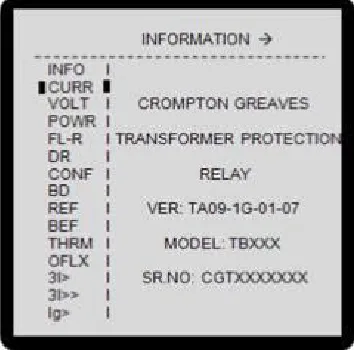
160*160 size. The purpose of this display is to show the configuration and parametrization values of the relay.
LCD display contains main menu at left most side and submenu. By using up and down key from keypad first we have to select main menu and according to the main menu different submenu related to that are selected.
Figure 5: LCD Display II
Fault that is occur in equipment that we want to protect it get display on LCD screen by American National Standard Institute numbers. Different faults have different numbers. These numbers are like:
Figure 6: Fault Numbers and their protection functions
4. Menu navigation and pointers:
Use the arrow keys UP and DOWN to move up and down in the main Menu which is on the left side of the display, the active main menu option is indicated with a cursor. The options in the main menu are abbreviations. Ex: INFO (Information)
After any selection in the Main Menu, the possible navigating directions are indicated on the top of the Display window by arrows.
The complete description of the selected menu is indicated on the top of Display window.
UP/DOWN Keys to navigate in Main Menu, to Increase/Decrease Numerical Values and for En-able/Disable operations.
RIGHT/LEFT Keys to navigate in Sub-menu.
ESC Key to cancel the current selection and to reset the output relays/LED.
edit & save the changed value.
CLOSE key is to close the breaker from the relay.
TRIP key is to trip the breaker from the relay.
6. SINGLE-CHIP USB TO UART BRIDGE (CP2102): The CP2102 is a highly-integrated USB-to-UART Bridge Controller providing a simple solution for updating RS-232 designs to USB using a minimum of components and PCB space. The CP2102 includes a USB 2.0 full-speed function controller,USB transceiver, oscillator, EEPROM, and asynchronous serial data bus (UART) with full modem control signals in a compact 5 x 5 mm MLP-28 package. No other external USB components are required.The on-chip EEPROM may be used to customize the USB Vendor ID, Product ID, Product Description String,Power Descriptor, Device Release Number, and Device Serial Number as desired for OEM applications. The EEPROM is programmed on-board via the USB allowing the programming step to be easily integrated into the product manufacturing and testing process.
Its features are depicted as follows:
Integrated USB transceiver; no external resistors required
Integrated clock; no external crystal required
Integrated 1024-Byte EEPROM for vendor ID, product ID, serial number, power descriptor, release number, and product description strings
On-chip power-on reset circuit
On-chip voltage regulator: 3.3 V output
100% pin and software compatible with CP2101
7. USB: The Front port of the relay is a standard USB port provided to communicate with PC. This port is used for relay configuration, downloading fault, event and disturbance records.
8. Low Dropout Voltage Regulator(KA78R05): The KA78R05 is a low-dropout voltage regulator suitable for various electronic equipment. It provides constant voltage power source with TO-220 4 lead full mold package.Dropout voltage of KA78R05 is below 0.5V in full rated current (1A). This regulator has various function such as peak current protection, thermal shut down, over voltage protection and output disable function.
Its features are as follows:
1A / 5V Output low dropout voltage regulator TO220 Full-Mold package (4PIN)
Overcurrent protection, Thermal shutdown
Overvoltage protection, Short-Circuit protection With output disable function
IV.APPLICATIONS
Differential protection with dual slope characteristics used for the protection of two winding distribution power trans-former.
Protection of Auto Transformer.
Different frequency stages used for the load shedding applications.
Other than differential remaining protections can be used as backup protection.
Protection Relays are microprocessor based relays. It analyzes power system voltages, currents or other process quantities for the purpose of detection of faults in an industrial process system. Power grid is extensively using Numerical relays for protection schemes of all new Lines & substations. Numerical relays simplify interfacing with CTs and VTs.
V.RESULTS
A relay is an electrically operated switch. Relays are used where it is necessary to control a circuit by a low-power signal (with complete electrical isolation between control and controlled circuits), or where several circuits must be con-trolled by one signal.The graphical user interface (GUI) is the single most important element of the overall Relay Assistant design.Its functions for test and waveform handling as well as, signal processing and displaying affect the productivity of the simulator user tremendously.GUI provides the required software/hardware transparency. Numerical Protection Relays are microprocessor based relays. It analyzes power system voltages, currents or other process quantities for the purpose of detection of faults in an industrial process system. Power grid is extensively using Numerical relays for protection schemes of all new Lines & substations. Numerical relays simplify interfacing with CTs and VTs. Considerable improvement in relay security espe-cially if the voltage signals are available.
REFERENCES
[1] B. Biswas, Member IEEE, K. D. Bhattacharya, Member IEEE, P. Purkait, Member, IEEE and J. K. Das Design of a Numerical Adaptive Relay Based on Memory Mapped Techniques, Proceedings of the International MultiConference of Engineers and Computer Scientists Hong Kong-2009.
[2] Prakash R. Kolhe, Gajanan P. Khetri, Research Scholar, Department of Computer Science, Singhania University, Rajasthan,India. Dr. N. K. Deshmukh, Assistant Professor,Department of Computer Science, S. R. T. M. University, Nanded, Maharashtra, India, Study of Standard Assumptions of Graphical User Interface (GUI) Based on Usability, Adaptability and Security Factors, International Journal of Emerging Research in Management & Technology, ISSN: 2278-9359.
[3] Reena Saini, Department of Computer Science and Engineering, B. K. Birla Institute of Engineering and Technology, Pilani, Rajasthan, India Graphical User Interface Design Essentials and Process, International Journal of Advanced Research in Computer Science and Software Engineering, Volume 3, Issue 9, September 2013 ISSN: 2277 128XB. Smith, “An approach to graphs of linear forms (Unpublished work style),” unpublished.(9)