184 |
P a g e
Study of Structural And Mechanical Properties of
Tungsten Carbides, Coatings With Different Cutting
Performance of Multilayer Diamond Coated Silicon
Nitride Inserts in Machining Aluminum−Silicon Alloy
M.Yugandhar
1, R.Siva Prasad
2V.Sitaramireddy
3, Dr.B.Prabhakar Kammar
41.
Associate Professor with HOD & Research scholar in -VTU, Department of Mechanical
Engineering, Newtons institute of science and technology College,Guntur,AP,(India)
2
Assistant professor - Department of Mechanical Engineering, Newtons institute of science and
technology College,Guntur,AP,(India)
3.Assistant professor - Department of Mechanical Engineering, Newtons institute of science and
technology College,Guntur,AP,(India)
4.New Horizon Engineering College –Professor in Mechanical Department
ABSTRACT
185 |
P a g e
Keywords: Thin films, RF magnetron sputtering, Coating, tungsten carbides, aluminum−silicon
alloy , multilayer diamond films; silicon nitride; cutting performance .
I. INTRODUCTION
185 |
P a g e
Table 1.In this work, nano-microcrystalline diamond films,namely MCD/NCD coating, were deposited to evaluatetheir cutting performances. The monolayer MCD andNCD films were also produced for comparison underconditions A and B, as shown in Table 1, respectively.For depositing MCD/NCD film, a layer of fine-grainedMCD film was deposited on the silicon nitride substratefirstly under the condition A. Thereafter, the surface ofas-deposited MCD film was polished with diamond grits(50 μm) and subsequently a layer of NCD film was deposited on the polished surface under the condition B.Field emission scanning electron microscope (FE-SEM) was employed to characterize the surface morphology of coatings. The identification of diamond and graphitic phases was done by Raman spectroscopy at room temperature. Carbides, particularly of the transition metals, have a number of valuable properties, which make them the most promising materials for use in various new fields of technology [1]. They are widely used in cutting tools, tools resistant to wear, brasive and hard coatings [2]. They are also used for catalytic applications, (similar to the noblemetals) [3]. Tungsten carbide is one of these carbides throughout these years. The coatings of pure tungsten carbide, or alloyed with cobalt or iron tungsten carbide, exhibit high wear resistance and low friction [4,5].Furthermore, their hardness at high temperatures is out standing [6]. Tungsten carbide is also highly corrosionresistant in acidic media. Owing to its high-temperature stability, chemical inertness and good electrical conductivity, tungsten carbide is a promising thin film diffusion barrier material for the microelectronic devices designed to function at sustained elevated temperature and in hostile environments [7].The investigation of thin layers for hard coatings or electrical applications requires the preparation of a homogeneous material. However, tungsten carbide exists indifferent phases, most important are WC and W2C [8].Although the W2C phase is unstable below 1300°C [8],normally a mixture of both WC and W2C was found by most of the thin layer techniques like sputtering [9,10] and reactive sputtering [11,12], chemical vapor deposition (CVD) [13], solid-phase reaction [14] and ion beamsynthesis [15].In the present work, we have formed thin hard coatings of tungsten carbides. The samples are thin layers of tungsten deposited by RF magnetron sputtering on steel substrate. The samples were submitted to thermal annealing in vacuum, at various temperatures (650-1100°C). The formation of tungsten carbides, the evolution of the microstructure and the morphology of the surface of samples were followed by X-ray diffraction (XRD) and scanning electron microscopy (SEM). The measurements of micro-hardness were carried out by Vickers tests.
II. EXPERIMENTAL DETAILS
One series of samples (thin layer of tungsten / steel substrate XC70) are prepared. The thin layers of tungsten(6 μm) are deposited by RF magnetron sputtering in a vacuum 10-7 mbar 650°C.After the deposition process, samples (W layer &substrate) were submitted to thermal annealing in vacuum,at various temperatures (650-1100°C) and during different times.
2.1 Multilayer Diamond Coated Silicon Nitride Inserts
186 |
P a g e
films were fabricated by HFCVD technique in a home-made bias-enhance apparatus. Six pair-twisted tantalum wires were used as the hot filaments, and all of them were dragged to be straight by the high temperature springs in equidistance and parallel manner. The substrates were put below the filaments, and the distance between the filaments and substrates was fixed at about 12 mm. A DC bias was applied between the filaments and substrates so as to enhance the diamond nucleation density. The detailed deposition parameters are listed in Table 1. In this work, nano-microcrystalline diamond films, namely MCD/NCD coating, were deposited to evaluate their cutting performances. The monolayer MCD and NCD films were also produced for comparison under conditions A and B, as shown in Table 1, respectively.For depositing MCD/NCD film, a layer of fine-grainedMCD film was deposited on the silicon nitride substrate firstly under the condition A. Thereafter, the surface ofas-deposited MCD film was polished with diamond grits (50 μm) and subsequently a layer of NCD film wasdeposited on the polished surface under the condition B.Field emission scanning electron microscope(FE-SEM) was employed to characterize the surface morphology of coatings. The identification of diamondand graphitic phases was done by Raman spectroscopy at room temperature.
2.2 Machining test
Dry machining tests were performed in an industry facility, INDEX G200 turning machine, which is a highperforming CNC multi operations millturn lathe with 10 controlled axes (including Y- and B-axis) and counterspindle, bar capacity 60 mm and 28 tool stations (14 in each revolver) with every station equipped for bothrotating and rigid tools. All of the inserts were mounted on PSSNR2020K12 tool holder. Aluminum−silicon (Al−Si) alloy with about 14% silicon was used as the work piece material because the trend to substitute thesteel and cast iron vehicle components by Al−Si light alloy is part of the effort to allow improved fuel economy and lower the emissions of pollutants. On the other hand, such material is also suitable for machining studies because it has a tendency to form considerable dust during machining due to the presence of hard Si-rich phase particles in the alloy matrix [7]. Experimental results indicate that the cutting performance of Al−Si alloy is widely influenced by the silicon content. Increasing amount of Si results in harder, stiffer and more wear resistant alloy. However, Si contents above 12% result in extremely abrasive materials withdetrimental effects on their workability and on the wear of the tools used to shape them [17]. Thus, Al−Si alloy is very difficult to machine, and many machining experiments suggested that diamond tools are considered the best choice for the machining of these materials. In our following tests, the cutting parameters were set as follows: cutting speed of 350 m/min; cutting depth of 0.4 mm; feed rate of 0.1 mm/r.Tool wear was conducted to evaluate cutting performance of inserts. The criterion used for the tool wear measurement was the maximum width of the flankwear width because the tool was not regularly worn and chipping was the major reason for the failure [7]. Thelifetime of the examined insert is evaluated by the flank wear where one insert will be thought as failure once its
tool wear surpasses 0.3 mm or the diamond coating peels off from the substrate. All measurements were taken near the nose radius. Prior to the wear measurement, the hydrofluoric acid was used to etch off the workpiecematerial that was adhering to the edge of the tool. The tool wear of the insert was evaluated in an analysis of theimages of the flank wear using a tool microscope. All of values were measured after each turning 375 m of cutting length by a digital image processing system. Then the terminal flank wear was examined by measuring scars that appeared on the cutting edge with FE−SEM.
187 |
P a g e
condition Volumefraction of
acetone /H2/Ar
Pressure /kPa Deposition
temperature /ºc
Filament
temperature /ºc
Bias current /A Duration/h
Condition A
(for MCD
films)
1.6/97.5/0 4-5 800-850 2200±100 3 6
Condition B
(for MCD
films)
188 |
P a g e
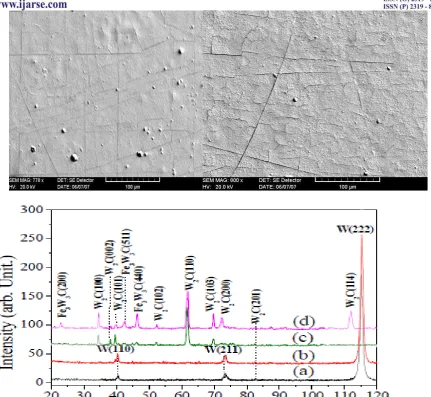
SEM surface images of the samples [W (8μm)/XC85]: before (a)and after annealed during 30 min at 800°C (b), 1000°C (c) and 1100°C (d).
III. RESULTS AND DISCUSSION
3.1 Analysis by X-rays diffraction (XRD)
189 |
P a g e
3.2. Study of Surface Morphology
The study of the morphology of the samples by SEM also shows that the surface morphology of samples angleswith the time and the temperature of annealing. The figure 2 illustrates the images obtained with the SEM.In the case not-annealed and annealing at 700°C during 30 min (fig. 2.a & b) the surface of the samples is relatively smooth, but it presents small white particles. After an annealing with 900°C during 30 min (fig. 2.c), the surface morphology changes with the appearance of the cracks on the surface of the samples W( 8μm)/XC85.The annealing at 1100 ° C for 30 min caused a remarkable increase of the cracks (fig. 2.d). This may be related to the reaction between the substrate and the thin layers of W
3.3. Micro-Hardness Measurements
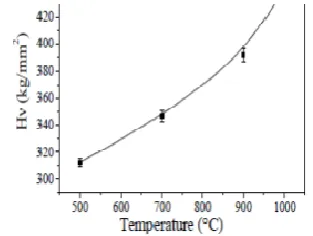
Figure 3 shows the variation of microhardness (Hn) of the samples as a function of annealing temperature. It is clear that micro-hardness increases slightly with annealing temperature. The value of micro-hardness of not-annealed sample equals 312 kg/mm2 (value comparable to that of solid tungsten) [8]. However, after annealing the values of microhardness are distinct: for example the samples annealed at 900°C for 30 minutes increased the microhardness up 392 kg/mm2. At 1000°C/30min microhardness was maximum and takes the value 442 kg/mm2.This increase is due, probably, to the formation and growth of W2C carbide. On also note that the values of microhardness throughout the annealing temperatures are lower than those of massive carbides WC (~2000kg/mm2)
,
190 |
P a g e
3.1 Characterization of as-Deposited Diamond Films
Figure 1 shows the surface morphologies of as-deposited diamond films. For the monolayer NCD film, the E−SEM image of its surface (Fig. 1(a)) shows that the substrate is covered by a layer of NCD filmswith diamond grains in nanometric level. Figure 1(b) shows the surface morphology of the monolayer MCDfilm, which indicates the typical features of conventional microcrystalline diamond coating with highly facetedgrains and the columnar structures. For MCD/NCD film,firstly, a layer of MCD film is deposited on the siliconcarbide insert. This layer of MCD film can facilitate adhesion strength enhancement of deposited multilayerdiamond films on silicon carbide substrate due to the mechanical interactions between diamond and SiC grainsof substrate [15]. The surface morphology suggests that the MCD film has a columnar structure, originating from large diamond grains at the free surface (Fig. 1(c)). These are responsible for the high values of roughness.Therefore, the as-deposited MCD film was polished with diamond grits in order to produce a flat surface. Subsequently, a layer of NCD film was deposited on this polished MCD film. Then, the surface morphology ofas-deposited MCD/NCD film can be seen in Fig. 1(d), which shows that the micron-sized diamond grains are
completely covered by many nano-sized diamond crystallites. It is clear that MCD and NCD films have avery distinct kind of structure as grain growth is suppressed by decreasing the atomic H density with theincrement of partial substitution by Ar, thus increasing the renucleation of diamond [6]. The cross-sectionalSEM image (Fig. 1(e)) indicates a thickness of 12–14 μm for the deposited MCD/NCD film.The quality of as-deposited coatings was examined by their physical properties by the corresponding Raman signatures. The typical NCD features present in the Raman spectrum of as-deposited NCD and MCD/NCD films, as presented in Fig. 2. A significantly broadening peak near 1332 cm−1 can be observed due to the decreasein grain size and phase purity, which is indicative of sp3diamond. Another peak located at approximately 1560cm−1, which can be assigned as the G band (1550−1580cm−1) [18,19], is responsible for the contribution fromthe sp2 component. The presence of scattering intensityat 1560 cm−1 is due to increasing graphite-like sp2bonded components at the grain boundaries in films. Onthe other hand, the Raman spectrum for the monolayerMCD film shows a sharp peak located in 1335 cm−1 andno graphitic peaks, which reveals the high purity andexcellent quality of the film. The shift between the sharppeak and the diamond peak (1332 cm−1) is associatedwith the residual stress of the MCD film [20].
3.2 Cutting Performance of as-deposited Multilayer
diamond films
191 |
P a g e
192 |
P a g e
IV. CONCLUSION
According to the results obtained in this study, we can conclude that it is possible to work out hard tungstencarbide coatings by indirect method consists the coating of a steel substrate, rich in carbon by a layer of tungsten, then the annealing of together to support the diffusion of carbon and the formation of carbides with tungsten. The thermal annealing of the samples leads to the formation of the carbide W2C but with a lower growth rate for the thin layer of thickness 8 μm. The morphology of surface and the micro hardness also depends on the thicknesses of the thin layers of tungsten. 1) Multilayer diamond films are deposited onsilicon nitride inserts with a mixture of acetone,hydrogen and argon as the reactant gas by the HFCVDmethod. Double-layer structure (MCD/NCD) is fabricated initially by the deposition of the rough
193 |
P a g e
havehigh surface smoothness.2) For comparative purpose, the uncoated insert and monolayer NCD and MCD coated inserts are also adopted in this work. The respective coating structure results in dissimilar cutting performance in dry turning of Al−Si alloys at 350 m/min of cutting speed, 0.4 mm of cutting depth and 0.1 mm/r of feed. The MCD/NCD coated insert exhibits the prefect behavior as tool wear.
For this coating, the flank wear is very low after turning 3000 m of cutting length and no diamond peeling occurs. The performance of the monolayer MCD coated insert is slightly inferior due to the high hardness. Theconventional monolayer NCD film, featured by a cauliflower-like morphology, suffers the coating peelingfrom its lower adhesion between diamond coating and substrate. 3) Compared with the uncoated inserts, themultilayer diamond film can protect inserts from suffering severe wear due to its extremely high hardnessand unique wear resistance, and plays a decisive role in prolonging the lifetime of the inserts.
REFERENCES
[1] R. Koc, S. K. Kodambaka, Journal of the European Ceramic Society20 (2000) 1859. [2] J. Esteve, E. Martinez, G. Zambrano and P. Prieto, Superficies &Vacio, 9 (1999) 276. [3] C. Liang1, F. Tian1, Z. Wei1, Q. Xin and Li Can, Nanotechnology,14 (2003) 955. [4] K.A. Taylor, Thin Solid Films 40 (1977) 189.
[5] E. Eser, R.E. Ogilvie, K.A. Taylor, J. Vac. Sci. Technol. 15(2) (1978)396.
[6] P. Dubcek, N. Radic, O. Milat, S. Bernstorff, Surface and CoatingsTechnology 151/152 (2002) 218. [7] H.-Y. Yang, X.-A.Zhao, M.-A.Nicolet, Thin Solid Films 158 (1988)45.
[8] H. Romanus, V. Cimalla, J.A. Schaefer, L. Spie, G. Ecke, J. Pezoldt;Thin Solid Films 359 (2000) 146. [9] G. Keller, R. Erz, I. Barzen, M. Weiler, K. Jung, H. Ehrhardt;Vacuum 41(4/6) (1990)1294.
[10] P. Gouy-Pailler, Y. Pauleau , J. Vac. Sci. Technol. A 11(1) (1993) 96.
[11] N. Radic, B. Grzeta, O. Milat, J. Ivkov, M. Stubicar, Thin Solid Films320 (1998) 192. [12] P.K. Srivastava, V.D. Vankar, K.L. Chopra, Bull. Mater.Sci. 8(3)(1986) 379. [13] C. M. Kelly, D. Garg, P.N. Dyer; Thin Solid Films, 219 (1992) 103.
194 |
P a g e
[15] H. Weishart, V. Heera, W. Matz, W. Skorupa, Diamond Rel. Mater. 6(1997) 1432.
[16] Pierson, Hugh O., Handbook of Chemical Vapor Deposition (CVD):Principles, Technology, and Applications, Published in the United States of America by Noyes publications, 1992
[17] Stephen W. H. Yih, Chun T. Wang, “Tungsten: sources, metallurgy,properties, and applications” Plenum Press, New York ,1979.
[18] KOPF A, FEISTRITZER S, UDIER K. Diamond coated cutting toolsfor machining of non-ferrous metals and fibre reinforced polymers [J]. International Journal of Refractory Metals & Hard Materials,2006, 24: 354−359.
[19] AMARAL M, OLIVEIRA F J, BELMONTE M, FERNANDES A J S,COSTA F M, SILVA R F. Tailored Si3N4 ceramic substrates for CVD diamond coating [J]. Surface Engineering, 2003, 19: 410−416.
[20] BELMONTE M. Diamond coating of coloured Si3N4 ceramics [J].Diamond and Related Materials, 2005, 14: 54−59. [20] XU Feng, ZUO Dun-wen, LU Wen-zhuang, ZHU Yong-wei, WANG Min. Grid and substrate bias effects on
mechanical properties ofdiamond films prepared by HFCVD [J]. Transactions of Nonferrous Metals Society of China, 2009, 19: s722−s726.
[21] CABRAL G, REIS P, TITUS E, MADALENO J C, DAVIM J P,GRACIO J, AHMED W, JACKSON M J. Impact of surfaceroughness of diamond coatings on the cutting performance when drymachining of graphite [J]. International Journal of Manufacturing Technology and Management, 2008, 15: 121−152.
[22] ALMEIDA F A, AMARAL M, OLIVEIRA F J, SILVA R F.Machining behaviour of silicon nitride tools coated with micro-,submicro- and nanometric HFCVD diamond crystallite sizes [J].Diamond and Related Materials, 2006, 15: 2029−2034.
[23] ARUMUGAM P U, MALSHE A P, BATZER S A. Dry machining ofaluminum−silicon alloy using polished CVD diamond-coated cutting tools inserts [J]. Surface & Coatings Technology, 2006, 200:3399−3403.
[24] QIN F, HU J, CHOU Y K, THOMPSON R G. Delamination wear of nano-diamond coated cutting tools in composite machining [J]. Wear,2009, 267: 991−995.
[24] ALMEIDA F A, SACRAMENTO J, OLIVEIRA F J, SILVA R F.Micro- and nano-crystalline CVD diamond coated tools in the turning of EDM graphite [J]. Surface & Coatings Technology, 2008,203: 271−276.
[25] HU J, CHOU Y K, THOMPSON R G. Nanocrystalline diamondcoating tools for machining high-strength Al alloys [J]. International Journal of Refractory Metals & Hard Materials, 2008, 26: 135−144.
[26] HU J, CHOU Y K, THOMPSON R G, BURGESS J, STREET S.Characterizations of nano-crystalline diamond coating cutting tools [J]. Surface & Coatings Technology, 2007, 202: 1113−1117.
[27] LIANG Q, VOHRA Y K, THOMPSON R. High speed continuousand interrupted dry turning of A390 aluminum/silicon alloy using nanostructured diamond coated WC-6 wt.% cobalt tool inserts byMPCVD [J]. Diamond and Related Materials, 2008, 17: 2041−2047.
[28] ALMEIDA F A, AMARAL M, OLIVEIRA F J, FERNANDES A J S,SILVA R F. Nano to micrometric HFCVD diamond adhesion strength to Si3N4 [J]. Vacuum, 2007, 81: 1443−1447.
[29] SHEN B, SUN F H. Deposition and friction properties ofultra-smooth composite diamond films on Co-cemented tungsten carbide substrates [J]. Diamond and Related Materials, 2009, 18:238−243.
[30] SUN F H, ZHANG Z M, CHEN M, SHEN H S. Improvement ofNai-chao CHEN, et al/Trans. Nonferrous Met. Soc. China 23(2013) 1985−1992adhesive strength and surface roughness of diamond films onCo-cemented tungsten carbide tools [J]. Diamond and Related Materials, 2003, 12: 711−718.
195 |
P a g e
[32] CASTRO G, ALMEIDA F A, OLIVEIRA F J, FERNANDES A J S,SACRAMENTO J, SILVA R F. Dry machining of silicon−aluminium alloys with CVD diamond brazed and directly coated Si3N4 ceramictools [J]. Vacuum, 2008, 82: 1407−1410.
[33] PRAWER S, NEMANICH R J. Raman spectroscopy of diamond anddoped diamond [J]. Philosophical Transactions of the Royal Society of London Series A: Mathematical Physical and EngineeringSciences, 2004, 362: 2537−2565. [34] ROY D, BARBER Z H, CLYNE T W. Ag nanoparticle inducedsurface enhanced Raman spectroscopy of chemical
vapor deposition diamond thin films prepared by hot filament chemical vapour deposition [J]. Journal of Applied Physics, 2002, 91: 6085−6088.
[35] FERREIRA N G, ABRAMOF E, CORAT E J, TRAVA-AIROLDI V J.Residual stresses and crystalline quality of heavily boron-doped diamond films analysed by micro-Raman spectroscopy and X-raydiffraction [J]. Carbon, 2003, 41: 1301−1308.
[36] MALLIKA K, KOMANDURI R. Low pressure microwave plasmaassisted chemical vapor deposition (MPCVD) of diamond coatings on silicon nitride cutting tools [J]. Thin Solid Films, 2001, 396:145−165.
[37] NESLADEK M, VANDIERENDONCK K, QUAEYHAEGENS C,KERKHOFS M, STALS L M. Adhesion of diamond coatings on cemented carbides [J]. Thin Solid Films, 1995, 270: 184−188.