Idiosyncratic Gap: A Tough Prolem to Structure-bound Machine Translation
Yoshihiko Nitre
Advanced Research Laboratory Hitachi Ltd.
Kokubunji, Tokyo 185 Japan
ABSTRACT
Current practical machine translation systems (MT,
in s h o r t ) , which a r e d e s i g n e d t o d e a l w i t h a h u g e a m o u n t o f d o c u m e n t , a r e g e n e r a l ] y s t r u c t u r e - b o u n d . T h a t i s , t h e t r a n s l a t i o n p r o c e s s i s d o n e b a s e d o n t i l e analysis and transformation of the structure of source sentence, not on the understanding and para-
phrasing of the meaning of that. But each language
has its own :~yntactic and semantic idiosyncrasy, and on this account, without u n d e r s t a n d i n g the total mean- ing of source sentences it is often difficult for MT to bridge properly the idiosyncratic gap between
source~ and target- language. A somewhat new method
called "Cross Translation Test (CTT, in short)" is presented that reveals the detail of idiosyncratic gap (IG, in short) together with the so-so satis-
fiable possibility of MT. It is also mentioned the
usefulness olf sublanguage approach to reducing the IC between source- and target- language.
i. Introduct:ion
The majoJ:[ty of the current practical machine translation system (MT, in short) (See [Nagao 1985] and [Slocum 11.985] for a good survey.) are structure- bound in tile sense that al] the target sentences (i.e.
translated ,~entences) are composed only from the syntactic st:ructure of the source sentences, not from
the m e a n i n g understanding of those. Though almost
all tile MT are utilizing some semantic devices such as semantic feature agreement checkers, semantic filters antl preference semantics (See [Wilks 1975] for example.) which are serving as syntactic structur- al disambiguation, they still remain Jn structure- hound approaches far from tile total[ meaning under- standing approaches.
]?he structure-bound MT has a lot of advantageous features among which the easiness of formalizing translation process, that is, w r i t i n g translation rules and the uniformity of lexicon description are vital from the practical standpoint that it must transact a huge v o c a b u l a r y and ]numerable kinds of sentence patterns.
On the other hand, the structure-bound MT has the inewttable limitation on the treatment of lingu:istic idiosyncrasy originated from the different way of" thinking.
In this paper, first of all, we will sketch out the typical language m o d e l i n g techniques on which the structure-bound M T ( = current practical machine
translation systems) are constructed. Secondly, we
will examine the difference between the principal m e c h a n i s m of machine translation and that of human translation irom the viewpoint of the language under-
standing abi]ity, l'hirdly, we will illustrate the
structural idiosyncratic gap (IG, in short) by com- paring the sample sentences in English and that in
,lapanese. These sentences are sharing the same reCall-
ing. This comparison will be made by a somewhat new
method which we call "Cross Translation Test (CTT, in short)", which will cventual]y reveal the various IGs that have origins in the differences of culture, i.e., the way of thinking or the way of representing con- cepts. But at" the same Lime, CTT wiJl give some encouraging evidence that the principal technologies of today's n o t - y e t - c o m p l e t e d structure-bound HTs have the potentia] for producing barely acceptable trans- lation, if the source language sentences are taken from tile documents of less equivocations or are ap-
propriately rewritten. Finally, we will briefly
comment on the sub]anguage to control or normalize source sentences as the promising and practical ap- proaches to overcoming the IGs.
2. Modelin~ of Natural L a n ~
Modeling natural, language sentences is, needless to say, very essential to all kinds of natural language processing systems inclusive of machine
translation systems. The aim of mode]ing :is to
reduce the superficia] complexity and variety of the sentence form, so as to reveal the indwell:Lug struc- ture which is indispensable for computer systems to analyze, to transform or to generate sententia] .representations.
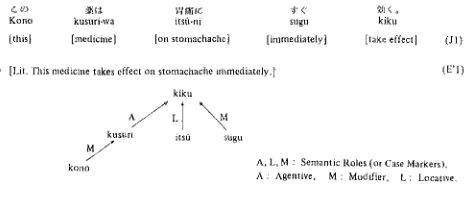
So far various modeling techniques are proposed (See for example [Winograd 1.983].) among which the two, tile dependency structure modeling (Figure l) and the phrase structure modeling (Figure 2) are impor-
tant. The former associated with semantic cole
labeling such as case marker assignment i s indispen-
sable to analyze and generate Japanese sentence strueture (See for example ]Nit,a, et all. 1984].), and the latter associated with syntactic rote label- ing such as governor-dependent assignment, head-com- plement assignment, or m o t h e r - d a u g h t e r assignment (See for example [Nitta, et el. 1982].) is essential to analyze and generate English sentences.
Kono kusuri-wa itsft.rli sugu
(thisj [medicine] [on stonmchache} [immediately I
[Lit. Fhis medicine takes effect on stomachache mlmediately.l kiku
Afr T
kusuri itsu sugu
[image:1.612.302.534.580.681.2]k o n o
Figure 1.
kiku
[take effect] ( J l )
(E':)
A, L, M : S e m a n t i c Roles (or Case Markers), A : ABeRIwe, M : Modifier, L : Locative
Example for Dependency Structure Modelin!!
machine translation. But it might be fairly asserted that the majority of the current "practical" machine translation systems (MT, in short)are structure-bound or syntax-oriented, though almost all of them claim
that they are semantics-directed. Semantics are used
only for disambiguation and booster in various syntactic processes, but not used for the central engine for transformation, generation and of course not for paragraph understanding (See [Slocum 1985, pp. 14 ~16] for a good survey and discussion on this problem; and see also [Nitta, et al. 1982] for the discussion on a typical (classical) structure-bound translation mechanism,i.e, local rearrangement method). Here "practical" means "of very large scale commercial systems" or "of the daily usage by open
users", but neither "of small scale laboratory sys- tems" nor "of the theory-oriented experimental sys-
tems". For structure-bound machine translation
systems, both the dependency structure modeling and the phrase structure modeling are very fundamental technical tools.
* This medicine has an immediate effect on stomachache. ( E l )
° [Lit. Co) ~1~ FHi~a) &l£-~/-lk¢9 I~ ~ / l ~ t z ~.~C~,~To.] (J'l) Kono kusuri-wa itsft no ue-nl subayai kikime-wo mottedm.
S
NP
Ni P PIP
(SUB J) (I'RH)) (On J) (ADV)
Ttlis medicine has an immediate effect on stonlachache.
SUB J, PRED, OBJ, ADV : Syntactic Roles.
[image:2.612.80.309.106.435.2] [image:2.612.332.560.254.564.2]SUBJ: Subject, PRED: Predicate llead, OBJ: Object. ADV: Adverbial.
Figure 2. Example of Phrase Structure Modeling
The semantic network medeling, which is recently regarded as an essential tool for semantic process- ing for natural languages (See for examples
[SimmOns 1984].), might also be viewed as a variation
of dependency modeling. However modeling problems
are not discussed further here. Comparing Figure 1
and Figure 2, note that the dependency structure modeling is more semantics-oriented, logical and abstract, in the sense of having some distance from surface word sequences.
3. Machine Translation vs. lluman Translation
Today's practical machine translation systems (MT, in short) (See for example [Nagao 1985] and [Slocum 1985].) are essentially structure-bound ]iteral type. The reasons for this somewhat extreme judgement are as follows:
(i) The process of MT is always under the strong control of the structural information extracted from source sentences;
(2) In all the target sentences produced by MT, we can easily detect the traces of wording and phrasing of the source sentences;
(3) MT is quite indifferent to whether or not the output translation is preserving the proper meaning of the original sentence, and what is worse, MT is incapable of judging whether or not;
(4) MT is quite poor at the extra-sentential infor- mation such as situational information, world knowledge and common sense which give a very powerful command of language comprehension.
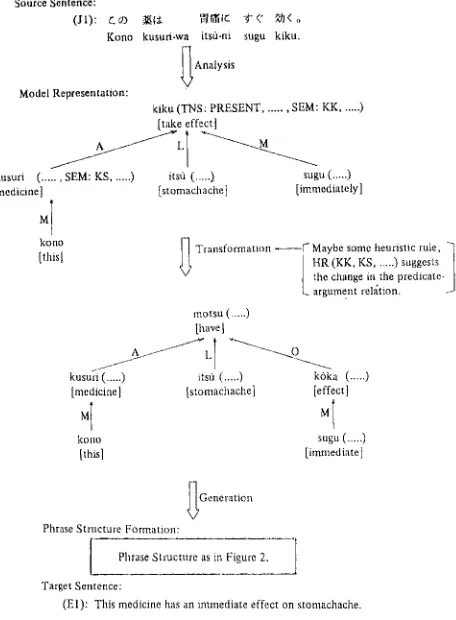
Now let us see Figure 3. This rather over-
simplified figure illustrates the typical process of Japanese-English structure-bound machine translation. Here the analysis and transformation phase are based on the dependency structure modeling (cf. Figure i) and the generation phase is based on the phrase structure modeling (cf. Figure 2) (For further details, see for example [Nitta, et al. 1984].). This figure reveals that all the process is bound by the grammatical structure of the source sentence, but not by the meaning of that.
Source Sentence:
Kono kusuri-wa itsu-ni sugu kiku.
~
A n a l y s i s M o d e l Representation:kiku (TNS: PRESENT ... . ... SEM: KK, ...) [take effect]
kusuri ( ... SEM: KS, ...) [medicine]
kono [this]
itst~ (...) sugu (...)
[stomachache] [immediately]
Transformation - - [ " Maybe some heuristic l'ule, HR (KK, KS, ...-) suggests ] the change m the predicate-] L argument relation. 3 motsu (,...)
[have l
kusuri (_...) itsu (...) k6ka (...-)
[medicinel [stomachache] [effect]
M!
M l
kono sugu (...,.)
[this] [immediate]
~
Genelation Phrase Structure Formation:Target Sentence:
(El): This medicine has an immediate effect on stomachache.
Figure 3. Simplified Sketch of Machine Translation Process
Thus, the MT can easily perform the literal syntax-directed translation such as 'from (Jl) into
(E'I)' (cf. Figure i). But it is very very dif-
ficult for MT to produce natural translation which reflects the idiosyncrasy of target language) pre--
serving the original meaning. (El) is an example of
a natural translation of (J1). In order for MT to
produce this (El) from (Jl), it may have to invoke
a somewhat sophisticated heuristic rule. In Figure
3, the heuristic rule, HR (KK, KS, ...), can sucess- fully indicate the change of predicate which may improve the treatment for the idiosyncrasy of target sentence.
But generally. , the treatment of idiosyncratic gap
is very difficult for MT. It m i g h t ' b e almost im- possible to find universal grarmnatical rules to manipulate this kind of gaps, .and what is worse, the appropriake heuristic rules are not always found successfully.
On the other hand, tile human translation (HT, in short) is essentially semantics-oriented type or meaning u n d e r s t a n d i n g type. 3?he reasons for this judgement are as follows:
(i) HT is free from the structure, w o r d i n g and phrasing of a source sentence;
(2) liT can "create" (rather than "translate") freely a target sentence from something like an image (Hagram obtained froln a source sentence (F~gure 4); (Of course the exact structnre of th].q image diagram is not yet known);
(3) }IT often refers tile extra-linguistic knowledge f~uch a s t h e common s e n s e a n d t h e c u l t u r e ; ( 4 ) T h u s , tIT cart o v e r c o m e t h e i d i o s y n c r a t : i c g a p s
( ] G ) f r e e l y a n d u n c o n s c i o u s l y .
Source Sentence(s) . . . ~/ b m " n g \
[
hkc \
[ Image Diagram )
Citation \ [ What tile source ] ]
Iarget Sentence(s) . . . - ~ ~e.Uence(s)nlean(s)/
• . ~ % _ . ~ _ _ J
Fiqure 4. Human ]'ra.slation Process
m e a n i n g b u t e a c h o f w h i c h b e ] . o n g s t o d i f f e r e n t l a n g u a g e . The r e a s o n f o r c o m p a r i n g t i l e two s e n - t e n c e s i s t h a t we c a n n o t : e x a m i n e t h e l i n g u i s t i c
idiosyncrasy itself. Because, currently, we cannot
fix the one abstract neutral m e a n i n g without using something like the image diagram (cf. Figure 4) w h i c h is not yet elucidated.
In order to examine tlm idiosyncratic gap, we have devised the practical method named "Cross
Translation Test (CTT, in short)." The outline of
CTT is as follows:
]first, take an appropriate w e l l - w r i t t e n sample sentence w r i t t e n in one language, say English; Let E denote this sample sentence; Secondly, select or make the proper free translation of E in the other ].anguage, say Japanese; ],et J denote this proper free translation; J must preserve tile orlginal mean- ing of E properly; At the same time, make a literal Lrans].tion of F, in the same language that ,] is w r i t t e n in; Let J' denote this literal translation; Lastly, make a Literal translation of J in the same language.that E is w r i t t e n in; Let E' denote tM.s literal translation.
iIere, the "literal" translation means the transla-
tion that :[.s preserving the wording, phras:ing and
various senteatial structure of the original (source) s e n t e n c e a s much a s p o s s i b l e . T h e n , e v e n t u a l l y we may b e a b l e t o d e f i n e ( a ~ d e x a m i n e ) t h e i d i o s y n c r a t i c g a p , ].C, by F i g u r e 5. Iu. o t h e r w o r d s , we may b e a b l e t o exam:ine a n d g r a s p t i l e i . d i . o s y n c r a t i e g a p b y c o m p a r -
l.ng ]:he s t r u c t u r e o f 1)', a n d t h a t ot! 1,',', o r b y c o m p a r i n g t h a t o f j i a n d t h a t o f J .
[n order {:o s:imp]ify the arguments, let us assume
Lhat some kind of diagram is to be :[nvokezd item ]:he
understaadiing of the original scntence. 'I/his d:iagram
may ( o r s h o u l d ) b e c o m p l e t e l y f r e e f r o m t h e s o p c r - f i c t a ] s t r u c l n r e s u c h a s w o r d i n g , p h r a s ~ n F , , s u b j e c t - o b j e c t r e l a t i o n a n d so o n , and may be s t r e n g t h e n e d and rood:irked l)y v a r l e u s e x C r a - - ] i u g u i s t l c k n o w l e d g e . ] t may be early f o r hnmalTl t o c o m p o s e t h e s e n t e t l c e s s u c h a s ( J 2 ) arm (E2) f r o m tlu{s k i n d o f :]aaage d i n - - g r a m . i n v o k e d f r o m ( J 1 ) . But t h e s e n t e n c e s s u < h a s ( J ' ] ) , ( J ' 2 ) , ( E ' l ) a n d ( g ' 2 ) w i l l n e v e r b e c o m p o s e d by huma[] unc[(lr t i l e nolTnla] e o n d ] . t l o n s .
o ~ o ) ~.'& f,.ktT~ '¢IcOf, ft'~/~ s J ¢ £ t l . / a . , (J2)
Ko,,o ktlsu it.we [iomll.to 1 lio-ita,,i,.ga sugu tore-ru. [this] ~nlellicme I [if(you) take I [stomadlacne] [soon / [delmved l
o [l.it. If you Iake this medicine :,ou will sonn be dep[ived of a stomachache ] # (E'2)
* This medicine will so.n cure you ol lhe stmnachache.
o [l,a. c_v] )~la &(~t:{- J ¢1c ~'It,llb~G ~ ; ) t ~ 4 ~ d
Kono kusun-wa :ma{a.wo saga-hi ilsu-kara suku/i d~ro. {tills] [medicine] [>m:] [so(ml [of tile stonlache] [will cure]
(E2] #(r2)
Now,
note that there are b:[g structural, gaps between (gl) and (],;]), and between (,]2) and (E2), whic.h are tile natura] ref]eetJons o] ]:ingu:istic idiosyncrasy orginated in thc culture, i.c, lhedifference of the way of thJnki.ng. So far we have
seen that MT is poor at tile idiesyncrasy treatment
and eonverse]y HT :is good at that. This d:ifference
between MT and HT depends on whether or not it has tile ahi]i.ty c f m e a n i n g underst:and:ing.
Iff
. . . ~ ... E . . . j' . . . . - , . . . .
/
I
. . . . '-' - E ' ~ . . . ± J - -
IG: Idiosyncratic Gap I , T : Literal Translation FT: Free Translation
E, E': Sentences Written m English J, J': Sentences Written in Japanese Is this paper, we have assumed that:
I,T '= MT and I:T ~ HT,
where, MT: Machine Translation, and lfi': Human Translation.
Fiyure 5. Illustrative Definitioil of Idiosyncratic Gap
Now, n o t e t h a t we (:all a s s u m e t h e r e ] a t J o n s h i l ) , i,']] e= MT,
a n d
]]'T -& ]HT,
where "-" " denoLes "near]y equal" or "be a].most equiv-
alent to". Namely, we can assume that the ]itera]
LranslatJon, ILl', w h i c h i.s preserving the wording, phrasing and structure of tile source sentence, Js almost e-qu:[va].ent to the idealized competence of today's practical structure-bonnd machine trans]ation,
MT. Tim rationale of this assumption has already been
discussed in Section 3.
£n this section, let us examine the idiosyncratic gaps between the two sentences which share the same
In this paper, the litera] trans]ation, ],T ( " MT), is performed by tracing the [)roeedural steps of a virtual machine translation system (VMTS) theoretical-
which never models itself upon any actually existing machine translation systems, but which models the general properties of today's practical structure- bound machine translation systems.
Now let us observe the gap, IG, by applying CTT to
various sample sentences. First, let us take an
example with large gaps.
Kokkyo-no nagal tonnent-wo nuken~-to yuki-guni de-atta. [of borderl [Iongl [ tunnell (after passing throughl [snow countryl Iwasl
• [Lit. After passing through the long border runnel, it was the snow country.] +(E'3)
• Tile train came out of the long tunnel into the snow country. (E3)
Ressha-wa nagal tonnenl-wo fluke-re ytlki-guni-ni de-ta.
(J3) is taken from the very famous novel "Yuki- guni" written by Yasunari Kawabata, and (E3) is taken from the also famous translation by Seidensticker. (E'3) :is the slight modification of [Nakamura 1973,
p.27] and (J'3) is taken from the same hook. In (E3)
the new word "the train [ressha]" is supplemented ac- cording to the situational understanding of the para- graph including (J3) which may, currently, be possible only for HT.
(J3) is a very typical Japanese sentence possessing the interesting idiosyncrasy, i.e., (J3) has no super-
ficial subject. But in (J3) some definite subject is
surely recognized, though unwritten. That is "the
eyes of the storyteller", or rather "the eyes of the reader who has already joined the travel to the snow
country by the train". So the actual meaning of (J3)
can be explained as follows:
After I (= the reader who is now experiencing the imaginary travel) passed through the long border tunnel by the train, it was the snow country tha~ I encountered.
Thus (J3) is very successful in recalling the fresh and vivid impression of seeing (also feeling and smelling) suddenly the snow country to the readers.
(J3) has a poetic feeling and a lyric appeal in its neat and concise style.
But the English sentence such as (E3) requires the concrete, clearly written subject, "the train [ = res- sha]" in this case, and this concrete subject requires the verb, "came", and again this verb requires the two locative adverbial phrases, "out of the long tunnel" and "into the snow country". Thus, the original
phrase "yuki-guni de-atta. [ = it was the snow
country.]" in (J3) has completely disappeared in (E3), but the new adverbial phrase "into the snow country [ = y u k i - g u n i - n i ] " appears instead. These drastic changes are made under the strong influence of linguistic idiosyncrasy, and, at the same time, with the effort to preserve the original poetic meaning as much as possible.
Consequently, these changes have invoked a large
distant gap, IG between (J3) and (E3). But this gap
is indispensable for this translation from (J3) into (E3),
H T : (J3) ÷ ( E 3 ) ,
where, ](J3) - (E3) I ~ l( E 3) - (E3) I ~ ~ G = large.
One more comment. Note that as a result of this
large gap, the literal translation from (J3) into (E'3),
LT: (J3) ÷ (E'3)
where, J(J3) - (E'3)J~J(E'3) - (E'3) I = 0
has failed to preserve the original meaning, i.e., (E'3) is an unacceptable translation which is
misleading. Because (E'3) can be interpreted as:
After something (=it) finished passing through the long border tunnel, something became (= changed into) the snow country.
However, it is not always the case with idio-
syncratic gaps. Lastly, let us now observe the
somewhat encouraging example favorable for struc-
ture-bound machine translation, MT ("-LT). In the
following quadruplet, the gap is not so small but the gapless translation, i.e~, LT ( ' M T ) is accept-
able. The following sample sentence (E4), is the
news line taken from [Newsweek, January 18, 1982, p.45].
• tie may ]lave saved fi~e flight from a tragic
[kare] [kamo-~hire-nail[ kyfljo-shi-ta ] [sono] [teiki-bin] [kara] [higeki-teki) repeat performance of tile American Airlines DC-IO crash that Killed 275 [hanpukul I jikk6 I [nol [tsuirakul [l~oroshi-tal 1275 nin-nol people in Chicago in 1979.
[hito-bitol [Cllicagc-de] [1979 hen-nil
Kare~'a sono teiki-bin-',~o, 1979 nen-m Chicago-de 275 nin-no hito-bito-wo koroshi-ta
American-K6ktl-no DC-I(]-no tsuiraku-no higeki-teki hanpuku-no jikk6-kara
$~J~btc 9)6 b~tX~0 kyfljo-shi-ta kamo-shirenai.
kore-ni-yotte kono ki-wa, shisha 275 m¢i-wo dashi-ta 1979 nen-no Chicago-kf~k6-de-no
tsuintku-jiko-no higeki-no ni-no-mai-wo sake-eta-to ie-y6.
• Lit. It may safely be said that. by this, this airplane could eseapefrom [to-ie-you] [kore-m-yottel Ikono hikouki] [sake-etal [kara[ tragic repetition of crash accident of American Airlines
[higeki-tekil [hanpuku, ni-no~mail [nol Itsuirakul Ijikol [nol DC-10 in Chicago Airport in 1979 that produced 275 dead persons. [Chicago-KflkO-de-no] [ 1979 nen-nil [daslfi-tal [silishal
(Ed)
#(J'4)
(g4)
a(E'4)
• The soldiers fired at the women and we saw several of them fail.
Heishi*taehi-ws on-na.tachi-ni happo-shi-ta soshite [soldiers] [at the womanl [firedl [and]
wareware-wa kare-ra-no s~nin~ga taoreru-no-wo [we] [of them] [several] If all]
The free translation, (Jd) is taken from [Eikyo
1982, p.203] with slight modifications. For tile
reason of space limitation we have omitted the comments to this example.
Let us see one more example sentence (iS) in order to confirm that the structure-bound MT, which lacks the ability to understand the meaning of source sentences, can produce the barely passable trans- lation, and to try to search for the reason for this.
(as)
1~o
} 0'5)
mila
Isaw[
(E5) is one of the sample sentences in [Wilks 1975] where anaphora and references are discussed as the important elements of sentence understanding. As is pointed out by Wilks, a certain extent of understanding is necessary to solve the anaphora and
reference problem of the sentence (E5), that is,
whether "them" refers "the soldiers" or "the women".
cut tO tile anaphora and references. ?in Japanese "kare-ra" denot:es the pronoun of ]male, third person, plural], and "kanojo-ra" denotes tile pronoun of
[female, third person, plural], so (,7'5) ].s somewhat
misleading translation. Nevertheless, human (i.e.
almost all thc~ Japanese readers) can sure].y under- stand the sentence (J'5) correctly; that is, they can understand that "kare-ra" ( = " t h e m " ) is referring "on-na-tachi" (= "the women") uot "heishi-tachi"
( = " t h e soldie-rs"). The reason of this is that the human's brain can understand lille ,leaning of the sentence (J'5) with the support of the colmnon sense like :
X fires at Y + Y will severly wounded + Y will fall and die,
which functions as the compensator for the anaphora and references.
The above example shows that the lack of the anaphoric ability in structure-bound MT may sometimes be compensated by the human-side, which is the en- couraging fact for MT.
So far the point we are trying to make clear is that even IG-neglecting MT ( = structure-bomld machine translation systems) can generate target sentences that convey the correct meaning of source sentences, when tlre ].att:er are written J.n simple, logical, struc- tures.
5. Conclusions
This paper has dealt with the ].imitations and potentials of structure-bound machine translation
(MT) from the standpoint of the idiosyncratic gaps (IG) that exist between Japanese and ]';nglish. Tile conmmrcial machine translation system (MT) curreut].y on t h e market: a r e i n e p t a t h a n d l i n g riG s i n c e t h e y a r e s t i l l n o t c a p a b l e of u n d e r s t a n d i n g t h e n l e a n i n g of s e n t e n c e s l:i.ko human t r a n s l a t o r s c a n , and a r e t h n s bound by t h e , q y n t a c t i c s t r u c t u r e s of t h e s o u r c e s e n t e n c e s . T h i s was p o i n t e d o u t by a p p l y i n g t h e
Cross Translation Test (CTT) to several sample
sentences, which brought the performance limitations of structure-bound mach:i.ne translation into sharp
relief. But the CTT applications also showed that if
the source language sentence Js simple, logical and contains few ambiguities, today's fG-neglectJng machine translation systems are capable of generating acceptable target sentences, sentences that preserve the meaning of the original (source) sentences atrd can be understood.
However ~ source sentences are not always simple,
logical and unambiguous. Therefore, to improve the
performance of machine trans]ation systems it will be necessary to develop technology and techniques aimed at rewriting .';ource sentences prior to inputting them into systems, and at formalizing (norma]izing) and
control.ling source sentence preparation. One move in
this direction in recent years has had to do with tile
source language itself. Research has been steadily
advancing in the area of Sub].anguage Theory. Sub-
languages are more regulated and controlled than everyday humml languages, and therefore make it easier to create simple, logical sentences that are re].ative-
ly free of ambiguities. Some examples of sublanguage
theories currently under study are "sublanguage"
[Kittredge and Lehrberger 1982]~"controlled language"
[Nagao ].98311 and "normalized language" [Yoshida ]984].
The aim of these sublanguage theories is to assign
certain rules arld restrict:lens to ]:he everyday human ]anguagea we use to trausmXt and explain information, improving the accuracy of parsing operations necessary ]for nlachJ.ne processJ.ng~ aud enhancing human under-
standing. Some examples of the ].ingnJstic rules and
restrictions envisioned by the sublanguage theories are rules governing the creation of lexicons
[Kigtredge and Lehrberger 1982], rules governing
the use of function words related to the log:tca] c o n s t r u c t i o n of s e n t e n c e s [ Y o s h i d a 1984] and r u ] e s
governirlg the expression of son]cut]el dependencies
[Nagao 1.983] .
References
Eikyo [Nihon-Eigo-Ky~Jku-Ky$kai] (eds.) (1982), '2
Ky~t Jitsuy$ Ergo Ky~hon' ('2nd Class Practical] English Textbook' ) , N:/hon-Eigo-Ky$iku-KySkai, Tokyo, 1982 pp.202-203 (in Japanese).
Kittredge, Richard and J. Lehrberger (eds.) (1982),
'8ublanguage: Studies of Language in Restricted
Semantic Domains', Walter de Gruyter, Berlin, New York, 1982.
Nagao, Makoto (1983), 'Selgen-Gengo-no Kokoromi' ('A Trial in Control.led I,anguage'), in ShJzen- (~n_]39-Shori-G"i j nt su _ S 3 £ m ~ i u n h Yok-~--~l$,'=fn f o r - mat]on Processing Society of Japan, Tokyo, 1983 pp. 91-99 (in Japanese).
Nagao, Makoto (]985), 'Kikai-Ilon-yaku-wa Doko-made Kan$--ka' ('To What Extent Can Machine Trans- late?'), K ag~u., lwanami, Tokyo, vol. 54 no.9, 1985, pp. 99-107 (in Japanese).
Nakamura, Yasuo (]973), 'ilon-yaku-no Gijutsu' ('Tech- niques for Translation'), Ch~-k$-Shinsho 345, Ch(~8)-K~ron-Sha, Tokyo, 1973 (in Japanese). Newsweek (]982), 'Newsweek' January, 18, 1982 p.45.
Nitta, Yoshihiko, et al. (1982), 'A Heuristic Approach
to F, ug]ish-into-Japanese Machine Translation',
i n J . Horocky ( e d ) . P r e c . (]OLING82:__~t P r g g ~ [ P r o c e e d i n g s of t h e 9 t h I n t e r n a t i m : a ] . . . C o n f e r e n c e on C o m p u t a t i o n a ] L i n g n i s t i c s ] . ~ ' I o r t h - I l o l l a n d P u b l i s h i n g Company, 1982, p p . 2 8 3 - 2 8 8 .
N J t t a , Y o s h i h i k o , e t a l . ( 1 9 8 4 ) , ' £ P r o p e r T r e a t m e n t of S y n t a x and S e m a n t i c s i n Machine T r a n s l a t i o n ' , :in P r e c . COLING 84 ( a t Stanford_) ] P r o c e e d ] n t i s o£ t h e - l O i : l ~ ' I n t e r n a t i o n a l C o n f e r e n c e on Coln-- putatdona] Lingudstics], Association for Com- l~-UTatl~ffa]7]Ti-ngui.~ics, 1.984, pp. 159-166. Simmons, Rohert F. (1984), 'Computations from the
English', Prentice-Hall, Englewood C].Jffs, New Jersey, 1984.
S]ocum, Jonathan (1985), 'Machine Translation: Its
llistory, Current Status and Future Prospects' Cqnli~utational LJ_nguist.ies, vol. 1.1 , no.l, 1984, pp. 1-17.
Wilks, Yorick (1975), 'An Intelligent Analyzer atrd Understander of EnglJ.sh', Communications of the ACM, vo].18, no.5, I!)75, iIp.264-274.
Winograd , Terry (1983), 'Language as a Cognitive Process: vol. I : Syntax', Addison-Wesley, Menlo Park, Calif. 1983.