CASE STUDIES IN THE USE OF COMPUTER SOFTWARE
IN THE TEACHING OF ENERGY
Thesis submitted in fulfilment of requirements for the degree of
DOCTOR OF PHILOSOPHY
by
G M NICHOLLS
Department of Science Education University of London Institute of Education
ABSTRACT
The project was designed to investigate how a piece of software could be used in the teaching of Energy. The central aim of the research was to show how the incorporation of software in the teaching of energy is dependent on a variety of factors, notably pupil's cognitive levels, and their underlying conceptions of energy.
The subjects of the study were four classes consisting of three age groups, who participated in a six week energy project.
The data consisted of:
(a) A special purpose conceptual questionnaire; (b) CSMS Science Reasoning Tasks;
(c) Observations during teaching; (d) Pupils work during teaching;
(e) Data about pupils from teachers and school records.
The questionnaire was given to pupils before and after teaching. From an analysis of the results it was possible to describe a structure of pupil's conceptions of Energy. Three of the classes were given Piagetian tests to establish pupil's cognitive levels, as a possible way of predicting problem areas that might occur in the use of the software. Observations of the interaction between pupils and the computer were made and used to develop teaching strategies. Detailed records of the pupil's project work were collected. The analysis of this work was made through:
1 A "systemic" network, that characterised pupil's conceptions of Energy from their written work;
2 A comparison of the cognitive level (on Piagetian lines) of the written work and the cognitive demands of the tasks set through the software;
3 A comparison of cognitive levels on SRTs and cognitive level as evidence in pupil's work and in their conceptions;
4 In certain cases, data about pupils was obtained from the teachers and school records to substantiate the results found in the analysis.
ACKNOWLEDGEMENTS
I dedicate this thesis to the memory of my father for without his encouragement in the first instance it would never have been attempted, and whose wish it was to be completed.
I am indebted to Jon Ogborn for his excellent supervision, continuous support, encouragement and patience, sometimes in the most difficult of situations; to Roger Wolfe and Wendy Matthews, whose support and good humour were invaluable; to Vince Stribbling, Julie Stribbling, and Gill Stowe, from British Gas South Eastern, who were always there to help with resources, advice, demonstrations in schools, and most of all encouragement and humour, to Dick Boohan for his endless help in the computer work, to the teachers and schools that made the research possible; to Margaret Walker for caring for my children in my absence; to Helen Tweedle whose encouragement, help in the Primary schools, and belief in the project has been wonderful; and finally to my husband whose loyalty, sense of humour and support have never faded.
CONTENTS PAGE
ABSTRACT
ACKNOWLEDGMENTS CONTENTS
FIGURES TABLES
CHAPTER 1 INTRODUCTION 1
1.1 Teaching and learning of energy using computer software 1
1.2 Goals of the Research 6
CHAPTER 2 PRELIMINARY AND PILOT WORK 7
2.1 Introduction 7
2.2 Development of Software Catalogue 7
2.3 Choice of Computer Software 9
2.4 Primary Energy Game (PEG) 11
2.5 CEDRIC 2.1 13
2.6 Preliminary Investigations and Pilot Work 14
2.6.1 Using PEG 15
2.6.2 Using CEDRIC 2.1 18
2.7 Some Conclusions 19
CHAPTER 3 CEDRIC 2.1 21
3.1 Introduction 21
3.2 Background of the Development of CEDRIC 2.1 21
3.3 Scope and Use of Program 22
3.4 What the Program Does 23
3.5 Detailed Description of Each Program 24 3.6 Basic Research Questions for the use of CEDRIC 2.1 in
the Classroom 30
CHAPTER 4 LITERATURE REVIEW 31
4.1 Introduction 31
4.2 Computers in Education 32
4.3 Teaching and Learning 38
4.4 Childrens Ideas on Energy 50
4.5 Cognitive Development 54
4.6 Overview 60
CHAPTER 5 RESEARCH QUESTIONS 63
5.1 Introduction 63
5.2 Questions raised 63
PAGE
CHAPTER 6 WORK CARRIED OUT and DATA COLLECTED
706.1 Overview of the Research 70
6.2 Formulation of Energy Questionnaire 75 6.3 The Energy Project Carried out in Schools 80
6.3.1 Introduction 80
6.3.2 Points Common to all schools 80
6.3.3 Primary School 1 82
6.3.4 Primary School 2 86
6.3.5 Secondary School 1 91
6.3.6 Secondary School 2 94
6.4 Extension Work on CEDRIC 2.1 96
6.5 Science Reasoning Tasks 96
6.6 Overview 99
6.7 APPENDIX to Chapter 6 100
CHAPTER 7 DATA ANALYSIS: ENERGY QUESTIONNAIRE
1077.1 Introduction 107
7.2 Energy Questionnaire 107
7.3 Rationale 107
7.4 Analysis of Data 108
7.4.1 Analysis of Questionnaire Prior Teaching 110 7.4.2 Analysis of Questionnaire Post Teaching 126
7.5 Some Conclusions 133
CHAPTER 8 DATA ANALYSIS: CSMS TASKS AND ANALYSIS OF CHILDRENS WORK
1358.1 CSMS Tasks 135
8.1.1 Introduction 135
8.1.2 Analysis 136
8.1.3 Looking at the SRT's alone 142
8.1.4 General Expected Level of Achievement based on SRT's 143
8.1.5 Individual Differences 149
8.1.6 Discussions of outcomes from the SRT's 153
8.2 Analysis of Children's Work 155
8.2.1 Introduction 155
8.2.2 Rationale 156
8.2.3 Analysis 156
8.3 Analysis Through Tasks 170
8.3.1 Some Conclusions 179
8.4 Looking at the Pupils Ideas of Energy in Relation to their
Cognitive Level 181
8.4.1 Summarising the Data 181
8.4.2 Analysis 182
8.4.3 Some Conclusions 190
8.5 Considering The Secondary School Pupils 191
8.5.1 Introduction 191
8.5.2 Rationale 191
8.5.3 Analysis 192
PAGE
CHAPTER 9 CONCLUSIONS
2009.1 Introduction 200
9.2 Summary 201
9.3 Pupils Conceptions and Cognitive level: Is there a Link? 201 9.4 Cognitive Level and Conceptual Demand: Is there a Link? 203
9.5 Teaching and Learning 204
9.6 Final Comment 206
BIBLIOGRAPHY
APPENDICES
1 Software availability Catalogue 1987/1988 2 CEDRIC 2.1 Original Household Data Sheet 3 Energy Questionnaire
4 Questions set to Primary and Secondary Schools
5 Record of Pupils responses from Primary and Secondary Schools 6 Revised Data Collection Sheet 1
7 Revised Data Collection Sheet 2 8 Revised Data Collection Sheet 3 9 Revised Data Collection Sheet 4 10 CSMS Tasks Sheets
11 "Holming in on Home Heating"
12 Pupils responses to Energy Questionnaire
13 Cognitive Level attained by pupils in Class la, lb and Class 3 14 Cognitive Level Scaling
15 Complete Curriculum Analysis Taxonomy 16 Responses to Energy Conservation Questions 17 Energy Efficient House
FIGURES
PAGE 2.1-1 Energy Software Available Autumn Term 1987 83.1-1 Flow Chart for CEDRIC 2.1 27
6.1-1 Objects Used for Energy Questionnaire 78 6.7-1 CEDRIC 2.1 Household Data Collection Sheet 1 102 6.7-2 CEDRIC 2.1 Data Collection Sheet 2 104 7.4-1 Aspects of Energy Questionnaire 108 7.4-2 Objects used in Energy Questionnaire 109 7.4-3 Multidimensional Scaling Map for Younger Pupils 111 7.4-4 Percentage Yes Answers for Younger Pupils 113/114 7.4-5 Dot Plots for Younger Pupils 118/119 7.4-6 Interpretation of two Dimensions 121 7.4-7 Multidimensional Scaling Map for Older Pupils 111 7.4-8 Percentage Yes responses for Older Pupils 123/124 7.4-9 Multidimensional Scaling Map for Younger Pupils Post Teaching 127 7.4-10 Percentage Yes responses for Younger Pupils Post Teaching 130 7.4-11 Multidimensional Scaling Map for Older Pupils Post Teaching 127 7.4-12 Percentage Yes responses for Older Pupils Post Teaching 132 8.1-1 Shayer, Percentage of Children at Various Stages 137 8.2-1 First attempt of Energy Network 158 8.2-2 Possible Interaction of entities 158 8.2-3 Final Version of Energy Network 159
8.2-4 House Design 1 176
8.2-5 House Design 2 177
TABLES
PAGE6.1-1 Types of Data Collected 74
7.1a Dot Plot Analysis 116
7.1b Summarising the Nature of Objects 117
7.2 Object Characterisation 120
7.3 Aspects which distinguish Entities 121
7.4 Differences between Groups 125
7.5 Comparison of Weightings from MDS maps Post and Pre Test 128 8.1-1 Cumulative Percentages for National Average 138 8.1-2 Number of Pupils in each Class Obtaining Cognitive Level 138 8.1-3 Chi-Squared Test for Classes la,lb and 3 139/140/141 8.1-4 Curriculum Analysis Taxonomy. Section 1.1 to 1.6 144 8.1-5 Curriculum Analysis Taxonomy. Section 2.1 to 2.9 145 8.1-6 Curriculum Analysis Taxonomy. Section P1 to P12 146
8.1-7 Example Results Sheets 150
8.1-8 Degree of Difficulty Found 154
8.2-1 Number of Pupils at each Cognitive Level 167
8.2-2 Work is Expended Energy 167
8.2-3 Energy has Many Sources 168
8.5-1 Energy Topic/Cognitive Level 196
CHAPTER: 1 INTRODUCTION
1.1 TEACHING AND LEARNING OF ENERGY USING COMPUTER SOFTWARE
It is more than a decade since the first publications about children's prior ideas and conceptions with relation to teaching first appeared, leaving researchers and teachers asking questions about how to incorporate these notions into effective teaching strategies.
Running
concurrently with this has been the advent of the computer into the classroom, adding to the need for research into how best to view its use and into how to include it in the everyday teaching of science and other areas of the curriculum. There have been various projects on possible uses of computers in the classroom, such as LOGO or wordprocessing, as there have been projects to consider how best to use childrens prior conceptionsin
practical teaching situations, eg (CLISP) (Centre for Studies in Science and Maths Education,University of Leeds, 196/)
This study is specifically concerned with the integration at a piece of software into the
teaching and
learning of energy and energy related concepts. It is a set of case studies, using a specific set of teaching strategies, and a particular program (CEDRIC 2.1). The study hopes to clarity the possibilities of using such a piece of software within an integrated teaching scheme and to identify gaps between intendedand
actual outcomes,Two major problems arise from the nature of the project:
(a) The type of software to be used;
(b) The nature of the subject matter, Energy.
These two problems each involve several issues. The first problem concerns the availability of suitable software and the process of choosing which software packages would be most: suitable to use within the main body of the research. The second problem concerns the nature of the subject matter to be taught. Energy is a very abstract concept that holds a variety ot meanings for adults and pupils alike, not always in agreement with the scientific view. ibis gives rise to the possibility that pupils hold very definite prior conceptions of energy that might influence the way they approach the teaching and learning, of energy in school. Added to this is the possibility that the conceptual demands of energy related topics do not match the conceptual levels of the pupils, in this way causing problems.
software, CEDRIC 2.1. The chapter concludes with a statement concerning some of the basic questions that guide the research. Four such questions are given:
1 Can pupils aged 9 to 13 learn about energy by using CEDRIC 2.1?
2 What teaching material/strategies can help make LEDNIc 2.1 part of an effective sequence:
3 What can be learned about the appropriateness of c,EDRIc 2.1 in this context?
4 How important is cognitive level, as opposed to knowledge, in determining the success of the learning tasks within CEDRIC 2.1?
These questions are elaborated and clarified in Chapter 5.
Chapter 4 reviews the literature relevant to the study of the learning of energy, using software. It is divided into four areas, each considering issues that have a bearing on the
present research.
1 Computers in Education.
2 Teaching strategies and classroom learning. 3 Children's ideas on Energy.
4 Cognitive development and demand.
ages of 9 to 13 think about energy, in this way giving direction to teaching strategies. Four schools were used, two Primary and two Secondary schools. The aim was to try the sot tware out with a cross-section of ages, abilities, and cognitive level, in this way trying to ascertain the types of teaching strategies required for the software.
Much of the data collected was of a qualitative nature, in the form of pupil's written work, tape recordings of classroom discussions, and assignments, all of which are discussed in detail. Finally a description of each school's project work is given with comments from teachers and pupils Involved. Developmentof teaching aids evolving from the projects can be found in the appendix to Chapter 6.
Analysis of the data collected is considered In Chapters 7 and 8. it is divided into three main sections:
1 Energy questionnaire - This aimed at finding a possible structure in the way pupils conceive energy at the various ages considered, and to see it there are important ditterences between them that could be accounted tor, either through teaching/learning experiences or cognitive level.
to try to predict possible areas of difficulty within the software. The levels of cognition as described in the taxonomies are then used to examine a selection of topics considered as difficult, in conjunction with the individual results of the pupil's cognitive levels obtained from GSMS tests, IShayer and Wylam (1978)l, to see if there is a correlation between those topics well or poorly understood, and the levels of cognition supposed to be required tor them.
3 Analysis of children's work. In order to extract as much information as possible from the pupil's work, it is analysed in three ways:
(a) Development of a network to analyse the children's conceptions of energy from their own work;
(b) Seeing how far the pupil's work reflects their cognitive levels;
(c) Seeing if there is any relationship between the results of the CSMS tasks and those of the energy questionnaire.
1.2 GOALS OF THE RESEARCH
In the light of the research questions raised in Chapter 5, the study sets out to accomplish the following:
1 To review available energy software, with respect to its possible use in teaching strategies;
2 To confirm that pupils do have prior conceptions of energy; 3 To identity a possible structure in these notions that could
influence teaching strategies;
4 To see it software can be analysed tor cognitive demand, and
whether this can be related to the cognitive levels of pupils; 5 To see if prior conceptions have any relationship with the
cognitive level of the pupil;
6 To see if teaching strategies can be evolved using such information to the benefit of both teacher and pupil;
CHAPTER: 2 PRELIMINARY AND PILOT WORK
2.1
INTRODUCTION
This chapter explains how the pilot and preliminary work was conducted, in order to investigate teaching strategies and learning experiences with respect to energy related software. It shows how the software was chosen for the main body of the research.
2.2
DEVELOPMENT OF SOFTWARE CATALOGUE
It appeared useful to begin by finding a way of collecting information concerning the type and availability of Energy related software. This was necessary in order that a decision could be made as to which software packages would be most useful for the research. It was also important to have this information so as to be able to consider what form of evaluation might be appropriate. Thus all the available software was documented in the form of a catalogue.
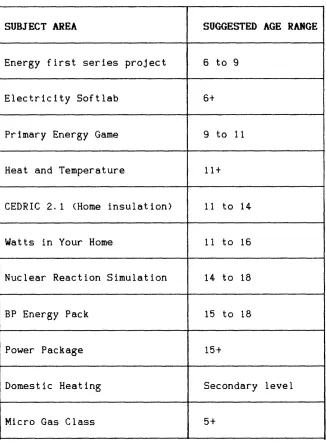
This information was collected by going through all Educational software catalogues, as well as approaching industries concerned with energy such as British Gas, Shell, BP, and CEGB. This showed both a lack of Energy software available at the time, and the diversity of that which existed, as can be seen in figure 2.1.1.
Figure
2.1.1
ENERGY SOFTWARE AVAILABLE AUTUMN TERM 1987
SUBJECT AREA
SUGGESTED AGE RANGE
Energy first series project 6 to 9
Electricity Softlab 6+
Primary Energy Game 9 to 11
Heat and Temperature 11+
CEDRIC 2.1 (Home insulation) 11 to 14
Watts in Your Home 11 to 16
Nuclear Reaction Simulation 14 to 18
BP Energy Pack 15 to 18
Power Package 15+
Domestic Heating Secondary level
Micro Gas Class 5+
Each piece of software was looked at and analysed under the following headings:
1 Type of software.
2 Program classification. 3 Intended program user.
6 Interaction with program. 7 Overall impression.
The catalogue was intended to be a way of looking at the software on a descriptive level. It aimed to analyse each program in a way that would be useful to a teacher who was looking for a range of software options that would give a distinctive contribution to a course or area of study in the curriculum. to full copy of the catalogue can be seen in Appendix I.>.
The catalogue was printed, packaged and sent to various schools throughout Britain, with a simple questionnaire attached asking for teachers' comments. The return was low but useful.
2.3
CHOICE OF COMPUTER SOFTWARE
The aim of the catalogue had been to see what type of Energy software was available, so as to decide what software to use in the research. It seemed, given the small quantity of software and its diversity, that it would be more appropriate to concentrate on two or three specific pieces of software that appeared to have similar content. In this way it was hoped that related aspects could be chosen in order to try to investigate them with respect to learning processes, knowledge and skills required, cognitive level, and applicability to various age ranges.
When choosing the software it was necessary to consider the nature of the problem, in that the software had to fit within a framework of Energy teaching in schools, and be suitable for
pupils in Secondary and Primary schools. It was also hoped that one of the software packages would be a British Gas production, as they were interested to see how their Energy software functioned within a given classroom setting. This interest arose as a part of their collaboration within the research work.
Several factors contributed to the decision to use two programs: Primary Energy Game (PEG), and CEDRIC 2.1 (Community Energy Data and Retrieval Information). Initally the programs were selected for the similar ideas and concepts they appeared to portray. Both were based on home heating and the conservation of fuel within a household setting. The programs used these ideas in different ways. PEG is a game designed for 9 to 11 year olds and CEDRIC 2.1 is a database aimed at the 11+ age group. This slight overlap of target ages, but difference of approach, was thought to be useful.
As previously mentioned, both software packages related to energy consumption within a domestic setting, but portrayed it in different ways. It is now appropriate to consider each.
2.4 PRIMARY ENERGY GAME (PEG)
PEG is a game in which the user tries to control the internal temperature of a house in response to a set of random events. The documentation of the software makes claims about the value and purpose of the program which could be tested by using this software over differing age ranges. The documentation claims that:
"PEG is a program that was developed so that young children are introduced to the principles of good household practice in a challenging and entertaining manner PEG has been designed for children in the age range of 9 to 11 although it a has an educational value for a much wider age range".
[Introduction to PEG documentation (1986) p2)
The program involves a person, PEG, controlled by the pupil, who can turn radiators on and off, and open and close doors and windows, in order to maintain the house at a constant temperature. The computer controls the variation of the outside temperature, which is guided by a twenty-four hour cycle and is shown by an outside thermometer, as well as a clock telling the time of the day and night. Added to this, the weather can change, sometimes dramatically from sunshine to snow, which adds variety to the game.
The documentation states that:
"Another element of the game is the random opening and closing of windows by other people, making it more exciting as well as introducing the ideas of ENERGY CONSERVATION PEG has to try to close them before too many points are lost, ie energy is BEING WASTED".
[PEG documentation <1986) p3]
The objectives behind PEG are notably:
"The overall objective of the package is to help the children to be more aware of the importance of domestic heat energy conservation, and the need to control the home environment economically SI
"There are also a number of subsumed conceptions within this overall objective that are worth noting as follows: 1 The concept of thermostat control
2 The concept of thermal equilibrium.
3 Differentiation between temperature and heat and the concept of temperature as 'degrees of heat'.
4 The concept of conduction of heat.
5 The concept of hot-warm-cold being a part of the same continuum.
6 Objects in general take time to cool down.
7 The concept of heat "spreading", eg leaving the door open heats neighbouring rooms
[PEG documentation (1986) pp5-6]
2.5 CEDRIC 2.1
The second package chosen was CEDRIC 2.1. This is a database program designed for Secondary school pupils. It is used to calculate the energy consumption of the individual pupil's home and possible areas of energy wastage. The documentation states that:
"CEDRIC 2.1 will help you to think about the way you use energy in your home".
[CEDRIC 2.1 Pupils guide (1987) p1]
The teacher's notes indicate that:
"The program attempts to answer the questions:
1 Is my home energy efficient in terms of thermal insulation?
2 What energy saving methods are best suited to improve the situation?"
[CEDRIC 2.1 Teachers notes (1987) p2]
CEDRIC 2.1 tackles these questions using three main programs:
1 PROFILE: This contains a lot of facts and figures about different kinds of homes in the United Kingdom, and how they use energy. You can then compare your own sample of homes with this data.
2 DHL (Designed heat loss): This calculates how much energy escapes from the home on a cold winter's day.
3 GUESTIMATOR: This estimates the quantity and the cost of the energy used for different purposes in the home.
These three programs are meant to be used to teach pupils various aspects of energy saving. The documentation states that:
"In Physics the topics of energy conservation and heat transfer can be related to the very practical problem of thermal insulation of the home. CEDRIC 2.1 provides an excellent introduction to the concepts of thermal equilibrium, the core concept upon which the program is based the topics of home insulation, choice of fuels for heating, transfer and conversion of energy and so on, can be taught in an entirely relevant manner".
[CEDRIC 2.1 Teachers notes (1987) p1]
Other claims made by CEDRIC 2.1 include:
The program provides for an excellent practical exercise in data collection, processing and presentation as well as introducing concepts of energy conservation in the home the program involves the children in measuring in metric units and calculating areas and volumes".
[CEDRIC 2.1 Teachers notes (1987) p1)
From these statements it can be seen that there is much similarity in what is intended to be taught by PEG and CEDRIC 2.1. The work for pupils that accompanies CEDRIC requires mathematical and measurement skills to collect data and make calculations so as to proceed through the program, (see Chapter 3). PEG, however, requires only qualitative decisions to be made by the child.
2.6 PRELIMINARY INVESTIGATION AND PILOT WORK
1 Does the software do the job intended?
2 Does the software have an identifiable position in the curriculum, or teaching strategy of the teacher, ie is there a job for the software to do?
3 What type of tasks are necessary to be able to obtain reliable information about how much the learner really knows in a given area?
With these questions in mind the two programs were taken into two Primary and two Secondary schools. The same schools were later used for the research, and will be discussed in detail in Chapter 6.
2.6.1 Using PEG
The first piece of software to be examined was PEG. This was designed for the Primary school, yet it was received poorly by the two Primary schools as well as by the Secondary schools. I took groups of children and introduced them to the computer program. Each group had a double session of approximately 60 to 80 minutes with me.
It was evident from watching the children that the program was being used more as a game than as an instructional instrument, and it was difficult to assess whether any learning was taking place. This can be seen from the children's comments after using the program. In what follows, Groups 1 and 2 were children from the fourth year juniors in Primary school one. They were high ability pupils who through selection were going to Grammes school. Groups 3 and 4 were mixed ability groups from the second Primary school.
GROUP 1
"We thought this game was fun to play with, but it didn't teach us as much as we thought it would".
On questioning the pupils it became noticeable that some of the basic concepts of the game were being misunderstood. For example, pupils realised that they were trying to keep the house warm, but could not understand the logic of the program, as their comments indicate.
GROUP 1
"There were some things we could not understand, eg the windows kept opening and closing at inconvenient moments. The thermometers also changed even at high temperatures to low - even though the radiators were on and the windows closed".
Group 2
"The game wasn't realistic enough to teach us about the advantages of saving energy in the home. In one sense that the windows opened by some magic force and lowered the temperature in the room also that when you turn the radiators on they automatically switch onto full temperature so raising the climate in the room also the sudden change of weather, because in a real situation the sun would never change to snow in about a couple of seconds".
(This statement comes from a 10 year old) GROUP 3
"The game was not set in realistic position, an example is that the windows kept opening and when you turned the radiators it lit up straight away
the sudden change of the weather without warning was not a good idea".
than trying to see what was actually making the game work. The gaining of points seemed to predominate, whoever was at the keyboard.
The above comments taken from pupils seem to reinforce the impression that they were puzzled about reasons for the effects of windows opening and doors closing etc. It appeared that they were simply reacting to what happened, and not being led to think about why each thing happened, or why their actions had the effect they did. After each group of pupils' had used the program, I started a discussion with them about what they thought the program was trying to teach them. This made it clearer that they had not grasped the basic concept of the program, ie that of the conservation of heat within the home.
The discussion was taken a stage further. I got one pupil to sit in front of the computer, and the other pupils to give him instructions as to how to control events. At the same time they also tried to explain to each other what was happening eg windows opening would lead to a temperature drop. Two reasons were given:
(a) That the room was too hot and the radiators needed to to be turned off, in terms of points to be gained in the game;
(b) A random event, in which case the windows had to be shut and the radiators turned on.
Gradually the pupils seemed to become aware that the events occuring on the screen related to the overall structure of the game, hence controlling the score they could achieve in the game. After this period of joint work I asked the group to discuss the points raised and to write a new comment on the program. A typical example is given by Group 4:
GROUP 4
"PEG had to try to keep his house at an even temperature, through night and day, sun and rain, and make sure energy wasn't wasted. It made Thalia and I quite frustrated because every time we shut a window and our score would start building up, a radiator downstairs would turn on and you'd have to remember to shut the door behind you",
2.6.2 Using CEDRIC 2.1
CEDRIC 2.1 was designed for 11 to 15 year olds, (a fuller description of its development and educational content can be found in Chapter 3). It appeared however that it had potential for being used in the Primary school. The same four groups were introduced to the program, in a similar way as described for PEG. It was evident from the way the pupils approached the program that they would need help in understanding the data collection sheets, however once they obtained the relevant information they appeared to understand what was required of them. The pupils' comments on the program reflect this:
GROUP 2
My observations here, were that the pupils found the program far more interesting than PEG. However CEDRIC was not without its problems, such as the data collection sheets. Nevertheless it appeared to have potential for the teaching of energy.
2.7
SOME CONCLUSIONS
It would appear that although the pupils had some appreciation of PEG, the game element still remained firmly in their minds. This made me realise that to try to see how, or in what way, the pupils were actually thinking about energy would require them to use more skills than were needed in the PEG program. Secondly, as most of the questions were posed by me in order to promote discussion, it was difficult to interpret what the pupils had learnt, and to what extent the program had influenced their thinking. From this point of view PEG appeared too limited for the research work, and this was a contributing factor in the decision not to use it in the main research.
However the preliminary work does suggest that PEG has limited uses for Energy work in the classroom. It appeared that the pupils, given sufficient direction and teaching, could grasp aspects of heat conservation within the home. But this in essence was not what the research was trying to achieve, although it is arguable that a similar line of research could be applied to the PEG program, in terms of knowledge and skills used, learning processes etc.
CEDRIC 2.1 was chosen as it appeared to give more opportunity to test knowledge, skills, cognitive level, and general appropriateness within the classroom situation. Teachers found it more flexible, with the possibility of cross curricula activities, than PEG.
CHAPTER; 3 CEDRIC 2.1
3.1 INTRODUCTION
The purpose of this chapter is to discuss the nature of
CEDRIC 2.1 and indicate the basic research questions that its use
in the classroom might raise. The chapter begins by giving a
background to the development of the program, followed by
detailed descriptions of each section and finally discussing- the
questions that will be looked at in the study.
3.2 BACKGROUND OF THE DEVELOPMENT OF CEDRIC 2.1
CEDRIC 2.1 (Community Energy Display and Retrieval of Information
and Calculation) was initially designed as an aid to
"Energy Study UK", a national schools competition ot the
Energy Efficiency Office. The competition was sponsored by
British Gas, Conoco and the
Electricity Council,
and wasorganised by the regions of British Gas and the Northern Ireland
Electricty Service
during the
latter halt of 1964. The object ofthe competition was to help children understand domestic energy
use and energy saving in their individual homes and their local
communities.
The popularity of the competition encouraged British Gas
Education Service to revise and distribute CEDRIC as a separate
teaching package. CEDRIC 2.1 is a major revision of the
original.
3.3 SCOPE AND USES OF PROGRAM
CEDRIC 2,1 features a built-in database of regional and national statistics concerned with energy use. In essence the program accepts pupils data and makes comparisons between them and the built-in database. It aims to enable pupils to process data that they themselves have independently collected so that they can draw conclusions about how energy efficient their own homes are, and make suggestions on how to make them more energy efficient. A number of concepts within the field of energy conservation, such as heat flow and thermal equilibrium, are introduced.
The program was designed so that it could be used in various areas of the curriculum. It is suggested by the documentation that in physics the topics of energy conservation and heat transfer can be related to the very practical problems of thermal insulation of the home; as CEDRIC 2.1:
"Provides an excellent introduction to the concept of thermal equilibrium, the core concept of the program". [CEDRIC 2.1 Teachers Notes (1987) p2I
With respect to Mathematics the program involves the children in
measuring in metric units and in calculating area and volume. It
therefore provides a very practical application of these
concepts, which can be used in a realistic and practical way.
With the advent of the National Curriculum all these suggested aspects of the program feature quite prominently in various
attainment targets in both the Science and Mathematics documents
as well as the proposals for Technology in the
National Curriculum [National Curriculum Documents
(1988, 1989)].
3.4 WHAT THE PROGRAM DOES
The program attempts to answer the questions:
1 Is my home energy efficient in terms of thermal insulation
2 What energy saving methods are best suited to improve the situation?
It attempts to answer these questions by processing data
collected by the pupils in groups or individually. It presents
the data both numerically and in graph form, in this way allowing
the pupils to make comparisons on both a national and regional
level, The "regions" refer to the British Gas Regions in which
the children live.
The three main programs making up the packages each contain a
data file of the national and regional information.
(a) PROFILE:
Has a data file on specific characteristics ot homes, such as property types, age, kinds of insulation, etc.
(b) DESIGNED HEAT LOSS (DHL):
Concerns itself with heat loss and gives an approximate measure for the Designed Heat Loss for each home, and proportion of heat loss through roofs, windows, wails and gaps.
(c) GUESTIMATOR:
Gives an estimate of how much energy a particular home, with its own pattern of energy use, could typically be expected to use in a specific region. This can then be compared with the actual energy use, and inter-regional comparisons, so that conclusions can be drawn by pupils.
The documentation claims that:
"It can be seen that by using the programs either individually or in tandem, a great number of questions under the umbrella of energy conservation can be answered".
(CEDRIC 2.1 Teachers Notes (1987) p21
3.5 DETAILED DESCRIPTION OF EACH PROGRAM
The teacher's notes indicate that the programs are designed to be simple enough to be operated by an inexperienced 11 year old, and flexible enough to cater for a wide range of classroom situations.
Profile
The characteristics to be studied are:
1 Property type: (detached, semi-detached etc); 2 Property age;
3 Source of main heating; 4 Type of central heating;
5 How the domestic but water is heated; 6 Type of insulation in property;
7 How many children under 16 live in the household; 8 Type of cooker fuel.
Data is collected from the whole group and entered tor one charactistic at a time. If necessary, input can be interrupted and intermediate results saved for later reloading from disc. When data input for a characteristic is completed, the data can be edited to make amendments, additions or deletions. After editing, the data can be saved to be analysed at a later date it required. When the data is analysed, the results are displayed in the form of a table. The table can be printed or saved tor subsequent printing. The same data can also be displayed in bar chart form.
Designed Heat Loss (DHL)
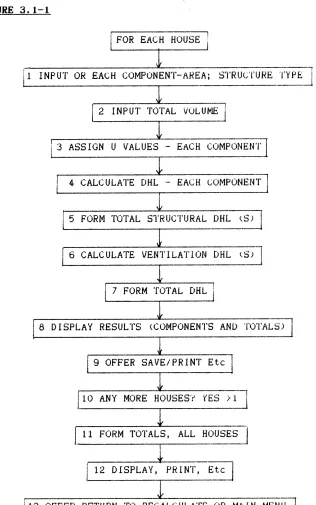
The main logical flow is shown in the figure 3.1-1 below: FIGURE 3.1-1
FOR EACH HOUSE
Ll INPUT OR EACH COMPONENT-AREA; STRUCTURE TYPE
2 INPUT TOTAL VOLUME
13 ASSIGN U VALUES - EACH COMPONENT
4 CALCULATE DHL - EACH COMPONENT
5 FORM TOTAL STRUCTURAL DHL (S)
V
6 CALCULATE VENTILATION DHL (S)]
7 FORM TOTAL DHL
8 DISPLAY RESULTS (COMPONENTS AND TOTALS)
9 OFFER SAVE/PRINT Etc
V
10 ANY MORE HOUSES? 'ES ).11
I11 FORM TOTALS, ALL HOUSES]
Y
12 DISPLAY, PRINT, Etc
V
1
13 OFFER RETURN TO RECALCULATE OR MAIN MENU1
The DHL value is calculated from stored tables of U values (heat loss coefficients), The equation for calculating DHL is as follows:
where QA is the energy loss per second (watts). A is the area ot the fabric of the house under consideration T2-T1 represent the internal and external temperatures.
DHL is a very useful measure of the effectiveness of thermal insulation of a building and is widely used by building designers and heating engineers.
The documents states that:
"To minimise the data collection requirements a representative number of U values has been selected, hence the DHL will be an approximation. However it will be sensitive enough to reflect the effect of improving roof insulation, for example".
CCEDRIC 2.1 Teachers Notes (1987) p31
Before starting the program the pupils have to collect information about their home, using the data collection sheets provided. When the data has been entered CEDRIC 2.1 gives the DHL value. chis can then be displayed for individual homes, when it will be expressed in KW or for the entire group, when it will be in MW.
Guestimator
the DHL program, and a factor known as Degree Days, which is a measure of weather variations between regions. A factor is also included that accounts for domestic hot water, which is multiplied by the number of people living in the house.
These equations only apply to centrally heated houses. For other houses that are not centrally heated, a different calculation is made, based upon fuel type used and numbers and type ot heaters in the house.
The program asks for information about the number ot people living in the home, how big the home is, how it is heated and what other appliances the house has. Guestimator then displays the amount of fuel used - both by type and by cost and will indicate the cost in kilowatt hours equivalent for each tuel type. The program can also show how the fuel is being used, by dividing up energy uses into heating, cooking, lighting, and
other uses. All these figures are displayed in the same units, kilowatts hours, and the cost of each heating use is shown, together with the percentage of the total energy use which that figure represents.
Guestimator can not only look at individual results, but can show whether the same house would use more or less energy it it was situated in a different part of the country, both in terms ot regional differences and differences in fuel costs.
Gathering Data
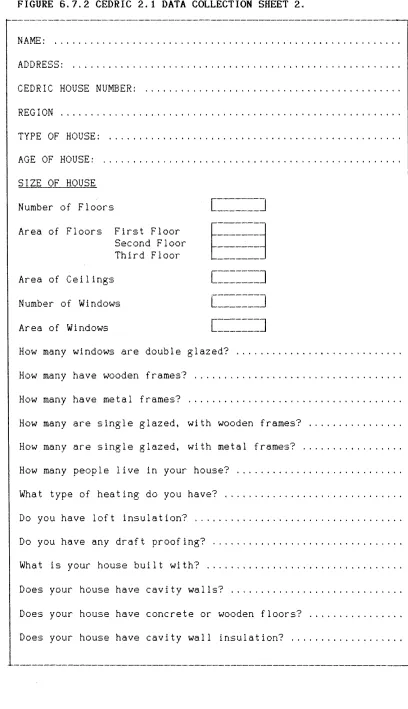
In all uses ot CEDRIC 2.1 data is needed as input. This is collected by the pupils by filling in a Household Data Form supplied with the program. (This can be seen in Appendix 2). As mentioned in Chapter 2 the Household Data Form caused problems, especially but not only with the younger pupils. The way the data collection sheet was set out was contusing and did not follow the sequence of the program. It also contained different terminology to that found in the program, which contused younger pupils. The data collection sheet was revised as part of the research (see Chapter 6).
3.6 BASIC RESEARCH QUESTIONS FOR THE USE UF CEDRIC 2.1 IN THE CLASSROOM
Four basic questions are considered:
1 Can pupils aged 9 to 13 learn about energy by using CEDRIC 2.1?
2 What teaching material/strategies can help to make LEDR1A, 2.1 part of effective teaching sequencee
3 What can be learnt about the appropriateness of CEDRIC 2,1 in this context?
4 How important is cognitive level, as opposed to knowledge, in determining the success of the learning tasks within CEDRIC 2.1?
Chapter 4
LITERATURE REVIEW
4.1 Introduction
This chapter reviews the literature relevant to the study of the learning of energy using computer software. There are four main needs.
The first is to understand how pupils view energy, on the assumption that the knowledge and ideas they hold prior to teaching will shape their general understanding, appreciation, and approach to the learning of ideas. Secondly, a theory of learning is needed as a framework for the research, so as to have a basis for planning a teaching strategy, and describing consequent learning episodes. Thirdly, to consider how useful a piece of software is for a teaching strategy or learning process, it is important to review work on computers in science education, with attention being given to pupils' cognitive skills with respect to those demanded by the software. For this last purpose it will also be necessary to examine research on cognitive demand.
Thus the review will be in four main parts:
1 Computers in education;
2 Teaching stategies and classroom learning; 3 Children ideas on energy;
4 Cognitive development and demand.
4.2 Computers in Education
It is more than a decade since the computer began to be considered as part of the Educational system in schools,
bringing with it a considerable quantity of Educational software. As a consequence teachers are faced with many and varied problems relating to this new technology, with respect to their teaching strategies, and to pupils' learning in all areas of the curriculum.
It appears from the literature that there are two main areas in which the computer can contribute to Education: as an aid to learning and instruction in the classroom and as a tool tor research on human cognition. in this review emphasis will be on the classroom and the role the computer and its software may play in that setting. It will focus on the interaction of the learner with computer programs.
"The awful truth is that over the last ten years the availability of mediocre computer-assisted learning material has increased in a steady and boring way - the main effect of the microcomputer revolution being to decrease the average quality of computer software." [O'Shea and Self, (1987), pp260 - 261: cf Self (1985)1.
Rutkowsaka J and Crook C (1981), share O'Shea and Self's view as to why so much educational software is unsatisfactory: they indicate that the available programs are too "unintelli.gent" to support flexible interaction with the learner. The most important attempt to remedy this is to draw on the discipline of Artificial Intelligence (A1). However, it is not the intention to discuss this issue here, but only to indicate that it is accepted as a problem in Educational computing..
Such authors suggest that the difficulties of bringing Computer Based Learning (CBL) into the science classroom, can mainly be attributed to software limitations [Walker (198„01. Nonetheless, such deficiencies need to be examined, and not overplayed. Computer based methods can now take on a variety of Educational roles, as there are materials, packages and tools to assist a range of practical applications [Hartley (198811. What is now required is more data on effective teaching practices and on the process of learning with the computer. Educationists might agree that the computer's presence otters new opportunities to enhance children's lives and to improve the quality, content and delivery of education in part by making more explicit the type of knowledge they are involved in learning or dealing with. However, more empirical data is required to substantiate this view. They might agree that in this way the computer can be an intellectual tool for both learner and teacher. However, improvement depends on taking. advantage of the computer's
potential, which requires an understanding of what is possible. It is therefore useful to examine how the computer has been conceived in Educational terms.
A common tramework for classifying Educational computing is seeing the computer as Tutor. Tool or Tutee [Nash (1982)1. This framework suggests that understanding the application of computing depends upon seeing all computer use in one ot these three modes, with the computer functioning as 'tutor', as a 'tool', or as 'tutee or student'.
The principle behind the tutorial mode is that the purpose ot running the program is known in advance, and its structure can therefore be tailored to this end. Its premises are that the objectives of running the program are defined and known in advance, the user being asked questions at each stage for data, and being given instructions, if only of a limited kind. In this way the user is led through a problem step by step. Although this method of computer use has advantages it is limited in what it can achieve. O'Shea and Self (1987) comment that:
"Computer tutors echo the expository teaching versus discovery learning controversy in Educational philosophy. It is straightforward to implement tutors to expound the facts in response to each and every student error but, not unreasonably, students do not take kindly to such programs. The aim as yet unrealised, must be to give only the suggestions, hints and corrections that a skilful human tutor would give." (pp 171-172)
any information which a teaching program has, that is specific to the particular student being taught. The data structures purport to represent a relevant part of the student's knowledge ot the subject.
While tutorial systems aim to build up the student's knowledge of certain skills, it is often difficult to make this knowledge explicit enough for the system to be able to generate direct comments about it. Hartley (1985), argues that student models tend to operate on the wrong level: they provide information about the student's attempt to solve specific problems but not directly about his understanding of the general skills involved.
Several of the research questions have been formulated in terms of regarding the computer as a tool. These can be seen in two ways:-
1 Is the computer tool learnable?
2 To what range of learning activities can the tool, in this case CEDRIC 2.1, be applied?
In some cases, eg LOGO, the first question is difficult to answer, but in the case of CEDRIC is more straightforward. The second question deals with the computational perspective of enriching the traditional curriculum. This in essence can refer to many very general purpose tools. However, CEDRIC is a special purpose tool built around a database system as described in Chapter
3.
Underwood (1984) suggests that databases are seen by many as one of the most effective ways of using a computer in schools, and that such programs use the full potential ot machines and give
pupils the opportunity to collect material from their own
environment. He further suggests that databases develop skills
of hypothesis testing by encouraging children to ask 'good'
questions. This type of program can be considered as a way of
fostering the acquisition and development of basic linguistic
skills, including;
(a) The ability to code information;
(b) The ability to organise knowledge within an information structure;
(c) The ability to express logical procedures tor research and analysis.
CDegl'Innocenti and Ferraris (1986)J
Database programs can be said to represent a useful tool
for promoting 'research' at an educational level by the
provision or creation of manageable data tiles which allow
and encourage pupils to set up a process ot
observation, classification, and making and testing hypotheses,
in this way allowing the formulation of new hypotheses.
IDegl'Innocenti and Ferraris (1988),I. It is arguable that in
this way the pupil can be enabled to study complex domains with a
fresh approach.
This would suggest that the application ot information retrieval
systems to the learning of complex subjects could prove useful in
creating the conditions t or using productive learning/ teaching
strategies. However, it such a system is to improve the skills
mentioned above, database programs must include additional
teaching materials as well as computer based materials. White
"Students ought to be led through a problem-solving process, with explicit demonstrations, practice in identifying information needs and establishing and applying criteria for information sufficiency, relevance and effective organisation."
At the present the difficulty appears to be in establishing criteria by which judgements can be made about the usefulness of such computer based activities. The arguments put forward have depended on the philosophical stand taKen, and are used as justifications for educational computing. Most reflect two paradigms of Educational philosophy. The first is concerned with the acquisition of knowledge, and the second with largely unstructured and undirected activity and play. More recently Kelly (1984), has suggested a third, which relates to Experience, with active learning seen as being a matter ot process rather than product, in this way promoting development of the child's thought processes. An exponent to this view is Papert (1980).
Papert sees learning as a constructive process where children build their own intellectual structures. He pursues such questions as: "What experience and knowledge lead children to change their theories. e"
Papert believes that children learn best when they are encouraged to draw on their own intuition and to put to use what they already know in developing new ideas. He sees the computer as providing a context in which this kind of learning can happen.
Papert's views represent what O'Shea and Self (1987), regard as the 'Revolutionary' faction of educational computing, as opposed to the 'Reformist', who are interested in using the computer in conventional educational contexts. Suppes (1966)
Through these ideas two fundamental questions arise, which are important to the present research. One concerns the 'functional' nature of the computer, and the other is a 'structural' question. In the 'functional' domain the questions arising can be summarised as:-
"What can the computer do to assist learning?"
In the structural domain:-
"Does the advent of the computer give grounds for changing our conceptions of the processes of teaching and learning, and thereby our teaching strategies"
The second question is fundamental, concerning our most basic assumptions about the nature of knowledge, how it is acquired, and what it is to have knowledge. The emergence of the computer, with its facilities for gathering, processing, storing and transmitting information can pose a challenge to the way Education and teaching are viewed. Teachers may consider their authority as a source of 'worthwhile knowledge' challenged by CBL. Faced with this type of challenge, CBI, could be considered as a fundamentally mistaken view of what knowledge is and of what is worthwhile.
4.3 Teaching and Learning
A view of learning that seems to lend itself to computing is that of Bruner (1973). His view that knowledge should be interpreted in terms of the individual's mastery of tools fits well with the current research. Central to his thesis is that:-
1 Man is distinctive in his capacity for inventing tools to augment his existing powers;
If as suggested previously the computer and its sottware is viewed as a 'tool', what makes Bruner's theory especially useful is its integration of the tool function; in this way the computer can be seen as an extension of the user's own powers of reflection. The suggestion here is that the interactive relationship between user and computer is highly significant, when considering the contribution it can make to the teaching/learning process. Functional issues then force teachers to face the formulation of a rationale in order to answer the question:
"What can the computer do to assist learning?"
The interactive element has been explored by Kemmis et al (19//). In their efforts to evaluate early examples of CAL they concluded that:
"The assessment of learner performance by prescribed criteria of achievement in the tradition of the behaviourist model of learning is inadequate. this view of knowledge compatible with a behaviourist position conflates knowledge and information." (p216)
This would indicate that a model ot learning is required that acknowledges the importance of the knowledge the individual brings to the learning experience, and that also accepts that such knowledge is not recalling items of intormation, but it is how knowledge is to be used.
"The successful attainment ot knowledge is not merely mastery of propositional knowledge about the subject domain, it is appropriate usage. The teacher will judge that the student has learned when he speaks of the objects in ways which the teacher regards as appropriate." CKemmis et al (l9//) p2081
It the teaching and learning process is to be improved a theoretical framework is required:
(a) To see how it could shed light on the way pupils think and; (b) On possible ways to adjust teaching strategies to compitment
pupils' thinking.
A recent piece of research which would appear to be of interest to the present research is the concept of 'Middle-Level-Model' ot Educational development psychology (MLM) Strauss (1967). 'the model appears to give a possible framework from which curriculum development/ teaching strategies wight evolve, the [4LPJ attempts to be in the mtddie 01 edoklalionat peac., ce and developmental theory. What is useful to the present research is the theoretical basis from which it has evolved.
MLM has been influenced by two traditions, those of Piaget and
It is here that Vygotsky's distinction between spontaneous and scientific (school learned) concepts, could give a possible way of considering these multiple representations. He regards spontaneous concepts as being unconscious, non-reflective, originating from childrens' direct experience of the world. They are non-systematic, and learnt through everyday experiences in order for them to become part of the child's conceptions. it is widely accepted that it is necessary for teachers to be conscious of these ideas when pupils come to science lessons.
Recently much emphasis has been given to a 'constructivist' form of teaching. For this purpose, these ideas could possibly be grouped together into two broad headings or domains as suggested by Solomon (1983). She regards the two domains as 'life world' Concepts derived through language, peer groups, and media, which are often context bound and used inconsistently
by pupils. On the other hand 'Scientific knowledge' is decontextualised and consistent, but is for most children confined to the science classroom. Solomon (1Y/8) drawing on work from Schutz and Luckmann (19/3), presents a theory of the social construction of meaning in which she argues that "Objects of commonsense", exist through social communication, whereby ideas are exchanged and explored. Whether a pupil can affirm or even share these ideas with others in a classroom situation has a part to play in shaping the construction of the knowledge gained by pupils.
"We take it for granted that those who are close to us see the world the way we do, but through social exchanges we seek always to have this reconfirmed. This continued reaffirmation of social notions make them very durable and resistant to change."
[Solomon 1987, 0573
Driver (1989) argues that learners need to be given access to the 'knowledge systems of science'. Here she means that pupils need not only the physical experiences, but also the concepts and models of conventional science, to be given, in order to construct them for themselves and appreciate their domains of applicability.
What consequence has this perspective for teaching strategies Various groups of researchers have attempted to identity features of science teaching that might have implications for classroom practice. Examples are taken from two action research projects:
1 Childrens Learning in science Froject, based at the University of Leeds lllriver and 01dham lf:jrit)) (c-LISP);
2 Student's intuitions and Scientific instruction. (Si) Project [Kuhn and Aguirre (1987)l, based at University of
British Columbia and directed by Gaalen Erickson.
Both projects worked collaboratively with teachers and took a constructivist approach to classroom work. The position taken especially by Driver is that:
"Learning in science is characterised neither by learning 'content' nor by learning 'process' but by a dynamic interaction where-by pupils continually and progressively construct and reconstruct their understanding of the world." [Driver (1989) p/61
"Crucial to listen to what students have to say, and that the teacher must make this listening part of reflecting back on what the pupil said or did."
(Aguirre and Kuhn (1987)1
It is claimed that this 'constructivist' approach to teaching and learning is based on current perspectives of cognition, that it takes account of the social processes of knowledge construction, and that it reflects contemporary views of the nature of science itself. Edward and Mercer (198i) have explored, and given an analysis of teacher-pupil interaction in activity orientated classrooms, and come to the conclusion that:-
We shall not be using any critique of progressive education to argue for a return to traditional didactic methods. The progressive movement was right to argue for the importance of children's active engagement in their own education. What we shall advocate is a third step, towards a cultural- communicative model of education The traditional ideology was all about teaching, and the progressive ideology is all about learning. What is needed is a new synthesis, in which education is seen as the development of joint understanding." (p36)
It has long been quoted that:-
"The most important single factor influencing learning is what the pupil already knows. Ascertain this and teach him accordingly." Ausubel (1968)
It would seem useful to the discussion to examine some examples of what is meant here before looking in depth at the literature concerning pupils' conceptions of energy.
spontaneous knowledge of temperature is learnt unsystematically. Similarly some of children's notions of energy are constructed through media representations for example that certain foods give energy and that certain fuels are more 'energy efficient' than others. They are often being told to eat because they need 'energy', or to switch the light out or shut the door in order not to waste, or to save energy. This could give insight as to why pupils have difficulty with conservation of energy and the definition of energy.
In contrast however. Vygotsky sees school-learned concepts as conscious, reflective, originating in the classroom tor in an informal educational setting), and systematic. Examples 1 to 4 below, taken from heat, temperature and energy, indicate what is implied by school based concepts.
1 Thermal equilibrium, when two objects at different temperatures eventually reach the same temperature.
2 Quantification of temperature in degrees. 3 Energy is neither created or destroyed. 4 Quantification of energy measured in Joules
would tit with Kelly's (1956) and Piaget's emphasis on cognitive interaction with the world, characterised by active assimilation.
How then can this be ot use for the teaching and learning of energy? Vygotsky suggests that:
"To devise successful methods of instructing the school child in systematic knowledge, it is necessary to understand the development of scientific concepts in the child's mind." (02)
He poses two questions ot particular relevance to guiding the present research.
1 "What happens in the mind of the child to the scientific concepts he is taught at school?"
2 "What is the relationship between the assimilation of information and the internal development of a scientific concept in the child's consciousness?" EVygotsky (198J) 021
The first of these two questions can be considered in relation to the view of 'meaningful learning' LAusubel (1968)1. That is, what sense do pupils make of scientific concepts as taught in schools? According to Ausubel meaningful learning occurs only when new material is linked by the learner to relevant ideas and conceptual schemes he possesses in his existing cognitive structures. Tomlinson (1981) suggests that the process of
learning must begin with some sort of acquisition or grasp of what is involved.
This leads to the second question which concerns much of the present work. Does the learning of scientific concepts, such as energy, as taught within a teaching strategy alter the pupils' everyday, commonsense, spontaneous understanding of the same concept? However, an equally important question to be asked is:
"To what extent do pupils' commonsense, spontaneous understanding influence what is learnt from scientific concepts as taught in schools."
To be able to construct a series of teaching strategies that might in some way attempt to focus on these issues, requires a framework deriving from a theory of learning that can highlight them. Although there has been much research on children's thinking and learning, there is still little that explains how pupils learn large bodies of complex material over a period of time. One such attempt was made by Norman (19/8). The
theory, and the way it could be used, in the present research, to identity the intellectual demands teachers make on children, is worthy of discussion. Norman is interested in the way learning takes place in complex situations. He defines this by referring to complex topics as:
"A rich set of conceptual structures that require learning periods measured in weeks or even years." [Norman (1978) p39)
them for the particular task required of them, this is called TUNING.
Accretion is necessary to provide a database upon which appropriate knowledge modules can later form. in the learning process accretion seems to be needed to till out the knowledge.
Reconstructuring is often characterised by insight into the topic. If accretion is knowledge acquisition, restructuring is knowledge understanding. The important notion here is that there need be no formal addition of knowledge by the pupil during
restructuring. In terms of a teaching situation this can be ot interest. The teacher need only ask questions, carefully avoiding the presentation of any new information. However, by skilful questioning it would seem possible to lead the pupils into recognising their own deficiencies in the structuring of their existing knowledge. Norman indicates that for restructuring to take place, good teaching must occur.
Tuning requires the repeated use of knowledge, and seems best accomplished by practice at the task or using the concepts of the topic matter.
What is useful to the present study is that Norman suggests that all three modes of learning are probably always present, however:
Because learning a complex topic has neither a definite starting point nor a definite ending point, the start always builds upon previously acquired material (thereby making unclear where the start really occurs)." [Norman (19/8) p42]
Further he suggests that one could obtain some reasonable information by tests at different times in the learning of new material
"In particular, the modes of learning differ in the kind of instructional procedures that are most relevant, the test of knowledge that seems most appropriate, the ability to transfer the newly acquired knowledge to other, related topics, and the susceptibility to interference from the simultaneous learning of related topics." p42
In an extensive research Bennet et al (.1964) attempted to use Norman's theory to examine the 'Quality of Pupil's Learning Experience'. The study considered the teaching process in the classroom environment, of 6 to / year old children. It brought to light a number of issues that could be regarded as important for teachers, such as the nature of classroom tasks, and their appropriateness and match to children's abilities and cognitive levels. The study appeared to show the possibility of this type of research.
Central questions here are:
"What does it mean to have learnt something?" and
"Is learning related to understanding?"
These are however fundamental in relation to the argument put forward earlier regarding Vygotsky and the nature of concepts. Norman categorises the above two questions into two sections, which can help when thinking of teaching strategies. These are:
1 The study of learning which relates to the acquisition of information;
Performance and understanding are different things. It isn't enough to know something; the knowledge must be available at the proper time, and it must be represented in a form appropriate to the specific needs ot the moment. This poses the question:
"What implications do these theories have for the teaching and learning ot energy with computer software?"
Bruner (1918) offers a view that the computer can be seen as a tool for learning, allowing the user to consider the computer as an extension of his own powers of reflection. This is important when considering Norman's (19/8) theory of learning, with respect to the acquisition of information and how that information is used. If we accept Ausubel's (1968) statement of meaningful learning as a prerequisite for teaching, then the computer as a tool allows the categories ot Norman's theory to be implemented in the development of teaching/learning tasks in terms of new information given, how it is to be used and to see if it is understood by the pupil.
If such tasks are to be developed, a theoretical framework relating to pupil's prior conceptions and developmental stages is needed. Strauss' (1988) MLM theory allows for the analysis of both as it originates from Piaget and Vygotsky. Vygotsky's approach is important to the research as it allows for the relations between Children's spontaneous common sense and formal school based concepts to be considered. The Piagetian approach allows for the analysis of concepts and their developmental relations. in this way teaching. strategies can consider the nature of the pupils' preconceptions and their cognitive level.
In conclusion the way these ideas are used in the research is that it takes Ausubel's statement as a starting point for thinking about teaching strategies, and that Bruner allows for the computer to be considered as a tool for learning. Norman gives a theoretical structure for the planning of teaching tasks, Vygotsky allows for the consideration of preconceptions, and Piaget allows for the assessing of the cognitive demands of a task in relation to the development of a child. the outcome of which can be seen in Chapters 6, 7 and 8.
4.4 Children's ideas on Energy
Many of the recent publications on children's ideas of energy have attempted to explain the underlying causes and origins of these conceptions. The literature can be divided into two broad categories, each approach focusing on certain elements, such as
1 General research that attempts to illuminate common aspects of a range of children's concepts such as Osborne, Bell and Gilbert (1983);
2 Research relating to children's understanding of specific concepts such as energy, eg Brooks, Driver, Solomon J,
Watts M (1983).
The literature in the first category has given the area various labels such as 'Alternative Frameworks', and 'Misconceptions'. Here I wish to discuss the specific conceptions found within the second category.