ABSTRACT
XIANG, LING. Performance Model for a Public Logistics Network. (Under the direction of
Michael G. Kay.)
A public logistics network (PLN) has been proposed as an alternative to private networks for
the ground transport of parcels. In this dissertation, a heuristic approach to approximate the
package average waiting time in a PLN is presented; and then based on this waiting time
approximation, a PLN design procedure is developed.
A PLN can be viewed as a priority queuing network with bulk arrivals and bulk service. It is
difficult to obtain a closed-form solution for package average waiting time in a PLN. The
problem is reformulated so that trucks transport loads instead of individual packages, thereby
relaxing the bulk arrivals and bulk service feature. The package average waiting time is
approximated fairly accurately by Kingman’s equation when the server utilization is high.
A simulation model is created to determine the parameters needed in Kingman’s equation
(the coefficient of variation for package interarrival times and for truck interarrival times). A
regression analysis of the results shows that the headway ratio is around 5.5. The package
average waiting time is approximated by the product of the truck headway (truck average
The PLN simulation with protocols and the package bidding process is discussed as an
extension to the basic simulation model. Packages bid for their trips along the way. The
highest bidder gets the highest priority for truck transport services. Results from a simulation
model incorporating a series of protocols developed by Kay show that a PLN with these
protocols performs better than a FIFO system.
For the PLN design problem, the goal is to design a PLN that results in the minimal package
average waiting time for the entire network. Potential locations (search space) for the
distribution centers (DCs) are found using the U.S. network of interstate and highways. A
genetic algorithm (GA) was applied to search for the optimal number of DCs, their locations,
Performance Model for a Public Logistics Network
by
Ling Xiang
A dissertation submitted to the Graduate Faculty of
North Carolina State University
in partial fulfillment of the
requirements for the Degree of
Doctor of Philosophy
Industrial and Systems Engineering
Raleigh, North Carolina
2009
APPROVED BY:
____________________
____________________
Michael G. Kay
Russell E. King
Chair of Advisory Committee
____________________
____________________
James R. Wilson
Tao Pang
ii
DEDICATION
This dissertation is dedicated to my mother and father. I am greatly indebted to them for their
iii
BIOGRAPHY
Ling Xiang was born in December, 1978 in Yunyang, Chongqing, China. He completed his
schooling at Wuhan, China. He earned a bachelor’s degree in automation science and
engineering from Huazhong University of Science and Technology, Wuhan, China.
He came to North Carolina State University for graduate school in the fall of 2004. He
studied industrial and systems engineering, focusing on logistics networks and production
iv
ACKNOWLEDGMENTS
I would like to thank the following people for their generous and continued support for this
work:
•
Dr. Michael Kay served as my advisor and committee chair. He spent an enormous
amount of time and effort on this project. He guided and encouraged me through hard
times along the way. Without him, I could not have finished this work. He has been
very supportive of my extracurricular activities as well.
•
Dr. Russell King, Dr. James Wilson, and Dr. Tao Pang served as my committee
members, and I thank them for their strong encouragement and feedback along the
v
TABLE OF CONTENTS
LIST OF TABLES ... viii
LIST OF FIGURES ... ix
1
Introduction ...1
1.1
Introduction ... 1
1.2
Operations of PLN ... 3
1.3
Literature Review ... 5
1.4
Research Objectives ... 5
1.5
Layout of the Dissertation ... 7
2
PLN Analytical Model and Simulation Model ...8
2.1
Literature Review ... 8
2.2
Headway and Headway Ratio for Waiting Time Calculation ... 8
2.3
Analytical Model ... 10
2.3.1
Analytical Model Assumptions
... 11
2.3.2
Analytical Model Input Parameters
... 11
2.3.3
Analytical Model Detailed Calculation
... 12
2.3.4
The Outputs from the Analytical Model
... 17
2.4
Simulation Model ... 18
2.4.1
Simulation Model Detailed Description
... 19
2.4.2
Simulation Model Input Parameters
... 25
2.4.3
Simulation Outputs
... 26
2.5
Simulation Model Validation ... 26
vi
3.1
Literature Review and Research Issues ... 31
3.2
Package Average Waiting Time Approximation in a PLN ... 33
3.2.1
The PLN Queuing Model Abstraction
... 33
3.2.2
Mathematical Formulation of Target Problem
... 35
3.2.3
Verification of Package Average Waiting Time Approximation
... 43
3.2.4
Headway Ratio
... 47
3.3
Conclusion ... 52
3.4
Future Work ... 53
4
Simulation with Bidding Scheme and Agent Behavior ...54
4.1
Package Bidding and Truck Offering Design in the Simulation Model ... 55
4.2
Optimization for the Simulation Model ... 58
4.3
PLN Performance under Natural Disasters ... 60
4.4
Performance Evaluation with Protocols ... 61
4.4.1
Experiment Design for Comparison of FIFO and PLN with Protocols
... 62
4.4.2
Results Comparison
... 63
5
PLN Network Design ...65
5.1
Introduction ... 65
5.1.1
Research Significance and Open Issues in the PLN Design
... 65
5.1.2
Related Research
... 66
5.2
PLN Underlying Road Network Design ... 70
5.2.1
Underlying Road Network Overall Process
... 70
5.2.2
Underlying Road Network Detailed Design
... 74
5.3
Genetic Algorithm ... 81
vii
5.3.2
GA’s Suitability for PLN Design Problem
... 83
5.3.3
Genetic Operations
... 84
5.4
GA Application on PLN Design ... 85
5.4.1
GA Implementation Package
... 85
5.4.2
Solution Structure Representation
... 86
5.4.3
Fitness Evaluation Functions and GA Parameters
... 86
5.5
Results ... 87
5.5.1
Optimal Number of DCs in a PLN
... 88
5.5.2
Comparison between Two U.S. Southeastern PLN Graph
... 90
5.5.3
Parameters Sensitivity for PLN Design
... 91
5.5.4
Other Constrains Imposed on PLN Design
... 94
5.6
Conclusion ... 95
5.7
Future Work ... 96
6
Conclusion and Future Work ...97
6.1
Conclusion ... 97
6.2
Future Work ... 99
6.2.1
Protocols and Agents
... 99
6.2.2
PLN Design
... 99
REFERENCES ...101
APPENDICES ...107
Appendix A MATLAB Code ...108
viii
LIST OF TABLES
Table 1.1. Comparison between Components of a PLN and the Internet ... 4
Table 2.1. Validation of the Simulation Model against Little’s Law ... 28
Table 2.2 Validation of the Simulation Model against the M/G/1 Queuing Model ... 30
Table 3.1. Comparison between Approximated and Recorded Values in Simulation on the
Network Level ... 44
Table 3.2. Comparison between True Waiting Time (Hrs.) and Approximated Value on the
Arc Level ... 46
Table 3.3.
2 AC
and
C
A2Values across Different PLNs ... 48
Table 3.4 Headway Ratio Regression Experiment Design ... 49
Table 3.5. Package Waiting Time (Hrs.) and Analytical Headway form Simulation ... 50
Table 4.1. Simulation Running Speed ... 60
Table 4.2. Comparison of PLN Performance between Normal and Disaster Mode ... 61
Table 4.3. Comparison Result between FIFO and PLN with Intelligent Protocols (Standard
Deviation is in the parenthesis) ... 64
ix
LIST OF FIGURES
Figure 1.1. Hypothetical PLN Covering the Southeastern USA ... 3
Figure 1.2. A Package Originating at DC 3 Travels to DC 5 ... 4
Figure 2.1. Packages Transported between DCs and Packages Transported on a Single Arc 16
Figure 2.2. Output Snapshot from the Analytical Model... 18
Figure 2.3. Object Design Configuration ... 19
Figure 2.4. Example DC Configuration ... 22
Figure 2.5. Illustration of Trucks Eligible for Load Offering ... 23
Figure 2.6. Output Snapshot from the Simulation Model ... 26
Figure 3.1. The PLN Abstraction to a Queuing Model ... 34
Figure 3.2. 15-DC PLN Configuration Plot ... 43
Figure 3.3. Output from Regression of Package Waiting Time on Truck Headway ... 51
Figure 3.4. Headway Ratio Regression Plot ... 52
Figure 4.1. Program Flow Chart ... 57
Figure 4.2. Package Bidding & Truck Offering Procedure ... 58
Figure 4.3. Efficient Design for Package Re-Ordering Process ... 59
Figure 5.1. Difference between Location-Allocation Problem and PLN Design Problem .... 67
Figure 5.2. U.S. Interstate Highway Network (Excluding State AK, HI and PR) ... 70
Figure 5.3. U.S. Interstate and U.S. Highway Network (Excluding State AK, HI and PR) ... 71
Figure 5.4. PLN Underlying Network Design Flowchart ... 73
x
Figure 5.6. Selection of CandiNode ... 76
Figure 5.7. Nodes along the Shortest Paths Are Selected as CandiNode ... 77
Figure 5.8. Delaunay Triangulation for CandiNode in a PLN Underlying Network ... 78
Figure 5.9. Network without Applying
Addconnector Procedure
... 79
Figure 5.10.
Addconnector Procedure
Illustration ... 80
Figure 5.11. Underlying Road Network for PLN Design ... 81
Figure 5.12. Genetic Algorithm Procedure Flow ... 82
Figure 5.13. Optimal DCs Layout across U.S. Contiguous States (TimeLU=5, Nopkg=1x10
7)
... 89
Figure 5.14. Plot of Average Package Travel Time on Number of DCs in the PLN
(TimeLU=5, Nopkg=1x10
7) ... 90
Figure 5.15. Comparison (36 VS 13 DCs) between two U.S. Southeastern Part PLN
(TimeLU=5, Nopkg=1x10
7) ... 91
Figure 5.16. Optimal DCs Layout across U.S. Contiguous States (TimeLU=5, Nopkg=5x10
7)
... 92
Figure 5.17. Comparison (36 vs. 20 DCs) between two U.S. Southeastern Part PLN
(TimeLU=5, Nopkg=5x10
7) ... 93
1
1
Introduction
1.1
Introduction
A public logistics network (PLN) has been proposed as a fast and low-cost alternative to
private logistics networks for the ground transport of parcels [1, 2]. In contrast to UPS or
FedEx, the resources in a PLN are owned by multiple companies instead of a single
company. Each of these companies functions totally on its own. For example, some
companies may own some trucks, and other companies may own one distribution center
(DC) or even part of a DC. Unlike private logistics networks such as UPS or FedEx, which
require a huge capital investment to operate, this structure allows even small companies with
limited capital to do business in a PLN, and to compete against each other [3, 4].
There is a similarity between the packages transported in the PLN and the data packets
transmitted through the Internet. In a PLN, a package is sent from a store or a warehouse and
then hops through a sequence of public DCs which are mostly located in metropolitan areas;
and finally it is delivered to a home in a matter of hours [1]. The DCs, functioning like
routers in the Internet, can also be located at major highway interchanges to avoid packages
being transported through local city areas that are not their final destinations. Currently,
private logistics firms like UPS and FedEx transport a package throughout their logistics
network by utilizing centralized control. In a PLN, different units of the network would be
separated in terms of function. In such a network, decentralized control is adapted so that
2
Due to the decentralized nature of a PLN, a coordination mechanism is needed to facilitate
communication and cooperation between different units and functions. Kay [1] proposed
some protocols for trucks and packages. Distribution centers play a central role in the
operation of a PLN by providing DC services to make packages, trucks, and other related
information available to every participating unit in the PLN.
However, a PLN has some drawbacks, such as huge initial building costs for new DCs and
other facilities. Sophisticated protocols, terms, and conditions need to be developed to make
the PLN function efficiently, and to also prevent some units from gaming the system.
Figure 1.1 shows a hypothetical public logistics network with 36 public DCs covering the
southeastern portion of the U.S., connected via interstate highways [1, 2]. Besides connecting
each other to form a backbone structure for a PLN, each of the DCs in the figure would also
3
−86 −84 −82 −80 −78 −76 −74
30 32 34 36 38 1 2 3 4 5 6 7 8 9 10 11 12 13 14 15 16 17 18 19 20 21 22 23 24 25 26 27 28 29 30 31 32 33 34 35 36
Figure 1.1. Hypothetical PLN Covering the Southeastern USA
1.2
Operations of PLN
In a PLN, each DC covers a specific area. Wherever a package enters the network, it is
transported to the closest DC. The package then starts its trip (usually involving multiple DC
hops), ultimately reaching its final destination DC, where it is then transported to its
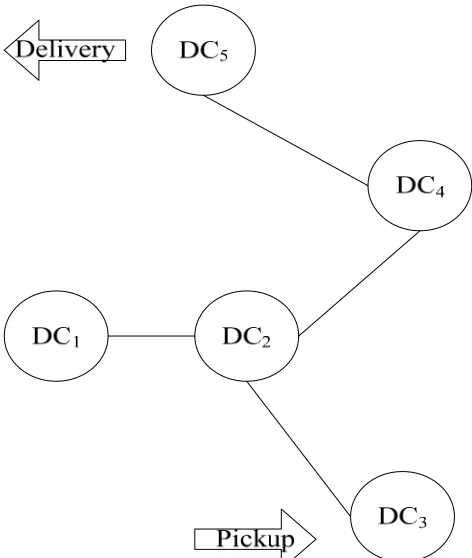
destination address. Figure 1.2 shows a package that enters at DC 3, travels to destination DC
4
Figure 1.2. A Package Originating at DC 3 Travels to DC 5Table 1.1 shows a comparison for functions of components in a PLN and the Internet [3].
DCs function like routers in the Internet. Packages transmitted by trucks are like data packets
transmitted by cables in the Internet.
Table 1.1. Comparison between Components of a PLN and the Internet
PLN Internet
Distribution Centers (DC)
Routers
Packages (Parcels)
Data Packets
5
1.3
Literature Review
Kay and Parlikad [2] analyzed material flow features in a PLN and compared three different
networks in terms of package average travel time. Bansal [5] studied PLN configurations and
proposed three mechanism to design a PLN. Kay [1] and Jain [3] proposed protocols for the
entities in the PLN to comply with. Those protocols make the PLN operate efficiently. In
their research, the average waiting time for a package is estimated to be the product of the
truck headway, which is the average interarrival time for trucks, and the headway ratio,
which is the assumed to have the value 0.5. As explained in the rest of this dissertation,
assuming a headway ratio of 0.5 is incorrect and yields inaccurate estimates of the
performance of a PLN.
1.4
Research Objectives
The main objectives of this research are to do the following:
1.
Develop a simulation model that builds on previous work of John Telford [6] to study
PLN operations. A PLN can be viewed as a priority queuing network with bulk
arrivals and bulk service. Due to the complexity of this problem, it is very difficult to
obtain a closed-form solution for package average waiting time. Therefore, a
simulation model is created in order to gain some insight and obtain some statistics on
the PLN operation, such as package average waiting time and the truck load factor
(that is, the space utilization for each truck trip, which is assumed to be the same for
6
2.
Use analytical and simulation models to find an accurate and practical procedure to
estimate package average waiting time. Kingman’s equation [7] is applied to
approximate the package average waiting time. The latter quantity can be represented
as the product of the truck headway and the headway ratio (refer to Section 2.2 for the
definition of this term). Statistics from the simulation and analytical models are then
used to estimate the headway ratio.
3.
Design the optimal PLN that yields minimal package average waiting times for all
packages’ origins and destinations. Potential locations (search space) for the DCs are
found using the U.S. network of interstate and highways. A genetic algorithm (GA) is
applied to the search space to determine the optimal number of DCs, their locations,
and the direct arc connections between adjacent DCs.
In addition to the main research objectives, we also discuss using the PLN simulation to
implement the protocols proposed in Kay [1] and Jain [3]. As an extension to the basic
simulation for the PLN, those advanced features focus on protocols, package bidding
procedures, truck agent behaviors, etc. A series of protocols have been developed by Kay [1]
for entities in the PLN to comply with. Packages bid for their transportation along the way.
Higher bidders get higher priority for truck transport services. Trucks obey a greedy rule, in
that they will transport the load of packages with the highest total bid. The bidding process
7
1.5
Layout of the Dissertation
Chapter 2 introduces the analytical and simulation models. We illustrate how the truck
headway and the headway ratio are used in the package average waiting time calculation.
Validation of the simulation model is presented as well.
Chapter 3 focuses on obtaining the package average waiting time approximation by
Kingman’s equation. Some statistics, such as the coefficient of variation for package
interarrival time, and the coefficient of variation for truck interarrival time, etc., are collected
from analytical and simulation models (with a simple package bidding scheme) and are used
in a regression-based method to estimate the headway ratio.
Chapter 4 presents the PLN simulation with some advanced features, including the package
bidding and truck acceptance of package loads. In addition, some of the simulation
architecture design issues are discussed.
Using results from Chapter 3, we present in Chapter 5 a procedure to design the PLN that
yields the minimal package average waiting time. A genetic algorithm is applied to search for
the number of DCs and their locations based on the U.S. network of interstate and highways.
8
2
PLN Analytical Model and Simulation Model
2.1
Literature Review
A computer simulation is a computer program that attempts to simulate an abstract model of
a particular system. Computer simulations have become a useful part of mathematical
modeling of many natural systems to gain insight into the operation of those systems, or to
observe their behavior [8, 9, 10]. Sadoun [11] provides a comprehensive review for applied
system simulation.
2.2
Headway and Headway Ratio for Waiting Time Calculation
Queuing theory has been widely used in practice to study average queue length, average
waiting time for a unit to receive service, etc. In the waiting time approximation, the service
time plays a big role. Actually, from the simple M/M/1 queue to the fairly complicated G/G/1
queue, expected waiting time is calculated as:
*
qW
= θ μ
, (2.1)
where
μ
is the average service time and
θ
is a number determined by server utilization, job
arrival rate, and machine service rate. Different types of queuing systems have different
representations for
θ
. For example, for an M/M/1 queue,
θ
=
ρ
/(1-
ρ
) (where
ρ
is server
utilization); and for a G/G/1 queue,
θ
=
2 2
1
2
A B
C
C
ρ
ρ
⎛
⎞
⎛
⎞
+
⎜
⎟
⎜
−
⎟
⎝
⎠⎝
⎠
, where
ρ
is the server utilization,
2 A
9
coefficient of variation of the service time. In Equation (2.1), the average waiting time for a
unit to receive service is expressed as the product of average service time (µ) and a number
(
θ
). In a PLN, the service time for package transportation is the truck interarrival time. This
suggests that, in a PLN, the package average waiting time can be approximated as the
product of truck headway (truck average interarrival time, which represents average service
time in a PLN) and the truck headway ratio, which is a term similar to
θ
in Equation (2.1),
consolidating all parameters except truck headway in the waiting time approximation
equation (for detailed queuing abstraction and model specification, refer to Section 3.2.1).
A simple example of this is as follows. If three trucks visit a station in 24 hours, then the
average truck headway is 8 hours. If the headway ratio is 0.5, then packages wait on average
four hours for a truck. Again, for different types of queues, the headway ratio has different
values.
The queuing principle that Poisson Arrivals See Time Averages (PASTA) states when the
arrival process to a system is Poisson, the long-run fraction of arrivals that see the process in
a particular state is equal to the long-run fraction of the time the process is in that state [12].
It is well known that, compared with the single-arrival, and single-service queuing model,
bulk features (bulk arrivals or/and bulk services) introduce more uncertainty and make the
average waiting time longer [15]. Without further research on package average waiting time
10
be less than one (if a random variable is exponentially distributed, its coefficient of variation
is 1). But it turns out that in a PLN, the headway ratio is much larger than 1, due to the
uncertainty induced by the bulk arrivals and bulk service as described above.
2.3
Analytical Model
Simulation is a good tool to study real-world problems. However, it is not always possible to
get insight into the system’s behavior solely by analyzing the output of a simulation of the
target system. Moreover, simulation is computationally intensive. Therefore, an approximate
analytical model has been developed and coded in MATLAB. This analytical model
calculates the number of trucks needed to handle a specific package demand, which can be
used as an input parameter in a simulation model to target a desired truck load factor.
In a PLN, the transport time for a package traveling from DC
ito DC
jis composed of three
parts: the time waiting for a truck (WT
ij), the loading and unloading time at each DC
(TimeLU, it is assumed to be the same in all DCs), and the actual travel time onboard a truck
(TT
ij):
WT + TT + TimeLU.
ij ij ij
t
=
(2.2)
Since the loading and unloading time and the travel time are fixed (assuming trucks travel at
a constant speed and packages are routed along the shortest paths), the only part left to
11
2.3.1
Analytical Model Assumptions
1.
Trucks operate around the clock and travel at constant speed.
2.
The truck load factor (which is defined to be the fraction of the truck’s capacity to
carry packages that is used on each trip) is 80%.
3.
The headway and headway ratio are used to approximate package average waiting
time as the product of the truck headway and the headway ratio.
2.3.2
Analytical Model Input Parameters
TimeLU: Loading and unloading time within DC (unit: minutes);
ProxFac: Proximity factor [2] (unit: none);
Nopkg: Total number of packages entering the PLN over a 24-hour period (unit: packages);
TrCap: Truck capacity (unit: packages);
TrSpeed: Truck traveling speed (unit: miles per hour);
LdFacA: Load factor for trucks (unit: none);
HWRatio: Headway ratio (unit: none).
The Proximity factor (ProxFac) represents the degree to which a DC is more likely to
12
information about the proximity factor can be found in Kay [2]. The quantity Nopkg is
assumed to be constant in the analytical model. The symbol arc
i,jrepresents the direct
connection from DC
ito DC
j.Similarly, the symbol arc
j,irepresents the direct connection from
DC
jto DC
i. We assume the direct connections between DCs are symmetric, that means if
arc
i,jexists, then arc
j,iexists as well, and vice versa. Note that if there is no direct connection
between DC
ito DC
j, then arc
i,jand arc
j,ido not exist.
2.3.3
Analytical Model Detailed Calculation
In the analytical model, analysis is focused on each individual arc (the direct connection
between two DCs). On each arc we calculate truck headway, package average waiting time,
and the number of trucks needed to meet the package demand.
In the analytical model, a number of packages (Nopkg) are transported by trucks in 24 hours.
The number of packages originating in a DC is determined by the population weight for the
area covered by that DC (as calculated in Equation (2.3)). The number of packages traveling
from an origin DC to a destination DC is proportional to the product of the population
weights for the origin and destination DCs (as explained in Section 2.3.3.1). For each specific
arc, the analytical model calculates how many truck trips are needed to meet the package
demand. Then the truck headway for that arc is the ratio of 24 to the number of truck trips on
that arc. The package average waiting time is calculated as the product of the truck headway
and the headway ratio. Since each truck travels at a constant speed, the package’s travel time
13
the PLN can be calculated by Equation (2.2). Finally, the number of trucks needed is the ratio
of the total truck hours (summing up the total travel time for each truck) to 24.
2.3.3.1 Number of Packages Transported between Two DCs
In the analytical model, the DC population weights are represented by a 36-element vector.
(We use Figure 1.1 as the PLN network where there are 36 DCs. Their locations and the
population each DC covers are known). The population weight of DC
i,
wi
, is calculated in
Equation (2.3),
36
1
Pop
1, 2,...,36,
Pop
i i
j j
w
i
=
=
=
∑
(2.3)
where Pop
iis the population covered by DC
i.
The number of packages originating at each DC is proportional to its population weight,
nopkg_DC
i=
nopkg * ,
w
i(2.4)
The number of packages originating at DC
iis the product of Nopkg and
w
i.
The total number of packages (
nopkg_OD
i j,) that travel from DC
ito DC
jis calculated as:
,
nopkg_OD
i j=
Nopkg * .
w
ij(2.5)
For a proximity factor equal to zero (ProxFac = 0),
*
.
ij i j
14
For none-zero proximity factor (ProxFac
≠
0), refer to Kay [2] for details on how to calculate
wij
.
Similarly, the total number of packages (
nopkg_OD
j i,) that travel from DC
jto DC
iis
calculated as:
,
nopkg_OD
j i=
nopkg *
w
ji.
(2.7)
Since
w
ij=
w
ji=
w
i*
w
j, the quantity
nopkg_OD
i j,is the same with the quantity
,
nopkg_OD
j i.
2.3.3.2 Number of Packages Transported on a Single Arc
The number of packages traveling over the arc from DC
ito DC
jis represented by
,
nopkg_arc
i j. Similarly, the number of packages traveling over the arc from DC
jto DC
iis
represented by
nopkg_arc
j i,. Dijkstra's algorithm [13] is used to find out the shortest path
from any DC to another.
The following example explains the difference between
nopkg_OD
i j,and
nopkg_arc
i j,. In
the PLN shown in Figure 2.1, the solid lines represent arcs between two DCs, and the dotted
lines represent packages transported from one DC to another. The quantity
nopkg_OD
3,2represents the number of packages traveling from DC
3to DC
2and the shortest path for those
packages requires travelling through arc
3,4, and arc
4,2. The quantity
nopkg_OD represents
4,215
requires travelling over arc
4,2. The quantity
nopkg_OD represents the number of packages
5,2traveling from DC
5to DC
2, and the shortest path for those packages requirs travelling
through arc
5,4, and arc
4,2.
The quantity
nopkg_arc represents the number of packages going through
4,2arc . In the
4,2example given above, the quantity
nopkg_arc is the summation of the quantities
4,23,2
nopkg_OD ,
nopkg_OD and
4,2nopkg_OD since all of those packages go through
5,2arc .
4,2Note that, as explained in Section 2.3.2, the symbol arc
i,jrepresents the direct connection
from DC
ito DC
j. But if there is no direct connection between DC
ito DC
j, then arc
i,jdoes not
exist and the quantity
nopkg_arc
i j,is not defined. For example in Figure 2.1, the symbol
arc
3,2does not exist since there is no direct connection between DC
3and DC
2. Therefore, the
quantity
nopkg_arc is not defined. However,
3,2nopkg_OD is defined as the number of
3,2packages traveling from DC
3to DC
2. This shows the difference between
nopkg_OD
i j,and
16
Figure 2.1. Packages Transported between DCs and Packages Transported on a Single ArcThus, the quantity
nopkg_arc
i j,is the total number of packages whose shortest path goes
through
arc
i j,,
nopkg
, 1
nopkg_arc
i j(pkg goes through the arc from DC to DC ),
i j kI
k
=
=
∑
(2.8)
where
I
(·) is an indication function,
1, if condition is true,
(condition)
0, if condition is false.
I
= ⎨
⎧
17
2.3.3.3 Truck Headway
Since we assume trucks operate around the clock, the truck headway is calculated as follows:
,
,
24
Headway ,
nopkg_arc / (TrCap * LdFacA)
i ji j
=
(2.10)
where TrCap*LdFacA represents how many packages each truck trip transports, and
,
nopkg_arc / (TrCap*LdFacA)
i jrepresents how many truck trips are needed on arc
i,jto meet
the demand.
2.3.3.4 Number of Trucks in the PLN
The number of trucks needed is calculated as follows:
nopkg
1
/ (TrCap*LdFacA)
notruck
,
24
kk
t
=⎡
⎤
⎢
⎥
⎢
⎥
=
⎢
⎥
⎢
⎥
⎢
⎥
∑
(2.11)
where
t
kis the total truck transport time of
k
th package. Notice that this does not include
package waiting for truck time and loading and unloading time at DCs.
2.3.4
The Outputs from the Analytical Model
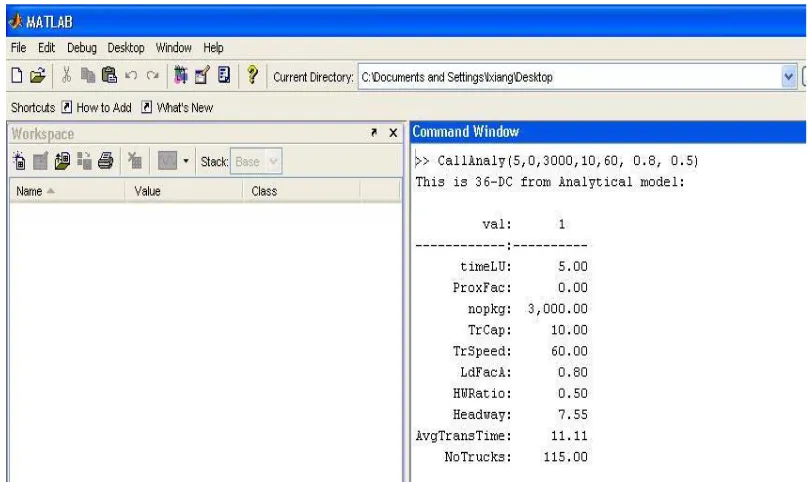
To give an example of output from the analytical model, we run the analytical model with
following parameter values, TimeLU=5, ProxFac=0, Nopkg=3000, TrCap=10, TrSpeed=60,
18
load factor, 115 trucks are needed in the simulation. This number of trucks serves as one
input parameter into the simulation model to achieve the same load factor level.
Figure 2.2. Output Snapshot from the Analytical Model
2.4
Simulation Model
The simulation model is developed using Microsoft .NET framework to take advantage of its
advanced data structures and efficient program control procedures [14]. Under the .NET
platform, every entity is implemented as an object [14]. This simulation model is based on
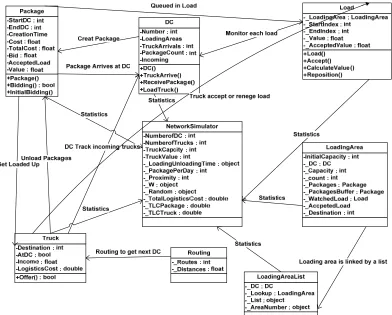
Telford’s logistics simulation library [6]. In Figure 2.3, each object is enclosed in a rectangle
along with its properties, operations, etc. For example, each package is an object and has
properties StartDC and EndDC, as well as several associated functions (e.g.,
Package
).
19
Figure 2.3. Object Design Configuration2.4.1
Simulation Model Detailed Description
2.4.1.1 Simulation Initialization
The simulation program runs 25 replications, and 3,600 days for each replication. The
initialization function initializes the simulation program. The initialization function generates
the event calendar, loads the input data sets, and calls functions to create DCs, loading areas,
20
waiting times, truck load factors, etc. Finally, it schedules the simulation termination events
onto the event calendar to finish the simulation when the termination condition is met.
2.4.1.2 Load Input Data Sets
The analytical model generates text files to hold the following information: distance between
any two DCs (
Distances
), a matrix representing the direct arc between two DCs
(
ArcDistance
), and the package routing scheme (
Routing
), which is determined using
Dijkstra’s algorithm [13]. The LoadData function loads this information to be used in
simulation.
2.4.1.3 Package Generation
The total number of packages generated in the simulation is 1.8 million per day, which is
approximately the same number of packages handled daily by UPS in the southeastern
U.S.A. [2]. Packages are generated according to a Poisson process. Like the analytical model,
the number of packages originating in a particular DC is proportional to its population
weight. When a package is generated, its origin DC and destination DC are randomly
generated based on the DCs’ population weights. At the same time, the count for total
number of packages generated in the simulation (
PackageID
) is incremented by one.
2.4.1.4 Package Routing
Whenever a package reaches a DC, the
Routing
function is called to determine its next DC
21
package’s destination DC, then the current package is eliminated from the simulation and
some statistics, such as PackagesDelivered, PackageWaitTime, etc. are updated. If the
current DC is not this package’s destination, then the package is put in the package queue
(loading area) to wait for a truck to transport the package to its next destination.
2.4.1.5 DC Services
DCs play a central role in the PLN operation. A DC collects packages originating from the
local areas it covers, maintains package queues, provides related information for incoming
trucks and packages, etc. Each DC has a loading area (package queue), for each immediately
adjacent DC, i.e., each DC that shares a direct arc connection. For example, in Figure 2.4,
DC
1is adjacent to DC
2, DC
3, and DC
4. Then, within DC
1, there are three loading areas
designated for packages heading to DC
2, DC
3, and DC
4. Whenever a package reaches a DC,
if this is not its destination DC, then the package is placed in the loading area that
22
Figure 2.4. Example DC ConfigurationWhen a truck arrives at a DC, the
ReceivePackage
function is called to perform the following
operations: (i) empty the arriving truck; (ii) call function
Routing
to route each package on
that truck to its next DC by putting the package in the corresponding loading area (if this is
the final destination DC for a package, this package is eliminated from the simulation); and
(iii) update all the related statistics.
In order to attract trucks to come to a DC and transport packages, only trucks currently at this
DC and trucks heading to this DC from other DCs directly connected with this one are made
eligible to accept a load of packages (that is, eligible for the load offering process). For
23
is heading to DC
4, which is adjacent to DC
2, and truck 3 is currently at DC
2. In this scenario,
only truck 1 and truck 3 are eligible for this load offering. Since truck 3 is currently at DC
2,
truck 3 has higher priority than truck 1; and thus truck 3 will be the first truck to have the
chance to consider accepting this load. Note truck 2 is heading to DC
4not DC
2, so truck 2 is
not eligible for the load offering at DC
2.24
2.4.1.6 Trucks
The analytical model calculates the number of trucks that are needed to achieve the target of
an 80% truck load factor on each arc on the average. In the initialization process, the initial
locations of all trucks are randomly generated. That means, unlike packages, all trucks enter
the simulation at one time. Once packages enter the simulation, trucks start to accept
packages, load the accepted packages, and travel to their next DC.
2.4.1.7 Loading Areas
Within a given DC, each loading area is a queue to hold packages waiting for transport to a
specific DC. When packages come into a DC and are routed to the next DC, a function
named
Add
is called to add those packages to the corresponding loading area. The first
L
packages (where 0<
L
<=TrCap*LdFacA) comprise a load (named
watchload
). The loading
areas in a DC take turns to offer their
watchload
to trucks. If a truck accepts that
watchload
,
then a function named
LoadTruck
is called to perform the following operations: (i) move this
load of packages onto the truck; and (ii) arrange for the truck to leave for the next DC
immediately by making a call to function
TruckAccepted
.
2.4.1.8 Statistics Objects
A number of statistics objects, such as
ArcPackageIntArrMean
,
ArcTrucksLastArr
,
25
2.4.1.9 Simulation Termination
When the simulation time reaches the preset limit, a function named
Terminate
is called to
terminate the simulation program. The function
Terminate
destroys all objects, releases
computer memory, and creates text files with designated statistical outputs.
2.4.2
Simulation Model Input Parameters
TimeLU: Loading and unloading time within a DC (unit: minutes);
ProxFac: Proximity factor (unit: note);
Nopkg: Total number of packages entering the PLN over a 24-hour period (unit: packages);
TrCap: Ttruck capacity (unit: packages per truck);
TrSpeed: Truck traveling speed (units: miles per hour);
NoTrucks: Number of trucks in the PLN (unit: trucks).
26
2.4.3
Simulation Outputs
Figure 2.6. Output Snapshot from the Simulation Model
Figure 2.6 shows that with the current set of parameters (TimeLU = 5, ProxFac = 0, Nopkg =
3000, TrCap = 10, TrSpeed = 60, LdFacA = 0.8), the load factor is 82%. The average transit
time for packages is 17.96 hours, and the package average wait time is 10.34 hours.
2.5
Simulation Model Validation
Before further research is carried out with the simulation model, it is necessary to validate
that it is working correctly. Little’s law [15] calculation and M/G/1 queuing calculation are
used to validate the simulation model.
Little’s Law: The long-run average number of customers in a stable system (over some time
interval), WIP, is equal to the long-run average arrival rate of customers,
λ
, multiplied by the
long-run average cycle time in the system, CT [15]:
WIP
=
λ
CT.
(2.12)
In the simulation, WIP is the average number of total packages waiting in queues and the
27
average arrival rate of packages, and CT is the average length of time a package stays in the
PLN. The simulation model keeps track of the total number of packages created and each
package’s cycle time. The long-run average arrival rate of customers is the ratio of the total
number of packages created to the simulation length. The long-run average cycle time is the
average of recorded package’s cycle time in the simulation. The value of WIP (denoted by
WIP_Calc) is calculated as the the product of the long-run average arrival rate of customers
and the long-run average cycle time. The simulation model aslo keeps track of package
queue length. The estimated WIP value (denoted by WIP_Simu) is the average number of
packages in the PLN. The validation is to see how much difference is between WIP_Simu
and WIP_Calc.
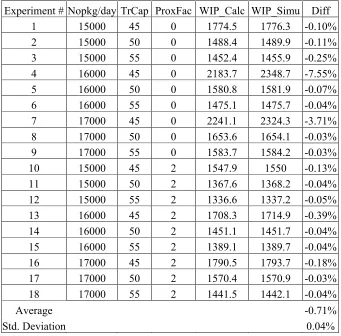
The simulation program runs 25 replications, and 3,600 days for each replication. The
simulation wamp-up period is 90 days. Based on a 36-DC PLN (shown in Figure 1.1),
eighteen different parameter sets were used in the simulation model. TimeLU (loading and
unloading time of 5 minutes), and TrSpeed (truck speed of 60 mph), were kept the same
28
Table 2.1. Validation of the Simulation Model against Little’s LawExperiment # Nopkg/day TrCap ProxFac WIP_Calc WIP_Simu Diff 1 15000 45 0 1774.5 1776.3 -0.10% 2 15000 50 0 1488.4 1489.9 -0.11% 3 15000 55 0 1452.4 1455.9 -0.25% 4 16000 45 0 2183.7 2348.7 -7.55% 5 16000 50 0 1580.8 1581.9 -0.07% 6 16000 55 0 1475.1 1475.7 -0.04% 7 17000 45 0 2241.1 2324.3 -3.71% 8 17000 50 0 1653.6 1654.1 -0.03% 9 17000 55 0 1583.7 1584.2 -0.03% 10 15000 45 2 1547.9 1550 -0.13% 11 15000 50 2 1367.6 1368.2 -0.04% 12 15000 55 2 1336.6 1337.2 -0.05% 13 16000 45 2 1708.3 1714.9 -0.39% 14 16000 50 2 1451.1 1451.7 -0.04% 15 16000 55 2 1389.1 1389.7 -0.04% 16 17000 45 2 1790.5 1793.7 -0.18% 17 17000 50 2 1570.4 1570.9 -0.03% 18 17000 55 2 1441.5 1442.1 -0.04%
Average -0.71% Std. Deviation 0.04%
As shown in Table 2.1, the average difference between the WIP value recorded in the
simulation and the theoretical WIP value is –0.71% (with a standard deviation of 0.04%, and
a 95% confidence interval of (–1.24% , –0.64%)).
In the PLN, if the truck capacity is constrained to be one and the packages arrival process is
Poisson distribution, then the PLN network reduces to a M/G/1 queuing model. The
Pollaczek-Khinchin formula [16] is used to calculate the long-run package average waiting
29
The package average waiting time ( ˆ
W
q) is computed as,
2 eff
eff
1
ˆ
,
1
2
B
q B
C
W
ρ
μ
ρ
⎛
⎞⎛
+
⎞
= ⎜
−
⎟⎜
⎟
⎝
⎠
⎝
⎠
(2.13)
where
ρ
effis the effective server utilization,
2 BC
is the squared coeffient of variation for the
truck headway (time between the (
k
-1)st truck and
k
th truck to arrive at DC
iwith DC
jas the
next destination) and
μ
Bis the mean value for the truck headway. Refer to Section 3.2.2.1
for detailed notation and definition. Note that since the package arrival process has a Poisson
distribution, the squared coeffient of variation for the package interarrival time is one.
The simulation program runs 25 replications, and 3,600 days for each replication. The
simulation wamp-up period is 90 days. Based on a 3-DC PLN, in the simulation model,
packages arrive according to a Poisson process (different numbers of packages for the PLN
are used for multiple experiments), the truck capacity is one, and the loading and unloading
time is 5 minutes. In the simulation, we record the squared coeffient of variation for the truck
headway (
2 BC
), the mean value for the truck headway (
μ
B), and the package average waiting
time (
W
q). The quantity
ρ
effis 80% (refer to Section 3.2.2.4 for a detailed discussion for the
effective server utilization) and then ˆ
W
qis estimated by Equation (2.13). The comparison
between the package average waiting time in the simulation (
W
q) and the estimated package
30
Table 2.2 Validation of the Simulation Model against the M/G/1 Queuing ModelExperiment # Nopkg/day WT_Simu (
W
q)
WT_Calc (W
ˆ
q)
Difference1 150 9.1 8.2 10.3%
2 160 9.1 8.3 8.5%
3 170 9.6 9.1 5.4%
4 180 9.7 9.5 1.8%
5 190 9.9 10.1 –1.6%
6 200 10.5 10.9 –3.8%
Average 3.4%
Std. Deviation 5.6%
On average, the difference between the package average waiting time recorded in simulation
(
WT_Simu) and those calculated by M/G/1 queuing model (WT_Calc)is 3.4% (with a standard
31
3
Package Average Waiting Time Approximation
3.1
Literature Review and Research Issues
Kay and Parlikad [2] analyzed material flow features in a PLN. Bansal [5] studied PLN
configuration and proposed some mechanisms to design a PLN. Kay [1] and Jain [3,3]
proposed some protocols (for package bidding, truck agent behavior, etc) for the PLN, and
they tried to make the PLN work more efficiently. In their research, the average waiting time
for a package is based on truck headway, which is the interarrival time for a truck at a DC.
Average waiting time is assumed to be half of the headway (headway ratio is 0.5).
In the PLN network design problem, the package average waiting time is critical since it is a
large component of the measurements to evaluate each proposed network configuration.
Therefore, a better approximation for package average waiting time is needed to revise and
refine a model of the performance of a PLN network.
A simulation model [8] has been built to observe the values of performance metrics that are
needed in the package average waiting time approximation. Those values cannot be obtained
by exact queuing-theoretic analysis due to the complexity of the PLN (a priority queuing
network with bulk arrivals and bulk service).
Bulk service queuing problems in transportation have attracted many researchers and
scholars since the mid-twentieth century. The original paper in this field was published by
32
number of waiting customers. Since then, a large number of contributions have been made to
the field, including Downton [18] Miller [19], Neuts [20], Cohen [21], Chaudhry [22] and
Powell [23, 24, 25]. Downton formally analyzed the average waiting time problem with bulk
arrivals and bulk service, which laid a solid groundwork for future research on this problem.
Neuts researched bulk queues with different vehicle-control strategies, but he only
considered a single Poisson arrival stream. Powell studied this research issue from the
perspective of load planning. He also approximated the average waiting time with iterative
numerical computing. However, his work is heavily dependent on his specific model and
vehicle-control policies. Tegiilm [26] and Borthakur [27] considered the general bulk service
rule for bulk arrivals (with variable sizes for arrivals).
Whitt [28, 29] studied limiting theorems in the condition of heavy traffic. He also studied an
interpolation approximation for the mean workload in a GI/G/ 1 queue. However, this does
not apply to the bulk-arrival and bulk-service scenario. Marchal [30] developed some simple
waiting-time approximations for the GI/G/1 and GI/G/c queues. Kingman [7] developed an
approximation for the average waiting time for the GI/G/1 queue. Kingman’s approximation
has been used by Hopp [15], who showed that when server utilization is high, the
33
3.2
Package Average Waiting Time Approximation in a PLN
3.2.1
The PLN Queuing Model Abstraction
Figure 3.1 shows the abstraction of the PLN to a standard queuing model. In a PLN, any arc
(direct connection) between two DCs contains a package queue. The arc between DC
1and
DC
2contains two package queues: one queue with packages going from DC
1to DC
2, and
another queue with packages going from DC
2to DC
1.A truck transports a load of packages
on each trip between two DCs, and when the truck reaches a DC, its load of packages are
disassembled, and the associated packages are moved to their assigned package queues.
Clearly, the PLN operation involves bulk arrivals and bulk service. A PLN is an open
interconnected network of such package queues. So a PLN can be abstracted as an open
queuing network with bulk arrivals and bulk service.
The package waiting time for truck transport is composed of two parts. In part 1 of the
waiting process, packages form a load in the assembly queue. In part 2 of the waiting
process, loads waiting in the transport queue for shipment to their next destination DC. When
packages arrive at a DC, they are put in the appropriate assembly queue. Whenever a number
of packages (
L
packages, where
L
is the load size) form a load, this load is immediately
moved to the transport queue to wait for truck transport. On each trip, a truck only transports
one load to the destination DC. If customers in the system are loads, then the system can be
modeled as a network of interconnected G/G/1 queues. The customers’ arrival process is
34
the time between the formation of consecutive loads. The service is defined as truck
transport, and the service time is the interarrival time between consecutive trucks destined for
the same DC. Detailed definition can be found in Section 3.2.2.1.
35
3.2.2
Mathematical Formulation of Target Problem
3.2.2.1 Definitions
The following definitions and terms apply to the package waiting time approximation.
Service: truck trip from one DC to another
Headway: interarrival time between consecutive trucks arriving at DC
ithat are
destined for DC
jAverage load size:
L
packages
k
U
: Time between arrival of package
k
–1 and package
k
at the assembly queue
of packages at DC
iwaiting for transport to DC
j.
u
μ
: Mean value of
U
ku
σ
: Standard deviation of
U
ku
C
: CV (coefficient of variation) of
U
k,
u uu
C
σ
μ
=
Ak
: Time between the formation of load
k
–1 and load
k
in the queue of loads at
DC
iwaiting for transport to DC
j.
A
μ
: Mean value of
A
kA
σ
: Standard deviation of
Ak
A
C
: CV of
Ak
, A A AC
σ
36
B
k: Headway, time between the arrival of the (
k
– 1)st truck and
k
th trucks at one
DC
with the same next destination.
B
μ
: Mean value of
Bk
B
σ
: Standard deviation of
Bk
B
C
: CV of
Bk
, B B BC
σ
μ
=
A
r
: Arrival rate of loads at one DC waiting for transport to the same next DC:
1/
A A
r
=
μ
B
r
: Rate at which trucks arrive to pick up a load from the queue of loads waiting
at DC
ifor transport to DC
j: 1/
r
B=
μ
Bρ
: Truck (server) utilization:
A BB A
r
r
μ
ρ
μ
=
=
Since a load is composed of
L
packages (
( 1) 1 kL
k j
j k L
A
U
= − +
=
∑
), we have
μ
A=
L
μ
u, and
2 2
A
L
uσ
=
σ
. Substituting in these values, we can see that
2 2 2
2 2
2
(
)
2 2u u u
A A
A u u
L
C
C
L
L
L
=
σ
=
σ
=
σ
=
μ
μ
μ
.
3.2.2.2 Average Waiting Time for a Load
Consider a load at DC
iwaiting to be transported to DC
j. Based on the average waiting time
37
2 2
ˆ
1
2
A B
q B
C
C
W
ρ
μ
ρ
⎛
⎞
⎛
⎞
+
=
⎜
⎟
⎜
⎟
−
⎝
⎠⎝
⎠
(3.1)
where
ρ
is truck utilization,
2 AC
is the squared coefficient of variation for load interarrival
time,
2 BC
is the squared coefficient of variation for trucks interarrival time (headway), and
B
μ
is the headway mean value.
Within a PLN, since the package arrival process is not a Poisson process due to the batch
arrival of packages on trucks to a DC and the service time (truck headway) is not
exponentially distributed, values for
ρ
,
2 AC
and
C
B2can only be observed from the
simulation. The headway mean value
μ
Bcan be obtained by the analytical model (described
in Section 2.3), given the demand rates at each DC and the truck capacity.
3.2.2.3 Average Waiting Time for a Package
In a PLN, when a package arrives, it is put in the assembly queue to wait for a load to be
formed. After a load is formed, it is put into a transport queue, where it waits for truck
transportation.
Suppose a package is currently in DC
i, and it is going to DC
j. The average waiting time for
this package consists of two parts:
(i)
The time spent waiting in an
“
assembly queue
”
until a
“
complete
”
38
truckload immediately exits the assembly queue and joins the “transport
queue,” which is a queue of truckloads waiting for a truck that will
transport the first waiting truckload from DC
ito DC
j;
(ii)
The time spent in the
“
transport queue
”
until a truck destined for DC
jfinally arrives at DC
iso that the first waiting truckload can exit the
transport queue and start the trip to DC
j.
The “service time” in the transport queue is taken to be the headway (delay) between the
arrival of successive trucks that are destined to deliver a truckload to DC
j, and where it is
assumed that the transport queue is rarely empty.
Let
X
denote the waiting time of the target package in the assembly queue. If the target
package is the th
k
package to be added to the truckload currently being assembled
for
k
=
1, , 1
…
L
−
, then for
l
= +
1, ,
k
…
L
, let
U
ldenote the interarrival time between the
l
th package and the
(
l
−
1)st
package in the same truckload so that the total waiting time in the
assembly queue for the target package is
1
0,
if
,
, if
1,...,
1.
Lk
l l k
k
L
X
U
k
L
= +
=
⎧
⎪
= ⎨
=
−
⎪⎩
∑
(3.2)
39
10,
if
[
]
(
)
for 1,..., .
[ ], if
1,...,
1
Lk U
l l k
k
L
E X
L k
k
L
E U
k
L
μ
= +
=
⎧
⎫
⎪
⎪
=
⎨
⎬
=
−
=
=
−
⎪
⎪
⎩
∑
⎭
(3.3)
The operation of assembling each truckload is defined as a renewal-reward process in which
a renewal epoch occurs each time the assembly of another truckload is finally completed,
therefore a standard renewal-reward argument can be used to prove the intuitively obvious
result that the long-run average time spent by the target package in the assembly queue is
assem 1
1
[
].
L k kW
E X
L
==
∑
(3.4)
From Equations (3.3) and (3.4), the long-run average waiting time for a package in the
assembly queue is
assem 1
1
(
)
L U kW
L
k
L
=μ
=
∑
−
(3.5)
1 1 L U v
v
L
μ
− ==
∑
(3.6)
(
1
)
2
U
L
L
L
μ
⎡
−
⎤
=
⎢
⎥
⎣
⎦
(3.7)
(
1)
.
2
U