ISSN(Online): 2319-8753 ISSN (Print): 2347-6710
I
nternational
J
ournal of
I
nnovative
R
esearch in
S
cience,
E
ngineering and
T
echnology
(A High Impact Factor & UGC Approved Journal)
Website: www.ijirset.com Vol. 6, Issue 8, August 2017
Reduction of Oil Consumption by Using Six
Sigma (A Case Study)
Md Taquee 1 Rajeev Choudhary 2 Avinash Kumar 3
Research Scholar, Department of Mechanical Engineering, Delhi, India1
Associate Professor, MED, (Geeta Engineering College Panipat Haryana) India 2
Production Head, AMTEK Company, Gurugram, Haryana, India 3
ABSTRACT: To attain maximum profit, we must minimize our 'wastage" that which we permanently throw away into the environment that will not be naturally recycled for reuse. Manufacturing process must be organized as closed systems. So we can not easily find out the problem which is minimize or reduce our consumption as well as cost. Increasing competition and increasing customer expectations make it imperative that cost at each head is to be reduced at the earliest. The hydraulic / lubrication cost is also an important head of total machining cost. In industry generally, We are not getting more profit due to tight margin from customer side , by attempting this project we are aiming to” reduce our oil consumption” and improve profit. This paper present the successful application of Six Sigma.Define-Measure-Analysis-Improve-Control (DMAIC) methodology in an manufacturing industry minimize the oil consumption during a machining process. And effective use of men,machine,material,money(4M) Hence, Six Sigma, DMAIC methodology was applied to this process for reducing the oil consumption. The potential causes of high oil consumption were identified through a brainstorming session.
KEYWORDS: Productivity Improvement, Six sigma (DMAIC), Cause and effect, Control, ( 4M)
I INTRODUCTION
ISSN(Online): 2319-8753 ISSN (Print): 2347-6710
I
nternational
J
ournal of
I
nnovative
R
esearch in
S
cience,
E
ngineering and
T
echnology
(A High Impact Factor & UGC Approved Journal)
Website: www.ijirset.com Vol. 6, Issue 8, August 2017
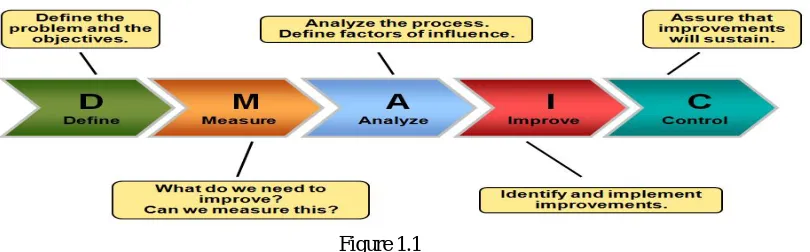
Figure 1.1
II. LITERATURE REVIEW
Many research had been done in implementing DMAIC technique in different process and manufacturing industry.
1
Kumar et al.(2011) presented some facts and benefits of using DMAIC Approach in improving the efficiency and performance level of the manufacturing process with lowest possible cost. 2Jiju Antony Ricardo Banvelas, Ashok Kumar demonstrated on how Six Sigma could be applied or has been applied in a real industry setting, and it also provides a systematic approach in contemporary organizations both for assessment and application purpose .The purpose of this book is to clearly explain how Six Sigma methodology can be applied to a particular manufacturing, service or transactional problem and also the calculations of estimated cost savings from the project and the benefits of Six Sigma, effective management decisions and improved internal communications. 3Thomas Pyzdekin the book “The Six Sigma Hand Book” explained the guidelines and directions to find a complete overview of management and organization of Six Sigma and its philosophy which underlines those problems solving techniques and and statistical tools most often used in six sigma. 4H.E. Cook explained the design for Six Sigma as strategic experimentation. It is a practical science based methodology for guiding the product realization process for highly competitive markets.
5
Debhasis Sarkar enumerated that the Six Sigma is probably one of the best methodologies to pervade the world of improvement. 6Terence T Borton and Jeff L Sams explained in their book which provides a detailed implementation road map and frame work for Six Sigma. It also includes methodologies, models hands on techniques case studies, implementation tools.
III. RESEARCH METHODOLOGY
1 DEFINE PHASE
TYPE OF OIL QTY USED PER MONTH(ML)
Hydraulic 68 4900
Spin 12 500
Spin 2 500
Mobile velocity 6 100 Table 1.1
ISSN(Online): 2319-8753 ISSN (Print): 2347-6710
I
nternational
J
ournal of
I
nnovative
R
esearch in
S
cience,
E
ngineering and
T
echnology
(A High Impact Factor & UGC Approved Journal)
Website: www.ijirset.com Vol. 6, Issue 8, August 2017
Pie chart of different type of oil used per month in percentage
Pie Chart 1.1
1.1 Potential saving calculation.
Current Oil consumption
Target consumption
Saving Price per Ltr
Saving per month
Saving per annum(approx)
MI/Pic 8 7 1 Rs. 90 0.45 lacs 5.4 lacs Ltrs 3992 3500 492
Table 1.2
1.2 OIL CONSUMPTION TREND BEFORE
Figure 1.2
Average oil Consumption in last six month is 8 ml/Part. 2 MEASURE
S NO. ACTIVITIES
1 Identified All Possible Causes of more Oil consumption
2 Implemented all identified quick wins
3 Data Collection for oil consumption in each line/machine started
0 5 10 15
Feb-17 Mar-17 Apr-17 May-17 Jun-17 Jul-17
DMAIC
ISSN(Online): 2319-8753 ISSN (Print): 2347-6710
I
nternational
J
ournal of
I
nnovative
R
esearch in
S
cience,
E
ngineering and
T
echnology
(A High Impact Factor & UGC Approved Journal)
Website: www.ijirset.com Vol. 6, Issue 8, August 2017
The main objective in this phase is to collect data pertinent to the scope of the problem. And identified all possible causes of more oil consumption and implemented following steps after identified causes of more oil consumption.
1 Trolley for handelling oil, 2 Provided funnel for top up 3 Shade for storage of oil
4 On job training for pressure setting 5 Provide trey to avoid spillage
3 ANALYSIS S
NO.
Key Process Input Variables (x’s) Line Statistical tools for
validation
1 Hose pipe and Slide lubrication return line condition verification CS2 Bar chart 2P Test 2 Hose pipe and Slide lubrication return line condition verification HUB Bar chart 2P Test
3 Hose pipe and Slide lubrication return line condition verification CS1 Bar chart 2P Test
4 Hose pipe condition verification HMSI Bar chart 2P Test Table 1.3
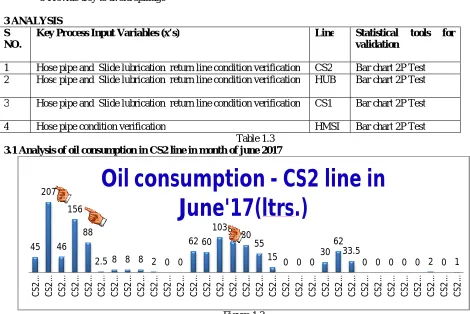
3.1 Analysis of oil consumption in CS2 line in month of june 2017
Figure 1.3
3.2 Top machines having high oilconsumption are ,
1 Turning(CS2-120) 2 Pin Milling(CS2-123) 3 Pin Grinder(CS2-130)
1 Investigation of Turning (CS2-120)
Observation: Hose pipe wear out resulting into leakage of oil Action taken: Hose pipe replaced
45 207
46 156
88
2.5 8 8 8 2 0 0
62 60103908055
15 0 0 0 30
62 33.5
0 0 0 0 0 2 0 1
C S2 … C S2 … C S2 … C S2 … C S2 … C S2 … C S2 … C S2 … C S2 … C S2 … C S2 … C S2 … C S2 … C S2 … C S2 … C S2 … C S2 … C S2 … C S2 … C S2 … C S2 … C S2 … C S2 … C S2 … C S2 … C S2 … C S2 … C S2 … C S2 … C S2 … C S2 … C S2 … C S2 …
ISSN(Online): 2319-8753 ISSN (Print): 2347-6710
I
nternational
J
ournal of
I
nnovative
R
esearch in
S
cience,
E
ngineering and
T
echnology
(A High Impact Factor & UGC Approved Journal)
Website: www.ijirset.com Vol. 6, Issue 8, August 2017
APRIL-17 MAY-17 JUNE-17 JULY-17
Figure 1.4
2 Investigation of pin milling (CS2-123)
Observation: Lubrication cartridge & hose pipe wear out resulting into leakage of oil Action taken: Lubrication cartridge & Hose pipe replaced.
Figure 1.5
3 Investigation of pin grinder (CS2-130)
ISSN(Online): 2319-8753 ISSN (Print): 2347-6710
I
nternational
J
ournal of
I
nnovative
R
esearch in
S
cience,
E
ngineering and
T
echnology
(A High Impact Factor & UGC Approved Journal)
Website: www.ijirset.com Vol. 6, Issue 8, August 2017
Test and CI for TwoProportions(2P test)
Sample X N Sample p
1 0 May ~ ,5 june 17 2864 10163 0.281807 06 june ~ 30 june,17 2025 8850 0.228814 Difference = p (1) - p (2)
Estimate for difference 0.0529930 95% CI for difference: (0.0406198, 0.0653661) Test for difference = 0 (vsnot = 0): Z = 8.39 P-Value =0.000
Conclusion: There is significant reduction of oil consumption in CS2 line
May ~ Jun,2017 = 281 ml/part July 2017 = 228 ml/part
NOTE:we have analyzed oil consumption of each line like hub line, cs1 line, hmsi line, and used statistical tools for validation of each line by using bar chart and 2p test. but here in this research report we provide details of only one line which is CS2 line.
4 IMPROVE
Improve Phase Plan
S NO. Activities
1 Verification of Hose pipe condition and to be replaced where ever required.
2 Cleaning of Slide lubrication return line
3 AMC to be given for oil chiller to maintain their viscosity. 4 Daily Monitoring of oil consumption of each line.
Table 1.4
OIL CONSUMPTIONFROM DECEMBER 2016 TOJULY 2017
ACIL LTD,MANESAR,GURUGRAM HARYANA
LSS Green Belt Project: Reduction of oil consumption
MONTH OIL
CONSUMPTI ON (LTRS)
PRODUCTION OIL/PART
(ML)
Project Stages
OIL/PART (ML)
OIL
COMSUMPTION / MONTH
Dec-2016 4900 463761 10.6 Project
selection 8.0
3992.5 Jan-2017 4000 534694 7.5
Feb-2017 3500 489949 7.1 Mar-2017 3155 510007 6.2 Apr-2017 3200 455304 7.0 May-2017 4200 423740 8.9
(10-15)-May-2017 3725 491292 7.6
During project
6.7
3218.0
ISSN(Online): 2319-8753 ISSN (Print): 2347-6710
I
nternational
J
ournal of
I
nnovative
R
esearch in
S
cience,
E
ngineering and
T
echnology
(A High Impact Factor & UGC Approved Journal)
Website: www.ijirset.com Vol. 6, Issue 8, August 2017
2017
(25-30)-May-2017 3089 458704 6.7 (31May-4
June)-2017 2838 474577 6.0 (5June-8
June)-2017 3106 519001 6.0 (9June-12
June)-2017 2584 513963 5.0
Project Completion
5.8
2839.0 (13June-17
June)-2017 2609 487722 5.3 (17June-25
June)-2017 3025 426025 7.1 (26June-30
June)-2017 2916 547439 5.3 (30June-5
July)-17 2935 478794 6.1 (5July-10
July)-2017 2965 491780 6.0
Table 1.5
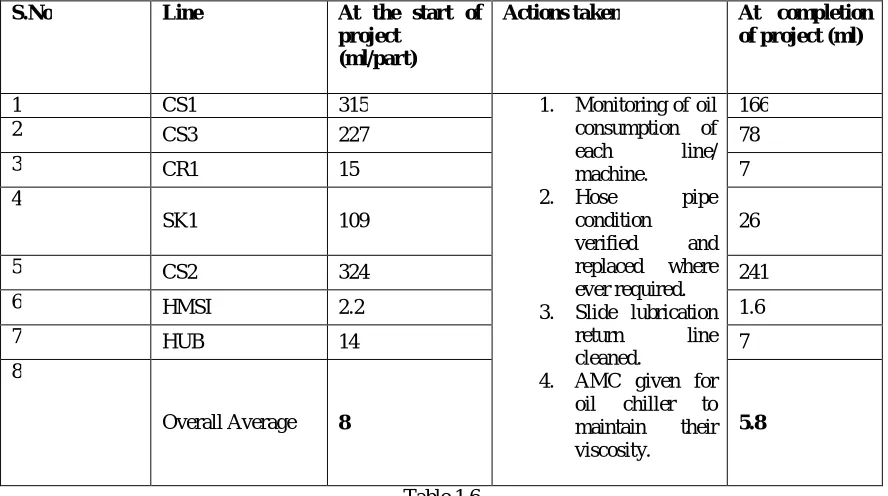
IMPROVE PHASE SUMMARY
S.No Line At the start of
project (ml/part)
Actions taken At completion
of project (ml)
1 CS1 315 1. Monitoring of oil consumption of each line/ machine.
2. Hose pipe condition verified and replaced where ever required. 3. Slide lubrication
return line cleaned.
4. AMC given for oil chiller to maintain their viscosity.
166
2 CS3 227 78
3 CR1 15 7
4
SK1 109 26
5 CS2 324 241
6 HMSI 2.2 1.6
7 HUB 14 7
8
Overall Average 8 5.8
ISSN(Online): 2319-8753 ISSN (Print): 2347-6710
I
nternational
J
ournal of
I
nnovative
R
esearch in
S
cience,
E
ngineering and
T
echnology
(A High Impact Factor & UGC Approved Journal)
Website: www.ijirset.com Vol. 6, Issue 8, August 2017
5 CONTROL Control Phase Plan
S. No. Activities
1
Preventive maintenance (Turning center)check list revised to Monitor hose pipe condition
2 Preventive maintenance (Pin Milling)check list revised to Monitor hose pipe condition
3 Given AMC for spindle oil chiller to ensure viscosity of oil
4 Monitoring of daily oil consumption in each line/machine
Table 1.7
DATA SUMMERY ON PROJECT
Parameter Before Project Target Actual
Ml/Pic 8 7 5.8
Ltrs 3992.5 3500 2839
Cost 325040 280000 227120 Table 1.8
Oil saving per month (Ltrs) : 1153.5 Saving in Rs. (Per Annum) = 12.5 Lacs
IV. CONCLUSION
The goal of this research was to improve the target company’s reduction of oil consumption. In addition, the goal was to demonstrate how this type of project can be executed using the Six Sigma methodology. To better understand the Six Sigma concept, both Lean and Six Sigma methodologies were studied. The Thesis described in this work is one of those projects that benefited greatly from the use of Lean Six Sigma. Lean offered some of the basic principles behind optimal production flow where as Six Sigma enabled the scientific analysis of the data and accurate estimations of process improvement potential. These together with the structure of DMAIC ensured that the project stayed on track and that no shortcuts were taken.Six Sigma projects are systematically executed processes that have the goal of reducing unwanted variation in processes to ensure better quality for processes and products. Six Sigma projects have a basic team structure. In the project described in this work, the researcher acted in the role of black belt. Black belt does most of the data analyzes and acts as the project manager and leader. In addition to a basic team structure, Six Sigma also has a basic predefined process for project execution.
REFERENCES
[1] Kim H.Pries (2006) “Six Sigma For New Millennium”, Pearson Education Pvt. Ltd
[2] James R. Evams &William M. Lindsay (2005) “An Introduction To Six Sigma Process And Improvement”, Cenangage Learning India Pvt. Ltd. [3] Jiju Antony Ricard Banvelas Ashok Kumar (2006) “World Class Applications Of Six
Sigma” Elsevier Ltd.
[4] Thomas Pyzdek (2003) “The Six Sigma Hand Book”, Mc Graw-Hill Companies.
[5] Geiff Tennant (2002) “Design For Six Sigma”, Launching New Products And Services Without Failure) Gower Publishing Limited. [6] Butter Worth Heinemann (2003) “6∂ Continual Improvement For Business) Butterworth Heinmann
[7] Greg Brue and Rod Howes (2006) “Six-Sigma –Text Book Tata Mc Graw –Hill Publishing Company Limited [8] Sung H.Park (2003) “Six Sigma For Quality And Productivity Promotion) Asian Productivity Organization.