Internationalizing Technopark
Master ThesisInnovative Entrepreneurship & Business Development
By: Mariska Roersen
Supervised by: J. Kraaijenbrink
A.J. Groen A.N. Petrovskyi
M. Roersen 2
Preface
Now that my final master thesis is completed, I can safely state that I did not take the easy way. Translations requested all of my patience and the volume of work to be done was occasionally frustrating. I did take an interesting way, however. I was given the opportunity to enlarge my knowledge of Russian business culture in a unique environment that would otherwise have remained closed to me. All my efforts resulted in this report, that researches MEPhI spin-offs located at Technopark and their possibilities to internationalize with help of a Dutch partner, and what role the MEPhI entrepreneurial support structure can play in this respect. Not only is this interesting for MEPhI and the companies in question, but also for anyone who is interested in Russian business culture.
This research was carried out in the framework of the CROSS project. The Dutch Ministry of Economic Affairs developed this CROSS project for knowledge transfer between the Netherlands and Central and Eastern European countries. The memorandum of understanding for collaboration in education with the Russian Federation forms the official framework of the CROSS activities in Russia. Within this framework, there is a collaboration between the University of Twente and MEPhI on educational processes and on entrepreneurship in networks. The last project is aimed at commercializing knowledge and is the framework in which my research is embedded.
M. Roersen 3
Table of contents
Chapter 1: Introduction to the project 7
1.1 MEPhI and Technopark 7
1.2 Introduction to the problem 7
1.3 Environmental context 8
1.3.1 Knowledge intensive entrepreneurship in networks 8
1.3.2 Soviet heritage 8
1.3.3 Research funding 8
1.3.4 Intellectual property 9
1.3.5 Social relations 9
1.3.6 Background implications 9
1.4 Project objective 10
1.5 Research issue 10
1.5.1 Research questions 11
1.5.2 Main concepts 12
1.5.3 Route to answering the research question 12
1.6 Division of the report 12
Chapter 2: Theoretical background 13
2.1 Collaboration 13
2.1.1 The four Cs of strategic alliances 13
2.1.2 Transaction cost approach 14
2.1.3 Shan’s market failures 14
2.1.4 Customer-supplier relationships in a larger network 15
2.1.5 Resource based view 15
2.2 Internationalization 15
2.2.1 Uppsala model 16
2.2.2 Model on international performance 16
2.3 Theory choice 16
2.3.1 Justification of chosen theory 16
2.3.2 The 4S model 17
2.3.3 Limitations of theory 20
2.4 Specifications of 4S model 21
2.4.1 Scope 21
2.4.2 Scale 22
2.4.3 Skills & values 22
2.4.4 Social network 23
2.5 Entrepreneurial support structure 23
2.6 Conclusion 25
3.3.1 Single informant bias 31
3.3.2 Asymmetry 31
M. Roersen 4
3.3.4 Lumpkin and Dess 31
3.3.5 Translation of concepts 31
3.3.6 Unconscious incapability 31
Chapter 4: Analysis of current capitals 32
4.1 Capitals of Technopark participants 32
4.1.1 Scope 32
4.1.2 Scale 34
4.1.3 Skills & values 34
4.1.4 Social network 35
4.2 Fit: Quarta-Rad with C-it and Steray Confidential
4.2.1 Capitals Quarta-Rad 4.2.2 Quarta-Rad and C-it 4.2.3 Quarta-Rad and Steray
4.3 Fit: Eskiz MEPhI with RWB Waterservices Confidential
4.3.1 Capitals Eskiz MEPhI
4.3.2 Eskiz MEPhI and RWB Waterservices 4.4 Fit: OKC Service with Bitkwadraat Confidential
4.4.1 Capitals OKC Service
4.4.2 OKC Service and Bitkwadraat
4.5 Conclusion 36
Chapter 5: Entrepreneurial support structure 39
5.1 Support instruments 39
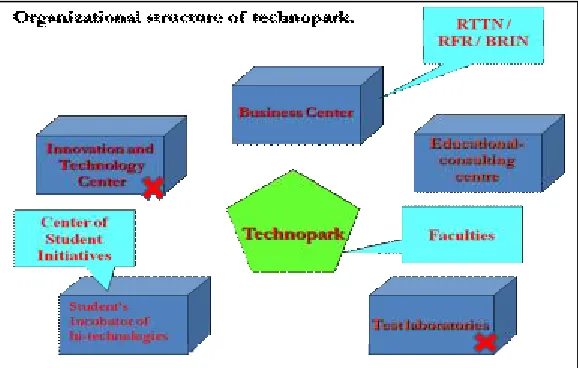
5.1.1 Business center 40
5.1.2 Education-consulting center 40
5.1.3 Student incubator of high technologies 40
5.1.4 Center of student initiatives 41
5.1.5 Russian Technology Transfer Network 41
5.1.6 Faculties 41
5.2 Activities to enhance the scope of Technopark firms 41
5.2.1 Mentorship 42
5.2.2 Training and counseling 42
5.2.3 Knowledge: Intellectual property 42
5.2.4 Monitoring 42
5.3 Activities to enhance the scale of Technopark firms 43
5.3.1 Facilities 43
5.3.2 Access to finance 43
5.4 Activities to enhance the skills of Technopark firms 44
5.4.1 Mentorship 44
5.4.2 Training and counseling 44
5.5 Activities to enhance social network of Technopark firms 45
5.5.1 Networking 45
5.6 Conclusion 45
Chapter 6: Recommendations 48
M. Roersen 5
6.3 Conclusion 52
Chapter 7: Conclusions 54
7.1 Summary 54
7.1.1 Problem and objective 54
7.1.2 Theory 54
7.1.3 Method 54
7.1.4 Analyses 53
7.1.5 Support structure 53
7.1.6 Recommendations 56
7.1.7 Answering main question 57
7.2 Practical and theoretical value of the research 57
7.2.1 Practical value 57
7.2.2 Theoretical value 58
7.3 Limitations 58
7.4 Suggestions for further research 59
References 60
Appendices 63
Appendix 1: Goals of Technopark and fields of operation 66 Appendix 2: Four dimensions of Entrepreneurial networking 67
Appendix 3a: Interview Protocol 68
Appendix 3b: Scheme interview questions for Technopark firms 87
Appendix 4a: Twente Interview 89
Appendix 4b: Scheme interview questions for UT firms 98
Appendix 5a: Interview MEPhI support structure 100
Appendix 5b: Scheme interview questions entrepreneurial
support structure MEPhI 111
Appendix 6: Necessary, preferable or good idea to facilitate support activities 113
Appendix 7: Factsheet 114
Appendix 8: General 4S analysis of Technopark Confidential
Appendix 9: Individual 4S analyses Confidential
Appendix 10: Analysis MEPhI support structure Confidential
Appendix 11: UT entrepreneurial support structure 113
M. Roersen 6
‘There is more light than can be seen through the window’
M. Roersen 7
Chapter 1: Introduction to the project
1.1 MEPhI and Technopark
The Moscow Engineering-Physics Institute (MEPhI) is a renowned Russian state university that was founded in 1942 as a mechanical institute for ammunition. It educates physics, mathematicians, system technologists and research engineers and can count Nobel Prize winners among its graduates. MEPhI professors and alumni contribute greatly in theoretical and experimental physics, mathematics, cybernetics, and computer sciences. The mission is to ‘advance learning through the integration of teaching, research and service to others’ (www.mephi.ru).
To preserve the scientific potential of MEPhI and to encourage entrepreneurship initiatives in the high-technology sector, including commercialization abroad, MEPhI established a scientific technology park in 1993. The main goals can be read in appendix 1A. Technopark v Moskvorechje is a non-commercial organization where a total of approximately 40 spin offs have executed their activities. Currently, there are 25 companies with 350 employees. These firms are active in 12 different areas, such as water purification, ecology safety, simulators for APPs and new materials. The total set of fields is summed up in appendix 1B. In 2005, sales was more than 375 million rubles, which is more than 10 million euro.
Technopark collaborates with more than 20 other Technoparks in Russia and has contacts with scientific parks and business-innovation centers in the UK, Germany, the Netherlands, South Korea, and Finland. It is a member of the Chamber of Commerce and Industry and takes part in the International Association of Scientific Technology Parks and Business Incubators.
1.2 Introduction to the problem
One of the goals of Technopark is to develop international scientific and technological relations and to transfer native technologies to foreign markets. There is no reason to believe that the quality of knowledge and products are not sufficient to compete with those of highly developed countries. At Technopark, European companies could try to find new technologies that are not familiar to them, or they can buy known technologies cheaper. Yet, the world is not familiar with many of the products or knowledge developed at MEPhI spin-offs, although former principal of MEPhI, B.N. Onykyi, stated that the better performing companies are also known across Russia’s borders and that much progress has been made since 1993 (10 let na rynke vysokikh tekhnologyi, 2003). For instance, Quarta-Rad produces devices for ecological monitoring that are sold world-wide through resellers, Eskiz-MEPhI has tried to become partners with a Dutch firm, and Lidasa has worked on projects in Arabia. However, almost all current international activities are coincidental and derived from initiatives of the other party.
M. Roersen 8 The problem can be formulated as follows:
‘Despite possibilities for international competitive advantages through cheaper or new technologies, there is an unsatisfactory level of international commercialization of knowledge developed at Technopark firms.’
1.3 Environmental context
To understand the problem fully, and to gain more understanding for the rest of the report, the environmental context of this research should be taken into consideration. This includes knowledge intensive high-tech entrepreneurship in networks and the Russian context.
1.3.1 Knowledge intensive high-technology entrepreneurship in networks
Knowledge Intensive Entrepreneurship refers to ‘entrepreneurial activity in industries where rapid advances in knowledge are a key to understanding new venture creation, competitive advantage, and ultimately market success’. Typically, they are network based firms performing their knowledge creation within networks of firms and individuals and collaborate across organizational boundaries (Brännback et al., year unknown). Groen et al. (2002) state that there is a growing multi-disciplinarity of technological innovations to be witnessed on one side, whereas there is also a need to specialize because of fast growing technological developments. For this reason, many R&D activities are carried out within a network of firms of different sizes, universities and other knowledge institutes. For the manager or director of a company it is important to have insights into what actor of a network brings in what contribution (Groen et al., 2002). Englis (2007) also recognizes that knowledge based enterprises have a shortened ‘window of opportunity’ and are likely to be ‘small, fast growing, organic, and network-based firms with high burn rate’. The network is used to internationalize rapidly (Englis, 2007). Knowing this, the network aspect can be used to internationalize the Technopark firms.
1.3.2 Soviet heritage
When the USSR collapsed, the process of entreprisation came into being, which is the process of ‘creation, transformation or adaptation of a former socialist organization in combining and exploiting its assets in a new way in order to sell goods or services and be able to continue its activities’ (Couderc, 1996, p. 15). Bruton and Rubanik state that the ‘former Soviet Union boasted of many world-class technologies’, but that research institutes installed by the Soviet authorities were of purely scientific nature, whereas there were market-inclined models in the West (Yashiro, 2004, 727). After the collapse, the more developed market economies already established conditions for a more or less efficient interaction between science and industry, whereas in Russia the market itself was a new phenomenon (Glebovskaya, 2004). Connected with this is the fact that in developed countries there are ten managers per one scientists, whereas in Russia there is one manager per ten scientists who is equipped enough in the field of international scientific and technological cooperation. As heritage from the USSR, graduates normally receive narrow-specialized technical knowledge, increasing the demand for technically trained graduates with foreign language skills to improve the quality of modern management decision-making in the area of high technologies promotion (Institute for International relations, 2002).
1.3.3 Research funding
M. Roersen 9 yield a profit. Also, they could use equipment, facilities and know-how of colleagues from the institutes (Couderc and Franceschi, 1999). However, research activities are considered an investment that should be financed by profitable activities, and academy institutes cannot be privatized while state financing has become very low (Couderc, 1996).
1.3.4 Intellectual Property
Another relatively new phenomenon in Russia is intellectual property. In the USSR, no such thing as property existed and in the transition economy it was not efficient to patent inventions as patent fees increased tremendously in a short time and inflation decreased the real value of sold licenses. Although the situation has stabilized, patents are still expensive. For this reason, much know-how is protected through secrecy or social relations. (Glebovskaya, 2004, p. 2-3)
1.3.5 Social relations
As said previously, know-how is often protected through secrecy and social relations. This is why Glebovskaya argues that social networks and cultural patterns are essential (Glebovskaya, 2004). The same counts for the uncertainty that results from historical conditions. Jager (2003) found that there is a low level of interdependence between large firms, subcontractors, banks and other financial institutions in Russia because of lack of trust and a reliable legal system. Because of this, alliances are replaced by ownership structures and a great degree of internalization or barter is used to arrange transactions and to minimize contracting breach. It could be said that risk sharing is not done through partnerships, but through diversifying the business portfolio. Although the previous is in the context of large firms, it provides insights into the collaboration culture in Russia. Jager links this lack of ‘strong institutional trust mechanisms’ with an ‘extensive reliance on personal networks between enterprises’. In addition, there was always a predominant focus on short-term growth because there was an ‘inability to rely on formal rules’ (Jager, 2003, p. 17). According to empirical evidence from Stark (1996) in Batjargal (2002) ‘firms in transition economies enter and build deliberately a complicated web of interconnected firms where assets and liabilities are creatively dispersed in order to reduce the harming effects of environmental uncertainties’. Batjargal concludes that ‘the heterogeneity in relational and resource dimensions of initial social capital of entrepreneurs determines varieties of entrepreneurial performance in Russia’, implying that ‘entrepreneurs should recruit more resource-rich weak ties into their personal networks’ (Batjargal, 2000, p. 3).
1.3.6 Background implications
M. Roersen 10 at Technopark could be expecting other roles from their international contacts than the international contacts themselves might expect.
As could be seen, the Russian culture and heritage is very different from those in European countries. From this, it could be doubted whether or not the general pattern for international inter-firm collaboration could be followed in this Russian context. Hagedoorn (1998) concluded that ‘strategic technology partnering with firms from Russia appears to follow the general pattern that is also found for alliances within the developed economies’ and that ‘the current academic perception of international alliances, in particular alliances between companies from the industrialized countries, is also relevant for understanding international strategic technology alliances with Russian firms’ (Hagedoorn, 1998, p. 184).
1.4 Project objective
There is an unsatisfactory level of international commercialization of knowledge developed at Technopark firms, where more international commercialization is expected to lead to growth and development. To internationalize, foreign contacts are necessary. Although the individual firms would benefit mostly from more international contacts, it would be wise to provide recommendations that Technopark can use in order to also benefit the next generation of spin offs. It could be said that the objective of this research is to provide recommendations for high-technology firms at Technopark to enhance their level of internationalization in networks with the aim of business development.
1.5 Research issue
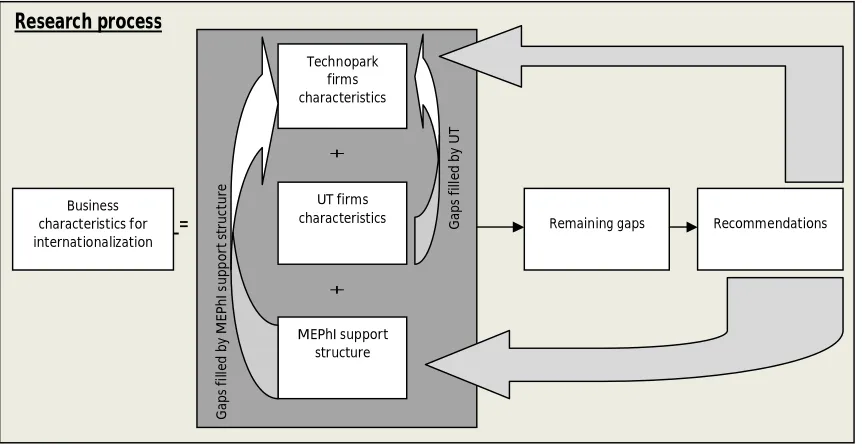
M. Roersen 11 internationalization of Technopark firms. These UT firms serve as illustrations, it is not the objective of this research to establish actual partnerships. Last, the MEPhI entrepreneurial support structure will be included to see in what way it adds value to the internationalization process of the firms. Only then is it possible to see which aspects for internationalization are present and which are lacking. Recommendations need to be made to fill remaining gaps. Figure 1.1 depicts the previously mentioned situation.
1.5.1 Research questions
Based on all of the above the following research question can be asked:
‘What characteristics of Technopark firms should be improved for international collaboration and what role can the entrepreneurial support system play in this respect?’
To be able to answer this, several other questions need to be asked:
1. What business characteristics enhance international collaboration between high-technology spin-off companies according to theory?
2. How can an entrepreneurial support system add to these business characteristics for international collaboration between high-technology spin-off companies according to theory?
3. To what extent do Technopark firms possess the necessary characteristics for international collaboration?
4. To what extent can characteristics of UT firms add to the characteristics of Technopark companies for international collaboration?
5. To what extent does the entrepreneurial support structure of MEPhI add to the business characteristics of Technopark firms for international collaboration?
6. What recommendations could be given to enhance collaboration between Technopark companies and UT firms with the aim of business development?
M. Roersen 12
1.5.2 Main concepts
The main concepts used are business characteristics, international collaboration and entrepreneurial support system. Business characteristics are capabilities and resources possessed by a company. International collaboration is seen as a partnership between two firms from different countries with the aim of commercializing knowledge. Last, an entrepreneurial support system includes all programs and instruments that the mother university offers its spin-offs to facilitate growth and development.
1.5.3 Route to answering the research question
The first two questions are of theoretical nature, to which the practical data will be tested. These answers will be found through literature search. Questions 3 and 4 analyze the current characteristics of Technopark firms and to what extent the potential partner from UT could add to these. The results from these question will be compared with the outcome of question 1. Question 5 analyzes the current situation of the MEPhI entrepreneurial support structure. The ideal situation is not only dependent on the outcome from literature search in question 2, but also on specific needs that became apparent from questions 3 and 4. For this reason, the results from the fifth question will be tested against the outcomes of questions 2, 3 and 4. The third, fourth and fifth sub questions will be answered through interviews with directors of firms and experts on support instruments mostly, although desk research is also used. The last question will fill the gaps between what should be and what is and should flow logically from the results of all other questions.
1.6 Division of the report
M. Roersen 13
Chapter 2: Theoretical background
As mentioned in chapter 1, this chapter introduces the theoretical framework for the rest of the report. The following sub questions will be answered:
1. ‘What business characteristics enhance international collaboration between high-technology spin-off companies according to theory?’
2. ‘How can an entrepreneurial support system add to these business characteristics for international collaboration according to theory?’
This chapter searches for a theory to describe and explain necessary business characteristics in international collaboration in the context of high technology and networks. The theory should clarify how different actors can add to the success of collaboration, as this research includes Technopark firms, UT firms and the MEPhI entrepreneurial support structure. The theory should provide the tools to give advice how MEPhI firms could develop to enhance their possibilities for international collaboration with help of the support structure. It should be sufficiently abstract to use the theory for different high technology sectors, but sufficiently concrete to provide guidelines on how to construct a collaboration. The model should have a broad focus, as I believe that many factors play a role in establishing or exploiting a collaboration.
Several theories on collaboration and internationalization are introduced, after which will be explained why the 4S model was chosen as the fundamental theory. A discussion will follow on what limitations of other theories it solves, although some limitations still remain. The second part of the chapter creates a model from the 4S model and an additional theory on entrepreneurial support to clarify how an entrepreneurial support system could add to the business characteristics in firms for international collaboration.
2.1 Collaboration
To survive in the current market place, firms must innovate in different sectors simultaneously because there is an increasing interdependence of technologies. Moreover, investments need to be recovered in a short time because of rapid technological change. Few firms can afford to do this alone, so collaboration must be considered (Narula and Hagedoorn, 1999). There is evidence of a strong relationship between collaboration and performance (Shrader, 2001). Collaboration is ‘working together, over an extended period of time, for the benefit of both companies involved’ (Middel et al., 2007, p. 225) that typically takes place within networks. Networks help to ‘identify opportunities, enable and constrain the exploitation of opportunities, and bridge so-called structural holes’ (Groen, During and Weaver, 2007, 5) and are ‘critical for the growth of an entrepreneurial venture because they provide access to a variety of resources held by other actors’ (Shaw and Shaw and Conway in Neergaard, 2005, p. 257). There are two motives to engage in interfirm collaboration, namely to economize costs and the strategic motivation aimed at long-term profit optimizing (Narula and Hagedoorn, 1999). There are various theories connected to collaboration.
2.1.1 The four Cs of strategic alliances
M. Roersen 14 done to find such a partner, where the examination should be focused on skills, technologies and markets. The companies should be willing to give as much as they receive. Secondly, there should be a cooperative culture between the firms. The key word is symmetry. It is necessary to have symmetry in size, financial resources, and peer relationships at the top level of management for an alliance to work. Furthermore, internal working environments should be comparable and there should be mutual trust. Brouthers et al. (1995) recognize the difficulty in finding comparable alliance cultures in firms from different countries. The third consideration of the ‘four Cs of Strategic Alliances’ is the necessity to have comparable goals. The alliance should satisfy the goals of both parties to be successful. The most ideal situation is when ‘strategic coals converge while competitive goals diverge’ (Lorange and Roos in Brouthers et al. 1995, p. 21). The challenge is to discover the real goals, as it is often argued that partners enter into alliances with hidden agendas (Duysters et al., 1999). The last consideration is to commensurate levels of risk. This is especially true for the high-techology sector, as firms can face major failure in this rapid changing market when they do not spread risks. Sharing risks could even be a motivation for starting a strategic alliance with competitors. It must be pointed out that the risk should be shared equally for an alliance to last (Brouthers et all, 1995). The ‘four Cs of strategic alliances’ offer clear guidelines on how a cooperation could be established in the best way and could easily be used to clarify the role of different actors in this respect. The theory could be used as a framework for this report, were it not that the ultimately chosen 4S model is more extensive, especially concerning social relationships. As will be seen at a later stage, the 4S model shows some striking resemblances with these ‘four Cs’.
2.1.2 Transaction cost approach
The transaction cost approach is often used to examine the efficiency aspect of horizontal collaboration. In this theory, trade-offs between costs and benefits are optimized to decide whether to cooperate or to internalize, which varies with the type of knowledge that is transferred. Collaboration is only optimal under the right circumstances, and entrepreneurs tend to focus mostly on the benefits of collaboration than on the costs. The theory is founded on bounded rationality and the risk of opportunism. Bounded rationality means that it is impossible to fully understand all consequences of making a decision and influences transfer of knowledge across organizational boundaries. It is difficult to write and enforce contracts between firms because bounded rationality makes that it is impossible to fully understand all implications of a decision, and tacit knowledge is very difficult transmittable across organizational boundaries. Furthermore, the concept of opportunism implies that there is a risk in transferring knowledge, as others might behave in their own interest, using collaborative contracts for other purposes than originally intended (Shrader, 2001). This does not mean that everyone will act in this way, but that there is a risk that the other might behave opportunistically. The transaction cost approach focuses mainly on what kind of collaboration to choose, rather than how to enhance collaboration. In this way, it does not provide guidelines on how to construct the collaboration, or how different parties can have synergetic effects on each other. As this theory limits itself to the question whether to cooperate or to internalize, this approach is of less relevance for this research.
2.1.3 Shan’s market failures
M. Roersen 15 on the long run profit needs to be shared. This can be very costly as long-term profits are expected. The opposite situation occurs in high-technology markets, where there is severe competition and windows of opportunities are small. There is no time to stretch the time to market of the innovation until the company makes the investments itself. Sharing of profit is not as costly as shortened life-cycles are inherent in this sector (Shan, 1990). This model lays bare the motives for collaboration, but does not include any information on how collaboration could best take place. It does not provide the necessary tools to construct a partnership and does not explain what business characteristics are needed for collaboration to succeed.
2.1.4 Customer-supplier relationships in a larger network
This model analyses cooperation between suppliers and customers embedded in a larger network of relations. Although the starting point is a supplier-customer relationship, successful relationship coordination can lead to extensions of the relationship, to for instance joint product development. The profitability of a cooperation is indirectly enhanced when other business relations support the cooperation, and directly enhanced when there is commitment for the cooperation. It comes down to the fact that both parties should consider the dyad ‘profitable or otherwise worthwhile’ (Blankenburg Holm et al., 1996, 1035). Additionally, the relationship should have an informal character to limit uncertainties and possible opportunism. However, there is need for more research on international business relationships of firms from different countries to investigate the role of cultural distance on the cooperation process (Blankenburg Holm et al., 1996). The concepts used in this model are rather abstract, making it very difficult to measure them. In addition, it requires close investigation of third parties, which is undoable in the time available.
2.1.5 Resource based view
This view implies that ‘differential endowment of organizational resources is an important determinant of strategy and performance’ (Knight, 2001, p. 158). In this context, resources include ‘all assets, capabilities, organizational processes, firm attributes, information, knowledge etc. controlled by a firm that enable the firm to conceive of and implement strategies that improve its efficiency and effectiveness’ (Barney, 1991, p. 101). Through ‘implementing strategies that exploit their internal strengths, through responding to environmental opportunities, while neutralizing external threats and avoiding internal weaknesses’ (Barney, 1991, p. 99), firms can obtain competitive advantages, also in foreign markets. This theory is based on two main assumptions: firms are heterogeneous regarding their resources, and resources are not perfectly mobile across firms, making heterogeneity long lasting (Knight, 2001). Sustained competitive advantage of a company is possible through the possession of resources that are valuable, rare, imitable and non-substitutable. In collaboration, firms can complement each other in their resources in order to achieve a joint competitive advantage over others in the industry. A limitation of this approach is that it is primarily focused on the firm’s assets and capacities rather than on industry structure and strategic interactions among competitors. Furthermore, it explains what kind of resources are needed to obtain competitive advantage, but it does not explain how to obtain these resources and argues that all resources are good by itself, as long as they comply to the previously mentioned characteristics. 2.2 Internationalization
M. Roersen 16 transportation and communication technologies, and a rising numer of people with international experience’ (Rasmussen, 2002, p. 4). It is very important that the management is commited to internationalization (Rasmussen, 2002, p. 8). Oviatt & McDougall at to this by stating that there is increasing ‘homogeneity of markets, emergence of international financing opportunities, and emergence of increasingly internationally mobile human capital.’ (Oviatt & McDougall in Autio and Sapienza, 2000, p. 6). These conditions make it very attractive for (knowledge intensive) start-ups to internationalize at, or soon after, inception.
Johanson and Vahlne (1977) and Knight (2001) are among the authors who have engaged themselves with international collaboration.
2.2.1 Uppsala model
The Uppsala model states that initial internationalization activities take place in physically close markets, and that the less committed modes of entry, such as exporting, are used. The firm learns and international market knowledge and experience increase, leading to an increase in commitments to the foreign market and targeting to physically more distant markets. This model is very positive about internationalization and does not question the constraints of international partnerships, as other theories such as the transaction costs approach do.
The Uppsala model does not consider more rapid internationalization of firms because of accelerating technological changes and the degree of regional and global integration of trade and production. Especially the first point is of relevance in this study on high-technology spin-offs. Furthermore, the phenomenon of global start-ups cannot be explained with this model. Last, McDougall and Oviatt discovered that the network of the company ‘appeared to have more influence on the founders’ country choices than did their physic distance’ (McDougall and Oviatt, 2003, p. 14). The authors themselves agree that there is a need to integrate this model with a new and more network-based model of internationalization (McDougall and Oviatt, 2003, p. 12). What is more, the model is rather describing than prescribing, and offers no guidelines for setting up international partnerships.
2.2.2 Model on international performance
Knight created a model on international performance, in which internationalization of SMEs is facilitated by orientation and strategies, leading to performance. Orientation is the basic culture of the firm, which is the ‘dominant pattern of beliefs and values’ (Knight, 2001, 159). Strategy can be divided into strategic competence, technology acquisition and internationalization preparation. International entrepreneurial orientation is fundamental, as it enhances the three components of strategy. These, in turn, are responsible for international performance. Next to this, strategic competence is enhanced by the two other aspects of strategy, namely internationalization preparation and technology acquisition (Knight, 2001). This model could provide assistance into how companies could improve their international performance, but does not clearly include the network and is not very broad as it is mostly focused on strategies.
Research on international entrepreneurship seems to be conducted either by entrepreneurship scholars, or by international business scholars. It is suggested that collaborative research on this topic by scholars from both disciplines could lead to fruitful insights (McDougall and Oviatt, 2003, p. 19). Furthermore, both theories previously mentioned do not fully include the network aspect of internationalization, whilst that aspect is of major importance in this research.
2.3 Theory choice
M. Roersen 17 to fill any gaps. This means that the concepts should be sufficiently concrete to offer a good instrument, and sufficiently broad to include all aspects of doing business. It is my opinion that the 4S model fits these prerequisites best. Although the chosen 4S model is not specifically meant for international contexts, there are no reasons to believe that it cannot be used for this purpose. First, the reasons for choosing this model will be outlined. Then, the model will be explained in detail. Afterwards, the limitations will be explored.
2.3.1 Justification of chosen theory
The most important reason for choosing the 4S model over other theories, is that it clearly provides guidelines on how cooperation could be optimized and how actors can have synergetic effects on another actor, and vice versa. In this way, it provides an instrument to construct a partnership. This was also the case in the ‘four Cs’ theory, but this is not as broad as the multi-dimensional 4S model. Both theories understand the importance of having comparable goals, but only the 4S model speaks about the possibilities to attain the desired goals. Further, the ‘four Cs’ do not include the social network aspect and what resources to attract from them as much as the 4S model does. In a similar vein, the Uppsala model and Knight’s theory on performance excluded network aspects. The 4S model goes beyond the question whether or not to cooperate, where transaction cost theory and Shan’s market failures stop. It is not sufficient to know whether or not to cooperate, but how this cooperation should be constructed for it to succeed. As said before, the 4S model does provide the means to do this. Another discussed theory was the resource based view. This is a rather static theory, but the multidimensional world makes that resources and capitals are often interlinked and cannot be separated. Therefore, much confusion can be taken away by focussing on capitals rather than resources. The 4S model is ‘a theoretical scheme useful for analyzing concrete streams of actions in organizational context’ (Groen, Kraaijenbrink and Heuven, 2007, p. 22). The 4S model specifically addresses the effects of actor’s interactions with other actors and the level of analysis depends on the research questions at hand. The theory is multidimensional as it strikes a balance between the four capitals. This is better than focussing on economic or strategic capitals as in other theories, as these are often lacking in developing firms. Last, the 4S model is very informative because it offers the possibility to investigate what types of capitals are present in the firms, and which are present in the firm’s network. According to this information, managers can decide what capitals need to be developed further (Groen, Kraaijenbrink and Heuven, 2007).
2.3.2 The 4S model
The 4S model is based on the social system theory of Parsons, who defined a social system as follows:
“… a social system consists in a plurality of individual actors interacting with each other in a situation which has at least a physical or environmental aspect, actors who are motivated in terms of a tendency to the ‘optimization of gratification’ and whose relation to their situations, including each other, is defined and mediated in terms of culturally structured and shared symbols.”
(Parsons in Groen, 2005, p. 5) This definition of a social system is based on two main assumptions. Firstly, it is assumed that actors act purposefully in interaction with other actors. The second assumption is that capitals are both inputs and outputs of an action, which is depicted in figure 2.1. (Groen, Kraaijenbrink and Heuven, 2007).
Figure 2.1: Input-Process-Output model Input-Process-Output model
M. Roersen 18 There are four functions that are necessary for a social system to last:
1. Optimization of gratification. This refers to the set of goals of an actor as mission and strategy. The process of creating this mission and strategy can be defined as the process of opportunity recognition, opportunity exploration and opportunity exploitation.
2. Economic challenge of allocation of scarce resources. This leads to more efficient processes. 3. Culturally structured and shared symbols. To have regulation of exchange it is essential to
have a pattern maintenance function.
4. Interaction with others. What ego gets is also dependent on the actions of alter. To survive, there must be a certain level of integration of joint actions.
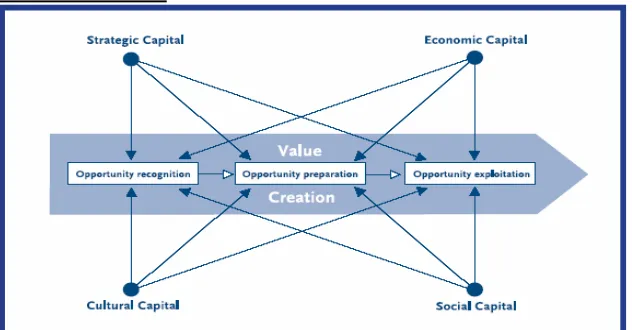
(Groen, 2005) and (Groen, Kraaijenbrink and Heuven, 2007) The above mentioned functions can all be translated into the four dimensions of scale, scope, skills & values and social network, leading to strategic, economic, cultural and social capital respectively, that should occur in each of the entrepreneurial phases: opportunity recognition, opportunity exploration and opportunity exploitation. Appendix two provides a short summary of relations between dimensions, capitals and resources. Value is created through this process. Each capital contributes to the performance of the company and none of the four is determining (Groen, 2005, p. 79). This process is depicted in figure 2.2. It could be said that ‘differences in acquiring the four types of capital explain differential performance of entrepreneurs’ (Groen, During and Weaver, 2007, 2). 4S in value creation
Figure 2.2: 4S in value creation (source: Sijde et al., year unknown).
Scope (Strategic capital)
This is the capacity of an actor to define goals and to control resources and other actors with the aim of achieving these predefined goals through power, influence and authority. It comprises the company’s processes of making sense of its existence and ‘aiming at realization of certain possibilities to exploit’ (Groen, During and Weaver, 2007, 3). Strategic capital can reside in people, but also in artifacts. Examples of artifacts are patents or technical innovations that have become standardized (Groen, Kraaijenbrink and Heuven, 2007).
Scale (Economic capital)
M. Roersen 19 Skills & Values (Cultural capital)
This is ‘the set of values, norms, beliefs, assumptions, symbols, rule sets, behaviors and artifacts defining the actor with respect to other actors and the environment’ (Groen, Kraaijenbrink and Heuven, 2007, p. 21), or pattern maintenance. It means that knowing how to do things effectively and efficiently leads to a fixed pattern of skills, and certain behaviors, values and methods of dealing with certain situations are supported whereas others are not in terms of the goals set by the company. Cultural capital is immobile and specific to the relation (Groen et al., 2002).
Social network
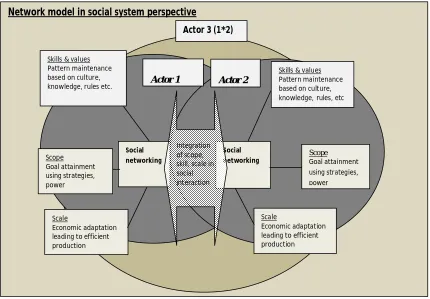
Social capital is ‘the set of network relations through which actors can utilize, employ, or enjoy the benefits of capital that is controlled or owned by other actors’ (Groen, Kraaijenbrink and Heuven, 2007, 20). The ability to interact with others within and beyond the organization leads to social capital as interaction patterns get meaning through the social integration of scope, scale and skills of the actor. So the three previously mentioned capitals are the content and mechanisms for the actor to perform in a social network (Groen et al., 2002). There can be too much and too little of social capital. Too little social capital leads to problems in obtaining necessary resources, to much leads to stifling of growth. Therefore, social capital should be optimized, not maximized (Woolcock, 1998). To prevent misunderstandings, it is of importance to note the difference in definition of social capital in the 4S model and in other theories. Many scientists define social capital as anything you get through the network (Nahapiet & Ghoshal in Audretsch and Monsen, 2007), (Bourdieu in Loohuis, 2007) and (Edwards and Foley in Woolcock, 1998). The 4S model defines social capital as the network itself, through which it is possible to obtain strategic, economic, cultural and other social capital.
Figure 2.3: Network model in social system perspective. Source: Groen et al., 2002, p. 5
Analytically, it could be stated that the capitals are mutually exclusive. However practically, the world is multidimensional and the capitals cannot be separated. The above can be put into a model
Network model in social system perspective
M. Roersen 20 depicted in figure 2.3 that is multi-dimensional, multi-level and dynamic. All dimensions are interrelated and any change in function will affect another function. To prevent constraints, all functions within a company and between collaborating companies should be compatible with each other. Furthermore, it is assumed that a social system can only last when all four functions are developed sufficiently above a certain threshold value in the stages of opportunity recognition, opportunity preparation and opportunity exploitation. More research is needed to define this threshold value, which is supposedly context-specific. It is also hypothesized that entrepreneurs with more capital perform better than those with less capital (Groen, 2005). Next to this, resources related to one kind of capital could also be used for another kind of capital. An example is money, which is usually related to the economic capital. However, when other actors are also dependent on this money, it also relates to strategic capital through the power that it offers. Use of resources is important in explaining to what capital it belongs. Finally, the capitals should be maintained over time, where a balance is struck between short and long term (Kerssens-van Drongelen and Groen, year unknown).
According to Middel et al. ‘continuous improvement in the performance between partners in a network of organizations’ need to take place (Middel et al., 2007, p. 222). In accordance to the 4S model, all mechanisms should be used successfully and should be developed sufficiently. In the scope dimension, actors are motivated to attain not only their own goals, but also improve the performance of the entire network. A shared vision that is understood by all parties is an essential prerequisite. This collaboration should be structural and proactive processes rather than ad-hoc problem solving. Regarding the scale dimension, there should be interaction between, and integration of, inter-company processes, as internal processes are increasingly linked with external suppliers and customers. In the skills & value dimension it is important for continuous improvement to have a ‘shared belief in the value of small improvements and the creative potential of actors’. One should build upon the knowledge of the other company to minimize actions needed in future initiatives. In the social dimension there should be interaction with each other on different levels, both internally and externally. It is not sufficient to focus on improvement related problems, but there should also be attention for ‘creative improvements’ (Middel et al., 2007).
2.3.3 Limitations of theory
M. Roersen 21 2.4 Specifications of 4S model
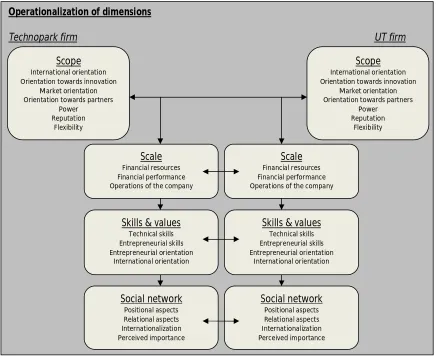
In order to actually use the 4S model in this research, the four dimensions need to be operationalized. This is done with help of additional theories, previous researches from NIKOS, Dervojeda (2006) and Loohuis (2007), and background information from Kerssens-van Drongelen and Groen (year unknown), and Groen, Jenniskens and van der Sijde (2005). This section will provide the details per dimension. All specifications are summarized in figure 2.4. As can be seen in figure 2.4, the first orientation point to look for possible partnerships is the strategic dimension. If the strategies of both potential partners are compatible with each other, it could be investigated if the other dimensions also align. Furthermore, it needs to be investigated if both parties are willing to cooperate, reflected in the perceived attractiveness dimension.
2.4.1 Scope
The typology of Miles and Snow is used to identify the type of strategy of the company with respect to innovation. This means that the firm can either be a prospector, a defender, an analyzer or a reactor. A prospector ‘aims to innovate, take risks, seek out new opportunities and grow’, which is a suitable strategy in a dynamic, growing environment. A defender is mostly concerned with stability and internal efficiency, which can be justified in a declining industry or stable environment. Analyzers ‘maintain a stable business while innovating on the periphery’, as they try to balance stable production of current product lines with creative new development. The last strategy is that of the reactor who ‘responds to environmental threats and opportunities in an ad hoc fashion’, which actually indicates a lack of long-term plan or explicit mission or goal (Daft, 2004, p. 62-63).
M. Roersen 22 Furthermore, Narver and Slater imply that ‘a study comparing the strategic profiles of different orientations would be interesting and useful to their more complete understanding’ (Slater and Narver, 1996, 170), which is why different strategic orientations are included in the
operationalization. There are five orientations: towards innovation, competitors, suppliers, alliance partners and customers. Orientation towards suppliers is not considered of relevance in this research, which is why it is excluded. International orientation is included, as it is useful to know to what extent the firms have the intentions to internationalize. The orientations towards competitors and customers are combined into marketing orientation. The MKTOR instrument is chosen because this scale and the MARKOR scale of Kohli et al. (1993) are the current state-of-the art in measuring market orientation, while Oczkowksi and Farell (1998) concluded that the MKTOR scale is better in explaining differences in business performance (Van Raaij, 2001).
Kerssens-van Drongelen and Groen operationalize strategic capital by means of looking at the percentage of goal alignment between the firm and its stakeholders. It is beyond the scope of this paper to cover this area. The outcomes of the strategic capital could rather be used to judge goal alignment between the Technopark firm and the UT company. The other factors of Kerssens-van Drongelen and Groen are used, which are power, reputation and flexibility (Kerssens-van Drongelen and Groen, year unkown). It can be said that these operationalizations include two interpretations of strategy: what is the strategy of the firm, and what is the capability of the firm to obtain the desired goals.
2.4.2 Scale
The scale dimension is divided into three factors, based on the questionnaire of Loohuis (2007) on networking capabilities in the aviation industry, and the questionnaire of Dervojeda (2006) on scouting and screening processes at the UT. These factors are financial resources, financial performance and operations of the company.
2.4.3 Skills & values
The skills and values dimension is based on Groen, Jenniskens and van der Sijde (2005), and Lumpkin and Dess (1996). According to Groen, Jenniskens and van der Sijde, successful high-tech companies should possess technical skills and entrepreneurial skills. Entrepreneurial skills can be divided into marketing, business administration and organization and financial management. These skills do not need to reside in one person, as long as the founding team and employees together possess these skills.
The values of the company can be assessed by the entrepreneurial orientation, which could be divided into four dimensions according to Lumpkin and Dess (1996). These are innovativeness, risk taking, proactiveness, and competitive aggressiveness. Innovativeness reflects the firms’ ‘tendency to engage in and support new ideas, novelty, experimentation, and creative processes that may result in new products, services, or technological processes.’ Risk is ‘the degree to which managers are willing to make large and risky resource commitments.’ Proactiveness can be defined as ‘acting in anticipation of future problems, needs, or changes’. It relates to market opportunities. Besides taking initiative in this sphere, a firm should also be responsive to its competitors. This relates to the last dimension of competitive aggressiveness, defined as ‘a firms’ propensity to directly and intensely challenge its competitors to achieve entry or improve position, that is, to outperform industry rivals in the marketplace’ (Lumpkin and Dess, 1996, 142-148).
M. Roersen 23
2.4.4 Social Network
For this dimension, Brass’ typical social network measures of ties are used. These measures can be divided into two kinds of aspects of networks, which is similar to operationalizations made by Kerssens-van Drongelen and Groen, namely positional and relational aspects. Indirect links, multiplexity, direction and symmetry relate to positional aspects, whereas frequency, stability and strength of ties are about relational aspects (Brass in Monge and Contractor, 1998). Indirect links mean that two actors are connected to each other through another actor. Multiplexity is the ‘extent to which two actors are linked together by more than one relationship’, direction relates to links that run one-way, and symmetry relates to links that are bi-directional. Frequency indicates how often a link occurs, stability says something about the ‘existence of the link over time’, and strength of a tie is ‘the amount of time, emotional intensity, intimacy, or reciprocal services’ (Brass in Monge and Contractor, 1998, table 1, appendix). Next to the above, the degree of internationalization of the current networks also needs to be taken into account, as well as the perceived importance of the current network.
2.5 Entrepreneurial support structure
It was pointed out that the Technopark firms, the UT companies and the MEPhI entrepreneurial support structure combined are responsible for successful internationalization of Technopark firms. For this reason, it is essential to have a theoretical background on entrepreneurial support systems that can easily be integrated with the 4S model. A theory needs to be found that does not specify
what needs to be supported, but how the operationalizations of the four dimensions can be supported. Part of the theory of Broekstra et al. (2002) can be used for this purpose.
Broekstra et al. (2002) developed a quality assessment model for university spin-offs, adapted from the European Foundation of Quality Management (EFQM) model. This model shows that there should be integration of external and internal aspects of the spin-off programs. The enablers policy & strategy, organization, human resource management and the financial management of the program are responsible for certain processes. These processes are marketing & promotion, recruitment of entrepreneurs, intake and first selection, support of entrepreneurs, and purchasing. These processes have internal, external and societal impacts, leading to key performance results. The enablers learn from the results.
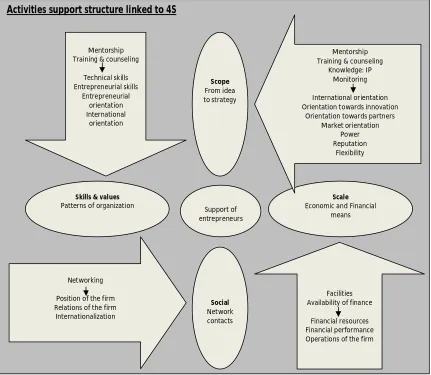
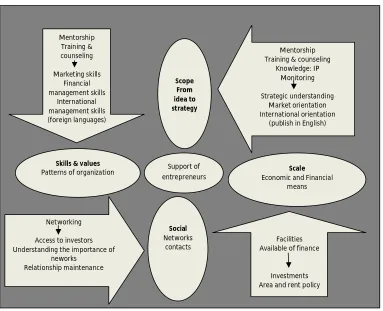
M. Roersen 24 Figure 2.5: Activities support structure linked to 4S
Figure 2.5: Activities support structure linked to 4S
Mentorship
The mentor is somebody to whom the entrepreneur can turn with questions and problems, and can be found inside or outside the university. Mentors from the field of business that the entrepreneur is entering can offer ‘specific experience and advice’, whereas mentors from the university ‘can share with the entrepreneur their experience in the field of science in which the spin-off business is operating’ (Broekstra et al., 2002, 32).
Monitoring
In order to give the right support, development of the firm should be monitored. The business plan should be the basis of regular meetings between the entrepreneur and the program to evaluate progress made. It is useful to set short-term objectives that should be met, and need to be discussed at the following meeting. A special monitoring team could be assigned to evaluate firm progresses. Training and counseling
The training and counseling offered should follow the needs of the firms, in order to add value. It is advisable to provide trainings in technical, but also in entrepreneurial subjects. The same counts for training in creating the business plan. Besides training, counseling should be given on training opportunities and on marketing and other business topics.
Activities support structure linked to 4S
M. Roersen 25 Networking
As networking is of the utmost importance to acquire necessary resources, the support structure should aid in connecting entrepreneurs with other actors. This could be done through organizing regular meetings.
Knowledge: Intellectual Property
As knowledge is one of the main assets for spin-offs, the entrepreneurial support structure could make knowledge accessible to them. This counts for informal knowledge and embedded knowledge such as patents or licenses owned by the university. Sharing of knowledge needs to be facilitated. Availability of facilities
As spin-offs face financial challenges in their initial stages of existence, they do not have the means to purchase all facilities needed. A spin-off program should offer facilities such as laboratories, office space, instruments and equipment. Facilities could be shared to increase efficiency.
Access to finance
As it is very difficult for start-ups to obtain money, the entrepreneurial support structure should provide assistance. There could be financial arrangements with the spin-off program or the university, or they could arrange contacts with business angels, informal investors or venture capitalists.
2.6 Conclusion
In this chapter, two sub questions were answered. Several theories were discussed that were not as suitable for this research as the chosen 4S model. Transaction cost approach and Shan’s market failures mainly focus on when and why to collaborate, but not how this is done. The theory on customer-supplier relationships in a larger network provides practical problems and the resource based view is too static. The Uppsala model and Knight’s model on international performance do not sufficiently include the network aspect of the study. The four Cs of strategic alliances was very suitable, but not as broad as 4S, although there are some striking similarities between the two theories. The four Cs do not include goal attainment and social networks and connected resources are not as prominent as in 4S.
The business characteristics that enhance international collaboration between high-technology spin-off companies are reflected in the 4S model. The scope, scale, skills and social network of partners have to be compatible with each other in order for a cooperation to succeed. Furthermore, the partnership needs to have sufficient strategic, economic, cultural and social capital in order to survive. If one partner does not have sufficient capital in one of the four dimensions, the other partner can fill this gap. The entrepreneurial support structure can add to these business characteristics through including specific activities into the spin-off program that lead to support in the four dimensions, such as mentorship, training & counseling, networking and providing access to finance.
M. Roersen 26
Chapter 3: Methods
In this chapter, the used research methods are explained. First of all, there is a section on the general methods after which the methods per sub question are discussed. Last, the limitations of used techniques will be presented in order to judge the level of reliability and validity of the research. 3.1 General methods
3.1.1 Case study
This research is a multiple case study, as it ‘attempts to examine a contemporary phenomenon in its real-life context’ (Yin, 1981, p. 59). It is an intensive study of firms in a specific context, namely Technopark and the University of Twente. It is a qualitative study, as it is important to gain deep understanding of how the companies function and what support is offered to be able to provide recommendations for international collaboration. The units of analysis are ten Technopark firms, four UT companies and one MEPhI entrepreneurial support structure, measured through individual entrepreneurs and experts on MEPhI entrepreneurial support instruments who are the units of observation. Detail is deliberately chosen over generalizability. The research results need to be useful to MEPhI and Technopark and its participants rather than to other Technoparks.
3.1.2 Research activities
Several research activities are used to obtain the necessary information. Theoretical questions are answered through desk and literature search. The more practically oriented questions are answered through desk research and interviews. Desk research is the first step in getting acquainted with the units of analysis, but does not offer enough detailed information to say anything sensible on business characteristics of Technopark firms and UT companies, or on the provided support from the support structures with respect to international collaboration. Very specific information that is needed can only be retrieved through in-depth interviews. Interviews are flexible, and open-ended questions are possible. In this way, much valuable information can be obtained that could not be foreseen. Furthermore, through personal contact it is possible to judge the quality of the response and the context of the study can be elaborated upon as the interviewee wishes, making this person more committed and more likely to cooperate. All of these features are more difficult when using a questionnaire.
3.2 Methods per sub question
Sub questions 1 and 2 were already answered in chapter 2. The methods for the remaining questions are elaborated upon in this section.
3.2.1 Sub question 3: ‘To what extent do Technopark firms possess the necessary characteristics for international collaboration?’
M. Roersen 27 increases. The ultimately chosen firms are Aleksandr+, Aquaservice, Eniko TSO, Eskiz MEPhI, Lekis, Lidasa, MEPhI Ineco, OKC Service, Quarta-Rad, and Teros MEPhI. A factsheet of these firms can be found in appendix 7. After study of these ten companies it became apparent that Aleksandr+, Aquaservice and Eniko TSO were not interested in internationalization.
The interviews with firms in Russia were conducted by me and by students of the faculty of Innovation Management of MEPhI. The initial idea was to conduct multiple interviews per company, making it impossible for me to do this by myself in this short period of time. Furthermore, these students needed to do an assignment before participation in a special project between MEPhI and UT, which is beyond the theme of this paper. However, the directors of the firms were not willing to let us interview employees, making this study vulnerable to single informant bias. The interviews were designed to reflect the operationalizations of the four dimensions as discussed in chapter 2. An interview protocol was designed to clarify the purposes and order of questions to the students, to be found in appendix 3a. In relation to this, a scheme was created to show what question belongs to which operationalization, as can be seen in appendix 3b.
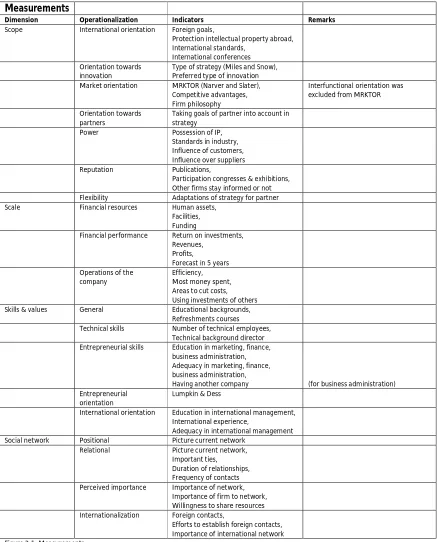
As said before, the scope dimension is divided into international orientation, orientation towards innovation, market orientation, orientation towards partners, power, reputation, and flexibility. The indicators for each operationalization are summarized in figure 3.1. To measure market orientation, the MKTOR scale of Narver and Slater is used. Originally, the MRKTOR scale includes interfunctional orientation (Narver and Slater, 1990). This is only of importance for big firms where different departments need to align their strategies with each other, but of no use for the small firms of Technopark or UT. Interfunctional orientation is therefore left out. In this scale, the firms could grade several statements on a scale from 1-7, or 0 if they did not know the answer or if the question was irrelevant. The numbers were added and divided by the number of questions answered. In connection to this, the firm’s opinion on its market orientation was asked, making comparisons between actual and perceived orientation possible. This is the triangulations process. Furthermore, there were questions about competitive advantages and firm philosophy. The orientation towards partners is indicated by the degree to which goals of partners are taken into account when designing a strategy. Questions on intellectual property, standardized products in the market, influence of customers and influence over suppliers indicate the level of power of the firm. Reputation was measured through publications, participation in congresses and exhibitions, and whether or not other firms stay informed about the activities of the company. Last, flexibility was indicated through adaptations of strategy because this was better for another network partner.
The scale dimension was divided into financial resources, financial performance, and operations of the company. First of all, the financial resources are measured to reflect the funding of the company, and to see if there are sufficient financial resources. Secondly, the financial performance will be measured to indicate the financial capabilities and size of the company. Thirdly, the operations of the company are examined to see what the firm does with its resources, and if operations are efficient. The indicators per operationalization can be found in figure 3.1
Technical skills, entrepreneurial skills, entrepreneurial orientation and international orientation are used in the skills and values dimension. Again, the indicators for these are reflected in figure 3.1. The instrument of Lumpkin and Dess was used to measure entrepreneurial orientation, where Likert-scale questions indicate the level of innovativeness, risk taking, proactiveness and competitive aggressiveness. In every dimension, the numbers are added and divided by number of questions in this dimension to calculate the degree of entrepreneurial orientation.
M. Roersen 28 operationalizations. It has to be realized that it is extremely difficult to create a picture of the larger network.
Measurements
Dimension Operationalization Indicators Remarks
Scope International orientation Foreign goals,
Protection intellectual property abroad, International standards,
International conferences Orientation towards
innovation Type of strategy (Miles and Snow), Preferred type of innovation Market orientation MRKTOR (Narver and Slater),
Competitive advantages, Firm philosophy
Interfunctional orientation was excluded from MRKTOR
Orientation towards
partners Taking goals of partner into account in strategy Power Possession of IP, Other firms stay informed or not Flexibility Adaptations of strategy for partner Scale Financial resources Human assets,
Facilities, Funding
Financial performance Return on investments, Revenues,
Profits,
Forecast in 5 years Operations of the
company Efficiency, Most money spent, Areas to cut costs, Using investments of others Skills & values General Educational backgrounds,
Refreshments courses Technical skills Number of technical employees,
Technical background director Entrepreneurial skills Education in marketing, finance,
business administration, Adequacy in marketing, finance, business administration,
Having another company (for business administration) Entrepreneurial
orientation Lumpkin & Dess
International orientation Education in international management, International experience,
Adequacy in international management Social network Positional Picture current network
Relational Picture current network, Important ties, Duration of relationships, Frequency of contacts Perceived importance Importance of network,
Importance of firm to network,
M. Roersen 29
3.2.2 Sub question 4: ‘To what extent can characteristics of UT firms add to the characteristics of Technopark companies for international collaboration?’
Selection of UT firms occurred partly through self-selection. The director of the Technologie Kring Twente (TKT) sent an inquiry to members of TKT, Business and science park Twente and the TOP program if they were interested in any of the remaining sevens Technopark firms with international aspirations. In addition, consultations with experts on entrepreneurial activity in Twente gave suggestions on what firms might be suitable for potential collaboration. During this process, it was pointed out that there were little chances for two Technopark firms. Lekis was too broadly oriented and the used technologies of Teros MEPhI were completely unclear. After this, desk research was done on the UT firms to compare activities and strategies with the remaining Technopark firms, in accordance to the model presented in figure 2.4. The ones with chances of success were contacted for interviews to obtain the necessary in-depth information. In order to make these interviews more concrete and useful, a possible fit between specific companies was already presumed. OKC Service was linked to Bitkwadraat, whereas Quarta-Rad was linked to C-it and Steray. The companies Eskiz-MEPhI, MEPhI Ineco and Lidasa were linked to RWB Waterservices. From the latter interview, it appeared that Lidasa was not interesting from technical point of view, and the applications of MEPhI Ineco do not have any added value in the Dutch market.
The interviews with firms in Twente were only conducted by me. From the results, the capitals of the Technopark and UT firms could be compared, laying bare possibilities for synergetic activity and gaps in potential collaborations. The majority of questions from the protocol for the Russian interviews were repeated for the interviews in Twente, be it that the order of questions might differ. The interview and scheme can be found in appendix 4. However, the same indicators were used, which are summarized in figure 3.1.
From the previously conducted interviews at Technopark, it became apparent in what dimensions they need help. In a similar vein as the perception of Technopark firms about Dutch firms, the Dutch firms must be given the opportunity to respond to the offer made by the Technopark firm. A potential link could already be made. The interviewees were confronted with the Technopark company in question and were asked about their thoughts of collaboration with such a firm in terms of fulfilling the desired function, expectations, alignment of goals, willingness to invest, openness to type of contact and possibilities to fill the gaps. The specific questions can be found in appendix 4.
3.2.3 Sub question 5: ‘To what extent does the entrepreneurial support structure of MEPhI add to the business characteristics of Technopark firms for international collaboration?’