Ectopic Expression of the Drosophila Cdk1 Inhibitory Kinases, Wee1 and
Myt1, Interferes With the Second Mitotic Wave and Disrupts Pattern
Formation During Eye Development
Donald M. Price, Zhigang Jin, Simon Rabinovitch and Shelagh D. Campbell
1Department of Biological Sciences, University of Alberta, Edmonton, Alberta T6G 2E9, Canada Manuscript received July 9, 2001
Accepted for publication March 11, 2002
ABSTRACT
Wee1 kinases catalyze inhibitory phosphorylation of the mitotic regulator Cdk1, preventing mitosis during S phase and delaying it in response to DNA damage or developmental signals during G2. Unlike yeast, metazoans have two distinct Wee1-like kinases, a nuclear protein (Wee1) and a cytoplasmic protein (Myt1). We have isolated the genes encoding Drosophila Wee1 and Myt1 and are using genetic approaches to dissect their functions during normal development. Overexpression of Dwee1or Dmyt1 during eye development generates a rough adult eye phenotype. The phenotype can be modified by altering the gene dosage of known regulators of the G2/M transition, suggesting that we could use these transgenic strains in modifier screens to identify potential regulators of Wee1 and Myt1. To confirm this idea, we tested a collection of deletions for loci that can modify the eye overexpression phenotypes and identified several loci as dominant modifiers. Mutations affecting the Delta/Notch signaling pathway strongly enhance a GMR-Dmyt1 eye phenotype but do not affect a GMR-Dwee1 eye phenotype, suggesting that Myt1 is potentially a downstream target for Notch activity during eye development. We also observed interactions with p53, which suggest that Wee1 and Myt1 activity can block apoptosis.
T
HE control of mitosis by inhibitory phosphorylation overcomes this inhibition, inducing mitosis in spatially of cyclin-dependent kinase (Cdk)1 has been charac- and temporally patterned mitotic domains (Edgarand terized extensively in unicellular eukaryotes. InSchizo- O’Farrell1990). The intricate pattern ofcdc25stringtran-saccharomyces pombe,signaling pathways responsive to cell scription is governed byciselements in a large regulatory size, DNA damage, and DNA replication target the phos- region that integrates a diverse array of patterning gene phorylation of Cdk1 residue tyrosine 15 (Y15), thereby inputs to direct the appropriate spatiotemporal pattern functioning to maintaining genome integrity (Rhindet ofcdc25stringexpression during embryonic and imaginal
al.1997; Rhind and Russell 1998). Inhibitory phos- development (Edgaret al. 1994;JohnstonandEdgar phorylation of Cdk1 is catalyzed by both Wee1 and Mik1 1998;Lehmanet al. 1999). Heat shock expression of a kinases inS. pombe(RussellandNurse1987b;Feath- constitutively active, nonphosphorylatable Cdk1 variant erstoneandRussell1991;Lundgrenet al.1991;Lee (Cdk1AF) is lethal to Drosophila embryos, indicating
et al.1994) and is reversed by Cdc25 and Pyp3 phospha- that inhibitory phosphorylation of Cdk1 is essential for tases (RussellandNurse1986;Gouldet al.1990;Millar regulating mitosis during development; however,
regu-et al.1991, 1992). In contrast, inhibitory phosphoryla- lation of a similar S phase kinase (Cdk2) on a conserved tion of a Cdk1 homolog (CDC28) is not required for tyrosine residue is not (Lane et al.2000).
maintenance of genome integrity inSaccharomyces cerevis- In metazoans, two adjacent inhibitory
phosphoryla-iae(Amonet al.1992;SorgerandMurray 1992). In- tion sites on Cdk1 (T14 and Y15) are substrates for two stead, a SWE1-mediated checkpoint delays mitosis by distinct Wee1-like kinases that differ in their subcellular inhibiting CDC28 in response to defective assembly of localization. Nuclear Wee1 kinases phosphorylate Y15 the actin cytoskeleton and promotes filamentous growth exclusively, whereas Myt1, a membrane-localized Wee1-when nutrients are limiting (LewandReed1995;Siaet like kinase, can phosphorylate either site (Kornbluth al.1996, 1998;McMillanet al.1998;Barralet al.1999; et al.1994;Muelleret al.1995;Booheret al.1997;Liu Edgingtonet al.1999). et al.1997). The physiological significance of these dif-During Drosophila embryogenesis, inhibitory phosphor- ferences between the Wee1 and Myt1 kinases is presently ylation of Cdk1 is required for maintaining G2 phase dur- unknown. We are addressing this question by character-ing the embryonic cell divisions. Expression ofcdc25string
izing the functions of Wee1 and Myt1 kinases during Drosophila development. Drosophila encodes a single
wee1homolog (Dwee1), originally identified by its ability 1Corresponding author:Department of Biological Sciences, University
to complement a lethal mitotic catastrophe phenotype of Alberta, CW405, Edmonton, AB T6G 2E9, Canada.
E-mail: [email protected] inS. pombecells that were mutant for bothwee1andmik1
Kafatos 1988). We were unsuccessful in isolating a cDNA
(Campbellet al.1995). Null alleles ofDwee1are
mater-clone by this approach, so we designed a reverse primer
spe-nal effect lethal and Dwee1-derived embryos undergo
cific to the clonedDmyt1fragment and used it in combination
catastrophic nuclear defects during the late syncytial with a pNB vector primer to PCR amplify the 5⬘ end of a divisions that include failure to complete nuclear divi- cDNA sequence from the same library. The fragment obtained
was cloned and sequenced and the information was used to
sion (Price et al. 2000) and failure to lengthen
inter-identify two cDNA clones from the Berkeley Drosophila EST
phase, as normally occur when a developing embryo
Project database (GH08848 and LD34963). These clones were
approaches cycle 14 (D.Price, unpublished data). The
both fully sequenced and found to include identical coding
phenotype ofDwee1-derived mutant embryos is similar regions that show significant sequence similarities to human to phenotypes of maternal mutants formei-41orgrapes and Xenopus Myt1 within the predicted kinase domain
(LD34963 is 20 bp longer at the 5⬘ end, but the sequences
(grp), the Drosophila homologs of the checkpoint
ki-are otherwise identical except for the length of the poly(A)
nases rad3/ATR andchk1, respectively (Fogarty et al.
tail at the 3⬘end). The complete molecular characterization
1994, 1997;Sibonet al.1997, 1999). These phenotypic
of the Dmyt1 gene will be presented elsewhere (Z. Jin, S.
similarities suggest that the three genes act in a common RabinovitchandS. D. Campbell,unpublished results). checkpoint pathway during early embryonic develop- Generation ofDwee1andDmyt1transgenic stocks: ment, an idea supported by genetic interactions
be-pUAST-Dwee1andpUAST-Dmyt1: To synthesize pUAST-Dwee1,
tween mutant alleles of these genes (Priceet al.2000).
a 2.2-kbDwee1cDNA fragment was excised from pBluescript
Given the critical importance of inhibitory phosphor- SK(⫹) by KpnI/NotI digestion and subcloned into the ylation during embryogenesis, it was puzzling that the pUAST vector using the same restriction sites (Brandand
Perrimon1993).pUAST-Dmyt1was constructed by cloning
zygotic function ofDwee1is not essential and thatDwee1
a 1.9-kbEcoRI/XhoI fragment that includes the entireDmyt1 mutants develop normally under ordinary circumstances.
cDNA from LD34963 and inserting it into the pUAST
plas-Dwee1mutant larvae do die when they are fed hydroxy- mid vector, also cut with the same restriction enzymes. urea at concentrations that wild-type larvae can tolerate, pUASp-Dwee1and pUASp-Dmyt1: The 2.2-kbKpnI/NotIDwee1 however, apparently due to a defective DNA replication cDNA fragment (as above) was inserted into the pUASp vector (Rørth1998) cut with the same restriction enzymes.
checkpoint (Priceet al. 2000). The viability of zygotic
A PCR-amplified Dmyt1 cDNA from the LD34963 clone
Dwee1mutants could be due to the presence of a
redun-containingKpnI/NotI linker restriction sites was cloned into
dant Cdk1 inhibitory kinase such as Myt1. Although the pUASp vector. This clone was then sequenced to estab-cellular localization and substrate specificity differences lish that no new mutations were introduced during PCR suggest that Wee1 and Myt1 homologs serve distinct amplification.
pGMR-Dwee1 and pGMR-Dmyt1: The glass multimer reporter
roles in cell cycle regulation, the two metazoan
Wee1-plasmid (pGMR;Hay et al.1994) was cut withHpaI and
like kinases may also share some redundant functions,
NotI. The Dwee1 and Dmyt1 cDNAs were isolated from
aswee1andmik1do inS. pombe(Lundgrenet al.1991).
pUASp vector constructs by cutting with KpnI, blunting
To investigate this possibility we cloned the singleMyt1- with T4 DNA polymerase, digestion withNotI, and then gel like gene from Drosophila,Dmyt1, and are undertaking purification. Insert and vector were joined with T4 DNA ligase and the products verified by colony PCR. The
trans-a genetic trans-antrans-alysis of its function during development.
gene constructs were then injected into y w Drosophila
In this report we describe phenotypic defects caused
embryos, using a⌬2-3-helper plasmid.
by overexpressing eitherDwee1orDmyt1in developing
tissues. Overexpression in the eye imaginal disc causes Scanning electron microscopy:Flies of the desired geno-types were collected several days after eclosion, fixed,
dehy-visible defects in the adult eye. The eye phenotype can
drated, and critical-point dried essentially as described in
Sul-be modified by mutations in known cell cycle regulators,
livanet al.(2000). Critical-point-dried flies were then either
suggesting that this system might be capable of detecting imaged directly with a Philips (Cheshire, CT) ESEM (model previously uncharacterized mitotic regulators that have XL30 ESEM ODP) or sputter-coated with gold and imaged
with a Jeol (Tokyo) scanning electron microscope (SEM;
evolved to coordinate cell proliferation with specific
model JSM-630FXV).
developmental events. We have tested this idea by
screen-Transmission electron microscopy :Fly heads of the desired
ing for dominant genetic modifiers, using a collection
genotypes were collected, fixed, and dehydrated as described
of deletions comprising 70–80% of the Drosophila eu- inSullivanet al.(2000). Dehydrated heads were embedded chromatic genome. These tests have identified several in Spurr resin (Spurr1969) with propylene oxide used as a
transition solvent. Embedded heads were sectioned to ⵑ60
loci that potentially encode novel regulators of either
nm thickness with a Diatome diamond knife using a
Reichert-Wee1 or Myt1.
Jung ultramicrotome (model ULTRACUT E). Sections were collected in water on copper grids, stained with uranyl acetate and lead citrate, and viewed on a Philips transmission electron MATERIALS AND METHODS
microscope (TEM; model Morgagni 268). Images were col-lected with a Soft Imaging System digital camera (model Mega-Cloning of the DrosophilaMyt1gene:A small fragment of
Dmyt1 was amplified by PCR using degenerate primers de- view II).
Immunochemistry:Imaginal discs were fixed in 4% formal-signed against conserved regions of Xenopus and humanMyt1
(CKLGDFG and AADVFSL). After sequencing to confirm that dehyde in PBS for 30 min at room temperature. Following fixation, the peripodial membrane was removed from the eye we had in fact isolated a genomic sequence that was similar
Figure 1.—Aberrant phenotypes caused by Dwee1overexpression. (A) Thorax of a wild-type fly. (B) Thorax of a fly with a single copy of UAS-Dwee1driven by a single copy ofap-Gal4. (C) Tho-rax of a fly with two copies of UAS-Dwee1and a single copy ofap-Gal4. (D) Thorax of a fly with a single copy ofUAS-Dwee1and a single copy of pnr-Gal4. (E) Thorax of a fly with two copies of UAS-Dwee1and a single copy ofpnr-Gal4. (F) Wing of a fly with a single copy of UAS-Dwee1 and a single copy ofsd-Gal4. (G) Wing of a fly with two copies ofUAS-Dwee1and a single copy ofsd-Gal4.
the fixed discs were washed three times for 5 min in PBT A more extreme phenotype is seen when thepnr-Gal4 and incubated at 4⬚ overnight in primary antibody (rabbit driver is combined with two copies ofUAS-Dwee1, pro-antiphosphohistone H3; Upstate Biochemicals) at 1/600
dilu-ducing a furrowed thorax, as if the two halves have failed
tion in 10% NGS. Discs were then washed four times for 10
to fuse properly (Figure 1E). This observation suggests
min in 5% skim milk in PBT and incubated in preabsorbed
secondary antibody (goat anti-rabbit conjugated with FITC; that fusion may require temporally or spatially regulated
Jackson Immunoresearch, West Grove, PA) at 1/1000 dilution. cell divisions that can be blocked by our overexpression Stained discs were washed four times for 10 min in PBT, system. In the wing,UAS-Dwee1combined with a wing-stained with Hoechst 33258, and washed again in PBT. Eye
specificsd-Gal4driver line produces extensive scalloping
discs were then separated from the optic lobe and mounted
of the wing margin (Figure 1F) and an additional copy
in 80% glycerol. Images were obtained on a Zeiss (Thornwood,
NY) Axioskop 2 microscope equipped with a Photometrics ofUAS-Dwee1(Figure 1G) also increases the severity of
(Tucson, AZ) SenSys digital camera. this mutant phenotype.
EctopicDwee1expression in the eye produces a rough eye phenotype (Figure 2). In Figure 2, A and B, are
con-RESULTS trols showing a wild-type eye and an eye from a fly with a
single copy of theninaE-Gal4driver, respectively (Freeman
Ectopic expression ofDwee1in developing imaginal
1996).WhenUAS-Dwee1is combined with theninaE-Gal4
tissues:To examine the consequences of overexpressing
driver, the eye facets are disorganized and frequent
Dwee1andDmyt1in different tissues, we generated
trans-duplications of bristles are observed (Figure 2C).
ninaE-genic lines that can express either gene under control
Gal4overexpression ofDmyt1produced a similar pheno-of the Gal4/UAS system, as described inmaterials and
type (not shown).TheDwee1andDmyt1-induced rough methods(BrandandPerrimon1993). Figure 1 shows
eye phenotypes suggested to us that we could useDwee1
the effect of Gal4-induced expression ofUAS-Dwee1in
or Dmyt1 transgenic flies in an assay system for identi-various tissues (hereafter “UAS” refers to the UAST
con-fying negative or positive regulators of mitosis, as de-structs). Thepannier-Gal4 (pnr-Gal4) andapterous-Gal4
scribed below. (ap-Gal4) drivers are each expressed in the developing
Genetic interactions withGMR-Dwee1andGMR-Dmyt1: dorsal thorax (Calleja et al. 1996). When either of
The GMR overexpression vector uses a Glass transcription these Gal4 drivers is combined with one copy of
UAS-factor-binding enhancer to direct transgene expression
Dwee1, reduced numbers of sensory bristles are seen on
posterior to the morphogenetic furrow (MF) in the the dorsal thorax, compared to wild type (Figure 1, A,
developing eye (Hayet al.1994). This single component B, and D). Flies withap-Gal4-drivenUAS-Dwee1also have
system thus provides a convenient tool for rapidly testing upturned wings, suggesting that the dorsal
compart-genetic interactions. After cloning the cDNAs for each ment of the wing is smaller than the ventral
compart-gene into this vector, we observed thatGMR-Dwee1and ment, consistent with these cells undergoing fewer cell
GMR-Dmyt1transgenic lines each show dosage-sensitive divisions (data not shown). When two copies of the
UAS-rough eye phenotypes. Inⵑ12 independent transgene
Dwee1 transgene are driven by either ap-Gal4 or
pnr-lines examined for each construct, the Dmyt1-induced
Gal4, the bristle effects are more extreme and the dorsal
epidermis is distorted, indicating that the phenotypic phenotypes are consistently stronger than the Dwee1 -induced phenotypes, suggesting a stronger effect of effects are sensitive to gene dosage (Figure 1, C and E).
Combination of the ap-Gal4 driver with two copies of Myt1 on eye development that is not attributable to chromosomal position effects (data not shown). In
Fig-UAS-Dwee1yields a nearly bald dorsal thorax
Figure 3.—Effects of Dmyt1 overexpression in the devel-oping and adult eye. (A) SEM of an eye from a wild-type fly. (B) SEM of an eye from a fly with four copies ofGMR-Dmyt1. (C) Eye-antennal disc from a wild-type fly stained with the mitotic marker, antiphosphohistone H3 (␣PH3), showing mi-totic figures in the first (FMW) and second (SMW) mimi-totic
Figure 2.—Effects ofDwee1 overexpression on the adult waves. (D)␣PH3-stained eye-antennal disc from a fly with four eye as visualized by SEM. (A) A single copy of the ninaE- copies ofGMR-Dmyt1.The SMW is disrupted and delayed, as Gal4 driver transgene. (B) A single copy of the UAS-Dwee1 shown by the decreased number and increased spread of mi-transgene. (C) A single copy ofUAS-Dwee1driven by a single totic figures posterior to the FMW. (E) TEM cross section of copy of theninaE-Gal4transgene. an adult eye from a wild-type fly. (F) TEM cross section of an
adult eye from a fly with four copies ofGMR-Dmyt1.
copies ofGMR-Dmyt1,compared with a wild-type control
isolated from aGMR-Dmyt1transgenic strain. Figure 3C eye (Figure 3A). Posterior to the MF, the second mitotic
shows mitotic activity in a wild-type third larval instar eye wave (SMW) generates a pool of uncommitted cells for
disc, visualized by antibody staining for phosphohistone recruitment into the developing ommatidial preclusters
H3. In discs isolated from aGMR-Dmyt1transgenic line, (WolffandReady1991). To test our assumption that
mitoses in the SMW are both reduced in number and the aberrant phenotypes we observe when Wee1 or Myt1
delayed (inferred from the increased distance of mitotic are overexpressed are a consequence of inhibiting or
cells from cells of the “first mitotic wave”; Figure 3D) delaying cell divisions required for normal
mor-Figure 4.—SEM analysis of eye phenotypes seen in genetic interactions withGMR-Dwee1and GMR-Dmyt1. (A) SEM showing a fly with a single copy of GMR-Dmyt1. (B) Fly heterozygous for a mutation in the cdc25string locus. (C) Fly with a
single copy ofGMR-Dmyt1and heterozygous for a mutation in thecdc25stringlocus. (D) Fly with a
single copy ofGMR-Dmyt1and heterozygous for a mutation in thecdc2locus.(E) Fly with a single copy of GMR-Dwee1. (F) Fly heterozygous for a mutation in thecdc2locus.(G) Fly with a single copy ofGMR-Dwee1and heterozygous for a muta-tion in thecdc2locus. (H) Fly with a single copy of GMR-rux. (I) Fly with single copies of both GMR-Dmyt1 and GMR-rux. ( J) Fly with a single copy ofp53-pExP-glass.(K) Fly with single copies of bothGMR-Dmyt1andp53-pExP-glass.
phogenetic furrow (the first mitotic wave) are unaf- 4D). TheGMR-Dmyt1/cdc25stringinteraction produces an
eye that is devoid of bristles, whereas theGMR-Dmyt1/
fected by GMR-Dmyt1, as expected since GMR-driven
expression does not occur in this region of the disc cdc2interaction shows milder bristle effects. Curiously, the dominant enhancement seen in these cases is consis-(Hayet al. 1994). We also observed that the ommatidial
preclusters in theGMR-Dmyt1flies appear disorganized tently stronger in more anterior parts of the eye that differentiate later in development. Cdc2 (now called when visualized by transmission electron microscopy of
sectioned adult eyes. Figure 3, E and F, shows the effects Cdk1) and its activating phosphatase, Cdc25stringare
es-sential for promoting mitosis in Drosophila (Edgarand of GMR-Dmyt1 on the arrangement of photoreceptor
cells. Most of the identifiable cell types in the ommatidia O’Farrell 1989; Stern et al. 1993), so these genetic interactions are consistent with known functions for appear to be present, although the arrangement and
size of the rhabdomeres are often irregular. TheGMR- these genes. A weak single-copyGMR-Dwee1phenotype (Figure 4E) is also enhanced by heterozygous mutant
Dmyt1photoreceptor cell clusters often contain too few
or too many cells, however, and there is a striking dis- alleles ofcdc2(Figure 4G), but unlikeGMR-Dmyt1, not by heterozygous mutations for cdc25string (not shown).
ruption of the regular hexagonal array of secondary and
tertiary pigment cells that normally forms an interface These genetic interactions were confirmed with multi-ple alleles ofcdc2andcdc25string to rule out nonspecific
between adjacent ommatidia (compare Figure 3E and 3F).
We next tested for genetic interactions with a set of genetic background effects. We also tested a number of other known cell cycle mutants for dominant modifier cell cycle regulatory mutants that are predicted to either
have a direct regulatory interaction withDwee1orDmyt1 effects on eitherGMR-Dwee1orGMR-Dmytphenotypes. Mutations incyclin A,cyclin B,mei-41,grapes,twine,cdk2, or play an independent role in Cdk1 regulation.
Muta-tions in factors that normally promote the onset of mito- cyclin E, fizzy, and dacapo all fail to either enhance or suppress the rough eye phenotype generated by either sis should enhance the Dwee1 or Dmyt1 overexpression
phenotypes, whereas mutations in genes that function transgene.
The ruxgene encodes a cycldependent kinase in-to delay miin-tosis should show the reverse effect. Figure
4 illustrates several such interactions. A single transgene hibitor (CKI) that inhibits Cyclin A/Cdk1 by promoting the degradation of cyclin A (Thomaset al.1994, 1997; copy ofGMR-Dmyt1produces a mild rough eye
pheno-type, whereas independently, a heterozygous mutation Sprengeret al.1997;Foleyet al.1999;Avedisovet al.
2000). WhenGMR-Dmyt1(Figure 4I) orGMR-Dwee1(not incdc25stringhas no effect on eye morphology (Figure 4,
A and B). When a single copy ofGMR-Dmyt1is combined shown) is coexpressed withGMR-roughex(GMR-rux) the phenotype is enhanced relative to that generated by with a heterozygous mutation forcdc25string, a significantly
enhanced eye phenotype is seen (Figure 4C). Likewise, GMR-ruxalone (Figure 4H), resulting in a stronger rough eye phenotype that is accompanied by a near complete removal of a single copy ofcdc2produces a similar effect
addi-Figure 5.—Coexpression of Dwee1 and trbl shows strong synergistic phenotypic effects. (A) SEM of a fly with one copy ofUAS-Dwee1driven by one copy ofninaE-Gal4. (B) Fly with one copy ofUAS-trbldriven by one copy ofninaE-Gal4. (C) Fly with single copies of bothUAS-Dwee1and UAS-trbldriven by a single copyof ninaE-Gal4.(D) Wing of a fly with one copy ofUAS-Dwee1driven by sd-Gal4 (hemizygous on the X chromosome). (E) Wing of a fly with one copy ofUAS-trbldriven by sd-Gal4.(F) Fly with single copies of both UAS-Dwee1andUAS-trbldriven bysd-Gal4.The arrow-head indicates the position of the small piece of wing tissue.
tive effects of these Cdk1 inhibitors, we also made the these coexpression experiments. Unlike the similar wing margin phenotypes we observe when UAS-trbl or surprising observation that otherwise viable zygoticDwee1
mutants show near-complete synthetic lethality with oth- UAS-Dwee1 are expressed during wing development,
UAS-trblexpression is associated with a noticeable reduc-erwise viable zygoticrux mutants. Rare double-mutant
“escapers” from these genetic crosses show various phe- tion of trichome density in the wing blade that appar-ently reflects increased cell size, a phenotype that is not notypic abnormalities, including enhancement of the
ruxrough-eye phenotype, bristle duplications and dele- observed withUAS-Dwee1(compare Figure 5D and 5E). We next conducted genome-wide screens for loci that tions, and “Minute” bristles (data not shown).
To investigate genetic interactions with a known com- modifyGMR-Dwee1orGMR-Dmyt1eye phenotypes, using the Drosophila deficiency kit (maintained by the Bloom-ponent of the DNA damage response pathway, we tested
the Drosophila homolog of the p53tumor suppressor ington Drosophila Stock Center). The kit presently com-prises 195 stocks that are estimated to cover 70–80% of gene. Expression of ap53-pExP-glasstransgene promotes
apoptosis, generating eye tissue that has no evidence of the Drosophila euchromatic genome. In two separate screens, we tested these deletions for their ability to intact ommatidia or bristles (Ollmannet al.2000;
Fig-ure 4J). Coexpression of a single transgene copy of either enhance the eye phenotypes associated with single-copy transgenic stocks of eitherGMR-Dmyt1orGMR-Dwee1.In
GMR-Dmyt1(Figure 4K) orGMR-Dwee1(not shown) can
markedly suppress this phenotype, with recovery of the a third screen to identify both enhancer and suppressor loci, we tested the deletions against a stock carrying two eye bristles being most pronounced (compare Figure
4J with 4K). copies ofGMR-Dmyt1and one copy ofGMR-Dwee1(made
by recombination of different transgene insertions). Thetribbles(trbl) gene encodes a novel mitotic
inhibi-tor that functions in mesodermal cells during early gas- The genetic crosses were scored without reference to whether or not the deletions uncovered any known cell trulation (Grosshans and Wieschaus 2000; Mata et
al. 2000; Seher and Leptin 2000). ninaE-Gal4-driven cycle regulators, to avoid biasing our results. The genetic loci that we have identified in these screens, as
cytologi-UAS-Dwee1orUAS-trbltransgenes alone generate slightly
roughened eyes, with occasional duplication of bristles cal regions defined either by deletions or by mutations in specific genes, are compiled in Table 1. Consistent (Figure 5, A and B). When the two genes are
coex-pressed in the eye, the ommatidial phenotype is dramati- with observations based on single alleles, Df(2L)Mdh, which includes thecdc2locus, enhances the phenotype cally enhanced and there is a near complete loss of
bristles (Figure 5C). In a complementary experiment, of all three tester strains, whereas deletions that include
cdc25string[
Df(3R)3450and Df(3R)Dr-rv1] were selected as the eye phenotype generated by two copies of
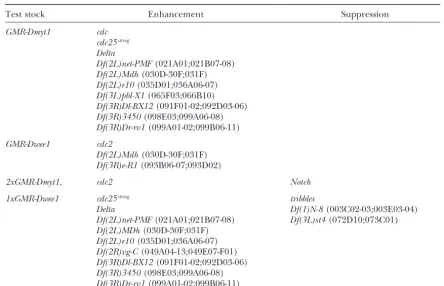
GMR-Dmyt1 combined with a single copy of GMR-Dwee1 is enhancers of GMR-Dmyt1 and 2xGMR-Dmyt1, 1xGMR-Dwee1 in this assay, but not as enhancers of the
GMR-partially suppressed by removal of one gene copy oftrbl
(data not shown). These striking synergistic interactions Dwee1transgene alone.
Six deletions, four of which represent loci not pre-are not confined to eye development, as coexpression
ofUAS-Dwee1andUAS-trblyields nearly complete abla- viously identified in crosses with known cell cycle regula-tors, were identified as specific enhancers ofGMR-Dmyt1
tion of wing tissue (Figure 5F), compared with
scal-loping of the wing margin observed when UAS-Dwee1 (Table 1). One of the GMR-Dmyt1 enhancer regions [Df(3R)Dl-BX12] contains Delta (Dl), which encodes a or UAS-trblare expressed singly with thesd-Gal4 driver
TABLE 1
Summary of interacting mutations/deficiencies
Test stock Enhancement Suppression
GMR-Dmyt1 cdc
cdc25string
Delta
Df(2L)net-PMF(021A01;021B07-08) Df(2L)Mdh(030D-30F;031F) Df(2L)r10(035D01;036A06-07) Df(3L)pbl-X1(065F03;066B10) Df(3R)Dl-BX12(091F01-02;092D03-06) Df(3R)3450(098E03;099A06-08) Df(3R)Dr-rv1(099A01-02;099B06-11)
GMR-Dwee1 cdc2
Df(2L)Mdh(030D-30F;031F) Df(3R)e-R1(093B06-07;093D02)
2xGMR-Dmyt1, cdc2 Notch
1xGMR-Dwee1 cdc25string tribbles
Delta Df(1)N-8(003C02-03;003E03-04)
Df(2L)net-PMF(021A01;021B07-08) Df(3L)st4(072D10;073C01) Df(2L)MDh(030D-30F;031F)
Df(2L)r10(035D01;036A06-07) Df(2R)vg-C(049A04-13;049E07-F01) Df(3R)Dl-BX12(091F01-02;092D03-06) Df(3R)3450(098E03;099A06-08) Df(3R)Dr-rv1(099A01-02;099B06-11)
thatDlis the gene responsible for this interaction. Since withDf(3L)st4. Further analysis to identify and character-ize the remaining gene modifiers will now be necessary some alleles of Dl exhibit dominant eye phenotypes
(specifically, Dl1), it is important to note that we ob- to determine if these loci do in fact encode distinct
regula-tors forDwee1andDmyt1. served enhancement with alleles (Dl3, Dl7, DlB2, and
DlRevF10) that by themselves are not associated with a
dom-inant eye phenotype. It is unlikely, therefore, that these
DISCUSSION
interactions reflect additive effects. We saw similar
en-hancement with gene duplications of theNotch locus, The G1/S and G2/M cell cycle transitions are tempo-which on their own are associated with a “Confluens” rally and spatially controlled during metazoan develop-or Delta-like phenotype [Dp(1;2)51b, Dp(1;2;Y)w⫹, and ment, allowing growth and cell division to be
coordi-Dp(1;2)72c21]. A deletion of the Notch locus, on the nated with patterning and differentiation (reviewed by other hand [Df(1)N-8], suppresses the phenotype associ- EdgarandLehner1996). Studies of G2/M checkpoint ated with a2xGMR-Dmyt1, 1xGMR-Dwee1strain. Specific controls in metazoans have emphasized regulatory mecha-genes responsible for the remaining threeGMR-Dmyt1 nisms affecting the Cdc25-like phosphatases, which acti-enhancer interactions have not yet been identified. vate the mitotic regulator Cdk1 by removing inhibitory
Df(2L)r10contains three known mitotic regulatory genes phosphorylation. Regulatory mechanisms affecting the (grapes,twine, and fizzy), none of which behaves as an activity and protein stability of the Cdk1 inhibitory ki-enhancer in tests with specific mutant alleles, however. nases are still poorly understood, but are probably just It is possible that the phenotypic modification seen with as important (MichaelandNewport1998;Lee et al.
this deletion reflects a combinatorial interaction with 2001). There are ample precedents for these
mecha-more than one of these genes. nisms from studies of Wee1 and Mik1 kinases inS. pombe
Only two cytological regions, identified by crosses to (RussellandNurse1987a;Colemanet al.1993; Par-the deletion collection, were identified as specific en- ker et al. 1993;Wu andRussell 1993; O’Connell et
hancers of aGMR-Dwee1eye phenotype, one of which al. 1997;RaleighandO’Connell2000) and SWE1 in containscdc2(Table 1). We have not yet identified the S. cerevisiae(LewandReed1995;Siaet al.1996, 1998; gene responsible for the remaining suppressor interac- Barral et al.1999;Edgingtonet al.1999;McMillan
During the third larval instar, the Drosophila eye disc escapers could indicate disruption of cell cycle timing or abrogation of genome integrity checkpoints, similar undergoes progressive transformation from a relatively
amorphous epithelial sac into the complex arrangement to the phenotypes seen inmus304 mutants exposed to ionizing radiation, which are associated with increased of ommatidial facets that comprises the adult compound
eye. This transformation is marked by passage of a con- genome instability (Brodskyet al.2000). Another piece of evidence suggesting a role for Wee1 kinases in regu-striction called the MF across the eye disc (Wolffand
Ready1991). Cells within the MF normally arrest in G1 lating genome stability is the interaction we observe with Drosophilap53. In humans, the p53 tumor suppressor and failure to synchronize cells at this stage disrupts
ommatidial patterning (Thomaset al.1994). Following promotes apoptosis in cells that have suffered DNA dam-age. Overexpression of Drosophilap53in the eye pro-the MF, a population of cells called pro-the SMW undergoes
a final cell cycle. If cells are blocked in G1 by overexpres- motes extensive cell death by apoptosis, resulting in extremely defective eyes (Ollmannet al.2000). We have sion of a p21 CKI homolog, insufficient cells are left to
form all of the cell types required for normal ommatidia, shown significant suppression of thep53overexpression eye phenotype by coexpression of either GMR-Dwee1
resulting in a rough adult eye phenotype (de Nooijand
Hariharan1995;de Nooijet al.1996). In this report, or GMR-Dmyt1, suggesting that these Cdk1 inhibitory kinases can negatively regulate p53-induced apoptosis. we have shown thatGMR-driven misexpression ofDmyt1
immediately after the MF both delays the SMW divisions Since Cdk1 activity has previously been implicated in promoting apoptosis, this effect would be consistent and reduces the numbers of mitotic cells, also resulting
in a rough eye phenotype. with known functions of Wee1 and Myt1 in Cdk1
inhibi-tion (Zhouet al. 1998). Other reports relevant to this We have established thatDwee1andDmyt1
overexpres-sion eye phenotypes are sensitive to modification by issue are somewhat contradictory, however. In human cell culture, Wee1 can inhibit granzyme B-induced apo-mutations in known cell cycle regulatory genes,
illustrat-ing the feasibility of screenillustrat-ing for mutations of genes ptosis; furthermore, Wee1 appears to be downregulated through a p53-dependent mechanism, suggesting that that are potential regulators of either Wee1 or Myt1.
Mutations in genes that promote mitosis, such ascdc2 p53 regulation of Wee1 might normally occur during this process (Chen et al.1995; Leach et al.1998). In andcdc25string, should dominantly enhance these
overex-pression phenotypes and we have confirmed this expec- contrast,Smithet al.(2000) showed that Wee1 activity can actually promote apoptosis in a Xenopus oocyte tation for both of these genes with Dmyt1. Although a
GMR-Dwee1 eye phenotype is also enhanced by muta- extract system. Further studies are clearly needed to establish the physiological significance of any purported tions incdc2, it is not enhanced by mutations incdc25string,
providing evidence that Wee1 and Myt1 kinases have roles for Wee1 or Myt1 in regulating apoptosis, p53-dependent or otherwise.
distinct Cdk1 regulatory effects in this developmental
context. This result could be explained by a require- A screen for modulators ofwee1 overexpression was previously conducted inS. pombe, by isolating suppres-ment for higher levels ofcdc25stringactivity to overcome
GMR-Dmyt1inhibition of Cdk1 relative to GMR-Dwee1, sors ofwee1-induced lethality (Aligueet al.1994;Munoz and Jimenez 1999; Munoz et al. 1999). These studies perhaps because it is inherently more difficult to
de-phosphorylate Cdk1 inhibited on both T14 and Y15 by identified mutations in the gene encoding the Hsp90 chaperone as potent suppressors, suggesting a role for Myt1 activity, compared with Cdk1 inhibited on Y15
alone by Wee1. Hsp90 in promoting the assembly and/or disassembly
of functional Wee1 protein complexes. In contrast, we Theruxgene encodes a novel Cdk1 inhibitor that
con-trols the onset of S phase during embryogenesis, eye have not found hsp83 mutant alleles (encoding Dro-sophila Hsp90) to act as suppressors of a combined development, and spermatogenesis (Gonczyet al.1994;
Thomaset al.1994, 1997;Sprengeret al.1997;Foley GMR-Dmyt1/GMR-Dwee1transgene eye phenotype (data not shown). We have, however, identified several other
et al. 1999; Avedisov et al. 2000). A recent study has
shown thatruxalso plays a novel role in mitosis, by an genetic loci as specific enhancers of eye phenotypes generated byGMR-Dwee1orGMR-Dmyt1alone, indicat-unknown mechanism (FoleyandSprenger2001). Rux
and Wee1 both negatively regulate Cdk1 activity; thus ing that phenotypic effects mediated by Wee1 and Myt1 are responsive to lowered expression of different genes. our observation that coexpression of these genes
gener-ates more extreme rough eye phenotypes than seen with These observations may reflect differences in threshold requirements for the relevant gene products in pro-either alone is consistent with known functions for these
genes. Surprisingly, we also found that flies lacking both moting mitosis (as suggested by the interactions with
cdc25string) or they may signify differences in the
regula-zygotic Dwee1 andruxfunctions show nearly complete
synthetic lethality, with rare escapers exhibiting exten- tion of Wee1 and Myt1 kinases that we will now be able to dissect by identifying and characterizing the relevant sive adult bristle phenotypes. This interaction suggests
thatrux andDwee1may also cooperate in some other, modifier loci. We are currently undertaking direct ge-netic screens for mutations in genes that modify
GMR-as yet undefined regulatory mechanism. The extensive
issue. One of the loci we have identified as a specific actions that we describe in this report are consistent with this possibility.
enhancer of theGMR-Dmyt1eye phenotype isDelta.This
interaction could reflect defects inDl-dependent neu- We thank Rakesh Bhatnagar and George Braybrook for assistance ronal specification that are enhanced by GMR-Dmyt1 with electron and confocal microscopy, Christine Walker for assem-bling thepUASp-Dwee1clone and assisting with embryo injections, activity, or it may indicate a novel role for Delta/Notch
Scott Hanna for advice and assistance in making transgenic flies, signaling in regulating Myt1 activity. We are presently
Bruce Hay for the gift ofGMR plasmid, Gary Ritzel for advice on trying to distinguish these possibilities. synthesizing the GMR clones, Veronica Rodrigues for thesd-Gal4 In S. pombe, the DNA damage and DNA replication stock, Barbara Thomas for theGMR-ruxstock, J. Grosshans for the
UAS-trblstock, and Exelixis for providing the p53-pExP-glass stock. checkpoint pathways that regulate Cdk1 by inhibitory
The Bloomington Drosophila Stock Center provided other stocks phosphorylation act by controlling the activity and
sta-described in this work. Funding was provided by research grants from bility of Wee1 and Mik1 kinases, as well as Cdc25 phos- the Alberta Heritage Foundation for Medical Research (AHFMR) and phatases (reviewed by Walworth 2000). Although the Canadian Institutes of Health Research to S.D.C. and by graduate metazoan homologs of components of these checkpoint student fellowships from the Natural Sciences and Engineering
Re-search Council of Canada and AHFMR to D.M.P. pathways show significant sequence conservation with
their yeast homologs, the actual functions and interac-tions of individual components are not necessarily
con-served. For example,GuoandDunphy(2000) showed LITERATURE CITED
that Xenopus homologs of the checkpoint kinases Chk1 Aligue, R., H. Akhavan-Niak andP. Russell, 1994 A role for and Cds1, which respond to DNA damage and blocked Hsp90 in cell cycle control: Wee1 tyrosine kinase activity requires
interaction with Hsp90. EMBO J.13:6099–6106. DNA replication, respectively, inS. pombe, respond in
Amon, A., U. Surana, I. MuroffandK. Nasmyth, 1992 Regulation the exact opposite manner to these stresses in Xenopus of p34CDC28 tyrosine phosphorylation is not required for entry egg extracts. This example serves as a warning that sim- into mitosis inS. cerevisiae.Nature355:368–371.
Avedisov, S. N., I. Krasnoselskaya, M. MortinandB. J. Thomas, ple predictions of metazoan gene function based on
2000 Roughex mediates G1 arrest through a physical associa-extrapolation from known functions of yeast genes can tion with cyclin A. Mol. Cell. Biol.20:8220–8229.
Barral, Y., M. Parra, S. BidlingmaierandM. Snyder, 1999 Nim1-be misleading. Metazoan development requires that
related kinases coordinate cell cycle progression with the organi-novel regulatory mechanisms exist to link specific
devel-zation of the peripheral cytoskeleton in yeast. Genes Dev. 13:
opmental processes with the basic cell cycle machinery. 176–187.
Booher, R. N., P. S. HolmanandA. Fattaey, 1997 Human Myt1 Drosophila represents an ideal model for analyzing
is a cell cycle-regulated kinase that inhibits Cdc2 but not Cdk2 these developmental controls of the cell cycle, since the activity. J. Biol. Chem.272:22300–22306.
effects of specific mutations on complex processes like Brand, A. H., andN. Perrimon, 1993 Targeted gene expression as a means of altering cell fates and generating dominant phenotypes. morphogenesis and differentiation can be established.
Development118:401–415.
The recent characterization of thetrblgene in Drosoph- Brodsky, M. H., J. J. Sekelsky, G. Tsang, R. S. HawleyandG. M. ila illustrates this point (Grosshans and Wieschaus Rubin, 2000 mus304encodes a novel DNA damage checkpoint protein required during Drosophila development. Genes Dev. 2000;Mataet al.2000;SeherandLeptin2000). Trbl
14:666–678.
activity delays mitosis in invaginating G2 cells (mitotic Brown, N. H., andF. C. Kafatos, 1988 Functional cDNA libraries domain 10) in a cycle 14 embryo. Although cdc25string
from Drosophila embryos. J. Mol. Biol.203:425–437.
Calleja, M., E. Moreno, S. PelazandG. Morata, 1996 Visuali-transcription initiates in domain 10 before it is
tran-zation of gene expression in living adult Drosophila. Science274:
scribed in other cells, these cells remain G2 arrested 252–255.
Campbell, S. D., F. Sprenger, B. A. EdgarandP. H. O’Farrell, until they are completely internalized, well after cells
1995 Drosophila Wee1 kinase rescues fission yeast from mitotic in nine other mitotic domains have subsequently
ex-catastrophe and phosphorylates Drosophila Cdc2 in vitro. Mol. pressed cdc25string and entered mitosis (Edgar and
Biol. Cell6:1333–1347.
Chen, G., L. Shi, D. W. LitchfieldandA. H. Greenberg, 1995 O’Farrell1989). Trbl activity downregulates Cdc25string
Rescue from granzyme B-induced apoptosis by Wee1 kinase. J. protein stability, providing an explanation for these
ob-Exp. Med.181:2295–2300.
servations (Mataet al.2000). A similar purpose could Coleman, T. R., Z. TangandW. G. Dunphy, 1993 Negative regula-tion of the wee1 protein kinase by direct acregula-tion of the nim1/ be served by Trbl simultaneously upregulating Dwee1
cdr1 mitotic inducer. Cell72:919–929.
or Dmyt1 activity (Grosshans and Wieschaus 2000). de Nooij, J. C., andI. K. Hariharan, 1995 Uncoupling cell fate Intriguingly, Trbl contains motifs reminiscent of Nim1- determination from patterned cell division in the Drosophila eye.
Science270:983–985. type kinases, which negatively regulate Wee1 and Swe1
de Nooij, J. C., M. A. LetendreandI. K. Hariharan, 1996 A cyclin-kinase activity and stability inS. pombe andS. cerevisiae dependent kinase inhibitor, Dacapo, is necessary for timely exit
(RussellandNurse1987a;Colemanet al.1993;Parker from the cell cycle during Drosophila embryogenesis. Cell87:
1237–1247.
et al.1993; Wuand Russell 1993;Barralet al. 1999).
Edgar, B. A., andC. F. Lehner, 1996 Developmental control of Despite these sequence similarities, the Trbl protein cell cycle regulators: a fly’s perspective. Science274:1646–1652. apparently lacks a functional catalytic domain, raising Edgar, B. A., andP. H. O’Farrell, 1989 Genetic control of cell division patterns in the Drosophila embryo. Cell57:177–187. the possibility that Trbl could act in a “dominant
nega-Edgar, B. A., andP. H. O’Farrell, 1990 The three postblastoderm tive” manner to activate Wee1 (or Myt1) by interfering cell cycles of Drosophila embryogenesis are regulated in G2 by
inter-Edgar, B. A., D. A. LehmanandP. H. O’Farrell, 1994 Transcrip- McMillan, J. N., R. A. L. SiaandD. J. Lew, 1998 A morphogenesis checkpoint monitors the actin cytoskeleton in yeast. J. Cell Biol. tional regulation ofstring (cdc25): a link between developmental
142:1487–1499. programming and the cell cycle. Development120:3131–3143.
McMillan, J. N., M. S. Longtine, R. A. Sia, C. L. Theesfeld, E. S. Edgington, N. P., M. J. Blacketer, T. A. BierwagenandA. M.
Bardeset al., 1999 The morphogenesis checkpoint in
Saccharo-Myers, 1999 Control of Saccharomyces cerevisiae filamentous
myces cerevisiae: cell cycle control of Swe1p degradation by Hsl1p growth by cyclin-dependent kinase Cdc28. Mol. Cell. Biol.19:
and Hsl7p. Mol. Cell. Biol.19:6929–6939. 1369–1380.
Michael, W. M., andJ. Newport, 1998 Coupling of mitosis to the
Featherstone, C., and P. Russell, 1991 Fission yeast p107wee1
completion of S phase through Cdc34-mediated degradation of mitotic inhibitor is a tyrosine/serine kinase. Nature349:808–811.
Wee1. Science282:1886–1889.
Fogarty, P., R. F. KalpinandW. Sullivan, 1994 The Drosophila
Millar, J., C. McGowan, R. Jones, K. Sadhu, A. Buenoet al., 1991 maternal-effect mutationgrapescauses a metaphase arrest at
nu-cdc25 M-phase inducer. Cold Spring Harbor Symp. Quant. Biol. clear cycle 13. Development120:2131–2142.
56:577–584.
Fogarty, P., S. D. Campbell, R. Abu-Shumays, B. S. Phalle, K. R.
Millar, J. B., G. LenaersandP. Russell, 1992 Pyp3 PTPase acts
Yuet al., 1997 The Drosophilagrapesgene is related to
check-as a mitotic inducer in fission yecheck-ast. EMBO J.11:4933–4941. point genechk1/rad27and is required for late syncytial division
Mueller, P. R., T. R. Coleman, A. KumagaiandW. G. Dunphy, fidelity. Curr. Biol.7:418–426.
1995 Myt1: a membrane-associated inhibitory kinase that
phos-Foley, E., andF. Sprenger, 2001 The cycldependent kinase
in-phorylates Cdc2 on both threonine-14 and tyrosine-15. Science hibitor Roughex is involved in mitotic exit in Drosophila. Curr.
270:86–90. Biol.11:151–160.
Munoz, M. J., andJ. Jimenez, 1999 Genetic interactions between
Foley, E., P. H. O’FarrellandF. Sprenger, 1999 Rux is a
cyclin-Hsp90 and the Cdc2 mitotic machinery in the fission yeast Schizo-dependent kinase inhibitor (CKI) specific for mitotic cyclin-Cdk
saccharomyces pombe. Mol. Gen. Genet.261:242–250. complexes. Curr. Biol.9:1392–1402.
Munoz, M. J., E. R. Bejarano, R. R. DagaandJ. Jimenez, 1999 The
Freeman, M., 1996 Reiterative use of the EGF receptor triggers
identification of Wos2, a p23 homologue that interacts with Wee1 differentiation of all cell types in the Drosophila eye. Cell87:
and Cdc2 in the mitotic control of fission yeasts. Genetics153:
651–660.
1561–1572.
Gonczy, P., B. J. ThomasandS. DiNardo, 1994 roughexis a
dose-O’Connell, M. J., J. M. Raleigh, H. M. VerkadeandP. Nurse, 1997 dependent regulator of the second meiotic division during
Dro-Chk1 is a wee1 kinase in the G2 DNA damage checkpoint. EMBO sophila spermatogenesis. Cell77:1015–1025.
J.16:545–554.
Gould, K. L., S. Moreno, N. K. TonksandP. Nurse, 1990
Comple-Ollmann, M., L. M. Young, C. J. Di Como, F. Karim, M. Belvinet
mentation of the mitotic activator, p80cdc25, by a human
protein-al., 2000 Drosophila p53is a structural and functional homolog tyrosine phosphatase. Science250:1573–1576.
of the tumor suppressorp53.Cell101:91–101.
Grosshans, J., andE. Wieschaus, 2000 A genetic link between
Parker, L. L., S. A. Walter, P. G. YoungandH. Piwnica-Worms, morphogenesis and cell division during formation of the ventral
1993 Phosphorylation and inactivation of the mitotic inhibitor furrow in Drosophila. Cell101:523–531.
Wee1 by the nim1/cdr1 kinase. Nature363:736–738.
Guo, Z., andW. G. Dunphy, 2000 Response of Xenopus Cds1 in
Price, D., S. Rabinovitch, P. H. O’FarrellandS. D. Campbell, cell-free extracts to DNA templates with double-stranded ends.
2000 Drosophila wee1has an essential role in the nuclear divisions Mol. Biol. Cell11:1535–1546.
of early embryogenesis. Genetics155:159–166.
Hay, B. A., T. WolffandG. M. Rubin, 1994 Expression of
baculovi-Raleigh, J. M., andM. J. O’Connell, 2000 The G(2) DNA damage rus P35 prevents cell death in Drosophila. Development120:
checkpoint targets both Wee1 and Cdc25. J. Cell Sci.113:1727– 2121–2129.
1736.
Johnston, L. A., andB. A. Edgar, 1998 Wingless and Notch regulate
Rhind, N., andP. Russell, 1998 Tyrosine phosphorylation of cdc2 cell-cycle arrest in the developing Drosophila wing. Nature394:
is required for the replication checkpoint inSchizosaccharomyces
82–84.
pombe.Mol. Cell. Biol.18:3782–3787.
Kornbluth, S., B. Sebastian, T. Hunter andJ. Newport, 1994
Rhind, N., B. FurnariandP. Russell, 1997 Cdc2 tyrosine phos-Membrane localization of the kinase which phosphorylates
phorylation is required for the DNA damage checkpoint in fission p34cdc2 on threonine 14. Mol. Biol. Cell5:273–282.
yeast. Genes Dev.11:504–511.
Lane, M. E., M. Elend, D. Heidmann, A. Herr, S. Marzodkoet al.,
Rørth, P., 1998 Gal4 in the Drosophila female germline. Mech. 2000 A screen for modifiers ofcyclin Efunction inDrosophila Dev.
78:113–118.
melanogaster identifies Cdk2mutations, revealing the insignifi- Russell, P., andP. Nurse, 1986 cdc25⫹functions as an inducer in cance of putative phosphorylation sites in Cdk2. Genetics155: the mitotic control of fission yeast. Cell45:145–153.
233–244. Russell, P., andP. Nurse, 1987a The mitotic inducernim1⫹
func-Leach, S. D., C. D. Scatena, C. J. Keefer, H. A. Goodman, S. Y. tions in a regulatory network of protein kinase homologs control-Songet al., 1998 Negative regulation of Wee1 expression and ling the initiation of mitosis. Cell49:569–576.
Cdc2 phosphorylation during p53-mediated growth arrest and Russell, P., andP. Nurse, 1987b Negative regulation of mitosis apoptosis. Cancer Res.58:3231–3236. bywee1⫹, a gene encoding a protein kinase homolog. Cell49:
Lee, J., A. KumagaiandW. G. Dunphy, 2001 Positive regulation of 559–567.
Wee1 by Chk1 and 14-3-3 proteins. Mol. Biol. Cell12:551–563. Seher, T. C., andM. Leptin, 2000 Tribbles, a cell-cycle brake that
Lee, M. S., T. EnochandH. Piwnica-Worms, 1994 mik1⫹encodes coordinates proliferation and morphogenesis during Drosophila a tyrosine kinase that phosphorylates p34cdc2 on tyrosine 15. J. gastrulation. Curr. Biol.10:623–629.
Biol. Chem.269:30530–30537. Sia, R. A., H. A. HeraldandD. J. Lew, 1996 Cdc28 tyrosine
phos-Lehman, D. A., B. Patterson, L. A. Johnston, T. Balzer, J. S. phorylation and the morphogenesis checkpoint in budding yeast. Brittonet al., 1999 Cis-regulatory elements of the mitotic regu- Mol. Biol. Cell7:1657–1666.
lator,string/Cdc25.Development126:1793–1803. Sia, R. A., E. S. Bardes andD. J. Lew, 1998 Control of Swe1p
Lew, D. J., andS. I. Reed, 1995 A cell cycle checkpoint monitors degradation by the morphogenesis checkpoint. EMBO J. 17: cell morphogenesis in budding yeast. J. Cell Biol.129:739–749. 6678–6688.
Liu, F., J. J. Stanton, Z. WuandH. Piwnica-Worms, 1997 The Sibon, O. C., V. A. StevensonandW. E. Theurkauf, 1997 DNA-human Myt1 kinase preferentially phosphorylates Cdc2 on threo- replication checkpoint control at the Drosophila midblastula nine 14 and localizes to the endoplasmic reticulum and Golgi transition. Nature388:93–97.
complex. Mol. Cell. Biol.17:571–583. Sibon, O. C., A. Laurencon, R. Hawley andW. E. Theurkauf,
Lundgren, K., N. Walworth, R. Booher, M. Dembski, M. 1999 The Drosophila ATM homologue Mei-41 has an essential
Kirschneret al., 1991 mik1 and wee1 cooperate in the inhibi- checkpoint function at the midblastula transition. Curr. Biol.9:
tory tyrosine phosphorylation of cdc2. Cell64:1111–1122. 302–312.
Mata, J., S. Curado, A. Ephrussi andP. Rorth, 2000 Tribbles Smith, J. J., E. K. Evans, M. Murakami, M. B. Moyer, M. A. Moseleyet
Sorger, P. K., andA. W. Murray, 1992 S-phase feedback control al., 1997 roughexdown-regulates G2 cyclins in G1. Genes Dev.
11:1289–1298. in budding yeast independent of tyrosine phosphorylation of
p34cdc28. Nature355:365–368. Walworth, N. C., 2000 Cell-cycle checkpoint kinases: checking in
on the cell cycle. Curr. Opin. Cell Biol.12:697–704.
Sprenger, F., N. YakubovichandP. H. O’Farrell, 1997 S-phase
function of Drosophila cyclin A and its downregulation in G1 Wolff, T., andD. F. Ready, 1991 The beginning of pattern forma-tion in the Drosophila compound eye: the morphogenetic furrow phase. Curr. Biol.7:488–499.
Spurr, A. R., 1969 A low-viscosity epoxy resin embedding medium and the second mitotic wave. Development113:841–850.
Wu, L., andP. Russell, 1993 Nim1 kinase promotes mitosis by for electron microscopy. J. Ultrastruct. Res.26:31–43.
Stern, B., G. Ried, N. J. Clegg, T. A. GrigliattiandC. F. Lehner, inactivating Wee1 tyrosine kinase. Nature363:738–741. 1993 Genetic analysis of the Drosophilacdc2homolog. Develop- Yao, S. L., K. A. McKenna, S. J. Sharkisand A. Bedi, 1996
Re-ment117:219–232. quirement of p34cdc2 kinase for apoptosis mediated by the Fas/
Sullivan, W., M. AshburnerandR. S. Hawley, 2000 Drosophila APO-1 receptor and interleukin 1beta-converting enzyme-related
Protocols. Cold Spring Harbor Laboratory Press, Cold Spring Har- proteases. Cancer Res.56:4551–4555.
bor, NY. Zhou, B. B., H. Li, J. YuanandM. W. Kirschner, 1998
Caspase-Thomas, B. J., D. A. Gunning, J. ChoandL. Zipursky, 1994 Cell dependent activation of cyclin-dependent kinases during Fas-cycle progression in the developing Drosophila eye:roughexen- induced apoptosis in Jurkat cells. Proc. Natl. Acad. Sci. USA95: codes a novel protein required for the establishment of G1. Cell 6785–6790.
77:1003–1014.