University of South Carolina
Scholar Commons
Theses and Dissertations
2018
The Art Of Resistance: An Arts Based
Understanding Of Activism
Stephen Michael Weiser
University of South Carolina
Follow this and additional works at:https://scholarcommons.sc.edu/etd Part of theSocial and Philosophical Foundations of Education Commons
This Open Access Dissertation is brought to you by Scholar Commons. It has been accepted for inclusion in Theses and Dissertations by an authorized administrator of Scholar Commons. For more information, please [email protected].
Recommended Citation
Weiser, S. M.(2018).The Art Of Resistance: An Arts Based Understanding Of Activism.(Doctoral dissertation). Retrieved from
THE ART OF RESISTANCE:AN ARTS BASED UNDERSTANDING OF ACTIVISM
by
Stephen Michael Weiser
Bachelor of Arts. Florida State University, 2003
Master of Education. University of South Carolina, 2010
Submitted in Partial Fulfillment of the Requirements
For the Degree of Doctor of Philosophy in
Foundations of Education
College of Education
University of South Carolina
2018
Accepted by:
Allison Anders, Major Professor
Payal Shah, Committee Member
Daniella Cook, Committee Member
Carla Pfeffer, Committee Member
© Copyright by Stephen Michael Weiser, 2018
DEDICATION
To the killjoys — those who don’t belong but remake the space for those who
ACKNOWLEDGEMENTS
This endeavor would not have been possible without the support of many people.
First and foremost is my partner, Kate. She has put up with my ridiculousness for many
years now and has been with me the entirety of this academic journey. During this time,
we moved in together, we got married, and made our family bigger by one, and are now
preparing to move halfway across the country. You are my best friend, best cheerleader
(whether triathlon, marathon, or dissertation), and the best of wives and best of women. I
write this as Liam is sleeping in the next room. I love you. I'm sorry for stealing hours
away from you to write. While your smile and laugh often pulled me away from work,
you always re-centered me and encouraged me to go on.
Of course, my wonderful family helped me and supported me along this journey.
My mom has always been my rock and I appreciate her always. My father challenges me
to think about ideas and issues from multiple perspectives, and was in many ways, my
first post-structural teacher. My brother inspires me, makes me laugh, and reminds me of
the little kids that we once were. Thank you all for this! To my mother-in-law and my
father-in-law, your un-ending confidence in me has always meant the world. Thank you
for this. To my brother-in-law, thank you for making me laugh and always being willing
to go on a Wawa run. I love you all!
My committee is made up of four of the smartest and most amazing individuals I
have ever known and I have been thrilled and honored to work with all four of you over
me, my family, and this project. To my chair, Allison, from my very first class with you
in 2013, you have inspired me, pushed me, and affirmed me. Without your guidance and
support, I wouldn’t be here. To Payal, thank you for pushing me to be more critical and
thoughtful in my scholarship and teaching. To Daniella, thank you for believing in me
and supporting me. Carla, thank you for all your guidance, humor, and advice.
To all the faculty members who have given me advice and love over my time here
not only in the College of Education (Payal, Kara, Michelle, Jenny, Christian, and
Spencer) but also in Women Studies (Carla, Ed, Danny, Emily, Drue, and Suzanne), and
AFAM (Nancy and Todd), I appreciate your mentorship and I will pay it forward. To my
OMSAFam, thank you for being a part of me. Though I leave you physically, you will
always be with me in my heart. To my Foundations Peeps: Tim, Salandra, Dalisha,
Binda, Bry, Hadrian, and Devin thanks for all the conversations and support. To my
writing partners: Travis, Nora, Toniqua, and Myles thank you for always pushing me and
making me smile. To all those in student affairs, thanks for the work that you do for our
community. Anyone else that has supported me through this journey, thank you. Even if
ABSTRACT
In this project, the researcher explored the ways that millennial activists
articulated the role of emotions in their activisms through artistic means. Specifically,
through the production of zines, a format that eschews standardization but often reflect
non-dominant positionalities, millennial activists explored their articulations,
experiences, and engagement with activism. Informed by arts-based research (ABR) the
researcher analyzed data from an emic perspective. Analyzing the experiences of the 14
millennial activists who reflected a heterogeneous group, the researcher represents eight
themes: the demands of artistry; building community; distance in families of birth;
resistance to oppression; emotion; mental health, self-care, and guilt; the South; and
social media. This study makes scholarly contributions to the empirical, theoretical, and
methodological spheres of education research, and student activism and is a resource for
educational researchers, scholar-activists, and university administrators who work in
community with young adult activists. Specifically, implications from the research
include among others: changes in support and policy for historically underrepresented
students, and campus response to hate-inciting speakers and events on and near college
campuses, the incorporation of new technologies in student affairs outreach, new
formations of university leadership, and a call for universities to be proactive to support
TABLE OF CONTENTS
DEDICATION ... iii
ACKKNOWLEDGEMENTS ... iv
ABSTRACT ... vi
LIST OF TABLES ... ix
LIST OF FIGURES ...x
CHAPTER 1 : INTRODUCTION ... 1
CHAPTER 2 : LITERATURE... 23
CHAPTER 3 : METHODS ... 104
CHAPTER 4 : IMAGE INTERLUDE ... 145
CHAPTER 5 : FINDINGS ... 174
CHAPTER 6 CONCLUSION... 307
REFERENCES ... 340
APPENDIX A - RECRUITMENT FLYER & DISSEMINATION ... 397
APPENDIX B – ARTIST REPORTED DEMOGRAPHICS ... 400
APPENDIX C - TRUMP COMMENTS ... 401
APPENDIX D - LEIA PROTEST ZINE ... 403
APPENDIX G - INFORMED CONSENT LANGUAGE ... 410
LIST OF TABLES
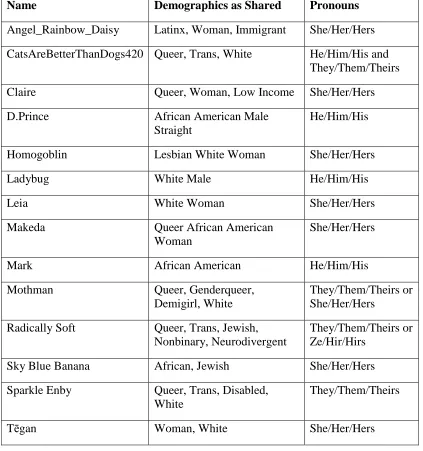
Table 5.1 Artist Reported Demographics ... 175
Table A.1 Recruitment Dissemination ... 398
Table B.1 Artist Reported Demographics ... 400
LIST OF FIGURES
Figure 4.1 Angel_Rainbow_Daisy 1... 146
Figure 4.2 Angel_Rainbow_Daisy 2... 147
Figure 4.3 CatsAreBetterThanDogs420 Exterior ... 148
Figure 4.4 CatsAreBetterThanDogs420 Interior... 149
Figure 4.5 Claire ... 150
Figure 4.6 D.Prince ... 151
Figure 4.7 Homogoblin 1 ... 152
Figure 4.8 Leia 1 Side A ... 153
Figure 4.9 Leia 1 Side B ... 154
Figure 4.10 Leia 2 ... 155
Figure 4.11 Makeda ... 156
Figure 4.12 Mark ... 157
Figure 4.13 Mothman and Ladybug... 158
Figure 4.14 Radically Soft ... 159
Figure 4.15 Sky Blue Banana 1 ... 160
Figure 4.16 Sparkle Enby ... 161
Figure 4.17 Tēgan ... 162
Figure 4.18 CatsAreBetterThanDogs420 2 ... 163
Figure 4.19 CatsAreBetterThanDogs420 and Leia ... 164
Figure 4.21 Homogoblin 2 ... 166
Figure 4.22 Leia 3 ... 167
Figure 4.23 Sky Blue Banana 2 ... 168
Figure 4.24 Makeda 2 ... 169
Figure 4.25 Collaborative Final Piece (CatsAreBetterThanDogs420, Leia, Sky Blue Banana, Homogoblin, Makeda, Claire, Mothman, and Lady Bug) ... 170
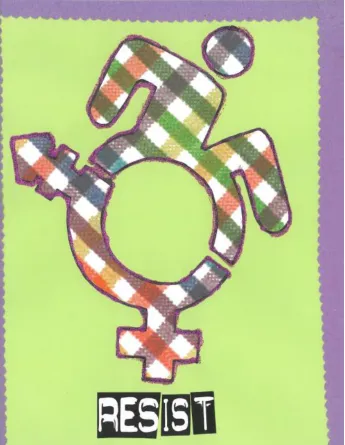
Figure 4.26 Leia Protest Zine – Cover ... 171
Figure 4.27 Leia Protest Zine - Page 1 & 2 ... 171
Figure 4.28 Leia Protest Zine - Page 3 & 4 ... 172
Figure 4.29 Leia Protest Zine -Page 4 ... 172
Figure 4.30 Leia Protest Zine – Back Cover... 173
Figure 4.31 Leia Protest Poster ... 173
Figure 5.1 Sparkle Enby ... 182
Figure 5.2 CatsAreBetterThanDogs420 Exterior ... 183
Figure 5.3 CatsAreBetterThanDogs420 Interior... 183
Figure 5.4 Radically Soft ... 185
Figure 5.5 CatsAreBetterThanDogs420 and Leia ... 188
Figure 5.6 D.Prince ... 190
Figure 5.7 Collaborative Art ... 192
Figure 5.8 Leia How To ... 193
Figure 5.9 Mark ... 194
Figure 5.10 Mothman & Ladybug ... 198
Figure 5.11 Makeda ... 202
Figure 5.13 Claire ... 204
Figure 5.14 CatsAreBetterThanDogs420 ... 205
Figure 5.15 Sky Blue Banana ... 206
Figure 5.16 Leia 3 ... 207
Figure 5.17 Homogoblin ... 207
Figure 5.18 Homogoblin ... 211
Figure 5.19 Angel_Rainbow_Daisy 2... 220
Figure 5.20 Makeda ... 230
Figure 5.21 Leia 1 Side A ... 240
Figure 5.22 Leia 1 Side B ... 241
Figure 5.23 Angel_Rainbow_Daisy 2... 250
Figure 5.24 Claire ... 252
Figure 5.25 Sky Blue Banana ... 274
Figure A.1 Leia Protest Zine – Cover ... 403
Figure A.2 Leia Protest Zine - Page 1 & 2 ... 403
Figure A.3 Leia Protest Zine - Page 3 & 4 ... 404
Figure A.4 Leia Protest Zine -Page 4... 404
Figure A.5 Leia Protest Zine – Back Cover ... 405
CHAPTER 1: INTRODUCTION Situating Myself
For the past decade I have worked in some capacity in student services at a large
school in the South. As a progressive-minded individual, who often would question
institutional traditions that privilege historically dominant groups, namely those
positioned by white, cisgender, heterosexual masculinity, often I received pushback from
other administrators. I was told that “we” were a “southern” or “conservative” institution.
Working with our students of Color on campus, I was reminded by upper-administrators
that we were a predominantly White institution (PWI). To that end, I name my site as
SCPWI, or Southern Conservative Predominantly White institution as the pseudonym.
While not all the individuals at SCPWI were White, or southern, or conservative, many
were. And for some student on campus, anecdotally, SCPWI was the most liberal space
they had lived (as discussed in Chapter 5).
On November the 16th, 2015 I received word that many of the students with
whom I had worked were planning a walk-out. I had been organizing with some of these
same students for an international game day as part of the kick-off for the
institution-backed international education week, and we had been working together for months.
When none of the students showed up to set up for the event, I was concerned and
confused. Standing there wondering what had happened, I heard that at approximately 11
a.m. there was going to be a walk-out on campus, another episode in the campus-based
where students and student athletes staged a walk-out to protest the lack of action to
combat racism on campus (Frizell, 2015). I walked with my then supervisor to watch the
walk-out but was explicitly told by her to not walk with the students and to not engage
with them, so as to not appear to be taking their side in the walk-out.
Over a quarter mile the group of students walked from an academic building
where they had gathered, across our historic quad and directly onto the patio of the
university’s administration building. They read a two-page letter addressed to the
president and disseminated it among the students who joined them in the walkout
(Randall, 2017). Following the address, they delivered a copy to the administration. The
letter contained a list of 12 demands, reflecting needs of a variety of marginalized
campus-based communities that were often overlooked by the administration. The list
became known as the #2020Vision, as the students who developed it called for their
demands to be met by 2020.
While I was quite close with a number of the leaders of this movement, they
purposely left me and my supervisor in the dark about their plans, so as to not implicate
us in their activism. They knew that we would get in trouble for assisting them. This was
evident after the event, when despite the absence of engagement with our office at a
forum with the president and other upper-administration, upper-administrators stated that
the students had the multicultural center to assist them. The students had remarked earlier
that we were “overworked” and “exhausted” as a way to advocate for us and the work of
the office but their characterization seemed to confirm in the minds of
upper-administrators that my supervisor and I were actually the ones behind the walk-out.
upper-administrators as a trouble-maker. They refused to believe that the students had come up
with the plan on their own and instead chose to charge me and my supervisor with having
given them direction on what to do. From that moment forward, upper-administrators
began targeting me directly for small infractions, such as wearing inappropriate footwear
to work. I was constantly reminded by them that SCPWI was a “southern, conservative”
institution and that working toward equity and justice was not appropriate “here”. These
were messages that I received not only implicitly, but also directly in statements to me
from university leadership. Due to a mismatch of values regarding the inclusion of
marginalized voices, my career as a student affairs professional was inhibited by staying
at SCPWI. I stayed much longer than I should have due to my love of the students with
whom I worked, but also because I in a doctoral program at a nearby university, and I
was determined to finish.
Just two years later, on November 8th of 2016, the election of Donald Trump
changed the way that I saw the world. I knew that oppression in the forms of racism,
sexism, and nativism was real, but I neglected to consider how these oppressions could
potentially figure into something such as a national election. The next day, on November
9, 2016, the multicultural center hosted space in our lounge for university students who
were feeling scared, hurt, and fearful; my supervisor and I worked all day to be with
students. While there were students on campus who were excited about the election, my
experiences were centered around the support of the students crying in my office. My
supervisor and I were hurt, scared, and fearful, too. On November 11th, the Friday of that
week, I was facilitating a Safe Zone for faculty and staff as part of the university’s creed
signed up last minute, anxious to learn how to support LGBTQ students in the wake of
the Trump election. At that point, perhaps even now, I had no idea how they might
support LGBTQ students.
That Friday afternoon, there was a gathering on the quad; university students
called it a “vigil”. They met and spread the word through social media to any and all
students, faculty, and staff who might feel scared, hurt, or fearful in the wake of the
election and invited them to come be in community with one another. One of the faculty
members from the Safe Zone training earlier that day was there, and I remember thinking
that was good to see. As my supervisor and I had done when we learned about the
walkout, we walked over to the gathering, but we had been told explicitly by her
supervisor that we were not to go, that doing so would “increase the size” of the “target
on my back” as a “trouble-maker” at the institution. I was not able to do my job, which
was to support marginalized students, nor was I able to be publicly in community with
others who felt scared, hurt, and fearful.
Statement of the Problem
Since the inauguration of Trump there have been an onslaught of attacks on
marginalized communities. These attacks have produced public protest and a rise in
activism (Sydell, 2017). For instance, instances of activism regarding news that President
Trump would dismantle Deferred Action for Childhood Arrivals (DACA) caused
marches in Washington DC, New York City, and other cities, just days after the leak of
this information in September 2017 (Cole, 2017; Valdes, 2017). In response to changing
educational policy related to Title IX, Betsy DeVos, Trump’s controversial Secretary of
2017; Lardieri, 2017). Protestors documented the inexperience and ignorance of DeVos
regarding federal law. As soon as Trump announced Senator Jeff Sessions for Attorney
General, activists protested the nomination which included a response from over 1,100
law faculty from across the country who penned a letter rejecting his nomination due to
Sessions’ anti-civil rights positions (Verhovek, 2017). Since his confirmation Sessions
has reversed President Obama-era positions on drugs and crimes and reverted to using
language reminiscent of the 1950s or 1960s about drugs, race, and immigration (Chang,
2016; Fretland & Jones, 2017). Actions against DeVos and Sessions were quickly
organized and disseminated by new media platforms such as Twitter TM and Facebook TM.
The use of social media to organize across physical space1 has been integral to many of
these moments of activism, brought to the fore through the use of hashtags, short phrases
preceded with a #, which enabled easy cataloging and searching of posts.
Activists responded quickly to other policy changes as well, in particular
Executive Order 13769, titled Protecting the Nation from Foreign Terrorist Entry into the
United States, more often referred to as the Muslim Ban, and the repeal of DACA. The
Executive Order placed a temporary ban on entry to the United States, with the exception
of U.S. citizens, for those traveling from Iraq, Syria, Sudan, Iran, Somalia, Libya, and
Yemen, predominantly Muslim majority nations (Department of Homeland Security,
2017). The ban provoked a great deal of outrage, and activists and lawyers responded by
taking to the airports within hours of the announcement of the bill to work on the behalf
of anyone affected by the Order and arriving in the U.S. Lawyers were among the
protestors and supported individuals from these nations with free legal assistance upon
arrival (J. E. Bromwich, 2017)
This routine questioning of U.S. and non-U.S. citizens marked as outsiders and
raced Brown and Black by enactors of a White supremacist state returned us to a political
moment just after 9/112. During the era that followed 9/11, many people perceived as
potentially Muslim and/or from the Middle-East3 were targeted and profiled and illegally
detained. Trump’s Executive Order 13769 which halted travel and immigration from
specific Muslim majority countries was reminiscent of the intense xenophobia that arose
post 9/114.
Social media was essential from the first moment of what became the largest
single-day protest in U.S. history (Broomfield, 2017). The Women’s March, which took
place in Washington, D.C., as well as many other cities, the day after Trump’s
inauguration was meant to send a “bold message to our new government on their first day
in office, and to the world that women's rights are human rights” (Lapowsky, 2017;
Tatum, 2017, p. np). The event took off like wildfire. The day after the election, Teresa
Shook5 created a page for a hypothetical march, and by the next morning, she had over
2 A series of coordinated terrorist attacks by al-Qaeda on the United States on September 11, 2001.
3 Or erroneously assumed as such as many Sikhs were also targeted (Puar, 2007).
4 This era was so rife with an us vs. them mentality that the House of Representatives cafeteria stopped
serving French Fries and began serving Freedom Fries as France critiqued American policies post 9/11 (Silver, 2011).
5 A woman from Hawaii who took to social media to plan the Women’s March for the day after Trump’s
10,000 responses. Organizing was made possible across the country through social media
platform Facebook TM.
Through my study, I intended to better understand young adult activism, and
intersections of activisms in the historical context of the Trump administration. Without
studying this phenomenon now, we lose access to understanding this moment of activist
response to the retrenchment of White supremacist, cisheteropatriarchal politics in in the
White House. My research question guiding this study was: How do young adults
experience and articulate the role of emotions in the activism in which they engage?
I am particularly interested in the role of emotions in activism for two reasons.
First, Baruch Spinoza (1677/1992) posited that the conatus, or the tendency to
self-preservation through action, was caused by emotion. As such I wanted to explore
connections between emotion and action. Second, in modern history often emotions have
been derided as being irrational (Jaggar, 1989), and I want to counter their dismissal.
Through this project I intend to challenge lines of argumentation that reflect that idea that
because activisms are emotionally driven that they are irrational. Turning to Spinoza, I
embrace his understanding of emotionality.
Jaggar (1989) argued that emotional research has long been devalued by Western
scientific traditions and that rationality has been valued for its role in acquiring
knowledge. Further, when emotion and rationality are cast as diametrically opposed,
rationality has been associated with “the universal, the public and the male, whereas
emotion has been associated with the irrational, the physical, the natural, the particular,
& Goodwin (2001), and Ahmed (2004, 2014), I argued that emotions were vital to
engagement for activists, because they intersected with actions of subversion and refusal
(Calhoun, 2001; Fèlix Guattari & Stivale, 2009; Polletta et al., 2001). In this moment
many positions of refusal are against Trump, his administration and its policies. I
anticipated an analysis that would address both the materiality of experiences with
activism and the effects of an administration that reifies a White supremacist
cisheteropatriarchal order. As you will see in Chapter 5, data reflects much of the former,
the materiality of experiences with activism and in some ways the effects of the Trump
administration and its policies.
I have chosen to focus on young adults for two reasons. First, in the last decade I
have witnessed a rise of interest in social justice issues and activism among college-aged
individuals. Further, I believe that young adults, who came of age with the rise of social
media, have used this technology to craft new communities. These communities are not
bound in the same ways in which communities were once bound, such as spatially or
racially, and for this reason, the contemporary activisms have arisen faster than in other
historical contexts (Gerbaudo, 2012; Idle & Nunns, 2011) and have been more
intersectional nature (Bailey, 2017; Carney, 2016; Randall, 2017).
Methodologically, I used art-based research methods to explore young adults’
engagement and resistance. Through a series of art sessions, artists produced artistic
representations that reflected their community building as a group; familial distance;
reistance to oppression; emotions of love, pride, and guilt; regional identies; and the use
of social media. My intent was to speak back to the effects of a White supremacist
expose [power] and welcome the opportunity to subvert it in the name of social justice”
(Pelias, 2007, p. 188). As I prepared for data coding and analysis, I planned to analyze
data from an intersectional standpoint (Crenshaw, 1991). I believe that in the wake of the
contemporary rise of White nationalism on a global scale (Giroux, 2017a) we have seen
an increase in activist response that focuses on an intersectional approach to justice. I
frame my understanding of justice from an intersectional standpoint and believe that
justice needs to be addressed not just for one queered community but for all (Crenshaw,
(1991). In Chapter 5 I represent intersectional commitments that some of the artists
expressed.
Further, I came to this study from a critical perspective, one that researchers adopt
to examine power relations inherent in interpersonal relationships (Lincoln, Lynham, &
Guba, 2012). Additionally, I came to this project from a perspective framed by queer
theory. I think of “queer” not as solely sexuality, but of transgression (Anzaldúa, 2010)
against the regimes of the normal (Warner, 1993). Taking a queer perspective means
questioning the unity of identity, dismantling (supposed) binaries, and exposing power
structures that are complex (Walters, 1996). Further, with practicable implications in
mind, I share a critical dissatisfaction with the ways institutions of higher education have
come to serve as cogs in a machine of “diversity management” rather than radical
inclusion (Puar, 2007). These ideas helped me in understanding how institutions
(governmental, educational, non-governmental) have come to situate themselves in
relation to refusals of the status quo. As a student affairs professional and educator, often
understand. What might we hear if we listened to understand? I offer one representation
of refusals here from millennial activists and invite you to listen to understand.
Context
On January the 20th of 2017 a new era began—an era of anxieties, fear,
hopelessness, and despair for some—for others, a chance to Make America Great Again
(MAGA ™) (D. Trump, 2016) The day was overcast and cloudy, both where I was in
South Carolina but also in Washington DC at the inauguration of the 45th president of the
United States. This cloud seemed to reflect the collective fears and anxieties of the
communities that I name as part of my life and had coalesced into a cloud. Thus, began
the presidency of Donald Trump for me. Amidst this historic event, one which Ta-Nehisi
Coates (2017) called the ascendancy of the first White president, came responses of
varied activisms. These moments of activism coincided with a collective anxiety
surrounding the erosion of democratic norms by the actions of the commander in chief,
which are still on-going more nearly two years after his election (American Psychological
Association, 2017; Sifferlin, 2017).
For some, such as Coates (2017), the ascendency of Trump to the presidency was
a direct response to the election of President Barack Obama, who was historically elected
as the United States’ first President of Color in 2008 and 2012. Trump leveraged
racialized actions over the course of President Obama’s presidency to his own ends, such
as his persistent questioning of President Obama’s citizenship6 (Coates, 2017). Trump’s
6 Also known as birtherism, it was this persistent questioning, spearheaded by then business man Donald
rise to power, built on a legacy of racism and directed toward President Obama,
represented a racist backlash against the Obama presidency itself. Trump was merely the
embodiment of broader racist backlash that peaked in response to the Obama presidency
(Hughey, 2014; Inglehart & Norris, 2016). The Trump presidency has been consumed
thus far with undoing the legacy of his predecessor. This is evidenced by the many noted
attacks on of President Obama signature accomplishments. These include repeated and
continued attacks on the Patient Protection and Affordable Care Act7; the attack on Trans
members of the military (Philipps, 2017), a reversal in environmental policies numbering
at least 608; a change in priorities in drug policy9; the change in direction in addressing
sexual assault on college campuses (Department of Education, 2017; Saul & Taylor,
2017); creating confusion regarding gender rights through the rescinding of the dear
colleague letter (Somashekhar, Brown, & Balingit, 2017); contempt for international
treaties, agreements, and norms10; and the foreclosure on the Deferred Action for
Childhood Arrivals (DACA); and beginning a “war on immigrants” (Huerta, 2017). Each
of these changes in federal policy can be viewed as an attack on a group of people who
challenge the nostalgic whitestream (Grande, 2003) narrative of what the United States
used to be, and this is evident in the temporal nature of President Trump’s signature
7 One of Trump’s first acts in office, this Executive Order was signed the same day as his inauguration
(Horsley, 2017).
8 This includes the overturn of bans on harmful pesticides, allowing the continuation of the Dakota Access
pipeline, and the largest rollback of federal land protection in history (Popovich, 2017; Turkewitz, 2017) 9 Despite information to the contrary, the War on Drugs has increased our prison population, decreased
illegal drug prices, militarized our police force, created for-profit prisons. This being all at the expense of the taxpayer (Winslow, 2017)
10 This is inclusive of reneging on the Paris Climate Accord (Liptak, 2017) and questioning if the sanctions
campaign phrase, “Make America Great Again”. This phrase reflected a notion of a
return to a time in which the United States was great. I believe, due to the rhetoric and
actions used in conjunction with the phrase, this return in time is tied up with moments of
U.S. history saturated with racism, misogyny, homophobia, and other forms of bigotry.
To “MAGA” asks us to misremember history and to neglect our commitments to equity
in the name of a misremembered past. There is no return to make. A reference to an
earlier epoch is a reference to a time when people of Color, when women, when queer
people, when immigrants, when poor people presented less challenge to the hegemony of
normative U.S. discourse and politics.
During President Obama’s term in office, widespread efforts to achieve rights for
lesbian, gay, bisexual, and trans (LGBT) people were realized. These included the
passage of the Matthew Shepard and James Byrd, Jr Hate Crimes Prevention Act, which
expanded the definition of hate crimes to include gender and sexuality. Under the
leadership of President Obama “Don’t Ask Don’t Tell”11 was repealed, which allowed
LGBT service members to serve openly in the military without fear of being discharged
from the military. These changes helped to pave the way for the Supreme Court decision
in Obergefell v. Hodges, which effectively legalized same-sex marriages12. Trump un-did
the legacy of military inclusion with his order to disqualify transgender people who had
11 Don’t Ask Don’t Tell was the official US policy in regards to lesbian, gay, and bisexual people in the
military. This was instituted by the Clinton administration in 1993 (Department of Defense, 1993). 12 While President Obama’s legacy is not one of effusive support for LGBT people, it was a time in which
“undergone gender transition” (H. Cooper & Gibbons-Neff, 2018). This act had no
guidance on Trans individuals who are currently serving.
During the Obama Presidency, Title IX of the Education Amendments of 1972
was expanded to include Trans students so they would be entitled to accommodations and
protections under Title IX. Initially, Title IX addressed discrimination based on sex. In
2013, Title IX was expanded to include an understanding that “sexual harassment of
students, including sexual violence, interferes with students’ right to receive an education
free from discrimination and, in the case of sexual violence, is a crime” (Office of the
Assistant Secretary, 2013, p. np). The expansion extended “to claims of discrimination
based on gender identity or failure to conform to stereotypical notions of masculinity or
femininity and OCR accepts such complaints for investigation” (Lhamon, 2014, p. 5).
During the first year of the Trump presidency in September 2017 under the leadership of
DeVos, sexual violence as an interference with a student’s right to an education was
removed from Title IX (Silva, 2017).
The Patient Protection and Affordable Care Act, often commonly referred to as
just the Affordable Care Act (ACA) serves as a way to ensure that all citizens of the
United States have access to affordable healthcare. It is an act that many conservative
politicians opposed. This act, colloquially known as “Obamacare”, has been under attack
was initially signed in an attempt to repeal the ACA13 (O’Brien, 2010). The promise to
repeal Obamacare was a signature piece of the platform on which Trump ran for election.
We have also witnessed an onslaught of changes in environmental policy that is
detrimental not only to the environment itself, but those who live, work, and play in the
natural world. With Trump’s long-established record of denying climate change, this was
perhaps of no surprise. Trump has stated that “the concept of global warming was created
by and for the Chinese in order to make U.S. manufacturing non-competitive” (D. J.
Trump, 2012). He also appointed Scott Pruitt, the self-proclaimed “leading advocate
against the EPA’s activist agenda” (State of Oklahoma, 2017, p. np) and a denier of
climate change (Davenport & Lipton, 2016) as the administrator of the Environmental
Protection Agency (EPA). Under the Trump administration, the completion of the Dakota
Access Pipeline (DAPL) took place in 2017. Moreover, under his administration, he
hastened the approval for both DAPL and the Keystone XL oil pipelines in spite of much
opposition from activists (Greshko, Parker, & Clark Howard, 2018). Shortly after the
approval of DAPL, another pipeline burst, leaking 176,000 gallons of oil (Hawkins,
2016), the primary concern of environmental activists protesting the building of these
pipelines. This rupture of the pipeline put at risk the water supplies of individuals living
and farming near these pipelines (Hawkins, 2016).
13 While the ACA is a step closer to ensuring that all have access and health-insurance through an
Eric Holder, President Obama14’s attorney general from February of 2009 until
April of 2015, began dismantling the use of mandatory minimum sentencing for low
level, non-violent, drug-related crimes. Mandatory minimums are often seen as sending
disproportionate numbers of African Americans to prison (Alexander, 2012, p. 113;
Beckett, 2017; Small, 2001). A reversal of this policy under the Trump administration to
reinstate the war on drugs reinvigorated a policy of racist and xenophobic practices
(Beckett, 2017). Winslow (2017) argued that the Trump administration was trading
policies that work (such as community policing and social programs) for ones that do not
(mass arrests and incarceration).15
These two actions, the reinvigoration of the War on Drugs and the Muslim Ban,
by the Trump administration directly target people of Color. For this administration and
its base, I believe that these communities are seen as outsiders to the administration’s
vision of a White supremacist-cisheteropatriarchal order. This status of outsider may even
be imagined, for such is the case with the Dreamers, the beneficiaries of DACA, for
many of them may have no memory of ever being anywhere else but the United States.
Many Dreamers arrived to the United States shortly after their birth. The actions of the
14 Holder was first appointed as Deputy Attorney General under the administration of Bill Clinton, and
temporarily served under George W. Bust as acting Attorney General until a new appointee was confirmed. He was then brought back to the post by Barack Obama.
15It is well-established that the initial call for the war on drugs was established as an us versus them-
Trump administration perpetuated xenophobia and racism; people of Color, particularly
non-Black people of Color, were and are routinely questioned about their legal status, and
moreover, their patriotism. Trump enacted such racism during a closed-door meeting in
January 2017 when he asked why the U.S. could not get refugees from such countries as
“Norway”. Referencing Haiti and African nations, he asked, “Why are we having all
these people from shithole16 countries come here?” (Emba, 2018). Rather than address
the racism expressed in Trump’s degrading comment,17 Republicans denied what was
said or quibbled over the word choice.
At a “Unite the Right” rally, organized by Jason Kessler of Unity & Security for
America (Bertrand, 2017) that took place in Charlottesville, Virginia, on and near the
campus of the University of Virginia, White supremacists and various other right-wing
groups18 marched with tiki torches, chanting hateful rhetoric directed at people of Color
and at people of Jewish descent. During the Unite the Right demonstrations, several
people died, including Heather Heyer who was run down by a car by a White man from
Ohio who had traveled to Virginia to attend the White supremacist gathering (Almasy &
Narayan, 2017). For these White supremacist groups, violence is an explicit aim (Morlin,
2017). In response to the vehicular homicide of Heather Heyer and the greater Unite the
Right Rally, Trump waited three days to address the role of the White supremacists. His
denouncement included language that there were “some very fine people on both sides”
16 An act of resistance occurred several days later when activists projected the word “shithole” onto one of Trump’s hotel properties (Thomsen, 2018)
17 They argued that Trump, in fact, said shithouse, not shithole as was initially reported.
18 Groups in attendance included The Daily Stormer, The Right Stuff, The National Policy Institute, the
(Gray, 2017). The delay was monumental for a president renowned for his proximal and
excessive tweets.
Trump was more responsive in his attack on National Football League (NFL)
players taking a knee to protest police violence than about the death and violence that
took place in Charlottesville (Boren, 2017). The delay is another example of the
explicitly racialized decision making by the Trump Administration. Plainly put, he took
three days to address the Charlottesville protest and did so with equivocation; in contrast,
he came down much more quickly and with no uncertainty in his viewpoint of NFL
players protesting police violence against members of communities of Color. This is an
instance of explicitly defending Whiteness—the Charlottesville protesters19—and
attacking communities of Color (the NFL athletes protesting have been mostly men of
Color).
In the fall of 2017, many hurricanes made landfall in the United States and
nations within the Caribbean. One major one to hit the United States was Hurricane
Harvey, which made landfall in Texas, devastating Houston (National Hurricane Center,
2018). Within weeks, Trump donated one million dollars to Hurricane Harvey relief
(Pullen, 2017). In contrast, when Hurricane Maria made landfall in Puerto Rico, a U.S.
protectorate, a month later, Trump's response was less than gracious. His response
included an attack on the mayor of San Juan (Summers, 2017); he insinuated that Puerto
Ricans “want everything done for them” (D. J. Trump, 2017b) and treated Puerto Ricans
as second-class citizens (Meléndez Olivera, 2017). Some reporters made comparisons to
George W. Bush’s response to Hurricane Katrina in 2005 (H. Cooper, Davis, & Healy,
2017). In both of these instances, the majority of the citizenry (New Orleans and Puerto
Rico) were people of Color. The different responses to Houston and Puerto Rico were a
reminder that in the Trump administration, the president consistently sides with
Whiteness, perhaps his greatest wealth from a man who made his life collecting wealth20.
I argue that through these Executive Orders and changes in policy, Trump marked
the return of a straight, White supremacist, masculine, cis-gender, heterosexist? and
nativist politics. It is clear that MAGA means a White America, a masculine America, a
cisgender America, and a straight America. Further, beyond direct actions by Trump, his
nominations have served as a reminder that we are no longer progressing toward more
inclusion. We have returned to the public spectacle of White supremacy. A resurgence of
White supremacy, now in the guise of the alt-right21, has found zealous followers in a
community of disaffected White men (Chalabi, 2016), who seem to be feeling more
comfortable with being public about their discriminatory actions (Hosking, 2017).
Today’s political climate is tumultuous. This tumult is particularly present on college
20 All of these moments during the Obama administration must not be confused as without nuance. For
many of these moments are viewed as victories for marginalized populations, they are not without critique, especially from those they purport to help. Even withstanding these various critiques, the undermining of these signature achievements signifies a renewed attack on these groups that fall outside of the nostalgic whitestream norm of MAGA.
21 Short for alternative right, a loosely connected movement of conservatives, banded together through
campuses where they have been targeted by virulent speakers such as Milo
Yiannopoulos22 and Ben Shapiro23 (Friedersdorf, 2015; Healy, 2017).
Significance of the Study
Since the 1960s a proliferation of activism movements has occurred (Kauffman,
2017). This particular study is important for activists and educators, because the research
represented here offers a chance to better understand how young adults experience and
practice social justice work when faced with the deployment of dominant narratives
(Delgado, 2000) so unequivocally opposed to inclusion and equity (Lyotard, 1984). We
are in a historical moment when speaking against the discourses perpetuated by the
Trump administration has been framed by the right as “snowflake”, liberal elitism and
morally questionable (Berlant, 2004). I believe that emotions play a significant role in
activism and deserve attention. Paradoxically, the Trump administration has decried and
devalued emotive anti-Trump responses by the public even as the same administration
deployed emotive propaganda and discourse against by the very people they have decried
and devalued.
As new media such as Twitter and Facebook are emergent, there is still room to
understand how these tools are being used by millennial activists (Milkman, 2017). At
the intersection of emotions and activism, more research needs to be produced
(Gerbaudo, 2012; Goodwin, Jasper, & Polletta, 2001). When emotion and activism have
22 A British writer and speaker who was a provocateur of progressive college student movements, caused
many protests on college campuses.
been studied, researchers examined macro impacts, for example, the ways that
governmentality of fear gives rise to an authoritarian mode of leadership (Moisi, 2009).
My aspiration is to better understand how a critical inquiry into the experiences of
emotions may provide a path of resistance and hope through our contemporary political
moment (Calhoun, 2001). Moreover, I hope this representation of research will provide
scholars of education, scholar-activists, university administrators, and student activists
with accounts of how young adults are navigating emotions during contentious times. I
direct my project specifically at these four groups, noting, of course, that in reality there
is overlap across the four for some individuals.
Delimitations and Limitations
As I am primarily concerned with the experiences of emotions and narratives
from marginalized, the participant artists were individuals who expressed
non-majoritarian political views. At this time, that would be anyone who does not identify as
a Republican, as the Republican Party controls both the U.S. Senate and the U.S. House
of Representatives, as well as the Executive Branch. To that end, while I have provided
context about the deployment of emotions/discourse by the Trump administration and its
espousal of dominant narratives (Delgado, 2000), I did not engage directly with
individuals who were a part of that deployment. This choice is also a limitation although
a purposeful one. Primarily, I am interested in the experiences of those who choose to
engage with liberatory efforts of inclusion, and so I did not engage in this iteration of
research with individuals whose views align with the actions of the Trump
It is hard, if not improbable, to exist in a vacuum devoid of the influence of a
Western White hegemony. However, I am informed by decolonial thought as I work
against myself and my privileges and as I engage in formal processes of research.
Analogous to my decolonial commitments are my queer commitments. The queering of
historically Western, White, and rational boundaries of knowledge (Jaggar, 1989;
Warner, 1993), means researchers privilege the concerns and worldviews of the
historically queer / non-normative, and interrogate the space and place for Western
knowledges and how they can be both productive and oppressive. I am informed by queer
theory in this project as well and hold a commitment to practicing recursive reflexivity
(Pillow, 2003) in order to queer my own practice, process, and representations.
Dissertation Layout
Emotions cause us to act, as affect is the drive to act based on emotion (Spinoza,
1677/1992). To that end, in Chapter 2 I inform my audience of relevant literature on
activism, activism within the academy, activism among young adults, new media and
activism, emotions and affect, emotions and activism, and queer theory. In Chapter 3 I
focus on the methodological approach to this study, which is informed by decolonial and
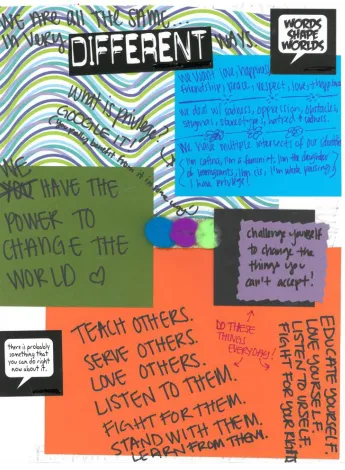
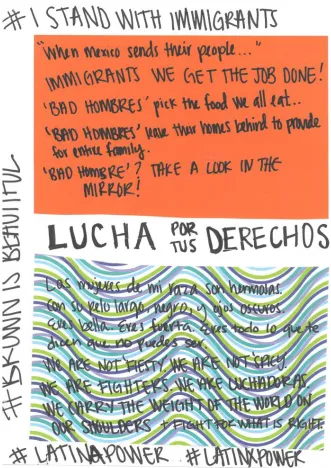
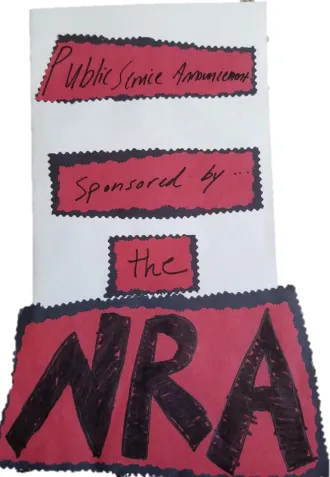
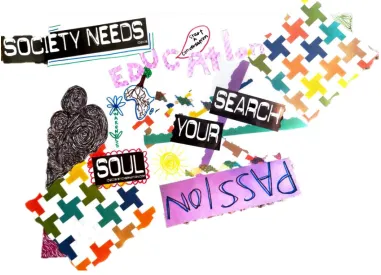
queer commitments. Chapter 4 is a visual interlude, highlighting the zines created by the
artists. Chapter 5 reflects the findings of the study, including the representation and
discussion of 8 themes: the demands of artistry; building community; distance in families
of birth; resistance to oppression; emotion; mental health, self-care, and guilt; the South;
and social media. Finally, Chapter 6 contains a summary and a discussion with respect to
attention paid to my four primary audiences: scholars of education, scholar-activists,
CHAPTER 2 : LITERATURE
In this chapter I explore the conceptual and theoretical frameworks that inform
my argumentation and review the extant literature on my research topic. I address the
ways activist-scholar identity and queer theory influence my topic and methodological
choices. Then, I review theoretical engagements with emotions and affect and empirical
studies on millennials’ political engagement.
First, I examine the role of the activist-scholar. Then, I examine activism among
young adults. Further, I engage in a historical examination of scholarship on emotions
and affect and their intersection with contemporary activism and political engagement. I
follow this by providing for theoretical contexts on affect and emotion. Then I explore
the state deployment of fear and anxiety as a means of control before moving on to a
review of hope as an emotion of resistance. Finally, I represent the layered ways queer
theory informs my work.
Conceptual and Theoretical Framework
Arts-based research (ABR) is an especially strong approach to scholarship
“involving identity work” and to projects that “confront stereotypes that keep some
groups disenfranchised” (Leavy, 2017, p. 10). ABR has the potential “to jar people into
seeing and thinking differently” (Leavy, 2017, p. 10) and to challenge ideologies that
I intend in the name of justice to speak back to the power that functions upon my kin,24
exposing that power and subverting it.
Activist-Scholar
As an activist-scholar, I aim to explore power structures to understand how to
erode oppressive social structures (Lincoln, Lynham, & Guba, 2011). Drawing on work
by Villenas (1996), I strive to explore and maintain the role of an activist-scholar and my
commitment to targeted communities while working within an academy that privileges a
particular formation of knowledge (Adsit, Doe, Allison, Maggio, & Maisto, 2015;
Ahmed, 2012; Talburt, 2000). Like Villenas (1996), I have struggled to find my place as
an activist-scholar. In my professional life, I have served as a university administrator. I
was deeply troubled, as a queer, progressive individual, by the experience of working at
an institution whose values were not in alignment with my own (Weiser & Wagner,
2017). My experiences of marginalization have served to forge my own activist and
scholar identities and my activist-scholar agenda, but I strive in my work to consider all
communities that face marginalization—not just my own. This commitment likely comes,
too, from my decade of work in a multicultural center at a southern, conservative,
predominantly White institution (which I will call SCPWI).25
24 A term often used in reference to queer and trans community solidarity (Nicolazzo, 2017).
25 While I may define and think of this university as a conservative institution, it is a flagship university in
Through my work and in my advocacy for justice and inclusion, often I faced
resistance that had real and embodied impact on my own experiences (Weiser, Wagner,
& Lawter, in press). I have never been one to settle for small victories, or to stop and rest
once some progress has been made. This is for three primary reasons. First, I was
working at SCPWI when Barack Obama won the presidential election in 2008. And while
I was excited and happy to witness such a historic event, subsequently my work in a
university multicultural center became more complex and nuanced. I was tasked with
facilitating racial reconciliation dialogues on campus, due to the rise of White racism and
White-racial backlash both on campus as well as larger cultural shifts. That work was a
part of my awakening to White-racial backlash to the election of the first person of Color
to the presidency. I became aware that despite how excited I and many of the students I
worked with felt, we had all been tasked with attending to the White fragility made
manifest through this historic event.
The second reason I do not settle for just some progress toward justice and
inclusion is an experience I had helping the LGBT student organization at SCPWI host a
National Coming Out Day event and seeing a student crying tears of rage at the fact that
“her” university would allow such a celebration. This was the same semester that SCPWI
had hired its first-ever full-time employee dedicated to serving LGBT students. Her tears
signaled to me that while SCPWI was officially hosting the event, some of the students
still were emotionally opposed to it.
The third reason is I have always questioned whether I could do more to bring
with upper level administrators, fellow entry-level support staff, and students who
questioned how far and how hard we should push. These challenges came from
professionals in the division of student affairs, too. Some have shared: “[It26] may not be
great for students of Color, but look how far we’ve come”, or “We could never have
gender-inclusive housing; this is a conservative school.” These statements, along with
“We can’t buck tradition because some students are upset; this is the way it’s always
been,” have served to continuously disenfranchise and stop student activist movements.
Administrators are apt to wait out students, knowing full well that students graduate and
that “troublemakers” leave (Randall, 2017). I have heard voicemails that upper level
administrators have left on student activists’ cellphones—sometimes intentionally,
sometimes by accident after they believed they had hung up—calling these students
“uppity.” For these reasons, I never slow down after one victory is achieved. I am always
suspicious of progress narratives, which in my experience serve to usurp radical
movements’ momentum.
I believe that participating in social movements is not a balm to being complicit in
systems of oppression, but that participation is a step toward challenging White
cisheteropatriarchal hegemonies. Likewise, individuals who challenge hegemonic power
may be complicit still in some areas of oppression. I believe we are all works in progress.
Activist-scholars in the academy run the risk of taking on the disturbing features of the
26 The [It] here can be a stand-in for so many actions taken by university administrators. Some examples:
very structures we hope to dismantle (Sandoval, 2000). Queer theorists encourage me to
never rest on my laurels but rather to continuously push to create a more just and
equitable space through nonstop critique.
I believe good theory “tells us a story—in nonordinary language (which jolts us
out of our complacency and into attention)—of how things are and helps us discover the
possibilities of how things might be” (Butler, 1997, p. 144). I attempt to theorize the data
the artists and I have generated together.
Activism
An activist is one who brings about activism; activism is the “active participation
or engagement in a particular sphere of activity; spec. the use of vigorous campaigning to
bring about political or social change” (“activism, n.,” 2010). It is this specialized version
of the word, denoting vigorous campaigning, that I call upon in my deployment of the
term activism.
Activism and the Academy
The Oxford English Dictionary gives an interesting definition of academic as “not
leading to a decision; unpractical; strictly theoretical or formal. Now also in weakened
sense: of no consequence, irrelevant” (“academic, n. and adj.,” 2011). This definition
runs in the opposite direction of the preceding definition of an activist. One reflects a
person of action; the other reflects a person of inaction, a thinker rather than a doer.
Adsit, Doe, Allison, Maggio, and Maistro (2015) addressed the precariousness, or
They analyzed various programs to discover that academic and student affairs
departments that trafficked in “identity politics suffer[ed] funding cuts and closures,
while science and technology programs [were] spared” (Adsit et al., 2015, p. 21).
Programs that acknowledge identity politics are considered a financial drain on the
institution, rather than possible sources of revenue. While fairness is the goal, the reality
is that “precarity is unevenly distributed in today’s corporate university” (Adsit et al.,
2015, p. 21), because the programs in danger are the ones that are not seen as financially
sustainable.
Adsit et al. (2015) addressed how emotionality plays a significant role in precarity
as well. They found that academic laborers who express and challenge the “emotional
hegemony that serves to maintain the status quo in naturalized power relations” (Adsit et
al., 2015, p. 33) often find themselves part of the precariat. Departments that engage in
“consciousness-raising as an explicit commitment are disproportionately affected by
institutional cuts” (Adsit et al., 2015, p. 25). The corporatization of higher education
continually undervalues certain forms of knowledge production, often in fields more
populated by those who have been historically marginalized (Adsit et al., 2015) and,
those who are more inclined to engage in social justice and consciousness-raising
activities.
Tessema (2015) used narrative inquiry in his dissertation to explore the ways in
which Ethiopian higher education activists have engaged in their work despite the state’s
repressive tactics. He explored the work of nine former students who engaged in ethnic
that where activism developed, the state eventually took counteractions in order to
repress the activists. So, while the study did not concern itself with undergraduate
students in a U.S. context, it underscores how activists across the world face repressive
actions by the state.
Building on Tessema (2015), Webb (2017) explored student activism through
qualitative interviews in the Trump era at the University of Tennessee. Primarily leaning
on Grzanka, Blazer, and Adler’s (2015) framework of “identity choreography,” Webb
(2017) argued that three themes bound contemporary college-aged activists together:
social networks, identities, and resistance. Using identity choreography—descriptions of
various knowledges and experiences that are used to constitute identities and the
identities of others (Grzanka et al., 2015)—Webb (2017) explored how contemporary
student activists used social media as a place for meaning-making and coalition-building.
Webb determined that social network space is important to activist identity and
resistance, a finding that echoes the research of other scholars (Bailey, 2017; Cabrera,
Matias, & Montoya, 2017; Carney, 2016; Gerbaudo, 2012). Webb asserted that through
social networks and motivation from resistance, student activists were “able to fight
against these systems of oppression, find community even in places where it feels like
their community is trying to be erased, and generally improve the lives of not only
themselves but others to come” (2017, p. 38).
This project has the potential to challenge the way that some people (Whites,
heterosexuals, males, the upper class, etc.) may see young adult activists with whom they
multiple, including the aforementioned people who hold privilege. Like other
activist-scholars, I work in community with the individuals in my project, and I tread carefully so
as to not misrepresent them. Further, I am careful to hold my own activist commitments
knowing that activist-scholars are often challenged by other activists.
Activist-scholars may face backlash from community members who feel
activist-scholars are not real activists (G. Brown & Pickerill, 2009). This misplacement of
activist-scholars, relegated by “real” activists to the border between grassroots activists
and academics, can cause conflicts within both communities (G. Brown & Pickerill,
2009; Chatterton, 2008). There are several different aspects of backlash facing
activist-scholars. First, the academy in the United States is part of a Eurocentric system27 that
privileges particular knowledges, and activists (including of the scholarly variety)
question whether activist-scholars can work from within this system. Second, while some
scholars may be part of the community they work with, there still may be divides along
differences of identity inside and outside the academy. The activist-scholar might not
share the everyday experiences and identities of the community. This is an illustration of
the intersection of identity and politics. Third, those of us who straddle the border
between two or more communities are often told to focus on one over another. In some
communities, including in academia, I have been told to forget where I come from,
namely my working-class background (Ardoin, 2013). At the same time, those of us who
27 U.S. institutions of higher education were built using slave labor, a pillar of White supremacist
are new to a community often are no longer welcomed in our home communities, and our
new community is foreign; we do not quite speak the language (Ardoin, 2013). When
scholars first enter academia, we are thrown headfirst into a new community and new
way of speaking. This immersion may be intended to help us orient quickly to the
academy, rather than to pigeonhole us (Delgado, 1984). But I see this help as an act of
hegemony, of benevolent oppression, coercing newcomers to conform to the expected
performance of an academic.
Depending on the institution, the discipline, and the faculty, that performance
often still demands apolitical, neutral, and rational research (Haraway, 1988; Harding,
1991; Jaggar, 1989). Activist research “helps us better to understand the root causes of
inequality, oppression, violence and related conditions of human suffering” (Hale, 2001,
p. 13). Importantly, activist research is pursued in “direct cooperation with an organized
collective of people who themselves are subject to these conditions” (Hale, 2001, p. 13).
While activism-based research and an activist agenda may constitute only part of an
academic’s research arc, I believe that when someone engages in activism, engagement
colors all aspects of their life, as it becomes part of their positionality and their embedded
situated knowledge (Haraway, 1988).
In activist research, researchers must focus on the needs of the community and not
merely on what is trendy or useful for our own research portfolio (Nagar, 2002). By
focusing only on what makes sense for one’s career, researchers fall into the trap of being
too far removed from a community we opt to call our own—for instance, when an
implications of the research and the academic’s relationships with the community. This
kind of research can end up doing more harm than good (Call-Cummings & Martinez,
2016). Communities need to be able to choose with whom they want to engage. It is an
honor to do activist informed research, one that ought not to be wasted on disingenuous
and/or self-interested research projects in which we pop in and out of the community
when it is useful or convenient (Cahill, 2007; Rahman, 1991).
Activism Among Young Adults
Activism has long been a part of the student experience on college campuses; it is
as “American as apple pie” (Ellsworth & Burns, 1970, p. 5). This is true of both
historically Black colleges and universities and predominantly White institutions (PWIs)
(R. Cohen & Snyder, 2013; Ellsworth & Burns, 1970; Thelin, 2011). From the “Great
Butter Rebellion” in the 18th century at Harvard to the rise of activism on college
campuses in the 1960s, students have used their voices to advocate for their needs and
beliefs (Ellsworth & Burns, 1970; Thelin, 2011). Black and White student activists rose
to prominence during the civil rights movement of the 1960s. For instance, some of the
civil rights leadership during this era came out of the work of Black high school and
college students, such as through the Student Nonviolent Coordinating Committee, the
Freedom Rides, and the Greensboro sit-ins (Astin, Astin, Bayer, & Bisconti, 1975;
Carson, 1995).
Historical Student Activism in the United States
The activism of millennials “synthesizes the identity politics of the New Left of
the Old Left of the 1930s” (Milkman, 2017, p. 25) to create a new movement cohered
through sensations, emotions, and feelings. Milkman (2017) argued that just as historical
movements built upon one another, taking from and breaking with movements that came
before and remaking activism as they saw fit, today’s activism is built on the foundation
of yesterday’s. To describe the activism of today, I start by situating activism by young
adults and students in the context of the United States since the 1960s.
1960s: SCLC, SNCC, and the Black Panthers.
The Student Nonviolent Coordinating Committee (SNCC) arose out of the
Southern Christian Leadership Conference (SCLC) when Ella Baker, then director of
SCLC, became concerned that SCLC was out of touch with younger people (Carson,
1995). She reached out to Black college students at Shaw University who had
participated in sit-ins to encourage them to organize their own group, which would
become SNCC. This outreach set the stage for more participation from young Black
Americans or African Americans to have a voice in the civil rights movement (King
Institute, n.d.).
As a student at Howard University, Stokely Carmichael (Kwame Ture) became
involved with SNCC and participated in its freedom rides of 1961 under the leadership of
Diane Nash, a leader of the student wing of the civil rights movement (Carmichael &
Thelwell, 2003). Carmichael eventually became a leader of SNCC, which had a role in
many other 1960s civil rights events, such as the 1963 March on Washington, Freedom
Summer, and the Selma campaign (Carmichael & Thelwell, 2003; Sargent, 2004). SNCC
identified as a Black radical organization (Federal Bureau of Investigation, 1967), which
contributed to the group’s demise.
There were some intergenerational divides and tensions between the older
membership of SCLC and the younger activists framed by some in SCLC as “upstarts”
(Carson, 1995). Relationships between SNCC and the “big five” organizations of the civil
rights movement (Congress for Racial Equality [CORE], the NAACP, NAACP Legal
Defense Fund, SCLC, and the Urban League) were often fraught, because SNCC had
developed as an antithesis to these other groups (Forman, 1972). SNCC was people- and
community-centered, rather than leader-centered like many of the big five (Forman,
1972). While other organizations sought acceptance from mainstream political
movements, SNCC stood in opposition to both major political parties, because it believed
that these parties were not doing enough for civil rights (Forman, 1972).
SNCC, composed in the 1960s largely of younger Black and African American
people, organized voter registration among communities of Color as seen in the
Mississippi Freedom Summer. Moreover, SNCC had a role in the execution of the Selma
campaigns and in the March Against Fear. In each of these actions, SNCC advocated for
civil liberties, with the larger purpose of helping Black and African American people
exercise their right to vote. SNCC also had a role in the planning of the 1963 March on
Washington, also referred to as the March on Washington for Jobs and Freedom, which
was instrumental in the passage of the Civil Rights Act of 1964 and the Voting Rights
Act of 1965 (Picard, 2013). After the Watts riots in 1965, SNCC sought to break ties with
when Stokley Carmichael took over as chair of SNCC and advocated for Black Power
(Carmichael & Thelwell, 2003).
Beyond SNCC, other moments of activism have also been youth-led or had large
student components. The Black Panther Party (BPP) was formed in 1966 by Huey P.
Newton and Bobby Seale, both African American students at Merritt College in Oakland,
California. The BPP was developed in response to police brutality against Black citizens
in California. Members of the BPP would patrol with loaded guns,28 following police to
ensure they would not abuse their power over Black citizens. Contemporary activists
filming incidents of excessive force and brutality, perpetrated by the police against
African Americans and other/queered populations is a contemporaneous example of
similar surveillance.
The BPP from its inception was seen as subversive and was put under
surveillance by COINTELPRO. In 1969, Then-FBI Director J. Edgar Hoover declared
that “the BPP, without question, represents the greatest threat to internal security of the
country” (Luna Ray Films, 2002, p. n.p.). The BPP resisted White supremacy to work
toward equality in four primary areas: education, housing, employment, and civil rights
(Bloom & Martin, 2016). These primary aims were further detailed in the original
Ten-Point Plan of the BPP.