HOW DOES THE CREDIT RATING REACT TO THE FUNCTION OF D&O INSURANCE?
Ya-Fang Wang1 1Department of Accounting, Providence University (Taiwan)
ABSTRACT
Article History
Received: 6 February 2018 Revised: 21 February 2018 Accepted: 26 February 2018 Published: 28 February 2018
Keywords
D&O insurance Credit rating Affiliated director Corporate government.
JEL Classification: M41, G30.
This study investigated the association between credit ratings and affiliated directors and found that credit raters perceive affiliated directors as a credit risk-increasing factor in corporate government and thus are more likely to assign unfavorable ratings to companies with high levels of affiliated directors. However, credit raters perceive the function of D&O insurance as a credit risk-decreasing factor in mitigating the effects of affiliated directors and thus are more likely to assign favorable ratings to companies with high ratio of affiliated directors when these companies have purchased the D&O insurance. These results imply that credit raters encourage companies purchasing D&O insurance in protecting the quality of corporate government.
Contribution/ Originality: This study contributes to provide empirical evidence regarding the association between rating decisions and corporate government situations; moreover, this study further examines effects of D&O insurance on previously association.
1. INTRODUCTION
Corporate government matters not only a firm’s perspective at managerial strategies and its economic consequences, but also a valuation of firm’s risks and values. The board is the life of corporate government, and the composition of board members plays a relevant role in the function of the board. To protect the board’s operations and the right and interests of both shareholders and directors, Directors’ and officers’ (D&O) insurance offers protections over corporate government settings. Therefore, the D&O insurance as a strategic tool on corporate governance seems to play an important role in promoting the efficiency of corporate governance and then increasing the confidence of market participants and investors (e.g., credit raters). Using credit ratings as proxy for the sophisticated investor’s valuations, this study examines the effect of the composition of board members on investor’s valuation, and explores whether the effect of D&O insurance would influence the relationship between affiliated directors and credit ratings.
Asian Economic and Financial Review ISSN(e): 2222-6737
ISSN(p): 2305-2147
DOI: 10.18488/journal.aefr.2018.83.424.432 Vol. 8, No. 3, 424.432
1.1. Credit Rating and Affiliated Director
Prior studies indicate that credit raters are sophistication, experience and use of portfolio strategies, they in incorporating both managerial risk-taking factors and managerial risk-mitigating strategies into their credit risk evaluation (Cheng and Neamtiu, 2009; Alp, 2013; Kuang and Qin, 2013; Bruno et al., 2016). Prior studies mainly focus on examining the association between credit ratings and financial quality/performance and demonstrate whether credit ratings provide a guarantee for default probability (Hribar and Jenkins, 2004; Lin et al.,
2009; Beaver et al., 2012; Alissa et al., 2013). From prior fraud cases (e.g., Enron and WorldCom), we know that the
quality of corporate government is directly related to financial reporting and default risk; moreover, the board plays an important role in promoting the efficiency of corporate government. Therefore, this study differs from previous studies in attempting to examine the association between credit ratings and corporate government situations by examining whether and how affiliated members of the board affect credit raters’ decisions, because affiliated members matter to the mechanism of corporate government and the quality of financial reporting, and assessments of credit risk of companies with high ratio affiliated directors can potentially provide useful and timely information to market participants. Thus, the first research question is as follows:
RQ1: Whether affiliated directors of the board affect rating decisions.
1.2. The Importance of D&O Insurance
Affiliated members are more likely to engage in self-interested strategies and incur shareholder lawsuits than Non-affiliated members, as a result, shareholders and directors are more likely to suffer losses of wealth. Boyer
(2014) indicates that there are three ways are recommended to protect the board member’s equity and wealth:
Corporate indemnification plans, Limited liability provisions and D&O insurance policies.1 However, only the D&O
insurance policy can protect both shareholders and directors in case of a lawsuit. The function of D&O insurance seems to play an important role in corporate government. Much of the research on the D&O insurance focuses on the managerial opportunism in accounting choice and economic consequences (Zou et al., 2008; Cao and
Narayanamoorthy, 2014; Woo et al., 2015; Boyer and Tennyson, 2016). This investigation differs from previous
studies in examining whether the function of D&O insurance matters for rating decisions in assessing cases of affiliated directors. Thus, the second research question is as follows.
RQ2: Whether the function of D&O insurance affects the association between affiliated directors of the board and rating decisions.
2. RESEARCH DESIGN 2.1. Data Sources
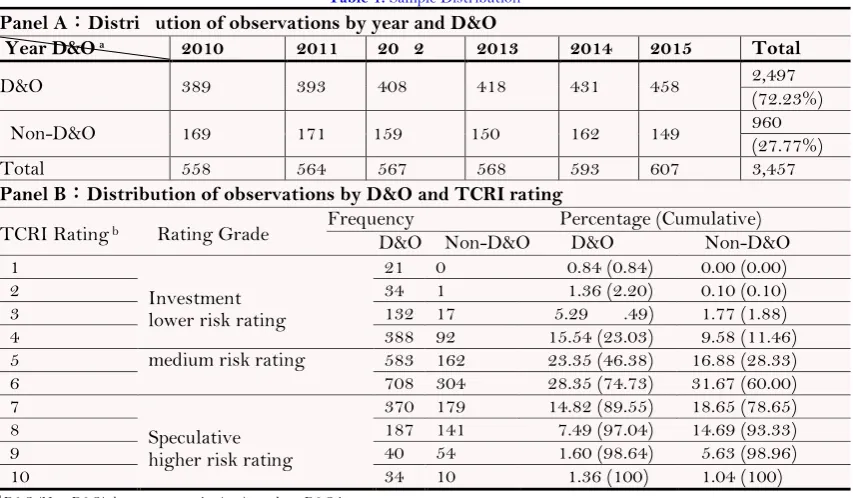
Our sample was restricted to Taiwanese listed electronic companies over the period 2010-2015 and included in the Taiwan Economic Journal (TEJ) database. This study focuses on the electronic industry because the available data on D&O insurance is limited. Information on D&O insurance, affiliated director, and financial data were obtained from the TEJ annual files. Cases that did not disclose information related to D&O insurance or financial data were excluded. Table 1 reports the sample distribution. Panel A shows there are 72.23% of electronic observations with D&O insurance. This highest percentage of D&O insurance purchasing seems to imply the importance of D&O insurance. Panel B shows that the non-D&O subsample has a median credit rating of 6, with 11.46 percent in the investment grade rating. Additionally, the D&O subsample has a median credit rating of 5, with 23.03 percent in the investment grade rating; moreover, this percentage is a more-than-double increase than the non-D&O subsample. Overall, the average credit rating in the non-D&O subsample seems to be somewhat inferior to that in the D&O subsample.
Table 1. Sample Distribution Panel A:Distri ution of observations by year and D&O
Year D&O a 2010 2011 20 2 2013 2014 2015 Total
D&O 389 393 408 418 431 458 2,497 (72.23%)
Non-D&O 169 171 159 150 162 149 960 (27.77%)
Total 558 564 567 568 593 607 3,457
Panel B:Distribution of observations by D&O and TCRI rating
TCRI Rating b Rating Grade Frequency Percentage (Cumulative)
D&O Non-D&O D&O Non-D&O 1
Investment lower risk rating
21 0 0.84 (0.84) 0.00 (0.00)
2 34 1 1.36 (2.20) 0.10 (0.10)
3 132 17 5.29 .49) 1.77 (1.88)
4 388 92 15.54 (23.03) 9.58 (11.46)
5 medium risk rating 583 162 23.35 (46.38) 16.88 (28.33)
6 708 304 28.35 (74.73) 31.67 (60.00)
7
Speculative higher risk rating
370 179 14.82 (89.55) 18.65 (78.65)
8 187 141 7.49 (97.04) 14.69 (93.33)
9 40 54 1.60 (98.64) 5.63 (98.96)
10 34 10 1.36 (100) 1.04 (100)
a D&O (Non-D&O) denotes companies (not) purchase D&O insurance.
b Taiwan Corporate Credit Rating Index (TCRI), where the credit rating is divided into ten degrees, with the highest degree representing the highest credit risk.
Model Specification-Credit Rating vs. D&O Insurance
To examine the effects of affiliated directors on credit ratings, the research model (1) was constructed. Further, the research model (2) was constructed to examine whether the association between credit ratings and affiliated directors are affected by the function of D&O insurance. Since the TCRI rating is in ordinal scale, research models (1) and (2) are the ordered probit model. Research models (1) and (2) are as follows:2
)
1
(
, , , , 8 , 7 , 6 , 5 , 4 , 3 , 2 , 1 0 , t i t i t i t i t i t i t i t i t i t i t i t iYEAR
LE
SIZEQUINTI
ZSCORE
OCF
DE
MB
GROWTH
ROA
LOSS
AFF
TCRI
)
2
(
&
&
, , , , 10 , 9 , 8 , 7 , 6 , 5 , 4 , 3 , 2 , 1 0 , t i t i t i t i t i t i t i t i t i t i t i t i t i t iYEAR
LE
SIZEQUINTI
ZSCORE
OCF
DE
MB
GROWTH
ROA
LOSS
O
D
AFF
O
D
AFF
TCRI
whereTCRIi,t = Taiwan Corporate Credit Rating Index (TCRI), where the credit
rating is divided into ten degrees, with the highest degree representing the highest credit risk;
AFFi,t = the number of affiliated directors divided by board size;
D&Oi,t = 1 if the company purchases the D&O insurance, and 0 otherwise;
AFF×D&Oi,t = this interaction is the AFF and D&O;
LOSSi,t = 1 if operating income is less than zero, otherwise 0;
ROAi,t = net income divided by total assets;
GROWTHi,t = the percentage increase in sales over one year;
MBi,t = market value of equity divided by book value of equity;
DEi,t = total debt divided by total assets;
OCFi,t = cash flow from operations divided by total assets;
ZSCOREi,t = the risk of financial distress from the Altman (1968)
z-score model;3
SIZEQUINTILEi,t = dummy variables controlling for size based on total assets;
YEARi,t = dummy variables controlling for years;
ε = the residual term.
The dependent variable, TCRI, is the TCRI ratings to capture credit risk (Gul and Goodwin, 2010; DeFond et
al., 2011). The test variable, AFF, is the level of affiliated directors, measured as the number of affiliated directors
divided by board size. In model (1), the coefficient on AFF is expected to be positive, implying that credit raters give unfavorable ratings to companies with weaker corporate governance. The test variable, D&O, is an indicator variable equals to 1 if the company purchases the D&O insurance, and 0 otherwise. In model (2), the coefficient on
D&O is expected to be negative, implying that credit raters give favorable ratings to companies with D&O insurance when their perceived risk is affected by the function of D&O insurance. Meanwhile, by examining the significance of the coefficient of AFF×D&O, this study can shed light on the association between the function of D&O insurance in mitigating the effects of affiliated directors and credit rating. Following prior research (Jorion et al., 2009; Li et al., 2010; Chandra, 2011; Bentley et al., 2013; Kaplan and Williams, 2013) control variables include major determinants affecting credit raters’ decisions. This study predicts the coefficients of ROA, GROWTH, MB, OCF
and ZSCORE (or LOSS, DE) to be negative (or positive) because profitable (or unprofitable) companies are less (or more) likely to receive unfavorable ratings. SIZEQUINTILEand YEAR are controlling for the effects of company size and year.
3. RESULTS AND ANALYSIS
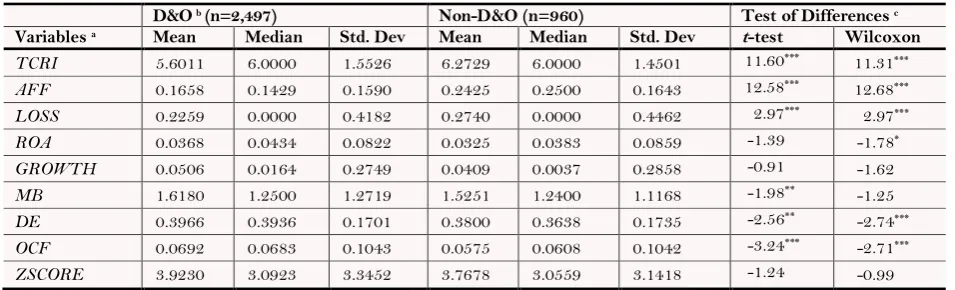
Table 2 presents the descriptive statistics for dependent variable, test variables, and all control variables used in this study, partitioned into D&O (n=2,497)and non-D&O (n=960) subsamples. The results show that the mean (median) values of TCRI (credit ratings) and AFF (the ratio of affiliated directors) reported in the non-D&O subsample is larger than those reported in the D&O subsample at least at the 0.01 level for both tests. These results indicate that companies without the D&O insurance are more likely to receive unfavorable ratings; moreover, such companies are more likely to appoint affiliated directors.
Table-2. Descriptive Statistics
D&O b (n=2,497) Non-D&O (n=960) Test of Differences c
Variables a Mean Median Std. Dev Mean Median Std. Dev t-test Wilcoxon
TCRI 5.6011 6.0000 1.5526 6.2729 6.0000 1.4501 11.60*** 11.31*** AFF 0.1658 0.1429 0.1590 0.2425 0.2500 0.1643 12.58*** 12.68*** LOSS 0.2259 0.0000 0.4182 0.2740 0.0000 0.4462 2.97*** 2.97*** ROA 0.0368 0.0434 0.0822 0.0325 0.0383 0.0859 -1.39 -1.78* GROWTH 0.0506 0.0164 0.2749 0.0409 0.0037 0.2858 -0.91 -1.62 MB 1.6180 1.2500 1.2719 1.5251 1.2400 1.1168 -1.98**
-1.25 DE 0.3966 0.3936 0.1701 0.3800 0.3638 0.1735 -2.56** -2.74*** OCF 0.0692 0.0683 0.1043 0.0575 0.0608 0.1042 -3.24*** -2.71*** ZSCORE 3.9230 3.0923 3.3452 3.7678 3.0559 3.1418 -1.24 -0.99 a The definitions of the variables reported in this table are: TCRI = Taiwan Corporate Credit Rating Index (TCRI), where the credit rating is divided into ten degrees, with the highest degree representing the highest credit risk; AFF = the number of affiliated directors divided by board size; LOSS = 1 if operating income is less than zero, otherwise 0; ROA = net income divided by total assets; GROWTH = the percentage increase in sales over one year; MB = market value of equity divided by book value of equity; DE = total debt divided by total assets; OCF = cash flow from operations divided by total assets; ZSCORE = the risk of financial distress from the Altman (1968) z-score model. All continues variables are winsorized at the first and 99th percentiles.
b D&O (Non-D&O) denotes companies (not) purchase D&O insurance.
c Asterisks *, **, *** indicate significance at the 0.10, 0.05, and 0.01 levels, respectively.
3Altman (1968) Z-score is defined as Z-score = 1.2w1+ 1.4w2 + 3.3w3 + 0.6w4 + 1.0w5, where w1 = working capital divided by total assets, w2 = retained earnings
divided by total assets, w3 = earnings before interest and taxes divided by total assets, w4 = market value of equity divided by book value of total debt, and w5 =
Table 3 reports the Pearson and Spearman correlations for dependent variable, test variables, and all control variables to be used in the ordered probit models (1) and (2). As depicted in this Table, most explanatory variables are not significantly correlated with each other. The results show that TCRI is positively correlated with AFF, statistically significant at the 0.05 level, implying that credit raters seem to be more concerned about the role of affiliated directors in corporate government, and then assign unfavorable ratings to companies with higher ratio of affiliated directors. Overall, the correlations between control variables are mostly not very high, except for some variables. This study further computed variance inflation factors (VIF) for research models (1) and (2), wherein the largest VIF was 3.53 and the mean VIF was 2.06, which is well below the 10 threshold of concern recommended by
Kennedy (1998). Thus, empirical results were not affected by multicollinearity.
Table-3. Correlation Matrix a
Variableb 1 2 3 4 5 6 7 8 9
1.TCRI 0.0908 0.4959 -0.5818 -0.1987 -0.2652 0.1053 -0.4683 -0.4167 2. AFF 0.0820 0.0498 -0.0427 -0.0230 -0.1199 0.0293 -0.0214 -0.0977 3. LOSS 0.4842 0.0477 -0.7389 -0.3391 -0.3078 0.0598 -0.4207 -0.4125 4. ROA -0.5535 -0.0070 -0.7379 0.4217 0.5835 -0.1947 0.5992 0.6141 5. GROWTH -0.1387 -0.0249 -0.2823 0.3767 0.3757 0.1089 0.1732 0.1917 6. MB -0.1520 -0.0706 -0.1586 0.3347 0.2646 -0.0566 0.3227 0.5413 7. DE 0.1456 0.0241 0.0657 -0.1840 0.0934 0.0204 -0.2020 -0.6384 8. OCF -0.4474 0.0026 -0.3817 0.5844 0.1474 0.2292 -0.1985 0.3640 9. ZSCORE -0.2595 -0.0971 -0.2458 0.4334 0.1050 0.4273 -0.5965 0.2901
a Pearson correlations in the lower diagonal and Spearman correlations in the upper diagonal. Bold text indicates 5% statistical significance.
b The definitions of the variables reported in this table are: TCRI = Taiwan Corporate Credit Rating Index (TCRI), where the credit rating is divided into ten degrees, with the highest degree representing the highest credit risk; AFF = the number of affiliated directors divided by board size; LOSS = 1 if operating income is less than zero, otherwise 0; ROA = net income divided by total assets; GROWTH = the percentage increase in sales over one year; MB = market value of equity divided by book value of equity; DE = total debt divided by total assets; OCF = cash flow from operations divided by total assets; ZSCORE = the risk of financial distress from the Altman (1968) z-score model. All continues variables are winsorized at the first and 99th percentiles.
Table-4. Credit Rating and D&O Insurance
(1) (2)
Variables a Pred. Sign Coef. z-value b Coef. z-value
AFF + 0.2147 1.91** 0.4364 2.20**
D&O - -0.1330 -2.10**
AFF × D&O ? -0.4815 -2.03**
LOSS + 0.4830 7.02*** 0.4760 6.93***
ROA - -5.6875 -10.58*** -5.8514 -10.86***
GROWTH - 0.3144 3.85*** 0.3137 3.84***
MB - -0.0867 -3.26*** -0.0817 -3.05***
DE + 2.5175 14.46*** 2.5372 14.65***
OCF - -1.1336 -4.54*** -1.1168 -4.50***
ZSCORE - -0.0021 -0.21 -0.0003 -0.03
SIZEQUINTILE Included Included
YEAR Included Included
Pseudo R2 26.95% 27.23%
N 3,457 3,457
a The definitions of the variables reported in this table are: TCRI = Taiwan Corporate Credit Rating Index (TCRI), where the credit rating is divided into ten degrees, with the highest degree representing the highest credit risk; AFF = the number of affiliated directors divided by board size; D&O = 1 if the company purchases the D&O insurance, and 0 otherwise; AFF × D&O = this interaction is the AFF and D&O; LOSS = 1 if operating income is less than zero, otherwise 0;
ROA = net income divided by total assets; GROWTH = the percentage increase in sales over one year; MB = market value of equity divided by book value of equity;
DE = total debt divided by total assets; OCF = cash flow from operations divided by total assets; ZSCORE = the risk of financial distress from the (Altman, 1968) z-score model. All continues variables are winsorized at the first and 99th percentiles.
b Asterisks *, **, *** indicate significance at the 0.10, 0.05, and 0.01 levels, respectively. One-tailed for directional expectations, two-tailed for others.
function of D&O insurance affects the association between credit raters (credit ratings) and weak corporate government (affiliated directors). Column (2) of Table 4 reports the estimated results from the ordered probit model in Equation (2). In Column (2), the coefficient of AFF is significant and positive (at the 5% significance level), whereas the coefficients of D&O and AFF × D&O aresignificant and negative (both at the 5% significance level). These results imply that credit raters perceive the role of D&O insurance as a credit risk-decreasing factor in mitigating the effects of affiliated directors and thus are more likely to assign favorable ratings to companies with high ratio of affiliated directors when these companies have purchased the D&O insurance.
3.1. Further Analysis: Life-Cycle Stage
Credit risk is close related to companies’ cycle stage, and firm’s credit risk taking varies across firm’s life-cycle. For example, growth companies may have high credit risk than those companies in the maturity or decline stage because such companies are commonly regarded as risk-taking. Thus, this study includes life-cycle effects into account and employs the methods of Anthony and Ramesh (1992) for the classification of a firm according to life-cycle. In Column (1) of Table 5, the coefficient on the test variable AFF × D&O was -1.3287, which is significant at the 1% level (z = -3.13), whereas the coefficient of AFF × D&O in Columns (2) and (3) of Table 5 isinsignificant. Notably, AFF × D&O is significant only in growth companies. These results imply that credit raters not only considered the role of D&O insurance in corporate government to make rating decisions, but their ratings are also affected by different life-cycle stages.
Table-5. Credit Rating and D&O Insurance: Life-Cycle Effect
(1) Growth a (2) Maturity (3) Decline
Variables b Pred. Sign Coef. z-value c Coef. z-value Coef. z-value
AFF + 0.7594 2.04** 0.2183 0.80 0.7304 1.39*
D&O - 0.1987 1.80** -0.4526 -5.09*** -0.0497 -0.21 AFF × D&O ? -1.3287 -3.13*** 0.3226 0.98 -1.1310 -1.43 LOSS 0.3492 3.34*** 0.5909 5.88*** 0.4038 1.58*
ROA - -7.2602 -9.59*** -5.0105 -6.25*** -4.3704 -2.42***
GROWTH - 0.4891 3.71*** 0.0817 0.70 0.6245 2.06**
MB - -0.1070 -3.38*** -0.0446 -0.98 -0.2269 -2.46***
DE + 2.9281 10.11*** 2.3934 10.29*** 2.6444 4.55***
OCF - -0.8301 -2.28** -1.6863 -4.60*** -1.6822 -2.06**
ZSCORE - 0.0407 2.93*** -0.0234 -1.51* -0.0471 -1.61* SIZEQUINTILE Included Includ d Included
YEAR Included Included Included
Pseudo R2 26.85% 29.69% 26.98%
N 1,366 1,812 279
a Growth denotes companies in the growth stage of life cycle; Maturity denotes companies in the maturity stage of life cycle; Decline denotes companies in the decline stage of life cycle.
b The definitions of the variables reported in this table are: TCRI = Taiwan Corporate Credit Rating Index (TCRI), where the credit rating is divided into ten degrees, with the highest degree representing the highest credit risk; AFF = the number of affiliated directors divided by board size; D&O = 1 if the company purchases the D&O insurance, and 0 otherwise; AFF × D&O = this interaction is the AFF and D&O; LOSS = 1 if operating income is less than zero, otherwise 0;
ROA = net income divided by total assets; GROWTH = the percentage increase in sales over one year; MB = market value of equity divided by book value of equity;
DE = total debt divided by total assets; OCF = cash flow from operations divided by total assets; ZSCORE = the risk of financial distress from the Altman (1968) z-score model. All continues variables are winsorized at the first and 99th percentiles.
c Asterisks *, **, *** indicate significance at the 0.10, 0.05, and 0.01 levels, respectively. One-tailed for directional expectations, two-tailed for others.
3.2. Further Analysis: Industry Supply Chain
insignificant. Notably, AFF × D&O is significant only in middle-stream companies. These results imply that rating decisions are affected by effects of different supply chain stages.
Table-6.Credit Rating and D&O Insurance: Supply Chain Effect
(1) Up-stream a (2) Middle-stream (3) Down-stream
Variables b Pred. Sign Coef. z-value c Coef. z-value Coef. z-value
AFF + 1.0020 2.43*** 0.0947 0.15 0.6480 1.91**
D&O - -0.1200 -0.89 0.1423 0.56 -0.1153 -0.95
AFF × D&O ? -0.1904 -0.35 -1.3771 -1.93* -0.4624 -1.10 LOSS + 0.3956 1.98** 0.2324 1.14 0.543 4.17***
ROA - -5.9491 -4.22*** -7.4895 -3.98*** -4.1258 -3.88***
GROWTH - -0.0170 -0.08 0.3792 1.46* 0.05 3 0.30
MB - 0.0711 0.84 -0.1172 -1.35* -0.0182 -0.44
DE + 3.2013 7.44*** 2.4113 4.84*** 1.6901 5.14***
OCF - -2.2413 -2.92*** -1.0772 -1.55* -1 9970 -3.95***
ZSCORE - 0.0224 0.83 -0.0513 -1.51* -0.1150 -3.77*** SIZEQUINTILE Included Included Include
YEAR Included Included Included
Pseudo R2 36.09% 25.73% 29.04%
N 616 449 947
a Up-stream denotes companies in the up-stream of supply chain; Middle-stream denotes companies in the middle-stream of supply chain; Down-stream denotes companies in the down-stream of supply chain.
b The definitions of the variables reported in this table are: TCRI = Taiwan Corporate Credit Rating Index (TCRI), where the credit rating is divided into ten degrees, with the highest degree representing the highest credit risk; AFF = the number of affiliated directors divided by board size; D&O = 1 if the company purchases the D&O insurance, and 0 otherwise; AFF × D&O = this interaction is the AFF and D&O; LOSS = 1 if operating income is less than zero, otherwise 0;
ROA = net income divided by total assets; GROWTH = the percentage increase in sales over one year; MB = market value of equity divided by book value of equity;
DE = total debt divided by total assets; OCF = cash flow from operations divided by total assets; ZSCORE = the risk of financial distress from the Altman (1968) z-score model. All continues variables are winsorized at the first and 99th percentiles.
c Asterisks *, **, *** indicate significance at the 0.10, 0.05, and 0.01 levels, respectively. One-tailed for directional expectations, two-tailed for others.
Table-7. Credit Rating and D&O Insurance: CEO-Duality Effect
(1) Duality a (2) Non-Duality
Variables b Pred. Sign Coef. z-value c Coef. z-value
AFF + 0.6532 2.52*** 0.2042 0.66
D&O - -0.1972 -2.11** -0.0831 -0.91 AFF × D&O ? -0.6663 -1.97** -0.2337 -0.66 LOSS + 0.4909 5.14*** 0.4536 4.53***
ROA - -4.9828 -6.78*** -6.9213 -8.33***
GROWTH - 0.2529 2.18** 0.3923 3.35***
MB - -0.0772 -2.38*** -0.0706 -1.73**
DE + 2.5226 9.73*** 2. 726 11.08***
OCF - -1.3476 -3.55*** -0.9209 -2.74***
ZSCORE - -0.0177 -1.22 0.0133 0.91
SIZEQUINTILE Included Included
YEAR Included Included
Pseudo R2 24.08% 30.05%
N 1,514 1,943
a Duality (Non-Duality) denotes CEO-duality (Non-CEO Duality) companies.
b The definitions of the variables reported in this table are: TCRI = Taiwan Corporate Credit Rating Index (TCRI), where the credit rating is divided into ten degrees, with the highest degree representing the highest credit risk; AFF = the number of affiliated directors divided by board size; D&O = 1 if the company purchases the D&O insurance, and 0 otherwise; AFF × D&O = this interaction is the AFF and D&O; LOSS = 1 if operating income is less than zero, otherwise 0;
ROA = net income divided by total assets; GROWTH = the percentage increase in sales over one year; MB = market value of equity divided by book value of equity; DE = total debt divided by total assets; OCF = cash flow from operations divided by total assets; ZSCORE = the risk of financial distress from the Altman (1968) z-score model. All continues variables are winsorized at the first and 99th percentiles.
c Asterisks *, **, *** indicate significance at the 0.10, 0.05, and 0.01 levels, respectively. One-tailed for directional expectations, two-tailed for others.
3.3. Further Analysis: CEO-Duality Effect
commonly regarded as weak corporate government, when compared to Non-CEO-duality companies. Thus, this study includes the CEO-duality effect to examine how the impact of D&O insurance affects the association between rating decisions and affiliated corporate government. In Column (1) of Table 7, the coefficient on the test variable
AFF × D&O was -0.6663, which is significant at the 5% level (z = -1.97), whereas the coefficient of AFF × D&O in Column (2) of Table 5 isinsignificant. Notably, AFF × D&O is significant only in CEO-duality companies. These results imply that credit raters view CEO-duality leadership as the factor in decreasing the function of corporate government; however, credit raters are more likely to assign favorable ratings to CEO-duality companies with higher ratio of affiliated directors when such companies purchase the D&O insurance.
4. CONCLUSIONS
This study provides empirical evidence regarding the association between rating decisions and corporate government situations; moreover, this study further examines effects of D&O insurance on previously association. Overall, evidence shows that companies with high ratio of affiliated directors are more likely to receive unfavorable ratings from credit raters; however, credit raters are more likely to assign favorable ratings to companies with high ratio of affiliated directors when such companies purchase the D&O insurance. These results imply that credit raters view the function of D&O insurance as a corporate governance mechanism in monitoring and improving the efficiency of the board. Empirical results also show that the above-mentioned association varies across firm’s life-cycle, supply chain, and CEO-duality leadership.
Funding: This study received no specific financial support.
Competing Interests: The author declares that there are no conflicts of interests regarding the publication of this paper.
REFERENCES
Alissa, W., I.S.B. Bonsall, K. Koharki and J.M.W. Penn, 2013. Firms’ use of accounting discretion to influence their credit ratings. Journal of Accounting & Economics, 55(2-3): 129-147.View at Google Scholar | View at Publisher
Alp, A., 2013. Structural shifts in credit rating standards. Journal of Finance, 68(6): 2435-2470.View at Google Scholar | View at Publisher
Altman, E.I., 1968. Discriminant analysis and the prediction of corporate bankruptcy. Journal of Finance, 23(4): 586-609. View at
Google Scholar | View at Publisher
Anthony, J.H. and K. Ramesh, 1992. Association between accounting performance measures and stock prices: A test of the life cycle hypothesis. Journal of Accounting & Economics, 15(2-3): 203- 227.View at Google Scholar | View at Publisher
Beaver, W., M. Correia and M. McNichols, 2012. Do differences in financial reporting attributes impair the predictive ability of financial ratios for bankruptcy? Review of Accounting Studies, 17(4): 969-1010.View at Google Scholar | View at Publisher
Bentley, K.A., T.C. Omer and N.Y. Sharp, 2013. Business strategy, financial reporting irregularities, and audit effort. Contemporary Accounting Research, 30(2): 780-817.
Boyer, M.M., 2014. Directors’ and officers’ insurance and shareholder protection. Journal of Financial Perspectives, 2(1): 1 -27. View at Google Scholar
Boyer, M.M. and S.L. Tennyson, 2016. Directors’ and officers’ liability insurance, corporate risk and risk taking: New panel data evidence on the role of directors’ and officers’ liability insurance. Journal of Risk & Insurance, 82(4): 753-791.
Bruno, V., J. Cornaggia and K.J. Cornaggia, 2016. Does regulatory certification affect the information content of credit ratings? Management Science, 62(6): 1578-1597.View at Publisher
Cao, Z. and G.S. Narayanamoorthy, 2014. Accounting and litigation risk: Evidence from directors’ and officers’ insurance pricing. Review of Accounting Studies 19(1): 1-42.View at Google Scholar | View at Publisher
Chandra, U., 2011. Income conservatism in the U.S. technology sector. Accounting Horizons, 25(2): 285-314. View at Google Scholar |
Cheng, M. and M. Neamtiu, 2009. An empirical analysis of changes in credit rating properties: Timeliness, accuracy and volatility. Journal of Accounting & Economics, 47(1-2): 108-130.View at Google Scholar | View at Publisher
DeFond, M.L., M. Hung, E. Carr and J. Zhang, 2011. Was the Sarbanes-Oxley act good news for corporate bondholders? Accounting Horizons, 25(3): 465-485.View at Google Scholar | View at Publisher
Gul, F.A. and J. Goodwin, 2010. Short-term debt maturity structures, credit ratings, and the pricing of audit services. Accounting Review, 85(3): 877-909.View at Google Scholar | View at Publisher
Hribar, P. and N.T. Jenkins, 2004. The effect of accounting restatements on earnings revisions and estimated cost of capital. Review of Accounting Studies, 9(2-3): 337-356.View at Google Scholar | View at Publisher
Jorion, P., C. Shi and S. Zhang, 2009. Tightening credit standards: The role of accounting quality. Journal Review of Accounting Studies, 14(1): 123-160.View at Google Scholar | View at Publisher
Kaplan, S.E. and D.D. Williams, 2013. Do going concern audit reports protect auditors from litigation? A simultaneous equations approach. Accounting Review, 88(1): 199-232.View at Publisher
Kennedy, P., 1998. A guide to econometrics. 4th Edn., Cambridge, MA: The MIT Press.
Kuang, Y.F. and B. Qin, 2013. Credit ratings and CEO risk-taking incentives. Contemporary Accounting Research, 30(4): 1524-1559.View at Google Scholar | View at Publisher
Li, C., Y. Xie and J. Zhou, 2010. National level, city level auditor industry specialization and cost of debt. Accounting Horizons, 24(3): 395-417.View at Google Scholar | View at Publisher
Lin, M.F., C.L. Chin and L.F. Lin, 2009. Ownership structures, accounting conservatism and firm’s credit ratings. NTU Management Review, 20(1): 289-329.View at Google Scholar
Woo, S., C.S. Rhee and S. Woo, 2015. The effect of directors and officers liability insurance on audit effort. Journal of Applied Business Research, 31(6): 2039-2046.View at Google Scholar | View at Publisher
Zou, H., W. Sonia, C. Shum and J. Xiong, 2008. Controlling-minority shareholder incentive conflicts and directors’ and officers’ liability insurance: Evidence from China. Journal of Banking & Finance, 32(12): 2636-2645. View at Google Scholar | View at
Publisher