S O C I A L L E A R N I N G
Learning and
Predicting the
Evolution of Social
Networks
Björn Bringmann, Katholieke Universiteit Leuven Michele Berlingerio, ISTI-CNR
Francesco Bonchi and Aristides Gionis, Yahoo Research
Graph Evolution
Rules help in
analyzing the
evolution of large
networks and can be
used to predict the
future creation of
links among nodes.
networks follow power-law degree distri-bution,2 have a small diameter, and ex-hibit small-world structure3 and community structure.4 Attempts to explain the proper-ties of social networks have led to dynamic models inspired by the preferential
attach-ment model,5 which assumes that new
net-work nodes have a higher probability of forming links with high-degree nodes, cre-ating a “rich-get-richer” effect.
Recently several researchers have turned their attention to the evolution of social net-works at a global scale. For example, Jure Leskovec and his colleagues empirically ob-served that networks become denser over time, in the sense that the number of edges grows superlinearly with the number of nodes.6 Moreover, this densification follows a power-law pattern. They reported that the network diameter often shrinks over time, in contrast to the conventional wisdom that
such distance measures should increase slowly as a function of the number of nodes.
Although some effort has been devoted to analyzing global properties of social net-work evolution, not much has been done to study graph evolution at a microscopic level. A first step in this direction investigated a variety of network formation strategies,7 showing that edge locality plays a critical role in network evolution.
We propose a different approach. Follow-ing the paradigm of association rules and frequent-pattern mining, our work searches for typical patterns of structural changes in dynamic networks. Mining for such lo-cal patterns is a computationally challeng-ing task that can provide further insight into the increasing amount of evolving network data. Beyond the notion of graph evolution
rules (GERs), a concept that we introduced
in an earlier work,8 we developed the Graph
W
ith the increasing availability of large social network data, there is
also an increasing interest in analyzing how those networks evolve
over time.
1Traditionally, the analysis of social networks has focused only on
a single snapshot of a network. Researchers have already verified that social
ware to extract such rules and ap-plied these rules to predict future net-work evolution.9,10
The merits of our approach go be-yond descriptive analysis. In many cases, frequent patterns are used as basic blocks to build more complex data-mining solutions. Our frame-work can help predict edges among old and new nodes and predict when a new edge is expected to appear. Even when comparing directly with the classic link-prediction problem,9 we show that simple scores based on our evolution rules represent impor-tant features providing good predic-tion performances.
Rules of Graph Evolution
We use the term G! (V, E, l) to de-note a graph G over a set of nodes V
and edges E " V #V. The function l: V$E ֏% is an assignment from graph nodes and edges to labels from an alphabet %. Those labels repre-sent properties, and for simplicity, we assume that they do not change over time. For example, in a social network nodes are users (with prop-erties such as gender, country, and college), while edge labels might rep-resent the type of link (such as friends or family).
We conceptually represent the graph evolution using a series of graphs G1, &, GT, so that Gt! (Vt, Et) represents the graph at time t. Be-cause G1, &, GT represent different snapshots of the same graph, we have
Vt"V and Et"E. For simplicity, we assume that nodes and edges are only added and never deleted as the graph evolves—that is, V1"V2"&VT and
E1 " E2" & ET. Our mining algo-rithm represents the data set by sim-ply collapsing all the snapshots G1, &,
GT in a graph G, in which edges are time-stamped with their first appear-ance. Thus, we have G! (V, E) with
We assign a time stamp t(e) ! min{j'e(
Ej} to each edge e ! {u, v}. Overall, a time-evolving graph is described as G ! (V, E, t, l), with t assigning time stamps to the edges. (The num-ber of edge deletions in social net-works is small enough to be negli-gible when analyzing the networks’ temporal evolution. However, in our framework, we also can handle dele-tions by slightly changing the match-ing operator.8)
Consider a time-evolving graph G. Intuitively, a pattern P of G is a sub-graph of G that in addition to match-ing edges of G also matches node and edge labels and edge time stamps.
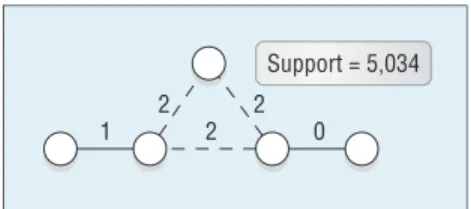
Now consider the pattern shown in Figure 1 extracted from the Digi-tal Bibliography and Library Project (DBLP) coauthorship network (http:// dblp.uni-trier.de), where nodes repre-sent authors and edges between nodes represent coauthorship. Arguably, the essence of the pattern in Figure 1 is that two distinct pairs of connected authors—one collaboration created at time 0 and one at time 1—are later (at time 2) connected by a collabora-tion involving one author from each pair, plus a third author. We want to account for an occurrence of that event even if it was taking place at times, say, 16, 17, and 18.
These considerations lead to the fol-lowing definition: Let G! (V, E, t, l) and P ! (VP, EP, tP, lP) be graphs, where G is the time-evolving input graph and P is a pattern. We assume that P is connected. We say that P oc-curs in G if there exists a )∈R and a function j : VP ֏ V mapping the nodes of P to the nodes in G so that the following conditions hold:
1. If (u, v) is an edge in EP, then (j(u), (j(v)) is an edge in E and lP(u) ! l(j(u)), lP(v) ! l(j(v)), and lP((u, v)) !l((j(u), j(v))). In
other words, an edge in the pat-tern graph is an edge in the host graph and all labels are matching. 2. If (u, v) is an edge in EP, then
t(j(u), j(v)) !t(u, v) *). That is, the time stamps on the edges are matched, possibly with a ) offset. With this definition, we obtain equiv-alence classes of structurally isomor-phic patterns that differ only by a constant on the time stamp of their edges. To avoid redundancies in the search space, we only pick one repre-sentative for each equivalence class; the one where the lowest time stamp is zero.
Mining Graph Evolution Rules
Following the association-rule-mining paradigm, we next have to define concepts of support and confidence. Frequent-pattern mining algorithms are based on the notion of support. The support s(P, D) of a pattern P
in a data set D is the number of oc-currences of P in D. In the classical graph-mining setting where D is a set of graphs (such as molecules), the support is easily defined as the num-ber of these graphs for which P is a subgraph. Various algorithms dealing with this setting exist; gSpan is one of the most efficient.11 However, in our case, the definition of support is more complex because we must compute the support in a unique time-evolving input graph G.
The most important property of a definition of support is
antimonoto-nicity, which is the basis of the
Apri-ori algApri-orithm. This property states
Figure 1. Relative time patterns. We extracted these patterns from the Digital Bibliography and Library Project (DBLP) coauthorship network.
S O C I A L L E A R N I N G
that a pattern’s support should be at least as large as the support of all its super-patterns. The main idea is that whenever a pattern’s support violates the frequency constraint, all its super- patterns can be pruned because they will also violate the minimum frequency constraint. Without antimonotonic-ity, frequent-pattern mining is essen-tially infeasible.
For our application of mining rules of evolving networks, we employ the minimum image-based support mea-sure,12 which is antimonotone and deals with the case of counting pat-tern occurrences in a single graph, as opposed to other measures that count occurrences in multiple graphs.
To characterize network evolution using frequent patterns, we need to decompose a pattern into the par-ticular sequence of steps and subse-quently determine each step’s confi-dence. Each step can be considered as a rule body + head, with both body and head being patterns. Given
a frequent pattern head PH, the corresponding body PB is uniquely defined as EB e EH t e t e e E H = ∈ < ∗ ∈ { | ( ) max ( ( ))}∗ and VB={v∈VH|deg( ,v EB)>0}
where deg(v, EB) denotes the degree of v with respect to the edges in EB. Moreover, we constrain PB to be con-nected. The support of a GER is the support of its head. Finally, following the association rules framework, we define a rule’s confidence as the ratio of the support of the rule’s head and body. (This definition yields a unique body for each head and therefore a unique confidence value for each head. This lets us represent the rules by the head only, as in Figure 1. This definition disallows disconnected graphs as body due to the lack of a support definition for disconnected graphs. As a consequence, not all fre-quent patterns can be decomposed into GERs.)
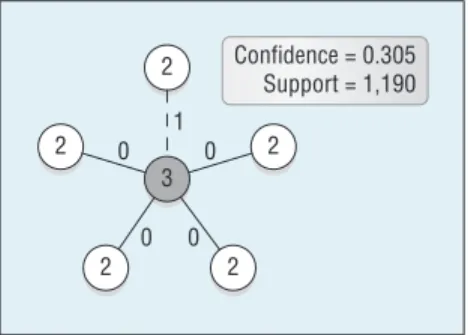
Figure 2 shows an example of a real GER extracted from the DBLP. The node labels represent the class of the node’s degree—that is, a node la-beled with a large number is a node with high degree. In this example, la-bel 3 indicates nodes with a degree larger than 50. Additionally, edge
labels capture the time information and represent the (relative) year in which the first collaboration between two authors was established. Intui-tively, the rule in Figure 2 might be read as a local evidence of preferential attach ment: a large-degree node (la-bel 3), which at time t is connected to four medium-degree nodes (label 2), at time t* 1 will be connected to a fifth node. The collaboration-rich researcher gets richer.
We developed a tool for mining rules of graph evolution using the al-gorithms we’ve just described. Our GERM tool is an adaptation of an earlier algorithm,12 which is in turn an adaptation of gSpan.11 (GERM’s executable code is freely available at http://www-kdd.isti.cnr.it/GERM.) Thus, GERM, like gSpan, is based on a depth-first search (DFS) traversal of the search space, which leads to low memory requirements. Indeed, in all our experiments, the memory con-sumption was negligible.
Figure 3 shows the basic structure of the GERM graph miner. The most involved part of the algorithm is the support computation. The starting point of our implementation is the frequent-subgraph mining frame-work,12 in which the gSpan support calculation is replaced by the mini-mum image based support.
One of gSpan’s key elements is the use of the minimum DFS code, which is a canonical form introduced to avoid multiple generations of the same pattern. We must change this canoni-cal form to enable GERM to mine patterns with relative time. As we ex-plained previously, we only want one representative pattern per equivalence class—the one with the lowest time stamp being zero. We therefore mod-ify the canonical form such that the first edge in the canonical form is al-ways the one with the lowest time stamp.
Figure 2. A graph evolution rule (GER) extracted from the Digital Bibliography and Library Project (DBLP) coauthorship network. 3 2 Confidence = 0.305 Support = 1,190 0 0 0 0 1 2 2 2 2
Figure 3. The basic structure of the Graph Evolution Rule Miner (GERM). G is the input graph, S is the set of frequent subgraphs mined by the algorithm, and s is the current subgraph, which is added to the solution set S if its frequency s(s, G) exceeds the minimum support threshold. The algorithm’s initial call is
SubgraphMining(G, ,, e).
1: ifs- min(s) then return // using our canonical form 2: S.S$s
3: enumerate all s potential children with one edge growth as s/
4: for all enumerated s/do
5: // considering ) offset and our support definition 6: ifs(s/, G) minSupp then
When matching a pattern to the host graph, we implicitly fix a value of ), which represents the time gap between the pattern and host graph. To complete the match, all remaining edges must adhere to this value of ). If all the edges match with the ) set when matching the first edge, the pat-tern matches the host graph with that value of ).
GERM’s computational complex-ity is similar to that of gSpan in the multiple input graphs setting, since one of the factors is the total number of nodes in both cases. However, the maximum node degree d is a second factor because it increases the possi-ble combinations that have to be eval-uated for each subgraph-isomorphism test. In detail, the worst-case com-plexity for computing the support of a pattern with m nodes on a data-base with k graphs, where n is the average number of nodes among the input graphs, equals O(kndm). In traditional applications of frequent- subgraph mining in the multiple input graphs setting, such as biology and chemistry, where the graphs typically represent molecules, n is approxi-mately 30 to 40 nodes and thus sig-nificantly smaller than in a network with n 0 10,000. On the other hand,
k equals 1 in the network setting but is significantly bigger in the molecular setting (k 0 1,000), leading to roughly the same number of total nodes. However, d usually reaches much higher values in a network than the
molecular setting where the graphs are of small size and low degree. Therefore, although the worst-case complexity is the same as for gSpan, social network mining is harder in practice.
For this reason, we equip GERM with a user-defined parameter on the maximum number of edges in a pat-tern. This constraint lets us deal more efficiently with the DFS strategy by reducing the search space.8
Experimental Results
To evaluate GERM, we experimented on four real-world data sets:
• Flickr (www.flickr.com) is a pop-ular photo-sharing portal. We sampled a set of Flickr users with edges representing mutual friend-ship and time stamp the moment when the bidirectional contact is established. We generated one set of evolving graphs with monthly granularity and one with weekly granularity.
• Y360 was an online service for blogging, sharing pictures, movies, and staying in contact with friends. We sampled a set of users and pro-cessed the data, as in the Flickr data set.
• The DBLP data set is based on a re-cent snapshot of the DBLP, which has a yearly time granularity. We represented authors using verti-ces with a connecting edge if they are coauthors. Time stamps on
edges represent the year of the first co-authorship.
• arXiv (arxiv.org) is a coauthorship graph on physics publications. The graph we obtained (arxiv92-01) rep-resents coauthorships that emerged between 1992 and 2001 with yearly time granularity.
We only report some of our exper-imental results here. A more com-prehensive set of experiments, in-cluding experiments on runtime, scalability, and the influence of the parameters, is available in our pre-vious work.8
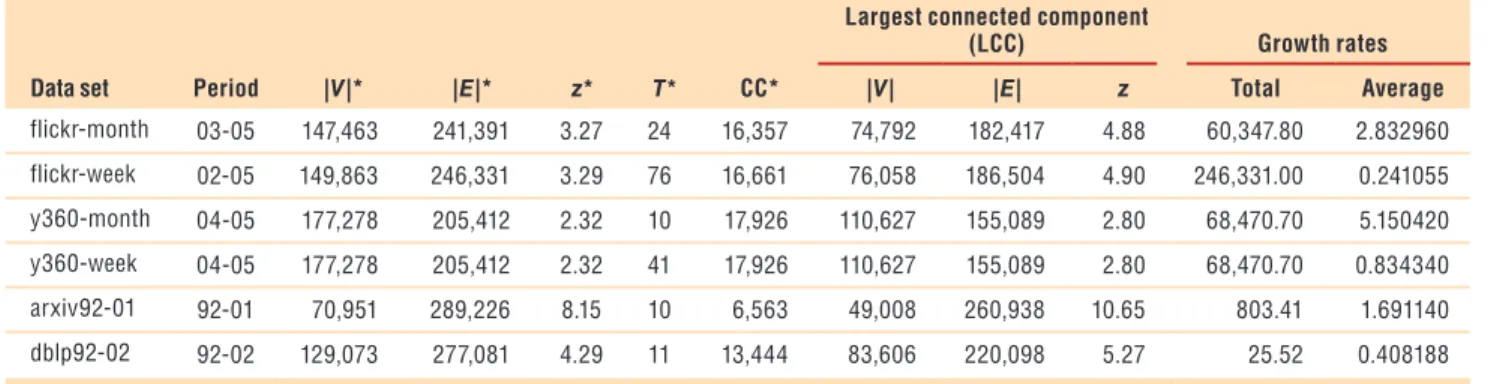
Table 1 summarizes some basic statistics of the four data sets. For each data set, we report the num-ber of nodes, the numnum-ber of edges, the average degree (z), the number of snapshots, and the number of connected components (CC) as well as the same statistics for the largest connected component (LCC). The table shows the size of the LCC and the number of connected compo-nents in all data sets. We also report
the growth rate, which we define
as the ratio of the number of edges in two different snapshots: the to-tal growth considering the last and the first snapshots and the average growth considering every two con-secutive snapshots.
Next, we considered whether the extracted patterns carry information that characterizes the analyzed net-works. We used a minimum support
Data set Period |V|* |E|* z* T* CC* |V| |E| z Total Average
flickr-month 03-05 147,463 241,391 3.27 24 16,357 74,792 182,417 4.88 60,347.80 2.832960 flickr-week 02-05 149,863 246,331 3.29 76 16,661 76,058 186,504 4.90 246,331.00 0.241055 y360-month 04-05 177,278 205,412 2.32 10 17,926 110,627 155,089 2.80 68,470.70 5.150420 y360-week 04-05 177,278 205,412 2.32 41 17,926 110,627 155,089 2.80 68,470.70 0.834340 arxiv92-01 92-01 70,951 289,226 8.15 10 6,563 49,008 260,938 10.65 803.41 1.691140 dblp92-02 92-02 129,073 277,081 4.29 11 13,444 83,606 220,098 5.27 25.52 0.408188
S O C I A L L E A R N I N G
threshold of 5,000 for all but the data sets involving weeks, for which we used a minimum threshold of 3,000. We compared all pairs of data sets
with respect to the confidence of the rules.
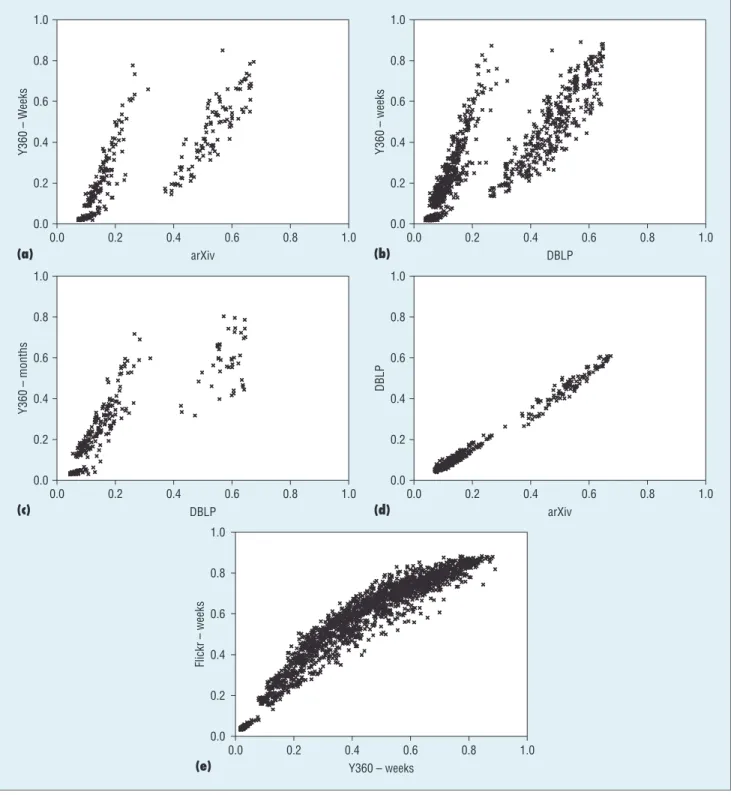
Figure 4 shows the pairwise com-parison results. From the plots, we
can see that the comparison be-tween a coauthor ship network (arXiv or DBLP) and a social network (Y360) as in Figures 4a, 4b, and 4c show
Figure 4. Comparison of graph evolution rules (GERs) confidence in different networks. (a–c) The comparison between a coauthorship network (arXiv or DBLP) and a social network (Y360) shows different confidence values of the rules for each data set. Comparing the (d) two coauthorship networks (arXiv and DBLP) or (e) two social networks (Flickr and Y360) reveals that each rule has similar confidence values in the both data sets.
0.0 0.0 0.2 0.4 0.6 arXiv (a) (b) 0.8 1.0 0.2 Y360 – W eeks 0.4 0.6 0.8 1.0 0.0 0.0 0.2 0.4 0.6 DBLP 0.8 1.0 0.2 Y360 – weeks 0.4 0.6 0.8 1.0 0.0 0.0 0.2 0.4 0.6 DBLP 0.8 1.0 0.2 Y360 – months 0.4 0.6 0.8 1.0 0.0 0.0 0.2 0.4 0.6 arXiv (c) (d) 0.8 1.0 0.2 DBLP 0.4 0.6 0.8 1.0 0.0 0.0 0.2 0.4 0.6 Y360 – weeks (e) 0.8 1.0 0.2 Flickr – weeks 0.4 0.6 0.8 1.0
ues of the rules for each data set (using Flickr in-stead of Y360 gives the same results).
In contrast, the com-parison of two coauthor-ship networks (arXiv and DBLP in Figure 4d) or two social networks (Flickr and Y360 in Figure 4e) reveals that all rules are in the proximity of the bi-sector, meaning that each
rule has similar confidence values in both data sets. We do not yet have a clear understanding of this striking behavior, but it indicates that GERs capture some aspects characteriz-ing how different types of networks evolve.
Predicting the Future
Given a pair of nodes in an evolving network, link prediction is the prob-lem of estimating the likelihood that an edge will eventually be formed be-tween these two nodes. In the con-text of a bibliographic collaboration network, link prediction estimates the likelihood that two authors will collaborate in the future. In the context of a social network such as Flickr or Facebook, it estimates the likelihood that two users will be-come friends.
David Liben-Nowell and Jon Klein-berg defined the link prediction prob-lem as follows: given a snapshot of a social network at time t and a fu-ture time t/, we can predict the new social ties that are likely to appear in the network within the time interval [t, t/].9 In their framework, Liben-Nowell and Kleinberg only consid-ered features based on the network’s link structure. For instance, they con-sidered a predictor to be the num-ber of common neighbors CN(i, j) of the two nodes i and j at time t.
Another predictor that performed well is the Adamic-Adar measure AA(i, j), which is the sum of log(d(z))11 over all common neighbors z of i and j. (Liben-Nowell and Kleinberg pro-posed other features based on the en-semble of all paths between i and j. However, even considering those more complex features, Adamic-Adar is among the top-performing predic-tors in all the networks studied.9)
We can use the rules extracted using the GERM algorithm to pre-dict edges in future instances of the network. We start with an input net-work N and a set of GERs R
ex-tracted from that network. For the sake of simplicity, we do not use all rules extracted, only the rules that have only one edge (v1, v2) of differ-ence between the head and the body. Our approach decomposes the pre-diction problem into two steps. The first step identifies all the embed-dings of the body of the rule into the network. Each embedding of a rule results in exactly one candi-date for prediction pc ! (v1, v2) be-tween nodes v1 and v2. We consider those embeddings only as candidate predictions, and we devise a set of scoring functions that let us make a more elaborate decision about those candidate predictions. Each of these prediction candidates pc might result from different rules or
the same rule. Figure 5 shows an example where the rule GER1 predicts the same edge (dashed red) twice. In fact, GER1 can be matched twice in the network, once to the upper right triangle and once to the lower left triangle, in either case with )! 5.
As a result, we know for each pc, the rule R gives rise to the prediction associated with the respective count count(pc, R)— that is, the number of times a rule can be matched—the support of the rule sup(R), and its confidence conf(R). Based on this informa-tion, we define four different scores score(pc, R) for each candidate pc and rule R:
• score1(pc, R) ! conf(R)
• score2(pc, R) ! sup(R) 2 conf(R) • score3(pc, R) ! conf(R) 2 count(pc, R) • score4(pc, R) ! sup(R) 2 conf(R) 2
count(pc, R)
To obtain one score for each pre-diction candidate, we need to ac-cumulate the scores for a particular prediction candidate given by all the rules. We decided to take the two simplest ways of accumulation: the maximum and the sum. Addition-ally, we explored a small variant that ensures that we only account for the score of the most specific rules. We call R
pc the set of all rules that yield
a candidate prediction pc, and Rpc
∗ the
subset of R
pc such that there are no
two rules R1, R2 in Rp
c
∗ with R R 1⊑ 2.
This gives us four possible ways to accumulate:
• pred1,i( )pc =
∑
R∈Rpc(scorei( , ))p Rc• pred score
2,i( ) maxpc = R∈Rpc( i( , ))p Rc Figure 5. Edge prediction using the Graph Evolution Rule Miner
(GERM) algorithm. GER1 is a graph evolution rule with two different embeddings predicting the same edge. GER2 is a rule predicting new nodes.
Body Head Body GER2 GER1 0 0 1 0 6 5 6 5 7 1 7 6 6 0 1 Head
S O C I A L L E A R N I N G
• pred1,( ) (score( , )) i pc pc p R R i c ∗ ∗ = ∈∑
R• pred2,i( ) max (score( , ))
pc pc p R R i c ∗ ∈ = R∗
Combining these with the four first scores gives us 16 different possible predictive features that we evaluated in our experiments. Since some of the features exhibit similar behavior, we only report on a subset of them in our plots.
Before discussing the details of our experiments, we need to point out an important difference. The task in the classic link-prediction setting is to predict edges appear-ing in the interval [t, t/] that have both incident nodes already part of the graph at time t. In addition, our GERs allow for predicting edges from existing nodes to new nodes
that are not yet part of the graph at time t.
Figure 5 depicts an example GER that might be used for predicting a new edge connected to a new node (GER2). The same rule might also match the additional node in the head of the rule to an already existing node in the network, thus helping predict new edges among existing nodes as in the standard Liben-Nowell and Kleinberg framework.
This is an important feature of our framework because many new nodes join the network over time. Table 2 reports some statistics on the target prediction period that we adopted for our experiments on three differ-ent data sets. In particular, the table reports the numbers of edges between two old nodes (that is, old-old nodes
that existed in the training period), one old and one new node (old-new), and two new nodes (new-new). The old-old category includes those be-ing handled by classical link predic-tion (and also by our framework), the old-new category are those cases that our framework can handle but clas-sical link prediction cannot. Neither our framework nor the classic link-prediction framework can handle the new-new category. As Table 2 shows, the old-new category represents a large fraction of the newly created edges for all data sets.
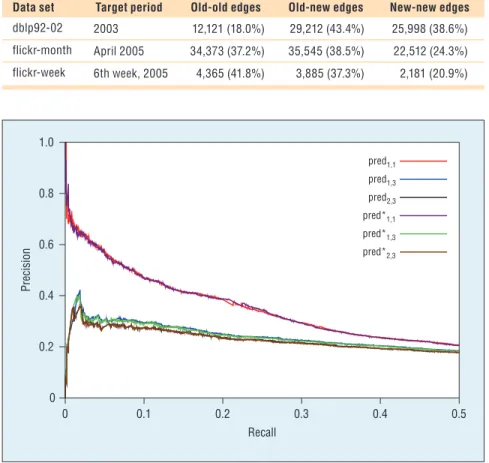
Figure 6 reports precision versus recall curves on various scores of our framework for the task of pre-dicting only old-new edges.
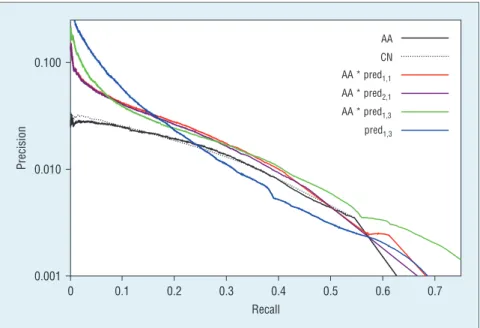
Next we report our experimen-tal evaluation in the classic link- prediction setting (predicting only old-old edges). Figures 7 and 8 report the results for week and flickr-month data sets, respectively. Both figures show precision-recall plots for various methods. In particular, we re-port CN and AA as baselines, one of our scores—namely, pred1,3, plus five combinations of our score with AA. The combination of our score predx,y with AA for an edge e is obtained by taking (predx,y(e) * 1) # (AA(e) * 1), where AA and predx,y are normalized before combining.
By comparing AA with our “pure” pred1,3 score, we can see that our method achieves a much higher pre-cision for low recall levels, but it per-forms worse than AA at higher recall levels. This observation suggests com-bining AA with our methods. Figures 7 and 8 confirm that the combination achieves the best of the two methods, outperforming each of the methods combined in the majority of cases.
From this preliminary analysis, we can conclude that our method pred1,3 is the most robust and stable among our predictors, and it should be
Table 2. Statistics on the new edges appearing in a target period. Data set Target period Old-old edges Old-new edges New-new edges
dblp92-02 2003 12,121 (18.0%) 29,212 (43.4%) 25,998 (38.6%)
flickr-month April 2005 34,373 (37.2%) 35,545 (38.5%) 22,512 (24.3%) flickr-week 6th week, 2005 4,365 (41.8%) 3,885 (37.3%) 2,181 (20.9%)
Figure 6. Plot of precision versus recall on the Digital Bibliography and Library Project (DBLP) for the task of predicting old-new edges. Our scores are derived from graph evolution rules (GERs) computed with minSupp = 5,000, minConf = 0, and at most five edges.
0 0.2 0.4 0.6 0.8 1.0 0 0.1 0.2 0.3 0.4 0.5 Precision Recall pred1,1 pred1,3 pred2,3 pred*1,1 pred*1,3 pred*2,3
link prediction.
O
ur framework, based on the ex-traction of local frequent pat-terns from the past evolution, repre-sents a very different approach from the classic link-prediction method, which adopts features based on the network’s link structure at time tto predict if an edge will appear in the future interval [t, t/]. The two features common neighbors and Adamic-Adar can essentially be con-sidered rules that predict closing tri-angles, such as GER1 in Figure 5. However, even if we consider only the closing-triangle rule in Figure 5 (and not the ensemble of all the extracted rules as our method prescribes), we incorporate some additional informa-tion about how the network evolved in the past in two ways. First, the time stamps on the edges allow for a matching sensitive to the current evo-lution instead of viewing the network without its evolutionary growth. Fur-ther, the confidence describes how likely such an evolution was in the past. This information is completely discarded in classic link prediction, which only uses the network’s struc-ture. Implicit in our work is the as-sumption that a model’s predictive power can be strengthened by learn-ing from the network’s entire evolu-tion history and not just using infor-mation presently available.
Acknowledgments
Björn Bringmann’s research is supported by the European Commission under the Seventh Framework Program FP7-ICT-2007-C FET-Open, under contract number BISON-211898.
References
1. F.-Y. Wang et al., “Social Computing: From Social Informatics to Social
Intelligence,” IEEE Intelligent Systems, vol. 22, no. 2, 2007, pp. 79–83. 2. M. Faloutsos, P. Faloutsos, and
C. Faloutsos, “On Power-Law Relationships of the Internet Topol-ogy,” ACM SIGCOM M Computer
Comm. Rev., vol. 29, no. 4, 1999, pp. 251–262.
3. D.J. Watts and S.H. Strogatz, “Col-lective Dynamics of ‘Small World’ Networks,” Nature, vol. 393, 1998, pp. 440–442.
Figure 7. Plot of precision versus recall on flickr-week showing a selection of our scores combined with Adamic-Adar compared with the baselines. Our scores are derived from graph evolution rules (GERs) computed with minSupp = 3,000, minConf = 0, and at most six edges.
0.001 0.010 0.05 0.10 0.15 0.20 0.25 0.30 0.35 0.40 0.45 0.50 Precision Recall 1,1 AA * pred2,1 AA * pred1,3 AA * pred2,3 pred1,3
Figure 8. Plot of precision versus recall on flickr-month showing a selection of our scores combined with Adamic-Adar compared with the baselines. Our scores are derived from graph evolution rules (GERs) computed with minSupp = 5,000, minConf = 0, and at most five edges.
0.001 0.010 0.100 0 0.1 0.2 0.3 0.4 0.5 0.6 0.7 Precision Recall AA CN AA * pred1,1 AA * pred2,1 AA * pred1,3 pred1,3
S O C I A L L E A R N I N G
4. M. Girvan and M.E.J. Newman, “Community Structure in Social and Biological Network,” Proc. Nat’l Academy of the Sciences
(PNAS), vol. 99, no. 12, 2002, pp. 7821–7826.
5. R. Albert and A.L. Barabasi, “Emergence of Scaling in Random
Networks,” Science, vol. 286, 1999, pp. 509–512.
6. J. Leskovec, J.M. Kleinberg, and C. Faloutsos, “Graphs Over Time: Densification Laws, Shrinking Diam-eters and Possible Explanations,”
Proc. 11th ACM SIGKDD Int’l Conf. Knowledge Discovery and Data Mining (KDD), ACM Press, 2005, pp. 177–187.
7. J. Leskovec et al., “Microscopic Evolution of Social Networks,” Proc. 14th ACM SIGKDD Int’l Conf. Knowledge Discovery and Data Mining (KDD), ACM Press, 2008, pp. 462– 470.
8. M. Berlingerio et al., “Mining Graph Evolution Rules,” Proc. European Conf. Machine Learning and Knowl-edge Discovery in Databases (ECML PKDD), LNCS 5781, Springer, 2009, pp. 115–130.
9. D. Liben-Nowell and J.M. Kleinberg, “The Link Prediction Problem for Social Networks,” Proc. ACM Int’l Conf. Information and Knowledge Manage-ment (CIKM 03), ACM Press, 2003, pp. 556–559.
10. L. Tang and H. Liu. “Toward Predict-ing Collective Behavior via Social Dimension Extraction,” IEEE Intel-ligent Systems, vol. 25, no. 4, 2010, pp. 19–25.
11. X. Yan and J. Han, “g-Span: Graph-Based Substructure Pattern Min-ing,” Proc. Int’l Conf. Data Mining
(ICDM), IEEE CS Press, 2002, pp. 721–724.
12. B. Bringmann and S. Nijssen, “What Is Frequent in a Single Graph?” Proc. 12th Pacific-Asia Conf. Advances in Knowledge Discovery and Data Min-ing, (PAKDD 2008), ACM Press, 2008, pp. 858–863.
Selected CS articles and columns are also available for free at http://ComputingNow.computer.org.
T H E A U T H O R S
Björn Bringmann is a postdoctoral researcher at the Katholieke Universiteit Leuven. His research interests include data mining from molecular data to complex social and biologi-cal networks. Bringmann has a PhD in computer science from the Katholieke Universiteit Leuven. Contact him at [email protected].
Michele Berlingerio is a postdoctoral researcher at the KDDLab of Institute of Infor-mation Science and Technologies, Italian National Research Council (ISTI-CNR). His research interests include graph mining, social network analysis, and workflow mining. Berlingerio has a PhD in computer science and engineering from IMT Lucca. Contact him at [email protected].
Francesco Bonchi is a senior research scientist at Yahoo Research, Barcelona, Spain. His research interests include mining query-logs, social networks, and social media. Bonchi has a PhD in computer science from the University of Pisa. Contact him at bonchi@ yahoo-inc.com.
Aristides Gionis is a senior research scientist in Yahoo Research, Barcelona, Spain. His research interests include algorithms for data analysis and applications in the Web domain. Gionis has a PhD in computer science from Stanford University. Contact him at [email protected].