Application of the dinuclear system model to fission process
A. V. Andreev1,a, T.M. Shneidman1,2,3, and A. Ventura4
1Bogoliubov Laboratory of Theoretical Physics, JINR, Dubna, 141980 Russia 2Institute of Theoretical Physics, CAS, Beijing 100190, China
3Kazan Federal University, Kazan 420008, Russia 4INFN, Sezione di Bologna, 40126 Bologna, Italy
Abstract.A theoretical evaluation of the collective excitation spectra of nucleus at large deformations is pos-sible within the framework of the dinuclear system model, which treats the wave function of the fissioning nucleus as a superposition of a mononucleus configuration and two-cluster configurations in a dynamical way, permitting exchange of nucleons between clusters. In this work the method of calculation of the potential energy and the collective spectrum of fissioning nucleus at scission point is presented. Combining the DNS model calculations and the statistical model of fission we calculate the mass, total kinetic energy, and angular distribution of fission fragments for the neutron–induced fission of239Pu.
1 Introduction
During the last years an investigation of the cluster prop-erties of heavy nuclei attracts more and more attention of the theoreticians and experimentalists working in nuclear physics. The first indications of an existence of sufficiently long living cluster-type configurations in heavy nuclear systems have been found in deep inelastic heavy ion col-lisions [1]. These cluster configurations composed of two touching fragments were called dinuclear systems (DNS). Later, the DNS concept was successfully applied to the description of the fusion process which was treated as the evolution of the initially formed DNS in mass asymmetry coordinate [2].
The cluster degrees of freedom play an important role in the fission process. It was shown, that the fissioning nucleus at the late stages of fission just before the separa-tion of two primary fragments can be considered as a sys-tem of two interacting clusters [3]. This consideration has been used to calculate mass, total kinetic energy and an-gular momentum distributions of fission fragments in neu-tron induced and spontaneous fission of actinides [3, 4]. The shell model calculations [5] demostrated that the ac-tinides in third minimum closely related to the system of two touching clusters (DNS), both in shape and in sin-gle particle structure. The arguments were presented that super- (SD) and hyperdeformed (HD) nuclear states can be considered as the DNS [6].
The evidences of cluster properties have been revealed also at ground state deformations of heavy nuclei. Strong correlation between the alpha-decay hindrance factor and energy of the lowest negative parity state in heavy alpha-emitters demonstrated in [7] leads to the conclusion that
ae-mail: [email protected]
the reflection asymmetric deformation of these nuclei caused by the admixture of alpha-cluster configurations to the intrinsic nuclear wave function [8].
The above-mentioned examples show the importance of cluster features at various deformations of heavy nuclei. Thereby, in the fission process, where the deformation of fissioning nucleus changes from ground state to scission, the independent treatment of cluster degrees of freedom seems to be essential. The description which includes both the deformation and cluster degrees of freedom is provided by the DNS model. In the present work we discuss the ap-plication of the DNS model to fission process and apply the model to calculate mass distribution, mean value of to-tal kinetic energy and angular anisotropy of the fragments produced in neutron–induced fission of239Pu.
2 Fission in the Dinuclear System Model
Instead of parametrizing the shape of the fissioning nu-cleus in terms of multipole deformation parametersβ0,β1, β2,β3, ..., the dinuclear system model deals with degrees of freedom related to the dinuclear system. Under the expres-sion dinuclear system we understand the system of two touching fragments (AL,ZL) and (AH,ZH) withAL+AH=A
and ZL +ZH = Z kept together by the molecular–type
nucleus–nucleus potential. The special case of the dinu-clear system in which one fragment has zero mass is de-noted as a mononucleus.
Each dinuclear system configuration can be specified by the mass-asymmetry ξ = 2AL/A, charge-asymmetry ξZ = 2ZL/Z and the vector of the relative distanceR =
(R, θR, φR). The valuesξ=0 orξ=2 correspond to the mononucleus configurations (AL =0,AH = A) or (AL = A,AH=0), respectively. Each fragment of DNS is
terized by the quadrupole deformation parameters (βi, γi),
(i = L,H) and the set of Euler angles Ωi = (φi, θi, αi),
(i = L,H) describing orientation of the fragments in the laboratory frame. These give a total of 15 degrees of free-dom, which can be used to describe the collective motion in a dinuclear system consisting of quadrupole-deformed fragments.
The main idea of the DNS model is that neither a sin-gle mononucleus nor a sinsin-gle dinuclear system can alone describe the nucleus. The intrinsic nuclear wave function can rather be described as a superposition of the mononu-cleus and different dinuclear configurations. The mononu-cleus is taken to be quadrupole-deformed; thus, in the DNS model, the contribution to the reflection asymmetric deformation of the nucleus related solely to the nonzero weight of the asymmetric dinuclear systems. This choice of the nuclear wave function gives us the possibility to de-scribe in one approach the ground state properties of heavy nuclei and the fission process as well. The various stages of fission can be characterized by the major contribution of different dinuclear systems to the total wave function of nucleus.
Qualitatively, when a nucleus is moving along the fission barrier, the elongation of the nuclear system in-creases. The increase of the elongation of the dinuclear systems that contribute to the nuclear wave function can be achieved either by increase of the deformations of DNS fragments or by increase of mass asymmetry. As shown in Ref. [8], in the vicinity of the ground state the nuclear wave function can be roughly represented as a superposi-tion of a mononucleus and a DNS with an alpha particle as the light cluster (ξ = ξα). The contribution of DNS withξ > ξαis negligible due to the much larger potential energies of such systems or due to the huge barrier separat-ing these systems from the ground state. Our calculations have shown that the increase of elongation of the fission-ing nucleus up to the saddle-point is achieved mainly by the increase of deformation of the heavy DNS fragments (and the mononucleus) whileξ≤ξα[9].
After passing the second saddle point the increase of elongation of the fissioning nucleus is related mostly to the rapid increase of the contribution of DNS’s with
ξα≤ξ≤1 while the contribution of the mononucleus con-figuration vanishes. Simultaneously, the dinuclear system characterized by the mass asymmetryξhas the possibility of decaying in relative distance coordinateRand undergo-ing fission. The competition between these two processes determines the dynamics of the fissioning nucleus beyond the saddle point.
As a first step towards the solution of these problems, in this work we consider the limiting case of a well de-fined scission configuration, assuming that statistical equi-librium among various degrees of freedom of the system is established before the decay inR[3]. It is thus possi-ble to calculate the probabilities of different scission point configurations, and, consequently, to describe various fis-sion characteristics, such as mass and charge yields as well as kinetic-energy and angular distributions of fission frag-ments.
3 Potential energy and relative yields at
scission
The fissioning nucleus at scission point is considered as a system of two axially–deformed fragments (AL,ZL) and
(AH,ZH). Under the assumption of a small overlap of
nu-clei in the dinuclear system, the potential energy of the DNS model is calculated as the sum of the binding ener-gies of the fragmentsBi, (i=L,H) and the interactionUint
between the fragments [3]
U(ξ, ξZ, βi, γi,Ωi,Ri,{i=L,H})
=BL(AL,ZL, βL, γL)+BH(AH,ZH, βH, γH)
+Uint(ξ, ξZ,R, βi, γi,Ωi,Ri,{i=L,H}). (1)
This approach allows us to calculate the potential energy as a function of the DNS degrees of freedom: mass and charge asymmetriesξandξZ, internuclear distanceR, de-formation parametersβi and orientation anglesΩi of the fragments (i=L,H).
The binding energy of the fragment (Ai,Zi) with
defor-mationβiis calculated as the sum of the liquid drop energy ULD
i and the shell correction termδUishell
Bi=ULDi +δUishell, (i=L,H). (2)
The liquid drop energy is calculated using the parameters that give, together with shell corrections, the best fit to the experimental binding energies of the separate fragments at their ground-state deformations [3]. The deformation-dependent shell corrections are calculated with the two-center shell model (TCSHM) [10]. The TCSHM can not be directly used to calculate the shell-correction term for the whole binary system. Due to the fact that the TC-SHM describes the binary system as a strongly deformed nucleus, the neutron-to-proton ratio N/Z is the same in different parts of the binary system and it is not possi-ble to set the masses and charges of the fragments sep-arately. To avoid this difficulty, we calculate the shell-correction terms separately for each fragment using the following method. For the fragment, (Ai,Zi) with
defor-mation parameterβi, we consider a symmetric binary
sys-tem (Ai,Zi)+(Ai,Zi) with well separated equally deformed
fragments. Then the half of the obtained value of the shell correction is taken as a shell correction of one fragment.
The interaction energy,Uint, is calculated as a sum of the CoulombUC and nuclearUN interactions. The latter
is taken in the form of a double folding of nuclear densi-ties and density-dependent Skyrme-type nucleon-nucleon forces [11].
The nuclear part of the interaction energy is attractive forR>RL+RH−dand repulsive forR<RL+RH−d,
where d ≈1 fm, thus simulating the Pauli principle and the structure forbiddeness effects in the motion to smaller values ofR. As a result of the interplay between nuclear and Coulomb interaction, the interaction potentialUintcan
actinides the minimum of the potential pocket is located at the touching distances. For nearly symmetric dinuclear systems, depending on fragment deformations, the mini-mum ofUintis shifted to distances (0.5 – 1) fm larger than
the touching distance. The existence of the minimum of the potential energy of the dinuclear system at distances equal or larger than the touching one justifies the Eq. (1) for the potential energy used in the DNS model.
To obtain observable quantities of fission we assume that the barrier in relative distanceR keep the nuclei of DNS in contact for some time with the consequence that the fissioning nucleus take a statistical distribution in frag-ment deformations, mass and charge asymmetry. Then the relative probability that the fissioning nucleus at scission can be in the form of the DNS whose fragments have mass and charge numbers (AL,ZL) and (AH,ZH) and
deforma-tionsβLandβHcan be written as
P({Ai,Zi, βi},Rb)=P0exp
−U({Ai,Zi, βi},Rb) T
, (3)
where T is the temperature related to the excitation en-ergy T = (E∗/a)1/2 and a = A/12 MeV−1, with A the mass number of the fissioning nucleus. The scission point is at nuclear distanceR = Rb, withRb denotes the
posi-tion of the outer barrier in relative distance between the fragments. The potential energy in Eq. (3) is calculated by means of Eq. (1) for the pole–to–pole configuration which corresponds to the minimum of the potential en-ergy. The damping of shell corrections with excitation energy is taken into account in calculations of the bind-ing energies of the fragments. The results of calculations are presented in Fig. 1 for the splittings240Pu→96Sr+144Ba and240Pu→102Zr+138Xe.
Figure 1. Potential energies (in MeV) of the scission configu-rations for the neutron–induced fission of240Pu leading to the 96Sr+144Ba (left) and102Zr+138Xe (right) primary fragments. The
potential energies are calculated with respect to the ground state energy of240Pu. The deformations of lighter (heavier) fragments
of DNS are denoted asβ1(β2).
Equation (3) is used to obtain the mass distribution of primary fission fragments (before evaporation of neutrons)
Y(AL)∼
ZL
exp
−U({Ai,Zi, βi},Rb) T
dβLdβH. (4)
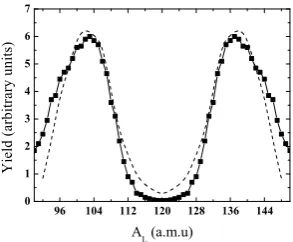
Figure 2 shows results of calculations of mass distribu-tion for thermal-neutron induced fission of239Pu in good agreement with experimental data.
Figure 2. Fragment mass distribution for thermal-neutron in-duced fission of 239Pu. Dashed line: calculation in the
scis-sion point model. Points connected by the solid line as an eye guide: experimental (pre-neutron emission) mass yields given by Ref. [12].
The important characteristic of fission is the kinetic en-ergy of fission fragments. In the present work it is sup-posed that all the interaction energy of the system at scis-sion transforms after fisscis-sion to the kinetic energy of the fragments:
TKE=UC+UN, (5)
where TKE is the total kinetic energy of the fragments. This method assumes no pre-scission kinetic energy in the system. If one introduces it to the model, the values of TKE can increase by several MeV.
The distribution of the total kinetic energy for fixed masses of the fragments is smoothed. Usually the main characteristics of this distribution, the mean TKE of the fission fragments and variation of TKE, are measured. In the statistical approach the mean total kinetic energy of the fragments for the fission of a particular binary system can be calculated using the following expression:
TKE(AL,ZL,AH,ZH)=
TKE({Ai,Zi, βi}) exp[−U({Ai,Zi, βi})/T]dβ1dβ2
exp[−U({Ai,Zi, βi})/T]dβLdβH
. (6)
This formula uses the probabilities of different config-urations to calculate the mean value of TKE. Hence, one should take the potential energyUcalculated at the barrier of the interaction potential. The results of the calculation for the neutron–induced fission of239Pu are presented in Fig. 3.
4 Angular distribution of the fission
fragments
Using the Boltzmann factor given by Eq. (3) we can cal-culate mean values of fragment masses AH andAL, with AH+AL=A, and corresponding fragments’s deformations βHandβL. These determine the most favourable dinuclear
Figure 3. Comparison of calculated and experimental average kinetic energy of fragments for neutron-induced fission of239Pu
as functions of the mass number of the light fragment, from Ref. [3].
on the direction of the incident neutron beam, it is possi-ble to determine a set of states with quantum numbers J
andMthat related to the excitation of different rotational and vibrational degrees of freedom of the most favourable dinuclear configuration. In particular, the rotational de-grees of freedom correspond to the independent rotations of the two fragments and to the rotation of the DNS as a whole. In the past, similar techniques have been used for the calculation of angular momentum distribution of fis-sion fragments [4, 13].
The Hamiltonian describing the collective excitations of the DNS consisting of fragment (AH,ZH) with
deforma-tionβH, and fragment (AL,ZL) with deformationβLcan be
written as
ˆ
H= 2 Jˆ2
H−Jˆ2H,(3)
2 ⊥H +
2Jˆ2 H,(3)
2 ||H + 2 Jˆ2
L−Jˆ2L,(3)
2 ⊥L
+
2Jˆ2 L,(3)
2 ||L + 2Jˆ2
0
2 0 +U
(Ω1,Ω2), (7)
where U(Ω0,Ω1,Ω2) is the potential energy of the dinu-clear system as a function of the relative orientation of fragments, ˆJH ( ˆJH,(3)), ˆJL ( ˆJL,(3)), and ˆJ0 are the angu-lar momenta (and their projections on the DNS symmetry axis) of the two fragments and the relative angular mo-mentum, respectively. The relative moment of inertia of the system is denoted as 0. The quantities ⊥H ( ||H ),
⊥
L( ||L) are the perpendicular (parallel) moments of
iner-tia of the corresponding fragments calculated in the rigid body limit. The choice of rigid body moments of inertia are justified since the dinuclear system at the scission point is highly excited.
In order to simplify the eigenvalue problem for the Hamiltonian (7) we approximate the potential energy by the expansion
U({1, δ1},{2, δ2})=u0+ c1 2 sin
2 1+ c2
2 sin 2
2
+c12sin 2 1sin 2 2cos(δ1−δ2), (8)
where ( i, δi), i = (1,2) are the Euler angles describing,
respectively, the orientation of the fragments AL andAH
in the molecular coordinate system, connected with vector
Rm. The similar expansion was used previously in [14] for the description of high–spin heavy–ion resonances. Ex-pressing angles ( i, δi), (i=1,2) in laboratory frame we ob-tain
U(Ω0,ΩL,ΩH)=U0+CL
2 [Y2(Ω0)×Y2(ΩL)](00)
+CH
2 [Y2(Ω0)×Y2(ΩH)](00)−Chl
L=0,2,4 C21L0,2−1
×YL(Ω0)×[Y2(ΩL)×Y2(ΩH)]L
(00). (9)
CoefficientsCH, CL andChl entering the expression (9)
are fixed by fitting the angular dependence of the potential energy calculated with use of Eq. (1).
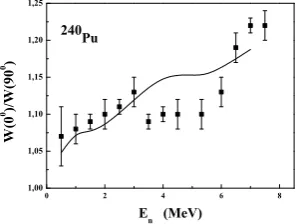
Figure 4.Calculated and experimental angular anisotropy of fis-sion fragments vs incident neutron energy. Data are taken from Ref. [15].
Diagonalizing the Hamiltonian (7) we obtain its eigenvalues En,KH,KL
JMΠ as well as its eigenfunctions,
Ψn,KH,KL
JMΠ (ΩH,ΩL,Ω0). Assuming that the decay of the scission-point configuration is a fast process, the proba-bility of emitting fission fragments from the stateΨnJMΠat an angleθis given by:
Pn,KH,KL
JMΠ =sinθdθ
|Ψn,KH,KL
JMΠ |2dΩHdΩLdφ. (10)
Here, the change of the angular distribution caused by the Coulomb excitation subsequent to the fission is neglected. The angular distribution of fission fragments for the channel characterized by angular momentumJ, projection
M, parityΠat temperatureT can be written as
WJMΠ(E∗, θ)=A(J)
n,KH,KL exp
⎡ ⎢⎢⎢⎢⎢ ⎣−E
n,KH,KL
JMΠ T(E∗)
⎤ ⎥⎥⎥⎥⎥ ⎦Pn,KH,KL
JMΠ , (11)
withA(J) a normalization constant.
Summing over the contributions of different channels, it is possible to compute the total angular distribution,
W(θ); a quantity that is commonly compared with exper-imental data is the angular anisotropy, W(θ = 0)/W(θ =
π/2), evaluated as a function ofEn, as shown in Fig. 4.
Our theoretical results are in good agreement with ex-perimental data at low energies (En < 4 MeV) . The
anisotropy first decreases and then rapidly increases again above 6 MeV may be due to the interplay of two factors that are not yet included in our model. The decrease of the angular anisotropy may be related to the threshold of excitation of two-quasi-particle states in the fragments of the most favourable dinuclear configuration. The rapid in-crease above 6 MeV energy is associated with the thresh-old of second-chance fission [16]. The amount of angu-lar momentum carried away by the evaporated neutron is small compared with the angular momentum of the com-pound system. However, the excitation energy is signifi-cant and, as a result, the angular anisotropy decreases.
5 Conclusion
In the present work we have discussed the application of the dinuclear system model to the fission process. The key idea of our approach is the account taken of the cluster degrees of freedom related to the formation of the DNS. Combining the DNS model with the scission-point model, we have computed mass distributions, mean total kinetic energy and angular anisotropies of fission fragments in neutron-induced fission of239Pu. The results are in good agreement with experiments. The calculations for angular anisotropies can be improved by including the effects of non-collective states and second-chance fission.
Acknowledgements
This work was supported by the RFBR (Moscow) and NSFC (Beijing). T.M.S. acknowledges the support from the CAS Fellowship for the the Young International Scientists (2013Y1JA0003) and Russian Government Subsidy Program of the Competitive Growth of Kazan Federal University.
References
[1] V.V. Volkov, Izv. Akad. Nauk SSSR, Ser. Fiz. 50, 1879 (1986)
[2] G.G. Adamianet al., Nucl. Phys. A633, 409 (1998) [3] A.V. Andreevet al., Eur. Phys. A26, 327 (2005) [4] T.M. Shneidman et al., Phys. Rev. C 65, 064302
(2002)
[5] S. Cwioket al., Phys. Lett. B322, 304 (1994) [6] T.M. Shneidman et al., Nucl. Phys. A 671, 119
(2000)
[7] R.K. Sheline and M A. Riley, Phys. Rev. C 61 057301 (2000)
[8] T.M. Shneidmanet al., Phys. Lett. B526, 322 (2002) [9] T.M. Shneidmanet al., EPJ Web of Conferences,38,
07001 (2012)
[10] J. Maruhn and W. Greiner, Z. Physik251, 431 (1972) [11] G.G. Adamian et al., Int. J. Mod. Phys. E 5, 191
(1996)
[12] C. Wagemanset al., Phys. Rev. C30, 218 (1984) [13] M. Zielinska-Pfabé and K. Dietrich, Phys. Lett. B49,
123 (1974)
[14] E. Uegaki and Y. Abe, Prog. Theor. Part. Phys.90, 615 (1993)
[15] J.E. Simmons and R.L. Henkel, Phys. Rev.120, 198 (1965); R.B. Leachman and L. Blumberg, Phys. Rev.
137, B814 (1965)
[16] R. Vandenbosch, J.R. Huizenga, Nuclear Fission