IJEDR1503027 International Journal of Engineering Development and Research (www.ijedr.org)
1
Coconut Rancidity Testing Using Slosh Testing
Mechanism
1Sharayu.P.Chaudhari, 2Vikas.V.Shinde 1Student 2Associate Professor
Mechanical Department, Sinhgad Institute of Technology, Lonavala, India
Abstract—Coconut has so varied uses, and since most of the uses are in consumable form, its rancidity needs to be tested b
efore being processed. It may not be palatable or edible for consumption. In any coconut processing industry, a coconut is f irst broken, water is extracted and coir is used for various purposes. Hence, it becomes very important to detect its rancidi ty. But this should be done before breaking the coconut for water extraction so that rancid coconuts are not being processe d further Water and meat extracted in a coconut processing line may get contaminated due to rancidity of mature coconut . To reduce entire coconut water and meat from being contaminated, it becomes a necessity to separate out rancid coconut s before water and meat extraction. The project involves design development of the brass tong striking mechanism, mounti ng pad and vibrometer probe mounting mechanism for non-destructive rancidity detection of a coconut. The proposed me thod involves creation of vibration response of the coconut shell to be tested by striking a brass tong onto the shell at vario us intensities and study the peak acceleration, displacement and frequency of the holding pad to detect rancidity of the coc onut.
Keywords- coconut, coconut rancidity, coconut testing, coconut water extraction, slosh test
I.INTRODUCTION
In any coconut processing industry, a coconut is first broken, water is extracted and coir is used for various purposes. [1][2] Hence, it becomes very important to detect its rancidity. But this should be done before breaking the coconut for water extraction s o that rancid coconuts are not being processed further. By doing so, we can eliminate the chances of rancid coconut water contami nating the entire extracted coconut water.Conventional methods used for rancidity testing are namely sloshing, Visual inspection, Ultra-sound or X-ray but it is found that the techniques though adaptable for full automation may not be reliable or economical he nce a new method of rancidity testing needs to be devised where in the process can be reliable , repeatable and also economical.
II.OBJECTIVE
To study different methods to study rancidity of coconut.
The objective is to test the rancidity of a coconut using non-destructive procedures in a reliable & economical way.
III.WHATISRANCIDITY?
Rancidity is the chemical decomposition of fats, oils and other lipids. When these processes occur in food, undesirable odors and f lavors can result.
Rancidity is a very general term and in its most general meaning, it refers to the spoilage of a food in such a way that it becomes u ndesirable (and usually unsafe) for consumption. When people say that a food has "gone bad," what they're usually talking about i s rancidity. Most of the time, but not always, rancidity can change the odors or flavors of a food in such a way that it becomes ver y unpleasant to smell or taste.
While most any food can technically become rancid, this term applies particularly to oils. Oils can be especially susceptible to ran cidity because their chemistry can make them exceptionally susceptible to oxygen damage. When food scientists talk about rancid ity, they are often talking about a specific type of rancidity involving oxygen damage to foods, and this type of rancidity is called "oxidative rancidity." During the process of oxidative rancidity, oxygen molecules interact with the structure of the oil and damag e its natural structure in a way that can change its odors, its taste, and its safety for consumption.
The methods conventionally inuse through automation in various industries are destructive testing methods and are also highly ex pensive.
Hence, the need of a cost effective Coconut Rancidity Testing machine which works on non-destructive testing principles arises.
IV.LITERATUREREVIEW
Very less research has been carried out in the field of detection of coconut rancidity. The research has been carried out in this field are destructive methods involving comparison in laminar viscosity of coconut water flowing through pipes. No research or develo pment has been carried out in the field of non-destructive testing of coconut rancidity. Also, after survey in State center of the Coc onut Development Board, it is found that there are no non-destructive techniques developed for use in this field.
IJEDR1503027 International Journal of Engineering Development and Research (www.ijedr.org)
2
Coconut is not just a hard nut to crack, but also one of the most difficult foods to detect rot. Due to the peculiar formation of cocon ut, it is several times impossible to identify rotten coconut.
Check the eyes
A fresh coconut has dry eyes with no funny growth around them. However, in case of rotten coconut, the eyes would be seeping. Check the Shell
Check the coconut skin (in case of raw green) and shell (in
Case of ripe brown). If you see any scratches, cracks, and lesions, the coconut is rotten. Slosh Test:
Principle: Water contents at 2/3rd full water state specified seems reasonable for a mature coconut and complete with water For a tender coconut. This concept is derived from slosh tests
Performed for fuel tank under working conditions of aircrafts [4]. the same method can be used for detection of rancidity of
Coconut; as a rancid coconut does not slosh the way a normal coconut does.
Forced vibration can be imparted to give the coconut a precise hammering. The frequency response obtained for a mature cocon ut of good quality can be compared with a rancid coconut. For a frequency response out of a certain range as per tested results, the coconut may be termed as rancid and can be separated out using a suitable push-mechanism.
Ultrasound Scanning Technique:
Ultrasonic testing is a type of non-destructive testing commonly used to find flaws in materials and to measure the thickness of ob jects. Frequencies of 2 to 10 MHz are common but for
Special purposes other frequencies are used. Inspection may
Be manual or automated and is an essential part of modern manufacturing processes. Most metals can be inspected as well as plast ics and aerospacecomposites. Lower frequency ultrasound (50–500 kHz) can also be used to inspect less dense materials such as wood, concrete and cement[5].
X-Ray Technique:
Hard X-rays can traverse relatively thick objects without being much absorbed or scattered. For this reason X-rays are widely used to image the inside of visually opaque objects. The most often seen applications are in medical radiography and airport security sc anners, but similar techniques are also important in industry (e.g. industrial radiography and industrial CT scanning) and research (e.g. small animal CT). The penetration
Depth varies with several orders of magnitude over the X-ray spectrum. This allows the photon energy to be adjusted for the appli cation so as to give sufficient transmission through the object and at the same time good contrast in the image. This technique can be used for coconut rancidity detection to compare penetration of rancid coconut with normal ones.
All above methods based on application and scope can be used for detection of coconut rancidity in a coconut processing industry. The method to be selected for the same shall depend
On the needs and requirement of application. Though, we can say that sloshing, ultrasonic testing and x-ray testing may be more r eliable and may give more accurate results. After various surveys & analysis, we consider slosh testing to be implemented for indu strial purpose [3].The proposed system is elaborated
further in this paper
V.PROPOSEDSYSTEM
i. Working Principle:
The system is designed to detect rancid coconuts using slosh testing & then separate them from the process line post coco-pith rem oval & prior to coconut water extraction. Slosh testing is based on the principle of frequency response range comparison between a rancid coconut and a normal coconut.
ii. Set-up:
The set-up shall consist mainly of the following components: Fig. 1. Motor
Fig. 2. Cam Fig. 3. Brass Tong
Fig. 1. Coconut Platform with Nylon-66 Pad & Base Frame Fig. 1. Fixed Jaw Clamp
Fig. 1. Moving Jaw Clamp Fig. 4. Lever
Fig. 5. Spring Fig. 6. Vibrometer
IJEDR1503027 International Journal of Engineering Development and Research (www.ijedr.org)
3
VI.WORKING
Once the cocopith is removed from the coconut, the coconuts are tested for rancidity using the slosh testing method described abo ve. The rancid coconuts may be then separated out using a push mechanism interfaced with the rancidity testing system. In this ma nner, the quality standards of coconuts required for a given application can be maintained. Now, to increase the
Fault rejection ratio, the rejected coconuts are broken and
Tested for rancidity. If the rejected coconut is found to be acceptable, it can be included in the process by-passing the above System. This will enhance the productivity of the system and
At the Same time maintain the quality standards of the coconuts use.
VII. SLOSH TESTING MECHANISM
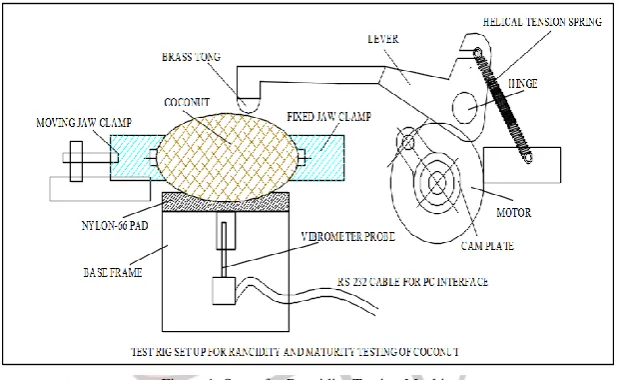
The proposed method involves creation of vibration response of the coconut shell to be tested by striking a brass tong onto The shell at various intensities and study of peak acceleration, displacement and frequency of the holding pad to detect rancidity o f the coconut. The motor is a 12 V DC motor variable
Speed, which will rotate the cam plate, which turns the lever about the hinge thereby deflecting the tension spring during Rise of the cam, the cam plate is designed such that the lever is released at the end of rise i.e., the dwell of cam plate is zero At a particular instance thereby releasing the entire energy of
The tension spring instantaneously making the lever to travel
Downward and strike the tong onto the coconut shell at a particular intensity governed by the speed of the motor. The striking of t he tong on the coconut shell will generate a set of vibrations in the shell which will be transmitted to the nylon-66 pad. These vibr ations will be measured for study the peak acceleration, displacement and frequency of the holding pad to detect
Rancidity of the coconut. The probe is connected directly to the vibrometer set-up to note the readings of above said parameters m anually. The same can also be read by logging it to PC by use of RS232 cable.
The schematically the setup of the proposed system can be represented as follows:
Figure 1: Setup for Rancidity Testing Machine
VIII. SLOSH TESTING MECHANISM DESIGN CALCULATIONS
Calculation of motor power and spring dimensions for jumping mechanism: Input data:
Weight of jumping mechanism: 0.8 kg (assumption) Maximum height of jumping (h) = 20 mm (assumption) The potential energy required to overcome the effect of Gravity to propel the mechanism against gravity is given by, E potential = 0.8 x 9.81 x 20 = 156.96 J
Considering that the mechanism is to have 5 jumps per minute Power required is given by,
Potential energy required (E-potential) / time = 156.96/ 12 =13.08 watt Energy of spring is given by Where k= spring constant
X = compression / deflection of spring = 20 mm (to achieve a minimum jump of 20 mm) Thus spring constant can be derived as,
Espring= Epotential, K = 156.96 x 2/ 202, K=0.78 Selection of Motor
Power = 7.2 Watt Speed = 10 rpm Torque = 0.29 N-m Design of Motor Shaft
IJEDR1503027 International Journal of Engineering Development and Research (www.ijedr.org)
4
Designation
Ultimate Tensile strength
N/Mm2
Yield Strength
N/Mm2
En24 800 600
Table 2 ASME CODE for design of shaft
Since the loads on most shafts in connected machinery are not constant, it is necessary to make proper allowance for the harmful e ffects of load fluctuations
According to ASME code permissible values of shear stress may be calculated form various relation. Fsmax = 0.18 fult = 0.18 x 800= 144N/mm2
OR
Fsmax= 0.3 fyt =0.3 x 600=180 N/mm2
Considering minimum of the above values fsmax= 144N/mm2
Shaft is provided with key hole for locking; this will reduce its strength. Hence reducing above value of allowable stress by 25% fsmax= 108 N/mm2
This is the allowable valve of shear stress that can be induced in the shaft material for safe operation. Assuming 100 % efficiency of transmission T design = 0.29 Nm
Check for torsional shear failure of shaft
Assuming minimum section diameter on input shaft = 6 mm Standard
d =6mm fsact = 6.84 N/mm2 as fsact<fsall Pinion shaft is safe under torsional load. Maximum radial load due to action of cam = T/r
Where: T= torque =0.29 X10 3 N R = eccentricity of cam =40 F = 7.25 N
Figure 2: Loading Diagram for Shaft Design of shaft for combined bending & torsion
D3 = (16/ π x 108) x sq. RT (kb M2 + kt x T2), Here kb =kt = 1.5 D = 5.57 mm
Hence selecting minimum section on shaft to be 6mm Design of lever
Material Selection: - Ref: - PSG (1.10 & 1.12) + (1.17)
Designation Ultimate tensile Yield strength
AL 280 180
IJEDR1503027 International Journal of Engineering Development and Research (www.ijedr.org)
5
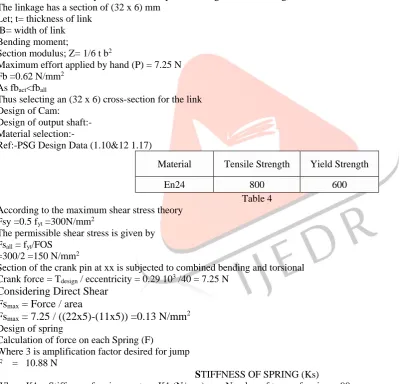
Figure 3: Design of Lever Cross section of link may be determined by considering lever in bending; The linkage has a section of (32 x 6) mm
Let; t= thickness of link B= width of link Bending moment;
Section modulus; Z= 1/6 t b2
Maximum effort applied by hand (P) = 7.25 N Fb =0.62 N/mm2
As fbact<fball
Thus selecting an (32 x 6) cross-section for the link Design of Cam:
Design of output shaft:- Material selection:-
Ref:-PSG Design Data (1.10&12 1.17)
Material Tensile Strength Yield Strength
En24 800 600
Table 4 According to the maximum shear stress theory
Fsy =0.5 fyt =300N/mm2
The permissible shear stress is given by Fsall = fyt/FOS
=300/2 =150 N/mm2
Section of the crank pin at xx is subjected to combined bending and torsional Crank force = Tdesign / eccentricity = 0.29 103 /40 = 7.25 N
Considering Direct Shear Fsmax = Force / area
Fsmax = 7.25 / ((22x5)-(11x5)) =0.13 N/mm2 Design of spring
Calculation of force on each Spring (F)
Where 3 is amplification factor desired for jump F = 10.88 N
STIFFNESS OF SPRING (Ks) Where K1 = Stiffness of spring per turn K1 (N/mm), n = Number of turns of spring = 90 Ref. PSG Design Data Handbook
Stiffness and permissible static and dynamic loads for helical compression springs Wire Diameter
(mm)
Outer Diameter (mm)
Stiffness of spring per turn (K1 N/mm)
Permissible load
Static Load (N) Dynamic Load (N)
1 12 7.98 32.4 14.5
Table 5 Ks = 1.33 N/mm
IJEDR1503027 International Journal of Engineering Development and Research (www.ijedr.org)
6
1 = 8.18 mm
Maximum Deflection of Spring (max) max = 21 = 8.18 = 17.64
max = 18 mm
Free Length of spring (Lf)
Lf = Solid length + Maximum deflection Lf = 90 + 18 =108mm
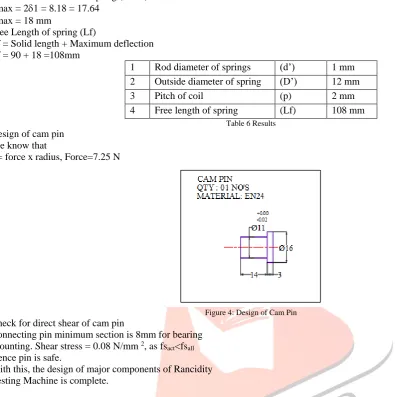
1 Rod diameter of springs (d’) 1 mm 2 Outside diameter of spring (D’) 12 mm
3 Pitch of coil (p) 2 mm
4 Free length of spring (Lf) 108 mm Table 6 Results
Design of cam pin We know that
T= force x radius, Force=7.25 N
Figure 4: Design of Cam Pin Check for direct shear of cam pin
Connecting pin minimum section is 8mm for bearing Mounting. Shear stress = 0.08 N/mm 2, as fsact<fsall Hence pin is safe.
With this, the design of major components of Rancidity Testing Machine is complete.
IX.CONCLUSION
From the survey & literature review carried out, we can conclude that the existing methods of Coconut Rancidity Testing are destr uctive type, expensive & complicated. Hence, a non-destructive testing method which is simple in implementation & cost effectiv e is required.
The method of coconut rancidity detection proposed in this paper is based on slosh testing and is a non-destructive method which i s simple in construction, operation and maintenance. Also, this is a cost effective technique. The frequency response on vibrating a coconut can be used as a parameter to detect the rancidity of a coconut. This technique of coconut rancidity detection coupled with further automation can be effectively used for industrial applications in coconut processing industries.
REFERENCES
[1] Hahn, William J. (1997). Arecanae: The palms. Retrieved April 4, 2011 from the Tree of Life Web Project website. [2] Royal Botanic Gardens, Kew. Cocos. World Checklist of Selected Plant Families.
[3] www.coconutboard.nic.in
[4] Advisory Group For Aerospace Research And Development (AGARD) REPORT No. 682-dynamic Environmental Qualificat ion Techniques