Based on Multiple Cube Tester
Nasser Ramazani Darmian
University of Aeronautical Science & Technology, Tehran, Iran [email protected]
Abstract. Rabbit stream cipher is one of the finalists of eSTREAM project which uses 128-bit secret keys. Prior to us, the attacks on Rabbit has been all focused on the bias analysis and the best result showed the distinguishing attack with complexity 2136. Our analysis in this paper,
is based on chosen IV analysis on reduced N-S round of Rabbit though using multi cube tester. For this purpose we show for a mature cube we could easily identify weaksubcubes which increase the probability of distinguishing for an unknown secret key. We also represent with 225
complexity, using one iteration of next state function the keystream is completely distinguishable from random.
Keywords: Rabbit Stream Cipher, Cube Attack, Chosen IV Analysis, Distinguishing
1
Introduction
Synchronous stream ciphers are symmetric cryptosystems which are suitable to encrypt message in communications protocols and can be used in hardware or software platforms. Rabbit stream cipher [1] proposed as finalist by ECRYPT, can be served for software application with synchronization purposes. For the first time, Ammuson in [2] showed a distinguish attack with 2247complexity due to a bias in keystream and this complexity was afterwards reduced to 2136 by Yi lu [3] and no other considerable result has been obtained. In many protocols, the message is divided into short frames where each frame is encrypted using a different publicly known initialization vector (IV) and the same secret key. The encryption algorithm used must therefore resist against variety of chosen IV at-tacks. In these attacks, a stream cipher is considered as a black box Boolean function, outputs of which depend on Key and IV variables.
Testing monomials of a Boolean function was first introduced as the name of
notion of the cube attacks utilized for key recovery, was introduced by Dinur and Shamir in a similar context [8]. At the same year, Aumasson et.al published an extended type of cube attack for distinguishing called cube testers goal of which is to distinguish nonrandomness via property testing.
2
Description of Rabbit
The internal state of the stream cipher consists of 513 bits. 512 bits are divided between eight 32-bit state variables xi,j and eight 32-bit counter variables ci,j
where xi,j is the state variable of subsystem j at iteration i, and ci,j denote
the corresponding counter variables. There is one counter carry bit, φi, which
needs to be stored between iterations. This counter carry bit is initialized to zero. The eight state variables and the eight counters are derived from the key at initialization.
The algorithm is initialized by expanding the 128-bit key into both the eight state variables and the eight counters such that there is a one-to-one corre-spondence between the key and the initial state variables xi,j and the
ini-tial counters, ci,j. The key K = (k127, . . . , k0) is divided into eight subkeys,
K0 = (k15, . . . , k0), K1= (k31, . . . , k16), ..., K7= (k127, . . . k112). The state and counter variables are initialized from the subkeys as follows:
xj,0=
{
K(j+1mod8)||Kj forjeven
K(j+5mod8)||K(j+4mod8) forjodd
(1)
And
cj,0=
{
K(j+4mod8)||K(j+5mod8)forjeven
Kj||K(j+1mod8) forjodd
(2) The system is iterated four times, according to the next-state function defined below, to diminish correlations between bits in the key and bits in the internal state variables. Finally, the counter values are re-initialized according to:
cj,4=cj,4⊕x(j+4mod8),4 (3) to prevent recovery of the key by inversion of the counter system. The IV setup scheme works by modifying the counter state as function of the IV. This is done by XORing the 64-bit IV on all the 256 bits of the counter state. The system is then iterated four times according to next state function (N-S function) to make all state bits non-linearly dependent on all IV bits. Since the Rabbit in our procedure is used as a black box described by a master polynomial [8], we do not recall next state function. This algorithm generates 128 bit keystream after one iteration of next state function used for encrypting/decrypting plaintext.
3
Algebraic IV Analysis
LetFnbe set of all function that mapping{0,1}
n
The algebraic normal form (ANF) of f is the polynomial f(x) over GF(2) in variablesx1, . . . , xn, xn+1, . . . , xn+m(in whichx1, . . . , xnshow key variables and
xn+1, . . . , xn+m show IV variables) is of the form
f(x) = 2n+m−1
∑
i=0
aixi11x
i2 2 . . . x
in+m
n+m (4)
For somea0, a1, . . . , a2n+m−1∈ {0,1}and whereijdenotes thejthdigit of the
bi-nary encoding ofi. The termtI can be indexed by the subsetI⊆ {1, . . . , n+m}
which is the monomial consist of allxi’s withi∈I, for any function inFn ANF
off could be represented algebraically under the form
f(x1, . . . , xn+m) =tI.pSI +q(x1, . . . , xn+m) (5)
tI andpSI are calledcube andsuperpoly respectively.
3.1 Testing Statistic Properties
Applying statically IV attack, one can choose I = {i1, i2, . . . , ik}, ij = 1, ..., m
andtI =xi1xi2. . . xik and fix otherxi’s bits (key and other IV bits) so he has a
cube of sizekand can obtain values off(. . . , xi1xi2, . . . , xik, . . .) for all possible values oftI =xi1xi2. . . xik. Now we can define partial ANF in this way
fK,V (x) =
2k−1 ∑
i=0
(
bixji11x
j2
i2. . . x
jk ik )
(6)
Wherejldenotes thelthdigit of the binary encoding ofiandV shows other IV
bits not appear in cube set{xi1, xi2, . . . xik}. Coffecientsbis are monomials
coeffi-cients and for each selection of key and IV bits we have an independentfK,V (x).
Having random properties, eachbimust appear infK,V (x) with 1/2 probability
[9]. It is worth reminding that summing all value offK,V(xi1, xi2, . . . , xik) for
en-tire (xi1, xi2, . . . , xik)∈ {0,1}
k
, the corresponding superpoly value ofpSI could
be constructed. A monomials coefficients vector (b0, b1, . . . , b2k−1) describes an ANF transform of a black box function fK,V in oracle, therefore by analyzing
sufficient number of coefficients vectors which are generated with a fixed key and different IVs and exploiting suitable decision rule, we could represent a distin-guisher. There are a lot of methods for testing randomness properties in a set of samples but here we use a new powerful test calledmulti χ2 test [10].
Assume that the set {δ1, δ2, ..., δN} is the sample set of an experiment derived
from a population with a balanced binomial distribution. The valuesδ1, δ2, ..., δN
can be interpreted as the value of an ANF monomial coefficient bi revealed
in fK,V(x) from N different experiments. We expect to have P(δi= 0) =
P(δi= 1) = 1/2 for i= 1, . . . , N. The output space of the experiment is
test assumes P(bi= 0) =P(bi= 1) = 1/2 for any monomial cofficientbi. The
chi-square statistic is then calculated from:
X2= (O0−E0) 2
E0
+(O1−E1) 2
E1
(7)
WhereEi andOi are the expected and observed frequencies of members ofAi,
respectively. By definition, we have E0 =E1 = 1/2,O0+O1 =N. Therefore, the chi-square statistic becomes:
X2 =
(
O1−12N
)2
1 4N
(8)
Due to the null hypothesis, X2 is expected to be a random variable with chi-square distribution with one degree of freedom. Corresponding to coefficients vector (b0, b1, . . . , b2k−1), the statistic of X2 =
2k∑−1
i=0
X2
i has a chi-square with
2k degree of freedom [10]. This test will be succeded if the value of statis-tic X2 become higher than critical value Xα2. Therefore we could distinguish
cipher from random with 1−α probability of success in which α is called level of confidence . As we mention above for an unknown key K, we can choose a set I = {i1, i2, . . . , ik}, ij = 1, ..., m and tI = xi1xi2. . . xik from IV bits. Therefore for each query of other IV bits we have partial ANF functions
fK,Vn(x), n= 1, . . . , N with corresponding coefficients. Considering sum of all
coefficients vectors (B0, . . . , B2k−1) = N ∑ n=1
(
bn
0, . . . , bn2k−1 )
, X2 statistics will be defined for these coefficients as follow:
X2= 2∑k−1
i=0
(
Bi−N2 )2
N
4
(9)
As we have N queries, the complexity of this attack will beN2k and drastically grew by increasing cube sizek.
3.2 Analysis of Biased Monomials Coefficients
In the previous attack we statically used analysis of coefficients vector in a black box stream cipher. It is obvious that sum vector (B0, . . . , B2k−1) do not have
normal distribution and each one has a little bias, also there are always someBi
variables with high and low biases. The maximum and minimum biases in sum vector variables (B0, . . . , B2k−1) could give us a good criterion to distinguish
stream cipher. Now, consider the following lemma could be deduced from [11].
Lemma 1. Maximum degree coefficient b2k−1 of an fK,V(x) with k size cube
cube(x1, x2. . . , xk).
We can extend it for each coefficient bi,0 ≤ i ≤ 2k − 1. Let bi be
coefficient of monomial in an fK,V(x1, x2. . . , xk), therefore one can
choose I′ = {i1, i2, . . . il} in which I′ ⊆ I = {1,2, . . . , k} and subcube
tI′ = xi1xi2. . . xil and makes fK,V (xi1, xi2, . . . , xil). The maximum degree coefficient b2l−1 in fK,V(xi1, xi2, . . . , xil) could be computed by XORing outputs of fK,V(xi1, xi2, . . . , xil) for all values of subcube (xi1, xi2, . . . , xil) which corresponds tobi infK,V (x1, x2. . . , xk).
Lemma 2. Let fK,V(x) be a partial ANF with tI = x1x2. . . xk and
I = {1,2, . . . , k}. For each I′ ⊆ I in which tI′|tI, all monomials in fK,V′(x)
will exactly appear infK,V (x).
In other words the partial ANF, fK,V (x) with I = {1,2, . . . , k} and
tI =x1x2. . . xk include entire monomials of other ANF,fK,V′(x) withI′ ⊆I.
We call tI =x1x2. . . xk and the whole possible cubes tI′|tI, mature cube and
subcubes respectively.
This is a simple fact that can be deduced from former Lemma 1. Because each bi coefficient degree in fK,V(x)can be interpreted as a maximum
degree in an independent different fK,V′(x), all possible cubes tI′|tI
con-struct the coefficients bi’s in fK,V (x)as a result. For example, considering
f(x1, x2, x3) = 1 +x1+x3+x2x3 +x1x2x3 with mature tI = x1x2x3 and subcubes tIj, Ij ⊆I, we havetI0 = 0, tI1 =x1, tI2 =x2,tI3 =x3,tI4 =x1x2,
tI5 =x1x3, tI6 =x2x3, tI7 =x1x2x3. As the maximum degree coefficients for each subcube isM0= 1, M1 = 1,M2= 0, M3 = 1 ,M4 = 0,M5= 0, M6 = 1,
M7 = 1, we can then reperesent a f(x) with maximum degree coefficients obtained from subcubes.
Now, consider a mature cube tI = x1x2. . . xkfor a black box stream
ci-pher. Having N different fK,Vn(x) for different IV with corresponding
monomials coefficients vectors
(
bn
0, . . . , bn2k−1 )
computed from a black box stream cipher, we can easily compute sum of these coefficients vectors (B0, . . . , B2k−1) =
N ∑ n=1
(
bn
0, . . . , bn2k−1 )
.
Basically, If fK,Vn(x) polynomials are random, their coefficients must be
ap-peared with 1/2 probabilities and sum of coefficient variables will have binomial distribution specially with expected value N/2 and standard deviation√N /2 . Any statistic weakness inBis could be useful for attacker to distinguish cipher.
Definingϵi = Bi−N
2
N
2
, i= 0, . . .2k−1 the maximum or minimum biases and its
coressponding subcubes could be the best choices of cubes in well-known cube attack. In the other hand by Lemma 2 monomials coefficients (b0, . . . , b2k−1) in
an ANF fK,V(x) with a mature cube contain entire coefficients of subcubes.
As a result the biases of variables of sum vector (B0, . . . , B2k−1) denoted by
whether there is possibility for cube tester to be succeded.
Summing coefficient vectors ofN partial ANFfK,Vn(x), n= 1, . . . , N makes a
binomial distribution for every coefficient. Therefore using [12] each monomial coefficient could be distinguished byN = ϵβ2
i
queries with Pe=Φ (
−√β
2
)
that
β is a small positive integer.
We utilize this technique as preprocessing phase in cube tester in which we find weak subcubes with maximum bias |ϵmax| for different K and V. If we
efficiently try sufficient large set of keys for a mature cube tI, we will observe
that some subcubes get maximum bias multiple times, choosing this subcubes increase the probablity of distinguishing.
As it shown in algorithm1, in online phase, despite of cube tester introduced in [9], we exploit more than one cube to distinguish cipher which means that we extend our variables to impart more nonrandom properties. In this phase a fixed key K is chosen and for mature cubetI we extractBis of weak subcubes
which were calculated at preprocessing phase. At the end, we exploit multiple
X2 decision rule to distinguish stream cipher.
Algorithm 1: Online Phase of Cube Tester
Input:K,{i1, i2, ...iv} Output: result of decision
1: Set (Bi1, . . . , Biv) to zero
2: Choose appropriatedN 3: forn←1, N
4: Vn←Rand()
5: for (x1, ..., x2k)←0,2k−1
6: (b0, ...b2k−1)←fK,Vn(x1, ..., xk)
7: end for
8: (Bi1, . . . , Biv)←(Bi1, . . . , Biv) + (bi1, . . . , biv)
9: end for
10: X2= ∑v j=1
(
Bij−N
2 )2
N
4 11: IfX2>Xv,α2
12: Cipher
13: else
14: Random
15: end If
4
Result
cube by size ofk= 12 withN = 6000 quaries are used and the result presented at table.1.
Table 1.Maximum Biases|ϵmax|2 for 1,2,3,4 and 5 iterations of next state function
Iteration of N-S function
Maximum Bias
1 2−5.5064<|ϵmax|<2−2.6024
2 2−5.7179<|ϵmax|<2−4.8296
3 2−5.7306<|ϵmax|<2−4.9809
4 2−5.7306<|ϵmax|<2−4.9819
5 2−5.7306<|ϵmax|<2−4.8925
Our observation shows that by using one iteration of N-S function the max-imum bias will obtain, also distribution function of monomials cofficients is re-ally far from random function and easily distinguishable which corresponds with [12]. In the worst case maximum bias is equal to|ϵmax|= 2−5.7306 which needs
N = 1009 samples to distinguish it from random with almost Pe = 13% error
probability so there probablly will some subcubes which made cipher distinguish-able. Furthermore, according to result on tdistinguish-able.1 we could deduce that iterating of N-S function more than twice does not influence distribution of monomials severely.
Applying cube tester, in preprocessing phase for mature cube tI = x1x2...x12 we tryed a large set of key K with different V and chose some weak sub-cubes and specified indexes (i1, i2, ..., iv) of their corresponding Bis in sum
vector (Bi1, Bi2, ..., Biv). we also exploited N = 6000 queries that result in 6000×212≈225complexity almost.
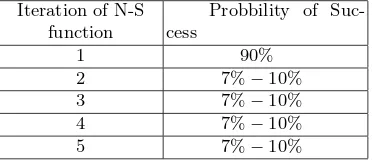
Finally, in online phase acorrding to algorithm.1 for an unknown fixed key we obtained cofficient sum vector (Bi1, Bi2, ..., Biv) and constructX
2for these cof-ficients. we repeat our attack for different fixed unknown keys withα= 0.05 and the results are presented in table.2.
Table 2.The distinguishing probabilities for unknown keys after 1,2,3,4 and 5 iteration of next state function
Iteration of N-S function
Probbility of Suc-cess
1 90%
2 7%−10%
3 7%−10%
4 7%−10%
Probability of distinguishing shows the probability that an unknown key could be distinguished. As we show in table.2 using one iteration of N-S function make our attack successful with high probability and almost for every unknown key we could easily distinguish keystream from random but using more than one iteration decreases the probability of distinguishing dramatically. Here we reached up to 10% distinguishing probability which means from 10 unknown keys one key is distinguishable. The probability of distinguishing could be increased by testing more keys and IVs in preprocessing steps to find weak subcubes or suitable indexes (i1, ..., iv) coresponds with (Bi1, ..., Biv) which have more biases. Also, considering mature cubes with higher length until computation is possible will result higher probability of distinguishing. Furthermore we comprehended that iteration of N-S function more than twice probably will not influence on probability of success.
5
Conclusion
Rabbit is a synchrounous stream cipher proposed by ECRYPT which has been resist against all kind of attacks. In this paper a new kind of cube testers examined on this stream cipher and the results show it might not immune against this types of attacks. This attack was done on reduced iterations of N-S function and the results represent that by using one iteraion of N-S function this algorithm can be distingished from random for any unknown keys. we also introduce mature cube and subcubes concepts and use them to construct new kind of cube testers. Our result is as follow:
- Sum cofficient vector (B1, ..., Bk) is sum of monomials cofficients of
ANF function fK,Vn(x) in which K and V are fixed. Amount of each Bi is
equate to maximum degree of it’s subcubes and therefore a little bias ϵi shows
the weakness of the subcube.
- Analysis of Sum cofficient vector for a mature cube of size tI = x1x2...xk
reveals the weak subcubes which could be considered as preprocessing phase. In this step weak subcubest′Is and their indexes{i1, ...iv}for sum vector cofficient
(Bi1, ..., Biv)is identified.
- In Online step for a fixed K we test more than one subcubes by well-known
X2 test. The probability of distinguishing can be increased if we test large set of
keys and IVs in preprocessing step and using more weak subcubes.
Our test could be extended to multiple weak mature cubes and these will improve the result but the complexity N2k will increase extremly.
References
2. Aumasson, J.-P.: On a bias of Rabbit (January 2007),
3. Lu, Y., Vaudenay, S., Meier, W., Ding, L., Jiang J.: Synthetic Linear Analysis: Improved Attacks on CubeHash and Rabbit. In: Kim. (eds.) ICISC 2011. LNCS, vol. 7259, pp 248–260. Springer, Heidelberg (2012)
4. Filiol, E.: A New Statistical Testing for Symmetric Ciphers and Hash Functions. In: Deng, R., Bao, F., Zhou, W., Qing S. (eds.) ICICS 2002. LNCS, vol. 2513, pp. 342–353. Springer, Heidelberg (2002)
5. Saarinen, I.: Chosen-IV Statistical Attacks on eSTREAM Stream Ciphers. Report, eSTREAM, ECRYPT Stream Cipher Project (2006)
6. Englund, H., Johansson,T., and Turan, M. S.: A Framework for Chosen IV Sta-tistical Analysis of Stream Ciphers. In: Srinathan, K., Pandu Rangan, C., Yung, M. (eds.) INDOCRYPT 2007. LNCS, vol. 4859, pp. 268–281, Springer, Heidelberg (2007)
7. Vielhaber, M.: Breaking ONE.FIVIUM by AIDA an Algebraic IV Differential At-tack. In: Cryptology ePrint Archive, Report 385, (2007)
8. Dinur, I., Shamir, A.: Cube attacks on tweakable black box polynomials. In: Cryp-tology ePrint Archive, Report 385, (2008). version 20080914:160327
9. Aumasson,J-P., Dinur, I., Meier W. , Shamir, A.: Cube Testers and Key Recovery Attacks On Reduced-Round MD6 and Trivium. In: Dunkelman, O. (eds) FSE 2009. LNCS, vol. 5665, pp. 1–22, Springer, Heidelberg (2009).
10. Vardasbi, A., Salmasizadeh, Mohajeri, J.: On the Multi Chi-square Tests and Their Data Complexity. ISeCure. vol 4. 15–24, (2012)
11. Fischer, S., Khazaei S., Meier, W.: Chosen IV statistical analysis for key recovery attacks on stream ciphers. In: Vaudenay, S.(eds), AFRICACRYPT, vol. 5023, LNCS, pp. 236–245. Springer , Heidelberg (2008).