Extended Criterion for Absence of Fixed Points
Oleksandr Kazymyrov, Valentyna Kazymyrova
Abstract
One of the criteria for substitutions used in block ciphers is the absence of fixed points. In this paper we show that this criterion must be extended taking into consideration a mixing key function. In practice, we give a description of AES when fixed points are reached. Additionally, it is shown that modulo addition has more advantages then XOR operation.
Keywords: S-box, Block Cipher, Fixed Point, AES
1
Introduction
Substitution boxes (S-boxes) map an n-bit input message to an m-bit output message. They provide confusion in symmetric algorithms. For different tasks S-boxes are used in various forms. In stream ciphers a substitution is represented usually as a vectorial Boolean function [1]. Per-mutations are a subclass of substitutions and are commonly used in block ciphers as lookup tables. Regardless of ciphers an S-box can be converted from one form to another one.
One of criteria is absence of fixed points. It is used in many ciphers for increasing resistance against statistical attacks [5]. Designers of modern cryptographic primitives try to get rid of the fixed points. This is achieved by applying affine equivalence, which is a special case of EA-equivalence. The S-box of advanced encryption standard (AES) was constructed using this technique [5, 6]. However, the application of this method does not totally prevent the appearance of fixed points. In this paper we show an isomorphic (equivalent) form of AES when fixed points are reached.
Two ciphersEi andEj are isomorphic to each other if there exist invert-ible maps φ :xi 7→ xj, ψ : yi 7→yj and χ : ki 7→kj such that yi = Ei(xi, ki) and yj = Ej(xj, kj) are equal for all xi, ki, xj and kj [7, 8]. Obviously, the cipher can have a lot of isomorphic basic transformations as well as full encryption procedures. The cipher BES is a well-known example of iso-morphic AES [9]. Another example of isoiso-morphic AES is the description of encryption procedure using system of equation of degree 2 [10]. We give one more description of AES which includes a substitution with a fixed point while almost all transformations are unmodified.
2
Preliminaries
Arbitrary substitution can be represented at least in three different forms: algebraic normal form (ANF), over field F2n and as a lookup table. Most
of substitutions used in block ciphers have a table representation because of simplicity of description and understanding [11]. Meanwhile arbitrary S-box S can be always associated with a vectorial Boolean function F in
F2n[x]. If a substitution is a permutation then F is defined uniquely [12].
The natural way of representing F as a function from Fn2 to Fm2 is by its algebraic normal form:
X
I⊆{1,...,n} aI
Y
i∈I xi
!
, aI ∈ Fm2 ,
and it is called linear if it is affine and F(0) = 0. A vectorial Boolean function given in table representation can be easily transformed to ANF form and vice versa.
Two functions F, G : Fn2 7→ Fm
2 are called extended affine equivalent
(EA-equivalent) if there exist an affine permutation A1 of Fm2 , an affine
permutation A2 of Fn2 and a linear function L3 from Fn2 to Fm2 such that
F(x) = A1 ◦G◦A2(x) +L3(x). (1)
Clearly, A1 and A2 can be presented as A1(x) = L1(x) +c1 and A2(x) =
L2(x) + c2 for some linear permutations L1 and L2 and some c1 ∈ Fm2 ,
c2 ∈ Fn2. Two functions F and G are linear equivalent if equation (1) is
hold for L3(x) = 0, c1 = 0, c2 = 0. If the equation (1) is preserved only for
L3(x) = 0, then functions F and G are called affine equivalent [13].
In matrix form EA-equivalence is represented as follows
F(x) =M1 ·G(M2 ·x⊕V2)⊕M3 ·x⊕V1
where elements of {M1, M2, M3, V1, V2}have dimensions {m×m, n×n, m×
n, m, n} [3].
An element a ∈ Fn2 is a fixed point of F : Fn2 7→ Fm2 if F(a) = a. The absence of fixed points criterion is defined as follows.
Proposition 1 A substitution must not have fixed points, i.e.
F(a) 6= a, ∀a ∈ Fn2 .
For any positive integers n and m, a function F from Fn2 to Fm2 is called differentially δ-uniform if for every a ∈ Fn
2 \ {0} and every b ∈ Fm2 , the
equation F(x) + F(x + a) = b admits at most δ solutions [1]. Vectorial Boolean functions used as S-boxes in block ciphers must have low differen-tial uniformity to allow high resistance to differendifferen-tial cryptanalysis [14].
The nonlinearity criterion is closely connected to the notion of Walsh transform which can be described as the function
λ(u, v) = X x∈Fn2
where ”·” denotes inner products in Fn2 and Fm2 respectively [1]. A sub-stitution has an optimal resistance to linear cryptanalysis if the maximum absolute value of Walsh coefficients is small [15]. Substitutions with the smallest value of λ(u, v) exist for odd n only.
These two criteria are major while selecting substitutions for new ci-phers. However, there are many others criteria like propagation crite-rion, absolute indicator, correlation immunity, strict avalanche critecrite-rion, etc [1, 2, 16]. It has been still not proven the importance of the criteria for block ciphers. For example, the substitution used in AES does not sat-isfy most of them [17]. Moreover, no theoretical or practical attacks were proposed on modern block ciphers based on these criteria.
LetE : {0,1}l× {0,1}k 7→ {0,1}l be a function taking a keyK of length k bits and input message (plaintext) M of length l bits and return output message (ciphertext) E(M, K). For each key K let EK : {0,1}l 7→ {0,1}l be a function defined by EK(M) = E(M, K). Then E is a block cipher if EK and EK−1 are efficiently computable and EK is a permutation for every K.
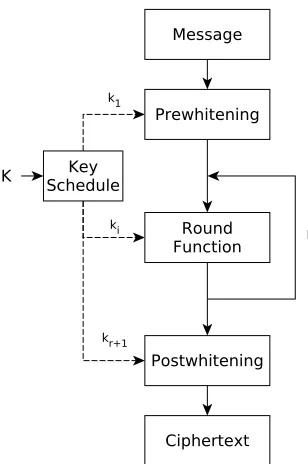
Most of the modern block ciphers are iterative (Fig. 1). Usually a round function is run multiple times with different parameters (round keys). An arbitrary iterative block cipher can be mathematically described as follows
EK(M) =P Wkr+1 ◦
r Y
i=2
(Rki)◦IWk1(M),
where R is a round procedure, IW is a prewhitening procedure and P W is a postwhitening procedure. In Fig. 1 a key schedule is an algorithm that takes a master key K as input and produces the subkeys k1, k2, . . . , kr+1
for all stages of encryption algorithm.
Figure 1: General Structure of An Iterative Block Cipher
3
A Brief Description of AES
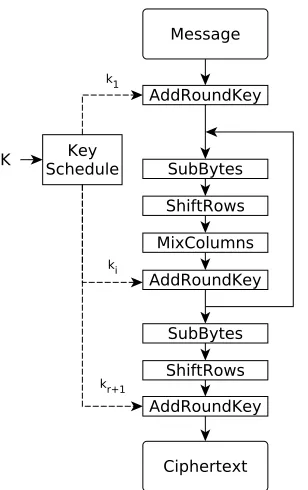
AES is a substitution permutation network (SPN) block cipher that sup-ports a fixed block size of 128 bits and a key size of 128, 192 or 256 bits [6]. The number of rounds depends on the key size and is equal to 10, 12 or 14, respectively. The round function consists of four functions: AddRoundKey (σk), SubBytes (γ), ShiftRows (π) and MixColumns (θ).
The entire encryption algorithm is described as follows (Fig. 2)
EK(M) =σkr+1 ◦π◦γ ◦
r Y
i=2
Figure 2: Encryption Algorithm of AES
The SubBytes transformation processes the state of the cipher using a nonlinear byte substitution table that operates on each of the state bytes independently [6]. The S-box of AES was generated by finding the inverse element in the field F28 followed by applying affine polynomial. In terms
of equation (1) the transformation has the form
F(x) = A1(x−1) =L1(x−1) +c1.
The substitution table generated by vectorial Boolean function F :
F28 7→ F28 satisfies the following criteria
• the maximum value of non-trivial XOR difference transformation prob-ability is 2−6,
• the maximum absolute value of linear approximation probability bias is 2−4,
It should be noticed that the chosen polynomial x−1 allows to describe the S-box and the entire cipher by overdefined system of equations of degree 2 [19]. But in the same time it gives resistant to differential, linear and many other cryptanalytical methods. In addition to the general properties, the constant of the AES S-box has been chosen in such way that it has no fixed points [5].
The MixColumns transformation takes all the columns of the state and mixes their data (independently of one another) to produce new columns [6]. This transformation can be represented in different ways. One of them is the matrix multiplication. For an input state x and 4×4 matrix M the output state y of the transformation is described as
y = M ·x.
The matrix with maximum distance separable (MDS) property is used in AES. In terms of Rijndael the MDS property associates with a branch number (β)
β = min
x6=0(W(x) +W(y)),
where W(z) is the byte weight of a vector z.
From the definition of MDS matrix, it is known that the maximum differential branch number of m by mmatrix is m+1 [11, 20]. Hence, MDS matrices have the perfect diffusion property for byte-oriented ciphers.
Multiplication in a field F2n is a linear transformation with respect to
XOR, so it preserves the linear property [9]
θ(x+y) = θ(y) + θ(y).
The ShiftRows transformation processes the state by cyclically shifting the last three rows of the state by different offsets [6]. More precisely, row i is moved to the left by i byte positions for 0 ≤ i ≤ 3. The ShiftRows is also a linear function that preserves π(x+y) = π(y) +π(y) property.
AddRoundKey transformation is the mixing key function in which a round key is added to the state using XOR operation. The length of a round key is equal to the size of the state. XOR operation of two n-bit length vectors a and b can be performed bit by bit n times. Therefore, AddRoundKey operation of AES can be done independently of each byte.
4
A New Cipher Isomorphic to AES
There exist several examples of ciphers isomorphic to AES. For example, the big encryption system (BES) describes AES over F28 [9]. On the other
hand, the cipher AES can be also represented as the system of multivariate equations of the 2nd degree over F2 [19]. These two examples are based
on the algebraic features of the substitution. However, there is another approach based on linear properties of the basic functions (MixColumns and ShiftRows).
The cipher AES is based on Rijndael that was proposed by Daemen and Rijmen to AES process [21]. Authors have used design simplicity principle, which led to performance improvement and code compactness properties of the cipher on a wide range of platforms. For increasing decryption per-formance of software implementation they have used precomputed lookup tables and the linear properties of the basic functions.
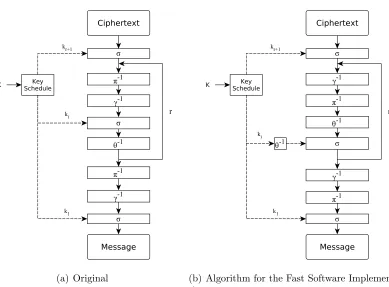
The original decryption algorithm for arbitrary ciphertextC mathemat-ically can be represented as follows (Fig. 3(a)) [6]
DK(C) =σk1 ◦γ
−1 ◦π−1 ◦
r Y
i=2
(θ−1 ◦σkr−i+2 ◦γ
−1 ◦π−1)◦σ
kr+1(C).
For using precomputed tables it is necessary to transform the decryption round function to the similar one of encryption algorithm. Since functions γ−1 andπ−1 are computed independently they have the commutative prop-erty γ−1 ◦π−1 = π−1 ◦γ−1 [5, 9]. In Section 3 it was stated that functions θ−1 and σ are linear w.r.t. XOR, hence
θ−1 ◦σkr−i+2 = σθ−1(k
r−i+2) ◦θ
(a) Original (b) Algorithm for the Fast Software Implementa-tion
Figure 3: Decryption Algorithm of AES
Thus, the whole decryption algorithm has the form (Fig. 3(b))
DK(C) = σk1 ◦π−1 ◦γ−1 ◦
r Y
i=2
(σθ−1(k
r−i+2)◦θ
−1 ◦
π−1 ◦γ−1)◦σkr+1(C).
Usage of such elementary transformations helps to achieve a significant acceleration of the decryption procedure due to the isomorphic properties of the basic functions [5].
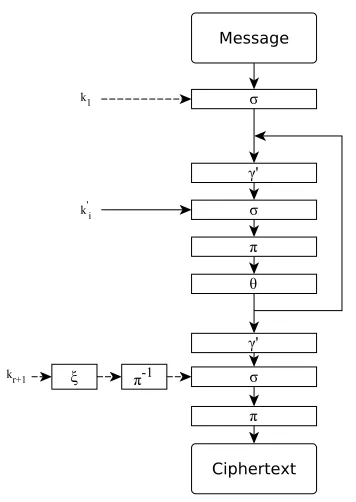
Obviously, the same technique can be applied to the encryption algo-rithm. However, the task is to find a representation of the cipher in which properties of a new substitution will differ from the original one. For sim-plicity of description, let us assume that the round keys are independent of each other. Then the encryption procedure takes a form (Fig. 4(a))
EK(M) = π◦σπ−1(k
r+1) ◦γ ◦
r Y
i=2
(θ ◦π ◦σπ−1◦θ−1(k
(a) Modified Encryption Algorithm (b) Isomorphic Encryption Algorithm with a Fixed Point
Figure 4: Isomorphism of AES
The last equation shows that the final ShiftRows operation is redundant in terms of resistance to attacks. As it was stated above the availability of this function is necessary for fast implementation of the decryption proce-dure.
Arbitrary permutationS can be represented as a vectorial Boolean func-tion F : F2n 7→ F2n which has the form [3]
F(x) = F0(x) +F(0).
Since the characteristic of the field is 2, the constant can be moved to the round keys. Let ξ be a function in which the constant F(0) is XORed with all bytes of a state. If the round keys π−1 ◦θ−1 ◦ξ(ki) are denoted by k0i then encryption procedure takes the form (Fig. 4(b))
EK(M) = π◦σπ−1◦ξ(k
r+1)◦γ
0◦ r Y
i=2
where γ0 is the SubBytes function which consists of the substitution of the form F(x) =L(x−1).
Fig. 4(b) shows that the structure of the cipher remains unchanged. Clearly, if an adversary finds a round key for modified cipher she also au-tomatically obtains corresponding round key of the original cipher because of the linear dependence of the keys ki and k0i. However, the new substi-tution F(x) = L(x−1) has the fixed point in x = 0. Consequently, the substitution of AES doesn’t satisfy the absence of fixed points criterion.
Described features of the cipher appears from the fact that the oper-ation XOR is linear with respect to MixColumns and ShiftRows. If one replaces AddRoundKey with some nonlinear function (i.e. based on addi-tion modulo 2n), then it will be impossible to find an isomorphic cipher of such a form. From this point of view a mixed key function based on modulo addition is cryptographically stronger than a function based on XOR operation .
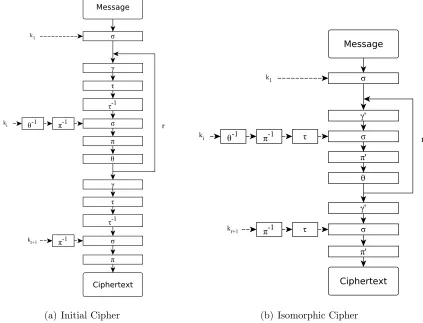
Furthermore, fixed points are directly connected with cyclic properties of substitutions. Inserting an invertible linear function (τ) into the en-cryption procedure gives a new isomorphic cipher (Fig. 5(a)). Herewith, the linearized polynomial can be added to the round key and the inverse function can be a part of the new substitution (Fig. 5(b)). The cyclic properties of the new substitution will depend on the selected function τ.
Thereby, the cyclic and the absence of fixed points properties of a sub-stitution can be controlled by adversary in the case of a linear mixing key function. Thus, a new criterion for substitutions follows from the descrip-tion above.
Proposition 2 SubstitutionsS1, S2, . . ., Sn used in a confusion layer must belong to different classes of equivalence.
(a) Initial Cipher (b) Isomorphic Cipher
Figure 5: Modified AES with an Invertible Linear Function
sense to check whether substitutions belong to different CCZ-equivalence classes.
5
Conclusions
It was shown that the absence of fixed points criterion works only in case if S-box is considered as a separate function. There are isomorphic repre-sentations of ciphers in which this criterion is not met. The new method of AES description allows to reconsider some of criteria for substitutions from the practical point of view. This may lead to a weakening of the cipher strength.
proce-dure, the adversary can control both the cyclic and absence of fixed points properties of substitutions. It was shown that mixing key function based on modulo addition is more resistant with respect to the absence of fixed points criterion than function based on XOR operation.
Isomorphism of ciphers adds additional restrictions on using multiple substitutions. The proposed criterion can be used to reduce the probability of finding the weakest one.
References
[1] Crama Y., Hammer P.L. Boolean Models and Methods in Mathemat-ics Computer Science, and Engineering. Encyclopedia of MathematMathemat-ics and its Applications // Cambridge University Press. — 2010.
[2] Rijmen V. Cryptanalysis and design of iterated block ciphers, PhD Thesis. // University of Leuven: 1997.
[3] Budaghyan L., Kazymyrov O. Verification of Restricted EA-Equivalence for Vectorial Boolean Functions // Lecture Notes in Com-puter Science. — 2012. — V. 7369. — P. 108-118.
[4] Carlet C., Charpin P., Zinoviev V. Codes, Bent Functions and Permu-tations Suitable For DES-like Cryptosystems // Designs, Codes and Cryptography. — 1998. V. 15 No 2. — P. 125156.
[5] Daemen J., Rijmen V. AES Proposal: Rijndael. — http://csrc.nist.gov/archive/aes/rijndael/Rijndael-ammended.pdf, 10.03.2013.
[6] Announcing the ADVANCED ENCRYPTION STANDARD (AES) // Federal Information Processing Standards Publication 197, United States National Institute of Standards and Technology (NIST). — 2001.
[8] Rimoldi A. On algebraic and statistical properties of AES-like ciphers, PhD Thesis // University of Trento: 2009.
[9] Murphy S., Robshaw M. Essential Algebraic Structure within the AES // Lecture Notes in Computer Science. — 2002. — V. 2442. — 1-16.
[10] Bard G.V. Algebraic cryptanalysis // Springer. — 2009.
[11] Knudsen L.R., Robshaw M. JB. The block cipher companion // Springer. — 2011.
[12] Carlet C. Vectorial Boolean functions for cryptography. // Boolean Models and Methods in Mathematics, Computer Science, and Engi-neering 134. — 2010. P. 398-469.
[13] Budaghyan L., Carlet C., Pott A. New classes of almost bent and almost perfect nonlinear polynomials // IEEE Trans. Inform. Theory. — 2006. — P. 11411152.
[14] Biham E., Shamir A. Differential Cryptanalysis of DES-like Cryp-tosystems // Lecture Notes in Computer Science. — 1991. — V. 537. — P. 2-21.
[15] Matsui M. Linear cryptanalysis method for DES cipher // Lecture Notes in Computer Science. — 1994. — V. 765. — P. 386-397.
[16] Burnett L. D. Heuristic Optimization of Boolean Functions and Substi-tution Boxes for Cryptography, PhD Thesis // Queensland University of Technology: 2005.
[17] Kazymyrov O., Kazymyrova V. Algebraic Aspects of the Russian Hash Standard GOST R 34.11-2012. — http://eprint.iacr.org/2013/556.pdf. — 04.09.2013.
[18] Nyberg K. Perfect nonlinear S-boxes // Lecture Notes in Computer Science. — 1991. — V. 547. — P. 378-386.
[20] Ailan W., Yunqiang L., Xiaoyong Z. Analysis of Corresponding Struc-ture of Differential Branch of MDS Matrixes on Finite Field // Pro-ceedings of the 2010 Third International Conference on Intelligent Net-works and Intelligent Systems, ICINIS’10. — Washington, DC, 2010. — P. 381-384.
[21] Nechvatal J. et al. Report on the development of the Advanced En-cryption Standard (AES) // Technical report DTIC Document. — 2000.
[22] Kwon D. et al. New Block Cipher: ARIA // Proc. Information Security and Cryptology, ICISC 2003. — Berlin, 2004. — P. 432445.
[23] Oliynykov R. et al. Results of Ukrainian Na-tional Public Cryptographic Competition. — http://www.sav.sk/journals/uploads/0317154006ogdr.pdf,