Journal
Long-term Grazing Effects on Stipa-Bouteloua Prairie Soils ____ __..._.___. _.._ _._._..__.____._____ _ _-....-._-_.________----_-..________________--..___.___-____ S. Smoliak, J. F. Dormaar, and A. Johnston 246 Effects of Wildfire on Timber and Forage Production in Arizona _____ _.._.___... __._______._
_-_._-.-_-.____-________-___---.--..___.____---_--__-- H. A. Pearson, J. R. Davis, and G. H. Schubert 250 Development of Grass Root Systems as Influenced by Soil Compaction __.__.__._..._____._
_____________________-_____-_---_---_---_--__---__---_--- D. W. Fryrear and W. G. McCully 254
Cattle Use of a Sprayed Aspen Parkland Range _______________________.___._______.__..____________________ James E. Hilton and Arthur W. Bailey 257
An Economic Evaluation of Buffelgrass in ParaguayRE ____________________--__---_--- _____--.____________---_____________________---_---_---_____--__---_ James R. Simpson and Ruben Fretes 261
Methods for Seeding Three Perennial Wheatgrasses on Cheatgrass Ranges
in Southern Idaho ________________________________________________ G. J. Klomp and A. C. Hull, Jr. 266 Ten Year Yield Response of Beardless Wheatgrass from a Single
Nitrogen Application _____..__._._._____._._.__..____ ______.. J. L. Mason and J. E. Miltimore 269 Low Level Nitrogen and Phosphorus Fertilization on High Elevation Ranges ____
__--__-____-_________________________________________-__-___---__-_---_---_-_-__---___-_---__--_---_---__-- James E. Bowns Vegetation Analysis of Grazed and Ungrazed Alpine Hair-grass Meadows .__.__________
_---_--._-____-.___-___~_______________-________________________________-_____________________-__-_--- Charles D. Bonham Response of Understory Species Following Herbicidal Control of Low Sagebrush
______________________--__ Richard E. Eckert, Jr., Allen D. Bruner, and Gerard J. Klomp Phreatic Tendencies of Exotic Grasses and Residual Species as Indicated by
Radioisotope Absorption _. J. H. Robertson, Clifton Blincoe, and Clark Tore11
Herbicidal Control of Western Ragweed in Nebraska PasturesRE _____________________-_________ ____________________--__---.________________________________._______.___ M. K. McCarty and C. J. Scifres
Forage and Serum Phosphorus Values for Bighorn Sheep ____________ Daryll M. Hebert A Model for the Stratification of Dairy and Mutton Sheep Breeds in Middle
Eastern Deserts ____________________---.---_-___--- _________________________________----____ M. Morag An Analysis of the Beta-Attenuation Technique for Estimating Standing Crop of
Prairie Range _____________________________._______________________________________-______----_-__---- J. E. Mitchell Thrips of the Sagebrush-Grass Range Community in West-Central Utah ________________
_---_---__--_---__-_____ Ward M. Tingey, Clive D. Jorgensen, and Neil C. Frischknecht Redberry Juniper Control with Soil-Applied Herbicide@ _______._.____._____ C. J. Scifres Technical Notes
Critical Soil Moisture Levels for Field Planting Four-wing Saltbush ________________
_____________________________________________________________________________________-______________________ Earl F. Aldon The Sickledrat: A Circular Quadrat Modification Useful in Grassland Studies
_______________._---_---__.---_---.-___________-______--__..___-___._---________________-___-- Robert K. Kennedy
Rapid Point Survey by Bayonet Blade ____________________________________________________________ Paule S. Poissonet, Philippe M. Daget, Jacques A. Poissonet, and Gilbert A. Long
Management Notes
Thrice-Weekly Supplementation Adequate for Cows on Pine-Bluestem Range _.___._ H. A. Pearson and L. B. Whitaker Acreage Increase Due to Slope __._ ..____________.____._____.__ ____________ E. William Anderson Viewpoints
Semidesert Ecosystems-Who Will Use Them? How Will We Manage Them? ._____ _ S. Clark Martin
Book Reviews ______________________---___----___-______________.____________________----._---____.__________._.._______..______ RE = Con Resumen en Espafiol
273
276
280
285
290 292
296
300
304 308
311
312
313
315 316
317 320
Cover
Photo-Awassi
Sheep Grazing on Bluebush (Kochia
breuifo~ia) Near Omer, in the Negev Desert, Israel.Long-term Grazing Effects on
Stz>a-Bouteloua
Prairie Soils
S. SMOLIAK, J. F. DORMAAR, AND A. JOHNSTON Range Ecologist, Soil Scientist, and Range Ecologist,
Research Station, Canada Department of Agriculture, Lethbridge, Alberta.
Highlight
The effects of grazing on Stipa-Bouteloua prairie soils in Alberta were eval- uated after 19 years of continuous summer use by sheep at three stocking inten- sities. Analysis of the soils under the heavy grazing treatment showed lower values for pH and percent spring moisture but higher values for total carbon (C), alcohol/b enzene-extractable C, alkaline-soluble C, polysaccharides, and belowground plant material than the soil under light or no grazing. The results were attributed to changes in amounts and kinds of roots due to species changes caused by grazing and to increased amounts of manure deposited by sheep on fields grazed at a higher intensity. Shallow-rooted species replaced the deeper- rooted ones on the drier environment induced by heavy grazing.
Grazing studies have emphasized plant-animal relationships and have usually considered range soils only in relation to damage by erosion. But the kind of vegetation affects and modifies the soil on which it grows (Humphrey, 1962). Hence, changes in vegetation caused by grazing animals should affect and modify soil of grazed fields.
Results of a study of long-term grazing effects on fescue grassland soils (Johnston et al., 1971) showed that very heavy grazing by cattle of range that previously had been lightly grazed changed the color of the Ah horizon from black to dark brown and the pH from 5.7 to 6.2, reduced percent organic matter, decreased percent soil moisture, re- duced percent total P but increased available P, and increased soil tem- perature. We suggested that the re- sults reflected increased use of vegetation by cattle and, hence, increased erosion from the more heavily grazed fields.
The purpose of this study was to assess long-term effects of grazing by sheep on Stipa-Bouteloua prairie soils.
Materials and Methods The study site was at the Canada Department of Agriculture Re- search Substation, Manyberries, Al- berta, where the vegetation is that
l Received May 3, 1971.
of the mixed prairie (Coupland, 1961), the climate is semiarid, and the annual precipitation averages about 31 cm. The soil is a member of the Brown Subgroup of the Solod Great Group of the Solonetzic Order. It has a leached Ae horizon and a strongly columnar B horizon. Numerous shallow, eroded pits are present throughout the area. Pro- file description is:
Ah O-10 cm Brown (1OYR 4/3- 5/3, dry), loam to sandy loam, weak platy to granular. Ae lo-14 cm Grayish to pale
brown (IOYR 5/2- 6/3, dry), loam, platy.
Bnt 14-27 cm Pale brown (10YR 6/3, dry), clay
loam to sandy clay loam, round- topped columnar. Cca At 27 cm Light brownish
gray (1OYR 6/2, dry), massive.
In 1950 the study site was divided into three fields. Prios to 1950 the area was lightly grazed by sheep. From 195 1 these fields were grazed by ewes with lambs from about May 1 to November 1 each year. The grazing treatments were: light, 2.5 hectares per animal unit month (AUM); moderate, 2.0 ha/AUM; and heavy, 1.7 ha/AUM. A nearby exclosure, protected since 1928,
246
served as an ungrazed control. Per- centage basal area of vegetation was determined by the vertical point method in August 1950 and 1969.
GRAZING
AND
PRAIRIE
SOILS
Table 1. Basal area (%) of vegetation on study areas at and 1969.”
Manyberries, 1950
Percentage total C, alcohol / ben- zene-extractable C, alkaline-soluble C, exchangeable acidity, and the C/N ratio increased whereas per- cent soil moisture, soil pH, and ex- changeable calcium (Ca) and so- dium (Na) decreased with increased grazing intensity (P < .05, Table 3). There were no significant dif- ferences in color, texture, moisture tension, bulk density, N, total and available P, exchangeable potas- sium (K), and cation exchange capacity (CEC).
247
Species
Blue grama Needle-and-thread Western wheatgrass 0 ther grasses Low sedge Forbs and shrubs Little club moss
Study areas in 1969 by Study area grazing treatments
in 1950 Ungrazed Light Moderate Heavy
2.0 0.3 2.4 2.8 3.6
0.6 2.2 1.3 1.2 0.5
1.4 1.3 1.7 1.2 0.7
1.3 1.4 1.6 1.5 1.1
0.9 0.4 0.5 0.8 1.1
0.5 0.4 0.7 0.9 0.4
7.1 9.6 18.7 22.6 26.0
* Each value is the mean of 4200 points.
A respiratory study was con- ducted on soils from the heavily- grazed and ungrazed fields. Dupli- cate 100 g samples of soil were placed in a respiration apparatus and incubated at 28 C with mois- ture maintained at 200 mbar or about 18%. Evolved CO2 was ab- sorbed in approximately 1 N NaOH,
and amounts were determined by differential titration using a Beck- man automatic titrator. Glucose, equivalent to 2000 ppm C, was added to half of the samples. The general procedure is described by Chandra and Bollen (1960) and by Bollen and Ku (1961). Results were plotted as accumulative difference in C released (mg/lOO g) as CO2 from glucose-treated and untreated soil.
Ten soil cores, 6.5 x 60 cm, were
obtained from each field, and amounts of belowground plant ma- terial by 15 cm increments were measured. Hot-water-soluble car- bohydrate content of belowground plant parts from the upper 15 cm increment of the soil profile was determined (Deriaz, 1961) .
Results Vegetation
Species composition of the vege- tation changed as a result of graz- ing. Percentage basal area of blue grama (Bouteloua gracilis (HBK.)
2 We are grateful to Dr. J. L. Neal, Soil Microbiologist, who conducted .the respiration study reported herein.
Lag.), low sedge (Carex eleocharis
Bailey), and little club-moss (Sela-
ginella densa Rydb.) increased with increased grazing pressure whereas that of needle-and-thread (Stipa corn&a Trin. and Rupr.) and west- ern wheatgrass (Agropyron smithii
Rydb.) decreased (Table 1). Weight of belowground plant parts in the upper 15 cm and in the O-60 cm increments of the soil pro- file increased significantly as graz- ing pressure increased, did not dif- fer significantly in the 15-30 and 30-45 cm depths, but decreased significantly at the 45-60 cm depth (Table 2). Water-soluble carbohy- drate content of belowground plant parts from the upper 15 cm incre- ment was significantly greater under light or no grazing than under moderate or heavy grazing.
Soil
Amounts of polysaccharides in the Ah horizon of soil of the fields in- creased significantly with grazing in- tensity and paralleled the amounts of manure deposited by sheep dur- ing the study. The amounts of poly- saccharides were 20 1, 2 19, 229, and 262 mg/ 100 g of soil from the un- grazed, lightly grazed, moderately grazed, and heavily grazed fields, respectively. Estimated amounts of manure deposited were 3,100, 3,800, and 4,400 kg/ha on the light, mod- erate, and heavily grazed fields, re- spectively. Analysis of soil outside and inside the holding pens showed that polysaccharides totalled 240 and 532, 293 and 533, and 400 and 706 mg/ 100 g of soil from the lightly grazed, moderately grazed, and heavily grazed fields, respec- tively.
Table 2. Weight and water-soluble carbohydrate content of belowground plant parts of study areas grazed at various rates for the previous 19 years at Many- berries, 1970. *
Measurement
and depth Ungrazed
Grazing treatments
Light Moderate Heavy
Belowground plant biomass (kg/ha)
O-15 cm 14,955 a 16,163 ab 18,946 b
15-30 cm 2,681 a 2,663 a 2,413 a
30-45 cm 2,120 a 2,495 a 1,877 a
45-60 cm 1,330 a 861 b 457 b
Total 21,086 a 22,182 a 23,693 a
Water-soluble carbohydrate content of roots (mg/g)
O-15 cm 22.0 a 21.4 a 17.6 b
24,038 b 2,529 a 2,299 a 599 b 29,465 b
14.8 b
248 SMOLIAK ET AL.
Table 3. Characteristics of Ah horizon of soil from the study areas various rates for the previous 19 years at Manyberries, 1970.”
grazed at
1.5 bar tension (%) Bulk density (g/cm3) Total C (%) Total N (%) NO,-N (pglg> C/N ratio
Grazing treatments
Characteristic Ungrazed Light Moderate Heavy / Color (dry) 1OYR 4/3 1OYR 5/3 IOYR 5/3 1OYR 513 Texture
sand (%) 53 a 51 a 51 a 52 a
clay (%) 17 a 16 a 15 a 15 a
Soil moisture
April 1970 (%) 19.0 a 15.1 b 15.0 b 11.1 c 200 mbar tension (%) 18.4 a 17.4 a 17.2 a 17.0 a 6.7 a 6.1 a 6.5 a 1.25 a 1.28 a 1.28 a 1.15 ab 1.16 ab 1.38 b 0.12 a 0.11 a 0.12 a 0.68 a 0.78 a 1.00 a 9.9 b 10.4 b 10.3 b
0.065 a 0.078 b 0.079 b
15.5 a 17.2 b 18.0 bc 19.5 c 0.035 a 0.035 a 0.032 a 0.035 a 2.5 a 2.6 a 2.5 a 2.3 a 6.4 a 6.3 ab 6.0 b 5.8 b
8.57 a 5.84 b 5.04 b 4.75 b 0.70 a 0.74 a 0.65 a 0.68 a 0.31 a 0.22 b 0.23 b 0.20 b
2.60 a 2.72 a 2.92 a 3.40 b 15.1 a 13.7 a 13.7 a 13.2 a 7,3 a
1.27 a 1.10 a 0.12 a 0.53 a 9.1 a Alcohol/benzene-
extractable C (%) 0.054 a Alkaline-soluble C
(% of total C) Total P (%) Available P (pg/g) Soil pH (CaC12) Exchangeable cations
Ca (meq/lOO g) K @q/l00 g) Na (meq/lOO g) Exchangeable acidity
(pH 8.1 (meq/lOO g) CEC (meq/lOO g)
* Values are means of two determinations on each of ten samples. Means in the same row followed by the same letter do not differ significantly at the 5yo level (Duncan’s multiple range test).
The accumulative difference be- 0.6 kg/ha N; 0.09, 0.12, and 0.15 tween the CO2 released by the kg/ha P; and 0.16, 0.21, and 0.25 glucose-treated and the untreated kg/ha Ca from the fields grazed at soil was greater for soil samples the light, moderate, and heavy in- from the heavily grazed than from
the ungrazed fields after 10 days tensity, respectively. amounts of elements contained The estimated in (Fig. 1).
With few exceptions, correlation the Ah horizon in the ungrazed coefficients among various soil fac- field were 2,700 kg/ha N, 780 kg/ha tors were highly significant (Table P, and 8,700 kg/ha Ca.
4).
Amounts of elements removed Discussion
by animals from soil of the grazing Increased grazing pressure had fields were low in relation to total little effect on physical character- amounts in the profile. The esti- istics of the soil such as texture, mated amounts of elements re- moisture tension, and bulk den- moved annually were 0.3, 0.5, and sity (Table 3); or on total and avail-
able P and N content. But a num- ber of significant changes did occur. The pH changed from 6.4 under no grazing to 5.8 under heavy grazing. Total C, alcohol/benzene- extractable C, alkaline-soluble C, and polysaccharides all increased with increasing grazing pressure. Most of these soil characteristics were significantly correlated (P < 0.05, Table 4). However, the corre- lation of total C content with alkaline-soluble C was low and not significant. It was likely that the increase did not occur simulta- neously, that is, the total C in- creased relatively less than did the alkaline-soluble C, when considered as percent in the soil. Usually a negative relationship exists between alkaline-soluble C and exchange- able Ca; however, in this study the relationship was not significant.
Although data obtained in labo- ratory respirometers, in which soil was wetted and treated with glu- cose, cannot be extrapolated to field conditions, the effect of dif- ferent grazing intensities on poten- tial in vitro decomposition rates can be studied using this technique. The greater difference in CO, re- lease between untreated and glu- cose-treated soils in heavily grazed than in ungrazed areas was expected because of the greater amount of total belowground plant biomass (Table Z), total C, NO,-N (Table 3), and the polysaccharide content of belowground plant materials in the heavily grazed areas than in the ungrazed ones.
Soil compaction on the fields grazed by sheep was not a problem on these generally dry soils. There were no differences in bulk density of soil from grazed or ungrazed fields. Soil compaction by trampling has been reported in other studies (Humphrey, 1962).
GRAZING
AND PRAIRIE
SOILS
Heavily grazed (1.7 ha/AUM)
Legend
BaselIne - Average C aa CO, accumulation of soil without glucose
0 IO 20 30 40 50 60
OOYS
FIG. 1. Potential accumulative decomposition of soil organic matter from the ungrazed enclosure and from a field heavily grazed for the previous 19 years, Manyberries, 1970.
blue grama. Coupland and John- upper portion of the soil profile. son (1965) have shown that depth of Under heavy grazing, soil moisture rooting of blue grama averaged 19 in spring was significantly lower cm less than needle-and-thread and than under no grazing. Beebe and 29 cm less than western wheatgrass. Hoffman (1968) found that where Both blue grama and little club- heavy grazing had significantly re- moss have roots near the soil surface duced the vegetation cover both soil and, hence, are well adapted to con- surface temperatures and evapora- ditions where moisture during the tion rates increased. The greater growing season is confined to the concentration of roots at the 45-60
cm level on the ungrazed site than on the grazed fields shows the effect, noted also by Lorenz and Rogler (1967), of herbage removal by graz- ing., As intensity of grazing in- creased, water-soluble carbohydrate content of the roots decreased. Kin- singer and Hopkins (1961), Jameson (1963), and Troughton (1957:56) ob-
tained similar results.
The addition of feces and urine may add growth-promoting sub- stances to the soil and thereby aid root growth (Jameson, 1963). Since these substances would . generally be present at shallow depths (Kon- onova, 1966:340), one would expect the proportion of roots at this depth to increase as intensity of grazing increased (Table 2). Kononova (1966:340) concluded that as ma- nure enriches the soil it increases the content of mobile forms of humic acids in the composition of humus. Also, root production by plants is vigorous in the presence of water-soluble humus substances. This study indicates that con- tinued heavy grazing of Stifxz-Bou- teloua prairie not only changes the vegetative cover but also some of the soil properties in the Ah hori- zon. Part of the changes in the soil were induced through a reduction
Table 4. Correlation coefficients to show relationships among environmental factors, Manyberries, 1970 (n = 40). ---~~~~~~~~~~~~~~~~~~~~~~~-~__________________________ ______________________~_~~~~~~~~~~~~~~~---
1. 2. 3. 4. 5. 6. 7. 8. 9. 10. 11. 12.
1.
2.
3.
4.
5.
6.
7.
a.
9.
10.
11.
12.
13.
Sand in Ah (X)
Clay in Ah (X)
Soil moisture - 200 mbar tension (2)
Soil moisture - 15 bar tension (2)
C (%)
N (2)
Alcohol/benzene-extractable C (X)
Polysaccharides (mg/lOO g)
Alkaline-soluble C (X of total C)
Total P (X)
CEC (meq/lOO g)
Exchangeable cations
Exchangeable cations
Ca (meq/lOO g)
K (maq/lOO g) 1.000
-0.628** 1.000
-0.795** 0.792** 1.000
-0.596** 0.724** 0.865**
-0.741** 0.551** 0.751**
-0.633** 0.542** 0.737**
-0.671** 0.292 0.560**
-0.691** 0.410** 0.689**
-0.113 -0.029 -0.020
-0.636** 0.713** 0.810**
-0.521** 0.576** 0.737**
-0.279 0.603** 0.687**
-0.702** 0.707** 0.812** 1.000
0.672**
0.692**
0.374*
0.702**
-0.024
0*779*x
0.789**
0.7a7**
0.885** 1.000
0.933**
0.752**
0.886**
0.122
0.726**
0.713**
0.341*
0.698** 1.000
0.604** 1.000
o.a41** 0.711** 1.000
-0.018 0.243 0.220 1.000
0.776** 0.366* 0.615** -0.090 1.000
o.i321** 0.317* 0.689** -0.066 0.7a3** 1.000
0.431** 0.061 0.407** -0.213 0.581** 0.601**
0.628** 0.503** 0.694** 0.054 0.?21** 0.670** 1.000
250 PEARSON, DAVIS, 4ND SCHUBERT
in rooting depth resulting from spe- BRINK, R. H., P. DUBACH, AND D. L. effects on fescue grassland soils. J ties change in which shallow-rooted LYNCH. 1960. Measurements of car- Range Manage. 24: 185-188.
species replaced the deep-rooted bohydrates in soil hydrolysates with KINSINGER, F. E., AND H. H. HOPKINS, ones, and part was due to increased anthrone. Soil Sci. 89: 157-166. 1961. Carbohydrate content of un- amounts of manure deposited by CHANDRA, P., AND W. B. BOLLEN. 1960. derground parts of grasses as affected sheep on the more heavily grazed Effect of wheat straw, nitrogenous by clipping. J. Range Manage. 14: fields. fertilizers, ratio on organic decomposition in a and carbon-to-nitrogen KONONOVA, 9-12. M. M.
subhumid soil. Agr. Food Chem. 8: 1966. Soil organic
Literature Cited 19-24. matter. Pergamon Press, New York, N.Y. 544 p.
BEEBE, J. D., AND G. R. HOFFMAN. COUPLAND, R. T. 196 1. A reconsider- LORENZ, R. J., AND G. A. ROGLER. 1968. Effects of grazing on vegeta- ation of grassland classification in 1967. Grazing and fertilization af- tion and soils in southeastern South the Northern Great Plains of North
America. J. Ecol. 49: 135-167. feet root develospment of range Dakota. Amer. Midl. Natur. 80:96-
COUPLAND, R. T., AND R. E. JOHNSON. grasses. J. Range Manage. 20:129-
110. 132.
BLACK, C. A. 1965a. Methods of soil 1965. Rooting characteristics of MUNSELL SOIL COLOR CHARTS. 1954. analysis. Part 1. Physical and min- native grassland species in Saskatch- Munsell Color Co. Inc., Baltimore, erological properties. Agronomy 9: DERIAZ, R. E. 1961. Routine analysis ewan. J. Ecol. 53:475-507. Md. Loose-leaf. np.
l-770.
BLACK, C. A. 1965b. Methods of soil of carbohydrates and lignin in herb-
TROUGHTON, A. 1957. The under-
analysis. Part 2. Chemical and mi- age. J. Sci. Food Agr. 12:152-160.
ground organs of herbage grasses. HUMPIIREY, R. R. 1962. Range ecol- Commonwealth Bur. Pastures and
crobiological properties. Agronomy Field Crops Bull. 44. 163 p.
9:771-1572. ogy. The Ronald Press Co., New York, N.Y. 234 p. UNITED STATES SALINITY LABORATORY BOLLEN, W. B., AND K. C. Ku. 196 1. JAMESON, D. A. 1963. Responses of STAFF. 1954. Diagnosis and im-
Microbial decomposition and nitro- individual plants to harvesting. Bot. provement of saline and alkali soils. gen availability of reacted sawdust, Rev. 29:532-594. U.S. Dep. Agr. Handbook 60. Gov- bagasse, and coffee grounds. Agr. JOHNSTON, A., J. F. DORMAAR, AND S. ernment Printing Office, Washing- Food Chem. 9:9-15. SILIOLIAK. 197 1. Long-term grazing ton, D.C. 160 p.
* * 9
Effects of Wildfire on Timber and
Forage Production in Arizona
H. A. PEARSON, J. R. DAVIS, AND G. H. SCHUBERT
Principal Range Scientist, Associate Forest Fuels Specialist, and Principal Silviculturist, respectively, Rocky Mountain Forest and Range Experiment Station,1 Flagstaff, Arizona.
Highlight
A severe May wildfire decimated an unthinned ponderosa pine stand in northern Arizona, while an adjacent thinned stand was relatively undamaged. Radial growth increased on burned trees where crown kill was less than 60% and decreased where crown kill was more than 60%. Burning initially stimulated growth of herbaceous vegetation in both stands. Herbage nutrient value was temporarily enhanced due to burning. Artificially seeded areas produced most herbage 2 years after burning.
Wildfire is a constant threat to ponderosa pine forests in the Southwest, but little has been pub- lished about effects of severe wildfire on lesser vegetation. In this case history, both ponderosa
l Forest Service, U.S. Department of Agriculture, with cen- tral headquarters maintained at Fort Collins in cooperation with Colorado State University; authors stationed at Flag- staff in cooperation with Northern Arizona University. Pearson is now with the Southern Forest Experiment Sta- tion, Pineville, Louisiana.
pine and herbaceous vegetation were measured prior to and following a severe May wildfire in northern Arizona.
Study Area and Methods
In 1967, lightning started a wildfire in a ponderosa pine (Pinus ponderosa Laws.) stand north of Flagstaff. About 800 acres of pine timber were burned, including two exper- imental pastures on the Wild Bill Range (Pearson and Jameson, 1967). Since tree and herbage growth had been measured for 5 years prior, the fire provided an opportunity to evaluate the damage and recovery of the vegetation.
The study area burned May 9, 1967, during clear weather, 3 days after a light snow and rain storm (0.14 inch precipi- tation). The upper layer of litter was relatively dry, the lower litter was moist, and wind averaged 20 to 40 mph. The fire danger rating was high.
Before it burned, one pasture (unthinned) had an average of 126 f@/acre basal area of pine trees which had not been logged or thinned for many years. This uneven- aged stand included many young trees established in 1919 through natural regeneration, and some older trees dating back to the 1800’s. The other pasture had been thinned in 1963 to approximately 20 fta/acre.
The dense, unthinned stand in one pasture burned by crown fire with flames 30 to 40 ft above the tree tops. The thinned stand in the other pasture burned by ground fire with tree scorch several feet high on the boles.
250 PEARSON, DAVIS, 4ND SCHUBERT
in rooting depth resulting from spe- BRINK, R. H., P. DUBACH, AND D. L. effects on fescue grassland soils. J ties change in which shallow-rooted LYNCH. 1960. Measurements of car- Range Manage. 24: 185-188.
species replaced the deep-rooted bohydrates in soil hydrolysates with KINSINGER, F. E., AND H. H. HOPKINS, ones, and part was due to increased anthrone. Soil Sci. 89: 157-166. 1961. Carbohydrate content of un- amounts of manure deposited by CHANDRA, P., AND W. B. BOLLEN. 1960. derground parts of grasses as affected sheep on the more heavily grazed Effect of wheat straw, nitrogenous by clipping. J. Range Manage. 14: fields. fertilizers, ratio on organic decomposition in a and carbon-to-nitrogen KONONOVA, 9-12. M. M.
subhumid soil. Agr. Food Chem. 8: 1966. Soil organic
Literature Cited 19-24. matter. Pergamon Press, New York, N.Y. 544 p.
BEEBE, J. D., AND G. R. HOFFMAN. COUPLAND, R. T. 196 1. A reconsider- LORENZ, R. J., AND G. A. ROGLER. 1968. Effects of grazing on vegeta- ation of grassland classification in 1967. Grazing and fertilization af- tion and soils in southeastern South the Northern Great Plains of North
America. J. Ecol. 49: 135-167. feet root develospment of range Dakota. Amer. Midl. Natur. 80:96-
COUPLAND, R. T., AND R. E. JOHNSON. grasses. J. Range Manage. 20:129-
110. 132.
BLACK, C. A. 1965a. Methods of soil 1965. Rooting characteristics of MUNSELL SOIL COLOR CHARTS. 1954. analysis. Part 1. Physical and min- native grassland species in Saskatch- Munsell Color Co. Inc., Baltimore, erological properties. Agronomy 9: DERIAZ, R. E. 1961. Routine analysis ewan. J. Ecol. 53:475-507. Md. Loose-leaf. np.
l-770.
BLACK, C. A. 1965b. Methods of soil of carbohydrates and lignin in herb-
TROUGHTON, A. 1957. The under-
analysis. Part 2. Chemical and mi- age. J. Sci. Food Agr. 12:152-160.
ground organs of herbage grasses. HUMPIIREY, R. R. 1962. Range ecol- Commonwealth Bur. Pastures and
crobiological properties. Agronomy Field Crops Bull. 44. 163 p.
9:771-1572. ogy. The Ronald Press Co., New York, N.Y. 234 p. UNITED STATES SALINITY LABORATORY BOLLEN, W. B., AND K. C. Ku. 196 1. JAMESON, D. A. 1963. Responses of STAFF. 1954. Diagnosis and im-
Microbial decomposition and nitro- individual plants to harvesting. Bot. provement of saline and alkali soils. gen availability of reacted sawdust, Rev. 29:532-594. U.S. Dep. Agr. Handbook 60. Gov- bagasse, and coffee grounds. Agr. JOHNSTON, A., J. F. DORMAAR, AND S. ernment Printing Office, Washing- Food Chem. 9:9-15. SILIOLIAK. 197 1. Long-term grazing ton, D.C. 160 p.
* * 9
Effects of Wildfire on Timber and
Forage Production in Arizona
H. A. PEARSON, J. R. DAVIS, AND G. H. SCHUBERT
Principal Range Scientist, Associate Forest Fuels Specialist, and Principal Silviculturist, respectively, Rocky Mountain Forest and Range Experiment Station,1 Flagstaff, Arizona.
Highlight
A severe May wildfire decimated an unthinned ponderosa pine stand in northern Arizona, while an adjacent thinned stand was relatively undamaged. Radial growth increased on burned trees where crown kill was less than 60% and decreased where crown kill was more than 60%. Burning initially stimulated growth of herbaceous vegetation in both stands. Herbage nutrient value was temporarily enhanced due to burning. Artificially seeded areas produced most herbage 2 years after burning.
Wildfire is a constant threat to ponderosa pine forests in the Southwest, but little has been pub- lished about effects of severe wildfire on lesser vegetation. In this case history, both ponderosa
l Forest Service, U.S. Department of Agriculture, with cen- tral headquarters maintained at Fort Collins in cooperation with Colorado State University; authors stationed at Flag- staff in cooperation with Northern Arizona University. Pearson is now with the Southern Forest Experiment Sta- tion, Pineville, Louisiana.
pine and herbaceous vegetation were measured prior to and following a severe May wildfire in northern Arizona.
Study Area and Methods
In 1967, lightning started a wildfire in a ponderosa pine (Pinus ponderosa Laws.) stand north of Flagstaff. About 800 acres of pine timber were burned, including two exper- imental pastures on the Wild Bill Range (Pearson and Jameson, 1967). Since tree and herbage growth had been measured for 5 years prior, the fire provided an opportunity to evaluate the damage and recovery of the vegetation.
The study area burned May 9, 1967, during clear weather, 3 days after a light snow and rain storm (0.14 inch precipi- tation). The upper layer of litter was relatively dry, the lower litter was moist, and wind averaged 20 to 40 mph. The fire danger rating was high.
Before it burned, one pasture (unthinned) had an average of 126 f@/acre basal area of pine trees which had not been logged or thinned for many years. This uneven- aged stand included many young trees established in 1919 through natural regeneration, and some older trees dating back to the 1800’s. The other pasture had been thinned in 1963 to approximately 20 fta/acre.
The dense, unthinned stand in one pasture burned by crown fire with flames 30 to 40 ft above the tree tops. The thinned stand in the other pasture burned by ground fire with tree scorch several feet high on the boles.
WILDFIRE-TIMBER AND FORAGE 251
Table 1. Ponderosa pine measurements on burned and unburned areas for 1966 (prefire) and 1968.
Area
and Basal area (ft?/acre) Canopy cover (%) year Unthinned Thinned Unthinned Thinned
Unburned
1966 108.3 20.0 52.2 12.8
1968 106.7 19.2 55.8 14.7
Burned
1966 135.4 22.4 66.8 7.8
1968 4.2 20.0 2.0 9.2
squirreltail (Sitanion hystrix (Nutt.) J. G. Smith), sedge (Carex geophilu Mackenz.), and a variety of forbs. The pri- mary shrub was Fendler ceanothus (Ceanothus fendleri A. Gray). Exotic species seeded in June after the fire in a portion of the unthinned pasture included orchardgrass (Dactylis glomeruta L.) and intermediate wheatgrass (Agro- pyron in termed&m (Host) Beauv.).
Ponderosa pine density was measured by two methods at 45 mechanically spaced locations in each pasture. Tree basal area was measured at breast height by the Bitterlich plotless method (Grosenbaugh, 1952) with a lo-factor prism. Tree crown cover was measured with a spherical densitometer.
Tree growth data were obtained from an increment core extracted at breast height from the south face of 30 trees in the spring of 1969 to evaluate individual growth response. These trees were selected to cover the entire range of crown kill. Growth at breast height provided an estimate of re- sponse to thinning and to the burn.
Herbage production (ovendry) by species was determined by clipping and weighing the material under 45 caged plots in each pasture at the end of each growing season. These plots were established in 15 randomly located per- manent sampling clusters. Each cluster consisted of three permanent sampling plots at 50-ft intervals along a transect line. Of the 45 plots in each pasture, 24 of the thinned and 27 of the unthinned were burned.
Litter was recorded as present or absent at 0.5-ft intervals along fifteen 100-ft transect lines between the permanent herbage sampling clusters.
Green material from the four principal native forage species was collected seven times on burned and adjacent unburned areas from 1967 through 1969 for analysis of crude protein, phosphorus, and in vitro digestibility. Crude pro- tein and phosphorus were determined by standard methods (AOAC, 1960) and dry-matter digestibility was determined hy the two-stage in vitro technique (Pearson, 1969). Each species sample was a composite of material from approxi- ma tely 10 plants.
Results and Discussion Tree Density
The crown fire essentially eliminated the entire living pine stand on the unthinned area (Table 1). The only surviving trees were on a rocky knoll. On the other hand, there were no significant re- ductions in tree density (basal area or canopy cover) after the ground fire in the thinned stand, although tree boles were scorched several ft high and needle
r
0 20 40 60
Crown kill (Oh)
80 100
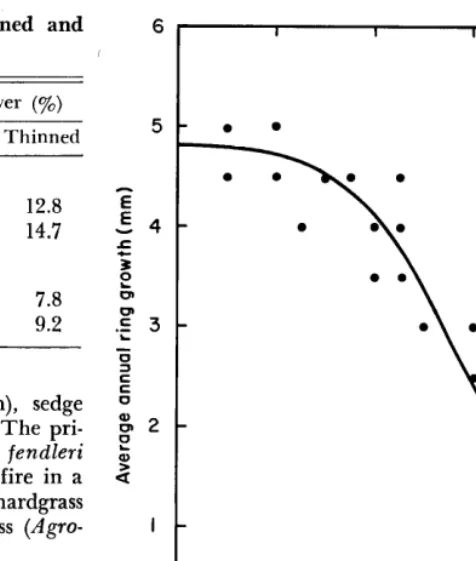
FIG. 1. Relation of diameter growth of ponderosa pine to crown kill by wildfire.
kill averaged 54%. Herman (1954) concluded that neither height of bark scorch nor presence of nearby fuels is related to tree survival. In the Wild Bill Fire, temperatures were high enough in the crowns to kill but not to ignite the needles. Unless needles are killed above the point of maximum crown width, a tree can sustain heavy needle kill without affecting its canopy cover.
Tree Diameter
Diameter growth of ponderosa pines on the thinned pasture was strongly correlated with per- cent of crown kill (Fig. 1). Before thinning, the 30 sample trees had an average ring width of 1.2 mm (Table 2). Trees that lost 50% or less of their live crown in the fire subsequently averaged 4.3 mm annual radial growth, with a minimum of 3.0. Trees that lost 65 to 80% of their crown grew at an average rate of 1.4 mm-just slightly more than their prethinning rate-while trees with 85 to 9571, kill averaged only 0.6 mm.
252 PEARSON, DAVIS, AND SCHUBERT
Table 2. Comparison of radial growth of 30 thinned ponderosa pines before thinning (1957-62), before fire (1963-66) , and after fire (1967-68).
Percent of DISH 1969
Average annual radial growth (mm) by periods
crown kill (Inches) 1957-62 1963-66 1967-68
0 13.9 1.34 3.25 5.00
0 14.4 1.34 2.50 4.50
10 8.4 1.34 2.50 4.50
10 12.4 1.17 2.50 5.00
20 12.7 1.34 3.00 4.50
20 13.1 1.34 2.25 5.00
2.5 14.2 1.34 2.75 4.00
30 14.2 1.17 2.25 4.50
35 10.4 1.17 2.25 4.50
40 11.7 1.17 2.75 4.00
40 13.8 1.00 2.25 3.50
45 11.5 1.17 2.50 4.00
45 12.1 1.17 2.00 4.50
45 19.9 1.34 2.50 3.50
50 13.4 1.17 2.00 3.00
60 9.9 1.17 2.50 3.00
60 10.0 1.17 2.50 2.50
65 9.3 1.17 2.50 2.00
70 16.9 1.17 2.00 1.00
70 17.3 1.17 2.00 2.00
75 12.7 1.17 3.00 1.00
75 13.3 1.17 2.75 1.50
80 12.5 1.17 2.75 1.00
85 8.6 1.17 2.50 1.00
90 5.1 .84 2.25 .50
90 6.3 1 .oo 2.50 .50
90 10.3 1.17 2.25 .50
95 12.7 1.17 2.00 .50
100 8.2 1.17 1.75 .oo
100 10.7 1.34 2.50 .oo
Ave. 54 12.0 1.19 2.43 2.70
Trees respond to release, reduced competition, and to increased nutrients. Ponderosa pines, how- ever, do not always respond immediately to re- lease (Schubert, 1971). Therefore, growth mea- sured after the fire included one or two annual rings when the trees were still growing at or near their before-thinning rate. The reduction of com- petition and the possible improvement in the soil nutrient level may also account for part of the higher growth rate following the burn.
Litter
Litter coverage on both burned areas was about the same immediately after the burn, although the unthinned stand had more originally (Table 3).
Table 3. Number of hits per 100 observation points of litter before and after wildfire.
Type of burn
No fire (unburned
1965 1966 1967 1968
portion of both stands) 77.1 85.4 77.7 80.1
Ground fire (thinned stand) 67.0 77.1 45.3 51.3
Crown fire (unthinned stand) 82.0 82.0 46.6 42.3
Litter coverage increased slightly 1 year after the fire on the thinned stand because the fire did not consume the overstory foliage. The unthinned stand in which the fire crowned, did not have the needle foliage necessary to increase coverage of ground litter.
Total Herbage
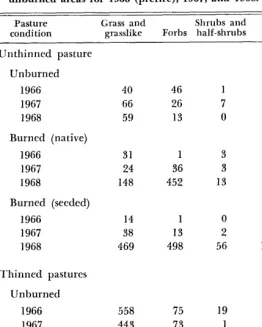
Total herbage production increased slightly on both unthinned and thinned pastures the first grow- ing season after the fire (Table 4). Total pro- duction continued to increase the second growing season on the unthinned area but decreased on the thinned area.
Grass
Production of grass and grasslike plants was higher the first year after fire where exotic grasses were seeded than on unseeded areas. The second year, production of grass and grasslike plants in- creased 12 times more than the previous year on seeded areas, but only about six times more on the unseeded areas.
Duvall and Linnartz (1967) found fire did not greatly influence grass production in southern pine forests. They attributed a short-period increase in production on an ungrazed paddock to reduction of needle litter; apparently heavy accumulations of litter smothered the grass production. In the present study the removal of litter by fire from the thinned pasture apparently provided opportunity for more grass production.
Forbs
Forb production was greater on the thinned than on the unthinned pasture during the first growing season after the fire, but it did not hold this superi- ority (Table 4). During the second growing season, forb production on the unthinned was more than triple the amount on the thinned pasture.
Shrubs
WILDFIRE-TIMBER AND FORAGE 253
Table 4. Herbage production (lb/acre) on burned and Table 5. Nutrient content (%) of the native forages on unburned areas for 1966 (prefire), 1967, and 1968. burned and unburned areas.
Pasture condition
Grass and
grasslike Forbs Shrubs and half-shrubs Total
In vitro
digestibility Crude protein Phosphorus
Un- Un- Un-
Date Burned burned Burned burned Burned burned June 1967 63.4 62.5 16.3 12.0 0.43 0.23 August 1967 65.6 57.2 18.6 12.1 .39 .32 October 1967 68.7 59.9 9.6 7.9 .27 .23 July 1968 65.2 62.0 9.2 10.0 .25 .22 August 1968 611.1 53.6 9.5 9.8 .22 .21 September
1968 51.3 50.1 9.6 9.6 .27 .22
July 1969 56.5 56.3 - - - -
Unthinned pasture Unburned
1966 1967 1968
Burned (native) 1966
1967 1968
Burned (seeded) 1966
1967 1968
Thinned pastures Unburned
1966 1967 1968
Burned (native) 1966
1967 1968
40 46 1 87
66 26 7 99
59 13 0 72
31 1 3 35
24 36 3 63
148 452 13 613
14 1 0 15
38 13 2 53
469 498 56 1023
558 75 19 654
443 73 1 517
452 28 10 490
603 47 0 650
594 139 36 769
470 145 23 638
following a burn (Curtis, 1952; Quick, 1959). Lay (1956) found, in southern pine forests, browse forage was reduced for 2 years after burning while herbaceous vegetation was increased for 3 years although no change was noted in total understory production.
Forage Quality
Crude protein, phosphorus, and in vitro digesti- bility were higher in the forages from the burned area the first gowing season (Table 5). Increases in digestibility and phosphorus lasted through the second growing season, while increases in protein lasted only the initial growing season following the wildfire. Lay (1957) indicated a similar improve- ment in protein and phosphorus following pre- scribed burning of southern pine forests.
Summary
Ponderosa pine canopy reduction resulted in more forage for livestock or wildlife. Fire enhanced germination of Fendler ceanothus, a good wildlife species, and forb and grass production increased. Seeding the burn with orchardgrass and interme- diate wheatgrass improved grass production signifi-
cantly. Forage quality was improved temporarily after the burning. The wildfire destroyed nearly all trees in an unthinned pasture, but caused little reduction in tree density in a heavily thinned pas- ture. Pines with 60yo or less crown kill grew faster while those with over 60y0 crown kill grew slower than their preburn rate.
Literature Cited
AOAC. 1960. Official methods of analysis. Ass. Offic. Agr. Chem. Ed. 9, Washington, D.C. 832 p.
CURTIS, JAMES D. 1952. Effect of pregermination treat- ments on the viability of ceanothus seed. Ecology 33: 577-578.
DUVALL, VINSON L., AND NORWIN E. LINNARTZ. 1967. In- fluences of grazing and fire on vegetation and soil of long- leaf pine-bluestem range. J. Range Manage. 20:241-247. GROSENBAUGH, L. R. 19.52. Plotless timber estimates-new,
fast, easy. J. Forest. 50:32-37.
HEIDMANN, L. J. 1963. Heavy pruning reduces growth of southwestern ponderosa pine. U.S. Forest Serv. Res. Note RM-3. 3 p. Rocky Mt. Forest and Range Exp. Sta., Fort Collins, Colo.
HERMAN, F. R. 1954. A guide for marking fire-damaged ponderosa pine in the Southwest. U.S. Dep. Agr., Forest Serv., Rocky Mt. Forest and Range Exp. Sta. Res. Note 13. 4 p. Fort Collins, Colo.
LAY, DANIEL W. 1956. Effects of prescribed burning on forage and mast production in southern pine forests. J. Forest. 54:582-584.
LAY, DANIEL W. 1957. Browse quality and the effects of prescribed burning in southern pine forests. J. Forest. 55 : 342-347.
PEARSON, HENRY A. 1969. Digestibility trials: in vitro techniques. U.S. Dep. Agr. Misc. Pub. 1147, p. 85-92. PEARSON, HENRY A., AND DONALD A. JAMESON. 1967. Re-
lationship between timber and cattle production on pon- derosa pine range-the Wild Bill Range. 10 p. U.S. Forest Serv., Rocky Mt. Forest and Range Exp. Sta., Fort Collins, Colo.
QUICK, CLARENCE R. 1959. Ceanothus seeds and seedlings on burns. Madrono 15:79-81.
Development of Grass Root Systems
\as Influenced by Soil Compaction1
D. W. FRYREAR AND W. G. McCULLYa
Agricultural Engineer, U.S. Department of Agriculture, Big Spring, Texas Professor, Texas A&M University, College Station.
Highlight
The roots of Premier sideoats grama seedlings do not penetrate a shallow compacted layer the first year. This restrictive layer, commonly found in cul- tivated fields being converted to grass, can be modified by tillage to permit grass roots to exploit the soil beneath these compacted layers to obtain nutrients
I and water.
Soil conditions must be conducive to good root growth if maximum top growth of the plant is to be realized. Considerable information is available on the forage produc- tion potential of various grass spe- cies and varieties, but little specific knowledge has been accumulated on soil physical properties as they affect the development of grass roots.
A compacted soil layer can be formed by tillage on cultivated soils or by excessive hoof traffic on graz- ing lands. Compacted soil layers interfere with the development of tap roots for many crop plants and with fibrous roots for grasses and cereal crops (Fiske11 et al., 1968; Hidding and Van den Berg, 1960). Barton et al. (1966) found that the yield of forage and the stand of seeded grasses declined as the strength of the compacted layer in- creased. Soil compaction did not influence seedling emergence, but seedlings on the compacted soils grew slower and suffered a higher mortality than those on a plowed soil. Rhoades et al. (1964) found that soil bulk density increased with an increased stocking rate and that water infiltration rate declined.
l Contribution from Soil and Water Conservation Research Division, Agri- cultural Research Service, USDA, in cooperation with the Texas Agricul- tural Experiment Station, Texas A&h1 University. Received August 23, 1971. 2 The assistance of Howard Taylor and James E. Box, Jr., SWC, in planning the study, and the help and advice of Richard Dudley, AERD, in chisel- ing the plots is appreciated.
Heavy stocking rates increased soil bulk density to a depth of 36 inches, but only in the 4. to 6.inch and 12- to 24.inch depths were the differ- ences significant.
Plant roots may be diverted hori- zontally when they encounter a compacted soil layer or “pan” (Tay- lor and Burnett, 1963; Taylor et al., 1964). The reaction of the growing point of the root to a compacted soil layer will depend on the type of crop and on such soil factors as the strength of the compacted layer and the lateral support available to the root. Wiersum (1957) re- ported that roots will enter com- pacted soil layers if the cracks or pores are larger than the root cap, but studies by Taylor and Gardner (1960) showed that roots can grow into and through a nonporous sub- strate provided the strength is not excessive.
The objective of this study was to determine the rooting pattern of 2, 3., and 5-year-old plants of sideoats grama (Bouteloua curti- pendula [Michx.] Torr. var. Pre- mier) as influenced by a compacted soil layer or “pan.”
Methods
The study was conducted in west Texas on a cultivated Amarillo sandy clay loam previously planted to grain sorghum. The main treat- ments were (a) compacted soil, ob- tained by using a IO-ton road roller, (b) plowed soil to a depth of 10 inches, and (c) field density ob- tained by sweep tillage (3 to 4 inches deep) of the sorghum stubble
254
just ahead of the planter. Sideoats grama was seeded in June 1963 at a rate of 5 lb./acre in 40.inch rows using a Z-row tractor mounted planter. To break up the com- pacted layer, half of each plot was chiseled between the grass rows in the winter of 1964.
Additional grass plantings were made in May in 1965 and in 1966 on replicated plots that were com- pacted, deep-plowed, or left at field density. One-half of the field den- sity and the compacted treatments were chiseled with a vibrating chisel to a depth of 12 inches on 40-inch centers before planting. Sideoats grama was seeded at the rate of 5 lb./acre directly over the chisel mark using a hand planter.
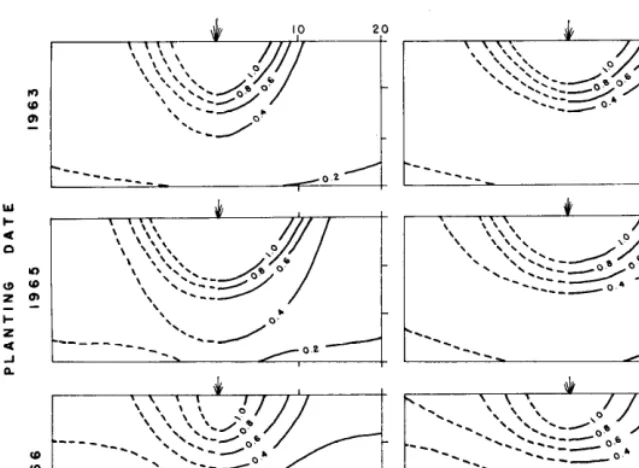
Soil cores 3.25 inches in diameter were taken in the grass row and at 10 and 20 inches from one side of the grass row to a depth of 18 inches in January 1968 from all subplots of all plantings. The l&inch cores were cut into 6-inch segments, and all roots within a segment were separated out of the soil using small root washers. Isoweight lines of the average root weights for six samples for an individual treatment were drawn to indicate the pattern of root production within the soil profile.
In November 1968, rectangular soil blocks were taken from selected plots for observing the rooting pat- terns. These soil blocks were 12 inches wide, 40 inches long, and 40 to 44 inches deep.
Results and Discussion
The development of the grass root systems on the deep-plowed
GRASS ROOT SYSTEMS 255
chiseling on a deep-plowed area can be seen by comparing the yield of roots from the chiseled and the non- chiseled areas for the 1963 planting (Fig. 1). Where the area was chis- eled, there was a slight increase in root weights directly below the grass plant, compared with a more lateral shallow development of the root system on the nonchiseled area. Evidently, chiseling fractured the subsoil enough to enhance root penetration (Fig. 2).
The influence of chiseling a soil at normal field density on root development is shown in Figure 3. Patterns of root development were similar for all 3 years, even though the 1963 planting was chiseled at 20 inches from the grass row in 1964; whereas, the grass was planted directly over the chisel mark in 1965 and in 1966 In all cases, more roots were concentrated under plants
growing on the chiseled area than on the nonchiseled area. Without chiseling, the grass roots were shal- low with limited development throughout the soil profile. On the chiseled plots, the grass root systems developed throughout the soil pro- file, and the roots had accehs to a greater volume of soil for extracting moisture and nutrients.
When grass was planted on a compacted area, there was a gradual increase in downward development of the root system for older plant- ings: however, it was not nearly so great as where the compacted treat- ment was chiseled (Fig. 4). Chisel- ing the compacted layer increased the horizontal and vertical develop- ment of the grass root system.
The mature root system mono- liths (Fig. 2) illustrate that sideoats gram” roots do locate areas of weak- ness in the compacted layer and can proliferate the soil volume below the compacted zone. There are large voids in the root system that corrapond to isolated zones or lay- ers in the 3oil profile with apparent differences in soil density or tex- ture. These local zones of relatively dense soil did not interfere with root proliferation around and be- low them. Similar results have been
C”ISELEO
reported for maize roots (Stolry and
H;,rley, 196X). nlent was very pronounced imme-
Extensive lateral root develop- diately (Fig. 2). \Vhen the area was chis- over the compacted zone
CHiSELED NONCHlSELE” CHiSELED NONCHlSELED
FIELD DENSITY COMPACTED
256
FRYREAR
AND McCULLY
I I
CHISELED
I I I I8
NONCHISELED
FIG. 3. Development of Premier sideoats grama grass root systems with time when planted on a normal field density area with half the plots chiseled. Each block repre- sents a cross section 40” wide by 18” deep. The dashed lines are a mirror image of the measured portion (solid lines) of the plant root system and are included to help illustrate the rooting pattern.
eled, the compacted layer was frac- tured and there was less horizon- tal root development immediately above the compacted zone. Overall root proliferation was roughly equivalent for the chiseled and non- chiseled treatments.
When grasses were established on an area of normal field density, chiseling increased root develop- ment 6 to 12 inches below the soil surface.
The influence of chiseling a com- pacted soil and planting the grass directly over the chisel mark is quite evident (Fig. 2). Without chiseling, initial root development was restricted to the soil above the compacted layer. With time, the grass roots found areas of weakness in the compacted layer and pro- liferated the soil s volume imme- diately below the layer. When the compacted soil was chiseled, the developing grass roots followed the chisel mark down and then prolif- erated the soil volume below the grass plant. There was some root growth on top of the compacted layer but very little within it.
Root distribution was ‘more uni- form throughout the entire soil
profile for the field density areas compared with the compacted areas (Fig. 2). The influence of chiseling directly below the grass plant was not nearly so apparent on the field density plots.
F
Root development for Z-year-old grasses planted on areas compacted or at field density was considerably less dense than for plants in the 3- and 5-year-old stands. The grasses developed an extensive shallow root system before penetrating the soil profile to greater depths. Grasses established on a field density soil in 1966 did not follow the chisel mark as in the 1965 planting. When the grasses were established on a compacted soil that had been chis- led, the grass roots developed in the chisel mark and proliferated the soil volume below the chisel mark.
Conclusions
Isoweight drawings of root yields from small soil cores together with monoliths of intact root systems il- lustrate the restriction imposed on root development of Premier side- oats grama grass by compacted soil layers. If the compacted layer is not broken up, forage yield is re- duced (Barton et al., 1966). Pre- plant tillage to break up a com- pacted soil zone, precision planting over a chisel mark, or chiseling an existing grass stand encouraged the growth of grass roots beneath the
6
L-- __.-__ -t
CHISELED NONCHISELED
GRAZING IN SPRAYED RANGE
257
compacted zone. In time, grass roots located zones of weakness in compacted layers during moist soil conditions and penetrated into the less dense soil below.
Literature Cited
BARTON, HOWARD, W. G. MCCULLY, H. M. TAYLOR, AND J. E. Box. 1966. Influence of soil compaction on emergence and first-year growth of seeded grasses. J. Range Manage. 19: 118-121.
FISKELL, J. G., V. W. CARLISLE, R. KASHIRAD, AND C. E. HUTTON. 1968. Effect of soil strength on root pene- tration in coarse-textured soils. 9th
Cattle
JAMES E.
Inter. Cong. of Soil Sci. Tran. 1: 794-802.
HIDDING, A. P., AND C. VAN DEN BERG. 1960. The relation between pore volume and the formation of root systems in soils with sandy layers. 7th Inter. Cong. of Soil Sci. 1:369- 372.
RHOADES, E. D., L. F. LOCKE, H. M. TAYLOR, AND E. H. MCLLVAIN. 1964. Water intake on a sandy range as affected by 20 years of differential cattle stocking rates. J. Range Manage. 17: 185-190.
STOLZY, L. H., AND K. P. BARLEY. 1968. Mechanical resistance encountered by roots entering compacted soils. Soil Sci. 105:297-301.
TAYLOR, H. M., AND E. BURNETT. 1963. Some effects of compacted soil pans on plant growth in the Southern Great Plains. J. Soil and Water Cons. 18:235-236.
TAYLOR, H. M., AND H. R. GARDNER. 1960. Use of wax substrates in root penetration studies. Soil Sci. Sot. Amer. Proc. 24: 79-8 1.
TAYLOR, H. M., L. F. LOCKE, AND J. E. Box. 1964. Pans in Southern Great Plains soils, III. Their effects on yield of cotton and grain sor- ghum. Agron. J. 56:542-545.
WIERSUM, L. K. 1957. The relation- ship of the size and structural sta- bility of pores to their penetration by roots. Plant and Soil 9:75-85.
Use of a Sprayed Aspen
Parkland Range1
HILTON2 AND ARTHUR W. BAILEY Department of Plant Science,
University
of
Alberta, Edmonton, Alberta, Canada.Highlight
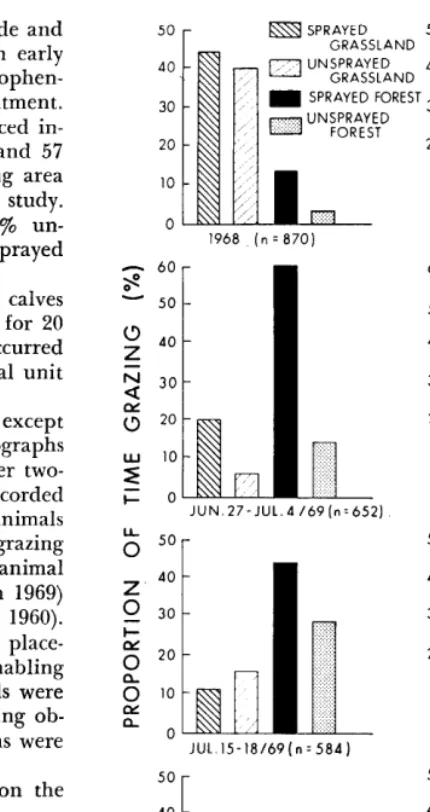
Aspen parkland range in central Alberta that had been treated with a herbicide two years prior to the study had greater grazing use of the sprayed forest vegetation than did the untreated forest. The grazing use was usually greater in sprayed versus unsprayed grasslands but the dif- ference was not as great as in the forest. During 1968 and 1969 when precipitation was heavy, the grasslands were extensively used. However, when dry conditions occurred, a greater use of the forest vegetation was observed. A re- gression equation was developed relating grazing use to precipitation.
One of the prerequisites of using herbicides to control woody species on rangeland is that addi- tional forage must not only be produced but that this forage must be utilized by grazing animals. It is known that herbicides can control aspen poplar (Populus tremuZoides)3 forests and subsequent for- age production is greater (Friesen et al., 1965) but the grazing use of these sprayed forests has not been documented.
l This research was partially supported by the Canada De- partment of Agriculture, Operating Grant No. 9007 and the Alberta Agricultural Research Trust, Grant No. 55- 28130 to the junior author. The Soil and Feed Testing Laboratory, Alberta Department of Agriculture is ac- knowledged for its analyses of forage samples. Received for publication August 16, 197 1.
2 Present address: Centro International de Agricultura Tropical, Apartado Aereo 58-l 3, Bogota, Colombia. 3 Nomenclature of vascular plants follows Moss (1959).
Ranchers and administrators recognize that, in the parkland area of central Alberta, the grasslands are usually grazed in preference to the aspen poplar forest. However, what occurs in a sprayed forest and adjacent grassland is unknown. Bailey (1970) has demonstrated that the shrub silverberry (EZ- aeagnus commutata) acts as a barrier to grazing cattle when it occurs in the fescue (Festuca scab- rella) grasslands. Tree density in the aspen poplar forests is frequently as great as the density of silver- berry in the grasslands. The trees are likely to be a significant barrier to grazing animals.
The objective of the study was to determine the comparative use made by cattle of sprayed and un- sprayed aspen poplar forest and adjacent sprayed and unsprayed rough fescue grassland.
The study area was located on the University of Alberta ranch, 95 miles southeast of Edmonton, Al- berta. The vegetation is primarily rough fescue grasslands on the uplands and south-facing slopes and aspen poplar forests on north-facing slopes and in lower areas. Small ponds and sedge (Carex
spp.)-dominated wet meadows occupy depressions. The precipitation averages 15 inches per year with
10 inches occurring during the May to September growing season. The study area is located in the Thin Black Soil zone but differences in micro- topography and the presence or absence of forest vegetation result in a number of soil types being present. In general, gleysolic soils are found in the low lying areas, dark grey luvisolic and degraded chernozemic soils under the forest vegetation and black and dark brown chernozems under the grass- land vegetation (Pettapiece, 1969).
Methods