Design, Fabrication and Testing of an UPS using PWM Control a
Prototype
J.K.Moharana, D.Mishra Dept.of EEE, GITA, BBSR, Odisha 8th Semester Dept.of EEE, GITA, BBSR, Odisha
Abstract- The project describes an uninterruptible power system (UPS) with pulse width modulation (PWM) control. It focuses on AC to AC , AC to DC and DC to AC power UPS, which aim efficiently transform an AC to DC and also DC power source to a high voltage AC power source similar to that would be available at an electrical wall outlet . UPSs are used for many applications as in situations where low voltage AC and DC source such as batteries and also no power as interruption. The solar panels or fuel cells must be converted into AC power so that devices can run off of an AC power. This project focuses on AC to AC , AC to DC and DC to AC power UPS, which aim efficiently transform an AC to DC and also DC power source to a high voltage AC power source similar to that would be available at an electrical wall[3] outlet . UPSs are used for many applications as in situations where low voltage AC and DC source such as batteries and also no power as interruption. The solar panels or fuel cells must be converted into AC power so that devices can run off of an AC power. A UPS is a device that sits between the plug in the wall and load side. Basically it is like a surge protector with it’s own temporarily power source. The advantage of an UPS is that the computer runs off the battery and as because the UPS is plugged in, it is always charging the battery and hence the computer will always get a constant flow of electricity.
Index Terms—UPS, AC bus, DC bus, PWM control ,RC differentiator, and Miller Integrator
I. INTRODUCTION
An uninterruptible power supply (UPS), also uninterruptible power source, UPS battery/flywheel backup [1-2] is an electrical apparatus that provides emergency power to a load when the input power source, typically mains power fails. An UPS differs from an auxiliary or emergency power system or standby generator in that it will provide near instantaneous protection from input power interruptions, by supplying energy stored in batteries, super-capacitors, or flywheels. The battery runtime of most uninterruptible power sources is relatively short but sufficient to start a standby power source or properly shut down the protected equipment. An UPS is typically used to protect hardware such as computers, data centers, telecommunication equipment or other electrical equipment where an unexpected power disruption could cause injuries, fatalities, serious business disruption or data losses. The UPS units range in size from units designed to protect a single computer without a video monitor (around 200 volt-ampere rating) to large units powering entire data centers or buildings. The world's largest UPS, the 46megawatt Battery Electric Storage System (BESS), in Fairbanks, Alaska .The pulse width modulation (PWM) or pulse duration modulation (PDM) is a technique used to encode a message into a pulsing signal [1-2]. It is a type of modulation. Although this modulation technique can be used to encode information for transmission, its main use is to allow the control of the power supplied to electrical devices, especially to inertial loads such as motors . The main
advantage of PWM is that power loss in the switching devices is very low. When a switch is off there is practically no current, and when it is on and power is being transferred to the load, there is almost no voltage drop across the switch. Power loss, being the product of voltage and current, is thus in both cases close to zero. PWM also works well with digital controls because of their on/off nature which can be easily set the needed duty cycle. PWM has also been used in certain communication systems where its duty cycle has been used to convey information over a communications channel.
This paper focuses on AC to AC , AC to DC and DC to AC power UPS, which aim efficiently transform an AC to DC and also DC power source to a high voltage AC power source similar to that would be available at an electrical wall[3] outlet .The UPSs are used for many applications as in institutions where low voltage AC and DC source such as batteries and also no power as interruption. The solar panels or fuel cells must be converted into AC power so that devices can run off of an AC power. One example of such a situation would be converting electrical power from a car battery to run a laptop, TV or cell phone. The method, in which the low voltage AC or interruptions, DC power is inverted, is completed in two steps. The first being the conversion of the low voltage DC power to a high voltage DC source, and the second step being the conversion of the high voltage DC source to an AC waveform using pulse width modulation. Another method to complete the desired outcome would be to first convert the low voltage DC power to AC, and then use a transformer to boost the voltage to 180 Volts. This paper focused on the first method described and specifically the transformation of a high voltage DC source into an AC output. A modified sine wave can be seen as more of a square wave than a sine wave; it passes the high DC voltage for specified amounts of time so that the average power and rms power are the same as if it were a sine wave.
II PRINCIPLE OF OPERATION OF UPS USING PWM
This Fig.1 shows the circuit diagram to generate a PWM as output signals for that a Quad OP-Amp (LM324) is used as a generator. This is an op-amp based design for generating PWM output. There are four stages of Op-amp running on a single-rail power supply. The saw tooth is generated with the circuit designed by 1st and 2nd op-amp. To generate a 10mSec of square wave pulse, for that IC NE555 timer IC is used which is configured as Mono-stable Multivibrator. Here two NE555 IC is used with a RC value (R=10K var and C=1uF). When the ZCD signal is crosses the zero signal at the R*R
section catches the signal and that signal to trigger pin-2 of IC 555,which in turn trigger the circuit and thus the output remains high. It remains high until the charging and discharging of capacitor through the resistor and C values decides the ON time. It is a consequence of the way power MOSFETs are created in the layers of silicon, and can be very useful. In most MOSFET architectures, it is rated at the same current as the MOSFET itself.
Fig.1: UPS Using PWM
III. DESCRIPTION OF THE INDIVIDUAL CIRCUITS
A Power Supply: The power supply is designed for catering a fixed demand connected in this main circuit as shown in Fig.2. The basic requirement for designing a power supply is as follows. There are two methods for designing power supply as given in Fig.2, the average value method and peak value method. In case of small power supply peak value method is quit economical, for a particular value of DC output the input AC requirement is appreciably less. In this method the DC output is approximately equal to Vm . A full wave bridge
rectifier is designed using four diodes and the output of the rectifier is filtered with a capacitor. There are two capacitors connected in this power supply, one for filtering and providing back up to positive power supply and other one for providing backup and filter action to the negative power supply. The capacitor value is decided so that it will back up for the voltage and current during the discharging period of the DC output. In this case the output with reference to the center tap of the transformer is taken in to consideration, though the rectifier designed is a full wave bridge rectifier but the voltage across the load is a half wave rectified output. The Regulator
section used here is configured with a series regulator LM78XX and LM79XX, the XX represents the output voltage and 78 series indicates the positive voltage regulator for power supply. The positive regulator works satisfactorily between the voltageXX±2 to 40 Volt DC. The output remains constant within this range of voltage. The output remains constant within this range of voltage. In this we are using Transformer (0-12) Vac /1Amp, IC 7805 & 7812 and 7912, diodes IN 4007, LED & resistors. Here 230V, 50 Hz ac signal is given as input to the primary of the transformer and the secondary of the transformer is given to the bridge rectification diode. The o/p of the diode is given as i/p to the IC regulator (7805, 7812 & 7912) through capacitor (1000μF/35V). The o/p of the IC regulator is given to the LED through resistors.
Fig.2: Dual Power Supply
During the +ve cycle of the ac signal the diodes & conduct due to the forward bias of the diodes and diodes
& does not conduct due to the reversed bias of the diodes. Similarly during the –ve cycle of the ac signal the diodes & conduct due to the forward bias of the diodes and the diodes & does not conduct due to reversed bias of the diodes.
The output of the bridge rectifier is not a pure dc along with rippled ac is also present.
= 2 / π or, = ( – 2 )= (12 – 1.4)=10.6= 19.1 ≅ ± 17 (1) To overcome this effect, a capacitor is connected to the o/p of the diodes ( & ). Which removes the unwanted ac signal and thus a pure dc is obtained.
We knew,
Q = C x V ⇒ C = Q / V= I x t / V = 1Amp x 10msec/ 17 = 588.2μF ≅1000μF (2) Here we need a fixed voltage, that’s for we are using IC regulators (7805 & 7812).”Voltage regulation is a circuit that supplies a constant voltage regardless of changes in load current.” This IC’s are designed as fixed voltage regulators and with adequate heat sinking can deliver output current in excess of 1A. The o/p of the bridge rectifier is given as input to the IC regulator through capacitor with respect to GND and thus a fixed o/p is obtained.
to 78XX / 79XX = ±35Vdc and to 78XX = 78XX ± 2V and also = 1Amp DC. to LED = 5mA and
to LED = 30mA
Then to find the value of series resistance by using the OHM’s law, R1 = V1 / I = 5/5mA = 1KΩ (3)
or ⇒R2 = V2 / I= 12 / 5mA =2.4KΩ. ≅2.2KΩ (4)
Due to the forward bias of the LED, the LED glows ON state, and the o/p are obtained from the pin no-3. Finally that is fed to the corresponding sub section as a with respect to GND.
B PWM Generator: In this sub section its aspect is to generate a PWM as output signals for that a Quad OP-Amp (LM324) is used as a generator as given in Fig.3. This is an op-amp based design for generating PWM output. There are four stages of Op-amp running on a single-rail power supply. The saw tooth is generated with the circuit designed by 1st and 2nd op-amp. The function of different sections is as follows. The 1st op-amp is configured as a Schmitt Trigger. The 2nd op-amp is configured as a Miller Integrator. The 3rd op-amp is used as a low gain amplifier. The 4th op-amp is used as a comparator to compare the saw tooth with the reference voltage and generate PWM with different pulse width.
Fig.3: Schematic diagram of PWM Generator
The reference voltage for the Schmitt Trigger is set at Vcc/2 due to the potential divider input given to the inverting input of the opamp1. The Upper limit voltage is dependent on the integrator output. Also the lower limit depends on the integrator output. The opamp2 acts as a Miller’s integrator this inverting type integrator. The slope of the integrated output depends on RC of the circuit. The opamp1 and opamp2 together generates triangle wave with Vcc/2 as reference line of symmetry. The 1st two sections of the quad op-amp form a triangle-wave generator, but now the third section is used as a low-gain amplifier, bringing the trough of the wave to just above zero volts and the peak to about 10v or as required by the design. The fourth op-amp section is connected as a comparator, comparing the triangle wave voltage with a reference voltage set by the potential divider R &VR1.When
the wave voltage goes above the voltage at the pot wiper, the comparator output goes high, else the comparator output goes low. With the pot turned fully clock-wise the wiper voltage is below about 0.5v and the load is on 100% of the time. Increasing the wiper voltage (by turning the pot anti-clockwise) reduces the duty cycle, and it's easy to set a minimum speed just by changing the value of R9.R9 – This
sets the minimum speed .With the 10k pot ,a 1k resistor will give 0–100% control which is OK for model motors or lighting,10k will give around 5V–12V range, more suitable
for cooling fans. VR1 can be changed to a 47k pot if it suits
you better, changing R8 to 4k7–47k depending on your required minimum. C1 – This is the timing capacitor, and with
the 47k timing resistor R1 and wave amplitude control
resistors R2 (22k) & R2 (10k) gives a PWM frequency of
around 117Hz according to the formula
Frequency = (5)
Don't change R2 or R3, but you can alter R1 and/or C1 if you want to try different frequencies. Finally that output signal is fed to the PWM converter as input signal.
C PWM converter:
1.5k
IR
F3205
IR
F3205 INV ERTER
TRANSFORM ER
1N
4007
1.3AH 12V dc
FROM MONOSHOT
IR
F3205
LOAD
FROM PWM
Fig.4: Circuit Diagram of PWM Converter
D MOSFET driver: MOSFETs come in four different types. They may be enhancement or depletion mode, and they may be n-channel or p-channel. The n-channel enhancement mode MOSFET as shown in Fig.5 is used here and these will be the only ones talked about from now. There are also logic-level MOSFETs and normal MOSFETs. The source terminal is
normally the negative one, and the drain is the positive one
Fig.5: Power MOSFET
(the names refer to the source and drain of electrons). The Fig.5 above shows diode connected across the MOSFET. This diode is called the "intrinsic diode", because it is built into the silicon structure of the MOSFET. It is a consequence of the way power MOSFETs are created in the layers of silicon, and can be very useful. In most MOSFET architectures, it is rated at the same current as the MOSFET itself.
E Monoshot Multivibrator: In this sub section its aspect is to generate a 10mSec of square wave pulse, for that IC NE555
timer IC is used which is configured as Mono-stable Multivibrator as given in Fig.6. Here two NE555 IC is used with a RC value (R=10K var and C=1uF).
TO MOSFET DRIVER
1uF
0.01uF
FROM RC DIFF..
555D 1 2 3 4 5 6 7 8 GN D
TR I GGER OU TPU T
RESET
CO
NTRO
L
TH R ESH OLD D I SC H AR GE
VC
C
V cc=+5V
10K
Fig 6: Monoshot Multivibrator
When the output is low i.e. the circuit is in a stable state, transistor Q1 is on and capacitor C is shorted to ground. However, upon application of a –ve trigger pulse to pin –2, transistor Q1 is turned OFF which releases the short circuit across the external capacitor C and drives the o/p high. The capacitor C now starts charging up towards through a RA. When the voltage across the capacitor equals 2/3 , Comparator 1;s o/p switches From low to high which in turn drives the o/p to low state via the o/p the flip-flop. At the same time, the output of the flip-flop turns transistor ON, enhances capacitor C rapidly discharges to the transistor. The output of the Monostable remains low until a trigger pulse again applied. Then the cycle repeats. The time during which the o/p remains high is given by, =1.1 R.C. When the ZCD signal is crosses the zero signal at the R*R section catches the signal and that signal to trigger pin-2 of IC 555,which in turn trigger the circuit and thus the output remains high. It’s remains high until the charging and discharging of capacitor through the resistor and C values decides the ON time.
F RC Differentiator:
Fig.7: RC Differentiator with their waveform
This circuit is used when getting the signal having to do with the pulse from the input signal of the square wave. The circuit of this form is used to interrupt the relation having to do with the direct current among the circuits, too. (Direct current cut) In the case, the signal of the square wave causes the warp. Also, in case of the analog signal, the voltage which is output in the capacity of the capacitor changes. The influence comes out to the extent that the input signal is low-frequency. The electric charge begins to store up in capacitor(C) when the voltage is applied to the input. The electric current which
flows into the capacitor as the electric charge is stored up decreases.
The electric current change which flows through the capacitor(C) and the resistor (R) is demanded by the following formula.
i = (V/R)[e-(t/CR)] (6) The change of the voltage which appears in the both edges of the resistor (R) becomes the following formula.
iR = V[e-(t/CR)] (7)
It is as follows when showing the formula above by the graph in Fig.8.
Fig.8: (a) iR drop vs time and (b) designed components in RC differentiator
G Opto-Isolator(ZCD): In this sub section its aspect is to 50Hz square wave pulse, for that we have to isolate the signal by using opto-isolator as given in Fig.9 which isolates both the signal. Here opto-isolator is configured as zero cross detector (ZCD). Whenever the input signal crosses the zero line, the output of the opto-isolator goes to saturation i.e., HIGH state and vice versa. An opto-coupler is a device containing an infrared LED and a matching phototransistor, mounted close together (optically coupled) within a light-excluding package as shown in below Fig.9. The control voltage energizes an LED which illuminates and switches on a photo-sensitive diode (photo-voltaic); the diode current turns on a back-to-back thyristor, silicon controlled rectifier, or MOSFET transistor to switch the load. The optical coupling allows the control circuit to be electrically isolated from the load.
VCC R1 2 1 U2 MCT2E 1 2 5 4 SW1 1 2 R2 2 1
Fig.9: Circuit connection of Opto coupler
Here sw1 is normally open, so zero current flows through the LED: is thus in darkness and also passes zero current, so zero output voltage appears across . When sw1 is closed, however current flows through the LED via , thus illuminating and causing it to generate an output voltage.
The output voltage can thus be controlled via the input current, even though and are fully isolated electrically. In practice, the device can be used to opto couple either digital or analogue signals which illustrated in Fig.10 and can provide hundreds or thousands of volts of isolation between the input and output circuits.
MCT2E
1
2
5
4
230Vac 50Hz
Vcc=+5V 0-12Vac
AND INVERTER TO RC DIFF..
10k 470E
Fig.10: Opto-isolator (ZCD)
H Inverter: In this sub section its aspect is to invert the ZCD input, for that a transistor is used as a driver which is configured as a switch or inverter. The application of the transistors is not limited solely to the amplification of the signals. Through proper design transistors can be used as switches for computers and control applications. The network of Fig.11 can be employed as an inverter in computer logic circuitry. Note that the output voltage is opposite to the applied to the base or input terminal. In addition note the absence of dc supply connected to the base circuit. The only dc source is connected to the collector or output side, and for computer applications is typically equal to the magnitude of the “high” side of the applied signal – in this case 5V.
Fig.11: Connection Diagram of Inverter
Proper design for the inversion process requires that the operating points switch from cut-off to saturation along the load line depicted in above Fig.11. For our proposes we will assume that IC = ICEO = 0mA, when IB = 0µA (an excellent
approximation in light of improving construction techniques), as shown in above Fig.3.10. In addition, we will assume that VCE = VCE sat = 0V.When = 5V, the transistor will be
“ON” and design must insured that the network is heavily saturated by a level of IB greater than that associated if the IB
curve appearing near the saturation level. In the above Fig.11, this requires that IB> 50µA. The saturation level for the
collector current for the circuit is defined by,
= …….(8)
The level of IB in the active region just before saturation results can be approximated by the following equation,
≈ …….(9)
For the saturation level we must therefore insure that the following condition is satisfied:
> …….(10)
For the network of the above figure (b), when = 5v the resulting level of IB is
IB = – 0.7 / = 5v – 0.7 / 1.5k = 2866µA ……. (11)
= = 5v / 10kΩ= 0.5mA …….. (12)
Testing the above equation gives:
=2866µA > = 0.5mA / 300
which satisfied the certainly any level of IB greater than
2866µA will pass through a Q- point on the load line that is very close to the vertical axis. Finally that output signal is fed to the mono-shot as input signal.
IV. RESULT ANALYSIS
In this section results of practical tests conducted on the prototype set-up are presented. The tests verify proper working of the hardware modules developed in the project inside the laboratory. Finally complete test on the total set-up is done and different waveforms (oscilloscope traces), tables, etc presented here uphold the success of the entire scheme, the experimental set-up as also its parts. The industrial module has all the safety protection and annunciation features may be built in. Hence the full scale test was done on the same.
A Power Supply: The circuit diagram of the power supply is given in Fig.2 and the fabricated circuit is illustrated in Fig.12. The output of the each module of the supply is given below. The step-down transformer of 230V/12V is used in power supply circuit. The secondary waveform of the transformer with peak value of 12*1.414= 16.968V is shown in Fig.13. The unregulated voltage (voltage across the capacitor) is illustrated in Fig.14.The average value of the unregulated voltage is 13.68V.From the datasheet we came to know that the input voltages of the voltage regulators of 7812 and 7805 is 19V and 10V respectively .The regulated voltage from 7812 regulator and 7805 regulator are depicted in Fig.15.This DC voltage can be suitably used in chips for their good operations
Fig.12: Hardware Fabricated power supply
Fig.13: Output of Power supply
Fig.14: Output of DC unregulated
Fig.15: Output of DC regulated
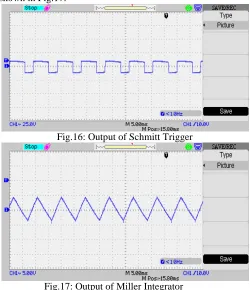
B PWM Generator: The circuit diagram of the PWM Generator is shown in Fig.3 and the output of the each module of the PWM Generator is given below. From the PWM Generator, the output waveform of the Schmitt Trigger and Miller Integrator has been taken from the Pin No.1 and Pin No.7 with respect to ground respectively. The output oscilloscope traces are depicted in the Fig.16 and Fig.17.In Fig.16 the frequency and pulse width are controlled by the external components of resistance and capacitance. From the figure the desired frequency and width are obtained. The triangular wave of Miller Integrator of the Fig.16 is clearly shown in Fig.17.
Fig.16: Output of Schmitt Trigger
Fig.17: Output of Miller Integrator
C Monoshot Multivibrator: The circuit diagram of the Monoshot Multivibrator is shown in Fig.6 and the output of the each module of the Monoshot Multivibrator is given below. From the Monoshot Multivibrator, the output waveform of the Monoshot Multivibrator 1 and combined waveform of the Monoshot Multivibrator 1 and 2 is shown in Figs.19 and 20 respectively.
Fig.18: Hardware fabricated Monoshot multivibrator1 &2
Fig.19:Output of Monoshot Multivibrator 1 From the above waveform we get the ZCD waveform and it is also seen that the waveform of the Monoshot Multivibrator gives the negative pulse which is not desirable for the proper operation. So, for the desirable operation of the Monoshot Multivibrator, diode is being used to cancel the negative pulse and at the output we get the positive waveform which is shown in Fig.19.
Fig.20: Output of Monoshot Multivibrator 1 and 2
D RC Differentiator: The circuit diagram of the RC Differentiator is shown in Fig.7 and the output of the each module of RC Differentiator is given below. In the above circuit when ZCD input i.e square wave is given to RC Differentiator. The spike of the RC Differentiator has been minimized by using the capacitor (as given in Fig.7) which is shown in Fig.21.
E Opto Isolator: The circuit diagram of the Opto Isolator is shown in Fig.10 and the output of the each module of Opto
Isolator is given below. When sinusoidal input is given to Opto Isolator a square wave form is obtained which is shown in Fig.22.
Fig.21: Output of RC Differentiator and ZCD
Fig.22: Output of ZCD
F UPS PWM Control: The hardware fabricated UPS circuit is shown in Fig.23.The oscilloscopic output waveform of UPS is given in Fig.24 which contains harmonics. To reduce harmonics a PWM control is used with the UPS circuit whose oscilloscopic traces is illustrated in Fig.25. Hence PWM control is the best way for elimination of harmonics in the circuit.
Fig.23: Hardware fabricated UPS circuit
Fig.24: Oscilloscopic traces of UPS without using a PWM control
Fig.25: Oscilloscopic traces of UPS with using a PWM control
IV CONCLUSIONS
In this paper, design, fabrication and testing of an UPS using PWM (inverter power control system) prototype have been proposed. The hardware set-up of a prototype UPS PWM based has been designed and fabricated. An UPS is a device that sits between the plug in the wall and load side. Basically it is like a surge protector with its own temporarily power source. The advantage of an UPS is that your computer runs off the battery and because the UPS is plugged in, it is always charging the battery and because of the computer will always get a constant flow of electricity.An UPS is typically used to protect hardware such as computers, data centres, telecommunication equipment or other electrical equipment where an unexpected power disruption could cause injuries, fatalities, serious business disruption or data loss. UPS units range in size from units designed to protect a single computer without a video monitor (around 200 volt ampere rating) to large units powering entire data centres or buildings. The PWM inverter corrects the output voltage and eliminates according to the value of the load connected at the output. This has been done here.
ACKNOWLEDGMENT
The authors would like to acknowledge the support received from the management of GITA, BBSR. The authors are also thankful to Principal and Dean (Admin) and Head, Dept. of Electrical and Electronics Engineering, GITA,BBSR,Odisha.
V.REFERENCE
[1] A.T. Johns, A.Ter-Gazarian and D.F.Wam,”Flexible ac transmission systems (FACTS)”, IEE Power and Energy Series, London, U.K.
[2] R.M.Mathur and R.K. Varma, “Thyristors-based FACTS Controllers for Electrical Transmission Systems, IEEE Press”, Wiley-Interscience Publication.
[3] M. H. Rashid ,”Power Electronics circuits, devices and applications”, Pearson education, third edition,2004.
[4] P.S. Bimbhra, “ Power electronics”, Khanna publication ,fourth edition.2009.
[5] R.A. Gayakward , “Op-amps and linear integrated circuits”, phi publication, fourth edition,2002.
[6] B.W. Williams, “Power Electronics devices , drivers, applications and passive components, ELBS publication, second edition, 1992.