Conscious interfaces: a shared responsibility
Emiliano Ramírez-Laureano3, Ana Lilia Laureano-Cruces1,2, Yoel Ledo-Mezquita3, Claudia Flores-Mendoza3
1
Departamento de Sistemas 2
Posgrado de Diseño-Visualización de la Información Universidad Autónoma Metropolitana – Azcapotzalco
3
Informática y Tecnologías de la Información Universidad de las Américas – CDMX
([email protected], [email protected], yledo, cflor{@udladf.mx}
Abstract
The interfaces have gradually become important because they are a conjectural point to achieve antropoformization of the spaces used by humans. Under this perspective, it is essential to have a certain degree of intelligence that allows autonomy during decision-making. Now, the interfaces appear in our lives being able of certain intimacy; this implies an implicit knowledge; even if it is a general form of human behavior and its vulnerability to certain events. This article presents a first version of what is intended to be the inference engine of an interface for an autonomous car. The mental models that represent the conducts of the interface are designed, which will be responsible for the continuous monitoring of the environment. The interface will make a decision considering its affects, that is, what does the interface feel as a conscious part within a context, in the case of study driving a car. In order to achieve this, is used a methodology that allows to take into account the emotions within a cognitive model.
Keywords: autonomous interfaces, cognitive ergonomics, cognitive psychology, affective computation, artificial intelligence, synthetic emotions, emotional design.
1. Introduction
Ergonomics is one of the most important currents of the discipline called design; it is in charge of the comfort that we can detect when using a certain device; being the device any element designed by man with a specific purpose.
Cognitive ergonomics [1,2] focuses basically on how best to achieve mentioned comfort when cognitive processes are involved. In this case, what is it about is to achieve a harmony between cognitive processes and the devices designed by man, in the case of study we refer to the design of the interface and its interaction with humans (human-machine interaction). The new technologies created to improve driving and avoid accidents have advanced at an accelerated pace; the incorporation of these
in the different cars almost reaches the totality without relying on the costs due to the usual lowering of these over time.
Here the question is how will be acquiring so desired and feared autonomy?
The different brands and models of cars have done so intelligently by incorporating them first - as a privilege of cars and expensive brands and almost without feeling; telling the user that they are aids that allow for safer driving.
With the passage of time and almost imperceptibly you get accustomed to them; to create some dependency and why not? A certain intimacy. Such is the case of Cortana and Siri, in their current versions and which we expect to continue surprising us with their respective degrees of autonomy. More evolved interfaces are expected to achieve some complicity.
In order to further argumentation below and as is usual in our articles a paragraph written by the great scientist and visionary Isaac Asimov in the book Prelude to Foundation, first released in 1988 is mentioned.
"You could crash easily," said Seldon, clearing his throat.
"So I probably would if everything depended on my senses and reactions, but this taxi is computerized and the computer can overrule me without trouble. The same is true for the other taxis. --Here we go."
If we analyze the sentence without problem, this implies complicity.
specified by the program of its flight domain, that is, the software and not the pilot exerts final control. In the case of the Boeing Company, they have focused the design of the software in a way that cannot de-authorize the pilot; even in extreme circumstances [3].
Affective computing (AC) begins in the year 2000 and has two basic objectives: 1) elicit the emotions of a user, 2) represent synthetic emotions, through computer systems. That is, computer models simulate human behavior or predict the emotions of users. The ultimate goal is to have more accurate and more localized interactions during the interaction of computer systems with the environment [4, 5].
Computer systems that include emotions within their interaction have any of the following perceptor models: 1) a cognitive structure of emotions or/and 2) a set of perceptors that allow them to know the heart rate, pupil dilation, the level of sweating, among others [4].
This work shows the development of the cognitive-affective model [6, 7] of an interface that combines the information coming from its internal motivation (emotions) and the environment. In other words, it is combined: 1) what it feels by recognizing its emotions as a substantial part of its job performance; represented by safe driving, and 2) information from two external environments: a) physiological aspects of the driver, and b) the environment in which his conduct develops. This work is located within the development of intelligent interfaces that we will also call devices.
The body of this article is organized as follows: section two reviews the latest technologies developed for safe driving; section three explains the sub-line of artificial intelligence known as affective computation and the importance of emotions within different cognitive processes; in section four, a brief explanation of the emotional design is given in order to understand the development of the cognitive-affective model; emphasizing synthetic emotions; in section five, we show the mental models of conduct in order to achieve the performance of the cognitive-affective model, and that will lead to the representation of a causal matrix; formed by the main elements of the conduct; section six establishes a formalization of the previous model in order to generate different test scenarios; Finally, section seven of conclusions sets out the benefits of including emotions as part of a safe driving performance.
2. A look at new technologies in transport
Even the most experienced drivers, have few opportunities to understand how to control a vehicle in accident conditions and especially what measures to take? In order to safeguard his person as best as possible. However, systems with artificial intelligence can learn, understand, call for medical and emergency assistance; and with experience to achieve an ad-hoc action in each case of accident. Before the previous scenario it is obvious that human beings are at a disadvantage.
Suppose a scenario on a future road where all cars communicate with each other, and suppose there is a collision. All cars would communicate to make a safe stop. And it is certain that they could be more successful than humans.
There are a number of restrictions for which control should be removed from the human being, and it is a matter of time in which a safe and prudent driving will be preferred to certain conditions where the human being is exposed to a serious danger.
Now here are two dilemmas: a) Who should decide which party bears control, b) moral dilemmas that maybe some driver goes wrong, because collective decision.
It's a long way, but definitely new technologies are in the battle to improve the lives of human beings through the anthropomorphization of the spaces in which human beings develop.
2.1 New technologies to make driving safer
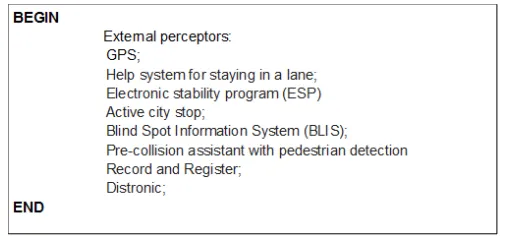
Record and register (FORD) the path from the driver's perspective; in order to make a quick recognition of patterns in real time before the driver sees them in order to help find objects such as: road signs, moving objects (pedestrians), traffic signs, among others, same as in roads and in the dark, are difficult to recognize [8].
The Distronic already available in Mercedes Benz, to lighten the operator’s driving by maintaining the distance and speed of the vehicle with respect to the one ahead [8].
Mitsubishi presents an engine ignition by button and in this case after three attempts is blocked; this would imply an inconvenient state (alcohol or health).
The automatic connection to the different applications of your compatible Smartphone, as well as the monitoring system of tire pressure [9].
The adaptive speed control and the intelligent speed limiter enable accidents to be avoided. In the first case the desired distance with the car ahead and the speed are set as parameters; the vehicle will decrease and accelerate based on the parameters provided. In the second case, in addition to the above characteristics traffic signals are recognized and the speed limit is detected; in this case the power of the engine and the gasoline supply is controlled in order to maintain the permitted speed and the distance between vehicles. They use the relevant information provided by Google maps and Waze to determine the speed allowed; instead of an a priori programming of the vehicle. The foregoing would prevent fines, but more important not to take risks with human life.
The help system for staying in a lane, is adapted for freeways and is always activated, with speeds below 65 km/h, is deactivated; or with the turn signal light to change speed/lane.
Control for hill start, in this case the brake is activated for a couple of seconds (three) to prevent the vehicle from rolling backwards and give time to step on the accelerator.
The electronic stability program (ESP), are sensors that detect any sudden change in: steering, brakes, or the car's own behavior that may cause an accident due to loss of control of the vehicle. ESP adjusts the speed of each wheel to prevent skidding; maintaining the stability traced (NISSAN model March and Ford).
Active City Stop avoids or reduces range collisions at low-medium speed. With complex internal behavior, this device consists of radar at the top of the windshield. It explores the area in front of the vehicle to detect possible obstacles; the operating speed range is between 30 and 50 km/h [9].
This device uses the brakes, in case that driver does not act and is sensitive to the change of direction of the driver in order to avoid the collision, in which case it is deactivated [9].
Adaptive headlights, night driving is one of the most delicate; visibility on unlighted roads is reduced. Dynamic LED technology is able to adjust the lighting pattern of the headlamps depending on speed, environment and conditions. With the help of a camera installed on the windshield, vehicles and bicycles are detected at a distance of 800 meters at night. In addition, it uses special
headlights in order not to blind the drivers of the opposite direction [9]. The system contemplates up to eight types of situations that approach scenarios in city, bad weather and highway.
Blind Spot Information System (BLIS); all drivers know that there is an angle in which vehicles are not observed when you want to change lanes; this is a blind spot. This system helps you to change lanes more safely since there is a car in the spot of blind vision, the device will notify you through the rearview mirror with an orange light (Ford). Full view behind the corners, it is known as split screen front view camera. By means of a self-cleaning camera located in the front grille, the driver has one hundred and eighty degrees vision of what happens in the corners of the front. This eliminates blind areas and others with reduced visibility [9].
Pre-collision assistant with pedestrian detection; is responsible for detecting the presence of a pedestrian, animal or child; in city (limited speed) that can cross over. The system reacts with a powerful braking in case the driver ignores the acoustic and visual warning signs [9]. In this case with the information coming from the camera and the radar, pattern recognition is made.
Warning system of fatigue (Driver Alert), controls the behavior of the driver and at the slightest change suggests taking a break; in case the alert level is increased a powerful sound warning [9] will be produced.
For a long time there is a project being worked of intelligent agents in which is intended that the cars communicate with each other in order to avoid traffic jams due to some collision and at the same time avoid collisions and major accidents. Chrysler goes to the forefront of this project [8].
It is emphasized that these aids to the driver definitely have been developed because driving is one of the most difficult and dangerous tasks for humans, however, for the moment and unfortunately the cars have not been homogenized with them due, among other things, high costs and patents.
3. Affective computing
3.1 Sally: a dream
The idea of artificial consciousness was born with Issac Asimov the visionary scientist in science fiction and through his ability to imagine the use of information technologies applied to his stories, we could say that he - he did innovate. In this case his story is related to the first cars with artificial consciousness. His story of Sally, from the work Robot Dreams refers to a computer model related to artificial consciousness and of course including emotions.
It should be emphasized that - if there is what we call artificial consciousness, it means that we are creating an autonomous device that will make its own decisions based on its emotions and the events of the environment.
The synthesis of Sally's story [10] takes place on a retired automobile farm; a place where their owners leave them when they die; not being able or not wanting to inherit them. Everyone has intelligent brains that allow them to exercise a degree of autonomy. These automatic cars had been developed to assist the disabled of wars; also of course that they could only be bought by people with a lot of money since its cost oscillated between 10 and 100 times more than the conventional cars. In this story is told how in the direction of a future year, these autonomous cars appear. The story emphasizes the fact that before its appearance there were tens of millions of people dead. It was a long road to acceptance, due to the unconformity of people. At the end, the battle was won because of the safety involved in driving; an autonomous brain (designed with AI and new technology) can react more quickly, due to the rapid process of information, as a consequence the percentage of deaths decreased. This led to acceptance. On the other hand, it is important to mention that this mode of autonomy could be turned off, by returning to manual mode. This was an aggression on the car.
Cars have a personality; based not only on their physical characteristics since: the convertibles are female and the sedans male; also within their positronic brains and their autonomy mechanism count on emotions and these provide them with an artificial level of consciousness. It is emphasized that all living beings have consciousness; being limited to their environments [11]; being able to transpolar the design of this mechanism of feeling to other devices. This allows for a degree of sensation, and this allows them to make better decisions for them and the beings they love.
The story ends badly since a thief arrives at this farm with bad intentions; for him, the 51 cars on the farm represented booty as every automatic engine had a cost on the black market.
The proposal was to remove the motors and assemble them in another car body, however, this was unthinkable since the engines and their positronics brains were designed for each car and each car was aware of its exterior, as if they tried to take our essence and put it in another body whether female or male. In the end cars realize and coordinate (among themselves); joining forces to beat him up and protect the caretaker.
3.2 Affective computing: a reality
Affective computing is a sub-line of artificial intelligence; it is about using the information coming from the emotions during the decision-making process. The study of emotions as already mentioned in the introduction section; has two aspects, namely 1) synthetic emotions and 2) elicitation of emotions.
This project takes into account the two aspects since it is intended to give the engine inference, that is, software that controls the car with an emotional state that allows him to
understand what a car can feel in front of certain external and internal events; in which case, they may be vulnerable; like Sally as they tried to steal her automatic engine away from her chassis - and as Sally also be empathetic about Jack's plight (in charge of caring for all the cars on the farm). In the story of Sally and his companions they go further since they also judge the action of the thief and they give him a deserved punishment; that is, they are able to judge the actions of a particular agent.
Researcher Rosalind Picard of the Massachusetts Institute of Technology (MIT), in the late 1990's, writes a book called Affective Computing (1998), in, which defines the importance of these as part of the design of devices involving artificial intelligence.
3.3 Why are emotions important?
For a long time the emotions were discarded from the process of reasoning, implying that having them generated a poverty of judgment coupled with irrational behavior - and so it is, however, the frame where it is desired to include them brings emotional balance, also known as emotional intelligence [12]. Below is a definition of the different sentimental states:
• Emotion: short feeling, usually abrupt appearance, causing perceptible physical alterations: agitation, paleness, palpitations, flushing, etc.
• Passion: intense, vehement feeling, which exerts a powerful influence on behavior.
Recent scientific discoveries show that emotions play an essential role in: 1) the decision-making process, 2) perception, and 3) other cognitive functions [13].
If we really want to create intelligent devices that naturally adapt and relate to humans, they must have the ability to recognize, express and have emotions; in essence count on emotional intelligence.
According to Picard [13], after half a century it has not been possible for a machine to have the ability to analyze difficult problems intelligently, or to relate to people intelligently.
Herb Simon mentioned in Picard [13], wrote about the foundations of cognition; emphasizing that any general theory about thinking and problem solving must include emotions.
On the other hand, emotions theorists have also maintained that they play a decisive role as elements of motivation, and are central in aspects such as: 1) attention, 2) perception, 3) creativity and 4) the ability to face life.
In the case of neurosciences (cognition and psychology), they indicate that emotions play a central role in: 1) planning, 2) attention, 3) reasoning, 4) learning, 5) memory and 6) decision making. The following text extracted from Picard [13]; says congently why emotions are imperative in behaviors simulated by humans in the devices we design.
Some scientists have argued that the demands for a system with certain resources operating within a complex and unpredictable framework naturally create the emotions need to face multiple situations in a flexible, intelligent and effective way.
Picard an Electronic Engineer in her book Affective Computing; generates a theoretical framework for emotional computing, that is, a field of computer science that relates to emotions and hence can be used in the development and testing of both old and new theories in this field.
Emotional computing also includes how to provide a computer with the ability to recognize and express
emotions; developing the ability to respond intelligently to human emotions, and enabling it to dose and use its own emotions. Assuming that emotions are a very important element in the activities of human beings; but not reckless - opposite to include them in the design of devices that interact with humans in order to create greater wealth of interaction and a fundamental part of the antropoformization, this is, humanize and personalize the spaces used by humans.
3.4 How do we know that an action comes from a
behavior designed with emotions?
In fact, with just looking at the action will not know. What is a fact is that the mechanism under which this action is created is very different from that action generated through sensory stimuli. And it is expected that having more information can be more accurate, this is with a level of rationality.
Now we will outline a theory created to achieve an affective-cognitive model, given that in our case they are the ones that will allow us to design the personality of a car that is not only capable of detecting, but also has a sense of vulnerability.
4. Theoretical framework
Approximately in 2000, several researchers such as Rosalind Picard, Donald Norman, Minsky, Ortony, Clore and Collins and Igor Aleksander, among others, found what is known as affective computing (AC). The latter is an artificial intelligence (AI) sub-line.
The main objective of AI is to emulate the behavior of human beings, whether this cognitive or physical. With the help of cognitive psychology (CP). A more formal definition is given in the following paragraph:
AI is the simulation of human intelligence in a machine, so that the machine is efficient in the process of being able to identify and use the correct piece of knowledge in a particular step related to the solution of a problem.
1. Synthetic emotions 2. Eliciting human emotions
The first current implies the ability of a device to reproduce emotions according to the context of the user. For example: a video game, or a second life, among others [6].
In the second current, what is important is to know what the emotions experienced by a user may be at any given moment; implying a degree of prediction of the possible state of the user. The above with the aim of having a richer and more contextualized interaction. For example, an ATM that detects the needs of the user, a pedagogical agent that detects the student's mood, among others; and emphasizing that this current is limited in cognitive emotions, leaving aside those produced by the physiological system [14].
In order to achieve this, mathematical models are always used, which treat the data considering uncertainty, the latter occurs when: a) there is imprecision in the data, or b) there is insufficient data to reason with them.
In addition, there are specific theories to develop behavioral models that come from CP and which allow us to model behaviors. The CP is born the same year as the AI, in 1956, with three months difference and this branch of psychology is responsible for understanding the different cognitive behaviors (any process that takes place in the brain); proposing in this way different tools and models that can be used by computer scientists, in order to simulate the behavior of human beings.
Next section, explain briefly one of the most important theoretical frameworks in order to design computer models that include emotions in the different devices.
4.1 The OCC theory
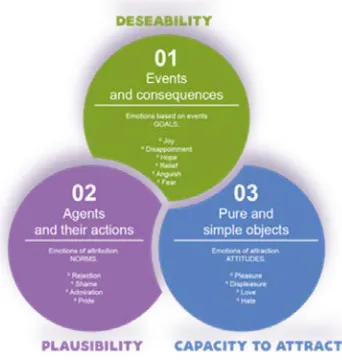
The OCC theory (so called by its authors: Ortony, Clore and Collins) is an effort to propose an order where there is an apparent chaos. An order that allows computer scientists to reproduce an emotion from a general structure in which it is specified that there are three great kinds of emotions [15]; each of which is part of the three outstanding aspects of the world: 1) events and their consequences; 2) agents and their actions; and 3) pure and simple objects. The three great kinds of emotions are:
• Emotions based on events: elaborate
consequences to desirable or undesirable events regarding goals.
• Emotions of attribution: they attribute responsibility to the agents on their actions according to norms.
• Attraction emotions: based on attitudes towards objects.
In the understanding that all people consist of different goals that they wish to achieve in their lives; these take shape through an affective-cognitive structure; which allows us to achieve our objectives in different contexts, through these goals; being one of them the main and the others a set of instrumental goals that allow us to achieve the main goals; then a brief explanation is given, for more depth consult the related reference.
Based on the above assumption, and in order to evaluate the environment, a series of variables are linked in parallel to the structure in order to be able to measure the impact of environmental events on the internal state of the affective-cognitive structure. To achieve this, local and global variables that modify the intensity of the emotions are established. As a result, the affections (cognitive elaboration of an emotion) related to these emotions are presented; Figure 1 summarizes the OCC theory [16]. Goals have two defining characteristics (not always present): 1) types of things to look for and 2) the kinds of things that can be achieved with a plan.
The goals are of different kinds: 1) active persecution (AGs); that one wishes to have made, 2) interest (IGs); which one wishes to happen, and 3) cyclic (CGs); which are cyclical, which is why even when they are fulfilled they are not abandoned. The above goals are related to the specific objectives within the conductual context such as: achievement (achieve certain things), satisfaction (satisfy biological needs), entertainment (enjoyment), preservation (preserving states), crisis when those of preservation are threatened), instrumental (make other goals).
Figure 1. Emotions according to OCC-Theory.
5. Analysis and design of an affective
behavior: Lumi a reactive interface
This work is related to the simulation of a conduct in which are expressed the emotions of vulnerability that can feel a car, starting from the assumption in which it is not the same to know that to feel; we can understand that an emotional state alters and determines how the brain processes the information it obtains from the outside world [17]. This implies that we are processing two sources of information: external and internal.
Emotions are part of the abilities of a human being during the decision-making process and these according to Picard [13] are a heuristic used by humans to prune the search tree; thus, becoming a tool of the new technologies that allows us the innovation; giving way to a new profession called cognitive and in charge of antropoformization of spaces / devices used by humans.
What is desired is to endow with a degree of autonomy; this interface called Lumi (equivalent to luminosity and honor to the car of one of the co-authors, destroyed in a recent accident in which he acted exceptionally and there were no fatal consequences, and it ¡still did not have the interface!).
To achieve the autonomy of the behavior, and to try that there are no inconsistencies we will resort to the emotions; which according to several researchers of the phenomenon of artificial consciousness are the door to simulate the
phenomenon of consciousness [18] and [19] and that leads to the much-desired autonomy.
It is emphasized that the framework of intelligence on which we design involves emotional intelligence, that is, a general context in which it is not to fall into the poles of the emotions as the case of passion [12].
5.1 Model of the artificial consciousness
To model Lumi's conduct, we will use a methodology based on that developed by [6]. Where the ultimate goal is to create an inference engine that, against of the different scenarios presented in the real world, is capable of rational behavior.
Being the first time we mention the term scenarios, we define them as follows: they are the representation of the state of the environment at a given moment, where both variables are considered external and internal (emotions). Hence we will have an input scenario and a future scenario with possible events.
As mentioned earlier (Section 4), we have three different sets of emotions. In order to recreate a conduct with emotions we must go to the subjective term, in other words, what is important, to get us to act. The meaning of something is treated in semantic terms within a specific context.
It is important to emphasize and remember that the main objective of AI is the simulation of human conduct; for this reason we must document the conduct in order to understand what it is that we will simulate.
One method is to ask who knows about the subject; but it is also important to reflect and introspect towards of what a human being might feel; in front of a situation where there was an event of vulnerability, in which its action depended on another human being. In the case of study, the following aspects will be considered: a) driving capability (ability-experience), b) knowledge of the rules of the skill, that is, what level of knowledge is on the traffic regulations, and c) in an extreme case to consider other human lives involved within the context (these cases will be handled as exceptions).
After the analysis of a similar situation in the human, we conclude that the most similar event to be faced with an incompetent whether is the owner, or a thief (caused by some state of intoxication or health); is the abduction, and the consequences of the fear to drive (amaxophobia).
attribution of point a) and will be mixed with the focus of point b) concerning the possible consequences according to the events at a given moment; where it is considered the vulnerability of the automobile and consequently that of him or the crew.
In this case the emotions of attribution must have rules that allow their generation, in this case are represented by the traffic regulations and the user's treatment of Lumi; since values carry a subjective value; it is not the same reckless without values and without vial preparation as the opposite. Implaying a range of possibilities that are product of a combination of events and emotions.
The result is a possible conduct linked to its actions, which main interest is to make Lumi happy, that is, to arrive safely to the target destination.
Figure. 2. Influence of emotions in decision-making according to Lowenstein and Lerner [20].
According to Lowenstein and Lerner [20], during the influence of emotions in the decision-making process; these basically have two paths that provoke an emotion at a given instant; 1) the expected emotions that are caused by the expected consequences and the immediate emotions brought about by incidental events (which have nothing to do with the factors that are taken into account for a certain decision) the above is shown in Figure 2.
5.2 Amaxophobia or fear of driving
In order to understand what Lumi might feel, we will discuss some of the symptoms of the fear of driving, called amaxophobia which refers to an irrational or intense fear of the situation of driving a vehicle. It comes from the greek words amaxo (vehicle) and phobia (fear).
It is emphasized that you want to emulate the behavior of a human being in this case including the emotions. And while we do not want Lumi to have a phobia about driving, it is considered that the results of symptoms can be a good guide in the design of conductual reactions.
To describe it, the three components of the human being are used in three different levels: a) cognitive, b) physiological, and c) conductual:
1. The cognitive level, refers to catastrophic thoughts, related to suffering an accident, losing control; related to events such as dying or causing death or harm to others. The above causes anxiety.
2. The conductual level refers to the evasion to drive under certain circumstances, such as: a) at night, b) on the road and at night, c) in the storm, d) in solitude, or otherwise drive alone under certain circumstances, such as: a) some ways, b) slow speed, c) talking to someone to distract oneself from bad thoughts (this being a two-edged sword), etc.
3. The physiological level, refers to the physical aspects that are caused by experiencing insecurity, such as: a) muscle tension, b) rigidity, c) increased heart rate, d) sweating, nausea, e) diarrhea, f) dizziness, g) feeling of looseness in the arms and / or legs, h) blurred vision.
The above three levels produce unpleasant emotions, when a certain threshold is exceeded.
The above paragraphs summarize what can lead to fear of driving, but if we transpole these feelings to Lumi, what would it feel like? And most important what events would be significant to involve a particular performance. Remember that the information to take a certain action depends on the information, and this comes from two environments, in this case 1) the internal, and 2) the external.
5.3 Mental models of Lumi
There will always be a complicity that will allow the mixed command, that is, the car will be in a constant survillance (monitoring status) that will allow detecting anomalous events to which the driver must be warned and in extreme case to react. We have two types of information: external and internal [7; 21, 22].
and c) irresponsible attitude (lack of awareness regarding the subject, in this case traffic regulations and values of the person) and 2) internal corresponding to emotions that arise from emotional expression generated in Lumi.
With these two sources of information an action will be generated and this is where the difference between an action generated only by stimuli, that is, only external events (referring to the environment) is found.
Section 2 mentions new technologies to prevent accidents, but we must not forget that there is always the human factor. And statistics show that most automobile accidents are caused by human error. As has been said on several occasions the processing of information that a computer can perform is infinitely faster and more accurate.
Based on the above we proceed to elaborate the mental models of the conduct of Lumi (Figure 3 ... 9), definitely control will be taken in the case of extreme danger in order to prevent accidents in which lose life of a human being and / or against the integrity of the human being or of Lumi.
Figure 3. Driving mental model of Lumi
Figure. 4. Mental model: surveillance.
Figure. 5. Mental model: acts.
Figure 6. Mental model: envionment perceptors.
Figure 7. Mental model: physiological perceptors.
Figure 8. Mental model: irresponsible attitude.
Figure 9. Mental model: Emotions.
5.4 Affective-cognitive model of Lumi
Figure 10. OCC Model.
Until now the new technologies are only capable of making beeps and squeaks to notice some type of anomaly, the dryer, the washing machine, the microwave oven, the car, and the alarm clock.
It is intended a more intimate relationship; intimacy announced with the customization of the new devices and that exists as the special watch for training of swimmers (poolmate), SIRI and CORTANA, among others.
In the case of study the conduct of Lumi will be analyzed from the cognitive point of view, with emphasis on the emotions and the events that will provoke a valence, that is, events with meaning.
It is necessary to know that Lumi feels before certain attitudes of its owner; or whoever drives him also includes a stranger.
The concepts that are considered based on Figure 10, are: 1) safe driving (SD), 2) survive (S), 3) cleanliness (Cl), 4) maintenance (M), 5) friendly greeting (FG), 6) feel valued
(FV), 7) Tranquil-content (TC), 8) admiration (Ad), 9) Non Confirmed Fears (NCF).
Figure 11. Cognitive-affective structure of Lumi.
The conduct and cognitive-affective structure that shapes the external and internal environment elements to be considered during the conduction behavior of the interface called Lumi has been designed (Figure 11).
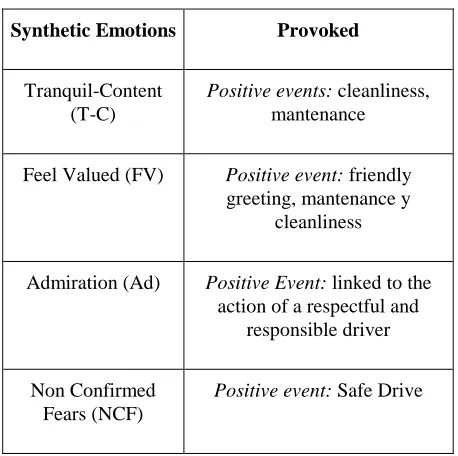
Table 1. Synthetic emotions of Lumi.
Synthetic Emotions Provoked
Tranquil-Content (T-C)
Positive events: cleanliness, mantenance
Feel Valued (FV) Positive event: friendly greeting, mantenance y
cleanliness
Admiration (Ad) Positive Event: linked to the action of a respectful and
responsible driver
Non Confirmed Fears (NCF)
Positive event: Safe Drive
Based on the OCC theory, described in Section 4, the affective-cognitive structure was elaborated corresponding to the conduct of Figure 11, which includes the emotions in Table 1.
elaborate a causal matrix that allows relating the different elements integrants of conduct.
6. An inference engine for Lumi
In artificial intelligence, it is called inference engine to the software that allows simulating reasoning (rational behavior).
Databases and knowledge databases are often contaminated with various forms of incomplete (lack of certainty).
When we speak of incomplete in the data we refer to imprecision, this appears generally for lack of appropriate data or for authenticity with respect to the sources from which those data were taken.
In the case of incomplete by the knowledge is known as uncertainty, this is due to a lack of certainty of the pieces of knowledge. Reasoning with the presence of imprecision in the data and uncertainty in knowledge is a complex problem. This requires different forms of representation [24].
This research is supported by the framework developed by Laureano et al. [6] where for the treatment of uncertainty causal matrices are used which formalization is a fuzzy cognitive map (FCM).
6.1 Causal matrices
According to Mora-Torres [24], the first expert systems of the 1970s used strictly logical reasoning, but this proved to be impractical for most real-world domains where knowledge of it is uncertain. Reasoning, in front of an uncertain knowledge of the real world, generates degrees of beliefs, rather than certainties, about the actual observations of the real world. The presence of uncertainty radically changes the way decisions are made, that is, an action can be selected or rejected depending not only on the objective but also on the consequences of that decision.
The decision-making process under uncertainty requires analyzing different methodologies to manage such uncertainty under risk conditions according to the nature of the problem because otherwise inaccurate inferences could be generated.
6.2 Fuzzy cognitive maps
According to Mora-Torres (2007), the FCMs are directed graphics structures; used to represent causal reasoning and that have been used in computationally controlled systems and also serve to represent the knowledge of an expert.
The FCMs constitute a new approach to the model of the behavior and operation of complex systems. They were introduced by Bart Kosko [25] to describe the behavior of a system in terms of concepts and causal relationships between these concepts.
The FCMs start from a cognitive model, this model constitutes the representation of a cognitive system (Figure 11).
The word cognitive is related to the process of cognition. This process refers to mental activities that: 1) deal with abstract information that comes from the real world, 2) its representation, and 3) the way in which this information is accessed from memory (the affective-cognitive structure Figure 11).
For the above, a cognitive system must give a framework that unites the disjecta membra of fragments and parts of our knowledge, forming a cohesive unit. A cognitive system must be a structured information body, organized in accordance with taxonomic and explanatory principles that unite that information into a coordinated whole with rational bases. The functional categories that govern this organizational enterprise are the understanding, the explanation and the cognitive rationalization [24, 25].
It is through the systematicity that a cognitive model succeeds in representing the causal relationships between the components that make it up; the latter manages to simulate reality, adapting to it in relation to objectives. Such a simulation is possible because different systems can be organized to show a behavior almost identical to reality. That is, the program is able to describe in detail the mechanism of the information process by means of which some cognitive function can be implemented.
6.3 Lumi's inference engine
Kosko mentioned in Laureano et al. [6] introduces FCMs as a way of modeling the behavior of complex systems. These FCMs are represented by a digraph (directed graph) in which the nodes represent concepts and the arcs establish causal relationships between these concepts. The FCMs have been used successfully to model the behavior of different inference engines [6, 14, 23]
part of this work since here they are used as a tool to represent the causal matrices; for more information consult the related references.
Let eij be an arc describing the causal relationship between the concepts of ci to cj.
Then:
eij : 1, if ci causes an increase in cj; directly proportional
eij : -1, if ci causes decrease to cj; indirectly proportional
eij : 0, if ci does not involve causality to cj.
Based on the behavioral concepts developed in the cognitive-affective structure of Figure 11, and the theoretical framework of Figure 10, the synthetic emotions are defined that together with the events of the conduct constitute the whole of the elements of the causal matrix that make up the cognitive system:
1) Safe Driving (SD): is the result of positive events, focusing on the driver's expertise and respect, and his / her responsibility in observing the traffic regulations. It is at this point that the emergence of the mental model of surveillance appears (Section 5).
2) Survive (S): is the result of positive events, which provokes comfort and long life being the main goal of Lumi, due basically to a safe driving and events related to its comfort.
3) Cleanliness (Cl): is a positive event that results from the assessment. 1).
4) Maintenance (M): it is a positive event that underlies safe driving; in addition to valuing Lumi.
5) Friendly greeting (FG): it is a positive event that provokes tranquility and happiness.
6) Feeling valued (FV): Occurs as a result of care and attentions causes tranquility and happiness (T-C).
7) Tranquil-content (T-C): appears when Lumi feels valued.
8) Admiration (Ad): appears when the driver demonstrates consideration in all aspects; being its driving respectful and responsible. It is a sign of appreciation of Lumi towards the user.
9) Non-Confirmed Fears (NCF): is a state that appears in response to safe driving.
Table 2 shows the causal matrix representing the Lumi inference engine. This matrix implies the causalities that
occur from one element to the other. According to the previous explanation of causalities.
Table 2. Matrix of causalities.
From/
To
SD S Cl M FG FV T-C Ad NCF
SD 0 + 0 0 0 + + + +
S 0 0 0 + 0 + + + +
Cl 0 0 0 + 0 + + 0 0
M + 0 0 0 0 + + + +
FG 0 0 0 0 0 + + + 0
FV + 0 0 + + 0 + + 0
T-C - 0 0 0 0 + 0 0 0
Ad + 0 0 0 0 0 0 0 0
NCF + 0 0 0 0 0 + 0 0
6.4 Test scenarios
The following section will test various input scenarios; and will be given interpretation to the outputs.
It is emphasized that the input scenario is the real-world state at a given time and the output scenario is the possible next state; being interpreted for a possible action according to the events evaluated (Section 5.2).
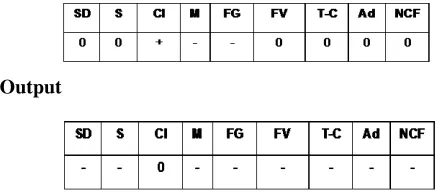
First scenario: 1) cleanliness, 2) no maintenance, 3) no friendly greeting.
Output
In this scenario the negative events are: M, FG and positive Cl.
The output is congruent with input events; in this case because there is no M, there will be no SD, which implies that there is no S, and it continues without saluting FG. In front of this negative scenario there is no T-C, there is no admiration towards the driver Ad and does not feel valued FV and of course fears are confirmed NCF. This implies that an action must be taken to prevent fatal consequences.
Second scenario: 1) cleanliness, 2) no maintenance, 3) no friendly greeting, 4) no admiration.
Output
Interpretation:
In this scenario the negative events are: M, FG, Ad.
The output is congruent with input events; this is a negative case from the beginning; because there is no Ad, and we must remember that this event is linked with a respectful and responsible driver. Therefore there will be no SD, implying that no S continues without saluting FG. In this negative scenario is not T-C, remains without admiring the driver Ad and does not feel valued FV, and of course confirmed fears NCF. This implies that an action must be taken to prevent fatal consequences.
Third scenario: 1) cleanliness, 2) maintenance, 3) friendly greeting, 4) admiration.
Output
Interpretation:
In this scenario there are no negative events; being this scenario the most positive, with events: Cl, M, FG and Ad.
The output is congruent with input events; in this case there is SD, so S, there persists a nice relationship in which the FG is given, feel valued FV, is T-C, persists the Ad by the driver and of course there are no fears NCF. The above implies the conditions are great for the relationship and a safe driving.
Fourth scenario: 1) no safe driving, 2) no survival 3) no cleanliness, 4) no maintenance, 5) no friendly greeting.
Output
Interpretation:
In this scenario there are no positive events; being this scenario the most negative, with events: SD, S, Cl, M, FG.
The output is congruent with input events; in this case there is no SD so no S, there is an unpleasant relationship in which there is no FG, does not feel valued FV, is not T-C, a reproach is presented to the driver Ad and of course there are fears NCFs. This implies that an action must be taken to prevent fatal consequences.
To these output scenarios, should be given an interpretation and review the state of the environment. Recalling that an unsecured driving SD; is due to any of the three outputs that the mental model of survillance S have (Figure 4).
This is mixed with the emotions in the cognitive-affective structure (Figure 11 and Table 1).
In this way, at the moment when there is no safe driving, fears are also presented and it is necessary to review what is the condition that alerts the event to take the necessary measures to prevent it.
This type of cognitive-affective model can be carried to the detail one wants, creating several causal matrices or even matrices in which output is the input of another. For more information on the topic, review the recommended references.
7. Conclusions
Artificial intelligence has finally been accepted as technology that helps in processes where the computer is faster and more accurate to process information. This opens up a range of infinite possibilities where this new technology can help the human being. Anthropoformizing spaces are an objective of artificial intelligence, and under this context emotions must be included. Without emotions there can be no intelligent decision; since the information that underlies them is valuable and cannot be despised. Artificial intelligence can help when man is not able to understand aspects of vulnerability and where human life is in danger. What is involved in including these systems is to prevent. There will always be detractors and there will always be cases that do not have the best endings, however, having the help of information processing already involves a breakthrough in order to enrich the decision-making process. On the other hand, it is important to emphasize that we should not be so demanding with intelligent systems; since human beings also make mistakes; that is, in no way implies that machines have no limits, that humans do not have. One of the future challenges will be the emphasis that will be placed on integrating autonomous systems into the real world, through perceiving and acting, that is, closing more quickly and efficiently the cycle between perception and action.
Acknowledgments
This work represents the research conducted by Emiliano Ramirez-Laureano, in order to obtain a Bachelor’s degree in Information Technology and Informatics at the Universidad de las Americas-CDMX.
References
[1] Cañas-Molina, J., Bajo-Delgado, M. (1991). Ciencia Cognitiva. Edit. Debate.
[2] Cañas-Molina, J., , Waerns, Y. (2001). Ergonomía Cognitiva. Edit. Médica Panamericana.
[3] Carr, N. (2014). Atrapados. Edit. Penguin Random House.
[4] Ramírez-Laureano, E. (2017). Las nuevas tecnologías en la era de la computación afectiva. Bachelor's degree in Computer Science and Information Technology at Universidad de las Americas-CDMX.
[5] Ramírez-Laureano, E., Laureano-Cruces, A. (2016). Las emociones como nueva tecnología. In Abstract Proceedings of Avances de las Mujeres en las Ciencias, las Humanidades y todas las disciplinas. Globalización y Tecnologías de Vanguardia, pp. 205. Edit. Universidad Autónoma Metropolitana. September 28-30.
[6] Laureano-Cruces, A.L. and Rodríguez-García, A. (2011). Design and implementation of an educational virtual pet using the OCC theory. In Journal of Ambient Intelligence and Humanized Computing, Vol. 3, iss. 1, pp. 61-71, 2011.
[7] Laureano-Cruces, A., Acevedo-Moreno, D., Mora-Torres, M., Ramírez-Rodríguez, J. (2012). A Reactive Behavior Agent: including emotions for a video game. Journal of Applied Research and Technology. Vol.10 No. 5, pp 651-672.
[8] Sharpe,B. (2006). Applications and Impact. Capítulo 12 in Cognitive Systems: Information Processing Meets Brain Science. (Eds.) Morris, Tarassenko, Kenward. (Edit.) Elsevier.
[9] Tecnologías actuales para evitar accidentes en
carretera FORD. Retrieved
from https://hipertextual.com/presentado-por/ford/tecnologia-ford-evitar-accidentes.
[10] Asimov, I. (2008). Sally, El Robot Completo. Edit Alamut.
[11] Van Eersel (2012). Votre Cerveau N’pas Fini de Vous Étonner. (Edit) Clés Albin Michel.
[12] Walton, D. (2012). Emotional Intelligence. Edit. MJF BOOKS, New York.
[13] Picard, R.W. (1998). Los ordenadores emocionales. Edit. Ariel.
[14] Laureano-Cruces, A.L., Mora-Torres, M., Sánchez-Guerrero, L., Ramírez-Rodríguez, J., Montiel-Bernal, I.I., Allier-Pavia, E.B. (2015). Dynamic Interaction through a Reactive Interface in Patients with Dementia, by Means of Cognitive Stimulation. E-Health Telecommunication Systems and Networks. Vol. 4, pp. 57-67.
[15] Ortony, A. Clore and G.L., Collins, A. (1996). La estructura cognitiva de las emociones, (1996). Edit. Siglo XXI de España Editores, S.A.
marzo 2011, pp. 64-79.
[17] Esquivel, L. (2012). El libro de las emociones. Edit. Punto de Lectura.
[18] Aleksander, I. (2005). The World in my Mind, My Mind in the World. IA Press.
[19] Minsky, M. (2006). The Emotion Machine. Simon & Schuster Paperbacks.
[20] Lowenstein, G., Lerner, JS. (2003). The role of affect in decision-making. In: Goldsmith H., Davidson, R., Scherer, K. (Editors). Handbook of Affective Science. Oxford University; Press New York, pp. 619-642. [21] Acevedo-Moreno, D.A. (2009). Diseño de una
Arquitectura para Incorporar Emociones en un Videojuego. MSc. thesis, Posgrado en Ciencia e Ingeniería de la Computación-Universidad Nacional Autónoma de México, 2009. Retrieved from: http://kali.azc.uam.mx/clc/.
[22] Acevedo-Moreno, D.A. Diseño de una Arquitectura para Incorporar Emociones en un Videojuego. (2011). Revista Ciencia, Tecnología e Innovación para el Desarrollo de México. Graduate Thesis Section: A4-0011-DF-2009-MT. Online: http://pcti.mx.
[23] Laureano-Cruces, A.L., Ramírez-Rodríguez, J., Mora-Torres, M., Sánchez-Guerrero, L. (2016). Artificial Self Awareness for Emergent Behavior. Frontiers in Psychological and Behavioral Science. Vol. 5 Iss. 1, pp. 1-15.
[24] Mora-Torres, M. (2007). Sistema Experto en la Toma de Decisiones de un Escenario de Riesgo: LOCA Pequeño en una Planta Nucleoeléctrica. MSc. thesis, Posgrado en Ciencia e Ingeniería de la Computación-Universidad Nacional Autónoma de México, 2007. Retrieved from: http://kali.azc.uam.mx/clc/.
[25] Mora-Torres,M., Laureano-Cruces, A., Ramírez-Rodríguez, J., Sánchez-Guerrero, L. (2015). Parallel and Distributed Decision Making Processes: Inference Engine. In Journal of Pattern Recognition and Intelligent Systems. Vol 3, Iss. 3, pp. 36-54.
Software References
[1] PUMAGOTCHI. Retrieved from:
http://kali.azc.uam.mx/clc/Software Section.
[2] COGNITIVE STIMULATION DEMO. Retrieved
from:https://www.dropbox.com/sh/ob9qkvyrn3okck3/
AAA7kVkxuuZ4J-r9nJ65ulpIa?dl=0&preview=Video1_espa%C3%B1ol. mp4
[3] Fuzzy Cognitive Maps. Retrieved
from: http://kali.azc.uam.mx/clc/. Docencia-Posgrado-Inteligencia Artificial Section.
Emiliano Ramírez-Laureano obtained a Bachelor’s degree Information Technology and Informatics at Universidad de las Americas-CDMX. Currently he continues his studies in art design; he is a high performance athlete who performs national and international competitions in
swimming (https://mipasionenazul.wordpress.com/). Working, like a freelance. His areas of interest embrace diverse themes highlighted with: artificial intelligence, and cognitive interfaces design.
Ana Lilia Laureano-Cruces, was born in Mexico City. She obtained a bachelor’s degree in Civil Engineering, a Master’s degree in Computer Sciences, and a Doctoral degree in Science at UNAM. She has been full-time professor at Universidad Autónoma Metropolitana since 1989 and guest professor at Universidad Nacional Autonoma de Mexico since 2003. She has more than 70 publications in the field of artificial intelligence. She was a guest researcher between: 1) 1998 and 2000, at the Departamento de Sistemas del Instituto de Automática Industrial del Consejo Superior de Ciencia y Tecnología de Madrid, 2) September 2011-April 2013 at Université d'Avignon et des Pays de Vaucluse (UAPV, Francia). Her principal research areas are: Multi-Agent Systems, Intelligent Systems applied to Education, Expert Systems, Knowledge representation, Behavioral Analysis, Affective Computing, Artificial Consciousness.
Yoel Ledo-Mezquita, he is currently an IT Consultant and Director of Information Technology and Technologies (LITI) at Universidad de las Américas CDMX. He has 21 years of professional experience, both in industry and academia. He has collaborated and advised organizations and companies such as Davinci, Rio Cuarto, Intelabra, Government of Mexico City, SEP, CFE, Minera Grupo Mexico, CONACYT, IPN, CUPET and MINSAP. Cisco, Microsoft and CompTIA certifications. Computer Engineer and Master in Telematics from ISPJAE. PhD in Computer Science by the IPN, in Inttelmex he works as a professor, advisor of titling projects and member of the Degree Evaluation Committee of the Master in Business Information Technology Management.
![Figure. 2. Influence of emotions in decision-making according to Lowenstein and Lerner [20]](https://thumb-us.123doks.com/thumbv2/123dok_us/7873216.1306046/8.612.61.279.309.462/figure-influence-emotions-decision-making-according-lowenstein-lerner.webp)