Driver Drowsiness Detection Using Eye
Blinking Algorithm
Smt.B.A Sujatha Kumari, Ashwik.P, Chirag R.C, Raghav.J, Akshay Anant Hegde,
Department of E&C, Sri Jayachamarajendra College of Engineering, Mysore, India
ABSTRACT: Rate of death due to road accidents is increasing day by day. Driver drowsiness is one of the common reasons for most of vehicle accidents. In this paper, we propose a drowsy driving detection and avoidance system. We utilized an image processing techniques to detect the eye blink of the driver. If the drivers eyes remain closed a certain period of time, the driver is said to be drowsy. As a result we get immediate information related to the driver’s condition and speed of the vehicle is reduced which reduces the chances of road accidents.
KEYWORDS: SVM, Adaboost, Preprocessing, motor driver circuit.
I. INTRODUCTION
According to Recent statistics estimate that annually 1,200 deaths and 76,000 injuries are caused by fatigue related crashes. National Highway Traffic Safety Administration [1] analysis data indicates that drowsiness while driving is a contributing factor for road accidents and it results in 4-6 times higher crash risk relative to alert drivers . Most of the fatal road accidents occurred when vehicle speed is greater than 45mph. The World Health Organization (WHO) has concluded that India has the worst road conditions in the world resulting approximately two and a half lakh deaths in 2010 and 2011.
Driver fatigue not only affects the alertness and response time of the driver but it also increases the chances of being included in car accidents. The sleepy drivers neglect to take right activities before hazardous impact. In most of the cases driver's exhaustion is that the driver might be excessively depleted, making it impossible to understand his own particular level of sleepiness. This is an important issue is frequently disregarded by the driver.
Consequently, the use of efficient systems that examine a driver’s level of vigilance is necessary to avoid road accidents. These systems should then awake by alerting the driver or accident avoidance method is introduced in the case of sleepiness or inattention. Some warning signs that can be measured as indications of driver fatigue are: day dreaming while on the road, yawning, feeling impatient, and feeling stiff and heavy eyes.
The aim of this project is to develop a drowsiness detection system. The vision-based systems is most preferred and widely used because of its accuracy and non-intrusiveness. Visual cues such as eye states (i.e. whether they are open or closed) can typically gives the driver’s drowsiness level. Therefore, an automatic and robust approach to extract the eye states from input images is very important.
The importance is given for designing a system that will accurately monitor the open or closed state of the driver’s eyes. By monitoring the eyes, it is believed that the symptoms of driver fatigue can be detected early enough to avoid a car accident. Detection of drowsiness involves a sequence of images of a face, and the observation of eye movements and blink patterns.
II. RELATED WORK
Srinivasu Batchu et.al proposed a drowsy detection algorithm also uses haar feature extraction by using raspberry pi and opencv platform. The HARR Classifier Cascade files inbuilt on OpenCV include different classifiers for the face detection and the eyes detection. The inbuilt OpenCV xml. The Visual Studio Express platform is used to show simulation output of the drowsiness system.
Amardeep Singh et.al in this particular work on non-recursive system have been introduced to detect shutting of eyes of the person driving an vechicle. Real time identification of driver’s eyes is processed using image processing in MATLAB platform to detect whether the eye remains closed more than the fixed duration thus indicating condition of fatigue and raise an alarm which could prevent a collision.
Mr. Raees Ahmad et.al [8] proposed a system to recognize the object which is cascaded by using vision tool box, which recognizes face, eyes, nose and mouth from the image which is captured from web camera. In his work the region of interest is eye and mouth. Along with eye open and close information, mouth region yawing also tracked and considered.
III. PROPOSED WORK
The architecture of proposed system is shown in figure 1 which consists of testing and training phase. In the training
phase, the system uses the input image of driver from real time camera.
Figure 1:Architecture of proposed system
And input image undergoes several image processing steps and required feature is extracted from an image. Features are trained and stored in knowledge base. In the testing phase same above said procedures are followed. The result of testing and is compared with coefficients stored in knowledge base using image classifier (SVM) and checked weather driver eye is opened or not. If the eye is closed then signal is sent to the controller through wireless communication. And controller in turn reduces the speed of vehicle (motor).
Figure 2: Image processing system for eye open or close detection
A. Face Detection
sub-window is acquired. Generally these sub-windows have a fixed size to which resizing is applied. And required portion of sub-window is cropped.
The integral image at location (x,y) contains the sum of the pixels above and to the left of (x,y) inclusive.
( , ) = ( , ) (1)
, , ′
Haar features are consisting of either two or three rectangles. Face candidates are scanned and searched for Haar features of the current stage and the weights are generated. Each Haar feature has a value that is calculated by taking the area of each rectangle, multiplying each by their respective weights, and then adding the results. The area of each rectangle is easily found using the integral image. The coordinate of the any corner of a rectangle can be used to get the sum of all the pixels above and to the left of that location using the integral image.
B. Eye Detection
The eye of driver is (Region of Interest) ROI detecting drowsiness. If eye of the driver is blinking at normal rates,[3] it means that driver is not sleepy, he is alert to drive. Whenever the driver is drowsiness the eye blink rate is reduced. This can cause
fatal accidents. The eye detection is also done using adaboost haar features. We have used haarcascade_eye.xml file is used
for the left eye and for the right eye detection.
C. SVM Classifier
Once the feature extraction is done, features are trained using SVM and stored in knowledge base. Support vector machines (SVMs) are a binary classification method. The SVM [5] classifier is designed and it classifies the image based on the extracted parameters and identifies the image (face). The SVM maps the features to higher dimensional space and then uses an optimal hyper plane in the mapped space. This indicates that though the original features carry sufficient data for efficient classification, mapping to a higher dimensional feature space could potentially provide better discriminatory clues that are not present in the original feature space.
IV. HARDWARE REQUIREMENT
A bot vechicle and a web cam is used for implementation of proposed system. A bot vehicle is a mechanical or virtual artificial agent, whose speed has to be reduced once the driver drowsiness is detected. It is a two wheeled bot vehicle constructed using two 100rpm motor, motor driver circuit L293D, ArduinoUNO, 12v battery, wireless RF transceiver.
A. Motor Driver Circuit
L293D is motor driver circuit which allows the DC motor to move in any of the direction. It works on the principle of H-bridge. H-bridge is electronic circuit which allows the voltage to flow in either direction. When the voltage changes its direction, the motor rotates either in clockwise and anticlockwise direction. In single L293d chip consists of two H-bridge which rotates two DC motor independently.
Figure 2: Motor driver circuit and Motor
B. Arduino Uno
V. RESULT AND DISCUSSION
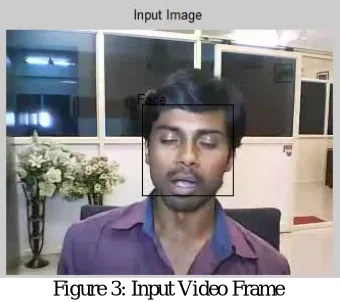
Using image processing methods and matlab platform. Driver eye open close is detected. Figure 3 shows the input video frame.
Figure 3: Input Video Frame
Adaboost is used for face and eye detection from the input frames. And SVM classifier is used to make open or close decision.
Figure 4:Face and Eye Detected Image
Once the driver eye close is detected, vechicle speed as to reduced which is illustrated using bot vechicle constructed using 100rpm motors.
VI. CONCLUSION
The proposed method efficiently detects the drowsiness as with good success rate. In this method, a driver’s drowsiness detection system has been proposed based on fatigue detection. The proposed system is based on eyes closer. The system continuously captures the image of the subject on site and detects face region, then eyes are detected in the face under consideration to determine if eyes are closed or open, if eyes found to be closed speed of the vehicles is reduced to avoid accidents.
REFERENCES
[1] Manisha Ruikar, National statistics of road traffic accidents in India,March 28, 2016.
[2] Amardeep Singh, Amardeep Singh Virk, “Real Time Drowsy Driver Identification Using Eye Blink Detection”, “International Journal of Advanced Research in Computer Science and Software Engineering”, Volume 5, Issue 9, September 2015.
[3] Vikash, Dr. N.C. Barwar, “Monitoring of Driver Vigilance Using Viola-Jones Technique”, International Journal of Application or Innovation in Engineering & Management (IJAIEM), Volume 3, Issue 5, May 2014.
[4] M.Gopi Krishna, A. Srinivasulu, Face Detection System On AdaBoost Algorithm Using Haar Classifiers, International Journal of Modern Engineering Research, Vol. 2, Issue. 5, Sep.-Oct. 2012.
[5] Latha Parthiban, A Novel Face Recognition Algorithm with Support Vector Machine Classifier, international journal of mathematics and scientific computing, vol. 1, no. 1, 2011.
[6] C.Murukesh, preethi padmanabhan, “drowsiness detection for drivers using computer vision”, wseas transactions on information science and applications.M. Young, The Technical Writer’s Handbook. Mill Valley, CA: University Science, 1989.
[7] Srinivasu Batchu, S. Praveen Kumar.” Driver Drowsiness Detection to Reduce the Major Road Accidents in Automotive Vehicles”. International Research Journal of Engineering and Technology (IRJET), Volume: 02 Issue: 01 April-2015