A hybrid Technique of Image Watermarking Using
DWT and Harmony Search Algorithm
Parvinder kaur1, Er. Jasdeep Singh Maan2
P.G. Student, Department of Computer Engineering, BMS Engineering College, Sri Muktsar Sahib, India1
Associate Professor, Department of Computer Engineering, BMS Engineering College, Sri Muktsar Sahib, India2
Abstract
With exploration of technology and internet, piracy has become a subject of concern. Digital watermarking is technique which is used to protect the copyright of digital media by preventing it from piracy and unauthorized users. In this paper a new method is presented which is based upon Discrete wavelet transformation (DWT) and harmony search algorithm (HSA). DWT is used to decompose the image into frequency based sub-bands namely LL, LH, HL and HH.A watermark image is hidden in three of these sub-bands except LL. Harmony search Algorithm is used to find the best blocks where the watermark bits are hidden. In the extraction process original watermark is extracted from watermarked image and the concept of secret key has enhanced the security of image. The method provides very efficient way to hide watermark in the original image. Certain performance measures are used to check the imperceptibility and robustness of technique. Different attacks are applied on the watermarked image to verify the robustness of images. The results are depicted through graphs and image. Calculated results and analysis has proved that the method is more secure and robust as compared to the various other approaches
Keywords: DWT, HSA, PSNR, HM, HMCR, PAR, PBW
1. Introduction
The Digital image watermarking plays a paramount role in the field of digital media. It is used to secure the image from piracy and unauthorized attackers. In the process of watermarking secret data is hidden into digital media such as images, video and audio in a way to authenticate it and later it is extracted to get original image. The data that is inserted into carrier media is called watermark. One can choose text or an image as a watermark. During transmission image can be attacked if it is not secured. The general process is shown in the figure .1. On the basis of human perception it can be of two types i.e. visible watermarking and invisible watermarking. If the added watermark can be noticed or recognized it is visible watermarking but when watermark is unseen and cannot be perceived by human eye it is known to be invisible. According to the working domain, watermarking can be of two types: Transform domain watermarking, and spatial
domain watermarking. In spatial domain watermarking, embedding and extraction is performed on spatial pixel values and in transform domain watermarking , initially spatial pixel values are altered using a predefined transform and then the watermark is embedded into transform coefficients. The transforms used are FFT (Fast Fourier Transform), DCT (Discrete Cosine Transform), DWT (Discrete Wavelet Transform), and SVD (Singular Value Decomposition). Watermarking techniques can also
Fig.1 general process of image watermarking
be classified as blind detection and non-blind detection based on detection or extraction techniques. Non-blind watermarking techniques require the original un-watermarked content, while blind techniques can extract a watermark without any reference to the original content.
2. Discrete wavelet transform
www.ijiset.com the image energy is concentrated at LL bands so hiding
watermark in it may downgrade the quality of image. Therefore high frequency subbands are mostly used for watermark embedding as these signals are less perceived by human eye.
3. Harmony search algorithm
Harmony search algorithm was proposed by Zong Woo Geem in 2001[4].Harmony search algorithm is metaheuristic process which is based on improvisation of music by musician. A musician improvises new musical harmony with the help of three possible choices:
1. Playing any existing music from his or her memory. 2. Playing new musical tone by slightly adjusting the pitch
of any exiting music.
3. Compose new random notes.
As the player composes new music by following any of the three options, likewise HSA searches the best solutions from given problem. Each solution in algorithm is known as ‘‘harmony” and represented by an n-dimension real vector. It begins with initialization of harmony memory (HM) that contains randomly generated population of harmony vectors from given set of problem. Harmony memory is crucial part of HSA. Selection of random solutions or harmonies from harmony memory is determined by parameters known by the names harmony memory considering rate (HMCR) and pitch adjusting rate(PAR).HMCR is probability of selecting harmonies from harmony memory and it varies between 0 and 1.PAR is used to slightly change frequency to get different solutions in HSA using pitch bandwidth(PBW). It includes the following steps [4]:
Step 1.Initialization of Harmony memory (HM).
Step 2.From the HM improvise a new harmony based on HMCR and PAR.
Step 3.Comparing fitness function if a new harmony is better than worst harmony it replaces worst existing harmony.
Step 4.If the termination criterion is not satisfied go to step 2.
Fig. 2 flowchart of HSA
4. PROPOSED WORK
The proposed watermarking technique presents hybridization of DWT and HSA.1 level DWT is implemented to decompose the original image into four sub-bands LL, LH, HL, and HH. From the four bands LL is most important one as most of the image energy is concentrated in LL frequency region and specify approximation coefficients. Therefore hiding watermark bits in this band may ultimately degrades the image quality .Hence in the proposed technique we are using other three bands to embed watermark.[2].These sub-bands are partitioned blocks of size 8x8and to improve the imperceptibility of technique only few blocks are selected to insert watermark. This block selection is done with Harmony search algorithm. On the basis of the fitness function HSA finds the best blocks from the available blocks. Peak signal to noise ratio (PSNR) is used as fitness function and is calculated with the help of equation(1). Address of selected blocks is used as secret key. Inverse
Initialize the parameters of hsa
Initialize the harmony memory
Compute the fitness function of each harmony
Itr =1
Itr<max itr
rand<HMCR
rand<PAR
Evaluate new harmony for given fitness function
Get new harmony by pitch adjusting
Get New harmony using randomization
Get the existing harmony
Get best harmony from last iteration
Update HM if it found best solution
DWT is used to rejoin the sub-band LL and other three watermark sub-bands to get watermarked image. In the extraction phase, again using DWT and secret key the watermarked blocks are extracted .The whole technique is implemented using MatlabR2014a.
4.1 Watermark embedding algorithm
Step 1.Read the original image and watermark image. Convert watermark image into binary form.
Step 2.Perform 1 level DWT on host image to get four sub-bands that are LL, LH, HL, and HH.
Step 3.Break the high frequency three sub-bands into 8×8 image non overlapping blocks.
Step 4.Find optimal blocks from the total blocks to hide watermark bits. Number of blocks selected should be equal to number of watermark bits to be hidden. Perform HSA to select most appropriate blocks.
1. Set the control parameters HMS=60, HMCR=0.95, PAR=0.3, PBW=0.2, Maximum iterations=1000.
2. Initialize the harmony memory (HM) and total blocks are counted and considered as harmonics of HM
3. Calculate the fitness function for the whole harmony memory. Here the fitness function corresponds to the PSNR values using equation(1).
4.For each iteration a new harmonics is generated
according to the three rules. a. Memory consideration b. Pitch adjustment c. randomization using the parameters
HMCR , PAR, PBW.
5. Accept the new harmonic if it is better than the existing worst harmonic.
6. Update the Harmony memory with new harmonic solution having maximum fitness function.
7. Go to 4 until the stopping criterion (maximum iterations) is met.
Step 5.Get the addresses of selected blocks to use them as secret key.
Step 6.Insert the watermark bits at uniquely selected blocks to hide one bit per block. Recognize the initial row coefficients for each block and find out highest coefficient MAXIMUM and lowest coefficient MINIMUM .
Substitute first row coefficient slctdBlk(1,1) as follows: if WmkImg(bitcount)==1
SlctdBlk(1,1)=MAXIMUM + u; else
SlctdBlk(1,1)=MINIMUM - u;
Where bitcount is binary watermark bit which can be 0 or 1.u is power scaling factor experimentally calculated according to three sub-bands. Value of u=1.95 for LH, u=2 for HL and u=2.55 for HH.
Step 7.Obtain sub-bands by rejoining watermarked and non watermarked blocks.
Step 8.Get the watermarked image by applying inverse DWT.
Fig.3block diagram of proposed watermark embedding process
4.2. Watermark extraction algorithm
Step 1: Apply 1-level DWT to obtain watermarked image to get sub bands.
Step 2: Divide three watermarked sub bands wLH, wHL, and wHH into non overlapped blocks of size 8 X 8 pixels. Step 3: Load the secret key to extract the watermarked blocks.
Step 4: Calculate average value of the initial row coefficients of each watermarked block. Based on average value, extract the binary watermark.
if SlctdBlk(1,1)>=AVG ExtrctdWmk(bitcount)=1; else
ExtrctdWmk(bitcount)=0; end
Step 5: Obtain the extracted watermark.
www.ijiset.com
Fig.4 block diagram proposed watermark extracting process.
5. Experimental results and analysis
This part includes the experiments conducted and results obtained in the technique implemented with the help of MatlabR2014a. It is divided into two parts .In section 1 input images and watermarked images are given. In section 2 performance check measures are described.
5.1. Various images used
Images used for experiments are four grayscale image that are Lena, Baboon , penguins, Boat and colored baby image which is shown in fig 5. Moreover watermarked images are shown in fig 6. Size of input images is 512 ×512 pixels and watermark image is of 32 ×32.Same watermark is embedded in all the images. To increase the robustness and quality of the image, watermark taken is of small size as compared to the original image. Higher robustness is achieved since no difference between the original image and watermark image can be perceived. Bits of logo image(watermark image) are hidden at the most suitable positions using HSA. It also enhances the imperceptibility, security and superiority.
a b c
d e f
Fig.5show original images (a) Lena,(b)boat,(c) baboon,(d) penguin,(e) baby,(f) watermark
g h i
J k
Fig.6 shows corresponding watermarked images
5.2. Performance analysis
Table 1.parameters table for watermarked images
Paramete rs
Baby
Lena
Boat Baboon
Penguin
MSE
0.0027 0.147 0.0219 0.4771 0.1812
PSNR
73.744 56.43 5
64.717 51.344 55.592
BER
0.0136 0.017 7
0.0155 0.0195 0.0180
CC
1.0000 0.999 8
0.9999 0.9989 0.9999
SSIM
1.0000 1.000 0
1.0000 1.0000 0.9997
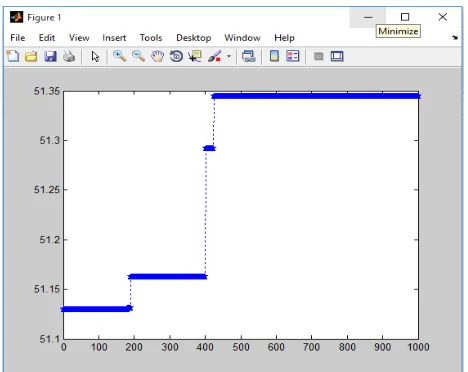
Figure 7 shows the PSNR values against 1000 iterations for grayscale Baboon image. It is depicted from the graph that for first 400 iterations the PSNR value varies. but after that the value attained is maximum as well as constant.
Fig.7 PSNR value verses no. of iteration for baboon image.
Fig.8 PSNR value verses on.of iteration for baby image
Figure 8 reflects the graph for colored baby image .PSNR value for the watermarked image reach to 73.401 db.which shows as the iteration increases the most suitable are selected by HSA resulting in better values at the end.
Peak signal to noise ratio (PSNR)
PSNR is used to measure the degradation in watermarked image as compared to the actual image. equation () is used to calculate it.
(1)
Mean squared error (MSE)
MSE is Mean Squared Error between original and watermarked picture of size M×N. It is obtained by equation
(2)
Where x(i,j) refers to pixel intensity of actual
image and y(i,j) refers to pixel intensity of
watermarked image.
Bit error rate (BER)
It defined as number of bits error to total bits. Value of BER nearer to zero means high quality of watermarked image.
BER=1/PSNR (3) Structural Similarity Index Metric (SSIM)
It denotes similarity between the structures of the two images. It is use to find degradation in structure information of image.It is given by equation
(4)
Where are given as:
(5)
(6)
(7)
(3.7)
(8)
(9)
C1 and C2 are constants.
www.ijiset.com it is relationship factor used to check the robustness of the
algorithm. it is denoted by ρ and evaluated by following equation.
(10)
is the pixel value of original watermark image and
is the pixel value of watermarked image
.
Robustness against attacks
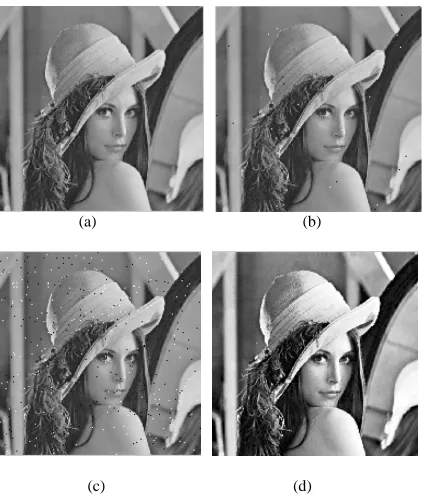
To check the robustness of the proposed method different attacks such salt pepper attack of 1% and 10%, histogram equalization are applied on watermarked images. The experimental outputs illustrate the obvious enhancement, both on the robustness and imperceptibility. In salt pepper attack some pixels of the image have different intensity than the other surrounding pixels. It occurs due to quick transients such as faulty switching. Histogram equalization attack directly affects the contrast of image by redistributing grey values. Fig (9) shows that different attacks are applied on colored baby image and grayscale Lena image.
(a) (b)
(c) (d) Fig.9 (a)host image,(b)1% salt pepper attack, (c)10% salt pepper attack (d)histogram equalization attack on baby image.
(a) (b)
(c) (d)
Fig.10 (a)host image (b)1%salt pepper attack, (c)10%salt pepper attack (d)histogram equalization attack on Lena image.
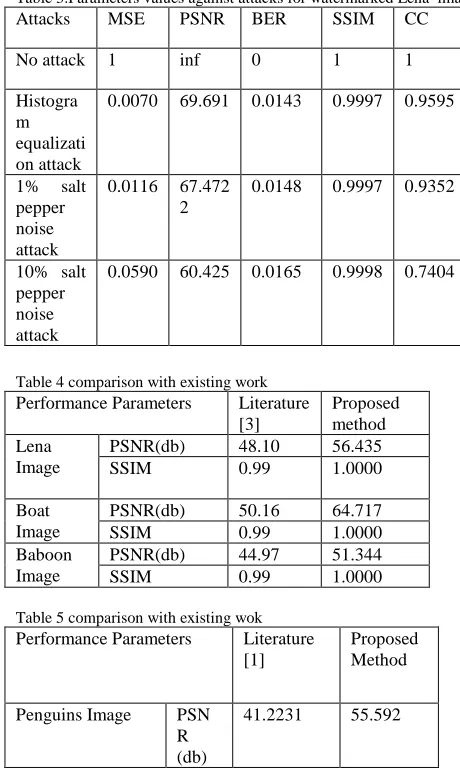
Parameters values such as MSE, PSNR, BER, SSIM and CC in table 2 and 3 depicts robustness of baby and Lena image after attacks .larger values of PSNR shows best performance of method proposed. Closer is the value of CC and SSIM to 1, better is the robustness.
Table 2.Parameters values against attacks for watermarked baby image
Attacks MSE PSNR BER SSIM CC
No attack 0 Inf 0 1 1
Histogra m equalizati on attack
0.0109 67.771 0.0148 0.9998 0.9385
1% salt pepper noise attack
0.0101 68.094 0.0147 0.9998 0.9440
10% salt pepper noise attack
0.0838 58.899 0.0170 0.9997 0.6475
Table 3.Parameters values against attacks for watermarked Lena image.
Table 4 comparison with existing work Performance Parameters Literature
[3]
Proposed method Lena
Image
PSNR(db) 48.10 56.435 SSIM 0.99 1.0000
Boat Image
PSNR(db) 50.16 64.717 SSIM 0.99 1.0000 Baboon
Image
PSNR(db) 44.97 51.344 SSIM 0.99 1.0000
Table 5 comparison with existing wok Performance Parameters Literature
[1]
Proposed Method
Penguins Image PSN R (db)
41.2231 55.592
6. Conclusions
In this paper, a new hybrid technique of image watermarking using DWT and Harmony search algorithm is presented. The method uses HSA to select most appropriate blocks from total blocks obtained from DWT subbands .The extraction of watermark has been done successfully. Since it makes use of transformed coefficients of frequency domain, it provides more robustness and imperceptibility of watermark and watermarked images. The algorithm can be applied to gray scale as well as RGB images. Efficiency has been tested under various attacks. Performance parameters are also employed to check the quality of algorithm. Illustrations of results are depicted through pictures and result tables. Analysis shows that it gives better results for variety of images. This blind watermarking technique is more secure
than various other existing techniques to protect images against piracy and illegal acts. In the future the technique can be further tested against other attacks such as cropping, median filter, Gaussian noise attack etc. Further the analysis can be extended with the help of different other error detection and correction algorithms. Moreover the proposed algorithm can also be improved by using other hybrid methods and algorithms for better efficiency.
References
[1] T. Pardhu, B. R. Perli, “Digital Image Watermarking in Frequency Domain”, International Conference on Communication and Signal Processing, April, 2016,pp.0208-0211.
[2] Mingzhi C, Yan L., Yajian Z., and Min L., “A Combined DWT and DCT Watermarking Scheme Optimized Using Genetic Algorithm”, Journal of Multimedia, Vol. 8, No. 3, June 2013,pp.299-305.
[3] Chaudhry A., Sikandar B., Ishtiaq M., Jaffar A., Kim J. Y., Tuan T. A., “Genetic Swarm Based Robust Image Watermarking”, ICUIMC (IMCOM), Kota Kinabalu Malaysia, Jan. 2013.
[4] Geem ZW, Kim JH and Loganathan GV (2001) A new heuristic optimization algorithm: Harmony search. Simulation, 76, pp. 60-68.
[5] Jumana Waleed, Huang Dong Jun, Saad Hameed and May Kamil, “Optimal Positions Selection for Watermark Inclusion based on a Nature Inspired Algorithm”, International Journal of Signal Processing, Image Processing and Pattern, Vol. 8, No. 1 (2015), pp. 147-160. [6] Nirupma Tiwari1, Naveen Hemrajamani and Dinesh Goyal,
“Improved Digital Image Watermarking Algorithm Based on Hybrid DWT-FFT and SVD Techniques”,Indian Journal of Science and Technology, Vol 10(3),jan,2017.
[7] Geem ZW (2009) Music -inspired harmony search algorithm: theory and applications. Springer, Berlin.
[8] A K Khanna, N Ranjan Roy, Dr. Bhupendra Verma(2016) , ” Digital Image Watermarking and its optimization using Genetic Algorithm”, International Conference on Computing, Communication and Automation (ICCCA2016),pp.1140-1144.
[9] Verma, B. Jain, S., Agarwal, D.P. and Phadikar, A., “A New color image watermarking scheme”, Info comp Journal of computer science, vol. 5, No.2,2006, pp 37-42.
[10] A. Rajani, and T. Ramashri, “Image Watermarking Algorithm using DCT, SVD and Edge Detection Technique”, International Journal of Engineering Research and Applications, vol. 1, issue 4, pp. 1828-1834
[11] Rafael C. Gonzalez, Digital Image Processing, third edition.
Attacks MSE PSNR BER SSIM CC
No attack 1 inf 0 1 1
Histogra m equalizati on attack
0.0070 69.691 0.0143 0.9997 0.9595
1% salt pepper noise attack
0.0116 67.472 2
0.0148 0.9997 0.9352
10% salt pepper noise attack