Collision Attack on 5 Rounds of
Grøstl
?Florian Mendel1, Vincent Rijmen2, and Martin Schl¨affer1
1 IAIK, Graz University of Technology, Austria
2 Dept. ESAT/COSIC, KU Leuven and Security Dept., iMinds, Belgium
Abstract. In this article, we describe a novel collision attack for up to 5 rounds of theGrøstl hash function. This significantly improves upon the best previously published results on 3 rounds. By using a new type of differential trail spanning over more than one message block we are able to construct collisions forGrøstl-256 on 4 and 5 rounds with complexity of 267and 2120, respectively. Both attacks need 264 memory. Due to the generic nature of our attack we can even construct meaningful collisions in the chosen-prefix setting with the same attack complexity.
Keywords:hash functions, SHA-3 candidate,Grøstl, collision attack
1
Introduction
In the last few years the cryptanalysis of hash functions has become an important topic within the cryptographic community. Especially the collision attacks on the MD4 family of hash functions (MD5, SHA-1) have weakened the security assumptions of these commonly used hash functions [26–28]. As a consequence NIST has decided to organize a public competition in order to design a new hash function, leading to the selection of Keccak as SHA-3 [19].
During the SHA-3 competition, the three classical security requirements (collision-, preimage- and second-preimage resistance) were not the main target of cryptanalytic attacks. Most results were published on building blocks such as the compression function, block cipher or permutation used in a hash function. Additionally, many distinguishers on these building blocks with minor relevance in practice were considered. Although these results are important from a theo-retical point of view, vulnerabilities that can be exploited for the hash function are certainly more important.
In this work, we present new results on the collision resistance of the SHA-3 finalist Grøstl. Grøstlis an iterated hash function based on design principles very different from those used in the MD4 family. The compression function of Grøstlis built from two different permutations that follow the design strategy of the Advanced Encryption Standard (AES) [3, 17]. The simple construction of the compression function and the byte-oriented design of Grøstl facilitates the security analysis. In the last years Grøstl has received a large amount of cryptanalysis. However, most of the analysis focus on the building blocks of Grøstland only a few results have been published for the hash function so far.
? c
Related Work. Grøstl is one of the SHA-3 candidates that has probably received the largest amount of cryptanalysis during the competition. Security analysis of Grøstl was initiated by the design team itself which led to the rebound attack [15]. Since then, several improvements to the rebound attack technique have been made, leading to new results on both the hash function [16] and its underlying components [6, 14, 22]. For the final round, Grøstlwas been tweaked to thwart internal differential attacks [7, 21] and to reduce the impact of the rebound attack and its extensions.
The best published attacks on the final version of both Grøstl-256 and Grøstl-512 are collision attacks on 3 rounds of the hash function and on 6 rounds of the compression function [9, 23]. Preimage attacks for the compres-sion function of Grøstl-256 andGrøstl-512 have been shown in [29] for 5 and 8 rounds, respectively. Additionally, non-random properties of theGrøstl per-mutation have been discussed in [1, 8]. For a detailed overview of the existing attacks onGrøstl we refer to the ECRYPT II SHA-3 Zoo [4].
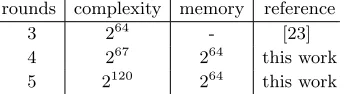
Our Contribution. By using a new type of differential trail we are able to show collision attacks on Grøstl for up to 5 rounds. The extension becomes possible by considering differential trails spanning over more than one message block to iteratively cancel differences in the chaining variable. Our new attack combines ideas of the attack on SMASH [13] with the rebound attack [15] on Grøstl. A similar approach has also been used in the attack on Grindahl [20]. The results are collision attacks on the Grøstl-256 hash function reduced to 4 and 5 rounds with a complexity of 267 and 2120, respectively. Both attacks have memory requirements of 264. Note that the best previously known collision attack on theGrøstlhash function was on 3 rounds with a complexity of 264[23]. We want to note that the same attack also applies to 5 rounds of Grøstl-512.
Additionally, we show that due to the generic nature of our attack we can construct collisions in the chosen-prefix setting with the same complexity. It has been demonstrated in [24, 25] that chosen-prefix collisions can be exploited to construct colliding X.509 certificates and a rogue CA certificate for MD5. Note that in most cases constructing such collisions is more complicated than constructing (random) collisions. Our results and related work for the Grøstl hash function are shown in Table 1.
Table 1: Collision Attacks on theGrøstl-256 hash function.
rounds complexity memory reference
3 264 - [23]
Outline. The paper is structured as follows. In Section 2, we give a short de-scription of theGrøstlhash function. The basic attack strategy and the collision attack for 4 rounds of the hash function is presented in Section 3. In Section 4, we describe the extension of the attack to 5 rounds, and in Section 5 the con-struction of meaningful collisions is discussed. Finally, we conclude in Section 6.
2
Short Description of
Grøstl
The hash function Grøstl[5] was one of the 5 finalists in the SHA-3 competi-tion [18].Grøstlis an iterated hash function with a compression function built from two distinct permutations P and Q, which are based on the AES design principles. In the following, we describe the components of the Grøstl hash function in more detail.
2.1 The Hash Function
The two main variants, Grøstl-256 and Grøstl-512 are used for hash output sizes ofn= 256 andn= 512 bits. The hash function first pads the input message
M and splits the message into blocksm1, m2, . . . , mt of`bits with `= 512 for Grøstl-256, and ` = 1024 for Grøstl-512. The message blocks are processed via the compression functionf(hi−1, mi) and output transformationΩ(ht). The size of the chaining valuehi is`bits as well.
h0=IV
hi=f(hi−1, mi) for 1≤i≤t
h=Ω(ht).
The compression functionf is based on two`-bit permutationsP andQ (some-times denoted byP` andQ`) and is defined as follows:
f(hi−1, mi) =P(hi−1⊕mi)⊕Q(mi)⊕hi−1.
The output transformationΩ is applied toht to give the final hash value hof sizen, where truncn(x) discards all but the least significantnbits ofx:
Ω(ht) = truncn(P(ht)⊕ht).
2.2 The Permutations P and Q
The two permutations P andQ are designed according to the wide trail strat-egy [2] and their structure is very similar to the AES. InGrøstl-256 each per-mutation updates an 8×8 state of 64 bytes in 10 rounds. In one round, the round transformation updates the state by means of the sequence of transformations
MB◦SH◦SB◦AC.
AddRoundConstant(AC). In this transformation, the state is modified by com-bining it with a round constant with a bitwisexoroperation. Different constants are used for the permutationsP andQ.
SubBytes (SB). The SubBytes transformation is the same for P and Q and
is the only non-linear transformation of the permutations. It is a permutation consisting of an S-box applied to each byte of the state. The 8-bit S-box is the same as in the AES with good cryptographic properties against differential and linear attacks. For a detailed description of the S-box, we refer to [17].
ShiftBytes (SH). The ShiftBytes transformation is a byte transposition that
cyclically shifts the rows of the state over different offsets. TheShiftBytes trans-formation is different for the two permutationsP andQ.
MixBytes (MB). TheMixBytes transformation is a permutation operating on
the state column by column. To be more precise, it is a left-multiplication by an 8×8 MDS matrix over F28. The coefficients of the matrix are determined in such a way that the branch number of MixBytes (the smallest nonzero sum of active input and output bytes of each column) is 9, which is the maximum possible for a transformation with these dimensions. This transformation is the same for both permutationsP andQ.
2.3 Alternative Description of Grøstl
To simplify the description of attack in the following sections, we use an equiv-alent alternative description of Grøstl. Let P0 andQ0 denote the permutation
P andQwithout the last application ofMixBytes. Then, by setting
h00=MB− 1
(IV)
h0i=P0(MB(h0i−1)⊕mi)⊕Q0(mi)⊕h0i−1 for 1≤i≤t
h=Ω(MB(h0t))
with hi =MB(h0i), we get an equivalent description of Grøstl, where the last
MixBytes transformation of the permutations has been swapped with the XOR
operation of the feed-forward.
3
Collision Attack for 4 Rounds of
Grøstl
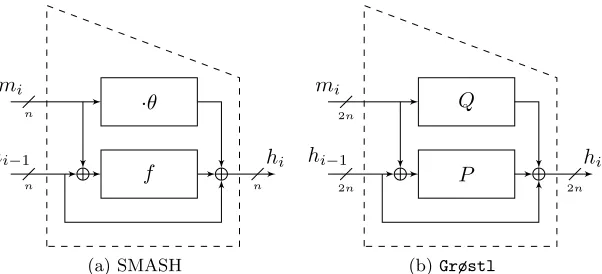
of 257 respectively 513 message blocks, a colliding output difference can be con-structed [13]. In this section, we show how to achieve the same for 4 rounds of Grøstlby having differences in only one permutation.
hi−1 hi
f ·θ mi
n
n n
(a) SMASH
hi−1 hi
P Q mi
2n
2n 2n
(b)Grøstl
Fig. 1: The compression function of (a) SMASH and (b)Grøstl.
3.1 The Second-Preimage Attack on SMASH
The second-preimage attack on SMASH presented in [13] is based on the tech-nique of controllable output differences for the compression function. By care-fully selecting consecutive message blocks, an attacker can step-by-step convert an arbitrary starting difference in the chaining variable into an arbitrary output difference. The attack is deterministic and the number of consecutive controllable message blocks is equal to the length of the chaining variable. The nonlinearity of f is made ineffective by strictly controlling its input differences and values. Controlling the input values off implies that the input values of the linear map are determined. Fortunately, for a linear map it suffices to know the input differ-ence to compute the output difference. The output difference of the linear map is controlled by the number of message blocks.
3.2 Application to Reduced Grøstl
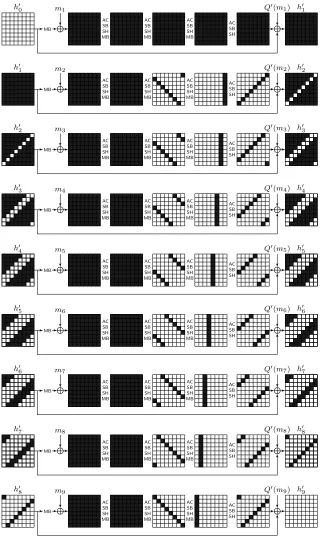
Our attack will start from an arbitrary difference in the chaining variable and convert it into an output difference equal to zero after 9 steps. The first message block can be selected arbitrarily. The only requirement is a difference in the message. The next 8 message blocks are fully controlled by the attacker and must not contain any differences. Then, each of the 8 message blocks is used to cancel one eighth of the differences at the output of the compression function to result in a collision at the end (see Fig. 2).
3.3 Details of the Attack
To simplify the description of the attack we use the alternative description of Grøstl given in Section 2.3. Since the last MixBytes transformation is moved out of the compression function, the limited set of differences at the output are more clearly visible.
The core of our collision attack on the reduced hash function are truncated differential trails with only 8 active bytes at the output of P0. Two full active states are placed at the beginning and the number of active bytes for the 4-round trail are given as follows:
64 r1 −→64 r2
−→8 r3 −→8 r4
−→8. (1)
For such a truncated trail, we can construct a pair following the trail with an amortized complexity of 1 (even for a given input differences). We postpone the detailed explanation how to do so until Section 3.4.
The high-level overview of the 4-round attack is shown in Fig. 2. In each iteration, the differences in 8 bytes are canceled. Since this has a probability 2−64, we need to compute 264 pairs forP0 (for the given input differences) to find aright pair that result in the desired output difference. The attack can then be summarized as follows:
1. Choose arbitrary message blocksm1, m∗1 and computeh01. Repeat this until one gets a full active state inh0
1. Note that randomly selectedm1, m∗1produce a full active state inh0
1 with probability at least 3/4.
2. Use a right pair for P0 following the trail of (1) to cancel 8 bytes of the difference in the stateh0
2, cf. Fig. 2.
3. Use a right pair for P0 for a rotated variant of the trail of (1) to cancel another 8 bytes of the difference in the stateh0
3.
4. Repeat steps 3-4 in total 8 times until a collision has been found inh0 9.
AC SB SH MB AC SB SH MB AC SB SH MB AC SB SH MB h0
8 m9 Q0(m9) h09
AC SB SH MB AC SB SH MB AC SB SH MB AC SB SH MB h0
7 m8 Q0(m8) h08
AC SB SH MB AC SB SH MB AC SB SH MB AC SB SH MB h0
6 m7 Q0(m7) h07
AC SB SH MB AC SB SH MB AC SB SH MB AC SB SH MB h0
5 m6 Q0(m6) h06
AC SB SH MB AC SB SH MB AC SB SH MB AC SB SH MB h0
4 m5 Q0(m5) h05
AC SB SH MB AC SB SH MB AC SB SH MB AC SB SH MB
h03 m4 Q0(m4) h04
AC SB SH MB AC SB SH MB AC SB SH MB AC SB SH MB h0
2 m3 Q0(m3) h03
AC SB SH MB AC SB SH MB AC SB SH MB AC SB SH MB h0
1 m2 Q0(m2) h02
AC SB SH MB AC SB SH MB AC SB SH MB AC SB SH MB h0
0 m1 Q0(m1) h01
3.4 Finding a Right Pair for P0
In this section, we show how to find a right pair for P0 reduced to 4 rounds following the truncated differential trail in (1) using the rebound attack [15]. Note that the input difference is fixed by MB(h0i−1) and we target an output difference such that 8 bytes of the difference in h0i can be canceled. Unlike the classical rebound attack, the inbound phase is placed at the beginning and covers the first two rounds, while the outbound phase covers the last two rounds.
Using super-box matches [6, 11, 12], we can find 264 pairs (solutions) for the inbound phase with a complexity of 264 in time and memory. In the outbound phase, all these pairs will follow the 4 round truncated differential trail with a probability of 1 and one of these 264pairs will match the desired output difference (condition on 64 bits). In other words, using the rebound attack we can find a right pair forP0 with a complexity of 264 in time and memory.
AC SH
SB MB AC SB
SH MB
AC SB SH MB
AC SB SH
P00 T1∗ T2∗ P20 P30 P40
average 1 probability 1
Fig. 3: Truncated differential trail forP0 used in the attack on 4 rounds.
In order to make the subsequent description of the rebound attack easier, we swap the SubBytes and ShiftBytes transformation in the first round of permu-tation P0 (see Fig. 3). Note that this can always be done without affecting the output of the round. Then, the attack can be summarized as follows:
1. Compute the input difference of the permutation (P0
0) forward to stateT1∗. 2. Compute all 264differences of stateP0
2backward to stateT2∗and store them in a listL.
3. Connect the single difference of stateT∗
1 with the 264differences of stateT2∗ using independent super-box matches. For each columnc={0,1, . . . ,7} we proceed as follows:
(a) Take all 264 values for column c of stateT∗
1 and compute both values and differences forward to columnc of stateT∗
2.
(b) Check for matching 8-byte column differences in listL. Since we compute 264 differences forward and have 264 entries in L, we get 264 solutions (differences and values) for the match. We updateLto contain these 264 solutions.
Since the truncated differential trail in the outbound part (the last 2 rounds) has probability 1, we get in total 264 pairs following the truncated differential trail and one of these pairs is expected to be a right pair, i.e. result in the desired output difference (condition on 64 bits).
4
Extending the Attack to 5 Rounds
In this section, we present a collision attack for the Grøstl-256 hash function reduced to 5 rounds with a complexity of about 2120and memory requirements of 264. The attack is an extension of the attack on 4 rounds. However, since the freedom in finding right pairs for the 5-round trail is limited, we need more message blocks for the attack to succeed. In the attack, we use the following sequence of active bytes inP0 (cf. Fig. 4):
64 r1 −→64 r2
−→8 r3 −→1 r4
−→8 r5
−→8. (2)
However, it is important to note that for this truncated differential trail (with a fixed input difference) only 28 pairs exist, in contrast to 264 for the 4 round trail. This complicates the application of the attack. The complexity of finding these 28 pairs is 264using the rebound attack, as described in Section 3.4.
AC SB SH MB
AC SB SH MB
AC SB SH MB
AC SB SH MB
AC SB SH
P00 P10 P20 P30 P40 P50
average 1 probability 2−56
Fig. 4: Truncated differential trail forP0 used in the attack on 5 rounds.
4.1 Details of the Attack
Since we can construct only 28 pairs following the truncated differential trail, but need to cancel a 64-bit difference at the output of the compression function, each step of the attack succeeds only with a probability of 2−56. However, this can be compensated for by using more message blocks in each step of the attack. Then, the attack can be summarized as follows:
1. Use the rebound attack (cf. Section 3.4) to find 28 pairs following the trun-cated differential trail. This has a complexity of 264 in time and memory. 2. For each of these 28pairs check if it can be used to cancel the corresponding
8 bytes of differences in stateh0
3. If no such right pair exists, then choose arbitrarily one of the 28 pairs and compute the stateh0
i. This generates a new starting point with new differ-ences for the next iteration, while keeping the same bytes inactive.
4. After 256new starting points, we expect to find aright pair with the desired output difference.
Since we need 256 new starting points to cancel the differences in 8 bytes of the state, the complexity of the attack is equivalent to 8·264+56= 2123compression function evaluations. Note that the length of such a colliding message is about 8·256= 259 blocks.
4.2 Reducing the Length of the Colliding Message Pair
Beside the large time and memory complexity of the attack, one might also see the length of the colliding message pair as a limiting factor of the attack. However, the length of the colliding message pair can be significantly reduced by using a tree-based approach. Instead of choosing only one of the 28 pairs to generate a new starting point, we can continue with all pairs in parallel. By using a huge tree with 8 levels and 28 branches at each level, we get (28)8= 264nodes at level 8. One of these 264 nodes will have the desired output difference. This way, the length of the colliding message pair can be reduced to 8·8 + 1 = 65 message blocks.
4.3 Improving the Complexity of the Attack
The complexity of the attack can be slightly improved by using denser charac-teristics except when canceling the last 8 bytes. Instead of using a truncated differential trail with a 8→1 transition in round 3 of the trail, we can use trun-cated differential trails with 8 →8, 8→ 7,. . . ,8→2 which have a probability greater than 2−48. The complexity of the attack is then dominated by the last iteration where we still need an 8→1 transition. This will improve the attack complexity by a factor of 8 resulting in a total complexity of 2120 compression function evaluations and 264 memory.
5
Collisions in the Chosen-Prefix Setting
In a collision attack on a hash function an attacker has to find two arbitrary messages M andM∗ such thatH(M) =H(M∗). However, in practice it might be required that the two messages contain some meaningful information, such that it can be used to practically compromise a cryptographic system. Such an example are, for instance, collisions in the chosen-prefix setting, where an attacker searches for a pair (M, M∗) such that
for a chosen-prefix (Mpre, Mpre∗ ). In [24, 25], it was shown that such a more pow-erful attack exists for MD5. Moreover, the application of the attack to construct colliding X.509 certificates and the creation of a rogue certification authority certificate has been shown.
However, in most cases constructing such collisions is more complicated than constructing (random) collisions. In the case of MD5 the collision attack in the chosen-prefix setting has a complexity of 249, while the currently best collision attack on MD5 has a complexity of 216. However, inGrøstlthe collision attack in the chosen-prefix setting has the same complexity as the collision attack. Due to the generic nature of the collision attack, differences in the chaining variables can be canceled efficiently (cf. Section 3).
6
Conclusion
In this work, we have provided new and improved cryptanalysis results for the Grøstlhash function, which significantly improving on previously known results. To be more precise, by using a new type of differential trail we were able to show collision attacks onGrøstlfor up to 5 rounds. The extension becomes possible by considering differential trails spanning over more than one message block.
Moreover, due to the generic nature of our attack we can also construct meaningful collisions, i.e. collisions in the chosen-prefix setting with the same complexity. It has been shown in the past that such collisions might be exploited for instance to construct colliding X.509 certificates.
Although our results do not threaten the security ofGrøstl, we believe that they will lead to a better understanding of the security margin of the hash function.
Acknowledgments. The work has been supported in part by the Austrian
Government through the research program COMET (Project SeCoS, Project Number 836628) and through the research program FIT-IT Trust in IT Systems (Project SePAG, Project Number 835919), by the Secure Information Technol-ogy Center-Austria (A-SIT), and by the Research Fund KU Leuven, OT/13/071.
References
1. C. Boura, A. Canteaut, and C. De Canni`ere. Higher-Order Differential Properties of Keccak and Luffa. In A. Joux, editor,FSE, volume 6733 ofLNCS, pages 252– 269. Springer, 2011.
2. J. Daemen and V. Rijmen. The Wide Trail Design Strategy. In B. Honary, editor, IMA Int. Conf., volume 2260 ofLNCS, pages 222–238. Springer, 2001.
3. J. Daemen and V. Rijmen. The Design of Rijndael: AES - The Advanced Encryp-tion Standard. Springer, 2002.
5. P. Gauravaram, L. R. Knudsen, K. Matusiewicz, F. Mendel, C. Rechberger, M. Schl¨affer, and S. S. Thomsen. Grøstl – a SHA-3 candidate. Submission to NIST (Round 3), January 2011. Available online:http://www.groestl.info. 6. H. Gilbert and T. Peyrin. Super-Sbox Cryptanalysis: Improved Attacks for
AES-Like Permutations. In S. Hong and T. Iwata, editors,FSE, volume 6147 ofLNCS, pages 365–383. Springer, 2010.
7. K. Ideguchi, E. Tischhauser, and B. Preneel. Improved Collision Attacks on the Reduced-Round Grøstl Hash Function. In M. Burmester, G. Tsudik, S. S. Magliv-eras, and I. Ilic, editors,ISC, volume 6531 of LNCS, pages 1–16. Springer, 2010. 8. J. Jean, M. Naya-Plasencia, and T. Peyrin. Improved Rebound Attack on the
Finalist Grøstl. In A. Canteaut, editor, FSE, volume 7549 ofLNCS, pages 110– 126. Springer, 2012.
9. J. Jean, M. Naya-Plasencia, and T. Peyrin. Multiple Limited-Birthday Distin-guishers and Applications. In T. Lange, K. Lauter, and P. Lisonek, editors,Selected Areas in Cryptography, LNCS. Springer, 2013. (in press).
10. L. R. Knudsen. SMASH - A Cryptographic Hash Function. In H. Gilbert and H. Handschuh, editors,FSE, volume 3557 ofLNCS, pages 228–242. Springer, 2005. 11. M. Lamberger, F. Mendel, C. Rechberger, V. Rijmen, and M. Schl¨affer. Rebound Distinguishers: Results on the Full Whirlpool Compression Function. In M. Matsui, editor,ASIACRYPT, volume 5912 ofLNCS, pages 126–143. Springer, 2009. 12. M. Lamberger, F. Mendel, C. Rechberger, V. Rijmen, and M. Schl¨affer. The
Re-bound Attack and Subspace Distinguishers: Application to Whirlpool. Cryptology ePrint Archive, Report 2010/198, 2010. http://eprint.iacr.org/.
13. M. Lamberger, N. Pramstaller, C. Rechberger, and V. Rijmen. Second Preimages for SMASH. In M. Abe, editor,CT-RSA, volume 4377 ofLNCS, pages 101–111. Springer, 2007.
14. F. Mendel, T. Peyrin, C. Rechberger, and M. Schl¨affer. Improved Cryptanalysis of the Reduced Grøstl Compression Function, ECHO Permutation and AES Block Cipher. In M. J. Jacobson Jr., V. Rijmen, and R. Safavi-Naini, editors, Selected Areas in Cryptography, volume 5867 ofLNCS, pages 16–35. Springer, 2009. 15. F. Mendel, C. Rechberger, M. Schl¨affer, and S. S. Thomsen. The Rebound Attack:
Cryptanalysis of Reduced Whirlpool and Grøstl. In O. Dunkelman, editor,FSE, volume 5665 ofLNCS, pages 260–276. Springer, 2009.
16. F. Mendel, C. Rechberger, M. Schl¨affer, and S. S. Thomsen. Rebound Attacks on the Reduced Grøstl Hash Function. In J. Pieprzyk, editor,CT-RSA, volume 5985 ofLNCS, pages 350–365. Springer, 2010.
17. National Institute of Standards and Technology. FIPS PUB 197: Advanced En-cryption Standard. Federal Information Processing Standards Publication 197, U.S. Department of Commerce, November 2001. Available online: http://www. itl.nist.gov/fipspubs.
18. National Institute of Standards and Technology. Announcing Request for Candi-date Algorithm Nominations for a New Cryptographic Hash Algorithm (SHA-3) Family. Federal Register, 27(212):62212–62220, November 2007. Available online:
http://csrc.nist.gov/groups/ST/hash/documents/FR_Notice_Nov07.pdf. 19. National Institute of Standards and Technology. SHA-3 Selection Announcement,
October 2012. Available online:http://csrc.nist.gov/groups/ST/hash/sha-3/ sha-3_selection_announcement.pdf.
20. T. Peyrin. Cryptanalysis of Grindahl. In K. Kurosawa, editor, ASIACRYPT, volume 4833 ofLNCS, pages 551–567. Springer, 2007.
22. Y. Sasaki, Y. Li, L. Wang, K. Sakiyama, and K. Ohta. Non-full-active Super-Sbox Analysis: Applications to ECHO and Grøstl. In M. Abe, editor, ASIACRYPT, volume 6477 ofLNCS, pages 38–55. Springer, 2010.
23. M. Schl¨affer. Updated Differential Analysis of Grøstl, 2011. Available online:
http://www.groestl.info/.
24. M. Stevens, A. K. Lenstra, and B. de Weger. Chosen-Prefix Collisions for MD5 and Colliding X.509 Certificates for Different Identities. In M. Naor, editor, EU-ROCRYPT, volume 4515 ofLNCS, pages 1–22. Springer, 2007.
25. M. Stevens, A. Sotirov, J. Appelbaum, A. K. Lenstra, D. Molnar, D. A. Osvik, and B. de Weger. Short Chosen-Prefix Collisions for MD5 and the Creation of a Rogue CA Certificate. In S. Halevi, editor,CRYPTO, volume 5677 ofLNCS, pages 55–69. Springer, 2009.
26. X. Wang, X. Lai, D. Feng, H. Chen, and X. Yu. Cryptanalysis of the Hash Functions MD4 and RIPEMD. In R. Cramer, editor,EUROCRYPT, volume 3494 ofLNCS, pages 1–18. Springer, 2005.
27. X. Wang, Y. L. Yin, and H. Yu. Finding Collisions in the Full SHA-1. In V. Shoup, editor,CRYPTO, volume 3621 ofLNCS, pages 17–36. Springer, 2005.
28. X. Wang and H. Yu. How to Break MD5 and Other Hash Functions. In R. Cramer, editor,EUROCRYPT, volume 3494 ofLNCS, pages 19–35. Springer, 2005. 29. S. Wu, D. Feng, W. Wu, J. Guo, L. Dong, and J. Zou. (Pseudo) Preimage Attack