ISSN 2286-4822 www.euacademic.org
Impact Factor: 3.1 (UIF) DRJI Value: 5.9 (B+)
Selective Image Encryption with 3D Chaotic Map
ASIA MAHDI NASER ALZUBAIDI Computer Science Department, College of Science
Karbala University, Karbala Iraq
Abstract:
Nowadays, with the incredible development of internet technologies and wireless communication networks. All kinds of multimedia data such as digital image, Audio, text and video can be accessed in easily way over internet. Due to this, cryptographic methods are required to accomplish a sufficient level of security, integrity, confidentiality as well as, to prevent unauthorized access of important information during data storage and transmission. In this paper, a novel and efficient selective image encryption and decryption schemes has been suggested based on 3D logistic chaotic map. Color transformation applied to convert from RGB to the YCbCr color space. On Y component a selective encryption algorithm is performed to protect the sensitive data. Further the confusion process is adopted by using two dimension Arnold cat transformation to make more distortion of the relationship among adjacent pixels of Y image and to hide the statistical structure of pixels. Encryption scheme is performed on Y encrypted and scrambling channel with CbCr components by using 3D logistic mapping system to diffuse the correlation between crypto-image and plain-image. The presented encryption Algorithm As mentioned in this work has been tested and analysis on some color images and the results showed a significant security and validity to resistance the statistical and differential attacks. Also the ciphered image has information entropy close to ideal value and correlation coefficients near to 0 value.
Key words: Image Encryption Techniques; 2D Arnold Cat Map; Chaotic Theory; Selective Encryption; 3D Logistic Map; Confusion and Diffusion.
1. Introduction
method Arnold cat mapping is a suitable candidate for this purpose. Finally, improved 3D logistic transform is essential for encrypting the scrambling Y channel with CbCr components separately. The logistic map used to diffusion the relationship among encrypt-image and original-image and consequently the proposed algorithm for encryption became more secure from cryptanalytic attacks (Pawan et al, 2012).The rest of this research is described as follow: Section 2 and 3 shows the related works of image encryption. In section 4, an image encryption scheme based on 3D logistic transform is depicted and discussed in details. In Sections 5, the security of the new algorithm is assessed by cryptanalysis and experimental results are explained. Finally, Section 6 involved the conclusion of the paper.
2. Background
Today, with the rapid evolution of communication networks and fastening on multimedia information in the digital world, the secrecy of data has become a central issue during transmission via insecure channels. Diverse digital image encryption techniques have been presented to increase the secrecy, integrity, confidentiality of these images. Actually, all image ciphering methods attempt to alter the original image to deformed image that is difficult to understand. On the other hand, image decryption try to reconstruct the plain image from the ciphered one by follow the reverse process of encryption steps.
3. Literature Survey
system (Rodrigues et al,2006).have proposed new approach of selective or partial encryption of human face images based on discrete cosine transform and AES stream cipher use Variable Length Coding(VLC)method of the Huffman’s vector, they found that it can be cipher an image without disturbing the compression rate. (Panduranga et al.2013) describe selective encryption in two methods to secure only selected portion of medical and satellite images, the first way is very useful if the selected portion of image is known while the second encryption scheme is suitable when region of interest is found in image.(Rajinder et al,2013)makes security comparison between full and selective image encryption techniques using fidelity criteria such as correlation, entropy and histogram analysis, they found that selective methods provide great level of protection since they reduced the encryption process time. (Abeer et al. 2013)In this research, a novel image encryption method based on 3D chaotic algorithm execute the diffusion and confusion operations. The experimental analysis show that the presented scheme provide high security level, they resistance to different types of attacks such as force attack, chosen-cipher text attacks and differential attack with encryption ratio equal to (6.25 %) and well-matched with compression process.
4. Proposed Technique
Green
Blue Red
plain
image conversionColor
Y Cb Cr Selective encryption Arnold cat map 3D logistic map cipher image YCbCr image
Image Encryption part
Green Blue Red Color conversion Y Cb Cr Selective encryption InvArnold cat map 3D logistic map cipher image plain image YCbCr image
Image Decryption part
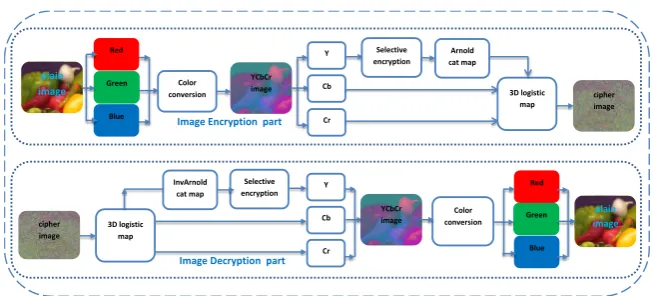
Figure (1) Block diagram of proposed Image encryption scheme
The block diagram of proposed method involved steps are:
4-1 Color Conversion
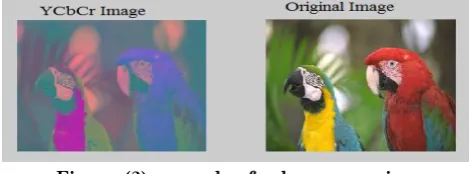
RGB color space is one of best widely used for handling and storing the data of image due to high connection between the red, green and blue components. Actually, RGB color space mixes the chrominance and luminance components so it can't use in color analysis and segmentation methods based on color criteria. While, YCbCr Color model is widely used in processing of video information since it separate between luminance and chrominance components. Y denoted the luma part with values range [16 235] and can be calculating as weighted sum of RGB values. Cb component obtained from the difference between blue and luma component with values range [16 240] and Cr is the difference among red and Y model (Amanpreet et al, 2012) with values also in range [16 240]. As shown in equation (1) and equation (2). Figure (2) show example of color conversion.
Figure (2) example of color conversion
4-2 Selective Image Encryption Based Chaos map
Selective image encryption approach based on chaotic function is a wonderful technique for image encryption can ubiquitous various set of real-time applications where privacy is essential issue (Lahieb et al 2013).The main objective of selective encryption techniques is to reduce the overhead involved in transmission of digital data via secure channels and to enhance the efficiency of the network with the help of Chaos based key Generation due to their powerful features such as Pseudo-random behavior, sensitive to initial condition, and ergodicity, non-linear dynamic system (Pavithra et al 2013) In this paper 3D logistic map have been suggested for diffusion technique to increase the security of encryption technique. The three-dimensional Logistic map is described in equation(3).
...(3) Y Z X ) Z -(1 Z Z X Y Z ) Y -(1 Y Y Z X Y ) X -(1 X X 3 i i 2 i i i 1 i 3 i i 2 i i i 1 i 3 i i 2 i i i 1 i
Three quadratic coupling constant factors are presented to strengthen the difficulty and security of 3D Logistic map[4]. The system provide chaotic behavior for 3.53<λ<3.81, 0<β<0.022, 0<α<0.015 and generate chaotic sequences X,Y in the range [0, 1].
Figure 3: Plot of X component of 3D logistic map
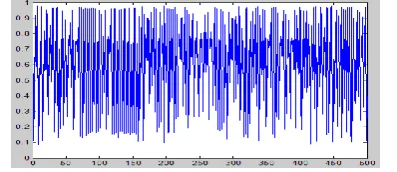
Figure (4) Plot of Y component of 3D logistic map.
Figure (5) Plot of Z component of 3D logistic map
4-3: 2D Arnold Cat Map System
Where:
p,q: represents the positive secret keys.
X,Y : original position of the image pixe before scrambling. X',Y': new position of the image pixel after scrambling.
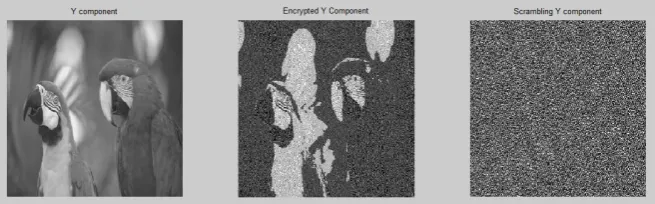
After applying 2D Arnold cat transformation for several iterations, the relationship between the neighboring pixels is entirely destroy and the original image seems deformation and meaningless (Vikas et al, 2012) Actually, for iterating it to many times it will return to original look. This means that Arnold cat map is a periodic transform. After image shuffling the statistical features are same for encrypt image and original image to increase the security of encryption system. Figure (6) show an example of Y component image, selective encryption and shuffled Y image with iteration of 2. Next of confusion process we use 3D logistic map System for diffusion and for enhancing the security (Ramesh et al, 2013).
Figure (6 ) Encryption and Scrambling of Y component
4-4Key Generator
=0.015 with initial value of x0 = 0.976, y0 = 0.677 and z0 = 0.973 represented as a secret keys to generate the next keys. The values of keys sequence lie among interval of [0 1] table (1) show some key samples. so we need to convert them to values of interval [1 256] to perform the X_OR operation by using (6). table (2) illustrate some key samples in this interval.
65536 1,2,3,...,
i
...(6) 256.0) *
X floor( =
Xi i
Table (1) Sample of keys value in range [0 1]
Table(2) Sample of keys value in interval [1 256]
4-5Image Encryption
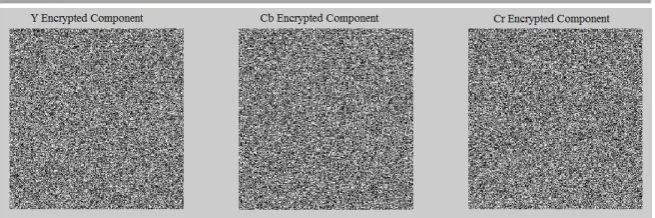
Image encryption performs by diffusion or substitute the shuffled image of Y component and Cb ,Cr components through changing the value of each of Y, Cb, and Cr pixels through exclusive X_OR operation with the sequence key values dedicated for each component(Manjunath et al 2011)figure(7) depict the encryption image for each components of YCbCr image.
0.9760 0.1136 0.3889 0.9158 0.3271 0.8460 0.5129 0.9781 0.0872 0.3212 0.8381 0.5327 0.9748 0.1082 0.3764 0.9171 0.2972 0.8215 0.5649 0.9539 0.1898 0.5946 0.9282 0.2754 0.7724 0.6774 0.8545 0.4909 0.9644 0.1649
Figure (7) YCbCr Encrypted Components
5. Experimental Analysis And Results
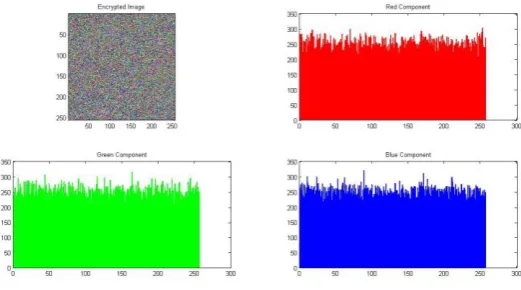
To evaluate the efficiency of suggested technique, we have performed several experiments wither in statistical or security analysis including histogram analysis for both plain and encrypted images, Number of Pixels Change Rate (NPCR) to measure the total differences between the cipher images and the original images, unified average changing intensity (UACI), entropy for original and cipher images and correlation coefficients analysis.
5-1 Histogram Analysis
Figure (8) Original Image with Components Histogram
Figure (9) Encrypted Image with Components Histogram
5-2 Correlation Analysis
...(7) )) ( ))(( ( ( 256 1 ) , cov( )) ( ( 256 1 ) ( ) ( 256 1 ) (
2 5 6
1 2 5 6
1
2 2 5 6
1
i i i i i i i Y E Y X E X Y X X E X X D x X EThen for both plain image and encrypt image, correlation coefficient of the adjacent pixel variable is calculated using equation (8). The value of CR is near to the one if the Adjusted pixels are closely correlated. On the other hand, if the coefficient is close to zero then the pixels are not related.
...(8) ) ( * ) ( ) , cov( Y D X D Y X
CRXY
where x and y represent colour intensity of two contiguous pixels in the cipher or original image. Table (3) and table (4) present correlation coefficients to plain and cipher images respectively and for five famous images in image processing applications.
Table (3) correlation coefficient for plain images
Tables (4) correlation coefficient for Encrpted images
Direction Horizontal Vertical Diagonal Anti-Diagonal Images
Baboon 0.9027 0.8830 0.8335 0.8293 Lena 0.9522 0.9763 0.9280 0.9480 Pepper 0.9672 0.9739 0.9422 0.9500 Cat 0.9669 0.9680 0.9503 0.9513 Onion 0.9928 0.9937 0.9861 0.9514
Direction Horizontal Vertical Diagonal Anti-Diagonal Images
It is obviously, that the correlation coefficient for cipher images is very small and near to zero value. This demonstrates that the suggested encryption algorithm leads to a more secured encryption.
5-3 NPCR and UACI Factors
There are two criteria to assess the differences among the original image and the encrypted image, the Number of Pixels Change Rate (NPCR) and the Average Changing Intensity (UACI). Equation (9) gives the mathematical formula of the NPCR measure. ...(9) j) (i, I' j) I(i, 0 j) (i, I' ~ j) I(i, 1 Dif % 100 * 65536 ) , ( 2 5 6
1 2 5 6
1
i jj i Dif NPCR
Where:
I(i,j) represent the original image I’(i,j) represent the encrypted image.
NPCR value indicates the different average of the number of pixels of the encrypted image when only one pixel of the plain image is adapted. It is obviously that NPCR value should be as big as possible to reach the performance of an ideal digital image encryption scheme. Equation (10) shows the mathematical expression of the UACI measure.
...(10) 100% * 256 ) , ( ' ) , ( 65536 1 UACI 256 1 i 256 1
j
j i I j i I
Asia Mahdi Naser Alzubaidi-Selective Image Encryption with 3D Chaotic Map
Tables (5)NPCR & UACI for original
In general, the NPCR and UACI of the suggested scheme being all close to unity and a good obvious that the encryption image scheme has a highly confidential security(Abeer et al 2013).
5-4 Information Entropy
It is well known, information entropy is a concept of measuring the degree of randomness in the encryption system. Actually, for any image encryption scheme it should decrease the connect information among encrypted Image pixels and thus mean increases the entropy value. Also, it should fulfil a condition that on the information entropy that is the cipher image should not offer any information about the plain image. Image entropy is calculated using equation (11).
...(11) ) ( 1 log * ) ( entrop y
256
1
2
i P i
i P
Where: P(i) is the probability of existence of pixel i. Truly, the ideal entropy value of random system is equal to8.In general, if calculated entropy value is very close to ideal value this mean that the cipher system is protect upon the entropy attack (Dhanashri et al,2014).
5-5 Mean Absolute Error (MAE)
Mean absolute Error (MAE) value is the a cumulative squared error between two digital images used to measure how close predictions are to the final results. The larger value of MAE means that the encryption system is more secure upon attacks.
Images NPCR UACI Baboon 0.9974 40.7375 Lena 0.9975 41.3395 Pepper 0.9945 43.4811 Cat 0.9945 42.6224 Onion 0.9908 47.9474
Table(6), shows the results of entropy information and MSE for the proposed cryptosystem(Dhanashri et al,2014).
Tables (6) MAE & entropy of encryption
6. Conclusion
This article presents the concept of selective encryption technique for Y panel and full encryption Technique for scrambling Y ,Cb and Cr channels based on 3D logistic chaotic function. All steps of encryption and decryption system were simulated using MATLAB. Experimental analysis for proposed system security covers histogram analysis, correlation analysis, mean absolute error, entropy analysis and others. The results show that the graphical shape of cipher image histogram is uniformly distributed, so the proposed algorithm is secure from frequency analysis attack. information Entropy analysis depicts that the scheme has entropy value that is close to ideal value, so the algorithm is protect from penetrate of image information. Also, the low correlation coefficient of encrypted image is near to the ideal value 0. Thus the experimental results and numerical analysis demonstrates the security, flexibility, correctness, effectiveness, Reliable and robustness of the proposed cryptosystem.
BIBLIOGRAPHY:
Abeer, M.Y. and M. M. Ali. 2013. "A Selective Image Encryption Based on Chaos Algorithm." Journal of Karbala
University 11(1): 136-149.
Amanpreet, K. and B.V. Kranthi. 2012. "Comparison between YCbCr Color Space and CIELab Color Space for Skin Color Segmentation." International Journal of Applied
Information Systems (IJAIS) 3(4): 30-33.
Dhanashri, M.T. and N.B. Sambre. 2014. "Blowfish Encryption Using Key Secured Block Based Transformation."
International Journal of Engineering Sciences &
Research Technology (IJESRT) 3(3): 1774-1780.
Lahieb, M.J. and G. B. Sulong. 2013. "A Review of Color Image Encryption Techniques." International Journal of
Computer Science (IJCSI) 10(6.1): 266-p275.
Manjunath, P. and K. L. Sudha. 2011. “Chaos image encryption using pixel shuffling with henon map.” Elixir Elec. Engg. 38: 4492-4495.
Osama, M. A., N. A. El-Fishawy, E. M. Nigm, and O.S. Faragallah. 2013. "A Proposed Encryption Scheme based on Henon Chaotic System (PESH) for Image Security."
International Journal of Computer Applications 61(5).
Panduranga, H. T. and S.K. Kumar. 2013. "Selective image encryption for Medical and Satellite Images."
International Journal of Engineering and Technology
(IJET) 5(1): 115-p121.
Pavithra, C. and B. Vinod. 2013. "Analization and Comparison of Selective Encryption Algorithms with Full Encryption for Wireless Networks." International Journal of
Engineering Trends and Technology (IJETT) 4(5):
2083-2088.
Pawan, N.K. and M. Narnaware. 2012. "3D Chaotic Functions for Image Encryption." IJCSI International Journal of
Rajinder, K. and E.K. Singh. 2013. "Comparative Analysis and Implementation of Image Encryption Algorithms."
International Journal of Computer Science and Mobile
Computing (IJCSMC) 2(4): 170 – 176.
Ramesh, K.Y, B. K. Singh, S.K. Sinha, and K. K. Pandey. 2013. "A New Approach of Color Image Encryption Based on Henon like Chaotic Map." Journal of Information
Engineering and Applications 3(6).
Rodrigues, J.M., W. Puecha, and A. G. Bors. 2006. "Selective Encryption of Human Skin in Jpeg Images." Image
Processing, IEEE Xplore 1981 - 1984.
Shubo, L., J. Sun, and Z. Xu. 2009. "An Improved Image Encryption Algorithm based on Chaotic System."
Journal of Computers 4(11): 1091-1100.
Vikas, C., P. Trivedi, and R.K. Pandey. 2012. “Novel Image Encryption of Color Image based on Henon Chaotic Systems and its Analysis.” International Journal of
![Table(2) Sample of keys value in interval [1 256]](https://thumb-us.123doks.com/thumbv2/123dok_us/7781126.1285288/9.439.122.320.342.424/table-sample-keys-value-interval.webp)