ABSTRACT
ANDOW, BENJAMIN ERIC. Privacy Risks of Sensitive User Data Exposure in Mobile Ecosys-tems. (Under the direction of Dr. William Enck).
Mobile applications frequently collect and share a wide-range of privacy-sensitive user data. Such data is an extremely valuable commodity for legitimate business purposes, but also for nefarious and illicit purposes. Therefore, identifying the privacy risks of exposing privacy-sensitive user data to applications has been a topic of great research interest over the past decade. However, prior works in this domain are plagued with significant limitations that result in incomplete or imprecise approximations of the privacy risks. These limitations are mainly due to an incomplete characterization of the types of data that applications request and the context-insensitivity of their privacy policy analysis techniques, or lack thereof.
vs. not collect) flow-to-policy consistency model. We design and implement POLICHECK
to perform a large-scale study on 13,796 Android applications and their corresponding privacy policies and find that up to 42.4% of applications either incorrectly disclose or omit disclosing their privacy-sensitive data flows.
© Copyright 2019 by Benjamin Eric Andow
Privacy Risks of Sensitive User Data Exposure in Mobile Ecosystems
by
Benjamin Eric Andow
A dissertation submitted to the Graduate Faculty of North Carolina State University
in partial fulfillment of the requirements for the Degree of
Doctor of Philosophy
Computer Science
Raleigh, North Carolina
2019
APPROVED BY:
Dr. Alexandros Kapravelos Dr. Bradley Reaves
Dr. Laurie Williams Dr. William Enck
DEDICATION
BIOGRAPHY
ACKNOWLEDGEMENTS
I would like to thank my advisor, Dr. William Enck, for his guidance and support throughout my six years of graduate school at North Carolina State University (NCSU). His mentoring, advice, unconditional support, and understanding helped me evolve and advance as an independent academic researcher and was one of the leading factors for the successful completion of my Ph.D. I wholeheartedly agree with the statement that choosing the right advisor is crucial to graduate school success.
I would also like to thank Dr. Bradley Reaves for his guidance, advice, and expertise, which began almost immediately since he arrived at NCSU. I can state with utmost certainty that my last two works of this dissertation would not have been nearly as strong without Brad’s guidance. Brad’s perspectives and insights on approaching and conducting research and empirical studies has had a significant positive impact on my research approach and helped me develop into a stronger independent researcher.
I would like to thank my collaborators, specifically, Dr. Kapil Singh, Dr. Tao Xie, Dr. Adwait Nadkarni, Sigmund Albert Gorksi III, Dr. Luke Deshotels, Dr. Jason Gionta, Samin Yaseer Mahmud, Justin Whitaker, Akhil Acharya, Dr. Wei Yang, Dr. Serge Egelman, Dr. Heqing Huang, Dr. Xusheng Xiao, Peipei Wang, Rui Shu, and Dr. Xiaohui Gu for their efforts and guidance. I would also like to thank my doctoral committee members, alphabetically, Dr. Alexandros Kapravelos and Dr. Laurie Williams, along with the aforementioned members, for their feedback and discussions during the course of my degree. I would like to explicitly thank, Dr. Kapil Singh, for his unbiased advice, support, lively discussions, and guidance throughout the years for my academic research, my internship at IBM, and guiding me through the next steps of my career. I would also like to thank, Dr. Tao Xie, for his discussions, insights, and valuable feedback on both my research and writing.
Anjum, Dr. Zach Jorgensen, Sanket Goutam, Athishay Kiran, and Shaown Sarker.
I would also like to thank Dr. Haodong Wang for his guidance and for introducing me to security research during my undergraduate degree at Cleveland State University. I likely would have not considered pursuing a Ph.D. had it not been for his guidance during my undergraduate research experience.
I would like to especially thank my parents, Janice and Robert Andow, and my in-laws, Daozhi Ju and Xiaoyun Wang, for their support throughout the years and for understanding when deadlines took priority over visiting home. Most importantly, I want to thank my wife, Dandan, and daughter, Evelyn, for their unwavering encouragement, understanding, patience, support, companionship, and love. You both have been my source of light and happiness through the long hours and occasional sleepless nights that I have spent working on this dissertation. I love you both dearly.
TABLE OF CONTENTS
LIST OF TABLES . . . viii
LIST OF FIGURES. . . ix
Chapter 1 Introduction. . . 1
1.1 Thesis Statement . . . 3
1.2 Contributions . . . 5
1.3 Thesis Organization . . . 6
Chapter 2 Foundations and Related Work . . . 8
2.1 Android Applications . . . 9
2.2 Program Analysis . . . 10
2.2.1 Permission Request Analysis . . . 10
2.2.2 Permission-protected API Call Analysis . . . 11
2.2.3 Information Flow Analysis . . . 12
2.3 Privacy Policies . . . 15
Chapter 3 UiRef: Analysis of Sensitive User Inputs in Android Applications . . . . 19
3.1 Introduction . . . 20
3.2 Background . . . 23
3.3 Problem and Challenges . . . 23
3.4 System Approach and Design . . . 26
3.4.1 Layout Extraction . . . 26
3.4.2 Label Resolution . . . 28
3.4.3 Semantics Resolution of Input Widgets . . . 30
3.4.4 Outlier Analysis . . . 33
3.5 Evaluation . . . 36
3.5.1 Layout-Extraction Performance . . . 36
3.5.2 Label-Resolution Performance . . . 37
3.5.3 Semantics-Resolution Performance . . . 39
3.6 Security and Privacy Analysis . . . 41
3.6.1 Sensitive Information Requests . . . 41
3.6.2 Identifying Anomalous Input Requests . . . 43
3.7 Discussion . . . 46
3.8 Related Work . . . 47
3.9 Conclusion . . . 48
Chapter 4 PolicyLint: Investigating Internal Privacy Policy Contradictions on Google Play . . . 49
4.2 PolicyLint . . . 53
4.3 Preprocessing Privacy Policies . . . 55
4.3.1 Ontology Generation . . . 57
4.3.2 Policy Statement Extraction . . . 61
4.3.3 Policy Contradictions . . . 67
4.4 Privacy Study . . . 73
4.4.1 General Policy Characteristics . . . 73
4.4.2 Candidate Contradictions . . . 74
4.4.3 Deeper Findings . . . 78
4.4.4 Notification to Vendors . . . 84
4.5 Limitations . . . 85
4.6 Related Work . . . 86
4.7 Conclusion . . . 88
Chapter 5 Actions Speak Louder than Words: Entity-sensitive Privacy Policy and Data Flow Analysis with POLICHECK . . . 89
5.1 Introduction . . . 90
5.2 Flow-to-Policy Consistency . . . 93
5.2.1 Clear Disclosures . . . 93
5.2.2 Vague Disclosures . . . 94
5.2.3 Omitted Disclosure . . . 95
5.2.4 Incorrect Disclosure . . . 95
5.2.5 Ambiguous Disclosure . . . 96
5.3 Consistency Model . . . 97
5.3.1 Data Flow and Policy Statements . . . 97
5.3.2 Ontological Operations . . . 98
5.3.3 Consistency . . . 100
5.4 Design . . . 104
5.5 Flow-to-policy Consistency Characterization . . . 106
5.5.1 Consistency Analysis . . . 106
5.5.2 Evaluation . . . 113
5.5.3 Additional Case Studies . . . 117
5.6 Limitations . . . 120
5.7 Related Work . . . 121
5.8 Conclusion . . . 122
Chapter 6 Conclusion and Future Directions. . . 124
BIBLIOGRAPHY . . . 128
APPENDIX . . . 144
LIST OF TABLES
Table 3.1 Semantic Bucket Excerpt (5/78) . . . 34
Table 3.2 Performance Evaluation Results . . . 37
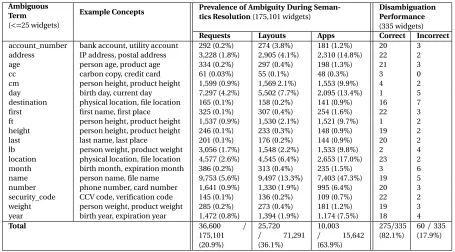
Table 3.3 Disambiguation Evaluation Results . . . 38
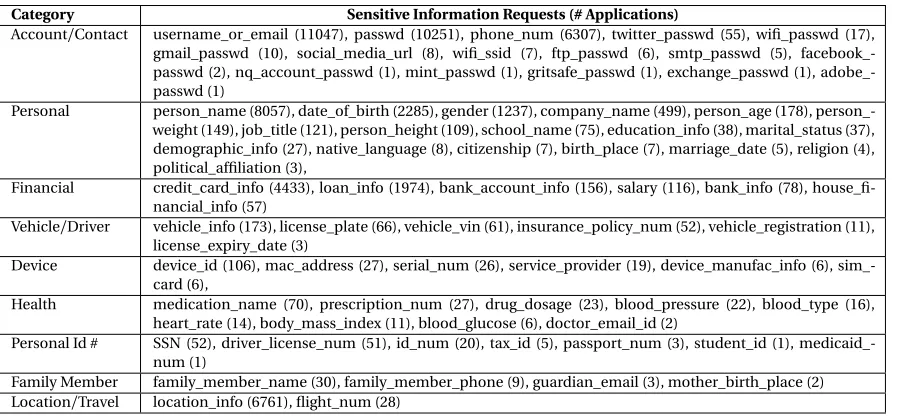
Table 3.4 Consolidated Sensitive Information Requests . . . 42
Table 4.1 NER Performance: Comparison of spaCy’s stock en_core_web_lg model versus our domain adapted model . . . 58
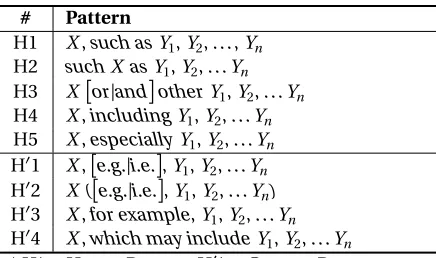
Table 4.2 Lexicosyntatic patterns for subsumptive relations . . . 59
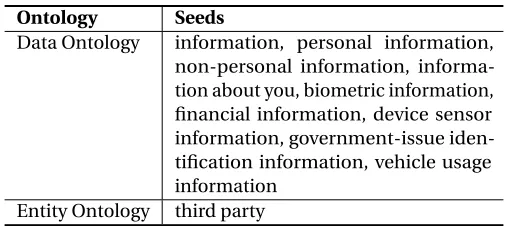
Table 4.3 Seed terms used for ontology construction . . . 60
Table 4.4 SoC verbs used by PolicyLint . . . 62
Table 4.5 Sentence Generation Templates . . . 64
Table 4.6 Rules that transform a CPS into an SPS . . . 68
Table 4.7 Contradictions (C) and Narrowing Definitions (N) . . . 70
Table 4.8 First-Party Synonyms . . . 72
Table 5.1 Types of conflicting policy statements in a privacy policy: logical con-tradictions (C1−5), flow-sensitive contradictions (C6−12), and narrowing definitions (N1−4). . . 101
Table 5.2 Data Flows and Apps for each Disclosure Type . . . 107
Table 5.3 Sensitivity Analysis of Flow-to-Policy Consistency Models for Classify-ing Disclosure Types: Entity-insensitive analysis results in the frequent misclassification of data flows. . . 114
LIST OF FIGURES
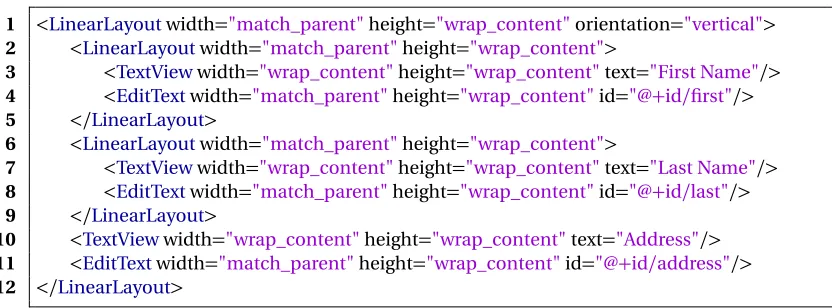
Figure 3.1 Example Android layout and corresponding XML specification with
stripped namespaces . . . 21
Figure 3.2 Screenshot of the Android layout in Figure 3.1 . . . 21
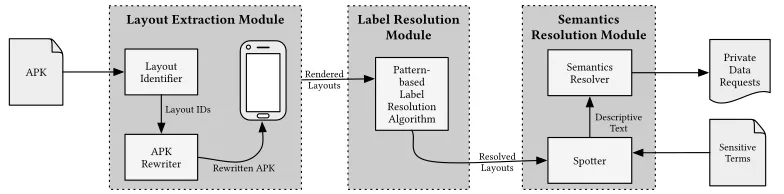
Figure 3.3 UiRef Architecture . . . 24
Figure 4.1 Overview of PolicyLint . . . 53
Figure 4.2 Transformation of Example 2 from its dependency-based parse tree to its DED tree. . . 61
Figure 4.3 CDF of Contradictory Policy Statements: 50% of contradictory poli-cies have 2 or fewer logical contradictions. . . 75
Figure 4.4 Ratio of Contradictory Policies per Category: 79.7% of contradictory policies have at least one or more logical contradictions (C1−5) that may indicate potentially deceptive statements. . . 75
Figure 4.5 Average number of unique candidate contradictions per category: Logical contradictions (C1−5) and narrowing definitions (N1−4) are both widely prevalent across Google Play categories. . . 76
Figure 4.6 Log 10 Frequency of Data Type Pairs in Contradictions: Negative statements that discuss broad categories of data are problematic (i.e., C1−5). . . 76
Figure 4.7 Email Template . . . 84
Figure 5.1 POLICHECKdetermines the consistency of a mobile application’s data flows to its privacy policy. . . 91
Figure 5.2 Policies are more clear about the first-party receiving a specific data type than a third-party doing so. . . 108
Figure 5.3 Policies often discuss the sharing of Android and advertising IDs in vague terms. . . 109
Figure 5.4 Policies are likely to use vague terms to describe both data types and entities. . . 109
Figure 5.5 POLICHECKidentified 1,912 incorrect disclosures across 719 applica-tions . . . 111
Figure 5.6 Policies often do not disclose when they share Android and advertis-ing IDs with third parties. This may be due to the perception that such collection is implied when they disclose that they use an advertiser. 111 Figure 5.7 Privacy policies are often contradictory when they discuss the sharing of Android and advertising IDs. . . 112
CHAPTER
1
INTRODUCTION
With over 4.3 billion smartphone subscriptions worldwide and an estimated 7.2 billion by 2023[Eri], mobile devices are continuing to become increasingly ubiquitous. In certain countries, such as the United States, mobile devices have become so pervasive that over three-fourths of adults own a smartphone[Pew]. In addition, mobile devices have surpassed traditional personal computers to become the primary method in which users access the internet, with 73% of internet traffic predicted to originate from mobile devices in 2018[Zen].
While manufacturers and vendors oftentimes bundle applications with the device, centralized application markets, such as Google Play and Apple’s App Store, are the pre-dominant way that users discover and install applications. These applications are generally developed by third-parties and the barrier-to-entry is relatively low to release an application. In fact, there are currently over 2.5 million applications on Google Play[Appd]and 2.1 mil-lion applications on Apple’s App Store[Appc]. Users are actively seeking out and installing applications from these markets. In 2017 alone, global application downloads reached 175 billion and revenue generated in the application markets surpassed $86 billion[Appa].
While providing functionality to users, applications consume a wide array of sensitive data, such as email addresses, date of birth, passwords, location data, and device identifiers. In many cases, it is required to provide applications with sensitive data to allow them to complete their given tasks. For example, when making a purchase in a shopping application, users generally must provide their credit card information, billing and shipping addresses, their name, and their email address to complete the transaction. In general, applications obtain sensitive data in two different ways. First, application may request that the user directly input sensitive data through user interfaces (e.g., email address, date of birth, password). Second, applications may automatically collect certain types of sensitive data through the use of the API calls provided by the operating system (e.g., location data, device identifiers, incoming text messages).
misuse. Thus, auditing an application’s usage of privacy-sensitive user data is required to reduce potential risks of abuse.
1.1
Thesis Statement
To reduce the risk of users encountering harmful applications, application markets generally assume the role as the initial gatekeepers that determine which applications become available to users. At a minimum, application markets generally place the following two requirements on applications before they are published to the market: (1) the application’s code must pass the market’s security and privacy vetting procedures; and (2) the application must provide a privacy policy if it handles sensitive user data.
To vet applications, application markets, such as Google Play, use a combination of static analysis, dynamic analysis, and manual application review (when needed)[Anda; Andb]. While the exact technical details of the techniques that markets deploy is not publicly available, the currently deployed analysis techniques are not the panacea for all harmful applications, as demonstrated by various news reports [Sym; Mal; Tec; Mas]and prior research[Han13b; Enc10; OM12]. One limiting factor is that performing more than simple and lightweight techniques is impractical at the market-level due to the scale of their analy-sis. Further, based on Google Play’s definitions of potentially harmful applications[Anda; Andb], their analysis scope appears similar to the majority of the prior research[Enc10; Arz14b; FWR14]that only consider sensitive data obtained through the well-defined API calls provided by the operating system that denote semantics of the data returned (e.g.,
getLastLocation()returns location data), which omits the privacy risks associated with sensitive user input disclosure to applications. We attribute this limitation to the difficulty of resolving the semantics of user input, as user input is obtained through API calls that do not denote the semantics of the data returned. For example, a user’s address and credit card
number are both fetched from the same API methodgetText(). Resolving the semantics
of user input is required for automated analysis of user input.
Play, do not perform a deep inspection, if any, on the content of privacy policies to identify problematic areas, such as contradictory privacy policy statements and whether the appli-cation complies with their given privacy policy. Existing techniques[Zim17b; Sla16; Wan18] that analyze data sharing and collection practices of privacy policies extract information at a coarse-granularity (i.e., paragraph-level or document-level), which does not allow for a precise reasoning over privacy practices. We attribute this limitation to the difficulty of extracting and representing sharing and collection practices at a fine-grained granularity (e.g., sentence-level) while capturing the correct meaning of the practice (i.e., “collect” or “not collect”) and the entities involved (i.e., first-party versus third-party).
The focus of this dissertation is to characterize and analyze the privacy risks associated with disclosing privacy-sensitive user data to applications. To enable analysis of user data and their uses, we design and implement several analysis and information extraction techniques that improve the state of the art. We observe that natural language processing and text analytics can be leveraged to address much of the aforementioned limitations.
Through our characterization of privacy-sensitive user data and privacy policies, and our design and implementation of analysis techniques, we provide the technical underpin-nings required for analyzing the privacy risks associated with disclosing sensitive user data to applications at-scale. We use these techniques to perform large-scale privacy studies on Android applications from Google Play and their corresponding privacy policies. In partic-ular, we seek to identify the privacy implications of: (1) how applications are requesting and handling privacy-sensitive user data; (2) how privacy-sensitive user data is discussed within privacy policies; and (3) how applications use privacy-sensitive user data in ways that conflicts their privacy policy.
We observe that considering the entities involved in an application’s privacy-sensitive user data practices (e.g., first-party vs. third-party) along with whether it is discussed with a positive or negative meaning (e.g., collect vs. not collect) is vital for assessing privacy risks of applications. The findings and observations from our studies of applications and their privacy policies informs the following thesis statement.
Identifying privacy violations by mobile applications requires fine-grained entity-sensitive
Evidence of this thesis can be found throughout Chapters 3-5. Findings 5 and 6 in Chapter 3 demonstrates that applications are stealthily sharing privacy-sensitive user data with third-parties and including third-party SDKs in their applications that directly display GUIs to collect such data, which demonstrates the importance of considering the entities that are receiving the data. In Chapter 4, we find that 14.2% of privacy policies contain contradictory policy statements, which may be indicative of potentially deceptive and ambiguous policy statements. Identifying contradictory statements requires entity-sensitive, negation-entity-sensitive, and holistic analysis of privacy policies. In Chapter 5, we demonstrate that prior works that use entity-insensitive and negation-insensitive models may falsely classify up to 38.4% of applications as having privacy-sensitive data flows consistent with their privacy policy. With our entity-sensitive and negation-sensitive flow-to-policy consistency model, we find that up to 42.4% of applications either incorrectly disclose or omit disclosing their privacy-sensitive data flows in their privacy policies.
1.2
Contributions
In this dissertation, we make the following main contributions:
• We characterize the space of privacy-sensitive user data sources to identify what types of data applications are requesting from users.We design and implement an analysis framework to resolve semantics of sensitive user inputs. Resolving the semantics of sensitive user inputs is a fundamental building block to enable automated analysis of such data. We propose UiRef (WiSec’17[And17]) to resolve semantics of sensitive user inputs. UiRef uses novel techniques for semantics analysis of sensitive user inputs to considerably improve over the current state of the art, such as resolving ambiguity using word embeddings. We demonstrate the utility of UiRef by performing security and privacy analysis through a large-scale study on 50,162 Android applications. Our study highlights various forms of questionable, and potentially malicious, practices by developers and emphasizes the need to consider user inputs in the security and privacy analysis of mobile apps.
(USENIX Security’19[And19]), a privacy policy analysis tool inspired by lightweight static analysis tools like
lint
. PolicyLint automatically generates ontologies captur-ing semantic relationships between data types and entities from a large corpus of privacy policies. It then uses sentence-level natural language processing to capture both positive and negative statements of data collection and sharing and the entities involved with those statements. We formally model 9 types of contradictions that result from semantic relationships between terms, providing an algorithmic method to detect contradictory policy statements. In a study of 11,430 privacy policies from mobile apps, we are the first to find that such contradictions arerampant, affect-ing 14.2% of policies. We manually reviewed 510 contradictions across 260 policies, finding that many contradictions are indeed indicators of misleading or problematic practices.• We formally specify an entity-sensitive and negation-sensitive flow-to-policy consis-tency model to detect when applications are inconsistent with their own privacy poli-cies.We design and implement POLICHECK to analyze flow-to-policy consistency at-scale. We use POLICHECKto study 13,796 applications and their privacy policies and find that at least 5.2% of apps may have data flows that are direct conflict with their policies. Our results demonstrate the significance of considering the entity: without considering entity, prior approaches would falsely classify up to 38.4% of applications as having privacy-sensitive data flows consistent with their privacy poli-cies. These false classifications include data flows to third-parties that are omitted (e.g., the policy states only the first-party collects the data type), incorrect (e.g., the policy states the third-party does not collect the data type), and ambiguous (e.g., the policy has conflicting statements about the data type collection). By defining a novel automated, entity-sensitive flow-to-policy consistency analysis, POLICHECKprovides the highest-precision method to date to determine if apps properly disclose their privacy-sensitive behaviors.
1.3
Thesis Organization
are in conflict with each other. To achieve this goal, we focus our analysis to Android applications, which runs on an operating system that accounts for 85.9% of the market share in 2017[Gar].
CHAPTER
2
FOUNDATIONS AND RELATED WORK
A generally agreed upon notion is that people have a right to privacy, which has been affirmed by court cases[US65]and various regulations[USC99; USC70; USC16; Law03; PEU16]. Samuel Warren and Louis Brandeis were the first to explicitly mention a person’s right to privacy[WB90], which was in direct response to the advancements in technology of the era, such as the invention of the Kodak’s portable box camera in 1888. Specifically, Warren and Brandeis’s article states, “Instantaneous photographs and newspaper enterprise have invaded the sacred precincts of private and domestic life; and numerous mechanical devices threaten to make good the prediction that ’what is whispered in the closet shall be proclaimed from the house-tops.[WB90]”’ The sentiment of this statement is echoed and significantly amplified when considering privacy implications imposed by mobile devices. Given the types of data to which mobile devices have access and their near persistent state of connectivity to the outside world, mobile devices have the means to encroach on a user’s privacy to an extent that almost every detail about their daily life runs the risk of being “proclaimed from the house-tops” (i.e., becoming public knowledge).
security and privacy risks of applications to users. These techniques are the main focus for the remainder of this chapter and serves as the basis for the remaining chapters of this dissertation. Note that while mobile device operating systems, such as Android, deploy a variety of protection mechanisms (e.g., permissions-based security model, file-based dis-cretionary access control, application sandboxing) and prior research propose a wide-range of additional protection mechanisms (e.g., decentralized information flow control[NE13; Nad16; Jia13; XW15], privilege-separation[RK13; Dav12; She12; Pea12], mandatory access control[Heu14; Bug13; SC13]), we limit our discussion to security and privacy analysis techniques, as the focus of this dissertation is on analyzing applications to understand security and privacy risks of sensitive data disclosure rather than enhancing protection mechanisms.
2.1
Android Applications
Android is an application-centric operating system where users perform tasks and interact with the device via applications. Android applications are composed as a set of compo-nents that correspond to the entry points of the application. Users directly interact with components called activities, which typically represent a single graphical user interface in the application. Services are components that run in the background without interaction from the user to typically perform a long-running task. Broadcast receivers are components that accept system or application events to perform some short-running task. Content providers are components that provide a database-style interface for managing and sharing application data. Each component has their own life-cycle, which are a set of callbacks that are invoked whenever the component’s status changes (e.g., create, start, pause, resume, stop).
components, developers also specify whether components are publicly accessible to other applications (i.e., exported) and also allow the developer to specify any permissions that are required to send an intent to the component.
Each application includes a manifest file (AndroidManifest.xml) that is specified before compilation and packaged with the application. All components along with their intent filters, exported attribute, and required permission must be specified in the manifest file, except for certain cases of broadcast receivers, which can be constructed dynamically at runtime. As Android uses permissions to protect certain sensitive API calls that provide access to protected resources (e.g., GPS, internet, device information), developers must also specify the permissions to which their application requests access.
2.2
Program Analysis
Program analysis is performed by physically running the application to execute its code (dynamic analysis), directly analyzing the application’s code without executing its code (static analysis), or a combination of both approaches (hybrid analysis). While program analysis techniques were initially proposed for compiler optimization and software reli-ability testing, these techniques have been adapted and applied to identify security and privacy risks of programs. While a myriad of research has used program analysis to identify security and privacy risks for traditional programs, analyzing Android applications pose new challenges, such as containing multiple execution entry points and having complex component life-cycles. Due to these challenges, various program analysis approaches have been proposed for assessing the security and privacy risk of Android applications.
2.2.1
Permission Request Analysis
feature vector to detect malware. Barrera et al.[Bar10]use the self-organizing maps on per-mission requests in Android applications to study the effectiveness of Android’s perper-mission model. WHYPER[Pan13], CHABADA[Gor14], and AutoCog[Qu14]examine permission request to application fidelity by using natural language processing.
Several prior works used permission requests to rank the risk of applications. Peng et al.[Pen12]uses probabilistic generative models to rank the risks of installing applications based on the application’s permission requests. Sarma et al.[Sar12]uses an application’s permission requests in comparison to the permission requests of other applications within the same application category to rank the risk of applications. MAST[Cha13]uses permis-sion requests along with other lightweight features, such as intent filters, presence of native code, presence of zip files, to triage malware for deeper analysis. DroidRanger[Zho12] uses permission requests to filter applications for deeper behavioral analysis to detect malware. MalloDroid[Fah12]uses internet permission requests to filter applications for further analysis to check for SSL vulnerabilities.
2.2.2
Permission-protected API Call Analysis
Due to the coarse granularity of Android’s permissions, other techniques propose to ana-lyze the presence of permission-protected API calls to identify security and privacy risks in mobile applications. Several prior works analyzed the usage of permission-protected API calls to detect over-privileged applications. Stowaway[Fel11b]uses dynamic analysis to create a permission-to-API call mapping to study whether applications are using the principle of least privilege. Vidas et al.[Vid11]uses lightweight static analysis to identify discrepancies in permission requested and permission-protected API calls within the code to detect and notify developers of over-privilege. Wu et al.[Wu13]use permission requests and the permission-protected API calls invoked to determine over-privilege in vendor applications.
they classify as dangerous (e.g., invocation causes financial loss) to study the risks of ad-vertisement libraries. Zimmeck et al.[Zim17b]use the presence of permission-protected API calls in the application’s code to check privacy policy compliance. Wijesekera et al. log invocations of permission-protected API methods to gauge whether users expected the access to occur. Nguyen et al.[Ngu19]map security and privacy-relevant user reviews to permission-protected API calls and demonstrate that security and privacy-relevant user reviews lead to privacy improvements. Han et al.[Han13a]compare API calls within iOS and Android applications, and show iOS applications call significantly more privacy-sensitive APIs than their Android counterparts. Moreover, other works[Bac16b; Ma16]enhance this analysis by proposing code analysis techniques to resolve the party responsible for the permission-protected API calls.
In addition to analyzing the permission-protected API calls, other works resolved ad-ditional application context of the call to identify security and privacy risks in applica-tions. RiskRanker[Gra12a]resolves the callbacks that cause the invocation of permission-protected APIs to use as signatures for malware detection. AsDroid[Hua14]resolves the graphical user interfaces displayed when permission-protected APIs are invoked to detect stealthy behaviors. AppContext[Yan15]resolves the callbacks and conditions that cause the execution of permission-protected API calls to identify malware. TriggerScope[Fra16] similarly resolves the conditions that trigger permission-protected API calls to identify logic bombs.
2.2.3
Information Flow Analysis
While analyzing permission-protected API calls denotes that an application is accessing a resource, API calls alone do not indicate how the application is using the resource. Therefore, prior works have proposed tracking information flows of an application or performing deep packet inspection at the network-level to determine how the application is using the sensitive data.
de-compile applications and use static data flow analysis to determine when sensitive data, such as device identifiers, flow to the network. PiOS[Ege11]and AndroidLeaks[Gib12] are the initial static analysis duals of TaintDroid for iOS and Android, respectively. Flow-Droid[Arz14b]uses context, flow, field, object, and life-cycle sensitive static taint analysis to detect privacy leaks in applications. DroidSafe[Gor15]models the Android runtime to increase precision of static information flow analysis on Android. IccTA[Li15]resolves inter-component communication to extend FlowDroid to detect cross-component privacy leaks. Amandroid[FWR14]provides a general static analysis framework that can detect data leaks, data injection vulnerabilities, and API misuse. AppIntent[Yan13]uses static analysis to build test cases of events and interactions required to trigger a sensitive data leak and then runs the test case to execute the application and observe the sensitive data leak. MudFlow[Avd15]uses static taint analysis to extract an application’s sensitive data flow be-haviors to differentiate between normal flows in benign applications and abnormal flows in malicious applications. FlowCog[Pan18]uses NLP to analyze the text within graphical user interfaces to infer whether the sensitive data leaks detected with static taint tracking are justified by the user interface. Feng et al.[Fen15]identify applications that aggregate privacy-sensitive user data by tracking accesses of such data and estimating the flow of the data by building dynamic link-ability graphs. Oltrogge et al.[Olt18]use a combination of static and dynamic analysis to analyze applications created by online application generators and find four application generators were stealthily collecting privacy-sensitive user data. Bhoraskar et al.[Bho14]identify several cases of advertisements requesting privacy-sensitive user data from children by static analysis to identify execution paths and binary rewriting for targeted execution. Zhang et al.[Zha15]create behavior graphs describing triggering conditions and information flows to generate application descriptions that disclose such behaviors. AutoPPG[Yu15]characterizes an application’s data flows using static analysis and generates sentences for privacy policies to describe the behaviors. Reaves et al. manually analyze data flows involving financial and account information in branch-less banking applications to identify vulnerabilities in processing financial transactions or authenticating the user. Bashir et al.[Bas16]propose using re-targeted ads for tracking information flows between different ad exchanges.
an on-device network monitoring tool that uses the VPN API to intercept network traffic of Android applications. Reyes et al.[Rey17] use the Lumen Privacy Tool to study the sensitive data leaks in Android applications targeted towards children to detect potential COPPA violations. Reyes et al.[Rey18]perform a follow-up longitudinal study and find that around one out of five children’s applications collect identifiers or personally identifiable information. Razaghpanah et al.[Raz18]identify advertising and tracking services through analysis of network traffic and present insights into the ecosystems and tracking behaviors. Ren et al.[Ren18]perform a longitudinal privacy study of sensitive data leaks on application updates over 8 years and find that applications are requesting more sensitive data in general. Reardon et al.[Rea19]monitor network traffic to determine when applications transmit privacy-sensitive user data, but do not have the permission to obtain such data. Han et al[Han19]use the Lumen Privacy Tool to study the privacy behaviors of free and paid applications and found that 38% of paid applications have the same privacy-invasive behaviors and the free versions. Continella et al.[Con17]propose detecting privacy leaks by using blackbox differential analysis to detect deviations from normal network traffic resulting from changing values of privacy-sensitive user data.
2.3
Privacy Policies
Privacy policies are the primary mechanism by which mobile applications inform users about data collection and sharing practices. In this section, we discuss studies and tech-niques proposed by prior research to analyze the content privacy policies.
Various research efforts opt for manual analysis to perform exploratory studies on the content of privacy policies or to collect annotations. Bhatia and Breaux[BB18]manually annotate 5 privacy policies with semantic roles to study which roles result in incomplete descriptions of data practices and how the presence and absence of these roles impact users’ perceptions of privacy risk. Bhatia and Breaux[BB17]manually annotate 5 policies to identify how purposes behind data collection are expressed and define categories of data purposes and identify a set of natural language patterns that could potentially be used for information extraction. Bhatia et al.[Bha16]manually analyze a set of 15 privacy policies to identify vague modifiers (e.g., “may,” “some,” “as needed”) and study how these vague terms influence users perceptions of privacy risk and willingness to share data. Note that our definition of vagueness in Chapter 5 is defined in terms of specificity of the terms used to disclose the specific data types and entities involved in data flows. While our definition of vagueness differs from Bhatia et al.[Bha16], they can be used to complement each other’s analysis of privacy policy vagueness, as they are not in conflict. Breaux and Schaub[BS04] propose a task decomposition approach for gathering crowd-sourced annotations of privacy policies to reduce the cost of manual extraction while increasing the coverage. Wilson et al.[Wil16a]demonstrate that crowd-sourcing non-trivial privacy policy annotations is feasible and propose a method to improve annotation by highlighting paragraphs associated with certain data practices relevant to the annotation task. Wilson et al.[Wil16b]have skilled experts annotate a set of 115 privacy policies and identify several future directions that can leverage this dataset. Breaux et al.[BR13; Bre15]manually analyze a privacy policy for a case study to populate their Description Logic and find a few cases of conflicting statements.
available. Costante et al.[Cos12]use machine learning to evaluate privacy policy complete-ness in respect to a set of topics (i.e., privacy categories) that are commonly discussed in privacy policies. Costante et al.[Cos13]extract data collection practices from privacy poli-cies by using named entity recognition and a manually constructed set of shallow sentence patterns. Brodie et al.[Bro06]define two sentence patterns to parse sharing and collection practices from privacy policies for their privacy policy authoring tool. Privee[ZB14]uses machine learning to assign privacy grades to six coarse-grained properties of a privacy policy (e.g., collection, encryption, ad tracking). Zaeem et al.[Zae13]apply data mining to extract coarse-grained summaries of privacy policies representing what information is used and how. Stamey and Rossi[SR09]apply topic modeling to identify ambiguity in privacy policies. Polisis[Har18]uses deep learning to assign labels to paragraphs in privacy policies that summarizes the practice, such as coarse grained categories of data collected and the reason for such collection.
Several prior works[Cra16; BR13; Bre15; Yu16]document the possibility of conflicting privacy policy statements. Cranor et al.[Cra16]analyzed the tabular model privacy forms of financial institutions and identified cases of self-contradictory statements when performing deeper inspection. Breaux et al.[BR13; Bre15]provide a formal language to detect conflicts in privacy policies for multi-tier applications manually. Similarly, Yu et al.[Yu16]developed a system that verifies the consistency of an app’s privacy policy with the policies of the app’s libraries. These prior works define a single class of broad contradictions. In contrast, as we describe in Chapters 4-5, we characterize various different types of contradictory statement and discuss their impact on privacy policies.
performs a similar task, but extracts sharing and collection practices at the paragraph-level. However, Yu et al. also analyzes consistency between the application’s privacy policy and the privacy policies of third-party libraries that the application includes. Okoyomon et al.[Oko19]analyze privacy policies and the data flows of applications and find that applica-tions are contradicting their statements in the privacy policy about secure data transmission. Further, they perform a keyword search for the term “third-party” or direct mentions of the name of the companies and find that around 10.5% omit disclosing the behavior. Reyes et al.[Rey17; Rey18]analyze COPPA compliance by analyzing privacy-sensitive data leaks in applications targeted towards children, but do not analyze the content privacy policies, as the data flow alone is considered a privacy violation. Degeling et al.[Deg18]study GDPR compliance by analyzing the existence of privacy policies and consent notices for websites served in the EU. Eijk et al.[Eij19]study the impact of cookie consent notices for websites requested from the EU, USA, and Canada.
Analyzing the usability and effectiveness of privacy policies is another well-researched focus area. Research has shown that privacy policies are hard to comprehend by users[MC08] and proposals have been made to simplify their understanding[Nor15; Ram14]. Gluck et al.[Glu16]perform usability analysis of privacy policy length’s impact on user awareness and suggest that limiting the length of privacy policies may increase awareness. Milne et al.[Mil06]perform a longitudinal study on the readability of 312 privacy policies and finds that readability has declined and the length of policies have increased in size. Reidenberg et al.[Rei15]study mismatches between the meanings of privacy policy statements and expert, knowledgeable, and typical users understanding and find disagreement between experts reflect ambiguous phrases in privacy policies. Jensen and Potts[JP04]study usability aspects (e.g., accessibility, readability, evolution) over a set of 64 privacy policies and find significant usability issues that impact users ability to understand the privacy disclosures and compliance with regulations.
CHAPTER
3
UIREF: ANALYSIS OF SENSITIVE USER
INPUTS IN ANDROID APPLICATIONS
In this chapter1, our goal is to understand the broad implications of privacy-sensitive
user data requested via application user interfaces. To this end, we propose UiRef (User Input REsolution Framework), an automated approach for resolving the semantics of user inputs requested by mobile applications. UiRef’s design includes a number of novel techniques for extracting and resolving user interface labels and addressing ambiguity in semantics, resulting in significant improvements over prior work. We apply UiRef to 50,162 Android applications from Google Play and use outlier analysis to triage applications with questionable input requests. We identify concerning developer practices, including insecure exposure of account passwords and non-consensual input disclosures to third parties. These findings demonstrate the importance of user-input semantics when protecting end users.
3.1
Introduction
Mobile applications continue to consume an increasing amount of sensitive data to perform a variety of tasks, such as personal banking, health tracking, and online shopping. Vetting these applications to identify abnormal behaviors is paramount to ensure that privacy and security requirements of users are adequately satisfied.
Prior research[Ege11; Enc10; Arz14b; Gib12; TR14; Avd15]has demonstrated the util-ity of analyzing sensitive-data requests to identify securutil-ity and privacy problems within applications, including insecure-data transmission, private-data leakage, and malware identification. Such approaches often rely on the semantics of the user data to enable automated analyses, e.g., for taint sources and runtime privacy notices. However, these approaches focus ononlysensitive data originating from well-defined, system API calls, which explicitly represent the semantics of the data returned by the API invocation. Such focus addresses only a part of the challenge: applications also obtain a wide range of sensi-tive data, such as passwords and credit-card numbers, as input within their graphical user interfaces (GUIs). These data requests are largely ignored by prior analyses.
In this chapter, we focus on protecting sensitive data collected by third-party applica-tions via their GUIs. Resolving the semantics of such data is challenging, as the API calls that retrieve a user input are generic and do not indicate the data’s semantics. For example,
a user’s home address and credit-card number are retrieved by the same
getText()
APIcall if entered into EditText widgets. Instead, the semantics of a user input is denoted by natural-language text in the GUI, which prompt the user to enter specific types of data.
Semantics resolution of user inputs has been explored in two recent techniques: SU-POR[Hua15]and UIPicker[Nan15]. However, as we discuss in Section 3.3, both techniques have significant limitations that lead to inaccuracies. Further, both techniques fail to take into account the problem ofword ambiguity, which is the coexistence of multiple meanings for a word or phrase. For example, the word “address” can refer to a postal address or an IP address depending on the context that the word is used, and hence can cause confusion for the existing techniques. In Section 3.5.3, we measure the prevalence of ambiguity dur-ing semantics resolution and show that 20.9% of input resolutions contain an ambiguous term. Although word ambiguity is a known and actively researched area in NLP, the limited amount of text within GUIs makes disambiguation especially challenging.
1 <LinearLayoutwidth="match_parent"height="wrap_content"orientation="vertical">
2 <LinearLayoutwidth="match_parent"height="wrap_content">
3 <TextViewwidth="wrap_content"height="wrap_content"text="First Name"/>
4 <EditTextwidth="match_parent"height="wrap_content"id="@+id/first"/>
5 </LinearLayout>
6 <LinearLayoutwidth="match_parent"height="wrap_content">
7 <TextViewwidth="wrap_content"height="wrap_content"text="Last Name"/>
8 <EditTextwidth="match_parent"height="wrap_content"id="@+id/last"/>
9 </LinearLayout>
10 <TextViewwidth="wrap_content"height="wrap_content"text="Address"/>
11 <EditTextwidth="match_parent"height="wrap_content"id="@+id/address"/>
12 </LinearLayout>
Figure 3.1Example Android layout and corresponding XML specification with stripped
names-paces
First Name
Last Name Address
Figure 3.2Screenshot of the Android layout in Figure 3.1
resolves the semantics of user-input widgets by analyzing the GUIs of Android applications. UiRef advances the state of the art using novel techniques in its three main stages: layout extraction, label resolution, and semantics resolution. First, UiRef’s layout extraction pro-vides a new hybrid analysis that accurately renders custom widgets. Prior techniques do not fully support custom widgets, which are used by 48.7% of the applications under our study. Second, UiRef’s label resolution models patterns within the spatial arrangement of widgets, achieving a 20.8% improvement over prior work[Hua15]. Finally, UiRef’s seman-tics resolution disambiguates words within input labels. Existing word-disambiguation techniques[Les86]cannot be applied directly, as GUIs rarely display text in full sentences. Instead, UiRef learns different word senses based on text that appears in other widgets within layouts.
broadly identify various questionable practices in collecting user inputs that can potentially compromise users’ security and privacy. Note that for this work, we do not differentiate a questionable practice from malicious intent. Such differentiation can be done by further analysis using existing techniques[Ege11; Enc10; Arz14b; Gib12; TR14; Avd15]. Rather, UiRef can filter the application dataset for focused deeper inspection.
Our analysis leads to three main security and privacy findings (see Section 3.6). First, we find that applications request a wide range of sensitive data, including SSNs, passport numbers, and healthcare information. While legitimate requests for this data may exist, we find that many such requests do not align with the purpose of the requesting application. Second, we identify 66 applications that directly request the user’s third-party account pass-words (e.g., Gmail). These requests expose the user’s third-party accounts to compromise, as well as violating the primary tenet behind OAuth-like solutions. Finally, we identify 6 popular applications that send sensitive-input data to advertisers without disclosing the behavior.
During our analysis, we also identify application design flaws that may result in loss of privacy. First, applications allow third-party libraries to directly request sensitive inputs from users, likely resulting in user confusion. In other words, the user cannot identify whether the library or the application is requesting data. This flaw can be exploited by malicious libraries to compromise sensitive data. Second, applications display untrusted third-party components in the same GUIs as sensitive-input requests, leaving the applica-tions vulnerable to private-data theft due to layout-traversal attacks[RK13].
In summary, this chapter makes the following main contributions:
• We develop novel techniques for semantics analysis of GUI inputs to considerably improve over the current state of the art (5.5%-25.6% more accurate at extracting layouts and 20.8% more accurate at resolving labels). We perform a direct comparison with prior work by implementing a representative solution in SUPOR[Hua15]. • We propose a novel approach to address ambiguity of descriptive text in mobile
appli-cations. Ambiguity is a key challenge unaddressed by prior work, and it is particularly challenging for GUIs due to limited text. We demonstrate that word embeddings can effectively perform this task.
emphasizes the need to consider user inputs in the security and privacy analysis of mobile apps.
The remainder of this chapter describes the design and implementation of UiRef, fol-lowed by its application towards security and privacy threats in user inputs.
3.2
Background
When using Android applications, users interact with layouts (i.e., GUIs) to enter inputs and perform actions. Layouts consist of widgets, such as push buttons, text fields, and check boxes. These widgets are arranged and grouped within layouts through the use of
view groups, which are containers for holding otherviews(i.e., view groups or widgets). Due to view groups, layouts are structured as hierarchical trees named asview hierarchies. Layouts are typically defined by the developer at compile time using XML. Figure 3.1 shows a simplified version of a layout’s XML file (i.e.,main_layout.xml) and Figure 3.2 shows the corresponding screenshot. To render a layout, applications pass the resource identifier of the layout’s XML file to the setContentView() or LayoutInflater.inflate() methods. To access a resource, developers use the Java R class generated during compilation, while the compiled application uses integer constants to internally refer to resources. For example, to render the layout in Figure 3.1, an app invokes setContentView(R.id.main_layout). The public.xml file in the application package (APK) provides a mapping of the integer constants to the strings used in the XML layout.
Android’s SDK provides a wide range of pre-defined view groups and widgets. However, developers may also define custom views in their Java code by extending these pre-defined classes, which can then be referenced in the layout’s XML files. The implementation of these custom views may customize rendering and also dynamically insert view groups and widgets within its view hierarchy.
3.3
Problem and Challenges
Semantics Resolution Module Label Resolution
Module
Pa! ern-based Label Resolution Algorithm Resolved Layouts Rendered Layouts Private Data Requests Layout Extraction Module
APK Rewriter
Layout Identifier
Layout IDs
Rewri!en APK
APK
Sensitive Terms
Semantics Resolver
Spo!er
Descriptive Text
Figure 3.3UiRef Architecture
Problem Statement:This work seeks to understand what information Android apps are requesting through their GUIs by automatically resolving the semantics of the user inputs and to further analyze their potential security and privacy repercussions.
Semantics resolution is the first step in ensuring proper handling of security and privacy sensitive input. There are many ways in which the resulting meta information can be used to enhance security analysis (e.g., semantics for taint sources). In this chapter, we use the resolved semantics to achieve two main goals. First, we use it to understand the general landscape of the types of security and privacy sensitive information that applications are requesting from the user. Second, we leverage it to identify questionable, and potentially malicious, practices used by apps by performing outlier analysis. This analysis identifies applications that request data uncommon for the its category (e.g., a game asking for an SSN) and allows us to triage apps for manual analysis.
Our work is not the first to consider the semantics of user inputs in Android applications. Prior techniques (SUPOR[Hua15], UIPicker[Nan15], and AppsPlayground[Ras13]) have significant limitations that impact the accurate and unambiguous resolution of the seman-tics of user inputs. We identify three areas of challenges: layout extraction, descriptive-text (label) resolution, and semantics resolution.
Layout Extraction:The spatial arrangement of widgets influences the layout’s semantics. While the parent-child and sibling relationships of a layout’s view hierarchy influence the spatial arrangement, it is a poor approximation of proximity due to the flexibility allowed by widgets. Further, code defining custom views may control the types of widgets displayed as well as their position in the layout. Around 48.7% of apps in our study (Section 3.6) use custom views.
In contrast, SUPOR extracts layouts by modifying the static rendering engine of the Android Developer Tool (ADT), which provides this positioning. However, neither UIPicker nor SUPOR sufficiently handles custom views. The UIPicker paper does not mention custom views. The static rendering engine of ADT used by SUPOR cannot execute the bytecode of custom views. Therefore, SUPOR renders custom views as the nearest superclass available in the Android framework, causing inaccurate and incomplete layout rendering. Finally, AppsPlayground can handle custom views, but it must dynamically navigate the GUI to reach layouts.
Descriptive-Text Resolution:To prompt the user for inputs, developers either use text widgets with a label in the nearby proximity to the input fields (Figure 3.1), or embed descriptive text as attributes on the input widgets (e.g., the hint and text attributes on the EditText widget). While embedded descriptive text is straightforward to resolve, identifying the correct label for an input widget is nontrivial. Even if embedded descriptive text exists for an input widget, the corresponding label widget must be resolved. Some applications use labels to denote the type of information and embedded descriptive text to provide instructions to the user (e.g., “required”).
A general approach to match an input widget with a label widget is to define a distance metric. Both UIPicker and AppsPlayground use sibling relationships in layouts to resolve the associated descriptive text. However, in practice, sibling relationships do not accurately gauge proximity. In contrast, SUPOR performs label resolution by partitioning the space surrounding an input widget into nine areas, calculating a position-based weighted average for each pixel in the input widget to the nearest pixels in labels, and mapping each input widget to the label widget with the lowest weighted average. However, SUPOR suffers from multiple limitations that are sources for incorrect label resolutions as shown in Section 3.5. First, it always resolves labels to an input widget even if the label istoo far awayfrom the input widget. Second, it depends on the input widget’s area size and predefined weights that bias it towards labels to the left and above, thus affecting the algorithm’s generality.
Semantics Resolution:Mobile applications use short text phrases in descriptive text, mak-ing semantics resolution of user inputs challengmak-ing. Word polysemy limits the use of simple key-phrase matching techniques, and affects 20.9% of input-field resolutions (Section 3.5.3). Therefore, disambiguation is required.
but cannot differentiate the multiple semantics of that key phrase. SUPOR acknowledges this limitation, and excludes the word “address” from their key-phrase list. Additionally, UIPicker leverages developer-defined variable names and input-widget type attributes (e.g., password) in their resolution. However, such developer-defined names are not tolerant to name-based obfuscation or poor coding practices.
3.4
System Approach and Design
The UiRef resolves the data semantics of user-input widgets by analyzing Android layouts. Figure 3.3 shows UiRef’s architecture. The layout-extraction module instruments APKs to force the rendering of their layouts and exports the rendered layouts for further analysis. The label-resolution module identifies patterns within the placement and orientation of labels with respect to input widgets in the layout and geometrically resolves labels. The semantics-resolution module applies text-analytics techniques on the input widget’s associated descriptive text to determine the expected type of information accepted by the input widgets.
3.4.1
Layout Extraction
The goals of the layout-extraction module are three-fold: (1) identify all layouts in an application; (2) identify the spatial relationships between UI widgets for each layout; and (3) identify the descriptive text displayed to users. The spatial relationships are needed to map label widgets to input widgets, as discussed in Section 3.4.2.
UiRef’s layout-extraction module uses a hybrid technique to extract rendered layouts. UiRef’s technique uses static analysis to identify the layouts used by the application, and dynamic on-device rendering to extract each rendered layout that users eventually interact with. Since on-device rendering allows for the execution of developer code, it allows for the correct rendering of custom views.
When the injected activity is executed, it iterates through the resource identifiers saved in the assets folder, and invokes the setContentView() method for each identifier to cause the application to render the layout. It then iterates through the rendered layout’s view hierarchy to extract associated metadata, such as the coordinates of each view, visibility attributes, and text strings. This information along with the view hierarchy is exported as XML.
As discussed in Section 3.4.2, UiRef’s label-resolution module requires a list of potential labels and a list of input widgets. To construct these lists, UiRef uses class-inheritance in-formation to identify the types of widgets that commonly accept user inputs (i.e., EditText, AbsSpinner, CheckedTextView, RadioButton, CheckBox, ToggleButton, Switch, SwitchCom-pat, RatingBar), and widgets that display static text (i.e., TextView). For example, an EditText, or widgets that extend EditText, are likely to accept user inputs. Note that this technique differs from SUPOR’s use of inheritance information, as SUPOR uses it during the rendering process to determine how to render custom views. In contrast, UiRef does not rely on inheritance information during rendering, as UiRef can render custom views. UiRef extracts inheritance information during layout extraction to avoid performing the Class Hierarchy Analysis offline.
To determine whether a widget accepts a user input, UiRef resolves the closest an-cestor in a widget object’s class hierarchy that is in Android’s framework, and includes the nearest SDK class in the metadata output. For example, if a class CustomTextView1 extends android.view.Textview, UiRef would mark its ancestor as TextView. Similarly, if Cus-tomTextView2 extends CustomTextView1, UiRef would also mark its ancestor as TextView, because CustomTextView2 extends CustomTextView1, which extends TextView. We identify 14 base widget types from Android’s documentation, and use Java’s instanceof operator to find the view object’s nearest SDK class.
Algorithm 1Resolution of Label to Input Widget
1: procedureRESOLVELABELS(u i f s,l a b e l s) 2: r e s o l v e d ←init empty list
3: do
4: p a i r s ←G e n C a n d i d a t e S e t s(u i f s,l a b e l s) 5: l a b e l s.r e m o v e(p a i r s.l a b e l s)
6: u i f s.r e m o v e(p a i r s.u i f s) 7: r e s o l v e d.a p p e n d(p a i r s) 8: whiles i z e(p a i r s)>0
9: returnr e s o l v e d
3.4.2
Label Resolution
The goal of UiRef’s label-resolution module is to identify the label associated with each user-input widget. It operates on the intuition that developers are consistent with the physical arrangement and orientation of labels to user-input widgets. For example, if a developer positions labels to the left of an input widget, then it is expected that other labels in the layout will also be positioned on the left. Therefore, the label-resolution module works by identifying patterns within the placement of labels relative to input widgets.
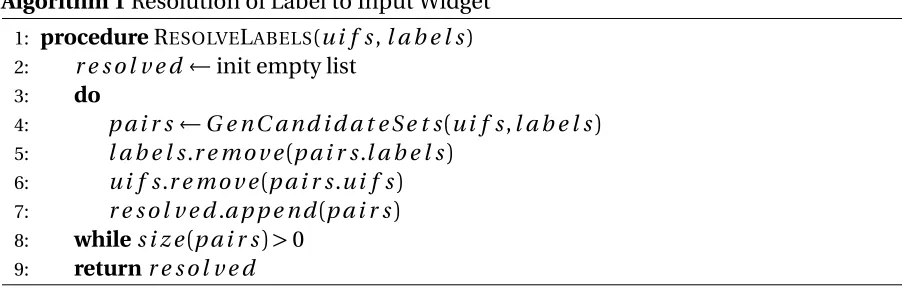
UiRef’s algorithm for label resolution (Algorithm 1) is iterative, so it correctly resolves labels even if inconsistencies exist. As an example, the “Address” label in the layout of Figure 3.1 is inconsistent as it is placed above the input widget while other labels are placed to the left of the input widgets, and is still successfully resolved by the algorithm. During the first iteration, UiRef resolves the label with the text “First Name” to the EditText with the identifier@+id/first, and “Last Name” to the EditText with the identifier@+id/last. During the second iteration, UiRef resolves the label with the text “Address” to the EditText with the identifier@+id/address.
The label-resolution module accepts the rendered layouts from the layout-extraction module as input, and resolves labels associated with user-input widgets.
Label-Resolution Algorithm:UiRef maps labels to input widgets by identifying patterns in their relative placements. Algorithm 1 describes the algorithm. The input is the sets of input widgets (u i f s) and potential labels (l a b e l s) identified using class-inheritance information within the layout-extraction module (Section 3.4.1).
Algorithm 2Create Candidate Map
1: procedureGENCANDIDATESETS(u i f s,l a b e l s) 2: c a n d i d a t e s ←init empty candidate map object
3: for each i ∈u i f s do 4: for each l ∈l a b e l s do
5: v←c a l c Sm a l l e s t V e c t o r(i,l) 6: if v.d i s t a n c e >t h r e s h o l d then
7: continue
8: c a n d i d a t e s[v].a p p e n d N E({i,l}) 9: returnG e t O p t i m a l S e t(c a n d i d a t e s)
creates a set of vectors from the input widget to all potential labels in the layout (Lines 3–8, Algorithm 2). The vectors represent the Euclidean distance (i.e., magnitude) and direction (i.e., angle) between the input widget and label. calcSmallestVector (not shown) creates up to three vectors for each input-widget and label pair. Two vectors go from the two closest corners of the input widget to the corresponding corners of the label. The third vector is created if a label is directly above, below or to the sides of the input widget, being anchored at the closest point between the input widget and label.
If a vector’s magnitude is greater than a predetermined threshold, it is not considered as a candidate (Lines 6–7, Algorithm 2). The algorithm then appends the input-widget and label pair to the candidate set under the entry for the corresponding vector if either of the widgets does not already exist (Line 8, Algorithm 2). During implementation, we empirically determine the threshold by taking the average distances of labels to input widgets for 100 randomly sampled applications. The distance threshold can be made independent from the device’s screen size by representing the threshold as a proportion of the screen size. Note that the apps in the validation set were excluded from the datasets used in our evaluation.
mapping.
Once Algorithm 1 receives the optimal mapping of label to input-widget pair, it removes the resolved pairs from the initial lists, and appends the resolved pairs to the resolved set (Lines 5–7, Algorithm 1). This process is repeated until no new labels are resolved.
3.4.3
Semantics Resolution of Input Widgets
The goal of semantics resolution is to resolve the types of input data prompted by the associated descriptive text. These types of data correspond toconceptsin our terminology, which are expressed by terms (i.e., single word or phrase) in layouts. However, the mapping of terms to concepts is not necessarily disjoint. Different terms may represent the same concept (synonymy), and the same term may represent multiple concepts (polysemy). Due to polysemy, strategies of keyword-based resolution cannot be used to resolve concepts.
The semantics-resolution module uses the context surrounding a term to resolve its concept. The module has two main tasks: (1) terminology extraction, and (2) concept resolution.
3.4.3.1 Terminology Extraction
Terminology extraction is used to determine candidate terms that represent concepts in the domain. UiRef requires terminology of security and privacy sensitive concepts that applications use to prompt for inputs. Terms can be a single word (uniterm) or a phrase (multiterm), such asgenderanddate of birth. UiRef uses a data-driven technique for defin-ing a list of security and privacy sensitive terms. The list is derived from the text displayed within layouts from the dataset in Section 3.6.
Our terminology-extraction process uses all text displayed in the layouts extracted by the layout-extraction module. We begin by using regular expressions to replace email addresses,
URLs, and common phone-number formats (e.g., [email protected], http://www.b.com,
123-456-7890) by their respective terms. For example, [email protected] is replaced by email_addr_example. We also substitute the # symbol with the word “number,” and use regular expressions to remove prompt text, such as “enter your.” We then lemmatize the text, being a common preprocessing step to normalize text. For example, lemmatizing the word “ethnicities” would change it to “ethnicity.”
Algorithm 3Find Optimal Mapping
1: procedureGETOPTIMALSET(c a n d i d a t e s)
2: m a x S e t s←G e t L a r g e s t S e t s(c a n d i d a t e s) 3: o p t ←m a x S e t s[0]
4: for eachs∈m a x S e t s[1 :]do
5: o p t L o r T ←I s L e f t O r T o p(o p t.v e c) 6: s L o r T ←I s L e f t O r T o p(s.v e c) 7: if!o p t L o r T &s L o r T then
8: o p t ←s
9: else if o p t L o r T ==s L o r T ANDo p t.v e c.d i s t >s.v e c.d i s t then
10: o p t ←s
11: returno p t
described below, we remove uniterms that appear only within a single layout. Note that removing uniterms may cause us to miss a few important terms; however, missed terms can be added manually.
Next, we create a candidate set of sensitive multiterms by extracting n-grams of sizes 2-4 for each piece of text. Note that this process uses a sliding window across the words in the text to find the most appropriate groupings of words.
Once the set of n-grams is created, we heuristically refine the set as follows. First, we remove n-grams that appear in less than two separate layouts. Second, we remove n-grams that are substrings of larger n-grams and appear in only the same layouts. For example, we remove the bigram “social security” if the only time that it appears is in the longer term “social security number.” Third, we remove n-grams that start or end in stopwords (e.g., “a,” “the,” “and”). Fourth, we remove n-grams with common verbs occurring in middle positions
with their synonyms. For example, in this step, we mark “last name” as a sensitive term, and “surname” as its synonym. We also create a list of potentially ambiguous terms (e.g., name, address, number), which is used later during semantics resolution to determine which terms require disambiguation.
3.4.3.2 Concept Resolution
The goal of concept resolution is to determine the semantics of an input widget. For ex-ample, UiRef aims to link the conceptsfirst name,last name, andpostal addressto the corresponding input widgets in Figure 3.1. Recall from Section 3.3 that key-phrase match-ing alone is not sufficient due to polysemy. Before we can disambiguate terms, we must determine the different meanings (i.e., senses) in which a term appears. Note that an auto-mated technique is required, as all possible senses of the term must be considered when performing disambiguation.
The process of determining these different meanings is known as word-sense induc-tion. The process of resolving the meaning of a specific instance of a term is known as word-sense disambiguation. UiRef performs these two tasks using the Adaptive SkipGram (AdaGram) model[Bar15]. AdaGram extends Mikolov’s SkipGram model[Mik13]by using a non-parametric Bayesian approach over Dirichlet processes to learn multiple word vectors per word. For a single word, a word vector represents asensein which the word appears.
Word-Sense Induction: Training an AdaGram model to perform word-sense induction requires flat text documents. To flatten text within layouts, UiRef generates a string from the text within layouts, scanning from the layout’s top-left corner to the bottom-right corner. For each piece of text, UiRef preprocesses the text by performing lemmatization, stripping stopwords, and transforming the text into lowercase. For input widgets with both labels and hints, UiRef outputs the label text before the hint. For example, Figure 3.1 produces the following document: “first name last name address.”
To allow for the disambiguation of multiterms, UiRef generates the second document for the same layout with multiterms treated as one lexical unit. UiRef collapses adjacent words that form multiterms by replacing spaces with underscores (e.g., “first name” becomes “first_name”) using the list of multiterms from the previous step. For example, Figure 3.1
also produces the following document: “first_name last_name address.”