Recursive Linear and Differential Cryptanalysis
of Ultralightweight Authentication Protocols
Zahra Ahmadian, Mahmoud Salmasizadeh, and Mohammad Reza Aref
Abstract—Privacy is faced to serious challenges in the ubiquitous computing world. In order to handle this problem, some researches in recent years have focused on design and analysis of privacy friendly ultralightweight authentication protocols. In less than a decade, many ultralightweight authentication protocols are proposed. Though, successful crypanalyses are proposed for almost all of them, most of these attacks are based on ad-hoc methods that are not extensible to a large class of ultralightweight protocols. So this research area still suffers from the lack of structured cryptanalysis and evaluation methods.
In this paper, we introduce new frameworks for full disclosure attacks on ultralightweight authentication protocols based on new concepts ofrecursive linearandrecursive differentialcryptanalysis. Both of them exploit triangular functions in ultralightweight protocols and recover all secret data stored in the tag in a recursive manner. The recursive linear attack is applied to Yeh et al. and SLMAP authentication protocols. This attack is passive, deterministic (i.e. the attacker can retrieve all the secrets with probability of one), and requires only a single authentication session. The recursive differential attack is more powerful and can be applied to the protocols which linear attack may not work on. We show the effectiveness of this attack on LMAP++and SASI authentication protocols. This
differential attack is probabilistic, active in the sense that the attacker suffices only to block some specific messages, and requires a few authentication sessions.
Index Terms—RFID technology, Ultralightweight authentication protocols, Triangular functions, system of linear equations.
F
1
INTRODUCTION
R
ADIOFrequency Identification (RFID) is the technol-ogy for automatically unique identification or track-ing of the objects ustrack-ing wireless non contact systems. The target object is attached a tag which is a transpon-der with limited capability of computation, storage and communications. The element that identifies the tag is called the reader which is a transceiver that comparing the tag, has much more computational capabilities. The reader is securely connected to a back end system which keeps the data associated with the tag, in a database.RFID technology, as the fundamental technology for ubiquitous services, has proliferated rapidly in recent years and its widespread applications can be seen ev-erywhere, ranging from libraries to supply chains. De-spite the advantages and promises, this technology has raised many potential aspects for abuse. Important se-curity concerns associated with the future ubiquitous-computing world, are Threats to privacy of consumers. In recent years, the cryptographic community have made an extensive effort to recommend mechanisms to re-spond to or at least limit such misuses. roughly speaking, the aim of all researches in this area is to design a privacy friendly mutual authentication protocol to be consistent with the inherent limitations of lightweight
• Zahra Ahmadian and Mohammad Reza Aref are with the Department of Electrical Engineering, Sharif University of Technology, Tehran, Iran. Mahmoud Salmasizadeh is with the Electronic Research Center, Sharif University of Technology, Tehran, Iran.
E-mail: [email protected], [email protected], [email protected]
environments.
Therefore, the primal requirements for a mutual au-thentication protocol are resistance against traceability attacks, desynchronization attacks, and full disclosure attacks. The full disclosure attack i.e. the recovery of all the static and dynamic secrets stored on tag, is the strongest one which if is successfully applied to a protocol, implies all the other types of the attacks.
Although all RFID protocols are categorized as lightweight protocols in the general expression, Chien [2] introduced a more accurate classification for such protocols based on the computational cost and the op-erations supported on tag side. The RFID protocols are categorized in four classesfull-fledged,simple,lightweight, andultralightweight, in descending order.
SASI [2] and Yeh et al. protocol [14]. [19] introduces a method for full disclosure attack of all secrets of the protocol using Grobner basis where successful attacks on a number of ultralightweight protocols, including UMAP family [5], [6], [7], and SASI [2] is presented.
1.1 Our contributions
In this paper, we introduce new frameworks for evalu-ating ultralightweight authentication protocols. We call them recursive linear and recursive differential cryptanal-ysis which are very efficient and powerful techniques for full disclosure of all secrets of a large class of ultralightweight authentication protocols. Both of them exploit triangular functions in ultralightweight protocols and recover all secret data stored in the tag in a recursive manner.
We first introduce the outline of recursive linear crypt-analysis. Yeh et al. and SLMAP authentication protocols are two examples of ultralightweight protocols which are successfully cryptanalysed by this technique. This attack is passive, deterministic (i.e. the attacker can retrieve all the secrets with probability of one), and requires only a single authentication session.
In the following we introduce the recursive differential cryptanalysis. This attack is more powerful and can be applied to the protocols which linear attack may not work on. We show the effectiveness of this attack on LM AP++and SASI authentication protocols. The recur-sive differential attack is probabilistic, active in the sense that the attacker suffices only to block some specific messages, and requires a few authentication sessions.
1.2 Outline
The rest of the paper is organized as follows: In section 2 we briefly describe the most important features of ultralightweight authentication protocols. In section 3 we present the recursive linear cryptanalysis and apply it to two well known protocols: SLMAP and Yeh et al. proto-col. In section 4 we describe the framework of recursive differential attack and apply it to two other important ultralightweight protocols: LM AP++ and SASI. Finally
we conclude our work in section 5.
2
ULTRALIGHTWEIGHT
AUTHENTICATION
PROTOCOLS.
Since the introduction of ultralighweight authentication protocols by Peris-Lopez et al. [5],[6], and [7], lots proposals have been presented in this field. Avoine et al. have made a comprehensive survey on the most important proposed ultralightweight protocols [1]:
Use of index pseudonym. In all ultralightweight au-thentication protocols, the tag uses a preshared tempo-rary index pseudonym, namely IDS, to identify itself to the reader. Though, two parties have shared a static identifier,ID, but it is never sent in clear on the channel. Since its clear transmission results in compromising the
tag’s owner privacy.IDSis updated in both sides at the end of each session.
Messages pattern. All the ultralightweight protocols share the same pattern of exchanged messages. The static IDhas been preshared between two parties. In addition, The tag shares with the reader a dynamic session keyK as well as the dynamic index pseudonymIDSallocated to each session. The pair(K, IDS) is called thestate of the tag. The reader first sends a Hello message to the reader to which the tag answers with its current index pseudonym IDS. The reader searches its database in-dexed by itsIDSto find the secrets associated with it in the database. Then, the reader generates a nonce, namely n. It then sends a message MR = f(IDS, ID, k, n) to
the tag. MR contains two parts, the first one wraps
n with a key dependent quantity, an the second part is a parameter by which the tag can authenticate the reader. Upon authenticating the reader, the tag sends the message MT =g(IDS, ID, k, n) to the reader, which is
used by reader to authenticate the tag. Both parties then update their state with (k, IDS)←h(IDS, ID, k, n).
Desynchronization attack prevention. The state up-date procedure is performed at the end of each session. i.e. when the last message is transmitted. The party that sends the last message, update its state immediately after sending the message without being assured that this message is received correctly by the other party or not. the party that receives the last message update its state upon correct receipt of this message. Therefore if the second party could not get the last message correctly, it does not update its state while the other one has done; resulting a desynchronization between two parties. In order to avoid this potential problem, the party that first updates its state (i.e. the transmitter of the last message), must keeps a backup of its previous state.
In the case that the tag keeps the backup data, the tage first identifies itself by its freshIDS at the beginning of next session. If the reader finds an entry indexed byIDS in its database, the protocol proceeds with this index pseudonym and associated dynamic secrets otherwise the reader sends to the tag another Hello message, to which the tag will reply with IDSold.This old indexed-pseudonym will be definitely accepted by the reader. In the case that the reader keeps the backup data, the tag identifies itself by the only IDS that it has. The reader keeps both old and new IDS’s in its database and can extract associated dynamic secrets whether it is fresh or not. Then the protocol proceeds with the tag’sIDSand relevant secrets.
Though this trick is very consistent with ultra-lightweight environments’ constraints, But it gives the attacker the opportunity to force two parties to work in their old state. This property is exploited in recursive differential cryptanalysis, as will be described in section 4.
are bijective functions with the property of (f(x))i =
fi(xi, xi−1, . . . , x0) i.e. the ith bit of output depends on
i = 0, . . . , i bits of input word and it does not depend on the more significant input bits. This feature is widely exploited in both recursive linear and differential attacks. As we will see in next two sections, this property gives the attacker the possibility to recover secret variables one by one, starting from the LSB.
2.1 Notations and Definitions
In the rest of the paper, the logical operations OR, AND, XOR and left rotation are denoted by ∨,·,⊕ and ≪ respectively. The addition and subtraction in modulo2n is denoted by + and − respectively, where n = 96 is length of all variables. The ith bit of n bit word X is
shown as Xi where 0 ≤ i ≤ n−1. In this notation,
the least significant bit (LSB) of X is X0 and the most
significant bit (MSB) is Xn−1. The index i is always
taken modulo nbut the term ”mod n” is eliminated for convenience.
The binary majority function, M aj(a, b, c) is defined as follows:
M aj(a, b, c) =a·b⊕a·c⊕b·c
For modular addition we adopted the following nota-tions:
Z =X+Y (mod2n)
Zi=Xi⊕Yi⊕cari
for i = 0, . . . , n−1. where cari is the carry that results
from the (i−1)th bits and sums up in theithposition.
car0= 0,
cari=M aj(Xi−1, Yi−1, cari−1)
Similar notation is used for modular subtraction:
Z =X−Y (mod2n)
Zi=Xi⊕Yi⊕bari
fori= 0, . . . , n−1. wherebari is the barrow that results
from the(i−1)thbits and subtracts from theithposition.
bar0= 0,
bari=Yi−1⊕bari−1⊕M aj(Xi−1, Yi−1, bari−1)
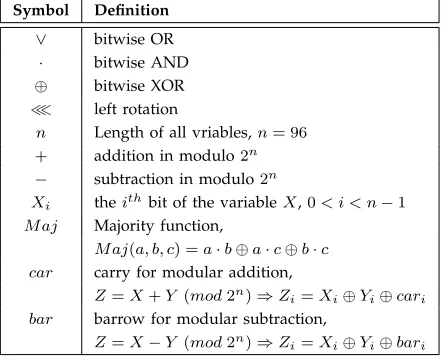
Table 1 shows the list of notations and definitions.
3
RECURSIVE
LINEAR
CRYPTANALYSIS
Recursive linear cryptanalysis directly exploits T-functions in ultralightweight protocols. In this attack, the attacker creates a system of independent linear equations for each bit of secret variables. Then she starts solving this system of equations from LSB and retrieves all secret data bits recursively. The steps of the attack is described in more detail below.
TABLE 1: list of notations and definitions
Symbol Definition
∨ bitwise OR
· bitwise AND
⊕ bitwise XOR ≪ left rotation
n Length of all vriables,n= 96 + addition in modulo2n
− subtraction in modulo2n
Xi theithbit of the variableX,0< i < n−1
M aj Majority function,
M aj(a, b, c) =a·b⊕a·c⊕b·c car carry for modular addition,
Z=X+Y (mod2n)⇒Z
i=Xi⊕Yi⊕cari
bar barrow for modular subtraction, Z=X−Y (mod2n)⇒Z
i=Xi⊕Yi⊕bari
1) Determine all the unknown variables (static and dynamic secrets and nonces) for a single session of the protocol.
2) Write a linearrepresentation for theithbit of each
message, involving the ith bit of known and
un-known variables. You may need to define interme-diate variablessuch as carries for modular additions or barrows for modular subtractions. Try to find enough independent linear equations for the ith bit involving all unknown variables or a subset of them. In other words, for each bit you have created a system of linear equations in unknown variables with nonsingular coefficient matrix. (the linear property of the attack)
3) Solve these systems of equations, Starting from the LSB. The LSB of carries and borrows are zero so the unique solution of the system directly yields the LSB of unknown variables. Now you can com-pute the next bits of intermediate variables which should be known when you solve the system of equations of next bit. In general, when solving the ith system of equations, the value of ith bit of intermediate variables are needed which have been calculated in the previous stepi−1. (the recursive property of the attack)
Therefore, the linear cryptanalysis recovers all secret data bits one by one with probability of one, provided the existence of enough independent linear equations.
ratio depends on the amounts of available data. Anyway, the recursive linear cryptanalysis of Ultralightweight protocols presented in this paper should not be mixed up with the linear cryptanalysis of symmetric primitives. In next subsessions the performance of recursive lin-ear cryptanalysis for the full disclosure attacks on two ultralightweight protocols is shown.
3.1 Recursive linear cryptanalysis of SLMAP
3.1.1 History
In 2007, Li and Wang proposed the ultralightweight mu-tual authentication protocol SLMAP intended for very low-cost RFID tags [12]. This protocol is analysed by Hernandez-Castro et al. in [13] by a traceability attack.
3.1.2 Protocol specifications
Each tag shares a unique static identifier ID, a public index-pseudonym IDS and two session keys K1 and K2 with the reader. The length of each of ID, IDS, K1 and K2isn= 96bits. The protocol works as follows:
1. Reader→T ag:Hello
2. T ag→Reader:IDS
The reader uses the received IDS as a search index to extract the secret information linked to the tag i.e. (ID, K1, K2).
3. Reader→T ag:A, B
The reader generates a n-bit nonces, r, and computes two messages Aand B as follows.
A= (IDS⊕K1) +r
B=IDS+ (K2⊕r)
4. Reader→T ag:C
Upon receiving the messages A and B, the tag first extractsrfromAthen checks the correctness ofB. If the reader is authenticated, the tag computes the response value C as follows.
C= (IDS+ (ID⊕r))⊕(K1 +r)⊕(K2 +r)
After sending C, the tag updates its pseudonym and secret keys.
Upon receiving C, the reader uses its local values to verify it. If the tag is authenticated the reader updates its pseudonym and secret keys. The pseudonym and keys updating are proceed as follows in both parties.
IDSn= ((IDS+ (K1⊕r) +ID+K2)⊕r
K1n= (K1⊕r) + (IDSn+K2 +ID)
K2n= (K2⊕r) + (IDSn+K1 +ID)
(IDS, K1, K2) = (IDSn, K1n, K2n)
3.1.3 Cryptanalysis
Here we apply the three stages of our linear cryptanal-ysis on the SLMAP protocol.
1) For a single session all the secret data include K1, K2, ID andr.
2) Each message in SLMAP protocol, i.e.
A, B, C, IDSn and D, provides a linear equation. Among them, equations given by A, B, C, and IDSn are enough for constructing a system of independent linear equations in secret data bits.
A= (IDS⊕K1) +r
B=IDS+ (K2⊕r)
C= (IDS+ (ID⊕r))⊕(K1 +r)
⊕(K2 +r)
IDSn= ((IDS+ (K1⊕r) +ID+K2)⊕r
Resulting in the following linear equation for bit i = 0, . . . , n−1: (For more clarity, unknown vari-ables are in bold)
Ai=IDSi⊕K1i⊕ri⊕car1i
Bi=IDSi⊕K2i⊕ri⊕car2i
Ci=IDSi⊕IDi⊕ri⊕K1i⊕K2i⊕car3i ⊕car4i⊕car5i
IDSni=IDSi⊕K1i⊕K2i⊕IDi⊕car6i ⊕car7i⊕car8i (1)
Where car10 = car20 = . . . = car80 = 0, and for
i= 1, . . . , n−1:
car1i=M aj(IDSi−1⊕K1i−1, ri−1, car1i−1)
car2i=M aj(IDSi−1, K2i−1⊕ri−1, car2i−1)
car3i=M aj(IDSi−1, IDi−1⊕ri−1, car3i−1)
car4i=M aj(K1i−1, ri−1, car4i−1)
car5i=M aj(K2i−1, ri−1, car5i−1)
car6i=M aj(IDSi−1, K1i−1⊕ri−1, car6i−1)
car7i=M aj(IDSi−1⊕K1i−1⊕ri−1⊕car6i−1,
IDi−1, car7i−1)
car8i=M aj(IDSi−1⊕K1i−1⊕ri−1⊕car6i−1
⊕IDi−1⊕car7i−1, K2i−1, car8i−1)
3) Equations given by (1) create a system of linear equations with the following matrix representation:
M·
K1i
K2i
ri
IDi
=V (2)
Where
M=
1 0 1 0
0 1 1 0
1 1 1 1
1 1 0 1
V=
Ai⊕IDSi⊕car1i
Bi⊕IDSi⊕car2i
Ci⊕IDSi⊕car3i⊕car4i⊕car5i
IDSni⊕IDSi⊕car6i⊕car7i⊕car8i
The coefficient matrix in (2),M, is nonsingular and therefore invertible in GF(2).
M−1=
1 0 1 1
0 1 1 1
0 0 1 1
1 1 0 1
In each step i one can obtain the missing bits, recalling that the intermediate variables (carries) in the right side of equation have been calculated in the previous stepi−1.
Attack summery.The attack ispassive, retrievesall secret data of the tag, and eavesdrops only one genuine au-thentication session. We have simulated this attack and verified its soundness.
Exclusive use of T-functions in this protocol, makes it vulnerable against recursive linear cryptanalysis. One way to avoid the exclusive use of T-functions in ul-tralightweight environments, first introduced by Chien [2], is use of rotations which are non triangular ultra-lightweight operations. We show in next subsecion that use of this operation does not necessarily frustrate the effectiveness of recursive linear attack.
3.2 Recursive linear cryptanalysis of Yeh et al. Pro-tocol
3.2.1 History
Yeh et al. proposed a process-oriented ultralightweight protocol in RFIDSec Asia 2010 [14]. The first attacks presented by Peris-Lopez et al. [15] in 2010, were trace-ability and passive full disclosure of ID, which requires eavesdropping of an average of 250 sessions. In 2012, Avoine et al. presented a passive full disclosure of ID on this protocol which requires eavesdropping of an average of 25 sessions [1].
3.2.2 Protocol specifications
Each tag shares a unique static identifier ID, a public index-pseudonym IDS and a session key K with the reader. The length of each of ID, IDS andK isn= 96 bits. To overcome de-synchronization attack, the reader keeps IDSold too, which is the pseudonym of the last
successful session. The protocol considers a status bit f lag indicating the success or fail of completion of the previous protocol session (respectively f lag = 0 and f lag= 1). The protocol works as follows:
1. Reader→T ag:Hello
2. T ag→Reader:IDS
3. Reader→T ag:A, B, C, f lag
The reader uses the received IDS as a search index to find out if the received IDS is new or it is an old pseudonym. The session key depends on the freshness ofIDS. In other words:
K=Kt andf lag= 0 if IDSis a new psudonym.
K=ID and f lag= 1 ifIDS is an old psudonym.
Then the reader generates twon-bit nonces, n1 andn2, and computes three messagesA, B andC as follows.
A=IDS⊕K⊕n1
B= (IDS∨K)⊕n2
K= (K⊕n2)≪(n1 modn)
C= (K⊕n1) +n2
4. Reader→T ag:D
Upon receiving the messages A, B, C, the tag first ex-tracts n1 from A, extracts n2 from B, computes K and then verifies the value ofC. If the verification succeeds, the reader is authenticated and the tag computes the response valueD as follows.
K′= (K⊕n1)≪(n2 mod n)
D= (K′⊕n2) +n1
Upon receiving D, the reader uses its local values to verify its correctness. If the tag is authenticated, the reader updates its pseudonym and secret key. The tag and the reader compute the next IDS, namely IDSn. The Pseudonym and key updating are proceed as fol-lows:
IDSn= (IDS+ (ID⊕K′)⊕n1⊕n2
Then, the reader updates old and next versions of (IDS, K)as follows:
(IDS, K) =(IDSn, K) (3)
IDSold=IDS
After updating, the reader sends anupdate commandto the tag.
5. Reader→T ag:update command
Upon receiving it, the tag updates(IDS, K)in the same vein as (3) for the next session.
3.2.3 Cryptanalysis
This attack works forf = 1 where due to the equation K=ID, number of unknown variables is one less.
2) The attacker waits for a session where f = 1 and saves the associated messagesA, B, D and IDSn. GivenK=ID,
A=IDS⊕ID⊕n1 (4)
B = (IDS∨ID)⊕n2 (5)
D= (K′⊕n2) +n1 (6)
IDSn= (IDS+ (ID⊕K′)⊕n1⊕n2 (7)
Eq. (6) and (7) hold:
IDSn= (IDS+ (ID⊕n2⊕(D−n1))
⊕n1⊕n2 (8)
The following linear representations for theith bit of (4), (5), and (8) are sufficient for constructing a system of linear equations with nonsingular coeffi-cient matrix:
Ai=IDSi⊕IDi⊕n1i
Bi= (IDSi∨IDi)⊕n2i
= (IDSi⊕1)·IDi⊕IDSi⊕n2i
IDSni=IDSi⊕IDi⊕Di⊕cari⊕bari (9)
Where
car0= 0
bar0= 0
bari=n1i−1⊕bari−1
⊕M aj(Di−1, n1i−1, bari−1)
cari=M aj(IDSi−1, IDi−1⊕n2i−1⊕Di−1
⊕n1i−1⊕bari−1, cari−1)
3) Equations given by (9) hold a system of linear equations with the following matrix representation:
M·
IDi
n1i
n2i
=V (10)
Where
M=
1 0 0
1 1 0
IDSi⊕1 0 1
V=
IDSni⊕IDSi⊕Di⊕cari⊕bari
Ai⊕IDSi
Bi⊕IDSi
The coefficient matrix M is nonsingular, whether IDSi = 0 orIDSi= 1. Therefore it is invertible in
GF(2) in any case.
M−1=
1 0 0
1 1 0
1 0 1
whenIDSi= 0.
M−1=
1 0 0
1 1 0
0 0 1
whenIDSi= 1.
In stepithe solution of the associated system gives directly theithbit of unknown variablesID, n1, n2. once again, note that the values ofcari andbariin
the right side of (9) have been calculated in the previous stepi−1.
After recovering all bits of ID, n1, n2, the remaining unknown variables,K, K′ can be computed straightfor-wardly.
Attack summery. This attack is passive, retrieves all secret data of the tag, and eavesdrops only one genuine authentication session withf lag= 1. The correctness of this attack have been also verified by simulation.
4
RECURSIVE
DIFFERENTIAL
CRYPTANALY-SIS
As described in section 3 recursive linear cryptanalysis is a straightforward an efficient manner for full disclosure attack on some ultralightweight protocols. This attack is deterministic and its success essentially depends on the existence of enough number of independent equations in unknown variables or a subset of them.
However, in some protocols, the attacker may not be so lucky to easily find such system of equations. Often in these cases, the number of equations of a sesseion is less than the number of unknown variables. Use of messages of one or more new sessions is neither an effective solution since new sessions bring new unknown variables as many as or even more than new equations. In such scenarios, a more poweful attack that can gen-erate enough independent equations is required.
Recursive differential cryptanalysis, presented in this section is a more effective technique for cryptanalysis of such protocols. Roughly speaking, in this attack, the attacker forces two parties to run new sessions in their
previous state. This trick limits the introduction of new variables, while giving new equations. more precisely, when the protocol runs in the same state, all the dynamic secret variables stay the same and only new nonces are generated in each protocol run. Moreover, new nonces have a clear differential relation (XOR difference or modular addition difference) with the old ones that can be efficiently used for creating new independent equations. This differential relation often can be find because the wrapped nonces generated by reader are usually delivered to the tag in the initial messages of the protocols in such way that it could be extractable for the tag. Therefore it is often xored or added with a secret dependent quantity. Though the attacker does not know this quantity, but she can obtain differences of two nonces provided that they both wrapped with the same secrets. The name of the attack is derived from the important role of differences.
how this process is possible, we recall from section 2 that in order to avoid possible desynchronization, the party that first updates its state (i.e. the transmitter of the last message), must keep a backup of its previous state. In the case that the tag keeps the backup data, the tag first identifies itself by its freshIDSat the beginning of each session. If the reader finds an entry indexed by IDS in its database, the protocol proceeds with this indexed-pseudonym and associated dynamic secrets otherwise the reader sends to the tag another Hello message, to which the tag will reply with IDSold.This old indexed-pseudonym will be definitely accepted by the reader. In the case that the reader keeps the backup data, the tag identifies itself by the only IDS that it has. The reader keeps both old and new IDS’s in its database and can extract associated dynamic secrets whether it is fresh or not. Then the protocol proceeds with the tag’sIDS and relevant secrets.
Therefore, to force the protocol to stay in the same state, the attacker can easily block the last message of the protocol. (In the case that the tag keeps the backup data, the attacker can do this by blocking the IDS message sent by the tag at the beginning of the protocol, too. Thereupon, the reader asks the tag to use its old IDS and new session will be run with IDSold and kold.)
furthermore, the attacker can repeat this scenario as many times as required to force the parties to work on the same state for any arbitrary number of sessions.
Thus, from this perspective, this attack is a kind of active attack. However, the attacker is a weak active attacker in the sense that she only blocks some specific messages rather than modifying or generating new mes-sages (this weak attacker should not be confused with weak adversary defined in privacy models [17] i.e. the adversary who is not allowed to corrupt tags).
Recursive differential cryptanalysis is outlined as fol-lows:
Phase 1. Data gathering
Allow two parties to run s+ 1 genuine consecutive sessions S(j), j= 0, . . . , s, and block the last message of
each of them to enforce parties to run all sessions in the same state as S(0). Save all message corresponding to
these sessions.
Phase 2. Secret Recovery
1) Determine all the unknown variables (static and dynamic secrets and nonces) for the first ses-sionS(0). Determine also new unknown variables
(nonces only) for the next sessionsS(j), j= 1, . . . , s.
Express clearly the (XOR or modular addition) differential relation of the nonces ofS(0) and their
counterparts inS(j).
2) Write the linear expansion of a proper message of
S(0)for bitipossibly containing some intermediate
variables (carries for modular additions or barrows for modular subtractions). Write the linear expan-sion for the corresponding message of S(j), too.
The first one contains a subset of unknown vari-ables, while the latter contains the same unknown
variables as well as differences of the nonces. The differences of these two linear equation results in a linear equation in the(i−1)thbit of secrets with random coefficients. (the differential property of the attack)
3) Each differential pair corresponding to sessions (S(0),S(j)), j = 1, . . . , s provides such a linear
equation in bit i−1. Therefore there are s linear equations for each bit i = 0, . . . , n −2. With a sufficient number of equations, and due to the randomness of coefficients, there will be an over defined system of linear equations for each bit that yields unknown variables uniquely. Solve the systems of equations starting from the LSB where intermediate variables (carries and borrows) are all zero. Then, compute the intermediate variables for next bit position. In general, in order to obtain the ith bit of secret data, the ith bit of intermediate
variables need to be known, which have already computed in previous step. (the recursive property of the attack)
Therefore, the linear cryptanalysis recovers all secret data bits one by one with probability close to one, provided that there are sufficient number of successive sessions whose last messages is blocked.
It should be mentioned that this terminology is adopted due to the differential essence of the attack as well as its recursive nature in recovering the secret data bits. However, the term ”differential attack” [21] in sym-metric cryptography refers to a well known technique in cryptanalysis of symmetric primitives. This technique is based on finding differential characteristics with max-imum possible probability and then combining them in an appropriate manner. This method is probabilistic in the sense that the attacker success ratio depends on the amounts of available data. Anyway, the recursive differential cryptanalysis of Ultralightweight protocols presented in this paper should not be mixed up with the differential cryptanalysis of symmetric primitives.
4.1 Recursive differential cryptanalysis ofLMAP++
Protocol
4.1.1 History
In 2008, Li proposed a new ultralightweight authentica-tion protocol and called it LM AP++ as an improved
of previous proposals [10]. In 2011, it received two cryptanalysis: the first one proposed by Safkhani et al. [9] that described a traceability an a desynchronization attack on LM AP++, and the second one was a
pas-sive full disclosure of all secrets presented by Wang and Zhang [11] that requires eavesdropping about 480 genuine sessions.
4.1.2 Specification
K2 with the reader. The length of each of ID, IDS, K1 and K2isn= 96bits. The protocol works as follows:
1. Reader→T ag:Hello
2. T ag→Reader:P ID
The reader uses the received P ID as a search index to extract the secret information linked to the tag i.e. (ID, K1, K2).
3. Reader→T ag:A, B
The reader generates a n-bit nonces, r, and computes two messages Aand B as follows.
A= (P ID⊕K1) +r
B =P ID+ (K2⊕r) (11)
4. T ag→Reader:C
Upon receiving the messages A and B, the tag first extractsrfromAthen checks the correctness ofB. If the reader is authenticated, the tag computes the response value C as follows.
C= (P ID+ (ID⊕r))⊕(K1 +K2 +r) (12)
Upon receiving C, the reader uses its local values to verify it. If the tag is authenticated, the reader updates its pseudonym and secret keys as follows:
P IDn= ((IDS+K1)⊕r) + ((ID+K2)⊕r)
K1n= (K1⊕r) + (P IDn+K2 +ID)
K2n= (K2⊕r) + (P IDn+K1 +ID)
(P ID, K1, K2) = (P IDn, K1n, K2n) (13)
and to avoid desynchronysation, it keeps the previous state, too.
(
P IDold, K1old, K2old)= (P ID, K1, K2)
Then the reader sends aCompletion messageto the tag.
5. Reader→T ag:Completion message (14)
Upon receivingCompletion message, the tag updates its pseudonym and secret keys in the same vein as (13).
4.1.3 Cryptanalysis
In this section we show the effectiveness of our recursive differential cryptanalysis on LM AP++ protocol.
Phase 1. Data gathering
Allow two parties to run s+ 1 genuine consecutive sessions S(j), j = 0, . . . , s, and block the fifth message
(14) of each of them. Save all message corresponding to these sessions.
Phase 2. Secret recovery
1) For a clear description of this attack, we first con-sider the first two consecutive sessions, S(0) and
S(1). The variables associated with S(1) is denoted
byX′whereXis its counterpart inS(0). For session
S(0) all the unknown data include r, K1, K2 and
ID. In session S(1), the variables K1, K2 and ID
stay the same (i.e.K1′ =K1, K2′ =K2, ID′=ID) but r′ is new generated. At first, we describe the attack basis for a single differential pair corre-sponding to sessions (S(0),S(1)), then extend it to
more differential pairs of (S(0),S(j)),j = 1, . . . , m
to complete the description of the attack scenario. The modular addition difference of two nonces r and r′ is obtained from equations given byAand A′.
A= (P ID⊕K1) +r
A′= (P ID⊕K1) +r′
Hence the following difference:
r′= (A′−(P ID⊕K1))
=A′−(A−r)
=r+α (15)
Where α = A′ −A is a known variable. Bit rep-resentation of (15) is as follows. (For more clarity, unknown variables are in bold):
r′i=ri⊕αi⊕cari (16)
Wherecar0= 0 andcari =M aj(ri−1, αi−1, cari−1)
for i= 1, . . . , n−1.
2) We use messagesB and B′ to construct the linear equation.
B=P ID+ (K2⊕r)
B′=P ID+ (K2⊕r′)
With the following bit representations:
Xi=K2i⊕ri (17)
Xi′ =K2i⊕r′i
=K2i⊕ri⊕αi⊕cari (18)
Where X = B − P ID and X′ = B′ − P ID
are known. The XOR difference of (17) and (18) eliminates the unknown variables K2i and ri and
yields the following one variable linear equation in ri−1:
∆Xi=cari⊕αi
where
cari=ri−1·(αi−1⊕cari−1)⊕αi−1·cari−1
Hence:
pi·ri=αi·cari⊕∆Xi+1⊕αi+1 (19)
fori= 0, . . . , n−2. Where the coefficientpi=αi⊕
cari is known in stepi. This linear equation yields
the unkonwn variableri if pi= 1.
The coefficient pi is a uniform binary random
variable sinceαiis uniform. Therefore, for a single
differential pair of sessions (S(0),S(1)), the
full disclosure attack, we need a sufficient number of such differential pair of sessions (S(0),S(j)),
j = 1, . . . , s, each one gives a new independent equation as follows.
pi(j)·ri=αi(j)·cari(j)⊕∆Xi(+1j) ⊕α(ij+1) (20) where the superscript (j) denotes the index of differential pair. p(ij), α(ij), cari(j), and ∆Xi(+1j) are the variables corresponding to differential pair of sessions(S(0),S(j)) which are defined in a similar
way of sessions(S(0),S(1)).
3) With a sufficient number of equations (20), there will be at least one equation that with a probability close to one p(ij) = 1, for all i = 1, . . . , n. So, except for the MSB, all bits of r can be retrieved recursively starting from the LSB. Again note that in each step i the carry bit cari, has been already
calculated in the previous stepi−1. Having recov-ered n−1 bits of r, there will be two answer for r which differ only in the MSB. For each one, the other unknown variables K1, K2, and ID can be calculated from (11) and (12) respectively. Finally, another additional equation, e.g.P IDntransmitted on the channel after the final session, can be used to verify the correct answer.
probability analysis.Here, we discuss that for a reliable full disclosure attack, how many differential pair of sessions(S(0), S(j)),j= 1, . . . , s, is required.
The coefficients pi’s are independent uniform binary
random variables. Hence the probability of failure for retrieving a single bit, given sdifferential pairs isPf =
(1 2)
s. Therefore, the probability of success for all n−2
bits is.
Psucc = (1−(Pf)s) n−2
=
(
1−(1 2)
s
)n−2
Which implies that for a success probability of more than 0.95, about s = 11 differential pairs (S(0),S(j))
is required. Totally, including S(0), This attack requires
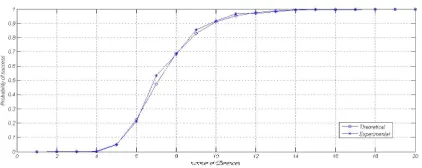
twelve sessions. The theoretical success probability of the attack as well as experimental results is depicted in Fig.1 for n= 96. The experimental results are based on about 300 times running the simulated LM AP++ protocol.
Attack summery. This attack is active (though the attacker only blocks some messages), retrieves all secret dataof the tag, and requires onlytwelveconsecutive gen-uine authentication sessions for probability of success more than 0.95.
4.2 Recursive differential cryptanalysis of SASI pro-tocol
4.2.1 History
In 2007, Chien proposed one of the most important ultra-lightweight protocols called SASI (Strong Authentication and Strong Integrity) as an improvement of the UMAP
Fig. 1: Recursive differential cryptanalysis ofLM AP++.
comparison of theoretical and experimental probabilities of success
protocols [2] to provide authenticity and integrity and withstand all the possible attacks to which the UMAP protocols are subject. The main contributions of this proposal were introduction of rotations as non triangular operations and desynchronization prevention by storing the previous state in the tag.
SASI received some successful cryptanalysis since its introduction. In 2008, Two traceability attacks proposed on SASI by Cao et al. [3] and Phan [4], separately. One year later, Hernandez Castro et al. [18] presented a passive full disclosure ofIDthat recovered theO(log n) least significant bits ofID by eavesdroppingngenuine successive sessions that was impractical due to its ex-ponential data complexity. In 2009, Sun et al. presented two desynchronization attacks, one of which is similar to D’ Acro and De Santis desynchronization attack in [16] in which the authors proposed an active full disclosure of ID and active full disclosure of all secrets, too. This attack requires an average of 309 communications with the tag. The only successful passive full disclosure ofID is given by Avoine et al. in 2011 [1], which recovered the IDby eavesdropping an average of217genuine sessions.
4.2.2 Specifications
Each tag shares a unique static identifier (ID), a public index-pseudonym (IDS) and two session keys K1 and K2 with the reader. The length of each of ID, IDS, K1 and K2 is n = 96 bits. To resist the possible de-synchronization attack, each tag keeps (IDSold, K1old, K2old) also which are the parameters associated with the last successful session. The protocol works as follows:
1. Reader→T ag:Hello
2. T ag→Reader:IDS
The reader uses the received IDS as a search index to to extract the secret information linked to the tag. If the reader could find a matched entry in the database, it proceeds the next step. Otherwise, it probes again and the tag responds with its oldIDS.
The reader generates two n-bit nonces, n1 and n2, and computes three messagesA, B and C as follows.
A=IDS⊕K1⊕n1 (21)
B= (IDS∨K2) +n2 (22)
K1 = (K1⊕n2)≪k1
K2 = (K2⊕n1)≪k2
C= (K1⊕K2) + (K1⊕K2) (23)
where k1 =H(K1) andk2 =H(K2) andH denotes the hamming weight function.
4. T ag→Reader:D
Upon receiving the messages A, B, C, the tag first ex-tracts n1fromA, extractsn2 fromB, computesK1 and K2 and then verifies the value of C. If the verification succeeds, the reader is authenticated and the tag com-putes the response valueD as follows.
D= (K2 +ID)⊕((K1⊕K2)∨K1) (24)
After sending D, the tage updates its pseudonym and secret keys.
Upon receiving D, the reader uses its local values to verify D. If the tag is authenticated the reader updates its pseudonym and secret keys. Pseudonym and keys updating are proceed as follows in both parties. The tag and the reader compute the nextIDS, namelyIDSn.
IDSn= (IDS+ID)⊕(n2⊕K1)
Then, the tag updates the old and next versions of (IDS, K1, K2) as follows:
(IDS, K1, K2) =(IDSn, K1, K2)
(
IDSold, K1old, K2old)= (IDS, K1, K2)
While the reader updates only (IDS, K1, K2) for the next session.
4.2.3 Cryptanalysis
Though recursive linear and differential attacks relies on use of T-functions in Ultralightweight protocols, recur-sive linear cryptanalysis of Yeh et al. protocol shows that use of rotations as non triangular operations does not necessarily cancel out the effectiveness of recursive linear attack. And now, cryptanalysis of SASI is an example of successful applying of recursive differential cryptanalysis to a protocol that uses rotations as non triangular operations.
Phase 1. Data gathering
Allow two parties to run s+ 1 genuine consecutive sessions S(j), j = 0, . . . , s, and block the forth message
D transmitted from the reader for each session. Save all message corresponding to these sessions.
Phase 2. Secret recovery
1) We first consider the first two consecutive sessions,
S(0) and S(1). The variables associated with S(1)
is denoted as X′ where X is its counterpart in
S(0). For sessionS(0) all the unknown data include
K1, K2, n1, n2 and ID. In session S(1), the
vari-ables K1, K2 and ID stay the same (i.e. K1′ = K1, K2′ =K2, ID′=ID) butn1′ and n2′ are new generated. At first, we describe the attack basis for a single differential pair corresponding to sessions (S(0),S(1)), then extend it to more differential pairs
of (S(0),S(j)),j= 1, . . . , m.
We get the XOR-differential ofn1andn1′ from (21) and modular-differential ofn2 andn2′ from (22):
n1′ =A′⊕IDS⊕K1
=A′⊕A⊕n1
=n1⊕α˜ (25)
n2′ =B−(IDS∨K2)
=B−(B′−n2)
=n2 +β (26)
Whereα˜=A⊕A′ andβ =B′−B are known. 2) Utilizing (23) for two sessions, linear equations of
some secrets can be obtained. By expanding (23):
C= (K1≪k1⊕K2⊕n2≪k1)+
(K2≪k2⊕K1⊕n1≪k2)
C′= (K1≪k1⊕K2⊕n2′ ≪k1)+
(K2≪k2⊕K1⊕n1′ ≪k2)
Let us define new variables X , Y and α as fol-lowes:
X =K1≪k1⊕K2
Y =K2≪k2⊕K1⊕n1≪k2
α= ˜α≪k2 (27)
Thus,
C= (X⊕n2≪k1) +Y
C′= (X⊕((n2 +β)≪k1) + (Y ⊕α) (28)
We first try to find enough equations to recover unknown variablesX,Y andn2. First, assume that the correct values of k1 and k2 are known. Bit representations of equation 28 are as follows:
Ci=Xi⊕n2i−k1⊕Yi⊕cari (29)
Ci′ =Xi⊕n2i−k1⊕βi−k1⊕cari′′−k1
⊕Yi⊕αi⊕car′i (30)
Wherecar0=car′0=car′′0 = 0, and
cari=M aj(Xi−1⊕n2i−k1−1, Yi−1, cari−1)
cari′′=M aj(n2i−1, βi−1, car′′i−1)
car′i=M aj(Xi−1⊕n2i−k1−1⊕βi−k1−1⊕car′′i−k1−1,
Yi−1⊕αi−1, cari′−1)
for i = 1, . . . , n −1. Eq. (29) yields one of the linear equations in three variablesXi,Yiandn2i−k1
From (29) and (30) bit representation of differential ∆Ci=Ci⊕Ci′ is:
∆Ci = ∆cari⊕cari′′−k1⊕βi−k1⊕αi (31)
Where∆car0 = 0. So, fori = 0, (31) immediately
results in:
car′′n−k1= ∆C0⊕βn−k1⊕α0 (32)
That gives the value ofcar′′n−k1 explicitly which is required in next stage for retrieving unknown LSB bits. Fori= 1, . . . , n−1:
∆cari=cari⊕car′i
=Xi−1·(∆cari−1⊕αi−1)⊕
Yi−1·(∆cari−1⊕car′′i−k1−1⊕βi−k1−1)⊕
n2i−k1−1·(∆cari−1⊕αi−1)⊕
M aj(βi−k1−1⊕car′′i−k1−1, αi−1, cari′−1)
(33)
Substitution (33) in (31), then some simplifications yields:
∆Ci=Xi−1·(∆cari−1⊕αi−1)⊕
Yi−1·(∆cari−1⊕cari′′−k1−1⊕βi−k1−1)⊕
n2i−k1−1·(∆cari−1⊕αi−1⊕car′′i−k1−1⊕βi−k1−1)
⊕M aj(βi−k1−1⊕cari′′−k1−1, αi−1, car′i−1)
⊕βi−k1⊕αi⊕car′′i−k1−1·βi−k1−1
Fori= 1, . . . , n−1, i̸=k1.
Fori=k1,car′′i−k1= 0in (31). So the expansion of (31) is slightly different:
∆Ck1=Xk1−1·(∆cark1−1⊕αk1−1)⊕
Yk1−1·(∆cark1−1⊕car′′n−1⊕βn−1)⊕
n2n−1·(∆cark1−1⊕αk1−1)⊕
M aj(βn−1⊕car′′n−1, αk1−1, car′k1−1)
⊕β0⊕αk1
Summarizing these both cases in a single equation gives the following linear equation in three vari-ablesXi,Yi andn2i−k1:
Pi·Xi⊕Qi·Yi⊕Ri−k1·n2i−k1=Mi (34)
Where fori= 0, . . . , n−2, i̸=k1−1:
Pi= ∆cari⊕αi
Qi= ∆cari⊕cari′′−k1⊕βi−k1
Ri−k1= ∆cari⊕αi⊕cari′′−k1⊕βi−k1
Mi=M aj(βi−k1⊕cari′′−k1, αi, car′i)⊕βi−k1+1
⊕αi+1⊕cari′′−k1·βi−k1⊕∆Ci+1
and fori=k1−1:
Pk1−1= ∆cark1−1⊕αk1−1
Qk1−1= ∆cark1−1⊕car′′n−1⊕βn−1
Rn−1= ∆cark1−1⊕αk1−1
Mk1−1=M aj(βn−1⊕carn′′−1, αk1−1, cark′1−1)⊕
β0⊕αk1⊕∆Ck. (35)
each differential pair of sessions(S(0),S(j)), results
in a new linear equaion with random coefficients Pi(j),Qi(j)and R(i−j)k1:
Pi(j)·Xi⊕Q
(j)
i ·Yi⊕R
(j)
i−k1·n2i−k1=M
(j)
i .(36)
3) In order to recursively recover all bits of X, Y andn2, we require enough number of independent linear equations in Xi, Yi, n2i−k1. One of them is
(29). The two other required equations are given from (36) for two distinct values of j. So we can construct such a system of linear equations:
M·
Xi
Yi
n2i−k1
=V (37)
Where
M=
P(j1)
i Q
(j1)
i R
(j1)
i−k1
P(j2)
i Q
(j2)
i R
(j2)
i−k1
1 1 1
(38)
V=
M(j1)
i
M(j2)
i
Ci⊕cari
(39)
Wherej1̸=j2,1≤j1, j2≤s.
For s differential pair of sessions, we can build
s(s−1)
2 distinct system of linear equations. For a
full recovery of the unknown bitsXi, Yiandn2i−k1
there must be at least one system of equations with nonsingular matrix of coefficients. Let’s examine the two cases ofi̸=k1−1andi=k1−1separately. For the case i = 0, . . . , n − 2, i ̸= k1 − 1, all matrix entries in the first two rows are independent uniform random variables so having enough such system of equations, one can hope that at least coefficients matrix of one of them is nonsingular. For the case i = k1 −1, according to (35), the first and third columns of M are the same for all differential pairs. In other words, for i = k1−1,
M is always nonsingular and Xk1−1, Yk1−1 and
n2n−1 could never be retrieved uniquely from (37).
However we can still construct the following linear equations:
Pk(j1)−1·(Xk1−1⊕n2n−1)⊕Q
(j)
k1−1·Yk1−1=M
(j)
k1−1
(40)
Thus, the linear system of equation corresponding to i=k1−1reduces to:
M· (
Xk1−1⊕n2n−1
Yk1−1 )
=V (41)
Where
M=
(
Pk(j1)−1 Q(kj1)−1
1 1
V=
(
Mk(j1)−1 Ck1−1⊕cark1−1
)
Each differential pair of sessions yields a new system of linear equations thus there are s such matrices. The two entries in the first row ofM are independent and uniformly distributed, So hav-ing enough such matrices, at least one of them is nonsingular. However, the unique values of Xk1−1 ⊕n2n−1 and Yk1−1 can be obtained from
(41). Although we could not getXk1−1 andn2n−1
separately, butXk1−1⊕n2n−1andYk1−1are solely
sufficient to obtain intermediate variables for the next stepi=k1 (i.e.cark andcar′k).
Hence, as long as the correct values of k1 and k2 are known, we can retrieve unknown bits of Xi, Yi andn2i−k1one by one starting from the LSB
exceptXk1−1, Xn−1, Yn−1, andn2n−1. At each step
the intermediate variables required for next step is calculated. For the LSB,car0andcar0′ are zero and
car′′n−k1 is driven from (32).
Anyway, the correct values of k1 and k2 are not known and we have to guess them from the most probable to the least probable one. P r(k1 = i) = P r(k2 =i) = (
i n)
2n Thus we guess the values ofk1
andk2according to the following order of priority:
k1, k2 = n 2,
n
2 ±1, . . . , n 2 ±
n 2.
The correct guess, definitely recovers the correct values of X, Y and n2. But, what happens if we guess these values incorrectly?
As described, one can construct one equation of the form (36) for each difference. For the correct guess ofk1andk2, all of thesesequations are valid and consistent with each other. For the wrong guesses of k1 or k2, these equations are not necessarily valid (more precisely each equation is valid with the probability of 1
2) and one can find some
contra-dictions between them which discovers the wrong guesses. For example, for biti= 0thejth
1 difference
may result in, say (P(j1)
0 , Q (j1)
0 , R (j1)
n−k1) = (1,1,0)
andM(j1)
0 = 1while thej
th
2 difference may result in
(P(j2)
0 , Q (j2)
0 , R (j2)
n−k1) = (1,1,0) andM (j2)
0 = 0. Such
contradictions happens with probability of 1 2. In
this problem all the wrong guesses are detected due to the high redundancy of equations. This claim will be discussed more precisely at the end of this session.
The recursive differential cryptanalysis ends here and yieldsX, Y andn2. In case of SASI, an additional stage should be done to extract the secretsK1, K2, n1 andID fromX, Y andn2. After obtaining almost all bits ofX, Y andn2, we can find the values ofK1andK2as follows.
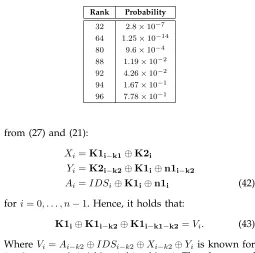
TABLE 2: PMF of the rank of the matrix
Rank Probability
32 2.8×10⁻⁷ 64 1.25×10⁻¹⁴ 80 9.6×10⁻⁴ 88 1.19×10⁻² 92 4.26×10⁻² 94 1.67×10⁻¹ 96 7.78×10⁻¹
from (27) and (21):
Xi=K1i−k1⊕K2i
Yi=K2i−k2⊕K1i⊕n1i−k2
Ai=IDSi⊕K1i⊕n1i (42)
fori= 0, . . . , n−1. Hence, it holds that:
K1i⊕K1i−k2⊕K1i−k1−k2=Vi. (43)
WhereVi=Ai−k2⊕IDSi−k2⊕Xi−k2⊕Yi is known for
i= 0, . . . , n−2, i̸=k2−1, k1 +k2−1. Therefore, set of equations given by (43) creates a system ofn−3 linear equations innvariables.
Let’s first assume that set of equations given by (43) holds for alli= 0, . . . , n−1. The rank of the coefficient matrix of such linear system equations, namelyR, takes some limited number of values between n/2 and n depending on the values of nonuniformly distributed random variables k1 and k2. Table 2 shows the prob-ability mass function of R for n = 96. In our problem, we have totally n−3 equations so (43) gives at least R−3independent linear equations inK1i’s. On the other
hand, (22) and (42) holds:
IDSi∨(Xi⊕K1i−k1) = (B−n2)i (44)
which also brings new linear equations in terms ofK1i
if IDSi = 0 which has a probability of 12. Therefore, in
average we obtain from (44) n/2 more equations that along with R−3 independent equations in (43) holds an overdefined system of linear equations inKi (except
the case R= 32 which has the negligible probability of 2.8×10⁻⁷). So the unique solution of this system, gives
all bits ofK1. The remaining secrets,K2,n1andIDare also recovered respectively by (42) and (24).
probability of success. Here, we discuss that for a reliable full disclosure attack, how many differential pair of sessions(S(0), S(j)),j= 1, . . . , s, is required.
First, two lemmas are stated:
Lemma 1. Assume s vectors m(j), j = 1, . . . , s where
m(j) = (m(j) 1 , m
(j) 2 ). m
(j)
i ’s (i = 1,2, j = 1, . . . , s) are independent uniformly distributed binary random variables. Let2×2 matrixM(j) be constructed as follows:
M(j)=
(
m(1j) m(2j)
1 1
for j = 1, . . . , s. The probability that all M(j)’s are singular
is:
Psing,2×2= (
1 2)
s
Proof:Consider the following outcome:
A:m(j)∈ {(1,1),(0,0)},∀j∈ {1, . . . , s} (45) for j = 1, . . . , s. All M(j) are singular if the outcome A
occurs. Hence,
Psing,2×2=P(A) = (
1 2)
s.
Lemma 2. Assumesvectorsm(j), j= 1, . . . , swherem(j)=
(m(1j), m2(j), m(3j)). m(ij)’s (i = 1,2,3, j = 1, . . . , r) are independent uniformly distributed binary random variables. Let 3×3matrixM(j1,j2) be constructed as follows:
M(j1,j2)=
m(j1)
m(j2)
1 1 1
where j1̸=j2 and j1, j2∈ {1, . . . , s}. There are s(s2−1) such
matrices. The probability that all M(j1,j2)’s are singular is Psing,3×3= 3·(
1 2)
s−2·(1
4)
s
Proof:Consider the following outcoums:
A:m(j)∈ {(1,0,0),(0,1,1),(1,1,1),(0,0,0)},
∀j∈ {1, . . . , s}
B:m(j)∈ {(0,1,0),(1,0,1),(1,1,1),(0,0,0)},
∀j∈ {1, . . . , s}
C:m(j)∈ {(0,0,1),(1,1,0),(1,1,1),(0,0,0)},
∀j∈ {1, . . . , s}
All M(j1,j2)’s are singular if the outcomes B or C or A occur. Hence,
Psing,3×3=P(A ∨ B ∨ C)
=P(A) +P(B) +P(C)
−P(A ∧ B)−P(A ∧ C)−P(B ∧ C)+ P(A ∧ B ∧ C) (46)
For a single j,
P
(
m(j)∈ {(1,0,0),(0,1,1),(1,1,1),(0,0,0)}
)
= 1 2 Hence,
P(A) =P(B) =P(C) = (1 2)
s (47)
Sincem(j)’s are independent.
P(A ∧ B) =P(A ∧ C) =P(B ∧ C)
=P
(
m(j)∈ {(1,1,1),(0,0,0)}, j= 1, . . . , s
)
= (1 4)
s
(48)
P(A ∧ B ∧ C) =P
(
m(j)∈ {(1,1,1),(0,0,0)}, j= 1, . . . , s
)
= (1 4)
s
(49)
Equations (46), (47), (48), and (49) holds:
Psing,3×3= 3·(
1 2)
s−2·(1
4)
s
(50)
Attack success depends on the existence of at least one nonsingular matrix Mamong all s(s2−1) matrices in (37) for all bits i = 0, . . . , n−2, i ̸=k1−1 and at least one nonsingular matrix M among all s matrices in (41) for bit i=k1−1. Thus, by the mentioned lemmas:
Psucc= (1−Psing,3×3)
n−2
×(1−Psing,2×2)
=
(
1−
(
3·(1 2)
s−2·(1
4)
s
))n−2
×
(
1−(1 2)
s
)
(51)
According to (51) for Psucc > 0.96, it suffices that s =
12. Thus, for a reliable differential cryptanalysis of SASI, 13 consecutive genuine sessions are sufficient, provided that the last message of each one is blocked.
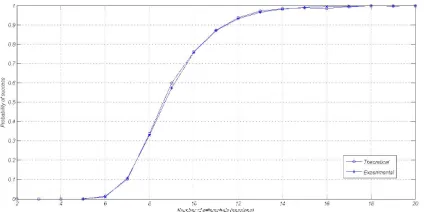
Fig. 2 shows the theoretical attack probability of suc-cess (51) in terms of number of differential pairs (s) as well as experimental results forn= 96. The experimental results is based on about 500 times running the simu-lated SASI protocol fors= 2, . . . ,20.
Probability of detecting wrong guesses of k1 and
k2. For each bit i (except the MSB), there are at most eight distinct set of coefficients(Pi(j), Qi(j), R(i−j)k1). Thus, there are at least s−8 equations with the coefficients that are repetitive. since the probability of consistency of two equations with repetitive coefficients are 1
2 (i.e.
the probability of equality of their associated constants Mi(j)), the probability of consistency of all the repet-itive equations for a wrong guess of k1 and k2 is Pnon−det= (12)(s−8)(n−1) which for s= 12 is completely
negligible. Thus the probability of detection of the all n2−1 wrong guesses is P
det = (1−Pnon−det)n
2−1 = (1−(1
2)
(s−8)(n−1))n2−1
which is very close to one for n= 96and s= 12.
Attack summery. This attack is active (though the attacker only blocks some messages), retrieves all secret data of the tag, and requires only thirteen consecutive genuine authentication sessions for probability of suc-cess more than0.96.