ISSN 2286-4822 www.euacademic.org
Impact Factor: 3.1 (UIF) DRJI Value: 5.9 (B+)
Construction and Validation of a Scale to Study the
Attitude towards Commerce Subject
BRINTHA.S (Ph.D., Research Scholar) Bharathiar University Coimbatore Assistant Professor Sri Muthukumaran College of Education, Chennai India Dr. K.S. RAMAKRISHNAN
(Research Supervisor) Assistant Professor School of Education Tamilnadu Open University, Chennai
India
Abstract:
Commerce is an integral part of our day-to-day life. Every economic activity is interwoven with commerce. Commerce education is that area of education which develops the required skills, attitudes and knowledge for the successful handling of trade and industry. During the last few years it has grown remarkably both in corpus and scope. Today, it is a growing discipline with a set of multi-dimensional key areas like accounting, finance, marketing, taxation statistics, human resource management, materials management and information systems. The growth and expansion of commerce has always been felt as being professional oriented and thus is generally accepted as more socially relevant than others.
the same time we, as teachers of commerce, cannot lose sight of an academic and professional competition from these sister disciplines. Competition in any area should improve the quality and relevance and result in consistent and constant improvement.
Key words: Construction, Validation & Attitude, Commerce education
Introduction
The evolution of commerce education in India can be traced back for a century. It was in the year 1886 that the Government of Madras took the initiative and established the first commerce school in the country at Madras. At college level, commerce education was started in the year 1903 in Presidency College, Madras. At the University level, Bombay University took the lead in the year 1913. Today almost all the universities in the country have post graduate departments of commerce offering M.Com. Courses.
Characteristics of Commerce Education:
Need for Commerce Education:
There has been a historic growth in the fields of commerce, industry and science in the recent past. These growth demands of specialized education in various fields are concerned with science, commerce and industry. The dependence of commerce on science has been exemplified by pointing out the fact that “The management side of commerce is wholly dependent on computers”. In India too computer is fully accepted by the business fields. Computer education has been introduced in the schools in India and with this it is expected that the school will become the machines of commerce education. However, at present commerce education in school stage is book-keeping or accountancy. In most of the advanced countries, commerce education is totally computerized.
Objectives of Commerce Education:
To develop skills in teaching and research in various areas of commerce.
To prepare students for executive and non-executive position in business and service sector.
To promote entrepreneurial skills for self-employment.
To promote general education of business and commerce and to equip students for understanding and appreciation of business etc.
Areas of Study in Commerce Education:
Commerce education is concerned with the study of the structure and functions of commerce. Following three areas of study are of interest in the study of commerce education.
Commerce education as a part of general education.
Knowledge about commerce as background
understanding check.
Commerce study as a specialized subject.
Commerce Education at School Level:
To cope with the increasing demand for the trained people to transact commercial and government jobs, it became essential to introduce the commerce education at school level.
To start with, the teaching of short-hand and typing was introduced in Government schools and aided schools in the vocational stream and afterwards the teaching of commerce was introduced in such schools. In the new scheme of education (viz. 10+2+3 pattern of education) sufficient attention has been paid to commerce education in Indian schools. In addition to shorthand and typing some more subjects that have been included for teaching in commerce are as follows:
Commercial law Industrial law
Income tax Taxation
Salesmanship Applied Economic
Public relations Advertising
The teaching of commerce subjects starts from class XI and in class XII the syllabus in quite advanced. Many a commercial subjects are also taught in vocational institutions.
At present commerce education is considered as good education because of the distinct advantages that a commerce student has over his counter-part ion the arts faculty. It is believed that a commerce student not only achieves just training and perfection, but also a general professional intelligence.
Need and Importance of the Study
The study had been undertaken to find out the attitude of students towards commerce. The important aim of the study is to formulate a tool to find this attitude towards commerce and validate the same.
Statement of the problem
The problem taken for the present study is “Construction and Validation of a Scale to Study the Attitude towards Commerce Subject”.
Definition of Terms
Attitude
Commerce Education
Paul. S. Lomax (1928) observed that “Commercial education is fundamentally a programme of economic education that has to do with the requirement, conservation and spending of wealth”.
Significance of the problem
This study is important because there is no scale to measure the attitude of students towards commerce subject. It will serve as a tool to provide guidance for the students to take up commerce subject and develop interest in the related course which will ultimately prepare them for a suitable vocation.
Objective of the study
1. To formulate an attitude scale in commerce. 2. To validate the commerce attitude scale.
3. To find out whether the students have a positive attitude towards commerce.
4. To determine the difference in view of both boys and girls towards commerce.
5. To compare the attitude of commerce students studying different type of schools (Government (G), Corporation (C) and Management (M) schools).
6. To determine the influence of the other subjects studied along with commerce at the higher secondary level.
Formulation of the tool
favourable or positive statements and unfavourable or negative statements.
A preliminary questionnaire was prepared as a part which elicited the personal data like name, class, sex, name of school and subject combination as shown in Appendix I.
The pilot Study
A pilot study was conducted with 82 commerce students from Bentick Higher Secondary School. The investigator personally administered the attitude scale. Before the commencement of the test, instructions were given about how to proceed with marking the scale. They were requested to indicate their attitude by checking the appropriate response for each statement. Any doubts which arouse were cleared and the difficult words which could not be understood by the pupils were noted down by the investigator.
Finalizing the Tool
After the pilot study, all scores were stored in a floppy. The scores of 82 students for each of the 75 items in the attitude scale were subjected to factor analysis. 26 different factors were identified. Since each of the statement in the scale had factor loading greater than 0.3, and all the 75 statements were related to commerce all the 75 items were retained for the final study
Hypotheses
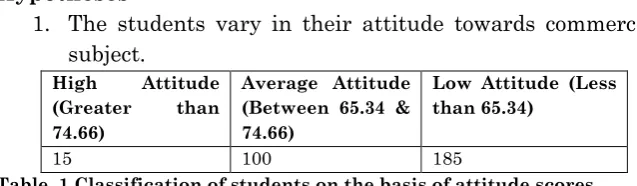
1. The students vary in their attitude towards commerce subject.
High Attitude (Greater than 74.66)
Average Attitude (Between 65.34 & 74.66)
Low Attitude (Less than 65.34)
15 100 185
2. There is no significant relationship between the attitude and achievement scores of the students in commerce. 3. There is no significant difference between the attitude of
boys and girls towards commerce subject.
Attitude of the students in Commerce
The scores of the students in the attitude scale were reduced to percentage, and this means and S.D. were calculated as 65 and 9.66. The students who scored above Mean + S.D. were considered to have higher attitude and the students who scored below Mean – S.D. were considered to have low attitude and in between the two were considered to be of average categories.
4. There is no significant difference between the attitude of students in the Government, Corporation and Management schools towards commerce subject.
Types of Schools
Mean S.D ‘F’ value REMARKS
Government ‘G’ 69.02 8.49
2.12 NS
Corporation ‘C’ 73.48 6.67
Management ‘M’ 69.45 15.41
5. There is no significant difference between the attitude of students with different group combinations towards commerce subject.
Group Combinations Mean S.D. ‘F’ value
REMARKS
X- Economics, Accountancy &
Commerce
68.69 9.84
30.45 NS
Y – Accountancy, Mathematics & Commerce
72.30 9.76
Z- Computer Science, Commerce & Accountancy.
64.55 8.54
Table.3 Group wise distribution of Mean and S.D. of Attitude scores.
Testing of Hypotheses
The first hypothesis states that “the students vary in this attitude towards commerce subject”. In the present study it was found that students differ in this attitude towards commerce, 5% have high attitude, 33.3% have average attitude and 66.66% have poor attitude.
relationship between the attitude and achievement scores of the students. But it was inferred in the present study that the correlation between attitude and achievement was 0.65. Hence there is a significant relationship between the attitude and achievement of the students in commerce.
The third hypothesis states that there is no significant difference between the attitude of boys and girls in commerce. Since the calculated ‘t’ value (.9685) (from table 4.9) is less than the table value at .05 level; we accepted the null hypothesis. Hence there is no significant difference between boys and girls in their attitude towards commerce subject.
The fourth hypothesis states that there is no significant different type school that is Government (G), Management (M), and Corporation (C) towards commerce. Since the calculated ‘F’ value (2.12 from table 4.10) is less than the table value (3.04), we accept the null hypothesis. Hence there is no significant difference between the attitude of students in different schools towards commerce subject.
The fifth hypothesis states that there is no significant difference between the attitudes of students with different group combination of subjects towards commerce. From the table 4.12 it is clear that there is significant difference between the attitudes of the students with different group combinations towards commerce.
Limitations
1. Only students studying English Medium were taken for the investigation.
2. Only some schools which have common question paper (in half yearly examination) were taken under this study.
Methodology
300 English medium commerce students of standard XI were selected from 8 different schools that is Government (G), Management (M), and Corporation (C). A tool was prepared and pilot study was conducted. Validation was done by comparing the attitude scores and achievement scores (half yearly examination scores). All the statements were finalised after factor analysis. Students were found to be different in this attitude. The scores were tabulated and statistical analysis was done. Validity and reliability of the test tool was also found.
Analysis and interpretation
After the tool has been constructed and the data have been collected the next step in the research process was analysis. The attitude of the statement and the validation of the tool are taken up for the analysis. The data analysis starts with the presentation of descriptive statistics and goes on inferential statistics including testing of hypothesis. The data was statistically analyzed using‘t’ and ‘F’ tests; to prove the hypotheses. Appropriate graphs were also drawn and interpreted to verify the hypotheses.
Major Findings
1. The students differ in their attitude towards commerce. 2. There is significant relationship between the attitude and achievement of students in commerce subject.
3. Boys and Girls do not differ significantly in their attitude towards commerce subject.
commerce subject.
5. There is significant difference between the attitudes of students with different group combinations towards commerce subject.
Also the study has resulted in the formulation and validation of a scale to study the attitude towards commerce subject.
Validation of the tool
The validation of tool is established by calculating the co-efficient of correlation of attitude scores and achievement scores of the students.
Educational Implications
By adopting commercial attitude and transferring this to situations in every day life, students can be expected to be more tolerant of those points of view and to be more successful in living and working alongside with other people.
So it is the teachers’ responsibility to develop positive attitude towards commerce in students. To develop commercial attitude in students the teacher must provide opportunities for the students to explore his likes and dislikes and study the world around him.
Pupils should be encouraged to take part in commercial exhibitions, shows, trips and so on, where they can exhibit the product of their ideas in commerce. Seeing other peoples work will also encourage them and thus the students can be helped to develop the spirit of ‘commerce temper’.
Suggestions for further study
1. A study of similar type can be conducted for other subjects.
2. The study was conducted only among English medium students. It could also be conducted among pupils with other medium of instruction.
3. The similar study may be undertaken with rural schools. 4. Comparative studies of commerce attitude and achievement in other related subjects may also be undertaken.
5. A study on attitude and achievement in commerce can be extended to college students in a wider range.
Conclusion
The purpose of the present investigation was to study Construction and validation of a scale to study the attitude. The study is sure to find some usefulness in the field of education and findings of the study can serve as a database for further research.
BIBLIOGRAPHY:
Agarwal, J.C. 1996. Teaching of Commerce. A practical
Approach. New Delhi: Vikas Publishing House Private
Limited.
Best, John W. 1983. Research in Education. New Delhi: Prentice Hall of India Private Limited. 46.
Carter, V. Good, A.S. Barr, D.E. Scates. 1941. Method of
Educational Research. New York. 167-168.
Kothari. C.R. 2000. Research Methodology: Methods and
techniques. New Delhi: Wishwa Prakasha.
Publications Private Limited.
Sivaya, K.V., M. Ganyadhara Rao, and V. Bala Mohan Das. 1990. Commerce and Management Education in India. New Delhi: Ashish Publishing House. 84.
_______. 1993. The Indian Journal of Commerce Vol. XLVI. No. 175. 76-80.
_______. 1991. JOURNALS the Educational Review. Vol. XCVIII. No. 7.