Gender, Age, Sibling Position and Educational
Level Difference in the Dichotomous Thinking and
Self-esteem of University Students of Dhaka City
M.A. UZZAMAN FARHANA AKHAND M.U. MORSHED
Jagannath University, Dhaka Bangladesh
Abstract:
The objective of the present study was to investigate whether there are any significant differences between dichotomous thinking and self esteem considering gender, age, sibling position and educational level difference in different University students. It was hypothesized that there is a difference in the Dichotomous thinking and self esteem in terms of gender, age, sibling position and educational level. In order to achieve this the study was conducted on a sample of 200 students (boys 100 and girls 100) of various university students from Dhaka city. The samples of the study were selected by using purposive sampling technique. The experiment was conducted from 11 November to 30 December, 2011 under the area of Dhaka city. In order to measure the variable of the study it was adapted the Bangla Version (Illayas, 2003) of Rosenberg’s (1965) self esteem scale. Dichotomous thinking scale was developed by M.A. Uzzaman, and M. U. Mourshed (2011) of Oshio’s (1999).The obtained data was analyzed by employing independent samples t-test and one way ANOVA with the help of a computer software called statistical package for social sciences (SPSS). The findings reveal that there is no significance difference between self-esteem score according to sex (t = .468, df = 198, p<.05). Again according to dichotomous thinking there is no significance difference between dichotomous thinking score according to sex (t = -1.059, df = 198, p < .05).
between dichotomous thinking score according to age. (t = 3.868, df = 198, p < .05).
There is significant difference at educational level according to dichotomous thinking score (F.05, 199, P < .01), which supports the hypothesis. On the other hand, there is significant difference at educational level according to self-esteem score (F.05, 199, P < .01), which does not support the hypothesis.
There is significant difference at educational level according to dichotomous thinking score (F.05, 199, P < .01), which fully supported the hypothesis. On the other hand, there is significant difference at educational level according to self-esteem score (F .05, 199, P < .01), which fully supported the hypothesis. The result has been interpreted in the light of past studies and the finding of the present study has both theoretical and practical implication and has high relevance for the education system on Bangladesh and International community.
Key words: Self Esteem, Dichotomous thinking, Gender, age, sibling position
Introduction
Over the last decades no studies have been conducted on dichotomous thinking and few studies have been conducted on Self-esteem in Bangladesh, in terms of gender, age, sibling position and educational level differences in university students of Dhaka city. In the present study, we are trying to see the nature of self-esteem and dichotomous thinking considering the demographic information of university students.
1.1 Self esteem
self esteem, he/she will become more positive and he/she will benefit in every area of life.
Self esteem is a term in psychology to reflect a person’s overall or appraisal of his or her own worth. Self esteem encompasses beliefs - for example, “I am competent” - and emotions, such on triumph, despair, pride and shame. Some would distinguish how the self concept is what we think about the self esteem, the positive or negative evaluation of the self, is how we feel about it. For a person, a self concept consists of the beliefs one has about oneself, one’s self perception, “the picture of oneself.” Baumeister (1996) described self concept as a perception which people hold about themselves. It is not the “faces” about one self but rather what one believes to be true about one self. Researchers used self concept as a descriptive construct, such as “I am an athlete”.
The original definition presents self esteem as a ratio found by dividing one’s successes and the individual failures in one’s life. The pretention problem with this approach comes from making self esteem contingent upon success. This implies that inherent instability can become failure at any moment. In the mid 1960s, Morris Rosenberg and social learning theorists defined self esteem in terms of a stable sense of professional worth or worthiness. Nathaniel Broaden, in 1969, defined self esteem as “the experience of life and being worthy of happiness”. According to Branden (2001), self esteem is the sum of self confidence (a feeling of personal capacity) and self respect (a feeling of personal worth). It exists as a consequence of the implicit judgment that every person does about oneself, his/her ability to face life’s challenges, that is, to understand and solve problems and on the other side, his right to dealing with limits of defining self-esteem primarily in terms of competence or worthiness.
That is due to the fact that, during development, and through life itself, people tend to move away from positive self-conceptualization [and self-conceptualization], or even not to approach to it. The reasons why this happens are diverse, and they can be found in the negative influence from other people, self-punishment for breaking one's values [or one's social group's values], or shortage of understanding or compassion for one's actions [or others' actions].
Self-esteem is a graduated concept. Taking this into consideration, people may essentially have three main degrees of self-esteem:
To have a high self-esteem is to feel confidently capable for life, or, in Brandon's words, to feel able and worth, or to feel right as a person.
To have a low self-esteem corresponds to not feeling ready for life, or to feeling wrong as a person.
To have middle ground self-esteem is to waver between the two states above, that is, to feel able and useless, right and wrong as a person, and to show these incongruities in behavior, acting, at times, wisely, and at rashly others, thus reinforcing insecurity.
In practice, and according to Nathaniel Branden's experience, everybody is able to develop positive self-esteem, and nobody has a totally undeveloped self-esteem. The more flexible is a person, the better he can resist everything that would otherwise make him fall into failure or desperation.
People with a healthy level of self esteem:-
Firmly believe in certain values and principals and are ready to defend them even when finding opposition, feeling secure enough to modify them in light of experience.
Do not lose time worrying excessively about what happened in the past nor about what could happen in the future. They learn from the past and plan for the future, but live in the present intensely.
Fully trust in their capacity to solve problems, not hesitating often in front of failures and difficulties. They offer to help the others when they need it.
Take for granted that they are interesting and valuable persons for others, at least for those with whom they have a friendship.
Resist manipulation, collaborate with others only if it seem appropriate and convenient.
Admit and accept different internal feelings and drives, either positive or negative, revealing those drives to others only when they choose.
Are able to enjoy a great variety of activities.
A brief historical description of Self-esteem:
Self-esteem, as a psyche's experience, has gone with human being since its beginning.
The construct of self-esteem (or self-concept) dates back to William James, in the late 19th century, who, in his work Principles of Psychology, studied the splitting of our “global self” into “knower self” and “known self”. According to James, from this splitting, which we all are more or less aware of, self-esteem is born.
on self-esteem were overlooked, since it was considered a less liable to rigorous measurement hypothesis.
In the mid-20th, Phenomenology and humanistic psychotherapy made self-esteem gain prominence again, and it took a central role in personal self-actualization and psychic disorders' treatment. Personal satisfaction and psychotherapy started to be considered, and new elements were introduced, which helped to understand the reasons why people tend to feel less worthy, discouraged and unable to understand challenges by themselves.
Carl Rogers, the greatest exponent of humanistic psychology, exposed his theory about unconditional acceptance and self-acceptance as the best way to improve self-esteem.
Robert B. Burns considers that self-esteem is a collection of the individual's attitudes toward himself. The human being senses himself at a sensorial level; thinks about himself and about his behaviors, and evaluates them and him. Consequently, he feels emotions related to him. That starts in him behavioral tendencies aimed to himself, to his way of being and behaving, and to his body's and character's features, and, in turn, that forms the attitudes which, globally, we call self-esteem. Thus, self-esteem, for Burns, is the evaluative perception of oneself. In his own words: "individual's behavior is the result of his environment's particular interpretation, whose focus is himself".
Having good self-esteem is also the ticket to making good choices about your mind and body. If you think you're important, you'll be less likely to follow the crowd if your friends are doing something dumb or dangerous. If you have good self-esteem, you know that you're smart enough to make your own decisions. You value your safety, your feelings, your health, your entire self. Good self-esteem helps you know that every part of you is worth caring for and protecting.
According to Megan (2011) the best, and single, place to begin changing this is to simply decide to do it. You will experience empowerment, and hopefully a little self-confidence, if you try to be educated on how to improve self-esteem. Also, it is extremely vital to understand and accept that a change like this doesn’t happen overnight. So you have to be diligent and work on it slowly but surely. You set off by examining your thought processes. As you run through your day, notice how you feel with great care. Pretty soon, you will ascertain the scope of your specific mental processes. How can you find out what things you need to change until you know what your actual patterns of thinking are?
Low self-esteem is a conditioned behavior that can be modified. There could be a lot of things that can contribute to this particular state of mind. Generally speaking you began placing more value on the attitudes and words other people say to you. All young kids and teenagers do this because they believe and believe authority figures. How our peers at school interact with us will affect our self-image as well. These earlier influences go on to shape us as we get older.
Understanding this is fundamental and universally beneficial since the development of positive self esteem increases the capacity to treat other people with respect, benevolence and good will, thus favoring rich interpersonal relationship and avoiding destructive ones.
Self esteem allows creativity at the workplace and is an especially critical condition for teaching professions.
1.2 Dichotomous Thinking (D.T)
issues. Egan, Piek, Dyck, and Rees (2007) reported relationships between this scale and negative perfectionism. In relation to this, Byrne, Allen, Dove, Watt, and Nathan (2008) explored factor structure using confirmatory factor analysis, internal consistencies, and validation by observing relationships among the DTEDS and eating disorder symptoms, depression, and perfectionism. However, because this scale is focused on eating disorders, it may be inappropriate for other psychological symptoms.
Researchers have previously investigated the nature of constructs related to the concept of dichotomous thinking such as intolerance of uncertainty (Dugas, Freeston, & Ladouceur 1997; Dugas, Gagnon, Ladouceur, & Freeston 1998) and intolerance of ambiguity (Budner 1962; Frenkel-Brunswik 1949). Both concepts are defined as an individual tendency to perceive or interpret a situation (environment) as a threat or a source of discomfort, anxiety, and disagreement in studies involving ambiguity and uncertainty (Grenier, Barrette, & Ladouceur 2005). In both cases, individuals respond to this perceived threatening situation with a set of cognitive, emotional, and behavioral reactions. The differences between these concepts relate to time-orientation (Grenier et al.). Individuals who are intolerant of ambiguity are unable to tolerate a “here and now” situation whereas those who are intolerant of uncertainty will not be able to accept that a future and negative event may occur, however small the probability of its occurrence (Dugas, Gosselin, & Ladouceur 2001). Thus, intolerance of ambiguity and intolerance of uncertainty contain not only a dichotomous-thinking cognitive style but also emotional and behavioral reactions to ambiguous and uncertain situations.
While splitting is generally regarded as an unconscious defense that plays a necessary role in psychic development, it is also an identified symptom of both Borderline and Narcissistic Personality Disorder (Jacobson 1954; Volkan 1988). In recent advances in cognitive therapy, some researchers proposed another meaning of splitting as relating to the cognitive domain. The central schema of splitting is to see oneself and others as “all good” or “all bad”. According to Benjamin and Friedrich (1991) and Horowitz (1977), any one component of a schema can activate the entire schema, evoking its power to influence current events. Because the dominant schema determines what is noticed, how it is processed, the meaning that is assigned, and the emotions that are evoked, schemas that are anchored in “all good” or “all bad” spheres perpetuate the abrupt oscillations (Siegel 2006). In this way, splitting relates not only to cognitive processes but also to processing of emotions and memory. Dichotomous thinking is a very important problem in people with borderline personality disorder (BPD). Dichotomous words force our thinking in to two categories. My choices of action are right or wrong, good or bad, this way or that you are either with us or against us.
Dichotomous Thinking is also sometimes called “black or white” thinking. This is when someone is only able to see the extremes of a situation and is unable to see the “Grey areas”, or the complexities of the situation. For example students who engage in D.T. may believe that if they don’t get an “A” in class, they have failed. Recent conceptualizations of perfectionism have involved dividing the construct into positive or negative components. Negative perfection is associated with positive affect and looser levels of distance.
feelings or beliefs about oneself or others. In other words, positive and negative attributes of a person are not joined together into a cohesive set of beliefs. The experience of splitting is very confusing and frustrating for people with BPD and their loved ones. Splitting can interfere with relationships and work life, and can lead to anger and self destructive behavior. Borderline Personality Disorder is one of several personality disorders recognized by the American Psychiatric Association. Personality disorders are psychological conditions that begin in adolescence or early adulthood and continue over many years. They can also often interface with a person’s ability to enjoy life or achieve fulfillment in relationship, work or school. Dove, Byrne & Bruce (2009), investigated the effect of D.T and depression on weight loss during a cognitive behavioral therapy – CBT intervention. Overweight and obese females (n = 76) participated in CBT for weight management for 12 weeks. Before treatment, D.T. moderated the association of depression with BMI. Such the depression was positively associated with BML among those with D.T moderated the association of depression with BMI. Such the depression was positively associated with BML among those with D.T but was not associated among there with high D.T. weight loss was negatively associated with pre-treatment depression but not with dichotomous thinking. Depression but not dichotomous thinking is likely to interfere with the ability to adhere to short term weight loss strategies.
1.3 Age
Age is a span of years during which some events occurred. In the present study we have considered University students of various universities in the Dhaka City, with an age varying from 18 to 22 and 23 to 26. All of them were undergraduate and postgraduate students.
In biology, sex is a process of combining and mixing genetic traits, often resulting in the specialization of organisms into a male or female variety (each known as a sex). Sexual reproduction involves combining specialized cells (gametes) to form offspring that inherit traits from both parents. Gametes can be identical in form and function (known as isogametes), but in many cases an asymmetry has evolved such that two sex-specific types of gametes (heterogametes) exist: male gametes are small, motile, and optimized to transport their genetic information over a distance, while female gametes are large, non-motile and contain the nutrients necessary for the early development of the young organism.
An organism's sex is defined by the gametes it produces: males produce male gametes (spermatozoa, or sperm) while females produce female gametes (ova, or egg cells); individual organisms which produce both male and female gametes are termed hermaphroditic. Frequently, physical differences are associated with the different sexes of an organism; these sexual dimorphisms can reflect the different reproductive pressures the sex’s experience. In this research we used two types of sex- male and female students.
1.5 Educational level
There are different educational levels in Bangladesh. In our present study we used undergraduate and postgraduate students from different universities of Dhaka city. In this research, the educational level is divided into 6 parts: first year students, second year students, third year students, fourth year students, Master’s Students, and Master’s result expected students.
study show that self-esteem was 0-62 (95% C1 0.56-0.63) in 14 years old boys and 0.40 (95% C1 0.26-0.56) in 14 years old girls, while the corresponding estimates at age 17 years were 0.48. for the boys the correlation was mainly (82%) due to genetic factor, with residual co-valuation due to unique environment. In girls genetic (31%) and common environmental (61%) factors largely explained the correlation.
Mary, Barbara & Myers (2000) studied the topic of “Adolescence self esteem and gender: Explaining relation to sexual Harassment, Body image, and Media Influence and emotional expression.” They used a cross sectional design to examine age and gender patterns in self esteem. Self reported influence on self esteem involving the media, sexual harassment, body, image, family and peer relation and emotional expression were evaluated with 93 boys and 116 girls. 5 ,8 and 12 years old girls reported lower self esteem than boys in early adolescence, while late adolescence boys report lower self esteem than younger boys.
Gerthe veen and Arnoud Arntz (2000) studied about Dichotomous thinking and age. Patients with BPD (N=16) control patterns with cluster C Personality disorder (PD: NO = 12) and normal controls (N=15) evaluated personalities from film clips in a structured response format. Film clip were presented with emotional themes which were hypothesized to be either specific or nonspecific for borderline pathology and with neutral themes, which were hypothesized to be either specific or nonspecific for borderline pathology and with neutral themes.
1.6 The research question:
Considering the above mentioned literature the present study seeks to answer the following question:-
Is there any sex difference between dichotomous thinking and self-esteem of University students?
Is there any difference between dichotomous thinking and self-esteem considering educational level of University students?
Is there any difference between dichotomous thinking and self-esteem in terms of sibling position of University students?
1.7 Hypotheses
Four Hypotheses are formed in order to answer the research questions that aroused in this experiment. They are as follows:-
There would be age difference between dichotomous thinking and self-esteem of University students.
There would be sex difference between dichotomous thinking and self-esteem of University students.
There would be educational level difference between dichotomous thinking and self-esteem of University students.
There would be sibling position difference between dichotomous thinking and self-esteem of University students.
2. Method
2.1 Participants
A total of 200 students of various universities in Dhaka City were considered as participants for the present study. Almost 50% students are male and the remaining are female. The age of the students range from 18 to 26. The selection was done in a few steps.
level, economic status, age) from each other but they all were moderately average in intelligence level in as much as they belong to same grade.
2.2. Instruments:
The following instruments were used for the present study-
Self-esteem scale (Rosenberg 1965)
Dichotomous thinking scale (Oshio 1999)
Self-esteem scale: The scale was adapted by Bengali version (Illyas 2003) of Rosenberg’s (1965). This is a self-esteem report questionnaire (10-items) designed to measure global self-esteem. The items were answered in a four point response format (strongly agree, agree, disagree, strongly disagree). The scale contains 5 positive and 5 negative items. In this scale total score ranges from 10 to 40, where high score indicates higher level of self-esteem and low-score indicates lower level of self-esteem. The English and Bengali Versions of the scale were administrated to 50 participants within an interval of 4 days. Significant co-relation (r = 0.760, p < .0005) between score of English and Bengali version indicated translation reliability of the scale. High Cronbach’s Alpha (= 0.87) of Bengali version further indicated internal consistency of the scale.
Dichotomous Thinking Scale: This scale was designed by Oshio (1999) to assess an individual’s dichotomous thinking style in a general setting. The 6 point scale was thought to be appropriate for measuring dichotomy because there is no middle point, meaning participants must have an opinion. This scale contains a total of fifteen questions. The DIT was scored on a 6 point scale (ranging from 1 = disagree strongly to 6 = agree strongly). The adapted Bangla Version was developed by Akhand (2011). The translating reliability is = .90.
For collecting proper information from participants, at first, permission was taken from concerned authority and participants were informed about the purpose and necessity of the present research in the context of Bangladesh. They were briefed about the questionnaire and how to fill questions. Then every participant provided his personal information and answered the questions. Participants’ demographic variables such as age, gender, marital status, sibling position and educational level were collected through PIF form and they were assured that their information will only be used for the research purpose and will be kept confidential until permission.
Participants were also requested to keep silent in the classroom and not to talk with others during the fill-up of questions. After the collection of information, the respondents were thanked for their cooperation and summated all score. A total of 1 month was required for collecting the information, from 15th September to 15th October, 2011 in various universities of the Dhaka City.
Results
In the present study, the obtained data were analyzed by independent-samples t-test, one way ANOVA, with the help of computer software, called statistical package for social sciences (SPSS). The mean, standard deviation, t-test and one way ANOVA are shown in the following tables gradually.
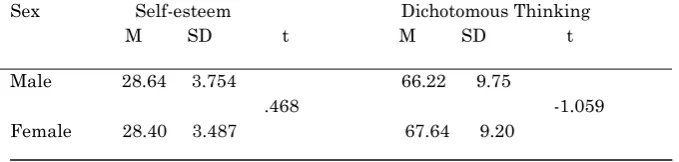
Table 3.1
Descriptive statistics of self-esteem and dichotomous thinking score according to sex
Sex Self-esteem Dichotomous Thinking M SD t M SD t
As shown in the above Table 3.1 the mean scores of male students are M = 28.64 and female students are M = 28.40 respectively. There is no mean difference between these two means. Measured value of t of self-esteem is 0.468 but the table value is (1.93) in the 0.05 level of significance of 198 df. It is found that there is no significant difference in the self-esteem score according to sex.
Again according to dichotomous thinking, the above Table 3.1 reveals that the mean scores of male students are M = 66.22 and female students are M = 67.64 respectively. There is no mean difference between these two means. Measured value of t of self-esteem -1.059 but the table value is 1.93 in the 0.05 level of significance of 198 df. It is found that there is no significance difference in the dichotomous thinking score according to sex.
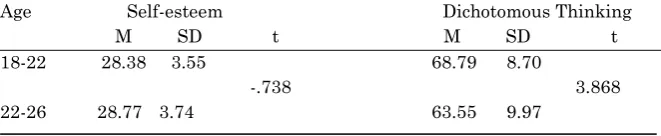
Table 3.1.2
Descriptive Statistics of self-esteem and Dichotomous thinking score according to age
Age Self-esteem Dichotomous Thinking M SD t M SD t 18-22 28.38 3.55 68.79 8.70 -.738 3.868 22-26 28.77 3.74 63.55 9.97
As shown in the above Table 3.1.2 the mean scores of age 18 to 22 is M = 28.38 and of the age 22 to 26 is M = 28.77 respectively. There is no mean difference between these two means. Measured value of t of self-esteem is -.738 but the table value is 1.93 in the 0.05 level of significance of 198 df. It is found that there is significant difference in the self-esteem score according to age.
table value is 1.93 in the 0.05 level of significance of 198 df. It is found that there is significant difference in dichotomous thinking score according to age.
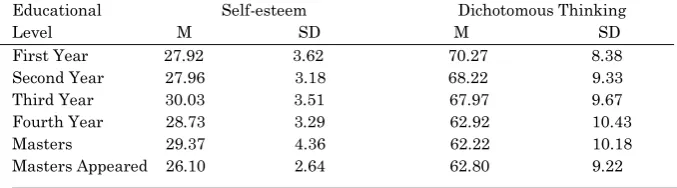
Table 3.1.3
Mean and standard deviation difference of Educational level of self-esteem and dichotomous thinking
Educational Self-esteem Dichotomous Thinking Level M SD M SD
First Year 27.92 3.62 70.27 8.38
Second Year 27.96 3.18 68.22 9.33
Third Year 30.03 3.51 67.97 9.67 Fourth Year 28.73 3.29 62.92 10.43 Masters 29.37 4.36 62.22 10.18 Masters Appeared 26.10 2.64 62.80 9.22
In the above Table it is shown that the mean and standard deviation of educational level of self-esteem are the highest (M = 30.03) in third year students, while master’s students displayed the lowest mean (M = 26.10). On the other hand, for dichotomous thinking, the highest mean (M = 70.27) is observed in first year students, while master’s student have the lowest mean (M = 62.22)
Table: 3.1.4
Summary of one way ANOVA according to dichotomous thinking score of different types of educational level
ANOVA dichothinking
Sum of df Mean F Sig. Squares Squares
Between 1879.198 5 375.840 groups
Within 16025.822 194 82.607 4.550 .001 groups
Total 17905.020 199
thinking score (F.05, 199, P < .01)., which supports the hypothesis.
Table: 3.1.5
Summary of one way ANOVA according to self-esteem score of different types of educational level
ANOVA Self-esteem
Sum of df Mean F Sig. Squares Squares
Between 195.030 5 39.006 groups
Within 2406.890 194 12.407 3.144 .009 groups
Total 2601.720 199
The above table reveals that there is a significant difference among educational levels according to self-esteem score (F.05, 199, P < .01), which does not support the hypothesis.
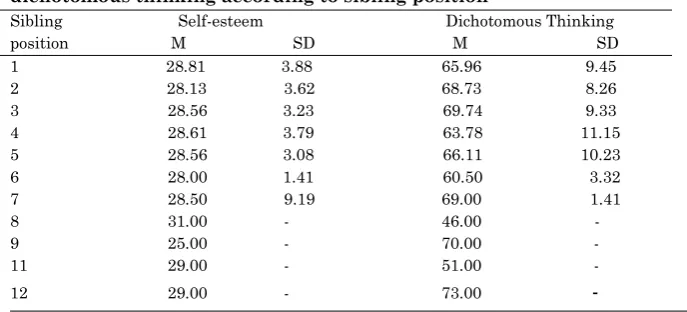
Table 3.1.6
Mean and standard deviation difference of self-esteem and dichotomous thinking according to sibling position
Sibling Self-esteem Dichotomous Thinking position M SD M SD 1 28.81 3.88 65.96 9.45
2 28.13 3.62 68.73 8.26
3 28.56 3.23 69.74 9.33 4 28.61 3.79 63.78 11.15 5 28.56 3.08 66.11 10.23 6 28.00 1.41 60.50 3.32
7 28.50 9.19 69.00 1.41
8 31.00 - 46.00 -
9 25.00 - 70.00 -
11 29.00 - 51.00 -
12 29.00 - 73.00 -
possesses highest and lowest mean (M = 31; M = 25) respectively. On the other hand, the highest and lowest mean score of dichotomous thinking of sibling position are of twelve and sixth ones (M = 73; M = 60.50) respectively.
Table: 3.1.7
Summary of one way ANOVA according to dichotomous thinking score of different types of sibling position.
ANOVA Self-esteem
Sum of df Mean F Sig. Squares Squares
Between 1683.489 10 168.349 groups
Within 16221.531 187 85.828 1.961 0.40 groups
Total 17905.020 199
As shown in the above table, there is a significant difference between sibling position according to dichotomous thinking score (F.05, 199, P < .01), which fully supports the hypothesis.
Table: 3.1.8
Summary of one way ANOVA according to self-esteem score of different types of sibling position.
ANOVA
Sum of df Mean F Sig. Squares Squares
Between 35.134 10 3.513 groups
Within 2566.786 189 13.581 .259 .989 groups
Total 2601.920 199
BIBLIOGRAPHY:
Beck, A. T., & A. Freeman. 1990. Cognitive therapy of personality disorders. New York: The Guilford Press.
Begue, L., & S. Roche. 2005. “Birth order and youth delinquent behavior testing the differential parental control hypothesis in a French representative sample.” Psychology, crime and law. 11(1):73-85.
Benjamin, L., & F. L. Friedrich. 1991. “Contributions of structural analysis of social behavior (SASB) to the bridge between cognitive science and a science of object relations.” In Person, schemas, and maladaptive interpersonal patterns, edited by M. J. Horowitz, 379-412. Chicago, IL: University of Chicago Press.
Budner, S. 1962. “Intolerance of ambiguity as a personality variable.” Journal of Personality 30: 29-50.
Byrne, S. M., K. L. Allen, E. R.Dove, F. J.Watt, & P. R. Nathan. 2008. “The reliability and validity of the Dichotomous Thinking in the Eating Disorders Scale.” Eating Behaviors 9: 154-162.
Byrne, S. M., Z. Cooper, & C. G. Fairburn. 2004. “Psychological predictors of weight regain in obesity.” Behavior Research and Therapy 42: 1341-1356.
Baumeister, Roy F., L. Smart, & J.Boden. 1996. “Relation of threatened egotism to violence and aggression: The dark side of self-esteem.” Psychological Review 103: 5–33.
Branden, N. 1969. The psychology of self-esteem. New York: Bantam.
Branden, N. 2001. The psychology of self-esteem: a revolutionary approach to self- understanding that launched a new era in modern psychology. San Francisco: Jossey-Bass
Dugas, M. J., M. H. Freeston, & R. Ladouceur. 1997. “Intolerance of uncertainty and problem orientation in worry.” Cognitive Therapy and Research 21: 593-606.
Dugas, M. J., F. Gagnon, R. Ladouceur, & M. H. Freeston. 1998. “Generalized Anxiety Disorder: A preliminary test of a conceptual model.” Behaviour Research and Therapy 36: 215-226.
Dugas, M. J., P. Gosselin, & R. Ladouceur. 2001. “Intolerance of uncertainty and worry: Investigating specificity in a nonclinical sample.” Cognitive Therapy and Research 25: 551-558.
Egan, S. J., J. P. Piek, M. J.Dyck, & C. S. Rees. 2007. “The role of dichotomous thinking and rigidity in perfectionism.” Behaviour Research and Therapy 45: 1813-1822. Frenkel-Brunswik, E. 1949. “Intolerance of ambiguity as an emotional and perceptual personality variable.” Journal of Personality 18: 108-143.
Grenier, S., A. M. Barrette, & R. Ladouceur. 2005. “Intolerance of uncertainty and intolerance of ambiguity: Similarities and differences.” Personality and Individual Differences 39: 593-600.
Gentile, B., S. Grabe, B. Dohan-Pacoe, E. B. Wells, and Matino. 2009. “Gender differences in Domain specific self-esteem: A meta analysis.” Review of general psychology. 13(1): 34-45.
Horowitz, M. J. 1977. “Cognitive and interactive aspects of splitting.” American Journal of Psychiatry 134: 549-553.
Illyas, Q.S.M. 2003. “Bengali Version of Rosenberg self-esteem scale.” Unpublished Manuscript. Department of Psychology, Dhaka University. Dhaka.
Jacobson, E. 1954. “Transference problems in the psychoanalytic treatment of severely depressive patients.” Journal of American Psychoanalysis Association 2: 595-606.
and private Bank Managers.” The Dhaka University Journal of Psychology 32: 9-20.
Maslow A. H. 1987. Motivation and Personality. 3rd ed. New York: Harper & Row.
Oshio, A. 1999. “Narcissistic personality and friendship in high-school students.” The Japanese Journal of Personality 8: 1-11. [In Japanese with English abstract.]
Orth, U., R. Robins, and W. Trzesniewski. 2010. “Self-esteem development from young adulthood to old age: A cohort-sequential longitudinal study.” Journal of personality and social psychology 98(4): 645-658.
Rosenberg, M. 1965. Society and the adolescent self-image. Princeton, NJ: Princeton University Press.
Reavuori, A. 2007. Genetic and environmental influences on self-esteem and its stability acorn adolescence. London: Cambridge University Press.
Shafran, R., Z. Cooper, & C. G. Fairburn. 2002. “Clinical perfectionism: A cognitive-behavioural analysis.” Behaviour Research and Therapy 40: 773-791.
Siegel, J. P. 2006. “Dyadic splitting in partner relational disorders.” Journal of Family Psychology 20: 418-422.
Volkan, V. 1988. Six steps in the treatment of borderline personality organization. Northvale, NJ: Jason Aronson.
Veen G., and A. Arntz. 2000. “Dichotomous thinking and age, cognitive therapy and research.” 24(1): 23-45.