Scholarship@Western
Scholarship@Western
Electronic Thesis and Dissertation Repository
5-22-2018 10:30 AM
Resource Brokering in Grid Computing
Resource Brokering in Grid Computing
Adrian T. Bienkowski
The University of Western Ontario
Supervisor
PROF. HAMADA H. GHENNIWA The University of Western Ontario
Graduate Program in Electrical and Computer Engineering
A thesis submitted in partial fulfillment of the requirements for the degree in Master of Engineering Science
© Adrian T. Bienkowski 2018
Follow this and additional works at: https://ir.lib.uwo.ca/etd
Part of the Computational Engineering Commons, Computer and Systems Architecture Commons, and the Other Computer Engineering Commons
Recommended Citation Recommended Citation
Bienkowski, Adrian T., "Resource Brokering in Grid Computing" (2018). Electronic Thesis and Dissertation Repository. 5649.
https://ir.lib.uwo.ca/etd/5649
This Dissertation/Thesis is brought to you for free and open access by Scholarship@Western. It has been accepted for inclusion in Electronic Thesis and Dissertation Repository by an authorized administrator of
i
Grid Computing has emerged in the academia and evolved towards the bases of what is currently known as Cloud Computing and Internet of Things (IoT). The vast collection of resources that provide the nature for Grid Computing environment is very complex; multiple administrative domains control access and set policies to the shared computing resources. It is a decentralized environment with geographically distributed computing and storage resources, where each computing resource can be modeled as an autonomous computing entity, yet collectively can work together. This is a class of Cooperative Distributed Systems (CDS). We extend this by applying characteristic of open environments to create a foundation for the next generation of computing platform where entities are free to join a computing environment to provide capabilities and take part as a collective in solving complex problems beyond the capability of a single entity.
This thesis is focused on modeling “Computing” as a collective performance of individual autonomous fundamental computing elements interconnected in a “Grid” open environment structure. Each computing element is a node in the Grid. All nodes are interconnected through the “Grid” edges. Resource allocation is done at the edges of the “Grid” where the connected nodes are simply used to perform computation.
ii
Keywords
iii
Acknowledgments
Foremost, I would like to thank my supervisor Prof. Hamada H. Ghenniwa for his support at many levels, his belief and perseverance for me to finish the work. It has been a great pleasure working with him and the CDS group on what is to become the next evolution in computing, with new software engineering paradigms and methodologies.
In the CDS group, it has been a pleasure working with Ra’afat, Wafa, Afshan and Ali, where we applied our collaborative research and ideas to practical real-world implementation scenarios.
iv
Table of Contents
Abstract ... i
Acknowledgments ... iii
Table of Contents ... iv
List of Tables ... viii
List of Figures ... ix
Chapter 1 ... 1
1 Introduction ... 1
1.1 Grid Computing ... 1
1.2 Scope of the Thesis ... 9
1.3 Organization of the Thesis ... 9
Chapter 2 ... 11
2 Literature Review ... 11
2.1 Resource Allocation in Grid Computing ... 11
2.2 Resource Allocation Classification ... 13
2.2.1 Centralized Class ... 14
2.2.2 Distributed Class ... 14
2.2.3 Decentralized Class ... 15
2.3 Current Broker Projects ... 15
2.3.1 Condor-G ... 15
2.3.2 NorduGrid Broker ... 16
2.3.3 Nimrod/G ... 17
2.3.4 AppLeS ... 18
2.3.5 GridWay ... 19
v
2.3.7 SPHINX ... 20
Chapter 3 ... 23
3 Problem Analysis ... 23
3.1 Grid Protocol Architecture Analysis ... 24
3.2 Open Issues ... 26
3.2.1 Autonomy ... 26
3.2.2 Adaptability ... 28
3.2.3 Interdependency ... 28
3.3 Summary ... 30
Chapter 4 ... 32
4 Proposed Solution ... 32
4.1 Model ... 32
4.2 Architecture ... 34
4.2.1 Proposed Grid Protocol Architecture ... 36
4.3 Grid Computing Entities ... 37
4.4 Computing Platform ... 37
4.4.1 Adaptability and Autonomy ... 38
4.4.2 Coordination and Cooperation ... 38
Chapter 5 ... 40
5 Grid Computing: Framework & Implementation ... 40
5.1 Computational Model ... 40
5.2 Brokering Architecture ... 41
5.2.1 Agent Model ... 43
5.2.2 CIR-Agent Interface ... 43
5.2.3 Action Interface ... 43
vi
5.3 Resource-Broker ... 45
5.3.1 Job Handling ... 46
5.3.2 Resource Matching ... 47
5.3.3 Scheduler ... 47
5.3.4 Job Execution ... 48
5.4 Resource Provider ... 48
5.5 Resource-Consumer ... 50
5.6 Computing as a Platform: Prototype Implementation ... 51
5.6.1 Programming Languages Used ... 52
5.6.2 JADE Platform ... 52
5.7 Prototype Validation and Verification ... 53
5.7.1 Globus Toolkit ... 56
5.7.2 JADE ... 56
5.7.3 Entity Structure ... 57
5.7.4 Resource-Broker ... 57
5.7.5 Resource-Consumer Agent ... 58
5.7.6 Job-Handling Agent ... 59
5.7.7 Resource-Matching Agent ... 59
5.7.8 Scheduling Agent(s) ... 59
5.7.9 Job Execution Agent ... 60
5.7.10 Resource Provider Agent ... 60
5.8 Implementation Challenges ... 61
5.8.1 Architecture ... 61
5.9 Dynamic Selection of Scheduler ... 61
5.10 Summary ... 63
vii
6 Summary and Conclusions ... 64
6.1 Summary of Contributions ... 65
6.2 Future Work ... 67
References ... 69
Appendix A - yWorks ... 74
viii
List of Tables
ix
List of Figures
Figure 1-1: Grid Protocol Architecture ... 5
Figure 2-1: The Sphinx Scheduling System [44] ... 21
Figure 3-1: Simplified Grid Protocol Architecture ... 24
Figure 4-1: Grid meta-model ... 33
Figure 4-2: Traditional distributed system ... 34
Figure 4-3: Proposed Architecture ... 35
Figure 4-4: Proposed Architecture with Resource-Brokering ... 35
Figure 4-5: Grid Protocol Architecture (current and proposed) ... 36
Figure 5-1: Agent-oriented design ... 42
Figure 5-2: Resource-Broker Architecture ... 43
Figure 5-3: Resource-Broker with Privacy Management ... 45
Figure 5-4: Job definition and PPL value ... 45
Figure 5-5: Job-Handling class diagram ... 46
Figure 5-6: Resource-Matching class diagram ... 47
Figure 5-7: Simple-Scheduler class diagram ... 48
Figure 5-8: Job-Execution class diagram ... 48
Figure 5-9: Resource-Provider class diagram ... 49
Figure 5-10. Resource-Consumer class diagram ... 51
Chapter 1
1
Introduction
This chapter introduces the field of Grid Computing and presents the fundamental concepts that are applied to the remaining parts of the thesis. The focus of the introduction is to bring an understanding of the field in general and to outline some critical issues in the existing architecture of grid computing environments.
1.1
Grid Computing
The concept of Grid Computing emerged around the mid-70s. The advancement in network technologies by the early 80s, coupled with the idea of implementing remote computing and making that available to a more substantial number of users became a novelty among educational institutions. Grid Computing as a computing paradigm was born. The idea of computing as a grid was borrowed from the electrical power grid model, where the ubiquitous access and use of the Power Grid, was and is part of everyday life. It took the Power Grid model almost one century to become what it is today, an essential and seamless part of our lives. Ubiquitous access is a natural extension and a form of computing, where ubiquitous computing defines the state as expected by the end user and grid provides the architecture as well as the means to deliver that state. There are some fundamental requirements such as usability by the end user, interoperability between devices connecting to the grid, continuous availability and reliability of supply, that have made the power grid something we take for granted in everyday use [58].
grid and computing grid can show how the evolution of the Grid Computing field is still much ahead of its predecessor. Grid computing is also described as an extension of the distributed computing field but at a much large scale [33][54]. Although this seems very natural, the requirements of the distributed computing infrastructure are much different, and such reference hinders its growth. Mark Weiser has coined the term “ubiquitous computing” in the late 1980s, where he defined ubiquitous computing to be the invisible computing that is all around us. A design that is invisible makes the adoption vast. Furthermore, he identified the most significant challenges related to the integration of human factors, computer science, engineering, and social sciences [64].
In an attempt to define what grid computing is for the purpose of this research, let us outline some key fundamental principles present in the existing grids.
A computing grid
• provides
o coordinated resource sharing and problem-solving capacity [33][58] • coordinates
o resources that are not subject to centralized control [29][58] • enables
o service or resource sharing between organizations [52][58]. • constitutes
o sharing of computer power and data storage capacity over the Internet [58]
The thesis focus is on extracting the fundamental concepts, which build the principle foundation for the definition of grid computing; modeled initially from the Electric Power Grid. Grid computing is a computing environment that is distributed and decentralized. The grid is built from a heterogeneous collection of geographically dispersed computing resources without centralized control. Organizations, which participate as part of the "grid" and offer their resources, are a synonym to the power companies that are all interconnected and supply the power to the grid for end users, being other companies or individual homes. Grid computing in my view is the basis to enable ubiquitous computing which is becoming available all around us [33][56].
One of the essential differences between the Internet and grid computing is the starting point. The Internet has been developed from scratch and overtime during the development, innovation of new technologies and approaches kept replacing existing technologies, which showed to be inadequate for the large scale. This approach, although initially slow, helped to build what we know today as the Internet. Grid computing, on the other hand, had a significant association with distributed computing and hardened network infrastructure. Furthermore, Grid computing had a tremendous vision of what it should be; yet it was built and constrained by the existing mindset of the contributors and applications within academia. The form of implementation of Grid computing in academia has created an environment, where the direction and the developed features have pushed Grid computing away from the original idea, to make computing available to business and people in the same way electricity is today. It seems that critical properties and requirements are still not clear or agreed upon [58].
Scaling and sharing are also standard features of the Internet and the Grid. It is a well-known fact that the Internet has well-established technologies that scale well with the number of users and available bandwidth. However, such claims cannot be made for grid computing. Scalability is a vital issue for widespread use of grid technologies [58]. The key aspects that contributed to the success of the Internet are the reliable infrastructure and relatively low cost for users [30]. The use of standards and the process of creating standards during the Internet evolution profoundly contributed to the reliable and inexpensive equipment that makes up the core foundation and enables the fast and reliable communication between users and resources. It is undeniable to note here that the Internet is an open environment, where numerous diverse systems exist and are connected to serve a specific purpose or functionality.
characteristics can be broken down into resources and their geographical location as well as policies that come with that ownership. With the ownership of different domains comes administrative aspect, which requires a level of autonomy. The independence of various resource owners needs to be preserved, as well as usage policies. As the grid is built out and expands to millions of resources, the problem of scalability and performance at that scale requires particular attention to performance degradation as the number of resources in the Grid increases. Applications that are written to utilize these resources also need to be designed with latency and bandwidth considerations. Considering that a computing grid is a collection of geographically distributed computing resources, under the control of different organizations; resource availability is not predictable, rather a failure of a resource shall be part of the design of any application, yet the grid is required to be adaptable to its dynamic pull of resources.
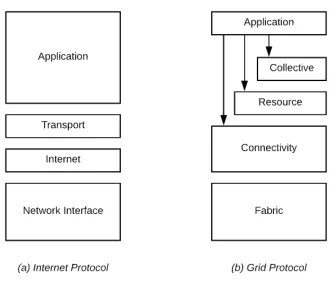
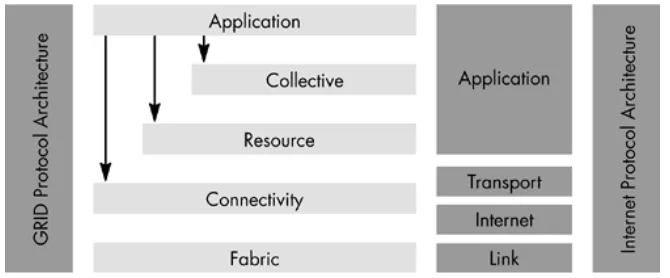
Figure 1-1: Grid Protocol Architecture
Examining the Grid protocol architecture, as shown in Figure 1-1, that has been developed to address key challenges in the existing grid-computing infrastructure will help to understand the current state of the research area.
itself. There is, however, best practices recommended for interfacing with that resource when connected to the Grid. These interfaces are of two parts, one related to the ability for querying information about the state of the resource and two about the ability to manage the resource [9]. The latter part will be expanded later in Chapter 3, where we look more closely at the autonomy of the resource.
The one level above the Fabric is the Connectivity layer. The Connectivity layer is expected to work with any of the transport protocols to provide secure access to the connected resources. This layer is also managing all access control and holds the responsibility for establishing a secure connection for services built and accessed by the upper layers of the architecture stack. The secure connection and access can be facilitated through the use of single-sign-on or delegation type services, where user permissions or a subset of the credentials are relayed to the connected resources. Other security methods, more specific to a group of resources under the control of a particular organization, can include Kerberos, Windows Security, or security of other operating systems. This approach helps to keep the common functionality and the heterogeneous nature of the resource connectivity into a single layer that deals with different implementations at the resource. Security in the grid-computing infrastructure is one of the key foundational constraints. Grid computing infrastructure is composed of computing resources under the management of different organizations. Providing secure access to those resources is a key requirement from both perspectives, ensuring the privacy and security for the user of the resources, and protecting the organizations that make the resource available from unauthorized access. Security service provided by the computing grid also includes data encryption.
over the resource, yet it is recommended that these protocols should focus on functionality provided by the resource.
The Collective layer gets into the management of resources as a group and takes into account a global state of a pool of resources, unlike the Resource layer where the resources were treated individually and in isolation. The protocols implemented at the layer deal with sharing-type behaviours, such as discovery, scheduling, brokering, monitoring, and diagnostics. The Collective layer allows for applications to utilize a pool of resources, as well as make it possible to build middleware like functionality that exposes all the features mentioned above. Globus ToolkitTM is such a middleware project that will be discussed in Chapter 2. Grid middleware provides essential services for remote process management, access to storage, registration, and user-level security. Grid middleware offers foundation and supporting functionality for application development, programming tools, resource management features and execution of tasks on a global set of available resources. Grid applications and portals are the user-facing part of the grid ecosystem and typically developed using a grid-enabled language. This is a significant contributor to the slow adoption of grid computing as a generic computing platform and is one of the challenges to be discussed in a later part of the thesis. Typically the core grid computing middleware only provides local scheduler functionality and the ability to submit jobs for execution at that level. In such a case, just jobs that have no interdependencies can be sent for execution on the selected set of resources. However, a typical use of grid computing resources requires a much more complex interdependency and conflict resolution. Runtime requirements can change based on the context of the application.
capability to securely and effectively make the data available to the application, based on the application needs and wants.
Resource management and job management are also fundamental features provided by the core grid middleware to support the local scheduler and execution of the jobs on selected grid resources. One of the very well established grid resource management systems is GRAM(Globus Resource Allocation Manager). It provides the required functionality to execute jobs at the local grid level and support the life cycle of the job execution, starting with the resource allocation, reallocation on failure, check status and deliver results upon completion [42]. Resource management plays a fundamental role in Grid Computing. At the integration level, the ability to discover, allocate, monitor and manage the utilization of grid resources and their capabilities to effectively and efficiently meet global qualities of service. In addition to the integration, resource management allows for a consistent way in which these resources are accessed and managed by services built on top of this layer. The definition of resource management is commonly focused on the process of matching various types of capabilities, arranging for their use and monitoring the state and progress of job execution. The problem of resource management is very well resourced in the context of traditional computing systems. In such an environment the system is designed to operate under the assumption of complete control when applied to grid computing [30].
Computing is further complicated by the necessity of having the ability to allocate multiple resources concurrently across administrative domains [20][30][32]. As such current research in this area is focused on understanding different policies from different administrative domains, as well resource provider and resource consumer [6][11] [17][30][43].
The emergence of Grid computing and ability to virtualize all levels of infrastructure and computing resources, virtualized service behaviour is becoming indistinguishable from non-virtualized services and becoming the rule rather than the exception. It should also be noted here that characteristics of grid-computing such as virtual organizations, coordinated resource sharing in our view are the basis for the specification for the application layer built on top of the grid infrastructure, to provide additional features for end users. These would be specific to an industry, and such keeping the focus on the fundamentals allows for a more generic solution.
1.2
Scope of the Thesis
The scope of the thesis is on the architecture of the Grid in the context of open environment. The key contribution is proposing a novel way of addressing the resource sharing by extending the computing to be at the network level. The extension of the architecture allows for resources to connect to the grid, make their capabilities available to other entities in the environment, and participate in the task assignment and execution of requests. The implementation of the proposed solution is also provided with details of the test environment and key scenarios for running the experiment.
1.3
Organization of the Thesis
Chapter 2
2
Literature Review
In open distributed computing environments such as Grid Computing, resources may not be available or known when needed and therefore is not feasible to expect to determine or to keep track of the resources and their capabilities. Although these resources are independently created and administered, they are expected to work together to accomplish individual or collective tasks.
Grid Computing traditionally is considered a closed system, in which only authorized and registered resources can be part of the grid and make themselves available as part of the computing pool of resources. Treating grid computing as open environment adds another level of complexity in which, not only the participating resources can become unavailable due to maintenance or failure, but also new resource can join the grid without the need for manual configuration and provisioning.
The open environment approach creates a very hard problem of “managing” computation in particular resource allocation. Such a problem can be solved in a different way. The focus of this chapter is to look at one of the solutions to this problem, which is Brokering, and how others have been trying to address the problem of resource allocation.
2.1
Resource Allocation in Grid Computing
Tremendous effort is devoted to proposing various algorithms to determine an optimal computation schedule based on the assumption that sufficiently detailed and up to date knowledge of the systems state is available to a single entity (usually called the Metascheduler) [33][42][55][58]. Although such approaches provide efficient means of optimal utilization of the existing resources, they are deemed to be not scalable when dealing with large numbers of machines. Maintaining a global view of the system becomes prohibitively expensive, and additionally, the unreliable networks might even make the scheduling process unattainable.
A different set of solutions to resource allocation and scheduling has also been proposed in the more recent literature. Conceptually, the economic-based approach is autonomous and decentralized to address specifically the needs of a large grid and peer-to-peer platforms [70]. One shortcoming of this approach in the implementation is the fact that it requires a centralized entity to implement and perform economic based functions. Such functions as a marketplace or auctioneer where seal-bid or second price actions can take place.
In open environments, entities need to locate and interact with others who possess the capabilities to achieve a particular goal. The explosion of the grid and cloud computing paradigm, has created, theoretically, an infinite number of available computing resources, for each with different requirements and objectives. However, fulfilling a resource request may go beyond the capability of the individual entities, this is known as the capability-interdependency problem [36]. To overcome this problem in the Grid, different coordination structures and mechanisms that imply various requirements and protocols for interoperability and interaction were proposed. Within this context, the structure refers to the patterns of communication amongst involved participants (for example, brokering, matchmaking or facilitation), whereas the mechanisms define the coordinated control and the interaction protocols.
environment. In the following section, a few of the existing solutions are reviewed with the focus on the problems each solution is trying to address.
2.2
Resource Allocation Classification
Resource allocation is a process through which available resources are assigned tasks for execution. The method of resource allocation in grid computing is much more complex, with a large set of data points and multiple levels of requirements this becomes an NP-hard problem, where the exact solution can not be computed in polynomial time. Solutions to this problem typically take a heuristic approach, however, the implementation of the solution can be classified into three categories: centralized, decentralized and distributed.
The existing typical approaches manage the resource allocation from the resource consumer job to the resource providers participating in the grid-computing environment. The traditional solutions focus on handling the fact that most user tasks deal with massive data processing requirements. Applications written to perform a typical job expect that a particular set of input data is available via a standard POSIX (Portable Operating System Interface) call. Besides, these applications produce data as a result of the computation performed and required storage facilities for the output of the execution. The input and output data is expected to be transferred between the computing nodes to make it available to the computing tasks and has a potential to reach several gigabytes in size. Perhaps, the most challenging task of the Grid is thus not just to perform resource matching for job execution, but to ensure that the necessary input is staged-in, and output is appropriately staged-out[26].
network access to use scheduling functionality. In addition, the centralized approach has the potential to produce optimal schedules, as it has full knowledge of the resources and job requests on the grid.
In the distributed class of broker, the use of a distributed architecture is mainly to address scalability and availability issues, and this makes the grid environment fault-tolerant. However, this type of architecture creates a problem for the scheduling component where only partial information is available to each instance of the distributed broker. A typical approach that has been presented in papers dealing with this class of brokers is a hybrid solution [27]. In the third class of brokers is the decentralized class, where the control of making a scheduling decision is not up to the broker itself. The broker plays a more orchestrating role. A decentralized broker can also be distributed. However, the decentralized notion is referring to the decision-making process. In such a case, the scheduling decision is up to all parties informed and a level of cooperation and coordination is needed to arrive at the scheduling decision collectively.
2.2.1 Centralized Class
The centralized approach to resource brokering does provide the simplest solution to address the distributed nature of grid resources. This type of design allows for a more straightforward approach to solving the scheduling problem, where all information about the system is available to a single entity that manages the resource allocation and assignment. Although the solution becomes “simple” it is not adequate. Even though, the issues that this approach exposes can be addressed through various performance and scaling techniques, the raw size of grid computing environments makes this approach not feasible.
2.2.2 Distributed Class
itself distributed and therefore the distributed computing provides higher throughput for improving performance. The distributed application introduces a new set of problems related to the communication between the physically separated computing resources.
2.2.3 Decentralized Class
The decentralized set of solutions are much more complicated, yet best suited for the Grid infrastructure. In this class of solutions, the typical approach is to apply the economic model and free-market type solutions [28][70], where the participants in a grid-computing environment have full control of the resource assignment and allocation. Decentralization is related to the control, where there is no single entity or system that controls the resource allocation in a dictating or commanding approach. Yet, the control is distributed in a way the participants of the solution have full control over accepting or rejecting the proposed solution through a form of negotiation or collaboration through coordination.
2.3
Current Broker Projects
The flowing section describes existing implementations of grid solutions related to resource matching and allocation. Where resource matching is focused on matching the capabilities with job requirements and allocation is related to the ability to execute the job within the requested time frame.
2.3.1 Condor-G
for a custom definition of attributes, yet it’s not clear how these custom attributes are used to match with the published information on the resources to the Matchmaker. Matchmaker uses the posted data by the resource and submitted by the users to schedule job execution on the reduced set of matched resources. However, due to the nature of the environment, typically there is no direct communication between the users and the providers of the computing utility. The ability for the custom attributes to be used in this process would require ontology-driven integration and semantic matching capabilities.
2.3.2 NorduGrid Broker
The NorduGrid middleware is built on standard protocols and interfaces with well-known open source software packages such as OpenLDAP[50], OpenSSL[51] and Globus Toolkit version 2 [31][37]. However, some of the features formerly part of the Globus Toolkit have been replaced with custom components[25]. The custom component approach creates a particular and proprietary solution. The proprietary solution causes a diverging effect on the overall grid-computing space. NorduGrid does make use of the Grid Security Infrastructure (GSI) in Globus Toolkit 2. GSI specifies a public-key infrastructure and SSL (TLS) for authenticated and secure encrypted communication. Also, NorduGrid uses Resource Specification Language (RSL[55], to specify resource requirements and job execution information.
One of the principal concepts introduced, as part of the work delivered by the NorduGrid team is the concept of Total Time to Delivery (TTD) for the application. This data is used by the resource brokering algorithms in the client toolkit to identify the resources that provide the shortest TTD for the application. TTD is the total time the job will take to execute, starting from the user submitting the job to the time when the output files are delivered to the requested destination. TTD includes the time required for transferring input files and executables to the resource, the waiting time for execution of the job, the actual execution time, and the time to transfer the output files to the requested location(s) [27]. It can be easily noted here that there are a lot of moving parts that make up the TTD value. Almost all of the variables require a level of estimation and it is not clear how this estimation determines the accuracy of the estimates and how or if the estimates are expected to be improved over time.
2.3.3 Nimrod/G
The Nimrod system is a tool that manages the execution of parametric studies [2]. It allows the domain experts to create parametric experiments through the use of a simple declarative parametric modelling language[4]. Nimrod/G is an extension that allows for executing the created jobs from a permutation of the parameters on a global grid [3]. Nimrog/G implements various resource brokering features including resource discovery and management, scheduling algorithms and dispatching of jobs on grid resources. It is one of the first to introduce economic based scheduling algorithm to support user-defined deadline and budget constraints[13]. The proposed economic model allows regulating the supply and demand of grid resources based on Virtual Organizations (VO), also referred to as virtual enterprises[12]. This approach, however, creates a centralized deployment model, to implement economic based aspects of scheduling. The centralized model is further confirmed in [2], where more detailed features are described, such as resource discovery, resource acquisition, and resource monitoring.
with the middle layer. Extensions at the top and bottom layer can happen while the core of the solution remains mainly unchanged. As described in [19], the three core components, the task farming engine, scheduler, and dispatcher, are loosely coupled and provide the core functionality of the broker service. The core components are entirely independent of the bottom layer that can be easily extended to support many different low-level middleware features. Also, this type of design pattern allows keeping the core of the solution independent of the external interfaces. Similarly, to how implementation can be extended to support different grid middleware implementations, the top layer can be extended to support different user interfaces with many additional features.
Nimrod/G has been deployed and integrated with the World Wide Grid (WWG) that spans across five continents. However, it still remains a solution for creating parameter-sweeping applications[19]. One could argue that this type of application is well suited to utilize grid resources, due to its repetitive and task-oriented process.
2.3.4 AppLeS
team has made available AppLeS Templets available for different application types[10]. The AppLeS Template is a software framework that allows for the application to insert its application-specific logic into the grid scheduler, and create a self-scheduling application for grid-computing environments. The templates have been designed for different application categories such as parameter sweep and master-worker type[10].
2.3.5 GridWay
GridWay is a meta-scheduler, with support for grid middlewares such as Globus Toolkit and gLite. The support for different grid middlewares is done through adapters, with the literature on GridWay broker referring to these adapters as MADs (Middleware Access Drivers). Two additional parts are attached to the GridWay core; the pluggable UI and the schedulers. The logical view of this architecture is similar to that of Nimrod/G, a typical way to abstract the external layers that require change and adaptation, away from the middle core layer, which contains the business specific functionality. Yet, the internals of the core middle layer are much different and focus on the flow of the job request. Different, manager like components provide the integration with external middlewares for things like grid information, job execution, file transfers and job migration [63].
2.3.6 GRUBER/DI-GRUBER
GRUBER (GridResourceUsageBrokER) main contribution is managing USLA (Usage
Service Level Agreement) in the grid and grid-like environments, where consumers and resource providers span multiple organizations. GRUBER understands the different aspects of an SLA related to its representation, enforcement, and management of the service agreements [24]. Service level agreement is a contract between the service or resource provider and the consumer of that service or resource. The agreement defines the expected level of service the provider is expected, or in most cases guaranteed, to offer. Based on the USLA the customer of that service is able to assume the availability and performance, and plan its operations accordingly. In addition, the consumer also shall abide by the agreement and use the service or resource in an expected way, and within the boundaries of the agreement. This concept in the context of distributed systems, and more specifically grid-computing, creates a very hard problem to solve for the broker where the resource providers to the Grid are subject to different policies under the control of different virtual organizations [33].
DI-GRUBBER, which is a distributed version and an extension of the GRUBER, to address scalability and performance issues in a large distributed systems, and more specifically, grid environment. DI-GRUBBER adds multiple decision points to the scheduling algorithm and provides the ability to efficiently store, retrieve, and publish USLAs in a grid environment [23].
2.3.7 SPHINX
Figure 2-1: The Sphinx Scheduling System [44]
The SPHINX project implements a much different architecture, as shown in Figure 2-1 above, then presented with other brokers in this chapter. For state persistence, it uses a Data Warehouse where information gathered from Data Replication Service and Grid Monitoring Interface is transformed into different informational tables for the control process. The tables in the data warehouse are used for caching information related to cataloguing, job tracking, and the list of resources. The control process, in turn, is used as the central brain and orchestrates the changes in the state of the submitted job. Although the related literature talks about the architecture as client-server, the diagram as shown in Figure 1-1, reflects a server-agent architecture, where the agent is doing the work assigned by the server, and various implementations of the agent take the form of an adaptor to support different local resource management systems. The light-way implementation of this part of the system validates this statement as it is the connection to the external components.
Chapter 3
3
Problem Analysis
Grid computing has emerged in the academia and evolved towards the bases of what is currently known as Cloud Computing and Internet of Things (IoT). The vast collection of resources that provide the environment for Grid Computing is very complex; multiple administrative domains, controlled access and set policies to the shared computing resources. It is a decentralized environment with geographically distributed computing and storage resources. In a grid-computing environment, the computing resources might be heterogeneous [33] where no assumption can be made about the operating system, CPU capabilities, and memory or storage capacity. The assumption is that mapping computing resources, including resource allocation problem, is a collective responsibility given that the computing entities participating in the environment can have full control over accepting or rejecting the allocation. In the traditional approach, the resources are controlled from the upper layers of the Grid Protocol implementation as described in the next section of this chapter.
3.1
Grid Protocol Architecture Analysis
The Grid Protocol Architecture as shown in Figure 3-1 illustrates a composition of functional layers for implementing grid computing protocols and services. The application layer of the stack has a direct interface to all lower layers. The flexibility of the application layer of the protocol stack, having direct access to multiple lower layers might lead to a complex architecture at the Application, through which it doesn’t provide the separation between the application and the supplied capabilities of the environment. This signifies that any service implemented at this layer has the freedom to use and control protocols from the layers below. Therefore, there is no clear separation of concerns when it comes to the use of the protocols and how they are utilized at the application or service built on top of the Grid Protocol stack. Based on that it is open to interpretation and up to the implementation of the Application layer and how these protocols are consumed. In other words, in the Grid Protocol Architecture, both Collective and Resource can be directly modelled as part of the application; shown in Figure 3-1(b).
Figure 3-1: Simplified Grid Protocol Architecture
environment. Once we go above the Connectivity layer, things start to break down. From here, the Application has direct access and can become the facilitator that manages the Collective and Resource through Connectivity and therefore provides an open landscape for creating problem-specific solutions that cross the top three layers of the protocol stack. Furthermore, the definition of each Connectivity and Resource layer emphasizes the access control and management of the lower level resources [33]. In an open environment, this becomes problematic since the resources are required to be autonomous, with full control over their capabilities and adaptable to the changes in the environment.
Brokering is an architectural pattern based on consumer-provider model for the interaction in a consumer-provider type environment. Consumer-provider is a general problem where large numbers of consumers interact with a large number of providers in order to achieve their goals. Goals can be further divided into objectives based on environment and entity-specific parameters. The consumer-provider solution is an NP-hard problem, and therefore to reduce the complexity, a resource brokering approach is used. The difficulty remains in that we are still dealing with existing systems and an architecture that is guided by the properties of the existing grid infrastructure.
3.2
Open Issues
This section of the thesis will examine and define each of the open issues that will be addressed in the next chapter.
3.2.1 Autonomy
Autonomy is the ability to self-govern, from the Greek meaning independent. Autonomy is a fundamental aspect of agent-oriented architecture, where the design of the system accounts for individual entities to interact and coordinate to solve a common problem. Autonomous entities exist in an environment and perform operations on the environment based on their internal state, their knowledge, beliefs, and intentions. Autonomous entities are designed to deal with the unexpected, where autonomous agents and multi-agent systems can leverage the capabilities of other multi-agents to accomplish a goal; an unexpected state of the world causes a condition where a single agent cannot perform such operations. A software agent is autonomous; it can use its knowledge and the current state of the world to modify the environment and accomplish its goals.
At the time of writing this chapter, there is no literature related to resource brokering in open environments. In order to design a solution for such an environment, one needs to study the characteristics that define an open environment. By definition, open environments are dynamic, where software systems are arranged at run-time to create a solution[72]. This type of system requires interaction and autonomy at the individual component or service level. Autonomy is a property of a software system that allows it to function under dynamic and unknown conditions and therefore a key characteristic of software entities designed for the open environment. The proposed solution will shown the ability to dynamically select a scheduling algorithm, different scheduling algorithms may not be available in the initial design and deployment of the system. However, additional scheduling algorithms can be deployed into the environment as separate and new entities with specific scheduling capabilities. Autonomy yields the required capability for entities to cooperate in an open environment. A particular type of interaction called coordination can provide solutions to problems that previously did not exist. The solution is composed of a newly formed system that can solve the problem, all done at run-time. For example, two autonomous robots exist in a building with different rooms and doors between each room. Each of the robots has different capabilities and the ability to communicate and cooperate, however, they are not designed as part of one system. Now, if a request is made for one robot to be present in a different room and that robot does not have the capability to open the door, in order to move between rooms, it would fail to fulfill the request. However, since another robot in that space exists with the capability to open the door, the goal can be attained by the first robot to have the door opened and moved to the desired location.
3.2.2 Adaptability
In the context of a computer system, the ability for computer systems to adapt to a changing environment is typically not a requirement during the design stage of the system. As the computing paradigms have evolved over the past two decades, both system architects and system developers see this as the next evolutionary and essential step in the next phase of evolution [7]. In grid-computing adaptability shall be considered as one of the key, non-functional requirements.
Adaptability is also a fundamental characteristic of an open environment, in which a computer system has the capability to change and adjust its behaviour based on the changes in the environment. Although, adaptability is not an obvious issue in the existing Grid systems, mainly due to the fact that current view of the Grid is a closed system. Yet, the issue has been explored in some recent papers [7][15][48][59][73]. The evolution of the Grid to support an open environment makes adaptability, or the lack thereof a key issue, and is proposed here as part of the solution in this thesis. In such context, adaptability of the participants in the computing environment is a requirement, yet the existing solutions do not take this into consideration.
Most all of the reviewed literature explores Grid Computing as a closed system, where a specific process is required in order to add additional computing or data resources to the existing grid infrastructures. The solution that is proposed to solve this problem is to look at adaptability at two levels. First, it looks at the solution from an open system perspective and requires the use of standard protocols to facilitate the communication between entities participating in the system. Secondly, it defines the protocol at the interaction level of the entities in order to enable efficient coordination. The efficiency of the cooperation of the entities participating in the computing environment is accomplished by introduction of the resource-broker service into the environment.
3.2.3 Interdependency
which two or more entities depend upon each other. Such a situation can only happen if more than one entity exists in an environment, and the entities have overlapping or dependent capabilities. This is also known as capability-based interdependency problem [36] and it is found in settings where multiple entities of similar and overlapping capabilities exist; such is the grip-computing environment[36]. In such an environment entities need to interact in order to solve their interdependencies and this requires a level of cooperation as shown in the next section 3.6.
Interdependency is a problem due to the overlapping dependence between entities in an environment. There are different interdependency types, and they are classified based on the domain of interaction. In such classification, we find the following types [36].
• physical - physical aspects of the environment require the sharing of resources
between the entities [36].
• mental - can be classified as capabilities, knowledge and interest [36]; this is
where entities are dependent on other entities to accomplish their goals.
Further, there is a topology to the interdependency types, which deals with the type of interactions of the entities [36]. For example, in a physical conflict where two entities require the use of a single resource, they will need to interact and share the resource based on the topology of their interdependency.
• pooled - which results in the least amount of conflict [67]; entities do not directly depend on each other and instead use a common pool of physical resources.
• sequential - when the dependency of one entity is on the output of work done by
another entity.
• reciprocal - results in the highest potential for conflict [67]; the information flow
is required to go both ways.
The problem becomes more apparent in the context of an open environment, where entities are capable of joining and leaving an environment at will. This creates a dynamic architecture that changes at runtime. The nature of the system creates a problem where entities with overlapping capabilities do exist in the same environment. This creates an interdependency problem with one or more of the topologies stated above. A typical approaches to solving the interdependency problem is through predefined architecture, where specific requirements and specification for system design dictate the relationship between components of the system architecture. In the case of open environments, the system is dynamic, and the interdependency problem exists at runtime. Others try to solve this through a centralized or federated approach and manage the resource capability overlap through a database information system, where the information needs to be updated and kept up to date very frequently, in order to be current and usable.
Interoperability is a problem identified in [33], the solution to interoperability is a standard protocol implementation that allows for interaction between components. Interoperability is a core requirement in open environments, as the protocols need to be known to entities that are not part of the environment and would like to join. Our focus is on open environment where we extend the Grid concept to Internet-size open environment where entities can come and leave at will and system has the ability to adapt. A standard communication protocol allows for interoperability between entities to allow them to interact and coordinate. In the literature review, some of the requirements for resource broker have been collected from different sources. The discussion below will show how all of these requirements have been considered during problem analysis and have been shown to address the issues outlined in the proposed solution.
The proposed solution looks at the interdependency problem from the perspective of interaction, where coordination is the solution to this problem and will be discussed in the next chapter.
3.3
Summary
Chapter 4
4
Proposed Solution
The proposed solution is addressing the currently known open issues as identified in Chapter 3.2. The open issues have resulted from simplifying the model of grid-computing and extending the model to include concepts of an open environment. In the mainstream literature on Grid Computing, the traditional approach is a closed environment. However, with the explosion of web-based services, the Internet has become a collection of heterogeneous computing resources, each providing a different function, with partially overlapping capabilities. Although this environment somewhat resembles grid-computing, the fundamental difference is that the Internet is an open environment where resources connect and disconnect, without centralized control. The analysis in the previous chapter outlines the current state and the ability of grid-computing to evolve beyond the traditional view. In today’s field of computing, the advancements have put forward a new computing paradigm, and such is cloud computing. Cloud-computing has been built on the longtime promise of "utility computing"[64]. "Utility computing" was coined by Mark Weiser back in 1980, where Grid-computing has fallen short to deliver on such vision; Cloud-computing has provided a computing paradigm as a utility, at various levels, IaaS, PaaS, SaaS, and various other XaaS (anything as a service) variances. Although such implementation does not realize the vision as presented by Mark W., it is a step closer in that direction.
4.1
Model
The Current model of Grid Protocol Architecture as depicted in Figure 1-1(b), is associated with strong assumptions that are not adequate for open environments.
with a resource broker requires custom logic and communication protocol specific to that implementation. This restricts the implementation to support open environment applications. In the proposed solution the aim is to re-define the Grid computing architecture supporting open environment principles, in which the entities making up the environment are not known at design time. This requires entities that exist in such an environment to be supported with the ability to adapt to the change of the environment and interact accordingly. This requires a level of autonomy at the entity level. Each entity needs to have the ability to perform an action on the environment based on its capabilities and the ability to interact cooperatively with other entities in order to achieve the individual or the collective goals.
Figure 4-1: Grid meta-model
the job requests from consumers and managed the interaction is carried out with the resource providers for their commitment to the job execution.
The resource allocation is based on identifying the adequate providers for the submitted jobs based on predefined criteria.
4.2
Architecture
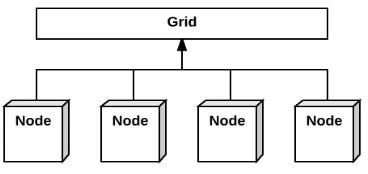
The proposed brokering-based model captures Computing in the form of job’s Capabilities and Resource Allocation, where the application is unaware of the individual Resources that execute it’s jobs. The application has a view of the Grid as a virtual single computing platform with the required capabilities to perform the requested job.
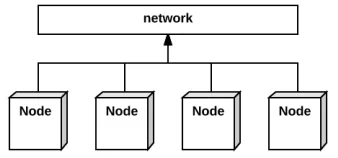
In a typical grid-computing environment the resources that provide computing capabilities to the grid, connect through the network to a centralized service, which is responsible for scheduling the job of a particular type to execute. Different resource brokers capable of executing jobs of different types have been outlined in Chapter 2. Such architecture uses the network to facilitate the communication between resource providers and other systems making up the grid-computing environment.
Figure 4-2: Traditional distributed system
Figure 4-3: Proposed Architecture
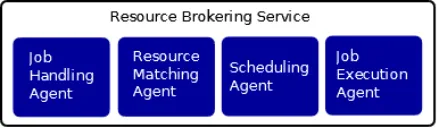
The proposed architecture is based on the brokering model. We identified four distinct functional areas of the resource broker, job handling, resource matching, scheduling and job execution, as shown in Figure 4-4.
Figure 4-4: Proposed Architecture with Resource-Brokering
4.2.1 Proposed Grid Protocol Architecture
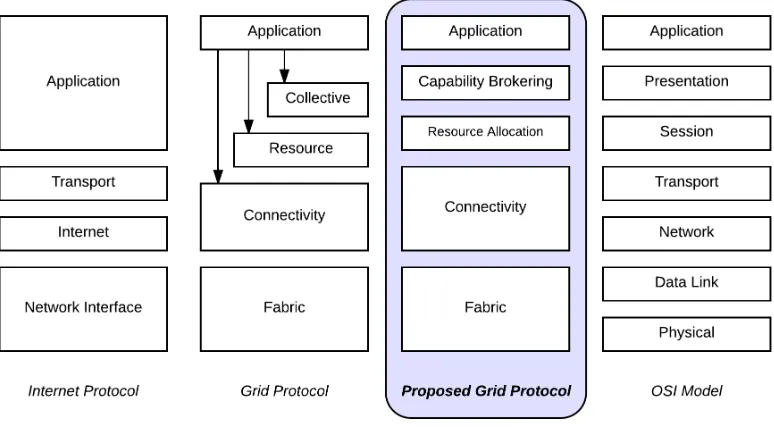
Existing Grid Protocol architecture as shown in Figure 4-5 Grid Protocol, allows Application layer implementations to control all aspects of the Grid. This approach allocates all the control at the top layer of the protocol architecture and therefore creating a centralized control mechanism and structure in the Grid environment. Further, this type of architecture reduces the ability for resources to be autonomous, where autonomy is one of the key requirements for entities in an open environment.
Figure 4-5: Grid Protocol Architecture (current and proposed)
4.3
Grid Computing Entities
The autonomous entities in the Grid are modeled as software agents. Agents architecture is a composition of knowledge and capability. Each component in the resource-broker service, normally job submission, resource matching, scheduling and execution, can be modeled as a software entity. The capabilities of the entity depend on its designated function. The system in this context is known based on the roles and responsibilities required to perform the brokering service. This approach allows for separation of concerns and well defined coordination pattern among the participating entities. For example, job-handling agent has responsibilities of accepting a job request, validating all required parameters and passing the job to the resource-matching. The resource-matching agent can be performed by multiple and different agents based on the parameters supplied in the job definition. New agents can be added into the system without changing the architecture, yet providing new capabilities that are not known at the initial design of the system.
Additionally, a resource-matching agent interacts with scheduling agent to assign the execution of a specific job to a specific resource at a specific time. Here the type of scheduling agent is selected at run-time based on the scheduling capabilities required by the submitted job. Furthermore, multiple agents representing the resource-providers can manage the job execution with the selected resource-provider as computing entity. These capabilities can interface with different grid middleware.
4.4
Computing Platform
the required computation are the fundamental guidelines that drive the platform’s requirements.
The proposed solution creates an architecture where multiple agents exist and coordinate their actions to accomplish a common goal. It views coordination as the solution to the interdependency problem with the specific focus on capability-based interdependency. The platform supports the following primary aspects of open environment applications.
4.4.1 Adaptability and Autonomy
The agent-based model provides the platform with a well-defined structure, as related to software entities that make up the computing environment. The entity structure enforces the required guidelines to support open environment applications. The open environment requires that entities are autonomous and can interact with other entities in that environment. Similarly, adaptability is required for the entities to interact and to solve new problems, which did not exist at design time.
The proposed brokering-based Grid protocol architecture enables the application of a consumer to adapt to the changes of the environment in terms of resource-providers.
4.4.2 Coordination and Cooperation
Coordination provides a structure and mechanism for agents to interact cooperatively. Cooperation can take a number of different forms; on one end being totally of self-interest and the other end being a total sacrifice. In this work, our focus is on cooperation for a mutual benefit to accomplish a common goal, where the coordination is the solution to the interdependency problem in a cooperative distributed system where agents exist in an open environment. The coordination of different resource-providers in an open environment is addressed at the application layer. Coordination is viewed here as the solution to the interdependency problem [36].
The study was done across multiple disciplines, including among others, computer science, organization theory, operations research, economics, linguistics, and psychology. Malone defines coordination as managing dependencies between activities. The dependencies in the context of the thesis are between overlapping capabilities. Similarly, [33] also outlines the interdependence between resources at the lower level of the grid infrastructure and the support for advanced reservations or advanced scheduling.
Chapter 5
5
Grid Computin
g: Framework & Implementation
In the previous chapter, the architecture for the proposed solution shows how extending the network with connected resources can bring computing to the network level and create a grid-computing environment where the computing happens on the network. This is an extension of the phrase, “Network is the computer” coined by John Gage from Sun Microsystems back in the mid ‘90’s. This vision statement has become more accurate over time. At the time of the vision, single computing nodes or clusters of computers which make up distributed systems were not enough to solve the complex problems. The statement recognized that computing needs to happen beyond the physical limitations of the computing node or a centralized management layer of a distributed system. In a similar way, grid computing needs to go beyond the boundaries of the computing nodes, and bring computing to the network layer, where the computing nodes are a simple resource with capabilities to participate in the execution.
The design and implementation of the proposed solution brings about a number of challenges. Each of the challenges is outlined in the following section of this chapter. Section 5.1 discusses the design requirements and choice of technologies used in the implementation. Section 5.2 outlines the design and implementation of the resource-broker. Section 5.3 and 5.4 contain design and implementation of the resource-provider and resource-consumer respectively.
5.1
Computational Model
functionality is described in terms of interoperating objects. The principles of this design approach focus on abstraction, encapsulation and modularity. In such a case it does not provide a way to directly address the characteristics of the open environment, where adaptability, autonomy and interdependency are the key requirements that need to be addressed.
• Adaptability – not all the participants of the system are known at design time;
this requires the known participants to be able to adapt to the environment.
• Autonomy – there is no centralized control; in an open environment each entity has a self-interest and control over its resources.
• Interdependency – the fact that a large number of entities do exist in the
environment and entities are able to join and leave the environment, and create a capability interdependency problem; the solution to such a problem is coordination between the entities.
Considering that we are dealing with self-interested entities in an open environment; an agent-based model is a better choice for the design approach. Agent-oriented is the next generation for software engineering paradigms and computer modeling of open environments and autonomous entities. Agent-oriented design provides the following principles as part of the design principles: autonomy, adaptability and coordination.
Based on the requirements the choice for the implementation of the proposed solution is an agent-oriented approach.
5.2
Brokering Architecture
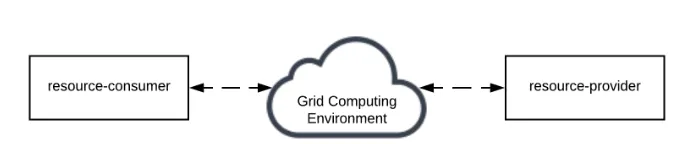
applied and used to implement the software system. In the analysis stage we develop the understanding of the system in the context of its organization. This process will focus on identifying the roles of the entities in the system and the required interaction between them. The outcome is expected to deliver autonomous self-interested aspects that are a natural fit for the Grid environment. In the Grid environment, there is no centralized entity to manage the overall dynamics and interaction. Further, we introduce another layer of abstraction at the participant level. The Grid environment consists of resource consumers and resource providers that utilize the Grid to share their capabilities. We abstract both the resource consumer and providers with our agent technology in order to bring computing to the network level and decouple the computing infrastructure from the interaction of different components, see Figure 5-1.
Figure 5-1: Agent-oriented design
The approach to design of the system is focus on defining key interfaces between each component. The first part looks at interfaces required in order to abstract the lower parts from concrete implementation. Following that is the look at each known entity of the environment and the role they play. This looks at the high-level view of the broker itself and provides a detailed look at the components making up the resource-broker. Further, we examine the overall system and the complexity of the interaction between the different entities, as well the similarities in the design of each entity as an agent.
provide the ability to switch to a different implementation of a specific component at run-time.
Figure 5-2: Resource-Broker Architecture
The known entities making up the system, as shown in Figure 5-1, are grouped into three categories, resource-consumer, resource-provider, and resource-broker. Furthermore, resource-broker is subdivided into four components, as shown in Figure 5-2, specific to the required functionality provided by the brokering service.
5.2.1 Agent Model
CIR-Agent is the agent model used in the CDS group, and it has been chosen for the implementation of the proposed solution as part of the work in this thesis.
5.2.2 CIR-Agent Interface
CIR-Agent interface has been created in order to decouple the application from the technology used in the implementation. A CIRAgentJADE class has been created as a separate project, which implements the CIRAgent interface and hides any platform dependent code. The application layer then uses this interface and provides a well decoupled design, where the underlying platform, JADE, can be removed and a new class for the new platform which implements the CIRAgent interface is put into the classpath and the software component will keep working without recompiling.
5.2.3 Action Interface
The Action interface also provides a way to set pre-conditions and post-conditions which are utilized by the problem solver within CIRAgent implementation. The problem-solver is able to compute a solution for a particular agent’s goal, based on this relationship.
5.2.4 Agent Interaction
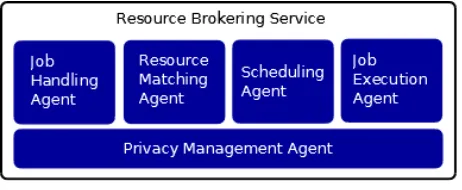
Figure 5-3: Resource-Broker with Privacy Management
The interaction between the different entities in the system is facilitated by a high-level protocol, ContractNET. ContractNET is a task-sharing protocol, and it can serve as the protocol for the base communication between the broker and the external entities. The protocol was extended to use an additional layer to support internal communication between the different agents within the broker service. This approach provides the required flexibility for the system to adapt at runtime. Internal to the broker, the communication component takes the received message from a resource consumer and puts that in a JSON format. The received content then becomes a value for the name job. The JSON structure adds flexibility in communication between internal component and the broker where each component can add additional name-value pairs to the structure and extract information from the structure which itself requires, leaving the rest of the structure unmodified for the next component. This is part of the information processed by the broker and creates new types of information, based on the information collection that accumulated from accepting the job and performing matching of the capabilities.
Figure 5-4: Job definition and PPL value
5.3
Resource
-
Broker
The resource broker implementation is logically divided into two main parts. At the core is the agent technology that provides the implementation of functionality for each component of the resource broker, as well as the agent abstraction of the resource
<JobDefinition ... PPL=”8”> ...
![Figure 2-1: The Sphinx Scheduling System [44]](https://thumb-us.123doks.com/thumbv2/123dok_us/1915716.1251282/31.612.199.451.67.274/figure-the-sphinx-scheduling-system.webp)