Lossy Encryption: Constructions from General Assumptions and
Efficient Selective Opening Chosen Ciphertext Security
Brett Hemenway∗ Benoˆıt Libert† Rafail Ostrovsky‡
Damien Vergnaud§
March 22, 2012
Abstract
Lossy encryption was originally studied as a means of achieving efficient and composable oblivious transfer. Bellare, Hofheinz and Yilek showed that lossy encryption is also selective opening secure. We present new and general constructions of lossy encryption schemes and of cryptosystems secure against selective opening adversaries.
We show that every re-randomizable encryption scheme gives rise to efficient encryptions secure against a selective opening adversary. We show that statistically-hiding 2-round Oblivious Transfer implies Lossy Encryption and so do smooth hash proof systems. This shows that private information retrieval and homomorphic encryption both imply Lossy Encryption, and thus Selective Opening Secure Public Key Encryption.
Applying our constructions to well-known cryptosystems, we obtain selective opening se-cure commitments and encryptions from the Decisional Diffie-Hellman, Decisional Composite Residuosity andQuadratic Residuosity assumptions.
In an indistinguishability-based model of chosen-ciphertext selective opening security, we obtain secure schemes featuring short ciphertexts under standard number theoretic assumptions. In a simulation-based definition of chosen-ciphertext selective opening security, we also handle non-adaptive adversaries by adapting the Naor-Yung paradigm and using the perfect zero-knowledge proofs of Groth, Ostrovsky and Sahai.
Keywords: Public key encryption, commitment, selective opening security, homo-morphic encryption, chosen-ciphertext security, lossy encryption
A preliminary version of this work appeared in the proceedings of ASIACRYPT 2011
∗
E-mail: [email protected]. Supported in part by NSF VIGRE Fellowship and NSF grants 0716835, 0716389, 0830803 and 0916574.
†
E-mail: [email protected]
‡
E-mail: [email protected]. Supported in part by IBM Faculty Award, Xerox Innovation Group Award, OKAWA Research Award, NSF grants 0430254, 0716835, 0716389, 0830803, 0916574, BSF grant, and U.C. MICRO grant.
§
Contents
1 Introduction 3
1.1 Previous Work . . . 3
1.2 Our Contributions . . . 4
2 Background 6 2.1 Notation . . . 6
2.2 Selective Opening Secure Encryption . . . 6
2.3 Lossy Encryption . . . 7
3 Constructing Lossy Encryption Schemes 9 3.1 Re-Randomizable Encryption Implies Lossy Encryption . . . 9
3.2 Statistically-Hiding 21 -OT Implies Lossy Encryption . . . 11
4 Chosen-Ciphertext Security 13 4.1 Chosen-Ciphertext Security: Indistinguishability . . . 13
4.2 Chameleon Hash Functions . . . 14
4.3 A Special Use of the Canetti-Halevi-Katz Paradigm . . . 14
4.4 Lossy and All-But-nTrapdoor Functions . . . 18
4.5 All-But-n Functions from Lossy Trapdoor Functions . . . 19
4.6 An IND-SO-stag-wCCA2 TBE Construction . . . 19
4.7 An All-but-nFunction with Short Outputs . . . 21
4.8 An IND-SO-stag-wCCA2 TBE Scheme from the DDH Assumption . . . 22
5 Conclusion 25 A Selective Opening Secure Commitments 30 A.1 Re-Randomizable One-Way Functions . . . 30
A.2 Commitments from Re-Randomizable One-Way Functions . . . 30
A.3 Definitions of Selective Opening Secure Commitments . . . 31
A.4 IND-SO-COM Constructions from Re-Randomizable One-Way Functions . . . 32
B Homomorphic Encryption 33 B.1 Efficient Re-Randomizable Encryption from Uniformly Sampleable Homomorphic Encryption . . . 34
C Simulation-Based Security 35 C.1 Selective Opening Security from the Composite Residuosity Assumption . . . 36
D Lossy Encryption from Smooth Universal Hash Proof Systems 37 E Chosen-Ciphertext Security: Simulatability 38 E.1 Unduplicatable Set Selection . . . 39
E.2 Non-Interactive Zero-Knowledge . . . 40
E.3 A SEM-SO-CCA1 Construction Based on the Naor-Yung Paradigm . . . 41
1
Introduction
In Byzantine agreement, and more generally in secure multiparty computation, it is often assumed that all parties are connected to each other via private channels. In practice, these private channels are implemented using a public-key cryptosystem. An adaptive adversary in a MPC setting, how-ever, has very different powers than an adversary in an IND-CPA or IND-CCA game. In particular, an adaptive MPC adversary may view all the encryptions sent in a given round, and then choose to corrupt a certain fraction of the players, thus revealing the decryptions of those players’ messages and the randomness used to encrypt them. A natural question is whether the messages sent from the uncorrupted players remain secure. If the messages (and randomness) of all the players are chosen independently, then security in this setting follows immediately from the IND-CPA security of the underlying encryption. If, however, the messages are not chosen independently, the security does not immediately follow from the IND-CPA (or even IND-CCA) security of the underlying scheme. In fact, although this problem was first investigated over twenty years ago, it remains an open question whether IND-CPA (or IND-CCA) security implies this selective opening security.
A similar question may be asked regarded in terms of commitments as well. Suppose an adver-sary is allowed to see commitments to a number of related messages, the adveradver-sary may then choose a subset of the commitments for the challenger to de-commit. Does this reveal any information about the unopened commitments? This question has applications to concurrent zero-knowledge proofs.
1.1 Previous Work
There have been many attempts to design encryption protocols that can be used to implement secure multiparty computation against an adaptive adversary. The first protocols by Beaver and Haber [BH92] required interaction between the sender and receiver, required erasure and were fairly inefficient. The first non-interactive protocol was given by Canetti, Feige, Goldreich and Naor in [CFGN96]. In [CFGN96] the authors defined a new primitive called Non-Committing Encryption, and gave an example of such a scheme based on the RSA assumption. In [Bea97], Beaver extended the work of [CFGN96], and created adaptively secure key exchange under the Diffie-Hellman assumption. In subsequent work, Damg˚ard and Nielsen improved the efficiency of the schemes of Canettiet al. and Beaver, they were also able to obtain Non-Committing Encryption based on one-way trapdoor functions with invertible sampling. In [CHK05], Canetti, Halevi and Katz presented a Non-Committing encryption protocols with evolving keys.
In [CDNO97], Canetti, Dwork, Naor and Ostrovsky extended the notion of Non-Committing Encryption to a new protocol which they called Deniable Encryption. In Non-Committing En-cryption schemes there is a simulator, which can generate non-committing ciphertexts, and later open them to any desired message, while in Deniable Encryption, valid encryptions generated by the sender and receiver can later be opened to any desired message. The power of this primitive made it relatively difficult to realize, and Canetti et al. were only able to obtain modest examples of Deniable Encryption and left it as an open question whether fully deniable schemes could be created.
zero-knowledge proof systems for NP with negligible soundness error, and they gave constructions of a weak form of SOA-secure commitments, but leave open the question of whether general SOA-secure commitments exist.
The question of SOA-secure commitments was put on firm foundations by Hofheinz [Hof11b] and Bellare, Hofheinz and Yilek in [BHY09]. In [BHY09], Bellare et al. distinguished between simulation-based and indistinguishability-based definitions of security, and gave a number of con-structions and black-box separations. In particular, Hofheinz showed that, in the simulation-based setting, non-interactive SOA-secure commitments cannot be realized in a black-box manner from standard cryptographic assumptions, but if interaction is allowed, they can be created from one-way permutations in a non-black-box manner. In the indistinguishability-based setting, they showed that any statistically-hiding scheme achieves this level of security, but that there is a black-box separation between perfectly-binding SOA-secure commitments and most standard cryptographic assumptions. Our results in the selective opening setting build on the breakthrough results of [BHY09].
The concurrent, independent work of Fehr, Hofheinz and Kiltz and Wee [FHKW10] also ex-amines the case of CCA2 cryptosystems that are selective opening secure. In their work, they show how to adapt the universal hash proof systems of [CS02], to provide CCA2 security in the selective opening setting. Their constructions are general, and offer the first SEM-SO-CCA secure cryptosystem whose parameters are completely independent ofn, the number of messages. Their work also considers selective opening security against chosen-plaintext attacks, and using tech-niques from Non-Committing Encryption [CFGN96] they construct SEM-SO-CPA secure systems from enhanced one-way trapdoor permutations.
The results of Bellare, Waters and Yilek [BWY11] show how to construct Identity-Based En-cryption (IBE) schemes secure under selective-opening attacks based on the Decision Linear As-sumption. Our work is orthogonal to theirs. Their work constructs IBE schemes secure under selective-opening attacks, while our work starts with a tag-based encryption scheme, and uses it to construct encryption schemes that are secure against a selective-opening chosen-ciphertext attack, but are not identity-based.
1.2 Our Contributions
In this paper, we primarily consider encryptions secure against a selective opening adversary. In particular, we formalize the notion of re-randomizable Public-Key Encryption and we show that re-randomizable encryption implies Lossy Encryption, as defined in [PVW08] and expanded in [BHY09]. Combining this with the recent result of Bellare, Hofheinz and Yilek [BHY09] showing that Lossy Encryption is IND-SO-ENC secure, we have an efficient construction of IND-SO-ENC secure encryption from any re-randomizable encryption (which generalizes and extends previous results). Furthermore, these constructions retain the efficiency of the underlying re-randomizable encryption protocol.
Applying our results to the Paillier cryptosystem [Pai99], we obtain an encryption scheme which attains a strong, simulation-based form of semantic security under selective openings (SEM-SO-ENC security). This is the first construction of this type from the Decisional Composite Residuosity (DCR) assumption. As far as bandwidth goes, it is also the most efficient SEM-SO-ENC secure encryption scheme to date. We note that the possible use of Paillier as a lossy encryption scheme was implicitly mentioned in [YY05]. To the best of our knowledge, its SEM-SO-ENC security was not reported earlier.
We go on to show that Lossy Encryption is also implied by (honest-receiver) statistically-hiding
2 1
[PVW08], we recognize that Lossy Encryption is essentially just a different way to view the well known statistically-hiding 21
-OT primitive. Applying the reductions in [BHY09] to this result, yields constructions of SOA secure encryption from both PIR and homomorphic encryption.
These results show that the Lossy and Selective Opening Secure Encryption primitives (at least according to the latter’s indistinguishability-based security definition), which have not been extensively studied until recently, are actually implied by several well-known primitives: i.e., re-randomizable encryption, PIR, homomorphic encryption, hash proof systems and statistically-hiding 21
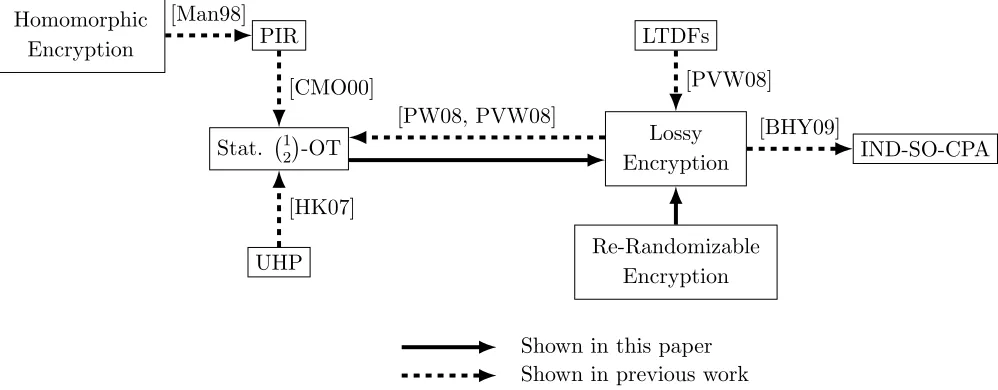
-OT. Prior to this work, the only known general1 constructions of lossy encryption were from lossy trapdoor functions. Our results thus show that they can be obtained from many seem-ingly weaker primitives (see figure 1).
Lossy
Encryption IND-SO-CPA
Homomorphic
Encryption PIR
Stat. 12-OT
UHP
LTDFs
Re-Randomizable Encryption [PW08, PVW08]
[CMO00] [Man98]
[PVW08]
[HK07]
[BHY09]
Shown in this paper Shown in previous work
Figure 1: Constructing Lossy Encryption
Selective Opening Security Against Chosen-Ciphertext Attacks: Continuing the study of selective-opening security, we present definitions chosen-ciphertext security (CCA2) in the selective selective-opening setting (in both the indistinguishability and simulation-based models) and describe encryption schemes that provably satisfy these enhanced forms of security. Despite recent progress, relatively few methods are known for constructing IND-CCA2 cryptosystems in the standard model. The problem is even more complex with selective openings, where some known approaches for CCA2 security do not seem to apply. We note how the Naor-Yung paradigm, even when applied with statistical zero knowledge proofs fails to prove CCA2 security in the selective opening setting. Es-sentially, this is because the selective opening adversary learns the randomness used in the signature scheme, which allows him to forge signatures, and thus create ciphertexts that cannot be handled by the simulated decryption oracle.
The results of Fehr, Hofheinz, Kiltz and Wee [FHKW10] show how to modify universal hash proof systems [CS02] to achieve security under selective openings.
We take a different approach and follow (a variant of) the Canetti-Halevi-Katz paradigm [CHK04]. This too encounters many obstacles in the selective opening setting. Nevertheless, un-der standard assumptions (such as DDH or the Composite Residuosity assumption), we construct
1
schemes featuring compact ciphertexts while resisting adaptive (i.e., CCA2) chosen-ciphertext at-tacks according to our indistinguishability-based definition. When comparing our schemes to those of [FHKW10], we note that our public key size depends on n, the number of senders that can be possibly corrupted, while the systems of [FHKW10] are independent ofn. On the other hand, to en-cryptm-bit messages with security parameterλ, our ciphertexts are of lengthO(λ+m), while theirs are of lengthO(λm). Our public-keys are longer than in [FHKW10] because our construction relies on All-But-N Lossy Trapdoor Functions (defined below), which have long description. The recent complementary work of Hofheinz [Hof11a] shows how to create All-But-Many Trapdoor Functions with short keys. Using his results in our construction eliminates the dependence of the public-key size on n. Regarding security definitions, our constructions satisfy an indistinguishability-based definition (IND-SO-CCA), whereas theirs fit a simulation-based definition (SEM-SO-CCA) which avoids the restriction on the efficient conditional re-sampleability of the message distribution.
The scheme of [FHKW10] is very different from ours and we found it interesting to investigate the extent to which well-known paradigms like [CHK04] can be applied in the present context. Moreover, by adapting the Naor-Yung paradigm [NY90], under more general assumptions, we give a CCA1 construction that also satisfies a strong simulation-based notion of adaptive selective open-ing security.
One advantage of our IND-SO-CCA scheme is the ability to natively encrypt multi-bit mes-sages. It is natural to consider whether our approach applies to the scheme of Bellare, Waters and Yilek [BWY11] to achieve multi-bit IND-SO-CCA encryption. The scheme of [BWY11], like [FHKW10], encrypts multi-bit messages in a bitwise manner. Applying a Canetti-Halevi-Katz-like transformation to the construction of [BWY11] does not immediately yield IND-SO-CCA encryp-tion schemes for multi-bit messages: the reason is that it is not clear how to prevent the adversary from reordering the bit encryptions without employing a one-time signature scheme.
2
Background
2.1 Notation
If f : X → Y is a function, for any Z ⊂ X, we let f(Z) = {f(x) : x ∈ Z}. If A is a PPT
machine, then we use a←$ A to denote running the machine A and obtaining an output, wherea
is distributed according to the internal randomness of A. For a PPT machine A, we use coins(A)
to denote the distribution of the internal randomness of A. So the distributions {a ←$ A} and
{r ←$ coins(A) :a=A(r)} are identical. IfR is a set, we use r ←$ R to denote sampling uniformly from R.
If X and Y are families of distributions indexed by a security parameter λ, we use X≈s Y to
mean the distributions X and Y are statistically close, i.e., for all polynomials p and sufficiently largeλ, we haveP
x|Pr[X=x]−Pr[Y =x]|< p(1λ).
We use X ≈c Y to mean X and Y are computationally close, i.e., for all PPT adversaries A,
for all polynomialsp, then for all sufficiently largeλ, we have|Pr[AX = 1]−Pr[AY = 1]|<1/p(λ).
2.2 Selective Opening Secure Encryption
fact that an adaptive MPC adversary learns the entire history of corrupted players (i.e., there are no secure erasures). If the adversary receives only the messages this would reduce to standard CPA security.
As in [BHY09], M denotes an n-message sampler outputting a n-vector m = (m1, . . . , mn)
of messages whereas M|I,m[I] denotes an algorithm that conditionally resamples another random
n-vector m0 = (m01, . . . , m0n) such that m0i =mi for each i∈I ⊂ {1, . . . , n}. If such a resampling can be done efficiently for all I,m, thenM is said to support efficient conditional resampling.
Definition 1. (Indistinguishability under selective openings). A public key cryptosystem (G, E, D) is indistinguishable under selective openings (IND-SO-ENC secure) if, for any message samplerM
supporting efficient conditional resampling and any PPT adversary A= (A1,A2), we have
Pr
h
Aind-so-real= 1i−PrhAind-so-ideal= 1i < ν
for some negligible function ν, and where the games ind-so-real and ind-so-ideal are defined as follows.
IND-SO-ENC (Real) IND-SO-ENC (Ideal)
m= (m1, . . . , mn) $
← M m= (m1, . . . , mn)
$
← M
r1, . . . , rn $
←coins(E) r1, . . . , rn
$
←coins(E)
(I, st)← A$ 1 pk, E(m1, ri), . . . , E(mn, rn)
(I, st)← A$ 1 pk, E(m1, ri), . . . , E(mn, rn)
b← A$ 2 st,(mi, ri)i∈I,m
m0 = (m01, . . . , m0n)← M$ |I,m[I] b← A$ 2 st,(mi, ri)i∈I,m0
Figure 2: IND-SO-ENC security
In the real game, the challenger samplesm= (m1, . . . , mn) $
← Mfrom the joint message
distri-bution. Then, it generates randomnessr1, . . . , rn
$
←coins(E) and sends (E(m1, r1), . . . , E(mn, rn)
to A. The adversary A responds with a subset I ⊂ {1, . . . , n} of size #I = n/2. The challenger reveals ri for each i ∈ I as well as the entire vector m= (m1, . . . , mn) to A. Finally, the latter
outputs a bitb∈ {0,1}.
In the ideal game, the challenger also samplesm= (m1, . . . , mn)
$
← Mfrom the joint
distribu-tion. Then, it generates random coins r1, . . . , rn ←$ coins(E) and sends (E(m1, r1), . . . , E(mn, rn))
to the adversary A. The latter chooses a subsetI ⊂ {1, . . . , n} with #I =n/2 and the challenger reveals ri for i ∈I. The only difference w.r.t. the real game is that, instead of revealing m, the challenger samples a new vector m0 ← M$ |I,m[I] and sends m0 to A. Eventually, the adversary outputs a bitb∈ {0,1}.
We stress that the challenger reveals both the plaintexts mi and the randomness ri for indices i∈I. If only the messagesmi were revealed, this security would follow immediately from IND-CPA security.
2.3 Lossy Encryption
and “lossy” or “messy” keys on which the system loses information about the plaintext. In partic-ular they require that the encryptions of any two plaintexts under a lossy key yield distributions that are statistically close, yet injective and lossy keys remain computationally indistinguishable.
In [BHY09] Bellare, Hofheinz and Yilek define Lossy Encryption, expanding on the definitions of Dual-Mode Encryption in [PVW08], and Meaningful/Meaningless Encryption in [KN08]. At a high level, a ‘lossy’ (or ‘messy’ in the terminology of [PVW08]) cryptosystem is one which has two types of public keys which specify two different modes of operation. In the normal mode, encryption is injective, while in the lossy (or ‘messy’) mode, the ciphertexts generated by the encryption algorithm are independent of the plaintext. We also require that no efficient adversary can distinguish normal keys from lossy keys. In [BHY09], they also require a property called openability, which basically allows a possibly inefficient algorithm to open a ciphertext generated under a lossy key toany plaintext.
Definition 2. A lossy public-key encryption scheme is a tuple (G, E, D) of efficient algorithms such that
• G(1λ,inj) outputs keys (pk, sk), keys generated by G(1λ,inj) are called injective keys.
• G(1λ,lossy) outputs keys (pklossy, sklossy), keys generated byG(1λ,lossy) are calledlossy keys.
Additionally, the algorithms must satisfy the following properties:
1. Correctness on injective keys. For all plaintexts x∈X,
Prh(pk, sk)←$ G(1λ,inj); r←$ coins(E) :D(sk, E(pk, x, r)) =xi= 1.
2. Indistinguishability of keys. In lossy mode, public keys are computationally indistinguishable from those in the injective mode. Specifically, if proj : (pk, sk) 7→ pk is the projection map, then
{proj(G(1λ),inj)} ≈c{proj(G(1λ,lossy))}
3. Lossiness of lossy keys. If (pklossy, sklossy)
$
←G(1λ,lossy), then for allx0, x1∈X, the statistical
distance between the distributions E(pklossy, x0, R) and E(pklossy, x1, R) is negligible in λ.
4. Openability. If (pklossy, sklossy)
$
← G(1λ,lossy), and r ←$ coins(E), then for all x0, x1 ∈
X with overwhelming probability, there exists r0 ∈ coins(E) such that E(pklossy, x0, r) =
E(pklossy, x1, r0). In other words, there is an (unbounded) algorithm opener that can open a
lossy ciphertext toany arbitrary plaintext with all but negligible probability.
Although openability is implied by property (3), it is convenient to state it explicitly in terms of an algorithm. In [BHY09], it was shown that, if the algorithm opener is efficient, then the encryption scheme is actually SEM-SO-ENC secure (instead of only IND-SO-ENC).
We do not explicitly require schemes to be IND-CPA secure since semantic security follows from the indistinguishability of keys and lossiness of the lossy keys. Indeed, for anyx0, x1 ∈X,
E(proj(G(1λ,inj)), x0, R)≈cE(proj(G(1λ,lossy)), x0, R))
≈sE(proj(G(1λ,lossy)), x1, R)≈cE(proj(G(1λ,inj)), x1, R).
Theorem 1. [BHY09] Any Lossy Encryption scheme where the plaintext space admits an-message samplerMthat supports efficient resampling is IND-SO-ENC secure.
3
Constructing Lossy Encryption Schemes
3.1 Re-Randomizable Encryption Implies Lossy Encryption
In many cryptosystems, given a ciphertext cand a public-key, it is possible to re-randomizec to a new ciphertext c0 such that c and c0 encrypt the same plaintext but are statistically independent. We call a public key cryptosystem given by algorithms (G, E, D) statistically re-randomizable2 if
• (G, E, D) is semantically-secure in the standard sense (IND-CPA).
• There is an efficient functionReRand such that ifr0 is chosen uniformly fromcoins(ReRand), and r0 are chosen uniformly from coins(E), then the distributions
{r0 ←$ coins(E) :E(pk, m, r0)} ≈s{r0
$
←coins(ReRand) :ReRand(E(pk, m, r1), r0)}
for all public keys pkand messages m, and randomnessr1.
There are many examples of re-randomizable encryption. For example, if (G, E, D) is homomor-phic(i.e., for any two pairs (m0, r0) and (m1, r1), we haveE(pk, m0, r0)·E(pk, m1, r1) =E(pk, m0+
m1, r∗) for somer∗ ∈coins(E)), it may be possible to takeReRand(pk, c, r0) =c·E(pk,0, r0). For all
known homomorphic cryptosystems (such as Elgamal, Paillier, Damg˚ard-Jurik, Goldwasser-Micali), we obtain statistically re-randomizable encryption with this definition of ReRand.
We note that, since re-randomization does not require any kind of group structure on the plaintext space or any method for combining ciphertexts, re-randomizable encryption appears to be a weaker primitive than homomorphic encryption. Although it is not implied by homomorphic encryption per se, all known homomorphic cryptosystems are re-randomizable. A more thorough discussion of the relationship between these primitives is given in Appendix B.
Our first result gives a simple and efficient method for creating lossy encryption from re-randomizable encryption. Let (G, E, D) be a statistically re-randomizable public-key cryptosystem, and we create Lossy Encryption ( ¯Ginj,G¯lossy,E,¯ D¯) as follows:
• Key Generation: ¯
G(1λ,inj) generates a pair (pk, sk) ← G(1λ). Then G(1λ,inj) picks r0, r1 $
← coins(E), and generates e0 =E(pk,0, r0), e1 =E(pk,1, r1). ¯G(1λ,inj) returns ( ¯pk,sk¯) = ((pk, e0, e1), sk).
¯
G(1λ,lossy) runs G(1λ), generating a pair (pk, sk). Then, it picks r0, r1 $
← coins(E) and generates e0 =E(pk,0, r0),e1 =E(pk,0, r1). ¯G(1λ,lossy) returns ( ¯pk,sk¯) = ((pk, e0, e1), sk).
• Encryption: E¯( ¯pk, b, r0) =ReRand(pk, eb, r0) for b∈ {0,1}.
• DecryptionD¯( ¯sk, c), simply outputs D(sk, c).
2
We first notice that, under an injective key, the encryption mapping is clearly injective and the decryption algorithm Dperforms the inverse operation. In lossy mode, it will be statistically lossy by the properties of the ReRand function. The proof that this is a Lossy Encryption system is straightforward and we check the details here.
1. Correctness on injective keys. This follows immediately from the correctness of E.
2. Indistinguishability of keys. This follows immediately from the IND-CPA security of (G, E, D).
3. Lossiness of lossy keys. Notice that under a lossy public-key ¯pk,e0ande1are both encryptions
of zero, so that ¯E( ¯pk, b, r) will also be an encryption of zero forb∈ {0,1}. By the properties of ReRand, the distributions {E¯( ¯pk,0, r)} and {E¯( ¯pk,1, r)} will be statistically close, which is exactly what is required for a key to be “lossy”.
4. Openability. Under a lossy public-key, we have ¯E( ¯pk, b, r0) =ReRand(E(pk,0, rb), r0). Since r0 is chosen uniformly fromcoins(ReRand), the properties of ReRand guarantee that the dis-tributions ReRand(E(pk,0, rb), r0) and ReRand(E(pk,0, r1−b), r00) are statistically close. The
existence of r00 such that ReRand(E(pk,0, rb), r0) = ReRand(E(pk,0, r1−b), r00) then follows
from lemma 1.
Lemma 1. IfR is a random variable, and f :R→X,g:R→Y and
X
z∈X∪Y
Pr [r←R:f(r) =z]−Pr [r←R:g(r) =z] =ν,
then Pr [r←R:∀r0 ∈R, f(r)6=g(r0)]< ν.
Proof. It suffices to notice that
ν = X
z∈X∪Y
Pr [r ←R:f(r) =z]−Pr [r←R:g(r) =z]
≥ X
z∈X\Y
Pr [r ←R:f(r) =z]−Pr [r←R:g(r) =z]
= Pr
r←R:∀r0∈R, f(r)6=g(r0) .
Although this scheme only allows encrypting single bits, it can be easily modified to encrypt longer messages if the underlying cryptosystem is homomorphic and if the set of encryptions of zero can be almost uniformly sampled (the details are available in Appendix B).
The above construction is easily seen to give a perfectly-binding SOA secure commitment scheme (with trusted setup). If our goal is only to construct SOA secure commitments, we do not need re-randomizable encryption, and a weaker primitive suffices. In Appendix A, we definere-randomizable one-way functions and show that these imply SOA secure commitments. While these constructions both require a trusted setup, in a sense, this is inevitable since it was shown in [Hof11b, BHY09] that perfectly-binding SOA secure commitments without trusted setup cannot be created in a black-box manner from any primitive with a game-based definition of security.
3.2 Statistically-Hiding 21-OT Implies Lossy Encryption
We briefly recall the definition of honest-receiver two-round statistically-hiding 21
-OT. Oblivious transfer is a protocol between a senderSen and a receiver Rec= (Recq,Recr). The senderSenhas
two strings s0, s1, and the receiver has a bit b. The receiverRecq generates a query q along with
some state informationsk and sends q to the sender. The sender evaluatesq(s0, s1) and sends the
result rsp=Sen(q, s0, s1) to the receiver Recr who usessk to obtain sb.
• Correctness: For alls0, s1 ∈ {0,1}k, for allb∈ {0,1}, there is a negligible function ν such
that
Pr[(q, sk)←$ Recq(1λ, b); rsp
$
←Sen(q, s0, s1) :Recr(sk,rsp) =sb]≥1−ν(λ).
• Receiver Privacy: bremains computationally hidden fromSen’s view. Specifically, we must have
{(q, sk)←$ Recq(1λ,0) :q} ≈c{(q, sk)
$
←Recq(1λ,1) :q},
where the distributions are taken over the internal randomness of Recq.
• Sender Privacy: for any b∈ {0,1}, for any strings s0, s1, s00, s01 such that sb =s0b and any
honest receiver’s queryq=Recq(1λ, b), it must hold that
{(q, sk)←$ Recq(1λ, b);rsp←$ Sen(q, s0, s1) :rsp} ≈s{(q, sk)←$ Recq(1λ, b);rsp←$ Sen(q, s00, s01) :rsp}
where the distributions are taken over the internal randomness of Recq and Sen.
Let (Sen,Rec) be a two-round honest-receiver statistically-hiding 21-OT. We construct a lossy encryption as follows:
• Key Generation: DefineG(1λ,inj) =Rec
q(1λ,0). Set pk=q, and sk=sk.
Define G(1λ,lossy) =Recq(1λ,1). Set pk=q, and sk=⊥.
• Encryption: DefineE(pk, m,(r, r∗)) =Sen(q, m, r;r∗), where r∗ is the randomness used in
Sen(q, m, r) and r← {$ 0,1}|m| is a random string.
• Decryption: to decrypt c=rsp in injective mode, we defineD(sk,rsp) =Recr(sk,rsp).
Lemma 2. The scheme (G, E, D) forms a lossy encryption scheme.
Proof. We need to show three things:
• Correctness on injective keys: This follows immediately from the correctness of OT.
• Indistinguishability of keys: This follows immediately from the receiver privacy of OT.
• Lossiness of lossy keys: This will follow from the statistical sender privacy OT. More precisely, if the cryptosystem is in lossy mode, the sender privacy of OT says that for all
m0, m1
where the distribution is taken over the internal randomness of Sen. Now, if we view the randomness ofSenas an explicit input to Sen(as we do in encryption), then we have that for all m0, m1 and r,
∆(Sen(q, m0, r;·),Sen(q, m1, r);·)< ν,
where the distributions are taken over the internal randomness of Sen. Applying lemma 3, we find
∆(Sen(q, m0,·;·),Sen(q, m1,·;·))≤ν,
where the distributions range over the uniform choice of r and the internal randomness of
Sen. This is exactly what is required to guarantee the lossiness of lossy keys.
Lemma 3. Let X, Y, Z be random variables such that ∆(X, Y|Z = z) < for all z. Then, ∆(X, Y)< .
Proof.
∆(X, Y) =X
a
|Pr(X=a)−Pr(Y =a)|
=X
a X
z
|Pr(X=a, Z=z)−Pr(Y =a, Z =z)|
=X
a X
z
|Pr(X=a|Z =z)−Pr(Y =a|Z =z)|Pr(z=z)
=X
z
Pr(Z =z)X
a
|Pr(X=a|Z =z)−Pr(Y =a|Z =z)|
=X
z
Pr(Z =z)∆(X, Y|Z =z)< X z
Pr(Z =z) =.
Applying the results of [CMO00] which show that single-server Private Information Retrieval (PIR) implies statistically-hiding OT, we find the following corollary.
Corollary 1. One round (two message) Single-Server PIR implies Lossy-Encryption.
Since homomorphic encryption implies PIR [KO97, Man98, IKO05], the following result follows.
Corollary 2. Homomorphic encryption implies Lossy-Encryption.
It was shown in [Kal05, HK07] that, in the half simulation model, statistically hiding 21
-OT can be based on smooth hash proof systems that fit a slight modification of the original definition [CS02] with suitable verifiability properties. In the honest-but-curious receiver setting (which suffices here), it was already noted in [HK07][Section 1.3] that ordinary hash proof systems, as defined in [CS02], are sufficient to realize 21
-OT. In Appendix D, we describe a simplification of the construction of lossy encryption from hash proof systems and obtain the next result.
Interestingly, the DDH-based lossy encryption scheme of [KN08, PVW08, BHY09] can be seen as a particular instance of that construction using the Projective Hashing of [CS98]. It can also be interpreted as being derived (after simplification) from the Naor-Pinkas OT protocol [NP01] via our construction.
The relationship with hash proof systems also suggests other implementations of lossy encryp-tion based on Composite or Quadratic Residuosity (which differ from the scheme in Appendix C.1 and from Goldwasser-Micali, respectively) and the Decision Linear assumption [BBS04].
To summarize this section, by applying Theorem 1, we obtain the following theorem.
Theorem 2. Statistically-hiding 2-round honest-player 21
-OT implies IND-SO-ENC secure en-cryption. Moreover, single-server PIR and homomorphic encryption and smooth projective hash proof systems also imply IND-SO-ENC secure encryption.
4
Chosen-Ciphertext Security
It has long been recognized that if an adversary is given access to a decryption oracle, many cryp-tosystems may become insecure. The notion of chosen-ciphertext Security [NY90, RS91, DDN91] was created to address this issue, and since then there have been many schemes that achieve this level of security. The attacks of Bleichenbacher on RSA PKCS#1 [Ble98] emphasized the practical importance of security against chosen-ciphertext attacks (CCA).
The need for selective opening security was first recognized in the context of Multi-Party Com-putation (MPC), where an active MPC adversary can view all ciphertexts sent in a current round and then choose a subset of senders to corrupt. It is natural to imagine an adversary who, in addition to corrupting a subset of senders, can also mount a chosen-ciphertext attack against the receiver. Schemes proposed so far (based on re-randomizable encryption or described in [BHY09]) are obviously insecure in this scenario.
In this section, we extend the notion of chosen-ciphertext security to the selective opening setting. As in the standard selective-opening setting, we can define security either by indistin-guishability, or by simulatability. We will give definitions of security as well as constructions for both settings.
Currently known techniques to acquire chosen-ciphertext security are delicate to use here. For instance, handling decryption queries using the Naor-Yung paradigm [NY90] and non-interactive zero-knowledge techniques [Sah99] is not straightforward as, when the adversary makes her cor-ruption query, she should also obtain the random coins that were used to produce NIZK proofs. Hash proof systems (HPS) [CS98, CS02] seem problematic to use as well. They typically involve security reductions where simulators know the private key corresponding to the public key given to the adversary. This seems inherently at odds with the features of lossy encryption, where secu-rity relies on the property that lossy public keys (for which private keys may not exist) look like well-formed public keys. As we will see, leveraging other tools such as the Canetti-Halevi-Katz paradigm [CHK04] raises its deal of technical issues.
4.1 Chosen-Ciphertext Security: Indistinguishability
• Challenge Query: let Mbe a message sampler. The latter samples m= (m1, . . . , mn) $
← Mand returnsn “target” ciphertexts
C= (C[1], . . . ,C[n])←(E(pk, m1, r1), . . . , E(pk, mn, rn)).
• Corrupt Query: Achooses a subsetI ⊂ {1, . . . , n}of cardinality #I =n/2. The challenger then reveals{(mi, ri)}i∈I toA.
– In the real game, the challenger then sends {mj}j /∈I to the adversary.
– In the ideal game, the challenger re-samplesm0= (m01, . . . , mn0 )← M$ |I,m[I](i.e., in such a way thatm0j =mj for each j∈I) and sends {m0j}j /∈I toA.
• Decryption Queries: Achooses a ciphertextCthat has never appeared as a target cipher-text and sends C to the challenger which responds withD(sk, C).
After a polynomial number of queries, exactly one of which is a challenge query and precedes the corrupt query (which is unique as well), the adversary outputsb∈ {0,1}.
Definition 3. A public key cryptosystem is IND-SO-CCA2 secure if, for any polynomial n and any n-message samplerMsupporting efficient conditional re-sampling, any PPT adversary Ahas negligibly different outputs in the real game and in the ideal game: for some negligible functionν,
we must have
Pr[A
ind-cca2-real= 1]−Pr[Aind-cca2-ideal = 1] < ν.
If the adversary is not allowed to make decryption queries, this reduces to IND-SO-ENC security. Our construction of IND-SO-CCA2 secure encryption requires some basic tools outlined below.
4.2 Chameleon Hash Functions
A chameleon hash function [KR00]CMH = (CMKg,CMhash,CMswitch) consists of a key generation
algorithmCMKg that, given a security parameter λ, outputs a pair (hk, tk)← G$ (λ). The random-ized hashing algorithm outputs y = CMhash(hk, m, r) given the public key hk, a message m and random coins r ∈ Rhash. On input of m, r, m0 and the trapdoor key tk, the switching algorithm
r0 ← CMswitch(tk, m, r, m0) outputs r0 ∈ Rhash such that CMhash(hk, m, r) =CMhash(hk, m0, r0).
Collision-resistance mandates that it be infeasible to find collisions (i.e., pairs (m0, r0)6= (m, r) such that CMhash(hk, m, r) =CMhash(hk, m0, r0)) without knowing tk. Finally, uniformity guarantees that the distribution of hashes is independent of the message m, in particular, for all hk, and
m, m0, the distributions {r ← Rhash : CMHash(hk, m, r)} and {r ← Rhash : CMHash(hk, m0, r)}
are identical. It is well-known that chameleon hashing can be based on standard number theoretic assumptions such as factoring or the discrete logarithm.
4.3 A Special Use of the Canetti-Halevi-Katz Paradigm
TBE = (TBEKg,TBEEnc,TBEDec) of efficient algorithms where, on input of a security parame-ter λ, TBEKg outputs a private/public key pair (pk, sk); TBEEnc is a randomized algorithm that outputs a ciphertext C on input of a public key pk, a string θ – called tag – and a message
m∈MsgSp(λ);TBEDec(sk, θ, C) is the decryption algorithm that takes as input a secret keysk, a tagθand a ciphertextC and returns a plaintextmor⊥. Associated withTBE is a plaintext space
MsgSp. Correctness requires that for all λ∈N, all key pairs (pk, sk)←TBEKg(1λ), all tags θ and
any plaintextm∈MsgSp(λ), it holds thatTBEDec(sk, θ,TBEEnc(pk, θ, M)) =m.
Selective Opening Security for TBE Schemes. In the selective opening setting, the weak
CCA2 security definition of [Kil06] can be extended as follows.
Definition 4. A TBE scheme TBE = (TBEKg,TBEEnc,TBEDec) is selective-tag weakly IND-SO-CCA2 secure (or IND-SO-stag-wCCA2 secure) if, for any polynomialnand anyn-message sampler
Msupporting efficient conditional re-sampling, any PPT adversaryAproduces negligibly different outputs in the real and ideal games, which are defined as follows.
1. The adversary Achooses ntags θ1?, . . . , θ?n and sends them to the challenger.
2. The challenger generates a key pair (sk, pk) ← TKEKg(1λ) and hands pk to A. The latter then adaptively makes the following kinds of queries:
– Challenge Query: letMbe a message sampler for MsgSp(λ). The challenger samples
m= (m1, . . . , mn)
$
← Mand returns ntarget ciphertexts
C= (C[1], . . . ,C[n])←(TBEEnc(pk, θ1?, m1, r1), . . . ,TBEEnc(pk, θn?, mn, rn)).
– Corrupt Query: A chooses a subset I ⊂ {1, . . . , n} of size #I =n/2. The challenger then hands {(mi, ri)}i∈I toA.
- In the real game, the challenger then sends{mj}j /∈I to the adversary.
- In the ideal game, the challenger re-samples (m01, . . . , m0n) ← M$ |I,m[I] and reveals
{m0 j}j /∈I.
– Decryption Queries: Asends a pair (C, θ) such thatθ6∈ {θ?
1, . . . , θn?}. The challenger
replies withTBEDec(sk, θ, C)∈MsgSp(λ)∪ {⊥}.
After polynomially-many queries, one of which being a challenge query, A outputs a bit b ∈ {0,1}. Her advantage AdvIND-SO-stag-wCCA2A (λ) is defined analogously to definition 3.
At first glance, one may hope to simply obtain IND-SO-CCA2 security by applying the CHK method [CHK04] to any IBE/TBE scheme satisfying some weaker level of selective opening secu-rity.
Let us assume a TBE scheme TBE = (TBEKg,TBEEnc,TBEDec) that is secure in the sense of definition 4 and let Σ = (G,S,V) be a strongly unforgeable one-time signature. The black-box CHK technique turns TBE into a public key cryptosystem PKE = (G, E, D) which is obtained by letting G(1λ) output (sk0,(Σ, pk0)) where (sk0, pk0) ← TBEKg(1λ). To encrypt a message m, E
generates a one-time signature key pair (SK,VK) ← G(1λ), computes Ctbe = TBEEnc(pk,VK, m)
under the tag VK and sets thePKE ciphertext as (VK, Ctbe, σ), whereσ =S(SK, Ctbe).
ciphertexts involving the same verification keys as target ciphertexts, which causes the reduction to fail. Although schemes using one-time signatures do not appear to become trivially insecure, the reduction of [CHK04, Kil06] ceases to go through and the same hurdle arises with the Boneh-Katz transformation [BK05].
It was showed in [Zha07] that chameleon hash functions [KR00] can be used to turn cer-tain TBE schemes, termed separable, into full-fledged IND-CCA2 cryptosytems and supersede one-time signatures in the CHK transform. A TBE scheme is said separable if, on input of
pk, m, θ, the encryption algorithm TBEEnc(pk, t, m) uses randomness r ∈ Rtbe and returns
Ctbe = (f1(pk, m, r), f2(pk, r), f3(pk, θ, r)), where functions f1, f2 and f3 are computed
indepen-dently of each other and are all deterministic (and give the same outputs when queried twice on the same (m, r),r and (θ, r)).
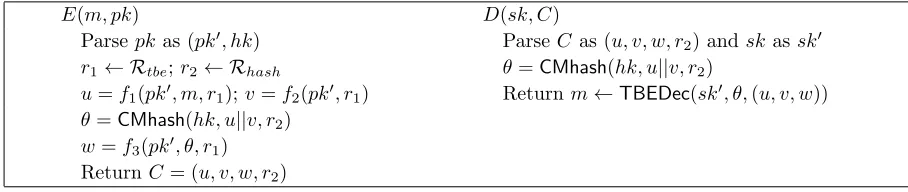
The construction of [Zha07] uses chameleon hashing instead of one-time signatures. Key gen-eration requires to create a TBE key pair (pk0, sk0) and a chameleon hashing public key hk. The private key ofPKE is the TBE private keysk0. Encryption and decryption procedures are depicted on figure 3.
E(m, pk) D(sk, C)
Parsepkas (pk0, hk) ParseC as (u, v, w, r2) andskassk0 r1← Rtbe;r2← Rhash θ=CMhash(hk, u||v, r2)
u=f1(pk0, m, r1);v=f2(pk0, r1) Returnm←TBEDec(sk0, θ,(u, v, w)) θ=CMhash(hk, u||v, r2)
w=f3(pk0, θ, r1) ReturnC= (u, v, w, r2)
Figure 3: The Separable-TBE-to-PKEtransform
Unlike the fully black-box transform where tags are generated independently of the TBE ci-phertext, this construction computes the ciphertext without using any other secret random coins than those of the underlying TBE ciphertext. The tag is derived from a ciphertext component u
and some independent randomness r2 that publicly appears in the ciphertext. For this reason, we
can hope to avoid the difficulty that appears with the original CHK transform. We prove that it is indeed the case and that any separable TBE that satisfies definition 4 yields an IND-SO-CCA2 encryption scheme.
Theorem 3. IfTBE = (TBEKg,TBEEnc,TBEDec) is a separable TBE scheme with IND-SO-stag-wCCA2 security, the transformation of figure 3 gives an IND-SO-CCA2 PKE scheme. For any IND-SO-CCA2 adversaryA, there is a TBE adversaryAtbeand a chameleon hash adversaryAhash
s.t.
AdvIND-SO-CCA2A (λ)≤2· AdvIND-SO-stag-wCCA2Atbe (λ) +qnδ+Adv
CR-CMhash
Ahash (λ)
,
whereqis the number of decryption queries andδis the maximal probability, taken over the random choice ofr1∈ Rtbe, that f2 outputs a specific element of its range.
Proof. We first note that the definition of IND-SO-CCA2 security is equivalent to a definition where the adversary A is faced with a simulator and has to decide whether the latter is playing the real game, where the actual plaintexts are revealed after the corruption query, or the ideal game. The game to be played is determined by a random bit b∈ {0,1} secretly chosen by the challenger and which Ahas to guess.
- Type I attackers never invoke the decryption oracle on (u, v, w, r2) for whichCMhash(hk, u||v, r2)
collides with a tags θ?
i associated with target ciphertexts.
- Type II adversaries make at least one decryption query for a valid ciphertext (u, v, w, r2) such
thatCMhash(hk, u||v, r2) hits the tagθ?i of some target ciphertext.
Type I adversaries are handled similarly to [Zha07]. We outline an adversary Atbe against the
TBE scheme using a type I IND-SO-CCA2 adversary A. The former begins by generating a key pair (hk, tk) ← CMhash(λ) for the chameleon hash. It chooses dummy u0i, vi0, r20,i in the appropri-ate domains and uses them to generappropri-ate tags θi? = CMhash(hk, u0i||v0
i, r02,i) for i= 1, . . . , n. These
are transmitted to Atbe’s challenger C, which replies with a TBE public key pk0. The public key pk= (pk0, hk) is given toA.
Any decryption query made by A is forwarded to Atbe’s challenger C and the latter’s
re-sponse is relayed to A. When A outputs a plaintext distribution M, Atbe sends M to her
own challenger. Upon receiving the vector of target ciphertexts C?tbe = (Ctbe[1]?, . . . , Ctbe[n]?)
(where Ctbe[i]? = (u?i, vi?, wi?) is associated with the tag θ?i), Atbe uses the trapdoor tk to
com-pute r?2,i = CMswitch(tk, u0i||v0i, r02,i, u?i||v?
i) (in such a way that θi? = CMhash(hk, u?i||vi?, r?2,i) =
CMhash(hk, u0i||v0
i, r20,i)) and sends the target vectorC? = (C[1]?, . . . ,C[n]?), whereC[i]? = (u?i, vi?, w?i, r?2,i)
for all i, toA.
Then, A makes new decryption queries, which Atbe handles by simply transmitting them to C and relaying the latter’s responses back to A. When A decides to make her corruption query
I ⊂ {1, . . . , n},Atbe sends I to C that replies with plaintexts and random coins{(m?
i, r1?,i)}i∈I for
ciphertexts {Ctbe[i]?}i∈I as well as {mi}i6∈I for which Atbe aims at deciding whether mi =m?i for
all i or mi ∈R M. All these elements are passed to A (note that Atbe does not need to include {r?
2,i}i∈I asA already obtained them as part ofC[i]?) who makes new decryption queries.
Since A is assumed to be a Type I adversary, no such decryption query (u, v, w, r2) ever
re-sults in a tag θ = CMhash(hk, u||v, r2) such that θ ∈ {θ1?, . . . , θn?}, Atbe can always query C to
decrypt ((u, v, w), θ) and give the answer back to A. Eventually, Atbe outputs the same result b0 ∈ {0,1} as A and we easily see that, if A is successful, so is Atbe. Therefore, it comes that AdvType-I(A)≤AdvIND-SO-stag-wCCA2(Atbe).
Type II adversaries. In the expectation of a Type II adversary, we construct a collision-finder
Ahash that sets up a public key (pk0, hk) by obtaining the chameleon hash keyhk from a challenger
and generates (sk0, pk0) ← TBEKg(λ) on its own. It challenges the adversary A on the public key pk = (pk0, hk) and uses the private key sk0 to perfectly handle all decryption queries. At the challenge step, A outputs a distribution M and obtains a vector C? = (C[1]?, . . . ,C[n]?) of tar-get ciphertexts, where, for each i∈ {1, . . . , n},C[i]? = (u?i, v?i, wi?, r2?,i) with u?i =f1(pk, m?i, r1?,i),
vi?=f2(pk, r?1,i),θ?i =CMhash(hk, u?i||vi?, r?2,i) andwi?=f3(pk, θi?, r?1,i) for plaintextsm?i
$
← Mand
random values r1?,i← R$ tbe, r?2,i← R$ hash.
In the simulation, algorithm Ahash aborts and fails in the event that, for some index i ∈ {1, . . . , n}, the ciphertext C[i]? = (u?i, v?i, w?i, r?2,i) is such thatvi? previously appeared in a decryp-tion query. This only occurs with probability smaller thanqnδifδdenotes the maximal probability, taken over the random choice ofr?
1,i
$
← Rtbe, that a specific element of the image of f2 is reached.
If Ahash does not abort, A makes new decryption queries that Ahash still perfectly answers
using sk0. At some point, A makes a corruption query I and obtains {(m?i, r?1,i, r2?,i)}i∈I.
Plain-texts {mi}i6∈I are the actual plaintexts if the challenger Ahash’s random bit is b= 0 and random
plaintexts if b= 1.
thatθ=CMhash(hk, u||v, r2) =CMhash(hk, u?i||v?
i, r?2,i) =θi? for some i∈ {1, . . . , n}. If that query
is made before the challenge phase, we must havev6=v?i asAhash would have aborted in the
chal-lenge phase otherwise. If the query is a post-chalchal-lenge query, we also have (u, v, r2)6= (ui?, vi?, r?2,i)
since, for any valid ciphertext, (u, v) = (u?i, vi?) andθ=θ?i would implyw=w?i and C would be a target ciphertext. In either case, we have a collision on the chameleon hash.
The above arguments give us the upper bound AdvType-II(A)≤qnδ+AdvCR-CMhash(Ahash).
The theorem is established by noting that Ahash can guess upfront (by flipping a coin
inde-pendently of A’s view) which kind of attack the adversary will mount and prepare the public key accordingly.
4.4 Lossy and All-But-n Trapdoor Functions
Lossy trapdoor functions were first defined in [PW08]. A tuple (Sltdf, Fltdf, Fltdf−1) of PPT algorithms
is called a family of (d, k)-lossy trapdoor functions if the following properties hold:
• Sampling injective functions: Sltdf(1λ,1) outputs (s, t), where sis a function index and
tits trapdoor. It is required thatFltdf(s,·) be injective on{0,1}dand Fltdf−1(t, Fltdf(s, x)) =x
for all x.
• Sampling lossy functions: Sltdf(1λ,0) outputs (s,⊥) where s is a function index and
Fltdf(s,·) is a function on {0,1}d, where the image of Fltdf(s,·) has size at most 2d−k.
• Indistinguishability: we have {(s, t)←$ Sltdf(1λ,1) :s} ≈c{(s,⊥)
$
←Sltdf(1λ,0) :s}.
Along with lossy trapdoor functions, Peikert and Waters [PW08] defined all-but-one (ABO) functions. Essentially, these are lossy trapdoor functions, except instead of having two branches (a lossy branch and an injective branch) they have many branches, all but one of which are injective. The Peikert-Waters cryptosystem only requires such function families to have one lossy branch because a single challenge ciphertext must be evaluated (on a lossy branch) in the CCA2 game. Since the IND-SO-CCA security game involves n >1 challenge ciphertexts, we need to generalize ABO functions into all-but-n (ABN) functions that have multiple lossy branches and where all branches except the specified ones are injective. In the case n= 1, ABN functions obviously boil down to ABO functions.
• Sampling with a given lossy set: For anyn-subset I ⊂ B,Sabn(1λ, I) outputss, twhere
s is a function index, and t its trapdoor. We require that for any b ∈ B \I, Gabo(s, b,·)
is an injective deterministic function on {0,1}d, and G−1
abn(t, b, Gabn(s, b, x)) = x for all x.
Additionally, for each b∈I, the imageGabn(s, b,·) has size at most 2d−k.
• Hidden lossy sets: For any distinct n-subsets I0?, I1? ⊂ B, the first outputs of Sabn(1λ, I0?)
and Sabn(1λ, I1?) are computationally indistinguishable.
4.5 All-But-n Functions from Lossy Trapdoor Functions
Given a set I ⊂ B, we create an unduplicatable set selector g : B →Bˆ. For each ˆb ∈ Bˆ, we will associate a lossy trapdoor function. Let ˆI = S
i∈Ig(i). For each ˆi∈ Iˆ, we will create a LTDF in
lossy mode, and for each ˆb∈B \ˆ Iˆ, we will associate a LTDF in injective mode.
• Sampling with a given lossy set: Create an (n,dlog|B|e) unduplicatable set selector g. SupposeB ⊂ {0,1}v, then the construction outlined above produces g which maps{0,1}v to
subsets ofF`×F`, where`= 2dlog22nve. For each element inF`×F`, we will associate a lossy
trapdoor function. Let ˆI =S
i∈Ig(i) ⊂F`×F`. For each y ∈Iˆlet Fy be an LTDF in lossy
mode, and for eachy∈F`×F`\Iˆ, letFy be an LTDF in injective mode.
Now, defineGabn(b, x) = (Fy1(x), . . . , Fy`(x))yi∈g(b).
Notice that if any of the functionsFy are injective, thenGabn is also injective, and if the image
size of F in lossy mode is 2r, then the images size of Gabn on a lossy branch is 2r`. Finally, we
notice that the lossy set is hidden by the indistinguishability of modes of the LTDF.
This construction is generic but suffers from a lack of efficiency since the description of the function and its output both have a size growing as a function of n, which is obviously not a desirable property. Luckily for specific lossy trapdoor functions, the growth of the output size can be avoided.
4.6 An IND-SO-stag-wCCA2 TBE Construction
We now give a method for constructing IND-SO-stag-wCCA2 tag-based cryptosystems from lossy trapdoor functions. Using a chameleon hash function (CMKg,CMhash,CMswitch) where CMhash
ranges over the set of branchesBof the ABN family, we eventually obtain an IND-SO-CCA2 public key encryption scheme. The LTDF-based construction (and its proof) mimics the one [PW08] (in its IND-CCA1 variant).
Let (Sltdf, Fltdf, Fltdf−1) be a family of (d, k)-lossy-trapdoor functions, and let (Sabn, Gabn, G−abn1 ) be
a family of (d, k0) all-but-n functions with branch set{0,1}v wherev is the length of a verification
key for our one-time signature scheme. We require that 2d−k−k0≤t−κ, forκ=κ(t) =ω(logt). Let Hbe a pairwise independent hash family from {0,1}d→ {0,1}`, with 0< ` < κ−2 log(1/ν),
for some negligible ν=ν(λ). The message space will beMsgSp={0,1}`.
• TBEKg(1λ): choose a random member h← H of the pairwise independent hash family and generate
(s, t)←Sltdf(1λ, inj), (s0, t0)←Sabn(1λ,{0,1, . . . , n−1}).
The public key will bepk= (s, s0, h) and the secret key will besk = (t, t0).
• TBEEnc(m, pk, θ): to encryptm∈ {0,1}` under the tagθ∈ B, choosex← {$ 0,1}d. Compute c0 =h(x)⊕m,c1 =Fltdf(s, x) and c2=Gabn(s, θ, x) and set the TBE ciphertext as
C= c0, c1, c2
= h(x)⊕m, Fltdf(s, x), Gabn(s0, θ, x)
.
• TBEDec(C, sk, θ): given C = c0, c1, c2
and sk = t, compute x = Fltdf−1(t, c1) and check
whether Gabn(s, θ, x) =c2. If not, output ⊥. Otherwise, output m=c0⊕h(x).
The scheme is easily seen to be separable since C is obtained asc0 =f1(pk, m, x) =m⊕h(x),
Theorem 4. The algorithms described above form an IND-SO-stag-wCCA2 secure tag-based cryp-tosystem assuming the security of the lossy and all-but-n families.
Proof. The correctness of the scheme is clear, so we focus on the security. We prove security through a sequence of games which is close to the one of [PW08, Theorem 4.2].
Let Game0 be the real IND-SO-stag-wCCA2 game. In this game, the adversary Afirst chooses
a set of tags{θ?
1, . . . , θ?n} under which target ciphertexts will be encrypted in the challenge phase.
Recall that A is not allowed to query the decryption oracle w.r.t. a tag θ ∈ {θ?
1, . . . , θn?} at any
time.
Let Game1be identical to Game0 except that we set the lossy branches of the all-but-nfunction
Gabn to be those identified by{θ?1, . . . , θn?}.
Let Game2 be identical to Game1 except that, in the decryption algorithm, we use G−abn1 to
decrypt instead of Fltdf−1,i.e., we set x=G−abn1 (t0, θ, c2) instead of x=Fltdf−1(t, c1).
Let Game3 be identical to Game2 except that we replace the injective function with a lossy one,
i.e., during key-generation we generate (s,⊥)←Sltdf(1λ, lossy), instead of (s, t)←Sltdf(1λ, inj).
• Game1 and Game0 are indistinguishable by the indistinguishability of lossy sets in ABN
functions.
• Game2 does not affectA’s view since she never makes a decryption query on a lossy-branch
of Gabn.
• The indistinguishability of Game3 and Game2 follows from the indistinguishability of lossy
and injective modes of lossy-trapdoor functions.
Now, if we can show that an adversary’s probability of success in Game3 is negligible, we will
be done. To this end, we follow the proof that Lossy Encryption is selective opening secure and apply Theorem 6 in [BHY09]. The key observation is that in Game3, the challenge ciphertexts are
statistically independent of the underlying messages. We begin by showing that this is, in fact, the case.
Now, Fltdf(s,·) and Gabn(s0, θ?i,·) are lossy functions with image sizes at most 2d−k and 2d−k
0
respectively for each i ∈ [n]. Thus the function x 7→ (Fltdf(s, x), Gabn(s0, θi?, x)) takes on at most
22d−k−k0 ≤2d−κ values. Now by Lemma 2.1 of [PW08], the average min-entropy is bounded below
˜
H∞(x|c1, c2, s, s0)≥H∞(x|s, s0)−(d−κ) =t−(d−κ) =κ.
Since `≤ κ−2 log(1/ν), by Lemma 2.2 of [PW08], for each target ciphertext C = (c0, c1, c2), we
have
∆((c1, c2, h, h(x)),(c1, c2, h, U`))≤ν,
where U` stands for the uniform distribution on {0,1}`. Now, we can incorporate the ideas of
Theorem 6. Since the target ciphertexts are statistically independent of the underlying plaintexts, there is a (possibly inefficient)algorithm opener, which, given (c0, c1, c2, m) outputs x such that
Fltdf(s, x) =c1,Gabn(s, θi?, x) =c2, andh(x)⊕m=c0. If no suchx exists, openeroutputs ⊥(the
statistical closeness guarantees that this happens with probability at mostν).
Now, let us consider a new series of games. Let Game30 be identical to Game3, except that
Now, forj∈[n], let Game3j be identical to Game30 except that fori≤j, the target ciphertexts
are
(E(pk, ξ, r1), . . . , E(pk, ξ, rj), E(pk, mj+1, rj+1), . . . , E(pk, mn, rn))
So, the only difference between Game3j and Game3j−1 lies in whether the j
th target ciphertext is
an encryption of a dummy message ξ or mj. Since these two distributions are statistically close,
even an unbounded adversary has a negligible chance of distinguishing them. Thus by the triangle inequality, an unbounded adversary has a negligible probability of distinguishing Game30 from
Game3n.
But Game3n is identical in both the real and ideal games, so an adversary has at most a negligible probability of distinguishing the two worlds.
When the scheme is instantiated with the lossy TDF of [RS09, BFO08] and the ABN function of section 4.7, the proof of the above theorem can be adapted as follows. We simply introduce an intermediate game between Game1 and Game2 and consider a failure event which reveals a
non-trivial factor of the modulus N if it occurs. In this game, ciphertexts are still decrypted via
Fltdf−1 and the trapdoor of the ABN function is not used. Suppose that the adversary A makes a decryption query involving a tag θsuch that gcd(P(θ), N)6= 1, where P(θ) =Qni=1(θ−θ?i). Since
N >2λ andθi?∈ {0,1}λ for each tagθ?
i, we cannot haveθ=θ?i modN for anyi∈ {1, . . . , n}since
it would implyθ=θi? (which is forbidden by the IND-stag-wCCA2 rules). Hence, the failure event would implyp|(θ−θ?
i) andq|(θ−θj?) fordistinct i, j∈ {1, . . . , n}, which would reveal a non-trivial
factor of N and a fortiori break the DCR assumption.
4.7 An All-but-n Function with Short Outputs
While generic, the all-but-n function of Section 4.5 has the disadvantage of long outputs, the size of which is proportional to nk. Efficient lossy and all-but-one functions can be based on the Composite Residuosity assumption [RS09, BFO08] and the Damg˚ard-Jurik cryptosystem [DJ01]. We show that the all-but-one function of [RS09, BFO08] extends into an all-but-n function that retains short (i.e., independent ofnork) outputs. Multiple lossy branches can be obtained using a technique that traces back to the work of Chatterjee and Sarkar [CS06] who used it in the context of identity-based encryption.
• Sampling with a given lossy set: given a security parameterλ∈Nand the desired lossy set I ={θ?
1, . . . , θ?n}, whereθ?i ∈ {0,1}λ for eachi∈ {1, . . . , n}, let γ ≥4 be a polynomial in λ.
1. Choose random primes p, q s.t. N =pq >2λ.
2. Generate a vector U~ ∈ (Z∗Nγ+1)n+1 as follows. Let αn−1, . . . , α0 ∈ ZNγ be coefficients obtained by expandingP[T] = (T−θ?
1)· · ·(T−θ?n) =Tn+αn−1Tn−1+· · ·+α1T+α0
in ZNγ[T] (note that P[T] is expanded in ZNγ but its roots are all in Z∗
N). Then, for
each i∈ {0, . . . , n}, set Ui = (1 +N)αiaNγ
i modNγ+1, where (a0, . . . , an)
$
← (Z∗N)n+1
and withαn= 1.
3. Set the evaluation key as s0 = {N, ~U}, where U~ is the vector U~ = (U0, . . . , Un), and
the domain of the function as {0, . . . ,2γλ/2 −1}. The trapdoor is defined to be t0 = lcm(p−1, q−1).
• Evaluation: to evaluateGabn(s0, θ, x), wherex∈ {0, . . . ,2γλ/2−1}andθ∈ {0,1}λ, compute
• Inversion: for a branchθ,c=Gabn(s0, θ, x) is a Damg˚ard-Jurik encryption ofy=P(θ)xmod
Nγ. Using the trapdoor t0 = lcm(p −1, q−1), the inversion procedure first applies the
decryption algorithm of [DJ01] to obtainy∈ZNγ and returnsx=yP(θ)−1 modNγ.
As in [RS09, BFO08],Gabn(s0, θ,·) has image size smaller thanN in lossy mode. Hence, the average
min-entropy ofx can be shown to be at least ˜H∞ x|(Gabn(s0, θ, x), N, ~U)
≥γλ/2−log(N) when
θ∈I.
We also note that the ABN function Gabn(s0, θ,·) is not strictly injective for each branchθ6∈I,
but only for those such that gcd(P(θ), Nγ) = 1. However, the fraction of branchesθ∈ {0,1}λ such
that gcd(P(θ), Nγ)6= 1 is bounded by 2/min(p, q), which is negligible.
Moreover, the proof of theorem 4 is not affected if the TBE scheme is instantiated with this particular ABN function and the LTDF of [RS09, BFO08]. As long as factoring is hard (which is implied by the Composite Residuosity assumption), the adversary has negligible chance of making decryption queries w.r.t. to such a problematic tag θ.
Lemma 4. The above ABN function satisfies the hidden lossy set property under the Decisional Composite Residuosity assumption.
Proof. Consider an adversaryAthat distinguishes two ABN functions with lossy setsIA={θ?A,1, . . . , θ?A,n}
andIB={θB,? 1, . . . , θ?B,n}of its choice. LetPA[T] andPB[T] be thenth degree polynomials having
their roots inIAandIB, respectively. We consider a sequence of games starting with GameA, where
the adversary is given an ABN with lossy setIA, and ending with GameB where the ABN has lossy
set IB. Then, we consider a sequence of hybrid games where, for j = 0, . . . , n−1, GameH,j is
defined to be a game whereU0, . . . , Uj are Damg˚ard-Jurik encryptions of the coefficients of PA[T]
until degree j whereas Uj+1, . . . , Un−1 encrypt the coefficients of PB[T]. Obviously, any adversary
distinguishing GameAfrom GameH,0 implies a semantic security adversary against Damg˚ard-Jurik
and the same argument applies to subsequent game transitions. The result follows by noting that GameB is identical to GameH,n−1.
The above ABN function yields an IND-SO-CCA2 secure encryption scheme with ciphertexts of constant (i.e., independent of n) size but a public key of size O(n). Encryption and decryption requireO(n) exponentiations as they entail an ABN evaluation. On the other hand, the private key hasO(1) size as well, which keeps the private storage very cheap. At the expense of sacrificing the short private key size, the decryption algorithm can be optimized by computingx=G−abn1(t0, θ, c2)
(instead ofx=Fltdf−1(t, c1)) so as to avoid computingGabn(s0, θ, x) in the forward direction to check
the validity of ciphertexts. In this case, the receiver has to store the coefficients α0, . . . , αn−1 to
evaluateP(θ) when inverting Gabn.
It is also possible to extend the DDH-based ABO function described in [PW08] into an ABN function. However, the next section describes a more efficient lossy TBE scheme based on the DDH assumption.
4.8 An IND-SO-stag-wCCA2 TBE Scheme from the DDH Assumption
The DDH problem informally consists in, given (g, gx, gy, gz), to decide whetherz =xy or not (a rigorous definition is recalled in appendix
Rigorously,
Definition 5. The Decisional Diffie-Hellman (DDH) problem in a group G, is to distinguish
the distributions D1 = {x, y $
← Zp : (g, gx, gy, gxy)} and D
2 = {x, y $
(g, gx, gy, gz)}. The DDH assumption posits that, for any PPT distinguisher D, the following function is negligible
AdvDDHG,D (λ) =|Pr[D({(g, X, Y, Z)←$ D1 :g, X, Y, Z}) = 1]−Pr[D({(g, X, Y, Z) $
←D2 :g, X, Y, Z}) = 1]|.
The system builds on the DDH-based lossy encryption scheme of [NP01, PVW08, BHY09] and could be seen as a variant of the encryption scheme described in [CKS08, Section 6.2], which is itself situated half-way between the Cramer-Shoup [CS98, CS02] and CHK methodologies [CHK04].
Again, attention must be paid to the fact that the adversary sees n >1 challenge ciphertexts with different tags. To apply the technique of [CKS08] (which uses ideas that were initially proposed for identity-based encryption [BB04]) in the security proof, we need some function of the tag to cancel in the exponent for each target ciphertext. This issue can be addressed using the technique of [CS06].
TBEKg(1λ): choose a groupGof prime orderp >2λ with a generatorsg, h←$ G. Pickai, bi←$ Zp,
for i= 0, . . . , n, and compute Ui =gai, Vi =hai, Wi =gbi, Zi =hbi and Y1 =gy, Y2 =hy
for a random y ←$ Zp. Set the public key as pk = {G, g, h, ~U , ~V , ~W , ~Z, X1, X2} and define
the private key to be sk = (~a,~b, y), for (n+ 1)-vectors U~ = (U0, . . . , Un), V~ = (V0, . . . , Vn),
~
W = (W0, . . . , Wn),Z~ = (Z0, . . . , Zn),~a= (a0, . . . , an) and~b= (b0, . . . , bn).
TBEEnc(pk, θ, m): to encrypt munder the tag θ∈Zp given pk,
1. Choose r, s←$ Zp and computeC0=m·Y1r·Y2s,C1 =gr·hs.
2. SetC2= Qnj=0Uθ
j
j r
· Qnj=0Vjθjs and C3= Qnj=0Wθ
j
j r
· Qnj=0Zjθjs.
Set the ciphertext asC =C0, C1, C2, C3
.
TBEDec(sk, θ, C): givensk = (~a,~b, y),θ and C = C0, C1, C2, C3
, return ⊥ifC2 6=C
Pn j=0ajθj
1 or
C36=C
Pn j=0bjθj
1 . Otherwise, return m=C0/C1y.
This scheme is separable since functionsf1,f2andf3can be defined so thatC0=f1 pk, m,(r, s)
,
C1=f2 pk,(r, s)
and (C2, C3) =f3 pk, θ,(r, s)
. The chameleon-hash-based transformation thus applies and we only have to prove that the TBE system satisfies IND-SO-stag-wCCA2 security.
Theorem 5. For any adversaryAmakingqdecryption queries, we haveAdvIND-SO-stag-wCCA2A (λ)≤ AdvDDHG (λ) +q/2λ.
Proof. The proof consists of a sequence of games, the first one of which is the real game. In all games, we call Si the event that the adversary Aoutputs 1 in Gamei.
Game0: the adversary choosesntags θ1?, . . . , θ?nand is supplied with a public key for which U~,V~, ~
W,Z~, Y1, Y2 are generated such thatY1 =gy, Y2 =hy, for somey $
←Zp, and Ui =gai, Vi =hai,
Wi =gbi and Zi =hbi fori∈ {0, . . . , n} where (a0, . . . , an)
$
←(Zp)n+1 and (b0, . . . , bn)
$
←(Zp)n+1.
The adversary Amakes decryption queries which the simulator D handles usingsk= (~a,~b, y), where~a= (a0, . . . , an),~b = (b0, . . . , bn). After polynomially-many decryption queries, A makes a
unique challenge query for a message distributionM of her choice. Then,D uniformly samples n