New Directions in Cryptanalysis of
Self-Synchronizing Stream Ciphers
Shahram Khazaei1and Willi Meier2
1
EPFL, Lausanne, Switzerland 2
FHNW, Windisch, Switzerland
Abstract. In cryptology we commonly face the problem of finding an unknown
keyKfrom the output of an easily computable keyed functionF(C,K)where
the attacker has the power to choose the public variableC. In this work we focus on self-synchronizing stream ciphers. First we show how to model these primi-tives in the above-mentioned general problem by relating appropriate functionsF
to the underlying ciphers. Then we apply the recently proposed framework pre-sented at AfricaCrypt’08 by Fischeret. al.for dealing with this kind of problems to the proposed T-function based self-synchronizing stream cipher by Klimov and Shamir at FSE’05 and show how to deduce some non-trivial information about the key. We also open a new window for answering a crucial question raised by Fischeret. al.regarding the problem of finding weak IV bits which is essential for their attack.
Key words:Self-synchronizing Stream Ciphers, T-functions, Key Recovery.
1
Introduction
input bits. The idea is to first identify some bits from C referred to asweak public
variable bitsand then to consider the coefficient of a monomial involving these weak
bits in the algebraic normal form ofF. If this coefficient does not depend on all the unknown bits of K, or it weakly depends on some of them, it can be exploited in an attack. Having modeled the self-synchronizing stream ciphers as the above-mentioned general problem, we consider the T-function based self-synchronizing stream cipher proposed by Klimov and Shamir [8] and use the framework from [7] to deduce some information about the key bits through some striking relations. Finding the weak public variable bits was raised as a crucial open question in [7] which was done mostly by random search there. In the second part of our work we try to shed some light in this direction in a more systematic way. The recently proposed cube attack by Dinur and Shamir [4], which has a strong connection to [7] and the present work, also includes some systematic procedure to find weak public variable bits.
The rest of the paper is organized as follows. In section 2 we review the method from [7] and try to make the connection between [4] and [7] clearer. In section 3 we describe the self-synchronizing stream ciphers and explain how to derive keyed func-tionsF(C,K)which suit the framework from [7]. Section 4 covers the description of the Klimov-Shamir T-function based self-synchronizing stream cipher along with its reduced word-size versions which will later be attacked in section 5 and 6. Section 6 also includes our new direction of finding weak bits in a systematic way.
2
An Approach for Key Recovery on a Keyed Function
Notations. We useB ={0,1}for the binary field with two elements. A general
m-bit vector inBmis denoted byC = (c1, c2, . . . , cm). By making a partition ofCinto
U ∈ Bl and W ∈
Bm−l, we mean dividing the variables set {c1, c2, . . . , cm} into
two disjoint subsets{u1, ..., ul}and{w1, ..., wm−l}and settingU = (u1, . . . , ul)and
W = (w1, . . . , wm−l). However, whenever we write(U;W)we mean the original
vectorC. For exampleU = (c2, c4)andW = (c1, c3, c5)is a partition for the vector C= (c1, c3, c4, c5)and(U;W)is equal toCand not to(c2, c4, c1, c3, c5). We also use the notationU =C\W andW =C\U. A vector of size zero is denoted by∅.
In this section we review the framework from [7] which was inspired by results from [1, 5,11]. LetF :Bm×Bn→Bbe a keyed Boolean function which maps them-bit public
variableCand then-bit secret variableKinto the output bitz =F(C,K). An oracle chooses a keyKuniformly at random overBnand returnsz =F(C,K)to an
adver-sary for any chosenC∈Bmof adversary’s choice. The oracle chooses the keyKonly
once and keeps it fixed and unknown to the adversary. The goal of the adversary is to recoverKby dealing with the oracle assuming that he has also the power to evaluate F for all inputs,i.e.all secret and public variables. To this end, the adversary can try all possble2n keys and filter the wrong ones by asking enough queries from the
n+β queries for some integerβ 0, then the probability that only the unknown chosen key by the oracle (i.e.the correct candidate) satisfies these queries while all the remaining2n−1keys fail to satisfy all the queries is(1−2−(n+β))2n−1≈1−e−2−β (forβ= 10it is about1−10−3). The required time complexity isO(n2n). However, if
F extremely deviates from being treated as a random function, the secret key bits may not be determined uniquely. It is easy to argue thatF dividesBn intoJ equivalence
classesK1, K2, . . . ,KJ for someJ ≤ 2n, see Lemma 1 from [7]. Two keysK0 and
K00belong to the same equivalence class iffF(C,K0) =F(C,K00)for allC∈Bm. Let
nidenotes the number of keys which belong to the equivalence classKi. Note that we
havePJ
i=1ni = 2n. A random key lies in the equivalence classKi with probability
ni/2n in which case(n−log2ni)bits of information can be achieved about the key.
The adversary on average can getPJ
i=1(n−log2ni)2nni bits of information about the nkey bits by asking enough queries. It is difficult to estimate the minimum number of needed queries due to the statistical dependency between them. It highly depends on the structure ofFbut we guess thatO(n)queries suffice again. However, in case where F does not properly mix its input bits, there might be faster methods than exhaustive search for key recovery. We are interested in faster methods of recovering the unknown secret key in this case.
If one derives a weaker keyed functionΓ(W,K) : Bm−l ×
Bn → B from F
which depends on the same key and a part of the public variables, the adversary-oracle interaction can still go on through Γ this time. The idea of [7] is to derive such functions from the algebraic expansion of F by making a partition of the m-bit public variable C into C = (U;W)with l-bit vector U and(m−l)-bit vector W. Let F(C,K) = P
αΓα(W,K)U
α where Uα = uα1 1 u
α2
2 . . . u
αl
l for the
multi-index α = (α1, . . . , αl). In other words, Γα(W,K) is the coefficient of Uα in the
algebraic expansion of F. For everyα ∈ Bl, the functionΓα(W,K)can serve as a
functionΓ derived fromF. The function corresponding toα= (1, . . . ,1)is the co-efficient of the maximum degree monomial. Previous works [5, 7] suggest that this function is usually more useful. We also only focus on the maximum degree monomial coefficient. Hence we drop the subscript αand write Γ(W,K)instead of Γα(W,K)
for α = (1, . . . ,1). Inspired by the terminology of [4] we refer toU ascube vector
and toΓ(W,K)as superpolycorresponding to cube vectorU. Thanks to the relation
Γ(W,K) = L
U∈BlF((U;W),K), the adversary can still evaluate the superpoly for anyW of his choice and for the same chosen keyKby the oracle. This demands that the adversary sends2lqueries to the oracle for each evaluation ofΓ.
In order to have an effective attack we need to have a weak superpoly function. In [7] several conditions were discussed under which the superpoly can be considered as a weak function and potentially lead to an attack. Refer to [4] for more scenarios and generalizations. In this paper we look for cube vectorsUsuch that their superpoly does not depend on a large number of key bits. We refer to those key bits whichΓ(W,K) does not depend on asneutral key bits. This is a special case of the third scenario in [7] whereprobabilistic neutral bitswere used instead. If the superpoly effectively depends ontk ≤ nkey bits andtw ≤m−lpublic key bits, assuming thesetk+twbits are
mixed reasonably well, the involvedtksecret bits can be recovered in timetk2l+tkby
from being treated as a random function, as we already argued, it may even happen that the tk key bits can not be determined uniquely. In this case one has to look at
the corresponding equivalence classes to see how much information one can achieve about the involvedtk key bits. In sections 5 and 6 we will provide some examples by
considering Klimov-Shamir’s self-synchronizing stream cipher.
2.1 Connection With Previous Works
The attack is closely related to differential [2, 9] and integral [3, 10] kind of attacks, and the recent cube attack [4]. For l = 0 we haveU = ∅ andW = C and hence Γ =F, that is we are analyzing the original function. Forl= 1let’s takeU = (ci)and
W =C\(ci)for some1≤i≤m. In this case we are considering a variant of
(trun-cated) differential cryptanalysis, that is we haveΓ(W,K) =F(C,K)⊕F(C⊕∆C,K) where∆C is an m-bit vector which is zero in all bit positions except thei-th one. For biggerl, this approach can be seen as an adaptive kind of higher order differential cryptanalysis. A more precise relation between the framework in [7] and (higher order) differential cryptanalysis seems to be as follows: The superpolyΓ(W,K), which com-putes the coefficient of the maximum degree monomial, is computed as the sum of all outputsF(C,K)whereC= (U;W)has a fixed partW andU varies over all possible values. This is what is also done in (higher order) differential cryptanalysis. However, in applications of the framework in [7], the values forW are often chosen adaptively. By adaptively we mean that a stronger deviation from randomness is observed for some specific choices forW (e.g.low weightW’s) or even a specific value forW (e.g.W = 0). Whereas in most applications of (higher order) differential cryptanalysis, specific in-put values are of no favour. The recently proposed cube attack by Dinur and Shamir [4] still lies in the second scenario (condition) proposed in [7], having had been inspired by the earlier work by Vielhaber [12]. In [7] the public variableCwas the Initial Vector of a stream cipher and the cube variables were calledweak IV bitswhenever the de-rived functionΓ turned out to be weak enough to mount an attack. This concept can be adapted according to each context depending on the public variable (weak cipher-text bits, weak plaincipher-text bits, weak message bits,etc). In general the terminologyweak
public variablescan be used. On the whole, it is not easy to find week public variables.
While [4] uses a more systematic procedure, [7] uses random search over cube vectors. In section 6, we will also take kind of systematic method. Another point which is worth mentioning is that cube attack [4] nicely works with complexityO(n2d−1)ifF is a random function of degreedin itsm+ninput bits. In this case the superpoly corre-sponding to any cube vector of sized−1is weak, since it is a random linear function in key bits and remaining public variables.
3
Self-Synchronizing Stream Ciphers
and{Si}∞i=0,{pi}∞i=0and{ci}∞i=0denote the sequences of cipher state, plaintext and ciphertext respectively. The initial state is computed through the initialization procedure
asS0=I(K, IV)from the secret keyKand a public initial valueIV. The ciphertext
(in an additive stream cipher) is then computed according to the following relations:
ci=pi⊕ O(K, Si), (1)
Si+1=U(ci, K, Si). (2)
Definition 1. [8] (SSF) Let{ci}∞i=0 and{ˆci}∞i=0be two input sequences, letS0and ˆ
S0be two initial states, and letKbe a common key. Assume that the functionUis used
to update the state based on the current input and the key:Si+1 =U(ci, K, Si)and
ˆ
Si+1 = U(ˆci, K,Sˆi). The function U is called a self-synchronizing function (SSF) if
equality of any rconsecutive inputs implies the equality of the next state, whereris
some integer, i.e.:
ci = ˆci, . . . , ci+r−1= ˆci+r−1⇒Si+r= ˆSi+r. (3)
Definition 2. The ”resynchronization memory” of a functionU, assuming it is a SSF, is the least positive value ofrsuch that Eq. 3 holds.
3.1 Attack Models on Self-Synchronizing Stream Ciphers
There are two kinds of attack on synchronizing stream ciphers:distinguishing attacks
andkey recovery attacks3. The strongest scenario in which these attacks can be applied
is aknown-keystreamattack model or achosen-IV-known-keystreamattack if the cipher
uses an IV for initialization. It is not very clear how applying distinguishing attacks make sense for self-synchronizing stream ciphers. However, in the strongest scenario, one considers key recovery attacks in achosen-ciphertextattack model or in a
chosen-IV-chosen-ciphertextattack if the cipher uses an IV for initialization.
In this paper we only focus on chosen-ciphertext attacks. Our goal as an attacker is to efficiently recover the unknown keyKby sending to the decryption oracle chosen ci-phertexts of our choice. More precisely, we consider the family of functions{Hi:Mi×
K×S → M|i= 1,2, . . . r}, whereris the resynchronization memory of the cipher and
Hi(c1, . . . , ci, K, S) =O(K,Gi(c1, . . . , ci, K, S)), whereGi :Mi× K × S → Sis
recursively defined asGi+1(c1, . . . , ci, ci+1, K, S) =U(ci+1, K,Gi(c1, . . . , ci, K, S))
with initial conditionG1=U.
Note that due to the self-synchronizing property of the cipherHr(c1, . . . , cr, K, S)
is actually independent of the last argumentS, however, all otherr−1functions depend on their last input. The internal state of the cipher is unknown at each step of operation of the cipher but because of the self-synchronizing property of the cipher it only depends on the lastrciphertext inputs and the key. We take advantage of this property and force the cipher to get stuck in a fixed but unknown stateS?by sending the decryption oracle
ciphertexts with some fixed prefix(c?
−r+1, . . . ,c?−1)of our choice. Having forced the
3
cipher to fall in the unknown fixed stateS?, we can evaluate any of the functionsH i,
i= 1,2, . . . , r, at any point(c1, . . . , ci, K,S?)for any input(c1, . . . , ci)of our choice
by dealing with the decryption oracle. To be clearer letz = Hi(c1, . . . , ci, K,S?). In
order to computez for an arbitrary (c1, . . . , ci), we choose an arbitrary c?i+1 ∈ M and ask the decryption oracle for(p−r+1, . . . , p−1, p0, . . . , pi+1)– the decrypted
plain-text corresponding to the cipherplain-text(c?
−r+1, . . . ,c?0, c1, . . . , ci,c?i+1). We then setz=
pi+1⊕c?i+1.
To make notations simpler, we merge the unknown valuesK andS? in one
un-known variableK= (K,S?)∈ K × S, calledextended unknown key. We then use the
simplified notationFi(C,K) = Hi(c1, . . . , ci, K,S?) : Mi×(K × S) → Mwhere
C= (c1, . . . , ci).
4
Description of the Klimov-Shamir T-function Based
Self-Synchronizing Stream Cipher
Shamir and Klimov [8] used the so-called multiword T-functions for a general method-ology to construct a variety of cryptographic primitives. No fully specified schemes were given, but in the case of self-synchronizing stream ciphers, a concrete example construction was outlined. This section recalls its design. Let ≪, +, ×, ⊕and∨ respectively denote left rotation, addition modulo264, multiplication modulo264, bit-wise XOR and bit-bit-wise OR operations on 64-bit integers. The proposed design works with 64-bit words and has a 3-word internal state S = (s0, s1, s2)T. A 5-word key K= (k0, k1, k2, k3, k4)is used to define the output filter and the state update function as follows:
O(K, S) = (s0⊕s2⊕k3)≪32
× ((s1⊕k4)≪32)∨1
, (4)
and
U c, K, S
=
((s01⊕s02)∨1)⊕k0
2
((s0
2⊕s00)∨1)⊕k1
2
((s00⊕s01)∨1)⊕k2
2
, (5)
where
s00=s0⊕c
s01=s1−(c≪21)
s02=s2⊕(c≪43).
(6)
Generalized Versions: We also consider generalized versions of this cipher which use
ω-bit words (ωeven and typicallyω = 8,16,32or64). Forω-bit version the number
of rotations in the output filter, Eq. 4, isω2 and those of the state update function, Eq. 6, arebω
3eandb 2ω
3 e,bxebeing the closest integer tox.
indeed. Our analysis of the cipher forω = 8, 16, 32and64shows that it resynchro-nizes afterr =ω−1steps (usingω(ω−1)input bits). It is an open question if this holds in general.
Remark 1. In [8] the notation (k0, k1, k2, kO, kO0 )is used for the key instead of the more standard notation(k0, k1, k2, k3, k4). The authors possibly meant to use a 3-word key (k0, k1, k2)by deriving the other two key words (kO andk0O in their notations corresponding tok3 andk4 in ours) from first three key words. However, they do not specify how this must be done if they meant so. Also they did not introduce an ini-tialization procedure for their cipher. In any case, we attack a more general situation where the cipher uses a 5-word secret keyK= (k0, k1, k2, k3, k4)in chosen-ciphertext attack scenario. Moreover, for the64-bit version the authors mentioned ”the best attack we are aware of this particular example [64-bit version] requiresO(296)time”, without mentioning the attack.
5
Analysis of the Klimov-Shamir T-Function Based
Self-Synchronizing Stream Cipher
Letω(ω= 8,16,32or64) denote the word size andr=ω−1be the resynchronization memory of theω-bit version of the Klimov-Shamir self-synchronizing stream cipher. LetB={0,1}andBωdenote the binary field and the set ofω-bit words respectively.
Following the general model of analysis of self-synchronizing stream ciphers in sec-tion 3.1, we focus on the family of funcsec-tionsFi(C,K) :Biω×B8ω→Bω,i= 1,2, . . . , r
whereC= (c1, . . . , ci)andK= (K,S?) = (k0, k1, k2, k3, k4,s?0,s?1,s?2). We also look at a wordbas anω-bit vectorb= (b0, . . . , bω−1),b0being its LSB andbω−1its MSB. Therefore any vector A = (a0, a1, ..., ap−1) ∈ Bpω could be also treated as a
vec-tor in Bp×ω where the(iω +j)-th bit ofAisai,j, thej-th LSB of the wordai, for
i= 0,1, . . . , p−1andj = 0,1, . . . , ω−1(we start numbering the bits of vectors from
zero).
Now, for anyi= 1, . . . , randj= 0, . . . , ω−1we consider the family of Boolean functionsFi,j:Biω×B8ω→Bwhich maps theiω-bit inputCand the8ω-bit extended
keyK into thej-th LSB of the wordFi(C,K). Any of these keyed functions can be
put into the framework from [7] explained in section 2. The next step is to consider a partitioningC = (U;W)withl-bit segmentU and(iω−l)-bit segmentW to derive the (hopefully weaker) functionsΓi,jU :Biω−l×B8ω →BwhereΓi,jU is the superpoly
inFi,j corresponding to the cube vectorU. Whenever there is no ambiguity we drop
the superscript or the subscripts. We may also useΓU
i,j[ω]in some cases to emphasize
the word-size. We are now ready to give our simulation results.
Note: Instead of giving giving the variables of cube vectorU we give the bit num-bers. For example forω = 16, the set{0,18,31,32}stands for the cube vectorU = (c1,0, c2,2, c2,15, c3,0).
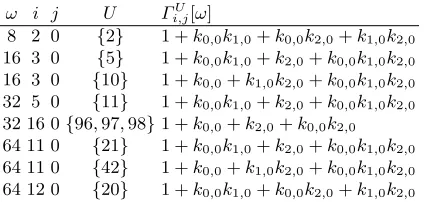
Example 1. For all possible common word sizes (ω = 8,16,32or64) we have been
key bitsk0,0,k1,0 andk2,0. Table 1 shows some of these quite striking relations. We also found relationsΓ1{,30}[8] = 1 +k2,0andΓ
{6,7,8,9,10}
1,0 [16] = 1 +k0,0involving only one key bit. Forω = 64, the three relations in Table 1 give 1.75 bits of information about(k0,0, k1,0, k2,0).
ω i j U Γi,jU[ω]
8 2 0 {2} 1 +k0,0k1,0+k0,0k2,0+k1,0k2,0
16 3 0 {5} 1 +k0,0k1,0+k2,0+k0,0k1,0k2,0
16 3 0 {10} 1 +k0,0+k1,0k2,0+k0,0k1,0k2,0
32 5 0 {11} 1 +k0,0k1,0+k2,0+k0,0k1,0k2,0
32 16 0{96,97,98}1 +k0,0+k2,0+k0,0k2,0
64 11 0 {21} 1 +k0,0k1,0+k2,0+k0,0k1,0k2,0
64 11 0 {42} 1 +k0,0+k1,0k2,0+k0,0k1,0k2,0
64 12 0 {20} 1 +k0,0k1,0+k0,0k2,0+k1,0k2,0
Table 1.Simple relations on three key bits(k0,0, k1,0, k2,0)
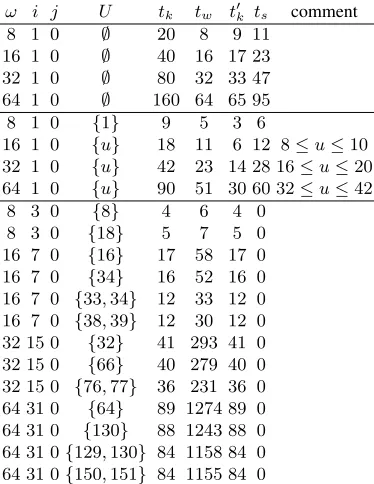
A more detailed analysis of the functionsΓi,jU[ω](W,K)for different values ofi,jand U reveals that many of these functions depend on only few bits of their(iω −l)-bit
and8ω-bit arguments. Lettwandtk respectively denote the number of bits ofW and
KwhichΓ effectively depends on. In addition lett0k out oftk bits come fromKand
the remainingts=tk−t0kbits fromS
?(rememberK= (K,S?)). Table 2 shows these
values for some of these functions.
Having in mind what we mentioned in section 2 and being too optimistic, we give the following proposition.
Proposition 1. If a functionΓi,jU is random-looking enough, recovering thetkunknown
bits of the extended key takes expected timei×tk×2l+tk.
The unity of time is processing one ciphertext word of the underlined self-synchronizing stream cipher. The factors2landicome from the following facts: computingΓ from
Fineeds2levaluations ofFi(rememberΓi,jU(W,K) =
L
U∈BlFi,j((U;W),K)) and computingFineedsiiterations of the cipher.
Even if the ideal condition of Proposition 1 is not satisfied, the only thing which is not guaranteed is that thetkinvolved unknown bits are uniquely determined. Yet some
information about them can be achieved. Refer to the note in section 2 regarding the equivalence classes.
ω i j U tk tw t0k ts comment
8 1 0 ∅ 20 8 9 11
16 1 0 ∅ 40 16 17 23
32 1 0 ∅ 80 32 33 47
64 1 0 ∅ 160 64 65 95
8 1 0 {1} 9 5 3 6
16 1 0 {u} 18 11 6 12 8≤u≤10 32 1 0 {u} 42 23 14 28 16≤u≤20 64 1 0 {u} 90 51 30 60 32≤u≤42
8 3 0 {8} 4 6 4 0
8 3 0 {18} 5 7 5 0
16 7 0 {16} 17 58 17 0
16 7 0 {34} 16 52 16 0
16 7 0 {33,34} 12 33 12 0 16 7 0 {38,39} 12 30 12 0 32 15 0 {32} 41 293 41 0 32 15 0 {66} 40 279 40 0 32 15 0 {76,77} 36 231 36 0 64 31 0 {64} 89 1274 89 0 64 31 0 {130} 88 1243 88 0 64 31 0{129,130} 84 1158 84 0 64 31 0{150,151} 84 1155 84 0
Table 2.Effective number of bits of each argument whichΓdepends on. Note that the functions having the same number of effective bits do not necessarily have the same involved variables.
(c1,4, c1,5, c1,6, c2,0, c2,1, c2,5, c2,6)of the ciphertext. The ANF of this function is:
Γ3{,180}[8] = 1 +k0,0k0,1+k0,0k0,1k2,0+k2,0k2,1+k0,0c1,4+
k0,0k2,0c1,4+k0,0k1,0c1,5+k0,0k1,0k2,0c1,5+
k0,0c1,6+k0,0k2,0c1,6+k2,0c2,0+k0,0k2,0c2,0+
k2,0c2,1+c2,0c2,1+k0,0c2,0c2,1+k2,0c2,0c2,1+
k0,0k2,0c2,0c2,1+k1,0k2,0c2,5+k2,0c2,6.
(7)
This equation can be seen as a system of2tw= 128equations versust
k = 5unknowns.
Our analysis of this function shows that only48of the equations are independent which on average can give3.5bits of information about the five unknown bits (2bits of infor-mation for25%of the keys and4bits for the remaining75%of the keys).
Example 3. Take the relationΓ7{,330,34}[16](W,K)from Table 2. This particular function depends ontk = 12 key bits and on tw = 33 ciphertext bits. Our analysis of this
function shows that on average about2.41bits of information about the 12 key bits can be achieved (10bits of information for12.5%of the keys,3bits for25%of the keys and0.67bits about the remaining62.5%of the keys).
function shows that on average about1.94bits of information about the 12 key bits can be achieved (10bits of information for12.5%of the keys,3bits for another12.5%of the keys and0.42bits for the remaining75%of the keys).
Example 5. Take the relationΓ7{,340}[16](W,K)from Table 2. This particular function depends ontk = 16 key bits and on tw = 52 ciphertext bits. Our analysis of this
function shows that on average about5.625bits of information about the 16 key bits can be achieved (13bits of information for25%of the keys,11bits for12.5%of the keys,4bits for another12.5%of the keys, and1bit for the remaining50%of the keys).
For larger values ofiwe expectΓto fit better the ideal situation of Proposition 1. There-fore, we give the following claim about the security of the64-bit version of Klimov-Shamir’s proposal.
Proposition 2. We expect each of the functions Γ31{129,0,130}[64] andΓ31{150,0,151}[64]to
reveal a large amount of information about the correspondingtk = 84involved key
bits for a non-negligible fraction of the keys. The required computational time is31×
84×22+84≈292.8.
In [7] the bits of the setU were calledweak IV bits. With the same terminology, here we call themweak ciphertext bits. How to find these weak bits was raised as an open question in [7]. In the next section we present a systematic procedure to find weak ciphertext bits, with the consequence of improving Proposition 2.
6
Towards a Systematic Approach to Find Weak Ciphertext Bits
The idea is to start with a setUand extend it gradually. At each step we examine all the ciphertext bits whichΓUdepends on, to choose an extendedU for the next step which
results in aΓwhich depends on the least number of key bits. Table 3 shows our simula-tion results by starting from funcsimula-tionΓ1{,410}[64]from Table 2 which effectively depends ontk = 90extended key bits andtw= 51ciphertext bits. Similar to Proposition 2, one
expects each of the functionsΓU
1,0[64]in Table 3 to reveal a large amount of information about the correspondingtkinvolved extended key bits (includingt0k effective key bits)
for a non-negligible fraction of the keys in timetk2l+tk, as indicated in the last
col-umn. In particular by starting from the function in the bottom of Table 3, (the promised large amount of information about) the involvedt0k = 12key bits andts= 33internal
state bits can be gained in time269.5(for a non-negligible fraction of the keys). Notice, that once we have the correct value for the unknown extended key for some function in Table 3, those of the previous function can be recovered by little effort. Therefore we present the following proposition.
Proposition 3. We expect that by starting fromΓ1{,10−9,32−41}[64]and going backwards toΓ1{,410}[64]as indicated in Table 3, a large amount of information about the involved
tk = 90 unknown bits (includingt0k = 30effective key bits) is revealed for a
Remark 2. By combining the results of different functionsΓ one can get better results. Finding an optimal combination demands patience and detailed examination of different Γ’s. We make this statement clearer by an example as follows. Detailed analysis of Γ31{129,0,130}[64]andΓ31{150,0,151}[64] shows that the key bits which they depend on are {0−27,64−90,128−156}and{0−28,64−90,128−155}, respectively. These two functions have respectively27and28bits in common with the30key bits{0−19,21− 30} involved inΓ1{,410}[64]. They also include the key bits{0,32,64}for which1.75 information can be easily gained according to Ex. 1. Taking it altogether it can be said that a large amount of information about the88key bits{0−30,32,64−90,128−156} can be achieved in time269.5with a non-negligible probability.
7
Conclusion
In this work we proposed a new analysis method for self-synchronizing stream ciphers which was applied to Klimov-Shamir’s example of a construction of a T-function based self-synchronizing stream cipher. We did not fully break this proposal but the strong key leakage demonstrated by our results makes us believe a total break is not out of reach. In future design of self-synchronizing stream ciphers one has to take into account and counter potential key leakage.
Acknowledgement: We would like to thank Martijn Stam for his helpful editorial comments.
References
1. J.-Ph. Aumasson, S. Fischer, S. Khazaei, W. Meier and C. Rechberger. New Features of Latin
Dances: Analysis of Salsa, ChaCha, and Rumba. InProceedings of Fast Software Encryption
FSE 2008, LNCS 5086, pp. 470-488, 2008.
2. E. Biham and E. Shamir. Differential Cryptanalysis of DES-like Cryptosystems. InIn
Pro-ceedings of CRYPTO’90, LNCS 537, pp. 2-21, 1991.
3. J. Daemen, L. R. Knudsen, V. Rijmen. The Block Cipher Square. InIn Proceedings of Fast
Software Encryption FSE’97, LNCS 1267, pp. 149-165, 1997.
4. I. Dinur and A. Shamir. Cube attacks on tweakable black box polynomials. InCryptology
ePrint Archive, Report 385, 2008.
5. H. Englund, T. Johansson, and M. S. Turan. A Framework for Chosen IV Statistical Analysis
of Stream Ciphers. InProceedings of INDOCRYPT 2007, LNCS 4859, pp. 268-281, 2007.
6. eSTREAM - The ECRYPT Stream Cipher Project - seewww.ecrypt.eu.org/stream.
7. S. Fischer, S. Khazaei and W. Meier. Chosen IV Statistical Analysis for Key Recovery
Attacks on Stream Ciphers InProceedings of AFRICACRYPT 2008, LNCS 5023, pp.
236-245, 2008.
8. A. Klimov and A. Shamir. New Applications of T-Functions in Block Ciphers and Hash
Functions. InProceedings of Fast Software Encryption (FSE 2005), LNCS 3557, pp. 18-31,
2005.
10. L. R. Knudsen and D. Wagner. Integral Cryptanalysis. InIn Proceedings of Fast Software Encryption FSE’02, LNCS 2365, pp. 112-127, 2002.
11. S. O’Neil. Algebraic Structure Defectoscopy. In Cryptology ePrint Archive, Report
2007/378. See alsohttp://www.defectoscopy.com.
12. M. Vielhaber. Breaking ONE.FIVIUM by AIDA an Algebraic IV Differential Attack. In