KATHOLIEKE UNIVERSITEIT LEUVEN FACULTEIT INGENIEURSWETENSCHAPPEN DEPARTEMENT ELEKTROTECHNIEK–ESAT Kasteelpark Arenberg 10, 3001 Leuven-Heverlee
Cryptanalysis of Stream Ciphers
Based on
Arrays and Modular Addition
Promotor:
Prof. Dr. ir. Bart Preneel
Proefschrift voorgedragen tot het behalen van het doctoraat in de ingenieurswetenschappen door
Souradyuti Paul
KATHOLIEKE UNIVERSITEIT LEUVEN FACULTEIT INGENIEURSWETENSCHAPPEN DEPARTEMENT ELEKTROTECHNIEK–ESAT Kasteelpark Arenberg 10, 3001 Leuven-Heverlee
Cryptanalysis of Stream Ciphers
Based on
Arrays and Modular Addition
Jury:
Prof. Dr. ir. Etienne Aernoudt, voorzitter Prof. Dr. ir. Bart Preneel, promotor Prof. Dr. ir. Andr´e Barb´e
Prof. Dr. ir. Marc Van Barel Prof. Dr. ir. Joos Vandewalle
Prof. Dr. Lars Knudsen (Technical University, Denmark)
Proefschrift voorgedragen tot het behalen van het doctoraat in de ingenieurswetenschappen door
Souradyuti Paul
Alle rechten voorbehouden. Niets uit deze uitgave mag vermenigvuldigd en/of openbaar gemaakt worden door middel van druk, fotocopie, microfilm, elektron-isch of op welke andere wijze ook zonder voorafgaande schriftelijke toestemming van de uitgever.
All rights reserved. No part of the publication may be reproduced in any form by print, photoprint, microfilm or any other means without written permission from the publisher.
D/2006/7515/88
To
my parents for their unyielding ambition to see me educated
and
My Gratitude
It feels awkward to claim the thesis to be singularly mine as a great number of people, directly or indirectly, participated in the process to make it see the light of day. At the end of such a long and laborious process, it is, therefore, a great pleasure for me to grab this opportunity to express my gratefulness.
First, I would like to express my sincere gratitude to my thesis supervisor Prof. Bart Preneel who not only guided me with technical help through this gestation period as a doctoral student, but also, most importantly, has shown me very convincingly the qualities, which an academician should acquire in order to reach the highest level of success. I strongly believe that I would continue in my pursuit to reach the standards he has set before me in those four and a half years of academic collaboration. I am also extremely indebted to him for putting up with all my nonsensical, silly questions, my emails fired at him at odd hours – be it academic or non-academic – with supreme patience and thereby, instilling in me a strong sense of self-confidence – something which I would always treasure. All in all, in hindsight, I feel that whatever little maturity that I have acquired since the time of being an all nervous student around five years ago, is pretty much due to the academic venture I was engaged with him in.
I am honored to have Prof. Andr´e Barb´e, Prof. Lars Knudsen, Prof. Marc Van Barel and Prof. Joos Vandewalle as the members of the jury and Prof. Etienne Aernoudt as the chairman of the jury.
During the doctoral period, I was extremely lucky to have the opportunity to supervise the theses of Gorka Munduate and Gautham Sekar. My own academic benefit from the joint work with them was immense.
In the past years, I came in contact with many cryptographers in diverse fields for their comments, remarks, opinions, suggestions on various topics. The list includes Eli Biham, Paul Crowley, Scott Fluhrer, Ilya Mironov, Kenneth G. Pa-terson, Palash Sarkar and Adi Shamir. I gratefully acknowledge their constructive comments.
My expression of gratitude will forever remain incomplete if I do not mention the name of Dai Watanabe who was the first to have made me appreciate the
particular, I would like to mention Alex, An, Antoon, Christophe, Christopher, Elena, Danny, Frederik, Gregory, Hirotaka, Hongjun, Jasper, Joe, Jongsung, Jorge, Michael, Nessim, ¨Oz¨gul, Robert, Stefaan, Taizo and Thomas.
Thanks are also due to Avishek Adhikari, Debrup Chakraborty, Kishan Chand Gupta, Matthew E. McKague, Alexander Maximov, Partha Mukhopadhyay, Sou-rav Mukhopadhyay, Mridul Nandi, Anirban Pal, Sankardas Roy and Sabyasachi Saha for many useful discussions on various branches of computer science includ-ing computer security.
Many thanks to Pela, Elvira and Ida for their priceless help with administra-tive matters.
Finally, I express my thankfulness to my parents and my brother for their constant encouragement and support without which the thesis would never have been possible.
Abstract
In modern cryptography, stream ciphers are most useful in applications where information needs to be encrypted/decrypted at high speed (e.g. high resolu-tion streaming video data) or when low footprint (gates/memory) encrypresolu-tion is required. In the literature, there exist plenty of stream ciphers whose internal states are based on arrays and that they use modular additions to generate output streams. The abundance of array-based stream ciphers with modular additions can be attributed to the fact that, when implemented in software skillfully, they are able to produce outputs at a very high speed. The main contribution of this thesis is a unified analysis of stream ciphers based on arrays and modular addi-tion. During the process, we detect cryptographic weaknesses in the designs of 9 widely known stream ciphers or pseudorandom bit generators (PRBGs).
At first, we show some theoretical results on solving an important class of equations known asdifferential equations of addition (DEA) that combine mod-ular additions over two different algebraic groups such as GF(2) and GF(232).
The results include,
• proof of the fact that the satisfiability of an arbitrary set of DEA is in the complexity classP,
• deriving all the solutions of an arbitrary set of DEA.
Next, we apply these results to attack a practical stream cipher named Helix (designed by Ferguson et al.) with both chosen plaintexts and adaptive chosen plaintexts.
In the second phase, the thesis closely scrutinizes a number of array-based stream ciphers (or PRBGs) in order to estimate their resistance against dis-tinguishing attacks. We eventually discover, counter-intuitively, that the cor-relations between the array-indices and their associated array-elements, which apparently seem to be useful from the point of view of implementation purposes, can be exploited to mount distinguishing attacks on such type of ciphers if ade-quate precautions are not taken. In support of our theoretical findings, we point out distinguishing attacks on 8 practical array-based stream ciphers (or PRBGs),
NGG (by Gonget al.); our attacks are based on the dependence of array-elements on array-indices. In all the cases we work under the assumption that the key-setup algorithms of the ciphers produce uniformly distributed internal states. We detect flaws in the mixing of bits in the keystream generation algorithms. Our analysis can be explained as the extension, development, adaptation and deeper characterization of the fortuitous states attacks on the RC4 cipher by Fluhrer and McGrew in 2000.
Samenvatting
In de moderne cryptografie bewijzen stroomcijfers vooral hun nut in toepassingen waar informatie op hoge snelheid ver- en ontsleuteld moet worden (bv. hoge-resolutie videosignalen), of wanneer de beschikbare hardware onderworpen is aan strenge beperkingen (maximaal aantal gates, geheugen, etc.). In de literatuur bestaan er tal van stroomcijfers waarvan de interne toestand bestaat uit arrays, en die gebruik maken van modulaire optelling om de uitgangsstroom te genereren. Het zeer grote aantal array-gebaseerde stroomcijfers met modulaire optelling kan toegeschreven worden aan het feit dat het gebruik van deze componenten in software kan leiden tot zeer snelle implementaties. De voornaamste bijdrage van deze thesis is een unificatie van de analyse van stroomcijfers die gebruik maken van arrays en modulaire optelling. Gedurende dit proces werden cryptografische zwakheden ontdekt in 9 wijdverspreide stroomcijfers en pseudo-willekeurige bit generatoren (PRBGs).
Eerst geven we een aantal theoretische resultaten die toelaten om een be-langrijke klasse van vergelijkingen op te lossen. Deze vergelijkingen, gekend on-der de naam differenti¨ele optellingsvergelijkingen (DEA) combineren modulaire optellingen over twee verschillende algebra¨ısche groepen zoals GF(2) en GF(232).
De resultaten omvatten:
• een bewijs dat de vraag naar oplosbaarheid voor een willekeurige verzamel-ing DEA gelegen is in de complexiteitsklasseP,
• een methode voor het afleiden van alle oplossingen van een willekeurige verzameling DEA.
Vervolgens passen we deze resultaten toe op het concrete stroomcijfer Helix (ont-wikkeld door Ferguson et al.), en voeren we een aanval uit gebruik makend van zowel gekozen als adaptief gekozen klaarteksten.
In een tweede fase spitst de thesis zich toe op een aantal array-gebaseerde stroomcijfers, met als doel hun weerstand tegen onderscheidingsaanvallen in kaart te brengen. Uiteindelijk ontdekken we, ietwat tegen-intu¨ıtief, dat de correlaties tussen de array-indices en hun overeenkomstige array-elementen, hoewel nuttig
genomen werden. Als bevestiging van onze theoretische conclusies, tonen we onderscheidingsaanvallen aan op 8 concrete array-gebaseerde stroomcijfers (of PRBGs): RC4 (ontworpen door Rivest), RC4A (door Paul en Preneel), Py, Py6 (ontwikkeld door Biham en Seberry), IA, ISAAC (ontworpen door Jenkins Jr.), GGHN, NGG (door Gonget al.). Al deze aanvallen berusten op de afhankelijk-heid van array-elementen en array-indices, en gaan uit van de veronderstelling dat de sleutel-initialisatie procedures van deze cijfers resulteren in een uniform verdeelde initi¨ele toestand. We ontdekken zwakheden in het mixen van bits in de sleutelstroomgeneratie. Onze analyse kan gezien worden als een uitbreiding, aanpassing, en verdere karakterisering van defortuitous states aanvallen op RC4 ontwikkeld door Fluhrer en McGrew in 2000.
Contents
1 Introduction 1
1.1 The Scope of Cryptology . . . 4
1.2 Symmetric Cryptology . . . 5
1.3 Stream Ciphers . . . 6
1.3.1 Mathematical Formulation . . . 6
1.3.2 Classification of Stream Ciphers . . . 7
1.3.3 Different Types of Attacks on Stream Ciphers . . . 10
1.4 Summary of the Results: Array and Modular Addition as Stream Cipher Components . . . 14
2 Differential Equations of Addition and Applications to the Helix Cipher 19 2.1 Introduction . . . 19
2.1.1 Model of Computation . . . 22
2.2 Solving an Arbitrary System of DEA . . . 23
2.2.1 Computing theCharacter Set and theUseful Set . . . 24
2.2.2 Precomputation . . . 24
2.2.3 Computation of ParametersGi,Si,0andSi,1from the Use-ful Set A˜ . . . 25
2.2.4 Satisfiability of DEA is inP . . . 26
2.2.5 Computing All the Solutions to a System of DEA . . . 29
2.3 Solving DEA in the Adaptive Query Model . . . 29
2.3.1 The Power of the Adversary . . . 30
2.3.2 The Task . . . 31
2.3.3 The Number of Solutions . . . 32
2.3.4 Worst Case Lower Bounds on the Number of Queries . . . . 33
2.3.5 Optimal Algorithms . . . 38
2.4 Solving DEA with Batch Queries . . . 40
2.4.1 The Power of the Adversary . . . 42
2.4.4 Algorithms . . . 47
2.5 Cryptographic Applications . . . 50
2.6 Conclusion and Further Research . . . 51
3 Cryptanalysis of the RC4 Stream Cipher 53 4 Design and Analysis of RC4A 55 4.1 Introduction . . . 55
4.2 RC4A: An Attempt to Improve RC4 . . . 55
4.2.1 RC4A Description . . . 56
4.3 Security Analysis of RC4A . . . 57
4.3.1 Precluding the Backtracking Algorithm by Knudsenet al. . 57
4.3.2 Resisting the Fortuitous States Attack . . . 60
4.3.3 Resisting the 2nd Byte Attack by Mantin and Shamir . . . 61
4.4 Attacks on the RC4A Stream Cipher . . . 61
4.5 Open Problems and Directions for Future Work . . . 61
4.6 Conclusions . . . 62
5 Cryptanalysis of Py 63 5.1 Introduction . . . 63
5.2 Description of Py . . . 64
5.2.1 Notation and Convention . . . 65
5.2.2 Assumption . . . 66
5.3 Motivational Observation . . . 66
5.4 Bias in the Distribution of the 1st and the 3rd Outputs . . . 68
5.5 The Distinguisher . . . 69
5.6 Biases among other Pairs of Bits and Distinguishers . . . 71
5.7 Generalizing the Bias at Roundstandt+2: A Distinguisher Using a Single Keystream . . . 74
5.8 A More Efficient Hybrid Distinguisher . . . 75
5.9 Do Our Distinguishers Break the Cipher Py? . . . 75
5.10 Future Work . . . 77
5.11 Conclusion and Remarks . . . 77
6 Array-based Stream Ciphers with Short Indices and Large Ele-ments: Attacks on Py6, IA, ISAAC, NGG, GGHN 79 6.1 Introduction . . . 79
6.1.1 Assumption . . . 82
6.2 Stream Ciphers Based on Arrays and Modular Addition . . . 82
6.2.1 Basic Working Principles . . . 82
6.2.2 Weaknesses and General Attack Scenario . . . 84
6.3 Distinguishing Attacks on Array-based Ciphers . . . 87
6.3.1 Bias in the Outputs of Py6 . . . 88
6.3.2 Biased Outputs in IA and ISAAC . . . 91
6.3.3 Biases in the Outputs of NGG and GGHN . . . 93
6.4 Data and Time of the Distinguishing Attacks . . . 96
6.5 A Note on IBAA, Pypy and HC-256 . . . 97
6.6 Conclusion . . . 97
7 Conclusions and Future Work 99 7.1 Results of the Thesis: In a Nutshell . . . 99
7.2 Open Problems . . . 100
A Helix 113 A.1 Proofs of Lemma 2.6 and Lemma 2.7 . . . 113
A.2 Proof of Lemma 2.11 . . . 114
A.3 Construction ofM from theLi’s . . . 114
B RC4 117 B.1 Criteria forito Reach an Index to Produce an Output . . . 117
B.2 Evaluation of the Maximum Value ofd2 . . . 118
C Py 119 C.1 Uniformity of Bits IfLDoes Not Occur . . . 119
List of Figures
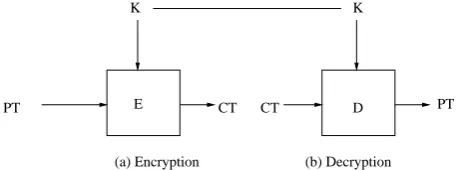
1.1 Encryption and Decryption: P T=Plaintext,CT=Ciphertext,K= Secret Key,E=Encryption Algorithm,D=Decryption Algorithm . 2 1.2 Encryption and decryption mechanisms of a synchronous stream
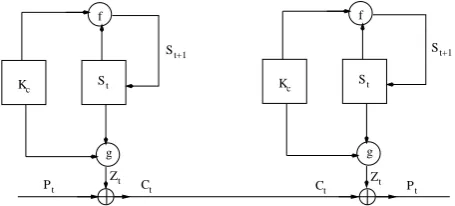
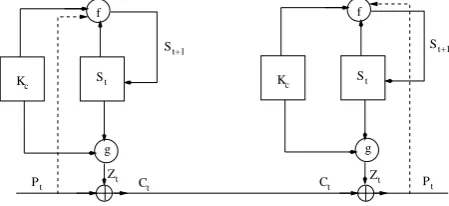
cipher . . . 8 1.3 Encryption and decryption processes of an asynchronous stream
cipher . . . 9 1.4 Encryption and decryption in a self-synchronizing stream cipher . 10 1.5 Regular distinguisher: adversary collects keystream produced by
a single key/IV . . . 12 1.6 Prefix distinguisher: adversary collects a few fixed bytes from
keystreams produced by many key/IVs . . . 13
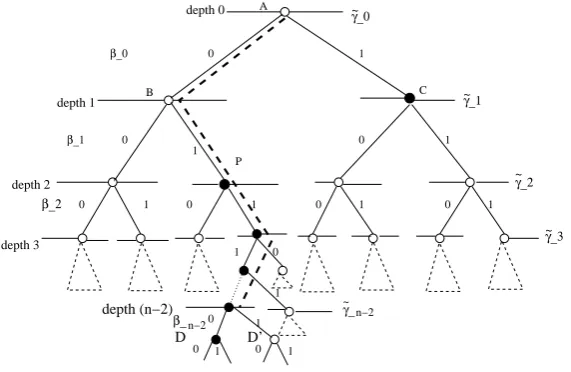
2.1 An arbitrary pathP in the subtree (black node indicates value 1 and white node 0) . . . 45
4.1 PRBG of RC4A . . . 57
5.1 (a) P1[26] = 1 (condition 5): G and H are used in O1,1, (b) Y2
(i.e., Y after the 1st round), (c)P3[208] = 254 (condition 6): G
andH are used inO2,3. . . 67
6.1 Internal State at (a) roundt and (b) roundt′=t+δ. . . 83 6.2 Py6: (a)P1[8] = 1 (condition 5): Gand H are used in Z1,1, (b)
Y2 (i.e., Y after the 1st round), (c)P3[21] = 62 (condition 6): G
andH are used inZ2,3 . . . 89
6.3 IA: (i) at roundtwhenmt[it+ 1] =a, (ii) at roundt+ 1 . . . 92
6.4 ISAAC: at roundt . . . 93 6.5 NGG: (a) the arrayS at the end of roundt, (b) the arrayS just
before output generation at roundt+ 1 . . . 94 6.6 GGHN: (a) the arrayS at the end of roundt, (b) the arrayS at
the end of roundt+ 1 . . . 96
2: no output; (c) Round 3: we reach Finney’s forbidden state as j3=i3+ 1 andS3[j3] = 1 . . . 118
C.1 Representations of Group 1 and Group 3 . . . 120 C.2 Group 2(a): I ↔ K, J ↔ L, M ↔ H, N ↔ G; Group 2(b):
I↔L,J ↔K,M ↔H,N ↔G . . . 121
List of Tables
2.1 The values of ˜γ(i+1)corresponding to (x(i), y(i), c(i)) (tabulated in
column k = 0) and (α(i), β(i),˜γ(i)) (tabulated in rowr = 0). A
row and a column are denoted byR(r) and Col(k). R(r)×Col(k) denotes the element in the table corresponding to row rand col-umnk. . . 25 2.2 New CP and ACP attacks on the Helix cipher . . . 51
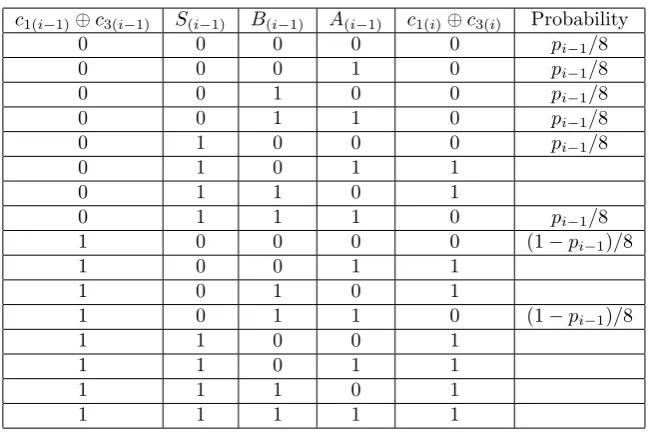
5.1 Truth table for (5.17). The last column in each row indicates the probability of the occurrence of that row . . . 73
6.1 Pros and cons of the RC4 Cipher . . . 81 6.2 Data and time of the distinguishers with advantage exceeding 0.5 . 96
List of Symbols
≪ cyclic left shift
≪ left shift
≫ cyclic right shift
≫ right shift
⇒ implies
⇔ implies and implied by
⊕ bitwiseexclusive-or of twon-bit integers
∧ bitwiseproduct of twon-bit integers
∨ bitwiseor of two n-bit integer
⊙ multiplication of twon-bit integers modulo 2n
+ addition of twon-bit integers modulo 2n
− subtraction of twon-bit integers modulo 2n
ab a∧b
GF(q) finite field withqelements
l(i) theith bit of an n-bit integerl (l(0) is thelsb)
n a positive integer
O order of complexity denoting asymptotic upper bound
Θ order of complexity denoting asymptotic tight bound
Ac complement of the eventA
[p, q] the set of integers{p, p+ 1, . . . , q} P[A] probability of occurrence of the eventA P[A|B] conditional probability ofAgivenB
PD[F(z) =c] probability ofF(z) =c wherez follows distributionD |S| the cardinality of the setS
X(m,n) the segment ofm−n+ 1 bits between themth and the
nth bits of the variable X Zq the set{0,1,2, . . . , q−1}
Zp
q p-fold Cartesian product of the setZq, i.e.,Zq×Zq× · · ·Zq
| {z }
ptimes
List of Abbreviations
ACP adaptive chosen plaintext
AES Advanced Encryption Standard
CP chosen plaintext
DC differential cryptanalysis
DEA differential equation(s) of addition
DES Data Encryption Standard
DTM deterministic Turing machine
ECRYPT European network of excellence for cryptology
eSTREAM ECRYPT stream cipher project
IV initialization vector
KSA key scheduling/setup algorithm
lsb least significant bit
MAC message authentication code
msb most significant bit
NESSIE New European Schemes for Signatures, Integrity and Encryption
N P class of problems solvable in polynomial time by an NTM
N PC class containing the hardest problems inN P
NTM non-deterministic Turing machine
P class of problems solvable in polynomial time by a DTM
PRBG pseudorandom bit generator
RAM random access machine
RSA Rivest-Shamir-Adleman
S-box substitution box (or vectorial Boolean function)
SSL secure sockets layer
TLS transport layer security/secure sockets layer
WEP wired equivalent privacy
XOR bitwise exclusive-or
Chapter 1
Introduction
To begin is half the work..
– Ausonius (310-395)
Cryptology is the science of hiding information from unauthorized users, and making them available to the legitimate ones. The word cryptology is derived from two Greek words: krypt´os which means ‘hidden’ andlogos meaning ‘word’. Historically, the art of secret writing is as old as the time of Pharaos of ancient Egypt. Julius Caesar (100 BC – 44 BC) is known to have had used some specific techniques, known asCaesar cipher, to protect messages of high military worth. In fact, the emergence of classical cryptology as a well structured scientific dis-cipline from a mere black art of middle ages has been greatly influenced by the growing military needs of modern times to disguise sensitive information from the enemy. It is still debated whether the breaking of the German secrecy system
Enigma by the Allied cryptologists (one of them was the famous British mathe-matician Alan Turing who is deemed the father of modern computer science) had shortened the duration of the World War II significantly. Interested readers are highly recommended to look at the classical book The Codebreakers by David Kahn that traces the evolution of cryptology since the dawn of civilization till the age of the modern computer science [43].
Modern cryptology is all about protecting sensitive information on the Inter-net from several forms of abuses. As a result the scope of cryptology is no longer limited to just military applications. As Internet banking, Electronic money transfer (e.g. payment through credit cards), Internet Shopping (e.g. ordering books on the amazon.com) are being widely used all over the world nowadays, the subject of cryptology has evoked unprecedented interest and enthusiasm in both industry and academia.
K
E D
PT CT CT PT
(a) Encryption (b) Decryption K
Figure 1.1: Encryption and Decryption: P T=Plaintext, CT=Ciphertext, K= Secret Key,E=Encryption Algorithm,D=Decryption Algorithm
Encryption and Decryption Algorithms. At the heart of cryptology, there are two mathematical functions E and D which are used for encryption and
decryption respectively (schematic diagram in Fig. 1.1). Another component, known as the secret key K, also plays an important role in cryptologic applica-tions. The functions E and D are publicly known but thesecret key is known only to the sender and the receiver of the message. Let us take an example. Suppose Alice wants to send a confidential email to Bob through an unprotected path which can be accessed by all. In other words, the email sent by Alice to Bob can be captured midway by a third party whose name is, say Oscar. Alice (the sender) will encrypt the email (technically called message) using the func-tionE and a secret keyK. Thus, if the message isP T then Alice generates the encrypted codeE(K, P T) =CT. The encrypted codeCT is then sent out on an insecure channel. At the receiving end Bob gets CT and decrypts it to recover the original message using the functionD and the shared secret key K, i.e., by performing the operationD(K, CT) =P T. When Oscar captures the encrypted message on the way, he tries to recover P T from CT without the knowledge of the secret key K. The system fails if Oscar succeeds. The system is consid-ered secure if the recovery of the original message from the encrypted message is ‘impossible’ without the knowledge of the secret key.
The main research in cryptology centers around designing the mathematical functionsEandDsuch that the communication is secure in a manner argued in the previous paragraph. An unconditionally secure cryptosystem is the classical
Vernam Cipher or one-time pad. The encryption and the decryption functions of theVernam cipher are as follows (more on the perfect security of theVernam cipher in [86]).
Encryption:CT = P T ⊕K, Decryption:P T = CT ⊕K.
3
of the plaintext. This condition renders this cipher completely impractical as, in most applications, long messages are required to be encrypted. In fact, no practical cryptosystem has so far been proved to be secure. Scores of cryptosys-tems are proposed at the conferences and in the journals every day and they are broken, sometimes more quickly than they are designed. This alternate making and breaking of secrecy systems, unlike any other scientific research, keep the practitioners of this subject always on an adrenalin rush.
A Few Notable Encryption/Decryption Algorithms. One of the most widely used cryptographic algorithms, known as the DES Cryptosystem (abbre-viation for Data Encryption Standard) designed by a team of IBM and selected as an official Federal Information Processing Standard (FIPS) for the United States in 1976, was once thought to be secure for a long time. DES has a block size of 64 bits and a key size of 56 bits. However, with the emergence of faster machines, the 56-bit key length of DES turned out to be too short to be secure against brute force attack. In addition, new sophisticated mathematical techniques were also developed to even to improve the brute force attack. Those methods are known as (1)Differential Cryptanalysis, publicly invented by Biham, Shamir in 1992 [9], and (2) Linear Cryptanalysis discovered by Matsui [54] in 1993. After its fail-ure, the DES Cryptosystem is being gradually replaced by a new standard called the AES Encryption Algorithm (Advanced Encryption Standard), also known as Rijndael named after its two Belgian designers Rijmen and Daemen of the Katholieke Universiteit Leuven [19]. The block size of AES is 128 bits. There are three possible key sizes for AES: 128, 192 and 256 bits. Till now, barring a few occasional rumors, AES-Rijndael has survived all attacks and is considered to be exceptionally strong.
Cryptosys-tem which is based on the hardness of a well known number theoretic problem of factoring large integers [78]. Discussion of how this type of cryptosystems works is out of the scope of this thesis, however, the underlying mathematical problem, which is the lifeblood of this type of secrecy system, can be described in a few words. If l =mn where m and n are large prime numbers then, given l, it is hard to determine the prime factors m and n quickly. Another very popular public key encryption system is the El Gamal cryptosystem which is based on the hardness of the discrete logarithm problem. The discrete logarithm problem is: given two elements g and hin a finite groupG, find an integerxsuch that gx=h. For example, the solution to the problem 3x= 10 (mod 17) is 3, because
33 = 27 = 10 (mod 17). This problem is assumed to be hard when considered
over some groups of large orders. Discrete logarithm problem, when considered in a slightly complex setting such as an elliptic curve group, can be used to build another important public key cryptosystem, known as Elliptic Curve Cryptosys-tem (ECC). Many other algebraic hard problems such as solving multivariate polynomial equations are also under investigation for the purpose of information hiding [94]. An elaborate discussion of the above cryptosystems can be found in [56, 88].
1.1
The Scope of Cryptology
Today the scope of cryptology is not limited to data encryption and decryption
only as mentioned above. The boundary of the subject is in continuous process of expansion and modification. The main purposes of cryptology are threefold: (i) confidentiality of message, (ii) message authentication and (iii) entity authen-tication.
• Confidentiality
– Alice wants to send a message to Bob through an insecure channel. Oscar, who captures the message midway, should not be able to learn any information about the contents.
– Cryptographic tools or primitives used to protect confidentiality are encryption algorithms and decryption algorithms.
– Examples: RC4 [76], AES [19].
• Message Authentication
– This service detects unauthorized alteration of data.
1.2. SYMMETRIC CRYPTOLOGY 5
accepted by Bob as original. For example, let the message sent from Alice to Bob be“India is a friend of Belgium.” The message during transmission should not become“India is an enemy of Belgium.”and be received by Bob as original.
– Cryptographic tools or primitives used to secure message authentica-tion are hash funcauthentica-tions (e.g. MD4 [74], MD5 [75], RIPEMD-160 [23], SHA-0 [83], SHA-1 [84], SHA-2 [85]), message authentication codes (MAC) [71] and digital signatures (e.g. DSS [24]).
• Entity Authentication
– Alice is communicating with Bob. Alice (claimant) will be able to prove her identity to Bob (verifier) by demonstrating knowledge of a secret known to be associated with her, without revealing the secret itself to Bob.
– Challenge-response protocols (e.g. Kerberos [62]), zero-knowledge pro-tocols (e.g. Fiat-Shamir [28] protocol) prove the identity of one party to the other.
The reader is kindly referred to [56] and [88] for extensive discussions on various subareas in cryptology.
1.2
Symmetric Cryptology
According to the nature of the secret keys used in the encryption or decryption algorithms, cryptology can be divided into two broad classes. If both the en-cryption and deen-cryption algorithms use the same shared key, then they come under symmetric cryptology. The encryption and decryption algorithms shown in Fig. 1.1 use the same secret key. Under symmetric cryptology, there are two ways in which information or data can be encrypted and decrypted: one is using a block cipher and the other is using a stream cipher. It is, however, worth not-ing that the distinctions between the functionalities of stream ciphers and block ciphers are not very sharp; they are partly quantitative and partly qualitative. These two types of ciphers should be viewed as two concrete points on a contin-uous design spectrum [82].
Stream Cipher. Stream cipher is an algorithm where
• both the encryption and the decryption functions use the shared secret key,
• the processing of data is usually fast,
• key processing is completely separate from the plaintext processing,
• plaintext processing is remarkably simple.
Block Cipher. Block cipher is an algorithm where
• both the encryption and the decryption functions use the shared secret key,
• encryption/decryption function to encrypt/decrypt a unit of message (usu-ally a large block of message) does not vary with time,
• key and plaintext are processed together in a relatively complex function.
Elaborate discussion on mathematical formalization of block ciphers and stream ciphers can be found in [56] and [88].
As most of the thesis deals with cryptanalysis of various stream ciphers, a brief discussion on different types of stream ciphers sounds justifiable.
1.3
Stream Ciphers
1.3.1
Mathematical Formulation
Typically a stream cipher consists of two phases: (i) a key setup algorithm (KSA) and (ii) a pseudorandom bit generation algorithm (PRBG). The KSAs on both the encryption and decryption sides are identical. However, the PRBG on the encryption side is slightly different from the one on the decryption side.
(i) Key Setup Algorithm. The inputs to the KSA are a secret key K and a known initialization vector IV. The output from the KSA is the initial internal state of the cipher, denoted byS0. Mathematically,
KSA(K,IV) =S0. (1.1)
(ii) Pseudorandom Bit Generation Algorithm. In this phase random look-ing stream of bits are generated sequentially. At any round tof the PRBG, the memory of a stream cipher consists of (1) an internal state St, (2) the key K
and (3) the initialization vector IV. Henceforth, theK/IV pair will be denoted byKc. It is also possible that theKc does not exist as a separate entity at some
round t; rather, after going through a transformation it becomes a part of the internal state St. Typically, at a round t, a stream cipher produces output Zt
1.3. STREAM CIPHERS 7
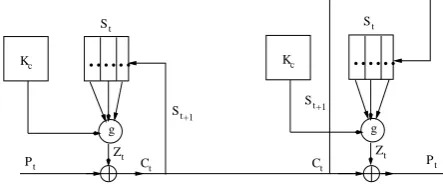
In general, three functions are executed at any round of the PRBG. The operations on the encryption side is as follows:
Zt=g(St, Kc), Ct=Zt⊕Pt, St+1=f(St, Kc, X).
(1.2)
Similarly, the operations on the decryption side is:
Zt=g(St, Kc), Pt=Zt⊕Ct, St+1=f(St, Kc, X).
(1.3)
The variableX in the above equations is eitherPtorCt. The value ofS0can be
computed from Kc.
Asymptotic Definition of a PRBG. Theoretically, the behavior of a crypto-graphically strong pseudorandom bit generator (CSPRBG) is analyzed asymp-totically in terms of the length ofkey (also known asseed). Note that, for most of the practical stream ciphers, such as RC4, Helix, the key lengths are fixed. From the theoretical point of view, a CSPRBG is an algorithmAthat, on being given a random seedkas input, generates a sequence of pseudo-random bitsa1,
a2, a3,· · ·. The function A possesses the following properties (see Blum and
Micali [11]):
1. Each bitai can be produced in time polynomial in the length of seedk.
2. Given the algorithmAand the firstsoutput bits generated by an unknown seedk, it iscomputationally infeasible to predict thes+ 1st bit with biased probability. The stringsis polynomial in the length of the seedk.
1.3.2
Classification of Stream Ciphers
Depending on the usage of different variables involved in the functions f and g of the PRBG, as shown in (1.2) and (1.3), stream ciphers are broadly classified into three categories: (1) synchronous, (2) asynchronous and (3) self-synchronous.
Synchronous Stream Cipher
A synchronous stream cipher is one which generates Zt (known as keystream)
function for this case becomes
Zt=g(St, Kc), Ct=Zt⊕Pt, St+1=f(St, Kc).
(1.4)
Similarly, the decryption function is
Zt=g(St, Kc), Pt=Zt⊕Ct, St+1=f(St, Kc).
(1.5)
Example: Py [6]. Working principles of a synchronous stream cipher are shown in Fig. 1.2. Some interesting properties of a synchronous stream cipher are worth
t
Kc S
f g f g St Kc
St+1 St+1
t
Z
t
C Ct
Pt t
Z Pt
Figure 1.2: Encryption and decryption mechanisms of a synchronous stream cipher
noting.
• The modes of operation of a synchronous stream cipher only allows for
known plaintext orknown ciphertext attacks as the keystream is produced independently of theplaintextor theciphertext. Chosen plaintextorchosen ciphertext attacks are not possible here.
• If some bits are deleted from or inserted into the ciphertext accidentally during message transmission, it is imperative to restart transmission with a new pair of key/IV to establish synchronization at both the encryption and the decryption ends. This process is known as resynchronization mecha-nism. Evidently,resynchronizationis quite expensive in this type of ciphers.
1.3. STREAM CIPHERS 9
• A secure synchronous stream cipher is a suitable candidate to be used as a PRBG.
Asynchronous Stream Cipher
An asynchronous stream cipher is one where the generated keystream depends on the plaintext or the ciphertext. Example: Helix [33]. Working principles of an asynchronous stream cipher are shown in Fig. 1.3. The encryption function for the cipher in Fig. 1.3 is:
Zt=g(St, Kc), Ct=Zt⊕Pt, St+1=f(St, Kc, Pt).
(1.6)
Similarly, the decryption function is:
Zt=g(St, Kc), Pt=Zt⊕Ct, St+1=f(St, Kc, Pt).
(1.7)
Two important features of this class of ciphers are as follows.
t
Kc S
f g f g St Kc
St+1 St+1
t
Z
t
C
Pt t
Z
t
C Pt
Figure 1.3: Encryption and decryption processes of an asynchronous stream ci-pher
• In general, the main disadvantage of this type of ciphers is that, if few bits of the ciphertext are altered then the error propagates through other ciphertext bits too.
• This type of ciphers admit of bothchosen plaintext/chosen ciphertext and
Self-synchronizing Stream Cipher
Self-synchronizing stream ciphers are a special case of asynchronous stream ci-phers. Aself-synchronizing stream cipher is one where the keystreamZtis
com-pletely determined by the key/IV pair and afixed of number preceding cipher-text bits. Example: MOSQUITO [42]. Working principles of a self-synchronizing stream cipher are shown in Fig. 1.4.
The advantages of aself-synchronizing stream cipher over asynchronous stream
c
Pt Pt
Kc
S
t
S St
K
g g
t
Z
t
C Ct Zt
t
S t+1
...
...
+1
Figure 1.4: Encryption and decryption in a self-synchronizing stream cipher
cipher are listed below.
• As the internal state dependsonlyon afixednumber of preceding ciphertext bits, the state can be fully recovered even after alteration, modification, deletion or insertion of some ciphertext words during transmission.
• For the same reason as above, error in some ciphertext bits only affects the decryption process for a limited number of subsequent bits.
However advantages the ciphers may have over others, design of a secure self-synchronizing stream cipher has so far turned out to be a difficult task. This fact has been reflected in the weaknesses discovered in all of this type of ciphers (SSS, MOSQUITO) of the ongoing ECRYPT eSTREAM project [18, 42].
1.3.3
Different Types of Attacks on Stream Ciphers
Broadly a stream cipher is analyzed against three types of attacks: (i) key recov-ery attack, (ii) distinguishing attack and (iii) related key attack.
1.3. STREAM CIPHERS 11
• secret key,
• an initialization vector (IV) (explained before),
• plaintext,
• ciphertext.
Note that except the secret key an adversary can select all the other parameters suitably to attack the cipher. Therefore, the ultimate target of the adversary is to derive the secret key by properly selecting the other parameters. Depending on the power of adversary, the modes of attacks on stream ciphers are listed below.
• Ciphertext Only Attack. This is the strongest form of attack. In this case the adversary recovers the key from the ciphertext only, no matter what the other parameters are.
• Chosen Ciphertext Attack. In this case the adversary chooses the ci-phertext and observes the corresponding plaintext. From the cici-phertext- ciphertext-plaintext pair the adversary finally recovers the key using the decryption algorithm. One variant ofchosen ciphertext attack is the adaptive chosen ciphertext attack. In such type of attacks, the adversary collects a number of ciphertext-plaintext pairs where the next ciphertext is determined from the previous ciphertext-plaintext pairs.
• Known Plaintext Attack. As the title suggests, the key is recovered from the known plaintext and the corresponding ciphertext.
• Chosen Plaintext Attack. In this case the adversary chooses the plain-text and recovers the key using the plainplain-text-cipherplain-text combination. In
adaptive chosen plaintext attack, the adversary collects a set of plaintext-ciphertext pairs where the next plaintext is computed from the previous plaintext-ciphertext pairs.
• Known IV Attack. In this mode of attack, only the IV and the ciphertext is known.
• Chosen IV Attack.In this case the adversary chooses the IV and recovers the key using the IV-ciphertext combination. In a similar way as described above, adaptive chosen IV attack is also possible.
• Combination of the above.
(ii) Distinguishing Attack. Apart from key recovery attack, another type of attack, known as distinguishing attack, is also possible on a stream cipher. A
random stream of bits, that is, a stream of bits that has been chosen according to the uniform distribution. There are several ways a cryptanalyst may try to distinguish between a string, generated by an insecure pseudorandom bit gener-ator, and one from a perfectly random source.
(a) Regular or Weak Distinguisher. In this case, the adversary selects a single
key/IV randomly and produces keystream, seeded by the chosen key/IV, long enough to distinguish it from random with high success probability. This attack
K Key/IV
key stream bytes
Figure 1.5: Regular distinguisher: adversary collects keystream produced by a single key/IV
scenario is rather common and suchdistinguisher is called aregular distinguisher
(see Fig. 1.5). In this scenario the adversary is “weak” as she has a keystream produced by a single key rather than many, and therefore the distinguisher is also called aweak distinguisher.
(b) Prefix or Strong Distinguisher. In this scenario, to build a distinguisher, the adversary may usemany randomly chosen key/IVs rather than a single key and a fewspecifiedbytes from each of the keystreams generated by those key/IVs (see Fig. 1.6). The distinguisher, so constructed, is called aprefix distinguisher. In this case the adversary is “strong” because she may collect outputs to her advantage from many keystreams to detect a bias. Therefore, thedistinguisher
so constructed is also termed astrong distinguisher. A bias present in the output at time t in a single stream may hardly be detected by a regular distinguisher
but aprefix distinguisher can easily discover the anomaly with a few bytes. This fact was nicely demonstrated by Mantin and Shamir [53] to detect a strong bias toward zero in the second output byte of RC4.
1.3. STREAM CIPHERS 13
keystream bytes K
K
K
K K
1
2
3
4
5
n
Key/IV Fixed Bytes
K
Figure 1.6: Prefix distinguisher: adversary collects a few fixed bytes from keystreams produced by many key/IVs
The idea of constructing distinguishers using many randomly chosen key/IVs has been a well studied subject. Goldreich has shown that a distribution which is computationally indistinguishable from the uniform distribution based on a
single sample is alsocomputationally indistinguishable from theuniform distri-bution based onmultiple samples [34].
Advantage of a Distinguisher. Theadvantage of a distinguisherF is a mea-sure which indicates the efficiency of the algorithmFto distinguish a distribution D0 from another distributionD1. It is given by the following formula [3]:
AdvF=PD0[F(z) = 1]−PD1[F(z) = 1]. (1.8)
related. This relation can be used to recover secret key if some other conditions are satisfied [30].
1.4
Summary of the Results: Array and Modular
Addition as Stream Cipher Components
The discourse on the rudiments of cryptology now lead us gradually to move deeper into the main contribution of this thesis. One of the major inspirations for working on stream ciphers for a Ph.D. thesis is to catch up with the recent flurry of activities and increased interests among the cryptologists to design sophisticated stream ciphers and to develop powerful cryptanalytic techniques to analyze them. This recent such enthusiasm in the areas of stream ciphers is largely attributed to two European projects: (1) NESSIE which stands for New European Schemes for Signatures, Integrity and Encryption [61] and (2) ECRYPT which is a Network of Excellence within the Information Societies Technology (IST) Programme of the European Commission [25]. The NESSIE project, which lasted four years (from 2000 till 2004), is ironically a failed one with respect to stream ciphers, as none of the submitted stream ciphers could be included in the final portfolio. However, this project indubitably established the requirements for deeper and more comprehensive study of stream ciphers. As a result, another European project eSTREAM (under the umbrella of ECRYPT), which called for primitives on stream ciphers only, was started in February 2004. In April 2005, ECRYPT received 34 candidate stream ciphers for its eSTREAM project.
This thesis scrutinizes a special class of stream ciphers which use arrays as internal states and modular additions as the main operations to produce output streams. In the course of our investigation, we show cryptanalytic attacks on 9 well known practical stream ciphers. Below we summarize the results of the thesis chapter by chapter.
1.4. SUMMARY OF THE RESULTS 15
and oracle output γ. The challenge is to optimize the number of queries to solve (x+y)⊕((x⊕α) + (y ⊕β)) = γ. Our algorithm solves this equation with only 3 queries in the worst case. Another algorithm solves the equation (x+y)⊕(x+ (y⊕β)) =γ with (n−t−1) queries in the worst case (t is the position of the least significant ‘1’ ofx), and thus, outperforms the previous best known algorithm by Muller – presented at FSE ’04 [59]– which required 3(n−1) queries. Most importantly, we show that the upper bounds, for our algorithms, on the number of queries match worst case lower bounds. This, essentially, closes further research in this direction as our lower bounds areoptimal. We also solve the above equations with a set of batch queries. Our algorithms require 6 and 2n−2 queries to solve the above equations where the lower bounds are 3
4·2 n−2
(theoretically proved) and 4 (based on extensive experiments) respectively. The above results are used to cryptanalyze a recently proposed cipher, namely Helix [33], which was a candidate for consideration in the 802.11i standard. We recover the secret key of the cipher with 210.6adaptive chosen plaintextswhich is
an improvement on the previous best known attack by a factor of 3 (the attack can be improved by a factor of 46.5 in the best case). Furthermore, for the first time, we show a key-recovery attack with 235.6 chosen plaintexts rather than
adaptive chosen plaintexts. All the above attacks assume reuse of nonce similar to the assumptions of all previous attacks.
The results of this chapter have been published in the volumes 3574 and 3797 ofLecture Notes in Computer Science [66, 67].
Chapter ??. Next, we analyze the RC4 stream cipher which is the most widely used software based stream cipher. The cipher is based on a secret internal state of N = 256 bytes and two pointers. This thesis proposes an efficient algorithm to compute a special set of RC4 states namednon-fortuitous predictive states. These special states increase the probability to guess part of theinternal state in a known plaintext attack and present a cryptanalytic weakness of RC4. The problem of designing a practical algorithm to compute them has been open since it was posed by Mantin and Shamir in 2001. We also formally prove a slightly corrected version of the conjecture by Mantin and Shamir of 2001 that, using onlyaknown elements along with the two pointers at some round, the RC4 pseudorandom generation algorithm cannot produce more thanaoutputs in the nextN rounds. Then, we present a new statistical bias in the distribution of the first two output bytes of the RC4 keystream generator. The number of outputs required to reliably distinguish RC4 outputs from random strings using this bias is only 225 bytes. Most importantly we show that the bias does not disappear even if the initial 256 bytes of the keystream are dropped.
The results of this chapter have been published in the volumes 2904 and 3017 ofLecture Notes in Computer Science [64, 65].
RC4A, which is based on RC4’s exchange shuffle model. It is shown that the new cipher offers increased resistance against most attacks that apply to RC4. RC4A uses fewer operations per output byte and offers the prospect of implementations that can exploit its inherent parallelism to improve its performance further. We also mention two distinguishing attacks on this cipher.
The results of this chapter have been included in the volume 3017 ofLecture Notes in Computer Science [65].
Chapter 5. After RC4, RC4A and Helix, we focus our attention on another array-based stream cipher Py which was designed by Biham and Seberry. Py is also a submission to the ECRYPT stream cipher competition. The cipher is based on two large arrays (one is 256 bytes and the other is 1040 bytes) and it is designed for high speed software applications (Py is more than 2.5 times faster than the RC4 on Pentium III). In the thesis we show a statistical bias in the distribution of its output-words at the 1st and 3rd rounds. Exploiting this weakness, a distinguisher with advantage greater than 50% is constructed that requires 284.7 randomly chosen key/IV’s and the first 24 output bytes for each key. The running time and the data required by the distinguisher aretini·284.7
and 289.2 respectively (tini denotes the running time of the key/IV setup). We
further show that the data requirement can be reduced by a factor of about 3 with a distinguisher that considers outputs of later rounds. In such case the running time is reduced to tr·284.7 (tr denotes the time for a single round of
Py). The Py specification allows a 256-bit key and a keystream of 264 bytes per
key/IV. As an ideally secure stream cipher with the above specifications should be able to resist the attacks described before, our results constitute an academic break of Py. In addition we have identified several biases among pairs of bits; it seems possible to combine all the biases to build more efficient distinguishers.
The results of this chapter have been published in the volume 4047 ofLecture Notes in Computer Science [68].
Chapter 6. In this chapter, from the experience of the attacks on the ciphers described above, we investigate the security of array-based stream ci-phers against certain types of distinguishing attacks in a unified way. We argue, counter-intuitively, that the most useful characteristic of an array, namely, the association of array-elements with unique indices, may turn out to be the origins of distinguishing attacks if adequate caution is not maintained. In short, an ad-versary may attack a cipher simply exploiting the dependence of array-elements on the corresponding indices. Most importantly, the weaknesses are not elim-inated even if the indices and the array-elements are made to follow uniform distributions separately. Exploiting these weaknesses we build distinguishing attacks with reasonable advantage on five recent stream ciphers, namely, Py6 (2005, Bihamet al.), IA, ISAAC (1996, Jenkins Jr.), NGG, GGHN (2005, Gong
1.4. SUMMARY OF THE RESULTS 17
Similar to the RC4 and the Py, in all the above cases also we worked under the assumption that the key-setup algorithms of the ciphers produced uniformly dis-tributed internal states. We only investigated the mixing of bits in the keystream generation algorithms. In hindsight, we also observe that the previous attacks on the other array-based stream ciphers (e.g. Py, etc.), can also be explained in the general framework developed in this chapter. It seems that our analyses will be useful in the evaluation of the security of stream ciphers based on arrays and modular addition.
The results of this chapter will be published shortly in a volume ofLecture Notes in Computer Science [69].
Chapter 2
Differential Equations of
Addition and Applications
to the Helix Cipher
Science is a differential equation. Religion is a boundary condition.
-Alan Turing (1912-1954)
2.1
Introduction
Addition modulo 2n. Mixing addition modulo 2n (+) with other Boolean
operations such as exclusive-or (⊕), or (∨) and/or and (∧) is extensively used in symmetric cryptography. The main motivation for includingaddition mod 2n
in cryptographic primitives is that it is a nonlinear transformation over GF(2) and the operation is extremely fast on all present day architectures. Nonlinear transformations are of paramount importance in the design of ciphers as they make functions hard to invert. Helix [33], IDEA [50], Mars [12], RC6 [77], and Twofish [81] which mix modularaddition withexclusive-or are a few examples of the application ofaddition. Very recently Klimov and Shamir also used an update function for internal state, known as aT-function, whereaddition is mixed with
multiplication andor in a certain fashion to achieve many useful properties of a secure stream cipher [45, 46].
Keeping with the trend of widespread use ofaddition in symmetric ciphers, there is a large body of literature that studies equations involvingaddition from many different angles. Staffelbach and Meier investigated the probability dis-tribution of the carry for integer addition [87]. Wall´en explained the linear
proximations of modular addition [93]. Lipmaa and Moriai [51] investigated the equation (x+y)⊕((x⊕α) + (y⊕β)) =γ, where α,β are the input differences and γ is the output difference, to compute many differential properties. The dual of the above equation (x⊕y) + ((x+α)⊕(y+β)) =γwas investigated for differential properties by Lipmaaet al. [52].
Differential Cryptanalysis (DC). Differential Cryptanalysis, introduced by Biham and Shamir [9], is one of the most powerful attacks against symmetric ciphers. There are broadly two lines of attacks based on DC. The first line of attack exploits the occurrences of input or output differences with nontrivial probabilities. In a cipher that is secure against DC, input and output differences should behave ‘pseudorandomly’, so that none of them can be guessed from any known values with a nontrivial probability. This line of attack usually results in distinguishing attacks [91]. A second line of attack is much stronger but more difficult to implement than the other. It recovers secret information from known input and output differences, akin to the algebraic attacks [59]. Note that this second line of attack implies the first but the converse is not true. Therefore, provable security against DC – introduced by Laiet al.[50] and first implemented by Nyberg and Knudsen [63] – remained a key factor in the evaluation of the se-curity of a cipher. However, the sese-curity of many complex modern ciphers against DC is hard to evaluate because of lack of theory to evaluate the security of its components. Our target is to mount a second line of attack (i.e., to recover secret information) on the much used symmetric cipher componentaddition modulo2n.
Definition of DEA. There are two basic addition equations under DC where differences of inputs and outputs are expressed asexclusive-or.
(x+y)⊕(x+ (y⊕β)) = γ , (2.1) (x+y)⊕((x⊕α) + (y⊕β)) = γ . (2.2) These equations are nameddifferential equations of addition (DEA). While en-gaged in cryptanalysis of MD5, Berson noted in 1992 that, for largen, it ishard
to analyze modular addition when differences are expressed as XOR [4]. This may have motivated the use ofaddition in conjunction with XOR in many sym-metric ciphers to increase resistance against DC.
Our Results. The results of this chapter can be divided into four parts.
(i) Solving an Arbitrary Set of DEA (elaborated in Sect. 2.2): we show that the satisfiability of a randomly generated set of DEA is in the complexity class
P. In other words, a Turing machine can show in O(nk) time whether there
2.1. INTRODUCTION 21
k >0 is an integer-valued constant computed from the degree of the polynomial (in n) which is an upper bound on the number of equations to be solved). This result, on one hand, gives deeper insight into the behavior of addition under DC. On the other hand this leaves a cautionary note for the cryptographers to be more careful about using addition in the design. Outside cryptography, satisfiability of a system of equations has a natural appeal to many areas such as computational complexity, combinatorics, circuit optimization and computer algebra (remember the most famousN P-Complete satisfiability problem: Boolean formula satisfia-bility [14]). For example, if a large system of DEA is NOT satisfiable then the whole circuit representing the system of DEA can be safely removed to optimize the circuit complexity. Going beyond the satisfiability problem, we also give an efficient algorithm to compute all the solutions to a randomly generated system of DEA with running time linear in the number of solutions. Another subtle but a noteworthy aspect of our work is the departure from the traditional technique for solving multivariate polynomial equations over GF(2) [2]. We heavily benefit from certain properties of DEA and solve such systems combinatorially.
(ii) Solving DEA with Adaptive Queries (elaborated in Sect. 2.3): next we extend our work to solve DEA in a crypto-friendly adaptive query model. The aim is to minimize the search space of the secret (x, y) using aminimum number of adaptive queries (α, β). Such an optimization problem – typically used to re-duce data complexity of adaptive chosen plaintext attacks – was first tackled by Muller [59] for (2.1). But an optimal solution has been elusive until now. We achieve optimal solutions for both the equations. We show that a worst case lower bound on the number of queries (0, β) to solve (2.1) is (n−t−1) where (n−t) > 1 with t being the bit-position of the least significant ‘1’ of x. A worst case lower bound on the number of queries (α, β) to solve (2.2) is 3 for n > 2. Most importantly, for solving the above equations we also design algo-rithms whose upper bounds on the number of queries match worst case lower bounds. Note that our algorithm outperforms the previous best known algo-rithm by Muller to solve (2.1) – presented at FSE ’04 – which required 3(n−1) queries [59]. Over and above, our results essentially close further investigation in this particular direction as the equations are solved with anoptimal number of queries in the worst case. It is particularly interesting to note that, for (2.2), although the number of all queries grows exponentially with the input sizen, an optimal lower bound to solve (2.2) is 3 for alln >2, i.e., constant asymptotically.
(iii) Solving DEA with Batch Queries (elaborated in Sect. 2.4): from crypto-graphic point of view,batch queriesare more practical than theadaptive queries. Attacks based on batch and adaptive queries are equivalent to chosen plaintext
attack, the queries are submitted all at once, where in an ACP attack the queries are submitted adaptively, i.e., the next query is submitted based on the answers to the previous queries – a situation which is difficult to implement in practice. There is a large number of research papers launching CP and ACP attacks on many practical ciphers. For example, the boomerang attack introduced by Wag-ner is an ACP attack [92] and, therefore, less practical. The slide attacks by Biryukov and Wagner can be implemented using both CP and ACP but with different amount of data and time [10]. The time-memory trade-off attack by Hellman [39] and the differential attack on DES by Biham and Shamir [9] are CP attacks; so they are attributed more practical importance.
Therefore, it is also important to solve DEA with batch queries where the adversary has access to only one computing oracle (note that, with adaptive queries, the attacker has access to two computing machines). Our algorithm solves (2.1) with 2n−2queries submitted in a batch, where a lower bound on the number of queries is 3
4·2
n−2 (for alln >3), i.e., our lower bound is optimal up
to a constant factor of 4
3. This exponential lower bound constitutes an
impor-tant theoretical reference point which endorses the equations’s strong resistance against DC. On the other hand, (2.2) has been solved with only 6 (for alln >2)
batch queries which is two more than a conjectured lower bound (note that the total number of queries is 22n) – this fact shows a major cryptographic weakness
ofadditionunder DC and therefore, this component should be used with caution.
(iv) Cryptanalysis of the Helix Cipher (elaborated in Sect. 2.5): our results can be used to cryptanalyze a recently proposed cipher, namely Helix [33], which was a candidate for consideration in the 802.11i standard. We recover the secret key of the cipher with 210.6 adaptive chosen plaintexts. This attack is an improvement on the previous best known attack by a factor of 3 [59]. We also show that the attack can be improved by a factor of 46.5 in the best case. In addition, we also demonstrate, for the first time, that the Helix cipher can also be attacked with 235.6chosen plaintexts rather thanadaptive chosen plaintexts. Note that both of
the above attacks are built under the assumption of reuse of nonce similar to the previous attack on it by Muller [59].
2.1.1
Model of Computation
The purpose of the chapter is to solve (2.1) and (2.2) for (x, y) using triples (α, β, γ) wherex, y, α, β, γ∈Zn2. The operation ‘+’ overZ2nwill be viewed as
a binary operation overZn2 using the bijection that maps (l(n−1), · · · , l(0))∈Zn2
tol(n−1)2n−1+· · · +l(0)20∈Z2n. Therefore, ‘+’ :Zn2 ×Zn2 →Zn2.
2.2. SOLVING AN ARBITRARY SYSTEM OF DEA 23
one-processor Random Access Machine (RAM) (i.e., instructions are executed sequentially) with a memory that is composed of an unbounded sequence of reg-isters each capable of containing an integer. Typically, RAM instructions consist of simple arithmetic operations (addition and bitwise XOR in our case), stor-ing, addressing (direct and indirect) and branchstor-ing, each of which is a constant time operation. However, the choice of RAM instructions is relatively less im-portant because algorithms based on two reasonable sets of instructions will have the same asymptotic complexity. A detailed analysis of RAM can be found in [1, 32]. It can be shown that a polynomial-time solvable problem on a RAM is also polynomial-time solvable on aTuring Machineand vice versa.
2.2
Solving an Arbitrary System of DEA
Our aim is to solve for (x, y) from the following set of differential equations of addition overZn
2,
(x+y)⊕((x⊕α[k]) + (y⊕β[k])) =γ[k], k= 1,2· · ·m . (2.3) We observe that theith bit ofγ[k] can be written as
γ[k](i)=x(i)⊕y(i)⊕c(i)⊕x˜(i)⊕y˜(i)⊕c˜(i), i∈[0, n−1], (2.4)
where ˜x(i) = x(i)⊕α[k](i) and ˜y(i) = y(i)⊕β[k](i) and c(i), ˜c(i) are computed
from the following recursion,
c(0) = c˜(0)= 0,
c(j+1) = x(j)y(j)⊕x(j)c(j)⊕y(j)c(j),
˜
c(j+1) = x˜(j)y˜(j)⊕x˜(j)˜c(j)⊕y˜(j)˜c(j), where j∈[0, n−2]. (2.5)
Thus we see that γ[k](i) is a function of the least (i+ 1) bits of x, y, α[k] and
β[k]. More formally,
γ[k](i) = Fi(x(0),· · ·, x(i), y(0),· · · , y(i),
α[k](0),· · ·, α[k](i), β[k](0),· · · , β[k](i)). (2.6)
Therefore, from a system of m differential equations of addition, a total of mn multivariate polynomial equations over GF(2) can be formed by ranging (k, i) through all values in (2.6).
as relinearization [44] have been proposed to solve a special case of overdefined systems of multivariate polynomial equations. Note that, in our case, the number of unknowns and equations are 2nandmnrespectively (ifm >2 then the system of equations is overdefined). However, taking full advantage of the specific nature of the differential equations of addition, we shall use a combinatorial technique to prove that, although the satisfiability of an arbitrary multivariate polynomial equation over GF(2) is N P-complete, this special cryptographically important subclass of equations is in the complexity class P(see [14], [40] for definitions of N P, P, N PC). Finally, we also derive all the solutions to a system of such equations.
2.2.1
Computing the
Character Set
and the
Useful Set
From (2.3) we construct A = {(α[k], β[k], γ[k])| k ∈ [1, m]} assuming (α[k], β[k], γ[k])’s are all distinct.1 We callA thecharacter set for that particular set of equations. Our first step is to transform the system of equations defined in (2.3) into a new set of equations overZn
2 as defined below,
(x+y)⊕((x⊕α[k]) + (y⊕β[k]))⊕α[k]⊕β[k] = ˜γ[k], k= 1,2· · ·m; (2.7) where ˜γ[k] =γ[k]⊕α[k]⊕β[k]. Now, we construct ˜A,
˜
A={(α, β,γ˜=α⊕β⊕γ)|(α, β, γ)∈A}. (2.8) We call ˜Atheuseful set. Let all the solutions for (2.3) and (2.7) be contained in the setsA-consistent and ˜A-consistent respectively. It is direct to show that
A-consistent = ˜A-consistent. (2.9)
Our aim is to compute A˜-consistent fromA˜.
2.2.2
Precomputation
Take an arbitrary element (α, β,γ˜) ∈ A˜ (n > 1). Observe that ˜γ(i+1) can be
computed usingx(i), y(i), c(i), α(i), β(i),˜γ(i), ∀i ∈[0, n−2], from the following
three equations:
˜
γ(i+1) = c(i+1)⊕˜c(i+1),
c(i+1) = x(i)y(i)⊕x(i)c(i)⊕y(i)c(i),
˜
c(i+1) = x˜(i)y˜(i)⊕x˜(i)˜c(i)⊕y˜(i)c˜(i)
where c(i) is the carry at the ith position of (x+y), ˜x(i) = x(i)⊕α(i), ˜y(i) =
y(i)⊕β(i) and ˜c(i)=c(i)⊕˜γ(i). Table 2.1 lists the values of ˜γ(i+1)as computed
from all values ofx(i), y(i), c(i), α(i), β(i),γ˜(i).



![Figure 5.1: (a) PY1[26] = 1 (condition 5): G and H are used in O1,1, (b) Y2 (i.e., after the 1st round), (c) P3[208] = 254 (condition 6): G and H are used inO2,3](https://thumb-us.123doks.com/thumbv2/123dok_us/1857791.1241280/91.595.169.394.125.282/figure-py-condition-used-round-condition-used-ino.webp)