
Further Results on Implicit Factoring in Polynomial
Time
Santanu Sarkar and Subhamoy Maitra
Indian Statistical Institute, 203 B T Road, Kolkata 700 108, India
{santanu r, subho}@isical.ac.in
Abstract. In PKC 2009, May and Ritzenhofen presented interesting problems related to factoring large integers with some implicit hints. One of the problems is as follows. Consider N1 = p1q1 and
N2 =p2q2, wherep1, p2, q1, q2are large primes. The primesp1, p2are of same bit-size with the constraint that certain amount of Least Significant Bits (LSBs) of p1, p2 are same. Further the primesq1, q2 are of same bit-size without any constraint. May and Ritzenhofen proposed a strategy to factorize both
N1, N2in poly(logN) time (Nis an integer with same bit-size asN1, N2) with the implicit information that p1, p2 share certain amount of LSBs. We explore the same problem with a different lattice-based strategy. In a general framework, our method works when implicit information is available related to Least Significant as well as Most Significant Bits (MSBs). Given q1, q2 ≈N
α
, we show that one can factor N1, N2 simultaneously in poly(logN) time (under some assumption related to Gr¨obner Basis) whenp1, p2share certain amount of MSBs and/or LSBs. We also study the case whenp1, p2share some bits in the middle. Our strategy presents new and encouraging results in this direction. Moreover, some of the observations by May and Ritzenhofen get improved when we apply our ideas for the LSB case.
Keywords: Implicit Information, Prime Factorization.
1
Introduction
Very recently, in [10], a new direction towards factorization with implicit information has been introduced. Consider two integers N1, N2 such that N1 = p1q1 and N2 = p2q2 where
p1, q1, p2, q2are primes andp1, p2sharetleast significant bits (LSBs). It has been shown in [10]
that when q1, q2 are primes of bit-sizeαlog2N, then N1, N2 can be factored simultaneously
if t ≥2α. This bound on t has further been improved when N1 =p1q1, N2 =p2q2, . . . , Nk=
pkqk and all the pi’s share t many LSBs. The motivation of this problem comes from oracle
based complexity of factorization problems. Prior to the work of [10], the main assumption in this direction was that an oracle explicitly outputs certain amount of bits of one prime. The idea of [10] deviates from this paradigm in the direction that none of the bits of the prime will be known, but some implicit information can be available regarding the prime. That is, an oracle, on input to N1, outputs a different N2 as described above. A nice motivation
towards the importance of this problem is presented in the introduction of [10].
platforms. Towards the partial results for efficient factorization in classical domain (factoring with explicit information from an oracle according to [10]), Rivest and Shamir [13] showed thatN (where N =pq) can be factored efficiently when 3
5log2pmany MSBs ofpare known.
Later, Coppersmith [1] improved this bound, where 1
2log2p many MSBs of p need to be
known for efficient factorization.
In this paper we assume the equality of either the MSBs or the LSBs or some portions of LSBs as well as MSBs, i.e., we consider that p1, p2 share either t many MSBs or t many LSBs
or total t many bits considering LSBs and MSBs together. Further, we consider the case when the primes share certain amount of bits at the middle. Our approach in solving the problem is different from that of [10].
Following this introductory section, in Section 2, we present the technical results con-sidering the LSBs and/or MSBs of p1, p2 are same. Section 2.1 considers LSBs and MSBs
together and the most general result is presented here. Sections 2.2, 2.3 follow the general idea for specific cases considering only the MSBs and LSBs. Comparisons with the existing work [10] is presented in Section 2.3. Next in Section 3, we consider the case when the primes
p1, p2 share a contiguous portion of bits at the middle. Section 4 explores the case when a
few MSBs of q1 or q2 are known. Section 5 concludes the paper.
All the theoretical results are supported by experiments. We have written the programs in SAGE 3.1.1 over Linux Ubuntu 8.04 on a computer with Dual CORE Intel(R) Pentium(R) D 1.83 GHz CPU, 2 GB RAM and 2 MB Cache.
Our strategy is based on lattice reduction [8] followed by Gr¨obner Basis technique [3, Page 77]. For detailed notion on the technique we use, the readers are referred to [11, 4, 5]. The main idea follows the generalized strategy for finding roots of multivariate polynomials as explained in [4]. In this regard, we like to point out that the polynomials, that we use in Theorems 1, 2, have not been studied earlier following the technique of [4] and one may note that these polynomials are not covered in [5, Table 3.2, Section 3.4].
Before proceeding further, let us clarify an assumption that is required for our theoretical results. Suppose we have a set of polynomials{f1, f2, . . . , fi}onn variables having the roots
of the form (x1,0, x2,0, . . . , xn,0). Then it is known that the Gr¨obner Basis {g1, g2, . . . , gj}, of
J =< f1, f2, . . . , fi >(the ideal generated by {f1, f2, . . . , fi}), preserves the set of common
roots of{f1, f2, . . . , fi}. For our problems, we assume that the roots can be collected efficiently
from {g1, g2, . . . , gj}. Though this is true in practice as noted from the experiments we
perform, we formally state the following assumption that we will consider for our theoretical results.
Assumption 1. Consider a set of polynomials {f1, f2, . . . , fi} on n variables having the
roots of the form (x1,0, x2,0, . . . , xn,0). Let J be the ideal generated by {f1, f2, . . . , fi}. Then
we will be able to collect the roots efficiently from the Gr¨obner Basis ofJ.
2
Implicit Factoring of Two Large Integers
Here we present the exact conditions on p1, q1, p2, q2 under which N1, N2 can be factored
efficiently.
Throughout this paper, we will considerp1, p2 are primes of same bit size andq1, q2 are primes
of same bit size. ThusN1 =p1q1 andN2 =p2q2 are also of same bit size. We useN to represent
an integer of same bit size as of N1, N2.
2.1 The General Result
We first consider the case where some amount of LSBs as well as some amount of MSBs of
p1, p2 are same. Based on this, we present the following generalized theorem.
Theorem 1. Let N1 = p1q1 and N2 = p2q2, where p1, q1, p2, q2 are primes. Let q1, q2 ≈
Nα. Consider that γ
1log2N many MSBs and γ2log2N many LSBs of p1, p2 are same. Let
β = 1−α −γ1 −γ2. Under Assumption 1, one can factor N1, N2 in polynomial time if
−4α2
−2αβ− 1
4β
2
+ 4α+5
3β−1<0 provided 1− 3
2β−2α≥0.
Proof. It is given that γ1log2N many MSBs and γ2log2N many LSBs of p1, p2 are same.
Thus, we can write p1 =N
1−α−γ1P
0+Nγ2P1+P2 and p2 =N
1−α−γ1P
0+Nγ2P10+P2. Thus,
p1−p2 =Nγ2(P1−P10). SinceN1 =p1q1 andN2 =p2q2, puttingp1 = Nq1
1 andp2 =
N2
q2, we get Nγ2
(P1−P10)q1q2−N1q2+N2q1 = 0. Thus we need to solvef0(x, y, z) =Nγ2xyz−N1x+N2y=
0 whose roots corresponding tox, y, zareq2, q1, P1−P10. Since there is no constant term inf0,
we define a new polynomialf(x, y, z) = f0(x−1, y, z) =Nγ2xyz−Nγ2yz−N
1x+N1+N2y.
The root (x0, y0, z0) off is (q2+ 1, q1, P1−P10). The idea of modifying the polynomial with a
constant term was introduced in [2, Appendix A] and later used in [4] which we follow here. Let X, Y, Z be the upper bounds of q2 + 1, q1, P1 − P10 respectively. As given in the
statement of this theorem, X = Nα, Y = Nα, Z = Nβ. Following the “Extended Strategy”
of [4, Page 274],
S = [
0≤k1≤t
{xiyjzk+k1
:xiyjzk is a monomial of fm},
M ={ monomials ofxiyjzkf :xiyjzk ∈S}.
We exploit tmany extra shifts of z wheret is a non-negative integer. Our aim is to find two more polynomials f0, f1 that share the root (q2+ 1, q1, P1−P10) over the integers.
From [4], we know that these polynomials can be found by lattice reduction if
Xs1 Ys2
Zs3
< Ws, (1)
where s=|S|,sj =Pxi1
yi2
zi3
∈M\Sij forj = 1,2,3, and W =||f(xX, yY, zZ)||∞≥N1X.
One can check
s1 = m
3
2 +
5
2m
2
+ 4m+ 2 + 2t+ 3
2m
2
t+7
2mt,
s2 = 5
6m
3
+ 4m2
+37
6m+ 3 + 2t+ 3
2m
2t
+ 7
s3 = 1 2m 3 +5 2m 2
+ 4m+ 2 + 3 2t
2
+7
2t+
3
2m
2
t+mt2
+9
2mt, and
s = 1
3m 3 +3 2m 2 +13
6 m+ 1 +t+m 2
t+ 2mt.
Let t = τ m, where τ is a nonnegative real number. Neglecting the lower order terms, form (1), we get the condition as
Xm 3 2 + 3 2m 2
tY 56m 3+3
2m 2
tZm
3 2 +
3 2m
2
t+mt2
< Wm 3 3 +m
2
t.
That is, we neglect the o(m3
) terms when one putst =τ m. Then the required condition is
τ2β+ (2α+3
2β−1)τ + (α+
β
2 − 1
3)<0. (2)
The optimal value of τ, to minimize the left hand side of (2), is 1−
3 2β−2α
2β . Putting this
optimal value, the required condition becomes −64α2
−32αβ −4β2
+ 64α+80
3β−16<0.
That is, when this condition holds, according to [4], we get two polynomialsf0, f1 such that
f0(x0, y0, z0) =f1(x0, y0, z0) = 0. Under Assumption 1, we can extractx0, y0, z0 following the
method of [9, Section 6] in poly(logN) time. ut
Remark 1. In the proof of Theorem 1, we have applied extra shifts over z. In fact, we have tried with extra shifts on x, y too. However, we have noted that the best theoretical as well as experimental results are achieved using extra shifts on z.
Looking at Theorem 1, it is clear that the efficiency of this factorization technique depends on the total amount of bits that are equal considering the most and least significant parts together. Next we present an example below.
Example 1. Let us consider 750-bit primes p1 and p2
3804472805395186392319221660578496208300951856349524536490291627689678450887 3994603764416042481638726883020251099785398270595309011413652074066298289696 31841459373573878076619162688905451127596423509967449841486470692918256969. and 3804472805395186392319221660578496208300951856349524536490291627689216610760 8916018165804358808795724349647533346298650637180633006710173703444662098451 70635265772659883844077694434985101401094132819711524954637781487537874249. Note that p1, p2 share 222 many MSBs and 220 many LSBs, i.e., 442 many bits in total.
Further, q1, q2 are 250-bit primes
1788684495317470472835032661187758515078190921640698934821176591562967327967and
1706817658439540390758485693495273025642629127144779879402852507986344279931
respectively. Given N1, N2, with only the implicit information, we can factorize both of
them efficiently. We use lattice of dimension 105 (parameters m = 3, t = 2) and the lattice
reduction takes 6227.76 seconds. ut
2.2 The MSB Case
The study when p1, p2 share some MSBs has not been considered in [10], which we present
Corollary 1. Let N1 =p1q1 and N2 =p2q2, where p1, q1, p2, q2 are primes. Let q1, q2 ≈Nα,
and |p1 − p2| < Nβ. Under Assumption 1, one can factor N1, N2 in polynomial time if
−4α2
−2αβ− 1
4β
2
+ 4α+5
3β−1<0 provided 1− 3
2β−2α≥0.
Thus fixing the bit-size of N, if the bit-size of q1, q2 (i.e., α) increases, then the equality
of the MSBs of p1, p2 should increase (i.e., β should decrease) for efficient factorization of
N1, N2.
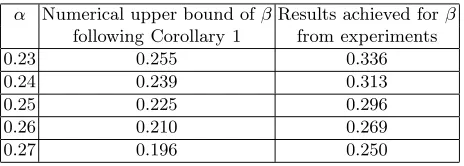
The theoretical as well as experimental results are presented in Table 1. The experimental results in each row are based on average of five runs whereN1, N2 are 1000-bit integers. The
experiments in Table 1 are performed with lattice dimension 46 (parameters m = 2, t = 1) and each lattice reduction takes around 30 seconds.
To explain the results of Table 1, let us concentrate on the first row. As α= 0.23, we have
q1, q2 are of bit size 0.23×1000 = 230. Thus,p1, p2 are of bit size 1000−230 = 770. Now, the
numerical value from Corollary 1 tells that 770−0.255×1000 = 515 many MSBs ofp1, p2need
to be equal to have efficient factorization of N1, N2 simultaneously. However, the average of
the experimental results are more encouraging which shows that only 770−0.336×1000 = 434 many MSBs of p1, p2 need to be equal.
α Numerical upper bound ofβResults achieved forβ
following Corollary 1 from experiments
0.23 0.255 0.336
0.24 0.239 0.313
0.25 0.225 0.296
0.26 0.210 0.269
0.27 0.196 0.250
Table 1.Theoretical and experimental values of α, βfor whichN1, N2 can be factored efficiently.
Remark 2. From Table 1 it is clear that we get much better results in experiments than the theoretical bounds. This is because, for the parameters we consider here, the shortest vectors belong to some sub-lattice. However, the theoretical calculation in Theorem 1 cannot capture that and further, identifying such optimal sub-lattice seems to be difficult. This kind of scenario, where experimental results perform better than theoretical estimates, has earlier been observed in [4, Section 7.1] too.
We also present evidences to show that higher lattice dimension provides better experi-mental results. In Examples 2, 3, we find that when α = 0.25, the values of β that can be achieved are as high as 0.308, 0.311 respectively for lattice parameters m = 3, t= 2. These results are better than the average β = 0.296 as presented in Table 1 for m= 2, t = 1.
Example 2. Consider 750-bit primes p1 and p2
38951443158292762268189891045388828922478530615979139037853178431738420087and
3967780110926558985695599259225508707353082348138173713914249580078148537872 6599867324275434123532276863604353073078110457548149609597672639849904669875 11414871763397210786172961055167000499946887837157176166275686743465332147. Note thatp1, p2 share 442 many MSBs. Further, q1, q2 are 250-bit primes
1791405259026492103131865184203435870047916914753003354202248185126637129539and
1359854273468970113914581544928445498889538930116761650886947228775354080297
respectively. Given N1, N2, with only the implicit information, we can factorize both of
them efficiently. We use lattice of dimension 105 (parameters m = 3, t = 2) and the lattice
reduction takes 6457.84 seconds. ut
Example 3. As another experimental result, consider 750-bit primes p1 and p2
3103293851234545621612884177271352199071965229969307590769556901553501696121 4868945041507537781070498998947022575729439699731098420594278482621105745216 61287756193724060104016731225285634163002534645448007119837656454227440177and
3103293851234545621612884177271352199071965229969307590769556901553501696121 4868945041507537781070498998947022575729439699731098420635006115660343901889 86791515114690594523923567275780555267831035031294553991617471138271288077. Note thatp1, p2 share 439 many MSBs. Further, q1, q2 are 250-bit primes
1761986055485501596400884508719659270275271677762068580864458138443043985389and
1793915333056311315115475413216227307458109801843263226409813428452265284467
respectively. Given N1, N2, with only the implicit information, we can factorize both of
them efficiently. We use lattice of dimension 105 (parameters m = 3, t = 2) and the lattice
reduction takes 7150.09 seconds. ut
The next example considers the primes p1, p2 of 650 bits and q1, q2 of 350 bits. This is to
demonstrate how our method works for larger q1, q2.
Example 4. Consider 650-bit primes p1 and p2
3275958003351638061986916939385797455267819362579720819294801659002592355528 2893332469832365701407840301695473429414066056981682108757248559561847864539 49781113664574387794170322092125817649417089and
3275958003351638061986916939385797455267819362579720819294801659002592355528 2893332469832365701407840301695473429414066056981682108757248559561847864539 49781116017823491796542769181094911460404833.
Note thatp1, p2 share 528 many MSBs. Further, q1, q2 are 350-bit primes
1823227073736496017375980522958217483156482551719830362235263547237757846388 546536472532649209077149673483and
2198082402853042081264929588674625335352875813205705506006454409313585071920 396431401126233354206989620787 respectively. Given N1, N2, with only the implicit
infor-mation, we can factorize both of them efficiently. We use lattice of dimension 105 (parameters
m= 3, t= 2) and the lattice reduction takes 10709.84 seconds. ut
In Theorem 1, we have considered that given the conditions, we can find f0, f1 by lattice
four polynomialsf0, f1, f2, f3 that come after lattice reduction. LetJ be the ideal generated
by{f, f0, f1, f2, f3}and let the corresponding Gr¨obner Basis be G. We studied the first three
elements ofG and found that one of them is of the formya(x−q2
q1y−1), where a is a small
positive integer. We observed a= 0,1,2 considering the experiments listed in Sections 2, 3. Note thatx0 =q2+ 1, y0 =q1 is the root of this polynomial.
Thus the result of Theorem 1 and the experimental evidences show that under certain conditions polynomial time factoring is possible with implicit hints.
2.3 The LSB Case
Let us first explain the ideas presented in [10]. Let N1 =p1q1 and N2 =p2q2. In [10, Section
3], it has been explained that if q1, q2 ≈ Nα, then for efficient factorization of N1, N2, the
primes p1, p2 need to share at least 2αlog2N many LSBs.
Our strategy is different from the strategy of [10] and we follow the result of Theorem 1 to get the result.
Corollary 2. Let N1 =p1q1 and N2 =p2q2, where p1, q1, p2, q2 are primes. Let q1, q2 ≈Nα.
Consider thatγlog2N many LSBs ofp1, p2 are same, i.e.,p1 ≡p2 modNγ. Letβ = 1−α−γ.
Under Assumption 1, one can factor N1, N2 in polynomial time if −4α2−2αβ− 1
4β
2
+ 4α+
5
3β−1<0 provided 1− 3
2β−2α≥0.
The numerical values related to the theoretical result of [10] and Corollary 2 as well as the experimental results are presented in Table 2. The experimental results in each row are based on one run where N1, N2 are 1000-bit integers. The experiments in Table 2 are
performed with lattice dimension 46 (parameters m = 2, t = 1) and each lattice reduction takes around 30 seconds. Similar to the observation in Section 2.2, we note from Table 2 that better results are obtained in experiments than the theoretical bound. We believe the reason is same as explained in Remark 2, Section 2.2.
α Numerical upper bound ofβNumerical upper bound of βResults achieved forβ
following [10] following Corollary 2 from experiments
0.23 0.31 0.255 0.336
0.24 0.28 0.239 0.314
0.25 0.25 0.225 0.296
0.26 0.22 0.210 0.268
0.27 0.19 0.196 0.251
Table 2.Theoretical and experimental values of α, βfor whichN1, N2 can be factored efficiently.
In our notation, the number of MSBs in each ofp1, p2 that are unshared isβlog2N. Thus
β = (1−α)−2α= 1−3α, whereαlog2N is the bit size ofq1, q2. Table 2 identifies that while
has been pointed out that for 250-bitq1, q2 and 750-bitp1, p2, the primesp1, p2 need to share
502 many LSBs. We have implemented the strategy of [10] and observed similar results. On the other hand, our experimental results are better as evident from Table 2, when α= 0.25. In fact, we experimented with a higher lattice dimension as explained in Examples 5, 6 and our strategy requires only 440 and 438 many LSBs respectively to be shared in p1, p2.
These results are better than [10], where 502 many LSBs have been shared.
Example 5. In this experiment, consider 750-bit primes p1 and p2
5232464401790173496889776813731992463007796797197958752484439607191540455235 6608087324378089911735572744300332234102069657955934461989289309962068103250 78810654140616439325724089448684722792481034854929045247229685114499401607and
4311796718402237315332622037900773800355832324549261614699895316190733254104 0376948850231036794311185546576317750184830286997614825307318419096215142451 35730269665188193197190838441262406453523279005533091728042442492020950919. Note that p1, p2 share 440 many LSBs which will be clear if one writes p1, p2 in binary and
checks the LSBs. Further, q1, q2 are 250-bit primes
1631651738790114027147107602960138604308539138427653628254827153426896347739and
1776124692833044236475237348456766321872003926797460168161822934670015844393
respectively. Given N1, N2, with only the implicit information, we can factorize both of
them efficiently. We use lattice of dimension 105 (parameters m = 3, t = 2) and the lattice
reduction takes 7160.63 seconds. ut
Example 6. Here we consider 750-bit primes p1 and p2
5895254139679228077142387416586490039613283191466241401307494261824605966908 4690420722716275439075281566487074700579275565739610880278518405272767367010 03322173329476277711235116947599147048863366019662261619304575961682668297and
4392119049423447468690947059559090008016802774014559696547174955333794465234 2861564934625350120675407265601224878945969002652471346685040069850301681742 01428949181076294088915910886847055459554005392066246146594876423472933641. Note thatp1, p2 share 438 many LSBs. Further, q1, q2 are 250-bit primes
916010977814643010666950783967979656772444969801926690589674791043059104197and
1587061752065032326280290326014711341044827082150757395718254111544994945759
respectively. Given N1, N2, with only the implicit information, we can factorize both of
them efficiently. We use lattice of dimension 105 (parameters m = 3, t = 2) and the lattice
reduction takes 7273.52 seconds. ut
The next example considers the primes p1, p2 of 650 bits and q1, q2 of 350 bits. This is to
demonstrate how our method works experimentally for largerq1, q2.
Example 7. Here we consider 650-bit primes p1 and p2
31370558899010969090775314583271711200148784533831527325125302572763631682927 85241218747273712763711037157637711966791419526760377688029885676273831127205 611509045644179511599106554189421550654601and
40545001634090447037011441230660481097503555238640524767415889480913091786359 014934176726120292021849927924906510931081.
Note thatp1, p2 share 531 many LSBs. Further, q1, q2 are 350-bit primes
18514205888865174789397135953034924041903821127915515977985711433395162336134 45774636517955322189132943773and
22583503051484782188700251613256676376586234088559388990147583389496665081155 61055599847183651567682695481
respectively. Given N1, N2, with only the implicit information, we can factorize both of
them efficiently. We use lattice of dimension 105 (parameters m = 3, t = 2) and the lattice
reduction takes 15016.42 seconds. ut
We now discuss in more details how our strategy compares with that of [10]. It is in-deed clear from Table 2, that our experimental results provide better performance than the theoretical results presented in our paper as well as in [10]. Moreover, we explain how the technique of [10] and our strategy perform in terms of theoretical results.
0.1 0.15 0.2 0.25 0.3 0.35 0.4 0.45 0.5 0
0.1 0.2 0.3 0.4 0.5 0.6 0.7
α→
β
→
Case(i) Case(ii) Case(iii)
Fig. 1.Comparison of our experimental (case (i)) and theoretical results (case (ii)) with that of [10] (case (iii)). The numerical values of the theoretical results are generated using the formulae β = 1−3α for [10] and Corollary 2 for our case. The experimental results are generated by one run in each case with lattice dimension 46 (parameters
m= 2, t= 1) for 1000 bitsN1, N2. The values ofαare considered in [0.1,0.5], in a step of 0.01.
Let us first concentrate on the formula β = 1−3α, that characterizes the bound on the primes for efficient factoring in [10]. Whenα = 1
3, then β becomes zero, implying thatp1, p2
need to have all the bits shared. Thus, the upper bound on the smaller primes q1, q2 isN
1 3,
where sharing of LSBs in p1, p2 helps in efficient factoring.
However, in our case, the bound on the primes is characterized by −4α2
−2αβ− 1
4β
2
+ 4α+5
3β−1<0 provided 1− 3
2β−2α≥0. We find that β becomes zero when α= 1
in our case, the upper bound on smaller primes q1, q2 is N
1
2, where sharing of LSBs in p
1, p2
helps in efficient factoring.
Theoretically, our method starts performing better, i.e., β in our case is greater than that of [10], when α ≥ 0.266. Thus for q1, q2 ≥ N0.266, our method will require less number
of LSBs of p1, p2 to be equal than that of [10]. This is also presented in Figure 1. Referring
Figure 1, we like to reiterate that our experimental results outperforms the theoretical results presented by us as well as in [10].
Though our result does not generalize for the case where N1, N2, . . . , Nk, we like to
compare the result of Example 7 with [10, Table 1, Section 6.2] when α = 0.35 and N is of 1000 bits. This is presented in Table 3. One may note that the idea of [10] requires 10 many
Ni’s as the input where Ni = piqi, 1 ≤ i ≤ 10. In such a case, 391 many LSBs need to be
same for p1, . . . , p10. On the other hand, we require higher number of LSBs, i.e., 531 to be
same, but onlyN1, N2 are needed.
Reference Bit sizes ofpi, qiNumber ofNi’s required Number of shared bits
[10, Table 1, Section 6.2] 650, 350 10 391
Our Example 7 650, 350 2 531
Table 3.Comparison of experimental results whenα= 0.35.
The analysis of our results related to LSBs, presented in this section, will apply similarly for our analysis related to MSBs or LSBs and MSBs taken together as explained earlier.
Our strategy is hard to extend with more than two integers, i.e., when one considers that
N1, N2, . . . , Nk are available such that N1 =p1q1, N2 =p2q2, . . . , Nk = pkqk and all the pi’s
sharet many LSBs and/or MSBs. This is because, the idea presented in Theorem 1 exploits the termp1−p2. It is not clear how to extend the idea whenpi−pj is considered in general.
The other case remaining in this direction is to study what happens when p1, p2 share
some bits at the middle. This is studied in the next section.
3
Primes
p
1, p
2Share a Contiguous Portion of Bits at the Middle
Now we consider the case when p1, p2 share a contiguous portion of bits at the middle.
Theorem 2. Let N1 =p1q1 and N2 =p2q2, where p1, q1, p2, q2 are primes. Let q1, q2 ≈Nα.
Consider that a contiguous portion of bits ofp1, p2 are same at the middle leaving theγ1log2N
many MSBs andγ2log2N many LSBs. Then under Assumption 1, we can factor bothN1, N2
if there exist τ1, τ2 ≥ 0 for which h(τ1, τ2, α, γ1, γ2) < 0 where h(τ1, τ2, α, γ1, γ2) = (3τ1τ2+ 7
3τ1+
7
3τ2+
17
24)α+ (τ
2
1τ2+
3 2τ1τ2+
3 4τ
2
1 +
2
3τ1+
2
3τ2+
1
6)γ1+ (τ1τ 2
2 +
3 2τ1τ2+
3 4τ
2
2 +
2
3τ1+
2
3τ2+
1
6)γ2−(τ1τ2+
τ1
2 +
τ2
2 +
1
8)(1 +γ)<0 and γ= max{γ1, γ2}.
Proof. We can writep1 =N1−α−γ1p10+Nγ2p11+p12 andp2 =N1−α−γ1p20+Nγ2p11+p22. So
p1−p2 =N1−α−γ1(p10−p20) + (p12−p22). Sincep1 = Nq1
1 and p2 =
N2
N1−α−γ1
(p10−p20)q1q2−(p12−p22)q1q2 = 0. Thus we need to solvef0(x, y, z, v) =N1x−N2y−
N1−α−γ1xyz−xyv= 0 whose roots corresponding to x, y, z, v are q
2, q1, p10−p20, p12−p22.
Since there is no constant term in f0, we define a new polynomial f(x, y, z, v) = f0(x−
1, y, z, v) =N1x−N2y−N1−N1−α−γ1xyz+N1−α−γ1yz−xyv+yv. The root (x0, y0, z0, v0)
of f is (q2+ 1, q1, p10−p20, p12−p22).
Let X = Nα, Y = Nα, Z = Nγ1
, V = Nγ2
. Then we can take X, Y, Z, V as the upper bound of x0, y0, z0, v0 respectively.
Following the “Extended Strategy” of [4, Page 274], we have the following definitions of
S, M, where m, t1, t2 are non-negative integers.
S = [
0≤j1≤t1,0≤j2≤t2 {xi1
yi2 zi3+j1
wi4+j2
:xi1 yi2
zi3 wi4
is a monomial of fm},
M ={monomials of xi1 yi2
zi3 wi4
f :xi1 yi2
zi3 wi4
∈S}.
From [4], we know that these polynomials can be found by lattice reduction if
Xs1 Ys2
Zs3 Vs4
< Ws, (3)
where s=|S|,sj =
P
xi1yi2zi3vi4
∈M\Sij for j = 1, . . . ,4, and
W =||f(xX, yY, zZ)||∞≥max{N1X, N2Y}=N1+γ. One can check
s1 = 3 2t1t2m
2
+t1m3+t2m3+ 1
4m
4
+o(m4
),
s2 = 3 2t1t2+
4 3t1m
3
+4
3t2m
3
+11
24m
4
+o(m4
),
s3 =t21t2m+ 3 2t1t2m
2 + 3 4t 2 1m 2 +2
3t1m
3
+ 2 3t2m
3
+1
6m
4
+o(m4
),
s4 =t1t22m+ 3 2t1t2m
2 + 3 4t 2 2m 2 +2
3t1m
3
+ 2 3t2m
3
+1
6m
4
+o(m4
) and
s =t1t2m 2
+1
2t1m
3
+1
2t2m
3
+ 1
8m
4
+o(m4
).
For a given integer m, let t1 = τ1m and t2 = τ2m. Then substituting the values of
X, Y, Z, V and lower bound of W in (3) and neglecting the lower order terms of sj we get
the required condition. ut
When α, γ1, γ2 are available, we need to take the partial derivative of h with respect to
τ1, τ2 and equate each of them to 0 to get non-negative solutions of τ1, τ2. Given any pair of
such non-negative solutions, ifhis less than zero, then N1, N2 can be factored in polynomial
time. When γ1 =γ2 =γ, then one can consider t1 to be equal to t2. In that case we get the
following result.
Corollary 3. Let N1 =p1q1 and N2 =p2q2, where p1, q1, p2, q2 are primes. Let q1, q2 ≈Nα.
Consider that a contiguous portion of bits of p1, p2 are same at the middle leaving γlog2N
many MSBs and as well as LSBs. Then under Assumption 1, we can factor both N1, N2 if
there exists τ ≥0 for which2γτ3
+ (3α+7
2γ−1)τ
2
+ (14
3 α+
5
3γ−1)τ+ (
17
24α+
5
24γ−
1 8)<0.
In Table 4, we present some numerical values of α, γ1, γ2 following Theorem 2 for which
N1, N2 can be factored in polynomial time. It is clear from Table 4 that the requirement,
of bits at the middle of p1, p2 to be same, is quite high compared to the case presented in
α γ1 γ2 0.25 0.019 0.019 0.25 0.010 0.035 0.20 0.061 0.061 0.20 0.052 0.080 0.15 0.146 0.146 0.15 0.137 0.176 0.10 0.277 0.277 0.10 0.268 0.314
Table 4.Values ofα, γ1, γ2 for whichN1, N2 can be factored in polynomial time.
lattice based technique we consider in this paper works more efficiently when the bits of
p1, p2 are same at MSBs and/or LSBs compared to the case when some contiguous bits at
the middle are same. Below we present an experimental result in this regard.
Example 8. In this experiment, we consider 850-bit primes p1 and p2
6010063291745673411630355586520987527501854123507752031634410338922261325200 7908441224870562785926663459589770176998171796837046320523689364119368753632 4043967528101378987325022248122037708305617873964005637745986435542948539825 7581885621415132927137653573and
59848256418709315858233822209629263442206705325544039333521056755710666727036 03259730323516347307682331134375921535484093155453663109803357469969320260504 32396316389068925325234493940473852769406714934240353469418641140783489390073 2303380146620012528421339.
Note that,p1, p2 share middle 504 many bits (leaving 177 bits from the least significant side).
Further, q1, q2 are 150-bit primes
1038476608131498405684472704928794724111541861and
1281887704228770097092001008195142506836912053 respectively. Given N1, N2, with only
the implicit information, we can factorize both of them efficiently. We use lattice of dimension 70 (parameters m= 1, t1 = 1, t2 = 1) and the lattice reduction takes 175.83 seconds. ut
Referring to Theorems 1, 2 together, one may be tempted to consider the case that a few contiguous intervals of bits are same in p1, p2. However, in such a scenario, the polynomials
contain increased number of variables as well as monomials. Thus, encouraging results cannot be obtained in this method.
4
Exposing a Few MSBs of
q
1or
q
2In this section we study what actually happens when a few bits of q1 or q2 gets exposed.
Without loss of generality, consider that a few MSBs ofq2 are available. In this case, q2 can
be written as q20+q21, where q20 is known and it takes care of the higher order bits of q2.
Theorem 3. Let N1 =p1q1 and N2 =p2q2, where p1, q1, p2, q2 are primes. Let q1, q2 ≈Nα.
Suppose q20 is known such that |q2−q20| ≤ Nδ. Consider that γ1log2N many MSBs and
γ2log2N many LSBs ofp1, p2 are same. Letβ = 1−α−γ1−γ2. Under Assumption 1, one can
factorN1, N2 in polynomial time if−18δ2−12δα−2α2−20δβ+4αβ−2β2+24δ+8α+ 40
3β−8<
0 provided 1− 3
2β−
α
2 −
3
2δ ≥0.
If one puts δ=α in Theorem 3, then the statement of Theorem 1 appears immediately. Since a few MSBs of q2 are known, we have δ < α. So we get increased upper bound on
β here than the bound ofβ in Theorem 1. This has two implications.
1. Knowing a few MSBs ofq2 will require less number of bits to be shared in p1, p2.
2. Keeping the same number of bits to be shared, knowing a few MSBs of q2, one may
increase the bound on α.
Now we summarize the effect of knowing a few bits ofq2in Table 5. We like to refer Example 7
(presented in Section 2.3) for the corresponding case when none of the bits of q2 is known.
Examples 9, 10 consider the cases when a few MSBs ofq2 are known.
Example Bit-size ofq1, q2MSBs known inq2 Bit-size ofpiNumber of shared LSBs inp1, p2
Example 7 350 None 650 531
Example 9 350 30 650 524
Example 10 360 30 640 531
Table 5.Effect of knowing a few MSBs ofq2.
Example 9. In this experiment, we consider 650-bit primes p1 and p2
27757677757905910469855618692335429577752743548050220860498453640802795440244 28057388547284585124301121331828873070555780864046349807788466212373756028939 921330525120578684995831943366630235878261and
38011833884522997124016509835225904151084733504877142135078129381000604705988 08773137606372304597846685796996725224416322734836743343895144721500290301718 857429556533325996125827735316520359080821.
Note that, p1, p2 share 524 many LSBs. Further, q1, q2 are 350-bit primes
22093146257640534178949861945934940658839646344549589477905311421973861208323 36613378820991430378869014127and
22045574409959133722861259507176021971950226374152878385249478679130514659734 79416134708098578709098671857 respectively. Given N1, N2, with the implicit information
and 30 MSBs ofq2, we can factorize both of them efficiently. We use lattice of dimension 105
and the lattice reduction takes 12889.92 seconds. ut
Example 10. In this experiment, we consider 640-bit primes p1 and p2
754812160919136728523814508982308428241and
42136543543784780989236788731650240617634853308807156936031412017545706833482 78788943601343802705906520843125102141673200117988651804259944422004067683253 229586251375139983258948708099714177489.
Note that, p1, p2 share 531 many LSBs. Further, q1, q2 are 360-bit primes
22861996238147593226615215376884792333747143614740529069903853796260756641853 95324016017013427591508941472939and
12801309138878504815450638851713901435459842803607979786929952054349717451232 01014643124723774455018327835627respectively. Given N1, N2, with the implicit
informa-tion and 30 MSBs ofq2, we can factorize both of them efficiently. We use lattice of dimension
105 and the lattice reduction takes 11107.04 seconds. ut
In a similar direction, we can extend Theorem 2 below, where we consider a few MSBs of q2 are known.
Theorem 4. Let N1 =p1q1 and N2 =p2q2, where p1, q1, p2, q2 are primes. Let q1, q2 ≈Nα.
Supposeq20 is known such that |q2−q20| ≤Nδ. Consider that a contiguous portion of bits of
p1, p2 are same at the middle leaving the γ1log2N many MSBs and γ2log2N many LSBs.
Then under Assumption 1, we can factor both N1, N2 if there exist τ1, τ2 ≥ 0 for which
h(τ1, τ2, α, γ1, γ2) < 0 where h(τ1, τ2, α, δ, γ1, γ2) = ( 3
2τ1τ2 +τ1 +τ2 +
1
4)δ + (
3
2τ1τ2 +
4
3τ1 +
4
3τ2+
11
24)α+ (τ
2
1τ2+
3 2τ1τ2+
3 4τ
2
1 +
2
3τ1+
2
3τ2+
1
6)γ1+ (τ1τ 2
2 +
3 2τ1τ2+
3 4τ
2
2 +
2
3τ1+
2
3τ2+
1
6)γ2−
(τ1τ2+ τ21 + τ22 + 18)(1 +γ)<0and γ = max{γ1, γ2}.
Our idea does not work well when one considers that pi, qi are of same bit-size. The bound
presented in Theorem 1 does not provide encouraging results as qi’s increase towards the
value of pi’s. Considering some MSBs of q2 are available, one can improve it a little bit as
explained in Theorem 3. Even if we consider that some information regarding bothq1, q2 are
available, that also does not help much. This is because, under such scenario, the structure of the polynomialf in Theorem 1 changes and more number of monomials arrive, that prevents to achieve a good bound.
5
Conclusion
In this paper we have studied poly(logN) time factorization strategy when two integers
N1, N2 (of same size) are given where N1 = p1q1 and N2 = p2q2 and p1, p2 share certain
amount of LSBs and/or MSBs taken together. We also study the case when p1, p2 share
some bits at the middle. Our results extend the idea presented in [10]. Further, for the LSB case, we obtain better results than [10] under certain conditions.
However, the techniques presented here cannot immediately be extended to the general-ized problem in [10] where N1, N2, . . . , Nk are considered. Settling these issues are left open
for future research.
Still, we like to point out that the problem of factorization with two integers N1, N2 in
two integers N1, N2, . . . , Nk. For the case of two integers, we present results that could not
be achieved earlier.
The strategy presented in [10] used lattice dimension 2 only for the case with two integers
N1, N2 and it is also not immediate whether similar technique can be extended with higher
lattice dimensions. However, our strategy allows to exploit larger lattice dimensions and thus during experiments we get better results as lattice dimension increases.
Acknowledgments: The authors like to thank Prof. A. May for important comments on an earlier draft that improved the technical as well as editorial quality of this paper. The first author likes to acknowledge the Council of Scientific and Industrial Research (CSIR), India for supporting his research fellowship.
References
1. D. Coppersmith. Finding a Small Root of a Bivariate Integer Equations. Eurocrypt 1996, LNCS 1070, pp. 178–189, 1996.
2. J. -S. Coron. Finding Small Roots of Bivariate Integer Equations Revisited. Eurocrypt 2004, LNCS 3027, pp. 492–505, 2004.
3. D. Cox, J. Little, D. O’Shea. Ideals, Varieties, and Algorithms. Second Edition, Springer-Verlag, 1998. 4. E. Jochemsz and A. May. A Strategy for Finding Roots of Multivariate Polynomials with new Applications in
Attacking RSA Variants. Asiacrypt 2006, LNCS 4284, pp. 267–282, 2006.
5. E. Jochemsz. Cryptanalysis of RSA Variants Using Small Roots of Polynomials. Ph. D. thesis, Technische Universiteit Eindhoven, 2007.
6. H. W. Jr. Lenstra. Factoring Integers with Elliptic Curves. Annals of Mathematics, 126, pp. 649–673, 1987. 7. A. K. Lenstra and H. W. Jr. Lenstra. The Development of the Number Field Sieve. Springer-Verlag, 1993. 8. A. K. Lenstra, H. W. Lenstra and L. Lov´asz. Factoring Polynomials with Rational Coefficients. Mathematische
Annalen, 261:513–534, 1982.
9. E. Jochemsz and A. May. A Polynomial Time Attack on RSA with Private CRT-Exponents Smaller Than
N0.073. Crypto 2007, LNCS 4622, pp. 395–411, 2007.
10. A. May and M. Ritzenhofen. Implicit Factoring: On Polynomial Time Factoring Given Only an Implicit Hint. PKC 2009, LNCS 5443, pp. 1–14, 2009.
11. A. May. Using LLL-Reduction for Solving RSA and Factorization Problems: A Survey. LLL+25 Confer-ence in honour of the 25th birthday of the LLL algorithm, 2007. Available at http://www.informatik.tu-darmstadt.de/KP/alex.html [last accessed 20 March, 2009].
12. C. Pomerance. The Quadratic Sieve Factoring Algorithm. Eurocrypt 1984, LNCS 209, pp. 169–182, 1985. 13. R. Rivest and A. Shamir. Efficient Factoring Based on Partial Information. Eurocrypt 1985, LNCS 219, pp.
31–34, 1986.
![Fig. 1. Comparison of our experimental (case (i)) and theoretical results (case (ii)) with that of [10] (case (iii))](https://thumb-us.123doks.com/thumbv2/123dok_us/1868186.1242983/9.612.154.464.296.466/fig-comparison-experimental-case-theoretical-results-case-case.webp)


