
http://dx.doi.org/10.4236/am.2014.513201
A Method to Simulate the Skew Normal
Distribution
Dariush Ghorbanzadeh, Luan Jaupi, Philippe Durand CANAM-Département IMATH, Paris, France
Email: [email protected], [email protected], [email protected]
Received 2 May 2014; revised 10 June 2014; accepted 17 June 2014
Copyright © 2014 by authors and Scientific Research Publishing Inc.
This work is licensed under the Creative Commons Attribution International License (CC BY). http://creativecommons.org/licenses/by/4.0/
Abstract
A new method is developed to simulate the skew normal distribution. The result is interesting from a practical as well as a theoretical viewpoint. The new method is simple to program and is more efficient than the standard method of simulation by acceptance-rejection method.
Keywords
Normal Distribution, Skew Normal Distribution
1. Introduction
In this paper, we denote by SN
( )
θ the skew normal distribution of parameter θ and density :( )
2( ) ( )
f x = ϕ x Φ θx (1) where ϕ and Φ denote the standard normal
( )
0,1 probability density function and cumulative distribu-tion funcdistribu-tion, respectively.The skew normal distribution, due to its mathematical tractability and inclusion of the standard normal distri-bution, has attracted a lot of attention in the literature. Azzalini [1], Azzalini [2], Chiogna [3], Genton & Liu [4] and Henze [5] discussed basic mathematical and probabilistic properties of the skew normal family. The multi-variate skew normal distribution is studied by Azzalini & Capitanio [6] and Azzalini & Dalla Valle [7]. For ad-ditional references and a review on related literature, see Azzalini & Capitanio [8] and Pewsey [9] for a collec-tion of papers on the subject. Henze [5], in his paper showed that if U1 and U2 are identically and indepen- dently distributed
( )
0,1 random variables, then 1 22
1
U U
θ θ +
+ has the skew normal distribution.
D. Ghorbanzadeh et al.
2074
the independent and identically distributed
( )
0,1 random variables.2. Method
Let U1 and U2 two independent and identically distributed
( )
0,1 random variables and U=max(
U U1, 2)
and V =min
(
U U1, 2)
. For simulation of the random variable XSN( )
θ , we take the combination of U andV. First note that:
• if θ=0, the density (1) becomes: f x
( )
=ϕ( )
x , simply simulate X( )
0,1 . • if θ = −1, the density (1) becomes: f x( )
=2ϕ( )
x(
1− Φ( )
x)
, we take X =V . • if θ =1, the density (1) becomes: f x( )
=2ϕ( ) ( )
x Φ x , we take X =U.For θ∈ −/
{
1, 0,1}
, note :(
)
(
)
1 2
2 2
1 1
,
2 1 2 1
θ θ
λ λ
θ θ
+ −
= =
+ + (2)
We note that: λ12+λ22=1. For simulation of the random variable X SN
( )
θ , we take the combination ofU and V in the form:
1 2
X =λU+λV (3)
Proposition The random variable X defined in the Equation (3) has the skew normal distribution SN
( )
θ . Proof. The pair(
U V,)
has density: fU V,( )
u v, =2ϕ( ) ( )
u ϕ v ll{v u≤}( )
u v, , where ll is the indicator function. Consider the transformation: x=λ1u+λ2v y, =λ1u. The inverse transform is defined by:1 2
,
y x y
u v
λ λ
−
= =
and the corresponding Jacobian is:
1 2 1 J
λ λ
= . X density is defined by:
( )
1 2 1 2
2
d
y x y f x ϕ ϕ y
λ λ ∆ λ λ
−
=
∫
(4)where
2 1
x y y
λ λ
−
∆ = ≤
. Taking into account
2 2
1 2 1
λ +λ = , we can write:
( )
121 2 1 2
y x y x y
x λ
ϕ ϕ ϕ ϕ
λ λ λ λ
− = −
(5)
Equation (4) becomes,
( )
( )
121 2 1 2
2
d
x y x f x ϕ ϕ λ y
λ λ ∆ λ λ
−
=
∫
(6)For the domain ∆, we have the following three cases:
Case 1: θ∈ −
(
1, 0) ( )
0,1 , we have:(
)
2
1 2 2
1 2 1 θ λ λ θ − =
+ and
1 1 2 x y λ λ λ ∆ = ≥ +
Case 2: θ< −1, we have:
) 2(1 1 = | | 2 2 2 1 θ θ λ λ + −
and 1
1 2 x y λ λ λ ∆ = ≥ +
Case 3: θ>1, we have:
) 2(1 1 = | | 2 2 2 1 θ θ λ λ + −
and 1
1 2 x y λ λ λ ∆ = ≤ +
Using Equation (6) and the three cases above, we get the result.
3. Simulation Results
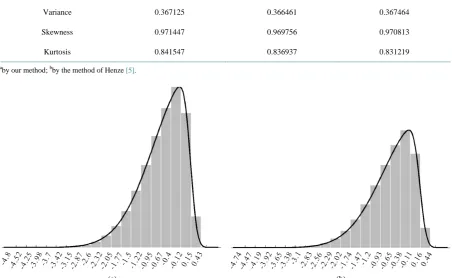
andTable 1,Table 2 show the results obtained by our method and the method Henze [5].
The results of Table 1 andTable 2 show that our method provides results close to the theoretical values and secondly, we obtain results similar to those obtained by Henze [5] results.
4. Conclusion
[image:3.595.89.538.183.311.2]In this article we propose a very simple method to simulate skew normal family distribution. The obtained
Table 1. Simulation results for a sample size of 500,000 and θ = −7.
θ = −7
Theoretical value Simulated valuea Simulated valueb
Mean −0.789865 −0.789651 −0.790496
Variance 0.376113 0.375669 0.376671
Skewness −0.916950 −0.915649 −0.924019
Kurtosis 0.779197 0.768095 0.796781
[image:3.595.89.539.350.471.2]aby our method; bby the method of Henze [5].
Table 2. Simulation results for a sample size of 500,000 and θ = 13.
θ = 13
Theoretical value Simulated valuea Simulated valueb
Mean 0.795534 0.795174 0.795930
Variance 0.367125 0.366461 0.367464
Skewness 0.971447 0.969756 0.970813
Kurtosis 0.841547 0.836937 0.831219
a
by our method; bby the method of Henze [5].
(a) (b)
[image:3.595.87.540.409.687.2]D. Ghorbanzadeh et al.
2076
[image:4.595.98.538.81.276.2](a) (b)
Figure 2. Histogram of simulations for a sample size of 500,000 and θ = 13. (a) histogram of simulations using our method; (b) histogram of simulations using the method of Henze [5].
results are very close to theoretical values and the method is more efficient than the standard one. The method is simple to program and exploit for practical applications.
References
[1] Azzalini, A. (1985) A Class of Distributions Which Includes the Normal Ones. Scandinavian Journal of Statistics, 12, 171-178.
[2] Azzalini, A. (1986) Further Results on the Class of Distributions Which Includes the Normal Ones. Statistica, 46, 199- 208.
[3] Chiogna, M. (1998) Some Results on the Scalar Skew-Normal Distribution. Journal of the Italian Statistical Society, 1, 1-13.http://dx.doi.org/10.1007/BF03178918
[4] Genton, M.G., He, L. and Liu, X. (2001) Moments of Skew Normal Random Vectors and Their Quadratic Forms. Sta-tistics & Probability Letters, 51, 319-325.http://dx.doi.org/10.1016/S0167-7152(00)00164-4
[5] Henze, N. (1986) A Probabilistic Representation of the Skew-Normal Distribution. Scandinavian Journal of Statistics,
13, 271-275.
[6] Azzalini, A. and Capitanio, A. (1999) Statistical Applications of the Multivariate Skew-Normal Distributions. Journal of the Royal Statistical Society, Series B, 61, 579-602.http://dx.doi.org/10.1111/1467-9868.00194
[7] Azzalini, A. and Dalla Valle, A. (1996) The Multivariate Skew-Normal Distribution. Biometrika, 83, 715-726.
http://dx.doi.org/10.1093/biomet/83.4.715
[8] Azzalini, A. and Capitanio, A. (2003) Distributions Generated by Perturbation of Symmetry with Emphasis on a Mul-tivariate Skew t Distribution. Journal of the Royal Statistical Society, Series B, 65, 367-389.
http://dx.doi.org/10.1111/1467-9868.00391
currently publishing more than 200 open access, online, peer-reviewed journals covering a wide range of academic disciplines. SCIRP serves the worldwide academic communities and contributes to the progress and application of science with its publication.
![Figure 2. Histogram of simulations for a sample size of 500,000 and θ = 13. (a) histogram of simulations using our method; (b) histogram of simulations using the method of Henze [5]](https://thumb-us.123doks.com/thumbv2/123dok_us/8078379.781572/4.595.98.538.81.276/figure-histogram-simulations-sample-histogram-simulations-histogram-simulations.webp)
