Available Online atwww.ijcsmc.com
International Journal of Computer Science and Mobile Computing
A Monthly Journal of Computer Science and Information Technology
ISSN 2320–088X
IJCSMC, Vol. 4, Issue. 7, July 2015, pg.78 – 87
RESEARCH ARTICLE
E-MAIL INTERACTIVE HOME
AUTOMATION SYSTEM
Sirisilla Manohar Mtech (Embedded Systems)
D. Mahesh Kumar Assoc.Prof
Abstract: Home automation is becoming more and more popular day by day due to its numerous advantages. This can be achieved by local networking or by remote control. This paper aims at designing a basic home automation application on internet through reading the subject of E-mail. LEDs were used to indicate the switching action. The popularity of network enabled home automation has been increasing greatly in recent years due to simplicity and much higher affordability. Moreover, with the rapid expansion of the Internet, there is the potential for the remote control and monitoring of such network enabled appliances. However, the new and exciting opportunities to increase the connectivity of devices within the home for the purpose of home automation through internet are yet to be.
1. INTRODUCTION
Nowadays, much research has been carried out to improve the Smart Home system. From the previous research various methods had been introduced to improve the Smart Home system and one of the important ways to improve the smart home system is to change from wired transmission to the wireless communication because the major weakness of the wired connection is the limitation of network ranges and upgrading difficulty. On those consequences, researchers have come to the idea of doing it wirelessly.
Hence, with the rapid development of wireless communications, microelectronic technology, integrated circuit and sensing technology, the wireless sensor network (WSN) has achieved a great progressed, which is now most of the WSN’s node had combine sensing, computation and communication into a single device so to use wireless communication is not impossible anymore.
Home/office automation is the control of any or all electrical devices in our home or office, whether we are there or away. Home/office automation is one of the most exciting developments in technology for the home that has come along in decades. There are hundreds of products available today that allow us control over the devices automatically, either by remote control; or even by voice command. Home automation (also called domestics) is the residential extension of "building automation". It is automation of the home, housework or household activity. Home automation may include centralized control of lighting, HVAC (heating, ventilation and air conditioning), appliances, and other systems, to provide improved convenience, comfort, energy efficiency and security. Disabled can provide increased quality of life for persons who might otherwise require caregivers or institutional care.
A home automation system integrates electrical devices in a house with each other. The techniques employed in home automation include those in building automation as well as the control of domestic activities, such as home entertainment systems, houseplant and yard watering, pet feeding, changing the ambiance "scenes" for different events (such as dinners or parties), and the use of domestic robots. Devices may be connected through a computer network to allow control by a personal computer, and may allow remote access from the internet. Typically, a new home is outfitted for home automation during construction, due to the accessibility of the walls, outlets, and storage rooms, and the ability to make design changes specifically to accommodate certain technologies.
1.2 NEED OF AUTOMATION
Earlier, we looked into the face of future when we talked about automated devices, which could do anything on instigation of a controller, but today it has become a reality.
a) An automated device can replace good amount of human working force, moreover humans are more prone to errors and in intensive conditions the probability of error increases whereas, an automated device can work with diligence, versatility and with almost zero error.
b) Replacing human operators in tasks that involve hard physical or monotonous work. Replacing humans in tasks done in dangerous environments (i.e. fire, space, volcanoes, nuclear facilities, underwater, etc)
1.3 METHODOLOGY
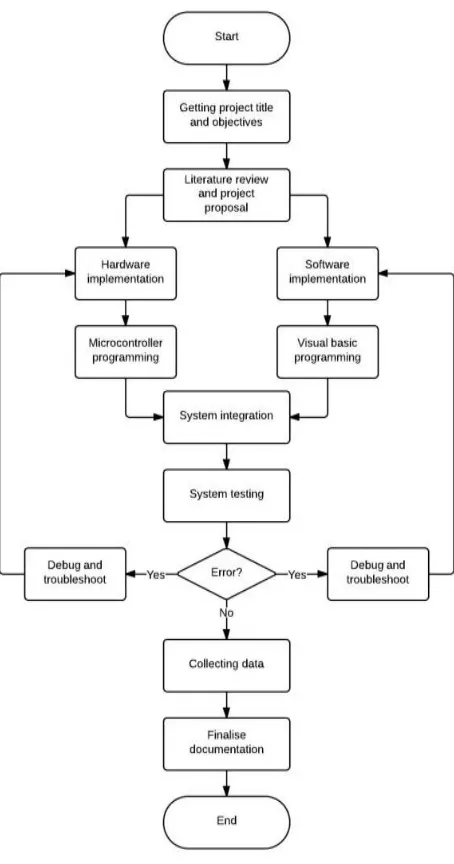
The first step for this project is getting the project title and objectives. Discussion with the supervisor was made to find the most suitable title for this project. The selection of suitable project title is necessary because the project title will give the first impression on the project to be developing as a whole.
After the suitable project title was chosen, the next step is conducting literature review before writing the project proposal. All the information needed to complete this project is gathered and studied by reviewing journals, articles, books and previous research that related to this project. The project proposal was later prepared before beginning the project. Both hardware and software research is done to improve the understanding in order to complete the project efficiently. The functions of each component, tools and instruments needed to be used in this project will be studied to reduce the time needed for the designing process. Software research will be done to increase the understanding and avoid many mistakes during the programming process.
Figure 1.4: Flowchart of methodology
2.1 HISTORY OF HOME AUTOMATION
Home automation has been around since the World War 1 (1914), in fact, the television remote (a simple home automation system) was patented in 1893. Since then different home automation systems have evolved with a sharp rise after the Second World War It's growth has been through various informal research and designs by technology enthusiasts who want a better way of getting things done at home without much effort on their part. The systems evolved from one that can automatically do routine chores like switch on and off security lights, to more sophisticated ones that can adjust lighting, put the television channel to favorite station and control doors.
2.2 HOME AUTOMATIONSYSTEMS
1. Individual Control Systems
These types were the first to hit the market in the early years, here each device like the heater or the air conditioner will have an independent control dedicated to it.
2. Distributed Control Systems
The main feature of these type of systems is emergency shut-down. With this system you can preset or change the control parameters of several similar devices, for example, the thermostat of several air conditioners and their ON/OFF timings.
3. Central Control Systems
These are computerized systems programmed to handle all functions of multiple utilities like air conditioning system, home entertainments, doors, windows, refrigerators and cooking systems, all at the same time regardless of whether you are at home or away. You can connect to the control system through telephone or internet from anywhere in the world.
2.3 HOMEAUTOMATION STANDARDS
There are many established industry standards for home automation systems and are implemented over the various carrier modes ranging from power line to wireless. The popular and major standards are INSTEON, European Home Systems (EHS), ZigBee, KNX, Z-Wave, and X10, Lon Works, ONE-NET and Universal Power line Bus (UPB).
2.3.1 ONE-NET STANDARD
ONE-NET is an open-source standard for wireless network designed for low-cost, low-power (battery operated) control networks for applications such as home automation, security and control, device control, and sensor networks. ONE-NET is not tied to any proprietary hardware or software, and can be implemented with a variety of low-cost off-the-shelf radio transceivers and microcontrollers from a number of different manufacturers.
ONE-NET uses UHF ISM radio transceivers and currently operates in the 868 MHz and 915 MHz frequencies. The ONE-NET standard allows for implementation on other frequencies, and some work is being done to implement it in the 400 MHz and 2.4 GHz frequency ranges. It utilizes Wideband FSK (Frequency-shift keying) to encode data for transmission and it features a dynamic data rate protocol with a base data rate of 38.4 kbit/s. The specification allows per-node dynamic data rate configuration for data rates up to 230 kbit/s.
ONE-NET supports star, peer-to-peer, and mesh networking topologies. Star network topology can be used for lower complexity and cost of peripherals, and also simplifies encryption key management. In peer-to-peer mode, a master device configures and authorizes peer-to-peer transactions. The wireless mesh network mode allows for repeating to cover larger areas or route around dead areas. Outdoor peer-to-peer range has been measured to over 500 m, indoor peer-to-peer range has been demonstrated from 60 m to over 100 m, and mesh mode can extend operational range to several kilometers. Simple, block, and streaming transactions are supported. Simple transactions typically use message types as defined by the ONE-NET protocol to exchange sensor data such as temperature or energy consumption, and control data such as on/off messages. Simple transactions use encryption techniques to avoid susceptibility to replay attacks. Block transactions can be used to transmit larger blocks of data than simple messages. Block transactions consist of multiple packets containing up to 58 bytes per packet. Blocks transactions can transfer up to 65,535 bytes per block. Streaming transactions are similar in format to block transactions but do not require retransmission of lost data packets.
2.3.2 UNIVERSAL POWER LINE BUS
The Universal Power line Bus (UPB) is an industry emerging standard for communication among devices used for home automation. It uses power line wiring for signaling and control. Household electrical wiring is used to send digital data between UPB devices. While in the X10 protocol this digital data is encoded onto a 120 KHz carrier which is transmitted as bursts during the relatively quiet zero crossings of the 50 or 60 Hz AC alternating current waveform, the UPB protocol works differently. The UPB communication method consists of a series of precisely timed electrical pulses (called UPB Pulses) that are superimposed on top of the normal AC power waveform (sine wave). Receiving UPB devices can easily detect and analyze these UPB Pulses and pull out the encoded digital information from them. UPB Pulses are generated by charging a capacitor to a high voltage and then discharging that capacitor’s voltage into the power line at a precise time. This quick discharging of the capacitor creates a large “spike” (or pulse) on the power line that is easily detectable by receiving UPB devices wired large distances away on the same power line.
UPB controllers range from extremely simple plug-in modules to very sophisticated whole house home automation controllers. The simplest controllers are plug-in controllers that are recommended for a moderate amount of switches and devices as it becomes cumbersome to control a wide range of devices. More sophisticated controllers can control more units and/or incorporate timers that perform pre-programmed functions at specific times each day. Units are also available that use passive infrared motion detectors or photocells to turn lights on and off based on external conditions. Finally, whole house home automation controllers can be fully programmed. These systems can execute many different timed events, respond to external sensors, and execute, with the press of a single button, an entire scene, turning lights on, establishing brightness levels, and so on.
UPB was developed by PCS Power line Systems of Northridge, California and released in 1999. Based on the concept of the ubiquitous X10 standard, UPB has an improved transmission rate and higher reliability. While X10 without specialized firewalls has a reported reliability of 70-80%, UPB reportedly has a reliability of more than 99%.
3. IMPLEMENATATION
3.1 ARCHITECTURE
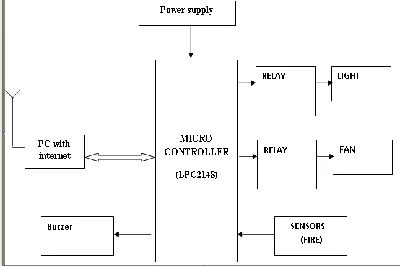
The proposed general architecture incorporates subsystems IR sensors, burglar alarm module and fire alarm module, into a single automated architecture for practical implementation in intelligent home environments. The figure shows a simple architecture diagram of the proposed system and its setup and connectivity. The modules work independently and parallel but share computational resources.
pathways, tracks or signal traces etched from copper sheets laminated onto a non-conductive substrate It is also referred to as printed-wiring board (PWB) or etched wiring board A PCB populated with electronic-components is a printed circuit assembly (PCA), also known as a printed circuit-board assembly(PCBA). Printed circuit boards are used in virtually all but the simplest commercially-produced electronic devices. PCBs are inexpensive, and can be highly reliable. They require much more layout effort and higher initial cost than either wire wrap or point-to-point construction, but are much cheaper and faster for high-volume production; the production and soldering of PCBs can be done by totally automated equipment. Much of the electronics-industry's PCB design, assembly, and quality control needs are set by standards that are published by the IPC organization
3.2 AT89S52 MICROCONTROLLER
3.2.1 Features
•Compatible with MCS-51Products
•8K Bytes of In-System Programmable (ISP) Flash Memory •4.0V to 5.5V Operating Range
•Fully Static Operation: 0 Hz to 44 MHz •Three-level Program Memory Lock •256 x 8-bit Internal RAM
•42 Programmable I/O Lines •Three 16-bit Timer/Counters •Eight Interrupt Sources
•Full Duplex UART Serial Channel •Low-power Idle and Power-down Modes •Interrupt Recovery from Power-down Mode •Watchdog Timer
•Dual Data Pointer •Power-off Flag
•Fast Programming Time
•Flexible ISP Programming (Byte and Page Mode)
3.2.2 Description
The AT89S52 is a low-power, high-performance CMOS 8-bit microcontroller with 8K bytes of in-system programmable Flash memory. The device is manufactured using Atmel’s high-density nonvolatile memory technology and is compatible with the industry standard 80C51 instruction set and pin out. The on-chip Flash allows the program memory to be reprogrammed in-system or by a conventional nonvolatile memory programmer.
By combining a versatile 8-bit CPU with in-system programmable Flash on a monolithic chip, the Atmel AT89S52 is a powerful microcontroller which provides a highly-flexible and cost-effective solution to many embedded control applications.
The AT89S52 provides the following standard features: 8K bytes of Flash, 256 bytes of RAM, 42 I/O lines, Watchdog timer, two data pointers, three 16-bit timer/counters, a six-vector two-level interrupt architecture, a full duplex serial port, on-chip oscillator, and clock circuitry.
4. RESULTS
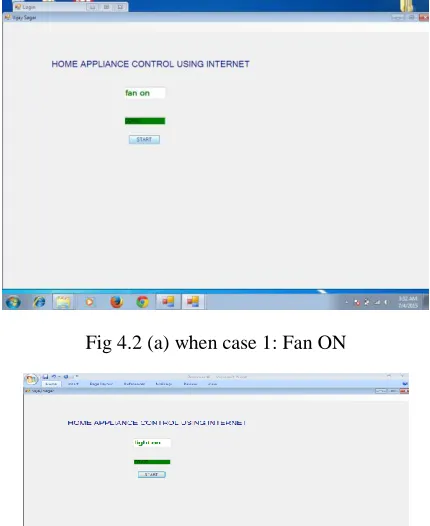
Fig 4.1 Working Experimental setup
Fig 4.2 (a) when case 1: Fan ON
Fig 4.2 (b) when case 2: Light ON
Fig 4.3 (a) when case 3: Fan Off
Fig 4.3 (b) when case 4: Light Off
Similarly the same switch can be turned OFF by sending an e-mail with subject 'OFFI' to the g-mail account. Further, This work consists of two more switches which can be controlled by sending e-mails under the subject- 'ON2' & 'ON3' to turn ON the switch2 & Switch3 and correspondingly - 'OFF2'& 'OFF3" to turn them OFF.
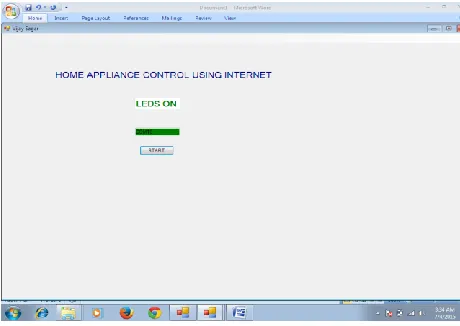
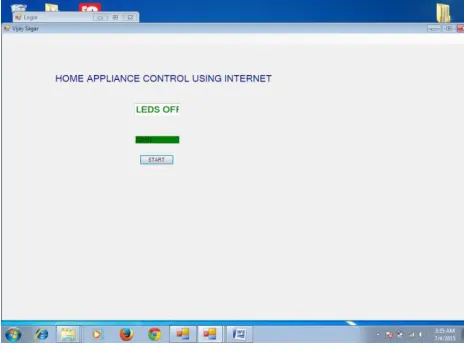
Fig 4.4 (b) when case 5: LED Off
The experimental setup is shown in above Fig Results were generated by a series of E-mails sent to the G-mail account of pc with internet and the corresponding inbox and sent G-mails of G-G-mail account respectively.
So, the results show that home automation has been successfully implemented with efficiency and reliability.
4.5 Results were generated by a series of E-mails sent to the G-mail account
CONCLUSION
appliance that is plugged into electrical power is remotely controlled. Costs mainly include equipment, components, furniture, and custom installation. Ongoing costs include electricity to run the control systems, maintenance costs for the control and networking systems, including troubleshooting, and eventual cost of upgrading as standards change. Increased complexity may also increase maintenance costs for networked devices.
Learning to use a complex system effectively may take significant time and training. Control system security may be difficult and costly to maintain, especially if the control system extends beyond the home, for instance by wireless or by connection to the internet or other networks
FUTURE SCOPE
The home gate way based on the mobile has developed for control the home appliances. The information selected of the mobile can transmitted into the base station and the home appliances of home. The GUI can control the gateway to establish the PC by an Internet.
Future of Automation: Future will be of Automation of all products. Each and every product will be smart devices that we use daily and that will be controlled through a smart chip called microcontrollers. Each and Every home appliances will be controlled either by PC or hand held devices like PDA or mobile handsets. Some examples of it are when you want you can switch on/off Fan of your home by mobile handset or PC.
Smart Grid: Home automation technologies are viewed as integral additions to the Smart grid. The ability to control lighting, appliances, HVAC as well as Smart applications (load shedding, demand response, real-time power usage and price reporting) will become vital as Smart Grid initiatives are rolled out.
REFERENCES
[I] AI-Ali A. R. and AI-Rousan M., "Java-based home automation system", IEEE Transactions on Consumer Electronics, vol. 50, no. 2, pp. 498- 504, 2004.
[2] Ali M., V laskamp J.H.A, Eddiny N.N. , Falconer B. and Oram c., "Technical Development and Socioeconomic Implications of the Raspberry Pi as a Learning Tool in Developing Countries", 5th Computer Science and Electronic Engineering Conference (CEEC), pp. 103- 108,2013.
[3] Ardam H. and Coskun I., "A remote controller for home and office appliances by telephone", IEEE Transactions on Consumer Electronics, vol. 44, no. 4,pp. 1291-1297, 1998.
[4] Baudel T. and Beaudouin-Lafon M., "Charade: remote control of objects using free-hand gestures", Communications of the ACM, voI. 36,no. 7,pp. 28-35, 1993.
[5] Bromley K., Perry M., and Webb G. "Trends in Smart Home S y s t e m s , C o n n e c t i v i t y a n d S e r v i c e s " , www.nextwave.org.uk,2003.
[6] Kushiro N. , Suzuki S., Nakata M., Takahara H. and Inoue M., "Integrated home gateway controller for home energy management system", IEEE International Conference on Consumer Electronics, pp. 386-387,2003.
[7] Ok S. and Park H. , "Implementation of initial provisioning function for home gateway based on open service gateway initiative platform", The 8th International Conference on Advanced Communication Technology, pp. 1517-1520,2006.
[8] Saito T., Tomoda I., Takabatake Y., Ami J. and Teramoto K., "Home Gateway Architecture And Its Implementation", IEEE International Conference on Consumer Electronics, pp. 194- 195,2000.