Improved (Pseudo) Preimage Attack and Second Preimage
Attack on Round-Reduced Grøstl
Jian Zou, Wenling Wu, Shuang Wu, and Le Dong
Institute of Software Chinese Academy of Sciences
Beijing 100190, China
{zoujian, wwl, wushuang, dongle}@is.iscas.ac.cn
Abstract. Grøstl is one of the five finalists in the third round of SHA-3 competition hosted by NIST. In this paper, we use many techniques to improve the pseudo preimage attack on Grøstl hash function, such as subspace preimage attack and guess-and-determine technique. We present improved pseudo preimage attacks on 5-round Grøstl-256 and 8-round Grøstl-512 respectively. The
complexity of the above two attacks are (2239.90
,2240.40
) (in time and memory) and (2499.50
,2499
) respectively. Furthermore, we propose pseudo preimage attack and pseudo second preimage attack on 6-round Grøstl-256. The complexity of our 6-round pseudo preimage and second preimage
attack is (2253.26
,2253.67
) and (2251.0
,2252.0
) respectively. As far as we know, these are the best known attacks on round-reduced Grøstl hash function.
Key words: Grøstl, meet-in-the-middle, guess-and-determine, initial structure, preimage attack
1
Introduction
Cryptographic hash functions are an important primitive in the modern cryptography; they are used in many applications, including MAC algorithms, digital signature schemes and so on. In general, hash function must satisfy three security requirements: preimage resistance, second preimage resistance and collision resistance. After the pioneering work of Wang, many new methods were proposed to attack the hash function in the last few years. There is a strong need for a secure and efficient hash function since the cryptanalysis of hash functions has been significantly improved. In 2008, NIST announced the SHA-3 competition[8] in order to select a secure hash function design.
Grøstl[4] is one of the five finalists in the third round of SHA-3 competition, which is proposed by Gauravaram et al. Grøstl is based on a wide-pipe compression function that is iterated in an MD-style manner. The compression function of Grøstl uses the SPN structure that follows the AES design strategy. Since the state is double-sized as the hash value, it’s difficult to find an attack on Grøstl hash function. The Grøstl hash function has been modified in the third round. The old version is renamed to Grøstl-0 and the new one is called Grøstl-1.
Our contributions In [16], Wu et al. converted the preimage attack on Grøstl into a three-sum problem. By using the b-bit partial preimage attack, Wu et al.made their complexity lower than the birthday bound. In this paper, we find out it is not necessary to solve the b-bit partial preimage attack. We propose the subspace preimage attack to replace the b-bit partial preimage attack. We will introduce the subspace preimage attack in Section 3.
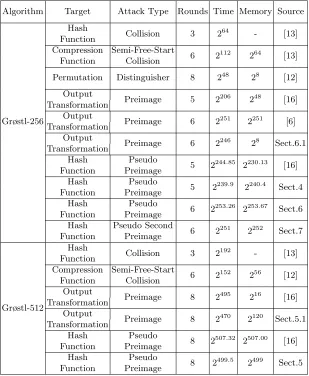
Using the subspace preimage attack, we propose an improved 5-round pseudo preimage attack on Grøstl-256. Then we combine the guess-and-determine technique with the MitM attack to improve the 8-round pseudo preimage attack of Grøstl-512. We also propose a pseudo preimage attack and a pseudo second preimage attack on 6-round Grøstl-256 hash function by using a complicated initial structure. Our cryptanalytic results of Grøstl are summarized in Table 1. We will explain these results in Section 4, 5 ,6 and 7.
Table 1.Comparison to previous works
Algorithm Target Attack Type Rounds Time Memory Source
Grøstl-256
Hash
Collision 3 264
- [13]
Function
Compression Semi-Free-Start
6 2112
264
[13]
Function Collision
Permutation Distinguisher 8 248
28
[12]
Output
Preimage 5 2206
248
[16] Transformation
Output
Preimage 6 2251
2251
[6] Transformation
Output
Preimage 6 2246
28
Sect.6.1 Transformation
Hash Pseudo
5 2244.85
2230.13
[16]
Function Preimage
Hash Pseudo
5 2239.9
2240.4
Sect.4
Function Preimage
Hash Pseudo
6 2253.26
2253.67
Sect.6
Function Preimage
Hash Pseudo Second
6 2251
2252
Sect.7
Function Preimage
Grøstl-512
Hash
Collision 3 2192
- [13]
Function
Compression Semi-Free-Start
6 2152
256
[12]
Function Collision
Output
Preimage 8 2495
216
[16] Transformation
Output
Preimage 8 2470
2120
Sect.5.1 Transformation
Hash Pseudo
8 2507.32
2507.00
[16]
Function Preimage
Hash Pseudo
8 2499.5
2499
Sect.5
Outline of the paper This paper is organized as follows. We describe Grøstl hash function in Section 2. In Section 3, we make a brief introduction to the previous work and our improvement work on Grøstl. Then we give our attacks on Grøstl in Section 4, 5, 6 and 7. Section 8 concludes the paper.
2
Specifications and Notations
2.1 Specification of Grøstl
Grøstl adopts a wipe-pipe design. The chaining value are 512-bit and 1024-bit for 256 and Grøstl-512 respectively. Message length should be less than 273−577 bits. The padding rule is omitted here,
since it’s not important in our attack. Assume a message is padded and divided into message blocks M0, M1, . . . , Mk−1. The hash valuehis generated as follows:
CV0←IV
CVi+1←CF(CVi, Mi) fori= 0,1, . . . , k−1
h=T runc(P(CVk)⊕CVk)
Here the IV is the initial value, and CF(CVi, Mi) is the compression function of Grøstl. P(CVk) is a
permutation that is a component of the compression function and will be defined later.
The compression function uses two permutationsP(·) and Q(·), and computes as follows(see also Fig.1):
CF(CVi, Mi) =P(CVi⊕Mi)⊕Q(Mi)⊕CVi.
P
Q
C V i1 C V i
M i1
X P
T ru n cated
Fig. 1. Compression function and output transforma-tion of Grøstl
10 40 16 15 14 13 12 11 23 22 2 1 20 19 18 17 39 38 37 36 35 34 33 32 3 1 30 29 28 27 26 25 24 48
47 46 45 44 43 42 4 1 57
56 55 54 53 52 5 1 50 49 2 1 0 63 62 6 1 60 59 58 7 6 5 4 3 9 8
Fig. 2.Byte positions for Grøstl-256
Here, byte positions in a state S for Grøstl-256 are denoted by integer numbersB,B ∈ {0,1,2, . . . ,63}, as shown in Fig. 2. We often denote several bytes of stateS byS[a, b, . . .], e.g. 8 bytes in the right most column are denoted by S[56,57, . . . ,63]. CVi is the chaining value and Mi is a message block. P(·)
and Q(·) are AES-like permutation with 8×8 and 8×16 sized state for Grøstl-256 and Grøstl-512 respectively. Grøstl-256 adopts 10-roundP(·) and Q(·). Grøstl-512 uses 14-roundP(·) and Q(·). The round function of the permutations consists of the following four operations:
– AddConstant:The AddConstant operation XORs a round-dependent constant to the state.
– SubBytes:The SubBytes transformation applies an S-box to each cell of the state.
– ShiftRows:The ShiftRows transformation cyclically rotates the cells of the i-th row leftwards by shift vector (define later).
We useAC, SB, SRandM C to denote these transformations for short. The shift vectors used inP(·) andQ(·) are different.P(·) in Grøstl-256 uses (0,1,2,3,4,5,6,7) andP(·) in Grøstl-512 uses (0,1,2,3,4,5,6,11). Q(·) in Grøstl-256 uses (1,3,5,7,0,2,4,6) andQ(·) in Grøstl-512 uses (1,3,5,11,0,2,4,6). For a detailed ex-planation, we refer to the original paper[4].
As shown in the submission document of Grøstl hash function[4], if we makeCVi′ =CVi⊕Mi, then
compression function can be rewritten as
CF(CVi, Mi) =P(CV ′ i)⊕CV
′
i ⊕Q(Mi)⊕Mi.
This important property will be used in our attack on Grøstl.
2.2 Definition of Attacks
Suppose that the target function is H with a range of{0,1}n. Several attacks are defined as follows.
Definition 1 (Preimage attack). Given IV andt, findM such that H(IV, M) =t.
Definition 2 (Pseudo preimage attack). Givent, find(IV, M)such that H(IV, M) =t.
Definition 3 (Partial preimage attack).Givent0, findM such thatH(M) =t0||∗(orT runk(H(M)) =
t0), where t0 is ak-bit value and T runk()is the truncation function.
Definition 4 (Subspace preimage attack). Givent, findM such that L(H(M)) =t, whereL()is a function with a range of {0,1}k andk≤n.
Definition 5 (Pseudo second preimage attack).Givent, IV1, M1, find(IV2, M2)such thatH(IV2, M2) =
H(IV1, M1) =t.
The partial preimage attack are used in Wuet al.[16] for the intermediate step of the pseudo preimage attack on the hash function. In this paper, our 5-round and 8-round pseudo preimage attacks for Grøstl hash function are based on subspace preimage attack. Specifically, by finding preimages in a linear subspace (with a linear function L), we can reduce the complexity of the previous attack. The details will be described in the following sections.
3
Previous Work and Our Improvement
3.1 Previous Work
In FSE 2012, Wu et al.[16] proposed the first pseudo preimage attack on Grøstl hash function. They idea can be summarized as below. Suppose the hash output is n-bit and the state size is 2n-bit. To find a pseudo preimage (CV, M) of Grøstl, it is desirable to invert the output transformation of Grøstl. Let X =CF(CV, M), thenX is the preimage of the output transformation. With H′
=CV ⊕M, we get
(P(H′)⊕H′)⊕(Q(M)⊕M)⊕X= 0.
Then the pseudo preimage attack turns into a three-sum problem.
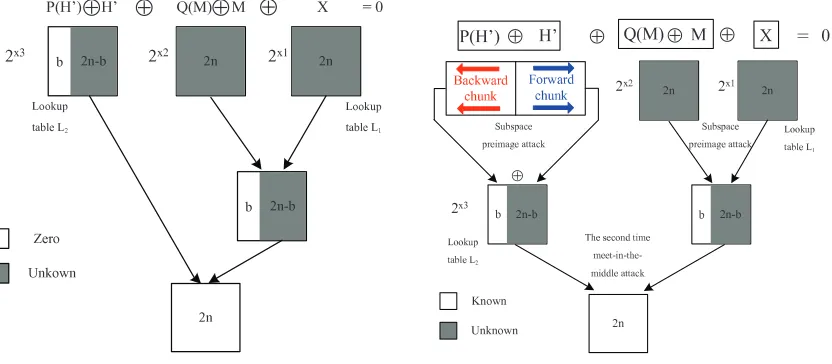
Using four parametersx1, x2, x3 and b, the attack process can be described as follow(see also in
Fig.3):
1. Find 2x1 preimagesX of the output transformation and store them in lookup table L 1.
2. Find 2x3 H′ such that the leftmost b bits ofP(H′)⊕H′ are zero. This step is considered to find
3. Find 2x2randomMwith the correct padding and calculateQ(M)⊕M. Check if there exists an entry
inL1that matches the leftmost b bits ofQ(M)⊕M. Then 2x1+x2−bpartial matchesQ(M)⊕M⊕X,
whose leftmost b bits are all zero, is expected to remain.
4. For each of the 2x1+x2−b Q(M)⊕M ⊕X remained in step 3, check whether there exists an entry
inL2that matches the remaining (2n−b)−bits. Once a full match is found, a pseudo preimage of
Grøstl hash function is found.
X
2 n&b
b 2 n 2n
2 n.b
b
2n Z ero
U n kow n
2 x3 2 x2 2 x 1 P (H ’) H ’ Q (M ) M
= 0
Lookup table L 2
L ookup table L1
Fig. 3.Outline for the Wuet al.attack on Grøstl
X
2n 2n
2nlb
b
2n K now n
U nknow n 2 x3
2 x2 2 x1 Q (M )
0
Lookup tableL2
Lookup table
L1 P (H ’) H ’ =
Subspace preim ageattack
2nµb
b
Thesecondtime m eetÂinÂthe m iddle attack Subspace
preim ageattack
Forw ard
chunk
B ackw ard chunk
M
Fig. 4.Outline for our pseudo preimage attack on Grøstl
Suppose for Grøstl with 2n-bit state, it needs 2C1(2n,n) computations to find a fixed position
n-bit partial preimage of X and it needs 2C2(2n,b) computations to find a chosen position b-bit partial
preimage ofP(X)⊕X. Then the complexity for each step can be calculated as follows:
1. In Step 1, building the lookup tableL1 takes 2x1+C1(2n,n)computations and 2x1 memory.
2. In Step 2, building the lookup tableL2 takes 2x3+C2(2n,b)computations and 2x3 memory.
3. In Step 3, It takes 2x2 Qcalls to calculateQ(M)⊕M in order to check the partial match in lookup
tableL1. The complexity is equivalent to 2x2−1 compression function calls.
4. In Step 4, checking the final match for 2x1+x2−b candidates needs 2x1+x2−b table look-ups, which
can be equivalently regarded as 2x1+x2−b·C
T L compression function calls.CT L1 is the complexity
of one table lookup, where unit one is one compression function call.CT L is chosen as 1/640 and
1/2048 for 6-round Grøstl-256 and 8-round Grøstl-512 respectively.
And the overall complexity to compute the pseudo preimage of Grøstl is:
2x1+C1(2n,n)+ 2x3+C2(2n,b)+ 2x2−1+ 2x1+x2−b·C
T L,
with memory requirement of 2x1+ 2x3. Note that the formula of 2x1+x2+x3−2n ≥1 should be satisfied
in order to find one final match.
1
The constantCT Lis the upper bound of the complexity that one table lookup takes. Consider the fact that
3.2 Outline for Our Pseudo Preimage Attack on the Grøstl Hash Function
We find out there is no need to find ab-bit chosen position partial preimage. Here we use the subspace preimage attack to improve their algorithm. We show an easy example of the subspace preimage attack in Fig.5. We should compute the 16 bits state value(red) in partial preimage attack, however we just need to find two state value(red) to satisfy a given 8-bit linear relationship(decided by the blue states) in the subspace preimage attack. Note that the subspace preimage attack is valid when the whole attack process can be divided into two phases MitM attack(see Fig.4). Then we will match the left relationships in the second time MitM attack.
M C
M atching point
Fig. 5.an easy example of subspace preimage attack
In [16], the notation 2C2(2n,b) stands for the complexity to find a b-bit chosen position partial
preimage ofP(H′)⊕H′. Here we adopt the same notation for the subspace preimage. Here,b denotes the bit size of the output of the linear functionL. The linear subspace defined by the equationL(x) =t0
has a dimension of n−b. Note that a b-bit partial preimage is a special kind of subspace preimage, where the linear function for the subspace isL(x) =T runb(x).
As shown in Fig.4, the attack can be described as follows: we adopt the subspace preimage attack in the first stage of MitM attack. Then we match the left bytes in the second time MitM attack.
Using the same four parametersx1, x2, x3andb, our attack process can be described as follow:
1. Find 2x1 preimagesX of the output transformation and store them in a lookup tableL 1.
2. Find 2x3 subspace preimage ofP(H′)⊕H′. Then storeP(H′)⊕H′ andH′ in a lookup table L 2.
3. Find 2x2 random M with the correct padding and calculateQ(M)⊕M. Check if there exists an
entry in L1 that X⊕Q(M)⊕M is in the same subspace of P(H ′
)⊕H′. Then 2x1+x2−b partial
matchesQ(M)⊕M ⊕X, are expected to remain.
4. For each of the 2x1+x2−b Q(M)⊕M ⊕X remained in step 3, check whether there exists an entry
inL2 that matches the remaining (2n−b) bits. Once a full match is found, a pseudo preimage of
Grøstl hash function is found.
Then the overall complexity to compute the pseudo preimage of Grøstl is similar to Wu et al.[16] and can be written as:
2x1+C1(2n,n)+ 2x3+C2(2n,b)+ 2x2−1+ 2x1+x2−b·C
T L, (1)
with memory requirement of 2x1 + 2x3. Note that our subspace preimage attack just improve the
2C2(2n,b).
4
Improved Pseudo Preimage Attack on 5-round Grøstl-256
According to equation(1), the overall complexity to compute the pseudo preimage of Grøstl depends on these parameters: x1, x2, x3, C1(2n, n) and C2(2n, b). If we can reduce the complexity of 2C1(2n,n)
and 2C2(2n,b), the overall complexity can be reduced. As a result, we try to minimize the complexity of
Since Wuet al.[16] have proved that their method to compute 2C1(512,256)= 2206for 5-round
Grøstl-256 is optimal, it’s impossible to improve the 2C1(512,256). However we find that 2C2(512,b)can be reduced
by the subspace preimage attack. As a result, we can improve the overall complexity of pseudo preimage attack on 5-round Grøstl-256.
4.1 Subspace Preimage Attack on P(H′)⊕H′(Reduce the 2C2(2n,b))
We show the chunk separation for the subspace preimage attack in Fig.6.
Parameter for the subspace MitM attack As shown in Fig.6, we adopt the MitM attack here. There are five colors shown in the attack. The red/blue color means neutral message. They are independent from each other. The white color stands for the bytes whose values are affected by red bytes and blue bytes both, and we can’t determine their values until a partial match is found. The gray bytes are constants that we can choose randomly in the initial structure. The yellow bytes are truncated bytes.
AC SB SR M
C
M C AC SB SR Initial
s
tructure AC SB SR
ACSBSR ACSBSR
M C
M C
M C
Matchingpoint
Chosen
p
osition Tru
ncated
Fig. 6.Chunk separation of 5-round chosen position partial preimage attack onP(H′)⊕H′ for Grøstl-256
In order to compute the complexity for the MitM attack, some parameters for the attack should be presented: the matching point size m. Here we use Dr and Db to denote the freedom degrees for the
red and blue bytes respectively. Without loss of generality, we assume thatDb ≥Dr. We usedranddb
to indicate the actually used freedom degrees:
The MitM Attack Algorithm The MitM preimage attack can be described in the following steps:
1. Set random value to constants in the initial structure.
2. For all possible values 2dr of red bytes, compute backward from the initial structure and obtain the
value at the matching point. Store the values in a lookup tableLr.
3. For all possible values 2db of blue bytes, compute forward from the initial structure and obtain the
result at the matching point. Check if there exists an entry in Lr that matches the result at the
matching point.
4. If no full match has been found, repeat the above 3 steps.
In Fig.6, freedom degrees for the red and blue bytes areDr= 48 bits andDb= 64 bits respectively.
Besides the matching point sizemmax= 64 bits, since we can construct 64 bits linear relationship for
48-bit subspace preimages with the complexity of 248. It means that a 48-bit subspace preimage is found
with the complexity of 21(= 248/248). Here the complexity is measured by compression function calls.
It takes about half P(·) calls in the MitM attack, i.e. 1/4 compression function calls to evaluate the matching point for one direction. So we multiply 2−2to the complexity: 2C2(512,48)= 2−2·21≈2−2.We
will multiply the same coefficient in the following of this paper. Then our 2C2(512,48)≈2−2 is smaller
than the 2C2(512,31)≈214in Wuet al.attack.
Minimizing the Overall Complexity With 2C1(512,256) = 2206 and 2C2(512,48)= 2−2, we can
com-pute the best overall complexity of pseudo preimage attack for 5-round Grøstl-256. Whenb= 48, x1=
32.4, x2 = 239.4 and x3 = 240.4, we can improve the overall complexity to about 2239.9. Memory
requirement is about 2240.4.
5
Improved Pseudo Preimage Attack on 8-round Grøstl-512
Here we talk about how to improve the 2C1(1024,512) and 2C2(1024,b)to reduce the overall complexity for
8-round pseudo preimage attack on Grøstl-512 hash function.
5.1 Preimage Attack on 8-round Grøstl-512 Output Transformation (Reduce the
2C1(1024,512))
Our 8-round preimage attack on Grøstl-512 output transformation is obtained by combining guess-and-determine technique with the MitM attack. The guess-guess-and-determine technique is first used in the preimage attack on SHA-0/SHA-1 by Aoki and Sasaki[3]. By guessing some unknown bytes, all the possible values of the guessed bytes are used as extra freedom degrees in the MitM attack. As a result, we can obtain enough matching points. Note that, the guessed bytes are extra constraints after a partial match is found, and we should check the guessed value to produce a valid preimage. We will talk about more details about the guessing technique in the following attack algorithm. The chunk separation for the 8-round attack(combine guess and determine with the MitM) is shown in Fig.7. Since Grøstl-512 compression function has slow diffusion, we can construct a 2-round initial structure easily.
Parameters for the Guess-and-Determine and the MitM Attack As shown in Fig.7, we use the purple bytes as the guessed bytes and the other colors are the same meanings as described in the MitM attack. In order to evaluate the complexity for the attack, we should define these parameters: freedom degrees in red and blue bytes (Dr, Db), the guessing red and blue bytes (Dgr, Dgb), the bits of
the matching point m and the bits of the partial preimage size b. Here we also use (dr, db) to denote
the actually used freedom degrees. Note that this attack is different from the simple MitM attack so that (dr, db) don’t satisfy the equation (2).
The Attack Algorithm and Complexity The attack algorithm is similar to the MitM attack and can be described as follows:
1. Set the constants in the initial structure randomly.
2. For all possible values 2dr of the red bytes and 2Dgr of the guessing red bytes, compute backward
from the initial structure and obtain the value at the matching point. Store the values in a lookup tableL.
3. For all possible values 2db of the blue bytes and 2Dgb of the guessing blue bytes, compute forward
4. Once a partial match is found, compute and check if the guessed value is right. The probability of the validity is 2−Dgr−Dgb. There are 2dr+db−m valid partial matches left. Then we continue the
computation and check the full match. The probability that a partial match is a full match is 2−(n−m).
5. The success probability for the above steps is 2dr+db+Dgr+Dgb−m·2−(Dgb+Dgr)·2−(n−m)= 2dr+db−n.
Then repeat the above steps for 2n−db−dr to find one full match.
The complexity for each step can be calculated as follows:
1. In Step 2, building the the lookup table Ltakes 2dr+Dgr computations and memory.
2. In Step 3, it takes 2db+Dgb computations to find the partial matches. Expected number of the partial
matches is 2db+Dgb+dr+Dgr−m.
3. In Step 4, testing all the partial matches in step 3 needs 2db+Dgb+dr+Dgr−m computations. The
probability of the validity is 2−Dgb−Dgr, and there are 2db+dr−mvalid partial matches left.
4. In Step 5, repeat the above four step for 2n−db−dr times.
Then the complexity of the above attack algorithm is:
2n−db−dr·(2dr+Dgr+ 2db+Dgb + 2db+Dgb+dr+Dgr−m) = 2n·(2Dgb−Dr + 2Dgr−db+ 2Dgb+Dgr−m). (2)
As shown in Fig.7, the parameters for the attack on the output transformation of 8-round Grøstl-512 are as follow:
The parameters for the attack are as follows:dr=db = 80 bits,Dgr=Dgb= 40 bits,m= 144 bits
andn= 512 bits. According to equation(2), the complexity is 2C1(1024,512) = 2−2·2512·(240−80+240−80+
240+40−144)≈2470compression function calls and 240+80= 2120memory. Then our 2C1(1024,256) ≈2470
is smaller than the 2C1(1024,256) ≈2495in Wuet al.attack. Note that the guess-and-determine technique
is especially useful for the slow diffusion target.
5.2 Subspace Preimage Attack on P(H′)⊕H′ (Reduce the 2C2(1024,b))
We show chunk separation in Fig.8. Note that we don’t adopt the guess-and-determine technique here, because we can’t find a good guess-and-determine method to make the complexity better than the simple MitM attack. We find out the guess-and-determine method is not suit for the b-bit subspace preimage attack(whenbis small).
The parameters for the MitM attack: the freedom degreesDr = 16 bits,Db = 16 bits. The size of
matching pointbmax= 32 bits. We set dr =db =bbest = 16 bits, then we can find 216(= 216+16/216)
16-bit subspace preimage with the complexity of 216. It means a 16-bit subspace preimage is found with
the complexity of 21(= 216/216). Then the complexity is 2C2(1024,16)= 2−2·21≈2−2.
Minimizing the Overall Complexity According to equation (1) and 2C1(1024,512)= 2470,2C2(1024,16)=
2−2, we can rewrite the overall complexity as 2x1+470+ 2x3−2+ 2x2−1+ 2x1+x2−16·C
T L. Whenb= 16,
x1= 27, x2= 498,andx3= 499, the overall complexity is the lowest:≈2499.5. Memory requirement is
2499.
ACSBSR
ACSBSR
MC
MC
MC
MC
MC
MC ACSBSR
ACSB SR
ACSB SR ACSBSR
ACSBSR
MC
M atching point MC
Initial
s
tructure
Target
Fig. 7.Chunk separation of 8-round fixed position partial preimage attack onP(X)⊕X
SR SB AC
MC
MC SR
SB AC
MC SR
SB AC
MC
TargetValue
M atching Point SR
SB AC
Initial Structure MC
SR SB AC
MC SR
SB AC
MC SR
SB AC
SR SB AC
MC
Truncated
6
Pseudo Preimage Attack on 6-round Grøstl-256 Hash Function
Since two rounds of Grøtl-256 compression function achieves the full diffusion, the previous attack without any new techniques are at most five rounds of Grøtl-256. Khovratovich[6] has proposed a 6-round attack on Grøtl-256 output transformation function using biclique technique.
6.1 Preimage Attack on 6-round Grøstl-256 Output Transformation
Our 6-round preimage attack is obtained by combining the MitM attack with a complicated initial structure. The detail of the initial structure is shown as follows(also in Fig.9):
1. Randomly choose the constant values for the State #6[1,3,5,7,8,10,12,14,17,19,21,23,24,26,28,30] (gray).
2. Set the value of the State #4[0,5,6,7,8,9,14,15,16,17,18,23,24,25,26,27] (blue) so that the chosen 4 bytes at State #3[7,14,21,28] (red) can be achieved through the InverseMixColumns operation. 3. For each value of the State #4[0,5,6,7,8,9,14,15,16,17,18,23,24,25,26,27] (blue), we
calcu-late the correspondent values of the State #5[0,1,2,3,5,6,7,15,16,17,22,23,24,29,30,31] (blue) through the SubBytes and ShiftRows operations.
4. With the known values of State #5 (blue) and State #6 (gray), we calculate the rest blue bytes of State #5 and State #6 through the MixColumns operation.
5. With the calculated blue bytes of State #5[4,5,6,7,11,12,13,14,18,19,20,21,25,26,27,28], we compute the values of the State #4[33,34,35,36,42,43,44,45,51,52,53,54,60,61,62,63] through the InverseShiftRows and InverseSubBytes operations. We check whether the values of the State #4[33,34,35,36,42,43,44,45,51,52,53,54,60,61,62,63] satisfy the liner relationship so that the chosen 4 bytes at #3 (#3[35,42,49,56]) can be achieved through the InverseMixColumns operation.
SB SR MC
AC SB
SR
MC AC SB
SR
MC AC SB
SR MC
AC
MC AC
SB SR MC
AC SB
SR
˛
#0 # 1 # 2 #3 # 4
#4
#5
# 6
#7
# 8
#8 #9 # 10
# 11
# 12
#0 Initial
s
tructu re
Fig. 9.Chunk separation of output transformation of Grøstl-256
Suppose for Grøstl-256 compression function, it needs 2Cr computations to find a suitable initial
structure for the forward direction(from #6 to #8) and it needs 2Cb computations to find a suitable
initial structure for the backward direction(from #6 to #4). Then the complexity to find a suitable initial structure can be calculated as follows:
Note that initial structure is from State #4 to State #8, the above steps just show the process from State #6 to State #4 (backward direction). The process from State #6 to State #8 (forward direction) is similar to the process from State #6 to State #4, and we just omit the details. In step 5, State #4[33,34,35,36,42,43,44,45,51,52,53,54,60,61,62,63] should satisfy a 8 bit liner relationship in each column, so we should repeat the above 5 steps 232times to get a initial structure that meet our
requirements.
Compared to guess-and-determine MitM attack, our new attack has two advantages: 1. We don’t require the matching pointsm > Db+Dr. It only requires dr> Cb anddb> Cr.
2. There is no guessed bytes, we don’t have to check if the guessed values is right. So this attack is suitable for the partial preimage attack.
The parameters for the attack are as follows: Cr =Cb = 32 bits, dr =db = 40 bits, m = 8 bits
and n = 256 bits. According to equation (3), the complexity is 2C1(512,256) = 2−2·2256·(232−40+
232−40+ 2−8)≈2246 compression function calls. Note that our (2246,28)(time,memory) is smaller than
(2251,2251) in Khovratovich attack[6].
6.2 Preimage Attack on P(H′)⊕H′
Since the guess-and-determine technique is not suitable for the partial preimage attack, Our new 6-round preimage attack is suitable to achieve a better 2C2(2n,b).
As shown in Fig.9, the parameters for our attack: the complexity to construct the complicated initial structure Cr = Cb = 32 bits. The size of matching point m = 8 bits, We set dr = db = 40
bits, then we can find 28(= 240+40−32−32/28) 8-bit subspace preimage with the complexity of 28. It
means a 8-bit subspace preimage is found with the complexity of 21(= 28/28). Then the complexity is
2C2(512,8)= 2−2·21≈2−2.
Minimizing the Overall Complexity According to equation (1) and 2C1(512,256)= 2246,2C2(512,8)=
2−2, we can rewrite the overall complexity as 2x1+246+ 2x3−2+ 2x2−1+ 2x1+x2−8·C
T L. When b= 8,
x1 = 5.67, x2 = 252.67, and x3 = 253.67, the overall complexity is the lowest:≈ 2253.26. Memory
requirement is 2253.67.
7
Pseudo Second Preimage Attack on 6-round Grøstl-256 Hash Function
Suppose the hash size is n-bit and the state size is 2n-bit. We know
Grøstl(CV0, M0, M1, . . . , Mk−1, Mk) =h,
and we want to find another (CV0′, M ′ 0, M
′ 1. . . , M
′
k−1, Mk) such that
Grøstl(CV0′, M ′ 0, M
′ 1. . . , M
′
k−1, Mk) =h.
LetCVk =CF(CVk−1, Mk−1), then CVk is the input to the last block of compression function. If we
want to find the pseudo second preimage of Grøstl, thenCVkandMkis known to us. Note thatMkobeys
the right padding rule. If we can use a technique to find (CVk′−1, M ′
k−1) that satisfiesP(CV ′ k−1⊕M
′ k−1)⊕
Q(Mk′−1)⊕CV ′
k−1=CVk, then we can also use the technique to find (CV ′ k−2, M
′
k−2). . .(CV ′ 0, M
′ 0) such
that Grøstl(CV0′, M ′ 0, M
′ 1. . . , M
′
k−1, Mk) =h. We can find a pseudo second preimage of Grøstl, after
we repeated the technique k times. In the following, we will talk about how to find (CVk′−1, M ′ k−1) to
satisfy the formula. WithH′ =CVk′−1⊕M
′
k−1, we have (P(H ′
)⊕H′)⊕(Q(Mk′−1)⊕M ′
k−1) =CVk.
As shown in Fig.10, the attack turns into a two phases MitM attack. With parameters y1, y2, y3
M
Forw ard
chunk
Backward chunk
P (H ’) H ’
Forward
chunk
Backward chunk
=
2 n K now n
U nkn ow n 2nb
b b 2 nb P artial
p
reim ag e attack
T he seco n d
tim e m eetin the m id dle attack L o okup table
L s
P artial
p
reim age attack
Fig. 10.Outline for our pseudo second preimage attack on Grøstl
1. Find 2y1 b−bitpartial preimages ofP(H′)⊕H′. Here we need to store the 2y1 P(H′)⊕H′ and
H′
in the lookup tableLs.
2. Find 2y2 the sameb−bitpartial preimage ofQ(M′
k−1)⊕M ′
k−1 asP(H ′
)⊕H′ in Ls. Check if the
remaining 2n−bbits are the same to CVk.
Once a full match is found, we find a (CVk′−1, M ′
k−1) such thatP(CV ′ k−1⊕M
′
k−1)⊕Q(M ′
k−1)⊕CV ′ k−1=
CVk. Then we can repeat the above attack algorithm k times to find a pseudo second preimage of Grøstl.
Suppose that for Grøstl with 2n-bit state, it needs 2C3(2n,b) and 2C4(2n,b) computations to find a
bbit partial preimage of P(H′
)⊕H′
and Q(M′
k−1)⊕M ′
k−1 respectively. Then we can calculate the
complexity for each step of the attack algorithm:
1. In Step 1, it takes 2y1+C3(2n,b)computations and 2y1 memory to build the lookup table L
s.
2. In Step 2, it takesC4(2n, b) computations to calculate the sameb−bitpartial preimage ofQ(M ′ k−1)⊕
Mk′−1 as P(H ′
)⊕H′. Calculating 2y2 b−bit partial preimage ofQ(M′
k−1)⊕M ′
k−1 and checking
the remaining 2n−bpartial match in tableLs.
So the overall complexity is: 2y1+C3(2n,b)+ 2y2+C4(2n,b),with memory requirement of 2y1. Note that
we need 2y1+y2−2n≥1 in order to find one full match.
7.1 Subspace Preimage Attack On P(H′)⊕H′ and Q(Mk′
−1)⊕M
′
k−1 of Grøstl-256
The chunk separation forP(H′)⊕H′ andQ(Mk′−1)⊕M ′
k−1are shown in Fig.9 and Fig.11 respectively.
As shown in Fig.9, the freedom degrees for the partial preimage attack onP(H′)⊕H′ are Dr = 128
bits, Db = 128 bits. The size of the matching pointb = 8 bits and n = 256 bits. The complexity to
construct the complicated initial structureCr=Cb = 32 bits. We setdr =db =b = 40 bits, then we
can find 28(= 240+40−32−32/28) 8 bit partial preimage with a complexity of 28. The average complexity
to compute a 8 bit partial preimage is 21(= 28/28). So we can calculate the complexity of a 8 bit partial
preimage attack onP(H′)⊕H′: 2C3(512,8)= 2−2·21≈2−2.This means we just need 2−2computations
to get a 8 bit linear relationship subspace preimage onP(H′)⊕H′. As shown in Fig.11, it also takes 2−2computations to get the same 8-bit partial preimage onQ(M′
k−1)⊕M ′
k−1asP(H ′
)⊕H′. Then we just need to choose y1=y2 = (512−8)/2 = 252, the complexity to calculate the pair (CV
′ k−1, M
′ k−1)
pseudo second preimage of Grøstl-256. Since the guess-and-determine method is not suit for theb-bit subspace preimage attack(whenb is small), we can’t find a pseudo second preimage attack on 8-round Grøstl-512 that its complexity is better than the pseudo preimage attack on 8-round Grøstl-512.
SB SR M C
AC SB
SR
M C AC SB
SR
MC AC SB
SR M C
AC
M C AC
SB SR M C
AC SB
SR
˛
#0 # 1 #2 # 3 #4
#4 #5 #6
# 7
#8
#8
#9 # 10
# 11
# 12
#0 In itial
s
tructure
Fig. 11.Chunk separation ofQ(Mk′ −1)⊕M
′
k
−1 of Grøstl-256
8
Conclusion
In this paper, first we improve the pseudo preimage attack on 5-round Grøstl-256. Besides we improve the 8-round Grøstl-512 by using the guess-and-determine technique during the MitM attack. At last we construct 6-round pseudo preimage attack and 6-round pseudo second preimage attack on Grøstl-256 by using a complicated initial structure.
We found out the guess-and-determine is useful to solve the full preimage attack instead of the partial preimage attack. It takes some complexity to check if the guessing bits is correct, which is not suitable to solve the partial preimage problem. Since the choices of number and position for the guessing bytes are too many, it seems impossible to do an exhaustive search. So it remains to be an open problem to find the optimal guess-and-determine strategy for Grøstl.
Besides the subspace preimage attack is just to replace the partial preimage attack. If we can divide the attack process into several times MitM attack, we can use the subspace technique to improve the complexity.
In our attack , we have difficulty in attacking more rounds of Grøtl because the difference ShiftRow operations betweenP(·) andQ(·). These result show it’s good to adopt difference ShiftRow operations betweenP(·) andQ(·). Our attacks do not threat any security claims of Grøtl.
Acknowledgement The authors would like to thank Lei Wang and Jian Guo for their inspiring suggestions.
References
1. Kazumaro Aoki, Jian Guo, Krystian Matusiewicz, Yu Sasaki, and Lei Wang. Preimages for Step-Reduced
SHA-2. In Mitsuru Matsui, editor,ASIACRYPT, volume 5912 ofLNCS, pages 578–597. Springer, 2009.
2. Kazumaro Aoki and Yu Sasaki. Preimage Attacks on One-Block MD4, 63-Step MD5 and More. In
Roberto Maria Avanzi, Liam Keliher, and Francesco Sica, editors,Selected Areas in Cryptography, volume
3. Kazumaro Aoki and Yu Sasaki. Meet-in-the-Middle Preimage Attacks Against Reduced SHA-0 and SHA-1.
In Shai Halevi, editor,CRYPTO, volume 5677 ofLNCS, pages 70–89. Springer, 2009.
4. Praveen Gauravaram, Lars R. Knudsen, Krystian Matusiewicz, Florian Mendel, Christian Rechberger,
Mar-tin Schl¨affer, and Søren S. Thomsen. Grøstl – a SHA-3 candidate. Submission to NIST (Round 3), 2011.
5. Jian Guo, San Ling, Christian Rechberger, and Huaxiong Wang. Advanced Meet-in-the-Middle Preimage Attacks: First Results on Full Tiger, and Improved Results on MD4 and SHA-2. In Masayuki Abe, editor,
ASIACRYPT, volume 6477 ofLNCS, pages 56–75. Springer, 2010.
6. Dmitry Khovratovich. Bicliques for permutations: Collision and preimage attacks in stronger settings. In
Xiaoyun Wang and Kazue Sako, editors,ASIACRYPT, volume 7658 ofLecture Notes in Computer Science,
pages 544–561. Springer, 2012.
7. Ga¨etan Leurent. MD4 is Not One-Way. In Kaisa Nyberg, editor,FSE, volume 5086 ofLNCS, pages 412–428.
Springer, 2008.
8. National Institute of Standards and Technology. Announcing Request for Candidate Algorithm Nominations for a New Cryptographic Hash Algorithm (SHA-3) Family. Federal Register, 27(212):62212-62220, Nov.
2007. Available:http://csrc.nist.gov/groups/ST/hash/documents/FR_Notice_Nov07.pdf(2008/10/17).
9. Yu Sasaki. Meet-in-the-Middle Preimage Attacks on AES Hashing Modes and an Application to Whirlpool.
In Antoine Joux, editor,FSE, volume 6733 ofLNCS, pages 378–396. Springer, 2011.
10. Yu Sasaki and Kazumaro Aoki. Preimage Attacks on 3, 4, and 5-Pass HAVAL. In Josef Pieprzyk, editor,
ASIACRYPT, volume 5350 ofLNCS, pages 253–271. Springer, 2008.
11. Yu Sasaki and Kazumaro Aoki. Finding Preimages in Full MD5 Faster Than Exhaustive Search. In Antoine
Joux, editor,EUROCRYPT, volume 5479 ofLNCS, pages 134–152. Springer, 2009.
12. Yu Sasaki, Yang Li, Lei Wang, Kazuo Sakiyama, and Kazuo Ohta. New Non-Ideal Properties of AES-Based
Permutations: Applications to ECHO and Grøstl. In ASIACRYPT, volume 6477 of LNCS, pages 38–55.
Springer, 2010.
13. Martin Schl¨affer. Updated Differential Analysis of Grøstl. Grøstl website, January 2011.
14. David Wagner. A Generalized Birthday Problem. In Moti Yung, editor,CRYPTO, volume 2442 ofLNCS,
pages 288–303. Springer, 2002.
15. Lei Wang, Yu Sasaki, Wataru Komatsubara, Kazuo Ohta, and Kazuo Sakiyama. (Second) Preimage Attacks on Step-Reduced RIPEMD/RIPEMD-128 with a New Local-Collision Approach. In Aggelos Kiayias, editor,
CT-RSA, volume 6558 ofLNCS, pages 197–212. Springer, 2011.
16. Shuang Wu, Dengguo Feng, Wenling Wu, Jian Guo, Le Dong, and Jian Zou. (pseudo) preimage attack on
round-reduced grøstl hash function and others. In Anne Canteaut, editor, FSE, volume 7549 ofLecture