(will be inserted by the editor)
Efficient Unconditional Asynchronous Byzantine Agreement with
Optimal Resilience
Arpita Patra · Ashish Choudhury · C. Pandu Rangan
Received: date / Accepted: date
Abstract We present an efficient and optimally resilient Asyn-chronous Byzantine Agreement (ABA) protocol involving n= 3t+ 1parties over a completely asynchronous network, tolerating a computationally unbounded Byzantine adver-sary, who can control at mosttparties out of thenparties. Theamortizedcommunication complexity of our ABA pro-tocol isO(n3log1
)bits for attaining agreement on a sin-gle bit, where ( > 0) denotes the probability of non-termination. We compare our protocol with the best known optimally resilient ABA protocols of Canetti et al. (STOC 1993) and Abraham et al. (PODC 2008) and show that our protocol gains by a factor ofO(n8(log1)3)over the ABA protocol of Canetti et al. and by a factor ofO(n5 logn
log1
)over the ABA protocol of Abraham et al. in terms of the commu-nication complexity.
To design our protocol, we first present a new, optimally resilient statistical asynchronous verifiable secret sharing (AVSS) protocol withn= 3t+ 1, which significantly im-proves the communication complexity of the only known optimally resilient statistical AVSS protocol of Canetti et al. Our AVSS protocol shares multiple secrets simultaneously and incurs lower communication complexity than executing
Few of the results in this paper appeared in PODC 2009 and PODC 2012.
Arpita Patra
Department of Computer Science ETH Zurich, Switzerland
E-mail: [email protected], [email protected]
Ashish Choudhury
Department of Computer Science University of Bristol, United Kingdom
E-mail: [email protected], [email protected]
C. Pandu Rangan
Department of Computer Science and Engineering IIT Madras, Chennai India
E-mail: [email protected], [email protected]
multiple instances of an AVSS protocol sharing a single se-cret. To design our AVSS protocol, we further present a new asynchronous primitive called asynchronous weak commit-ment (AWC), which acts as a substitute for asynchronous weak secret sharing (AWSS), which was used as a primitive for designing AVSS by Canetti et al. We observe that AWC has weaker requirements than the AWSS and hence can be designed more efficiently.
The common coin primitive is one of the most impor-tant building blocks for the construction of an ABA proto-col. The best known common coin protocol of Feldman et al. requires multiple instances of an AVSS protocol sharing a single secret as a black-box. Unfortunately, this common coin protocol does not achieve its goal when themultiple invocationsof AVSS sharing a single secret is replaced by asingle invocation of an AVSS protocol sharing multiple secrets simultaneously. Therefore in this paper, we extend the existing common coin protocol to make it compatible with our new AVSS protocol (sharing multiple secrets). As a byproduct, our new common coin protocol is much more communication efficient than the existing common coin pro-tocol.
1 Introduction
the BA problem in the asynchronous settings, as an asyn-chronous network models a real-life network like the Inter-net more appropriately than a synchronous Inter-network. Though considered to be interesting, the problem of asynchronous BA (called ABA) has got relatively less attention in com-parison to the BA problem in the synchronous setting. Un-like a synchronous network, there is no upper bound on the message delivery time in an asynchronous network and the messages can be arbitrarily delayed. The inherent difficulty in designing an asynchronous protocol is that we cannot dis-tinguish between a slow but honest sender (whose messages are delayed) and a corrupted sender (who did not send any message); due to this, at any stage of an asynchronous proto-col, a party cannot wait to receive the communication from all thenparties and the communication fromt(potentially slow but honest) parties may have to be ignored. Due to this, designing asynchronous protocols calls for new techniques (for a comprehensive introduction to the asynchronous pro-tocols, see [8]).
Compared to the synchronous BA protocols, the best known ABA protocols involve huge communication com-plexity (more on this in the sequel). The main goal of this paper is to provide a communication efficient ABA proto-col.
1.1 Existing Results
We consider a computationally unbounded threshold adver-saryAdv, who can corrupt any t parties out of then par-ties in a Byzantine1 fashion. From [26], a BA (and hence
an ABA) protocol toleratingAdvis possible if and only if t < n/3. Thus, an ABA protocol designed with exactly n = 3t+ 1 parties is called an optimally resilient proto-col. Fisher, Lynch and Paterson’s impossibility result on de-terministic ABA protocols [17] implies that any (random-ized) ABA protocol must have non-terminating runs, where some honest party(ies) may not output any value and thus may not terminate at all. An ABA protocol is called(1− )-terminating [9, 8]), if the honest parties terminate the pro-tocol with probability2 at least(1−), where > 0. On
the other hand, an ABA protocol is calledalmost-surely ter-minating[1], if the probability of the occurrence of a non-terminating execution is asymptotically zero. The important parameters of an ABA protocol are:
– Resilience: it is the maximum number of corruptions (t) that the protocol can tolerate.
– Communication Complexity(CC): it is the total number of bits communicated by the honest parties in the proto-col. The communication complexity has two parts: the 1 A Byzantine corrupted party can behave in any arbitrary manner
during the execution of a protocol.
2 In the rest of the paper, all probabilities are taken over the random
inputs of the honest parties.
privatecommunication, done privately among the hon-est parties and thebroadcastcommunication, done pub-licly. The broadcast primitive in the asynchronous set-ting is implemented using the Bracha’sA-castprotocol [7].
– Expected Running Time(ERT): we consider the expected running timeRof an ABA protocol,conditioned on the event that the parties terminate; this notion of expectancy is weaker than the usual notion of expectation, where the expectancy is taken over all possible events. Since an (1−)-terminating ABA protocol may have non-terminating runs, in which case the (usual) expected ning time will be infinity, we measure the expected run-ning time with respect to the executions where the par-ties terminate. This notion of ERT was used in [9, 8] (more on this later) and we follow the same notion.
Based on the above parameters, we summarize the best known ABA protocols in Table 1.
Table 1 Summary of the best known ABA protocols. Herepoly(x)
stands for polynomial inxand AST stands for almost surely terminat-ing. The ERT is conditioned on the event that the parties terminate the protocol.
Ref. Type Resilience CC ERT (R) [7] AST t < n/3 O(2n) O(2n) [15, 16] AST t < n/4 poly(n) O(1)
[9, 8] (1−) t < n/3 poly(n,1) O(1)
[1] AST t < n/3 poly(n) O(n2)
The same approach is followed by the authors in [9, 1] for designing their optimally resilient ABA protocols3 and in this paper, we follow the same approach (a more detailed discussion on our and the existing approaches will appear in the sequel).
1.2 Our Motivation and Contribution
In the literature, a lot of attention has peen paid for con-structing communication efficient BA protocols in the syn-chronous setting (see for example [6, 10, 14, 27, 20]). Unfor-tunately, the same is not the case for ABA protocols with optimal resilience. Designing an optimally resilient, com-munication efficient ABA protocol that runs in constant ex-pected time is an important and interesting problem to work on. Our result in this paper marks a significant progress in this direction.
We present an optimally resilient,(1−)-terminating ABA protocol that requires a private communication ofO(R n4log1)bits and broadcast ofO(Rn4log1)bits for reach-ing agreement ont+ 1 = Θ(n)bitsconcurrently; hereR is the expected running time of the protocol, conditioned on the event that the protocol terminates. So the (expected) amortized communication complexity of our protocol for reaching agreement on a single bit isO(Rn3log1
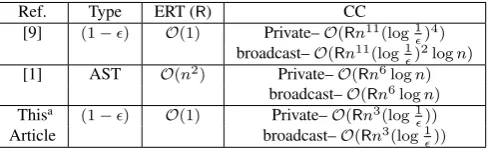
)bits of private, as well as broadcast communication. Moreover, con-ditioned on the event that our ABA protocol terminates, it does so in constant expected time; i.e.R=O(1). In Table 2, we compare our ABA protocol with the optimally resilient ABA protocols of [9, 1].
Table 2 Comparison of our optimally resilient ABA protocol with the best known optimally resilient ABA protocols. Here AST stands for almost surely terminating. The communication complexity is the ex-pected communication complexity as it depends on the exex-pected run-ning time of the protocol. The expected runrun-ning time is conditioned on the event that the honest parties terminate the protocol.
Ref. Type ERT (R) CC
[9] (1−) O(1) Private–O(Rn11(log1
)
4)
broadcast–O(Rn11(log1
)
2logn)
[1] AST O(n2) Private–O(Rn6logn)
broadcast–O(Rn6logn)
Thisa (1−) O(1) Private–O(Rn3(log1
)) Article broadcast–O(Rn3(log1
)) aThe communication complexity of our protocol is the amortized
com-plexity for reaching agreement on a single bit.
From the table, we find that our ABA protocol achieves a huge gain in the communication complexity over the ABA protocol of [9], while keeping all other properties in place
3 The authors in [1] followed a slightly different approach.
(namely constant expected running time and(1−)-terminating). On the other hand, our ABA protocol enjoys the following merits over the ABA protocol of [1]:
1. Our ABA protocol is better in terms of the communica-tion complexity when(log1)< n5logn.
2. Our ABA protocol runs in constant expected time (con-ditioned on the event that the protocol terminates). How-ever, we stress that our ABA protocol is(1−)-terminating, whereas the ABA protocol of [1] is almost surely termi-nating.
A Brief Discussion on the Approaches Used in the ABA Protocols of [9, 1] and the Current Article : We now briefly discuss the approaches used in the ABA protocols of [9], [1] and the current article.
•The ABA protocol of Canetti et al. [9, 8] uses the reduction from the ABA to AVSS. Hence they have first designed an AVSS protocol withn = 3t+ 1. There are well known in-herent difficulties in designing an AVSS protocol withn= 3t+1(see [9, 8]). To overcome these difficulties, the authors in [9] used the following route to design their AVSS proto-col:ICP→A-RS→AWSS→Two & Sum AWSS→AVSS, whereX → Y means that protocol Y is designed using the protocol X as a black-box. Since the final AVSS pro-tocol is designed on the top of so many sub-propro-tocols, it is highly communication intensive as well as very much involved. The protocol incurs a private communication of O(n9(log1)4)bits and broadcast ofO(n9(log1)2log(n)) bits during the sharing phase; during the reconstruction phase, it incurs a private communication ofO(n6(log1
)
3)bits and broadcast ofO(n6(log1) log(n))bits4. The protocol shares
a single secret and all the (honest) parties terminate the pro-tocol with probability at least(1−).
•The ABA protocol of [1] followed the same reduction from the ABA to AVSS as in [9], except that the use of AVSS is re-placed by a variant of AVSS calledshunning(asynchronous) VSS (SVSS), where each (honest) party is guaranteed to ter-minate almost-surely (i.e. with probability one). SVSS is a slightly weaker notion of AVSS in the sense that if all the parties behave correctly, then SVSS satisfies all the prop-erties of AVSS without any error; otherwise it fails to sat-isfy the properties of AVSS, but enables some honest party to identify at least one corrupted party, whom the honest party “shuns” from then onwards. In order to design their SVSS protocol, the authors in [1] first designed a weaker primitive calledweakSVSS (W-SVSS), which is used as a black-box to design the SVSS protocol. Here W-SVSS is the “shunning” variant of theasynchronous weak secret sharing
4 The exact communication complexity analysis of the AVSS (and
(AWSS) primitive, which was used in [9, 8] for designing the AVSS protocol.
The use of SVSS instead of AVSS in generating the com-mon coin causes the ABA protocol of [1] to run forO(n2) expected time; however unlike the AVSS of [9] (which is (1 −)-terminating), the SVSS protocol of [1] is almost surely terminating. The protocol shares a single secret and requires a private communication ofO(n4log(n))bits and broadcast ofO(n4log(n))bits.
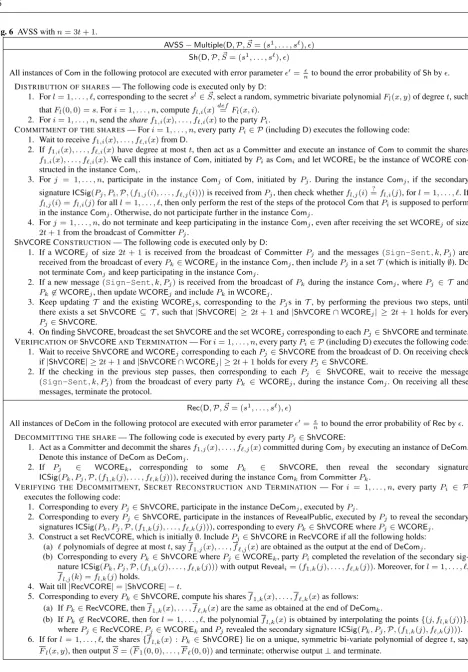
• Similar to [9, 8] and [1], we too follow the same path of constructing an AVSS protocol to design our ABA protocol. So we first design a communication efficient AVSS protocol withn = 3t+ 1. But instead of following the fairly com-plex route taken by [9] for the design of their AVSS proto-col, we follow a much shorter route:ICP→AWC→AVSS. Hereasynchronous weak commitment(AWC) is a new prim-itive introduced by us, which acts as a substitute for the AWSS primitive, which was used as a black-box in [9] as well as in [1] (the shunning variant) for designing the AVSS (SVSS). We find that AWC has “weaker” requirements than the AWSS and hence can be designed more efficiently than the existing AWSS protocols (the details are elaborated in Section 2.3.2 and section 4.3). More specifically, while the existing AWSS and W-SVSS are based on the idea of us-ingbi-variatepolynomials of degreetin each variable, we design an AWC scheme using Shamir secret sharing [30], which is based onunivariatepolynomials of degreet; this immediately implies a gain ofΘ(n)in the communication complexity. In addition to introducing the new primitive AWC, we also extend the existing notion ofinformation checking protocol (ICP) [9] to deal with multiple verifiers simulta-neously, instead of a single verifier (the details will appear later). This helps us to use the ICP primitive in designing our AWC protocol.
Besides following a shorter route and introducing a new primitive for designing the AVSS, we significantly improve the communication complexity of each building block. In addition, each of the building blocks is designed to deal with multiple values concurrently (unlike the existing pro-tocols) and this leads to a significant gain in the communi-cation complexity. Specifically, our AVSS protocol requires a private communication and broadcast communication of O((`n2 +n3) log1) bits to share ` secrets concurrently, where` ≥ 1. Moreover, it requires a broadcast communi-cation ofO((`n2+n3) log1
)bits to reconstruct the` se-crets. Like the AVSS protocol of [9], our AVSS protocol is also(1−)-terminating, where all the parties terminate with probability at least(1−).
To design our ABA protocol, we also make several changes to the existing common coin protocol. As discussed earlier, the common coin protocol is a very important building block for an ABA protocol. The best known common coin
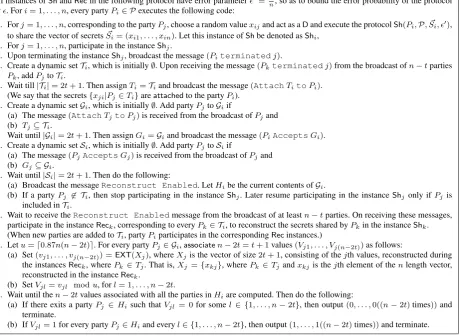
proto-col of [16, 8] employs AVSS sharing a single secret. Infor-mally, in the common coin protocol of [16], each party is asked to act as a dealer and sharenrandom secrets using an AVSS protocol. So each party invokesnparallel instances of an AVSS protocol as a dealer to sharensecrets in paral-lel. It is obvious that we can do better if each party invokes a single instance of our new AVSS protocol that can sharen secrets concurrently. However, our detailed analysis of the existing common coin protocol shows that the above “triv-ial” modification leads to an incorrect common coin pro-tocol. Hence we bring several modifications to the existing common coin protocol, so that it can use our new AVSS pro-tocol (that shares multiple secrets concurrently). As a result, our new common coin protocol is more communication ef-ficient than the existing common coin protocol of [8, 9].
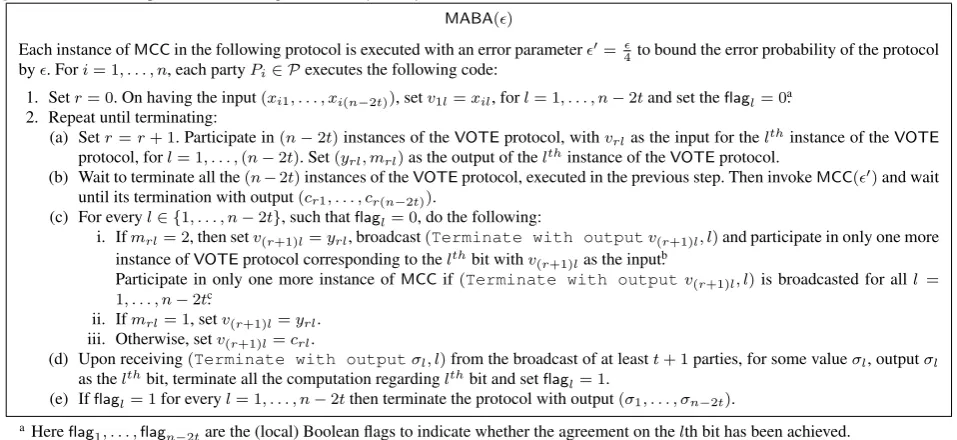
Interestingly, we show that our new common coin pro-tocol is actually a multi-bit common propro-tocol, which allows the parties to generate(t+1)random common coins concur-rently, which further allows the parties to reach agreement ont+ 1bits concurrently.
1.3 Organization of the Paper
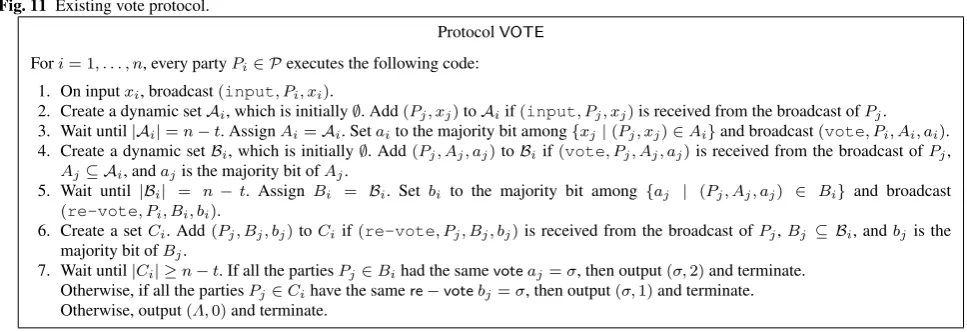
In the next section, we describe the asynchronous network model and formally define ABA, AVSS, AWC, AWSS and AICP. This is followed by the description of the existing tools used in our protocols. In section 3, we present our AICP, followed by our new primitive AWC in section 4; in the same section, we also compare our AWC scheme with the best known existing AWSS scheme of [25] and the ex-isting W-SVSS scheme of [1]. In section 5, we present our AVSS scheme. The existing common coin protocol from [8] is presented in section 6. In the same section, we show that a simple substitution of the existing AVSS scheme (sharing a single secret) by our AVSS scheme (sharing multiple se-crets) in the common coin protocol may lead to an incorrect common coin protocol. This is followed by the modifica-tions needed to get a correct (multi-bit) common coin proto-col. In section 7, we recall the existing voting protocol from [8], which is required along with the common coin protocol to get an ABA scheme. Finally, in section 8, we present our (multi-bit) ABA protocol.
2 Model and Definitions
(active) adversary, denoted asAdv. The adversaryAdv, com-pletely dictates the parties under its control and can force them to deviate in any arbitrary manner during the execution of a protocol. The parties not under the influence ofAdvare called honest or uncorrupted.
The underlying network is asynchronous, where the com-munication channels between the parties have arbitrary, yet finite delay (i.e the messages are guaranteed to reach their destinations eventually). Moreover, the order in which the messages reach their destinations may be different from the order in which they were sent. To model the worst case sce-nario,Advis given the power to schedule the delivery of ev-ery message in the network. Note that, whileAdvcan sched-ule the messages of the honest parties at its will, it has no access to the “contents” of the messages communicated be-tween the honest parties.
As in [8], we consider a computation (protocol execu-tion) in the asynchronous model as a sequence of atomic steps, where in each such step, a single party isactive. The party is activated by receiving a message after which it per-forms an internal computation and then possibly sends mes-sages on its outgoing channels. The order of the atomic steps are controlled by a “scheduler”, which will be under the con-trol ofAdv. At the beginning of the computation, each party will be in a special start state. We say a party has termi-nated/completedthe computation if it reaches a haltstate, after which it does not perform any further computation. A protocol execution is said to be complete if each (honest) party terminates the protocol. Notice that the executions that complete do so after a finite number of steps.
Running Time of an Asynchronous Protocol : We now recall the definition of running time of an asynchronous pro-tocol from [9]. Consider a virtual “global clock”, measuring the time in the network. Note that the parties cannot read this clock. Let thedelay of a message be the time elapsed from its sending to its receipt. Let theperiodof a finite ex-ecution of a protocol be the longest delay of a message in the execution. Thedurationof a finite execution is the total time measured by the global clock divided by the period of the execution (infinite executions have infinite duration).
More precisely, consider a protocol execution, with some inputs and random inputs for the parties. Recall that such an execution is a sequence of atomic steps. Assume that the first atomic step is a fictitious step, where a special “wakeup” message is sent to all the parties. We now assign round-numbers to the atomic steps as follows: The fictitious atomic step, denotedl0is the only step at round zero. Next, for each
i >0, letlibe the last atomic step where an(i−1)-message is delivered; we call a message an(i−1)-message if it was sent in an atomic step that belongs to round(i−1). All the steps afterli−1until (and including) the stepliare in round
i. The duration of the execution is the round number of the last atomic step.
LetC denote the event that the (honest) parties termi-nate the execution of a given protocol. The expected run-ning time(ERT) of a protocol, relative to an adversary and some input values for the parties and conditioned on the eventC, is the expected value of the duration of acomplete execution (thus the expectancy is taken only over the ran-dom inputs of the parties in which the eventCoccurs). The (non-relative) expected running timeR(π|C)of a protocol π, conditioned on the eventC, is the maximum over all in-puts~x= (x1, . . . , xn)and adversariesAdv, of the expected running time of the protocol relative to input~xand adver-saryAdvand conditioned on the eventC. That is:
R(π|C) =Max~x,Adv{Exp~r[D(π,Adv, ~x, ~r)|C]},
whereD(π,Adv, ~x, ~r)is the duration of the execution of the protocolπwith inputs~x= (x1, . . . , xn)and random inputs
~r= (r1, . . . , rn)for the parties and with adversaryAdv. We now present the definition of ABA and the primitives which are used for the construction of our ABA protocol. Our ABA protocol is(1−)-terminating, where >0. To bound the probability of non-termination by, all our pro-tocols work over a finite fieldFwhereF= GF(2κ), such that|F| >2nand = 2−Ω(κ), for some non-zeroκ. Thus each field element can be represented byκ=O(log1)bits. Moreover, we assumen=poly(κ). That is,nis polynomial inκ. Thus we have thatn=poly(log1).
2.1 Asynchronous Byzantine Agreement (ABA)
Definition 1 (ABA [9]): Letπbe an asynchronous protocol executed among the set of parties inP, where each party has a private binary input. We say thatπis an(1−)-terminating ABA protocol for a single bit, for an allowed error parameter (where >0) if the following holds for every possibleAdv and every input vector of the parties:
1. Termination: If all the honest parties participate in the protocol then with probability5at least(1−), all honest parties eventually terminate the protocol.
2. Correctness: All the honest parties who have terminated the protocol hold identical bit as the output. Moreover, if all the honest parties had the same input, sayρ, then all honest parties upon termination outputρ.
The above definition can be extended in a straight forward way for agreement on`bits, where` >1and we call such a protocol asmulti-bitABA protocol.
5 Here and in the sequel the probabilities are taken over the random
2.2 Asynchronous Verifiable Secret Sharing (AVSS)
We now present the definition of AVSS, which is the major component in the design of the existing common coin pro-tocol. As mentioned earlier, any AVSS protocol consists of two protocols: a sharing protocol (calledSh) where a spe-cial player called dealer shares a secret among the parties and a reconstruction protocol (calledRec) where the parties reconstruct the secret from its shares. More formally: Definition 2 (Asynchronous Verifiable Secret Sharing (AV SS) [9])Let (Sh, Rec) be a pair of protocols for then par-ties, where a dealerD∈ Phas a private inputs∈FforSh. Then (Sh, Rec) is a(1−)-AVSS scheme6, for an allowed error parameter(where > 0), if the following require-ments hold for every possible behavior ofAdv:
– Termination: With probability at least(1−), the fol-lowing requirements hold:
1. IfDishonestand all the honest parties participate in the protocol Sh, then eachhonest party eventually terminates the protocolSh.
2. If some honest party terminatesSh, then irrespective of the behavior ofD, eachhonestparty eventually terminatesSh.
3. If all the honest parties have terminatedShand in-vokedRec, then eachhonestparty eventually termi-natesRec.
– Correctness: If some honest party terminatesSh, then there exists a fixed values, wheres ∈ F∪ {⊥}, such that the following requirements hold with probability at least(1−):
1. Eachhonestparty outputss upon terminatingRec (i.e. sis the reconstructed secret). This property is also called thestrong-commitmentproperty7. 2. IfDishonest, thensis the shared secret; i.e.s=s. – Secrecy: Let VIEW(s) denote the random variable (over the random inputs of the parties), describing the view of the adversary during an execution ofSh, whereDhas the inputs. IfDishonestduringShand no honest party has begun executing the protocolRec, then the distribu-tion of VIEW(s) is the same (i.e. identically distributed) for alls∈F.
Before proceeding further, we make the following note:
Note 1 There exists a “stronger” definition of VSS (AVSS) which requires that D’s committed secret s ∈ F, instead of F∪ {⊥}[22]. Such a stronger definition8 is required if VSS is used for secure multi-party computation MPC [3]. However, VSS (AVSS) satisfying the above (weak) defini-tion is enough for the construcdefini-tion of (asynchronous) BA
6 Such schemes are also called statistical AVSS.
7 We often say thatDhas committedsduring the sharing protocol. 8 The interpretation ofs=⊥will be clear during the description of
our protocol.
protocols. We also note that the above weak definition of VSS is used in [24] to study the round complexity of VSS. The above definition is equivalent to saying thats ∈ F, by fixing a default value inF, which may be output in case the
Recprotocol ends with a⊥. 2
The above definition can be extended in a straight forward way for a secret S~ = (s1, . . . , s`), containing ` elements fromF.
2.3 Asynchronous Weak Commitment (AWC)
To design our AVSS protocol, we introduce a new asyn-chronous primitive called AWC. This new primitive will act as a “substitute” for theasynchronous weak secret sharing (AWSS) primitive; recall that AWSS was used as a primitive in [9] to design a(1−)-AVSS, while a “shunning variant” of AWSS was used as a primitive in [1] to design an almost surely terminating shunning AVSS.
Informally, an AWC scheme consists of two protocols: a commitment protocol (calledCom) and a decommitment protocol (called DeCom). In the commitment protocol, a special party called Committer “commits” a secret to the parties in a distributed fashion and during the decommit-ment protocol,Committer“decommits” the secret and the parties verify whether this was the secret committed earlier and either accept or reject the secret. More formally:
Definition 3 (Asynchronous Weak Commitment (AWC)) Let (Com,DeCom) be a pair of protocols for thenparties, where a Committer ∈ P has a private input s ∈ F for Com(the secret to be committed). In the protocolDeCom, Committerhas a private inputs?∈F∪{⊥}(the secret to be decommitted) and each party upon terminatingDeCom ei-ther outputss?or outputs⊥. Then (Com,DeCom) is a(1−
)-AWC scheme, for an allowed error parameter(where > 0), if the following requirements hold for every possi-ble behavior ofAdv:
– Termination: With probability at least(1−), the fol-lowing requirements hold:
1. IfCommitterishonestand all the honest parties par-ticipate in the protocolCom, then eachhonestparty eventually terminates the protocolCom.
2. If somehonestparty terminatesCom, then irrespec-tive of the behavior ofCommitter, eachhonestparty eventually terminatesCom.
3. If all the honest parties have terminatedCom,Committer invokesDeComand all the honest parties participate inDeCom, then eachhonestparty eventually termi-natesDeCom.
that the following requirements9 hold with probability
at least(1−)upon the completion (if it completes) of DeCom:
1. If anhonestparty outputss? ∈F(namelys? is ac-cepted as the decommitted secret ands?is from the fieldF), then all the honest parties outputs?. More-over,s?=s(so in this case,s∈
F).
2. If Committeris honest, then all the honestparties outputs?, wheres?=s=s.
– Secrecy: Let VIEW(s) denote the random variable (over the random inputs of the parties), describing the view of the adversary during an execution ofCom, where Committerhas the inputs. IfCommitterishonest dur-ingComand has not begun executing the protocol DeCom, then the distribution of VIEW(s) is the same (i.e. identically distributed) for alls∈F.
The above definition can be extended in a straight forward way for a secret S~ = (s1, . . . , s`), containing ` elements fromF.
Comparison of AVSS and AWC: There are two (subtle) differences between the AVSS and AWC. The first is regard-ing the termination of the reconstruction protocol and the decommitment protocol respectively. In AVSS, we demand that irrespective of the behavior ofD, if the honest parties terminate the sharing protocol and invoke the reconstruc-tion protocol, then all the honest parties should eventually terminate the reconstruction protocol. But this need not be the case for the decommitment protocol. Specifically, the de-commitment protocol requires theparticipationofCommitter and so if Committeriscorruptedand does not invoke the decommitment protocol, then the honest parties will never terminate the decommitment protocol.
The second difference is regarding the committed value. In AVSS, we demand that irrespective of the behavior ofD, onlythe committed value s ∈ F∪ {⊥}should be recon-structed by the honest parties in the reconstruction proto-col. That is, acorruptedDcannot later change the commit-ted secret during the reconstruction protocol in co-operation with the corrupted parties. However, in AWC, acorrupted
Committercan later decommit ans?during the decommit-ment protocol, wheres?isdifferentfrom the secrets, com-mitted during the commitment protocol, provided s 6= ⊥ ands? =⊥(sos∈
F). Notice that even thoughCommitter can later “change” the committed value, the change is al-lowedonlyfrom a non-⊥committed value to⊥; so a cor-rupted Committercannot commit an s ∈ F and later de-commits?∈
F, wheres?6=s.
9 We often say thatsis the value committed byCommitterduring
the commitment protocol. The interpretation ofs= ⊥will be clear during the description of our protocol.
Finally, we note that the above differences between AVSS and AWC holds only whenCommitteriscorrupted; other-wise AWC provides the same properties as the AVSS.
2.3.1 Asynchronous Weak Secret Sharing (AWSS)
Like AVSS, an AWSS protocol also consists of two pro-tocols: a sharing protocol (called WSh), where the dealer shares a secret and a reconstruction protocol (calledWRec), where the parties reconstruct the secret from its shares. An AWSS protocol also has three properties, namely Termina-tion, CorrectnessandSecrecy. The Terminationand the Secrecyconditions are the same as for the AVSS (see Def-inition 2), except that Sh is replaced by WSh andRec is replaced byWRec. The Correctnesscondition is also the same as for the AVSS for the case when the dealer ishonest; however, theCorrectnesscondition isweakenedin AWSS for the case when the dealer iscorruptedas follows:
If an honest party terminatesWShthen a value, say s∈F∪ {⊥}is fixed. Moreover, with probability at least(1−), each honest party will outputeithers or⊥at the end10ofWRec.
2.3.2 Comparison of AWSS and AWC
Property wise, the sharing protocol of AWSS and the com-mitment protocol of AWC demands thesame; namely a dis-tributed commitment to a unique values, which should be secure ifD(resp.Committer) is honest. However, the (sub-tle) difference is between the decommitment protocol and the reconstruction protocol. The difference is about the role of Committerand Dfor the termination of the respective protocols: the reconstruction protocol of an AWSS scheme does not demand a special role byDto enforce the termi-nation. So this protocol will always terminate (if it is in-voked by the honest parties) even ifDis corrupted and does not participate. On the contrary, the decommitment protocol demands a special role fromCommitterto enforce the ter-mination. HereCommitterhas to invoke the protocol; so if Committeris corrupted and does not invoke the decommit-ment protocol, this protocol may never terminate.
The above difference intuitively suggests that Dhas to work/communicate “more” during the sharing protocol of an AWSS scheme, as compared to what is done byCommitter dur-ing the commitment protocol of an AWC scheme. The ve-racity of the intuition is confirmed by our ability to design an AWC protocol more efficiently than the existing AWSS protocols (for the comparison, see Section 4.3).
2.4 Asynchronous Information Checking Protocol (AICP)
An Information Checking Protocol (ICP) is used for authen-ticating data in the presence of computationally unbounded corrupted parties. The notion of ICP was first introduced by Rabin et al. [29]. As described in [29, 9, 12], an ICP is exe-cuted among three parties: aSigner, an intermediaryINTand aVerifier. Informally, an ICP consists of two phases (where each phase is implemented by different protocol(s)):
– Signature generation phase: hereSigner computes his IC (information checking) signature on a secrets ∈F, denoted byICSig(Signer,INT,Verifier, s) and hands it toINT. Signeralso computes some verification infor-mation and hands it toVerifier.
– Signature revelation phase: hereINTreveals the signa-tureICSig(Signer,INT,Verifier, s), claiming that he has received it from Signer.Verifier then verifies the sig-nature, using the verification information and either ac-cepts or rejects the signature (and hences).
IC signature may be considered as the information theoret-ically secure substitute of traditional digital signatures. It provides the properties like unforgeability and non-repudiation; in addition, it also provides information theoretic security. That is, ifSignerandINTare honest, then at the end of the signature generation phase,sremains secure in the informa-tion theoretic sense.
We extend the above notion of ICP in two directions: First, we considermultipleverifiers, where each party inP acts as aVerifier. This will be later helpful in using the ICP as a tool in our AWC protocol. It is important here to note thatSignerandINTcan be any two parties from the setP. They just play their “special” role asSignerandINT. Sec-ond, instead of a single secret, we consider ICP that can deal with multiple secrets concurrently and thus achieves better communication complexity, than executing multiple instances of ICP, dealing with a single secret. Our ICP is ex-ecuted in the asynchronous settings and thus we call it AICP. We now formally define AICP.
Definition 4 ((Multi-Verifier) Asynchronous Information Checking Protocol (AICP))An AICP involves three enti-ties: aSigner ∈ P, an intermediary INT ∈ P and the set ofnparties inP acting as verifiers. The protocol is carried out in three phases (where each phase is implemented by a protocol):
1. Generation Phase: this phase is initiated bySigner, where Signerhas a secret inputS~ = (s1, . . . , s`)∈F`. In this phase,SignersendsS~toINT, along with some authenti-cationinformation. In addition,Signersends some veri-ficationinformation to each individual verifier.
2. Verification Phase: this phase is initiated byINT, where INTinteracts withSignerand the verifiers to ensure that the secretS~ received fromSignerwill be later accepted
by each (honest) verifier inPduring the revelation phase. During the interaction,Signerhas the option of replac-ingthe secretS~, as well as the authentication informa-tion and the verificainforma-tion informainforma-tion (by sending new values for them) . The secretS~, along with the authenti-cation information, which is finally possessed byINTat the end of this phase is calledSigner’sIC signatureon
~
S, denoted asICSig(Signer,INT,P, ~S),giventoINTby Signer.
3. Revelation Phase: this is carried out byINTand the ver-ifiers in P, where INT and the verifiers interact with each other. Here INTreveals ICSig(Signer,INT,P, ~S) and each verifier checksICSig(Signer,INT,P, ~S)with respect to his verification information and possibly let his findings known to the other verifiers. Based on the verification information and possibly on the response re-ceived from the other verifiers, each individual verifier Pi ∈ Peither outputsReveali =S~ (indicating thatPi is convinced thatINTindeed obtainedS~ fromSigner) orReveali=⊥(indicating thatPiis not convinced that
INTobtainedS~fromSigner). Accordingly, we say that the verifier Pi accepted (resp. rejected) the ICSig and henceS~.
A triplet of protocols(Gen,Ver,RevealPublic)(for the gen-eration, verification and revelation phase respectively), where Signerhas a private inputS~ ∈ F` for the protocolGen, is called an(1−)-AICP, for an allowed error parameter (where > 0), if the following requirements hold for every possible behavior ofAdv:
1. AICP-Correctness1: IfSignerandINTarehonest, then eachhonestverifierPi∈ Pwill outputReveali=S~at the end ofRevealPublic.
2. AICP-Correctness2: IfINTishonestand possessesICSig (Signer,INT,P, ~S)at the end ofVer, then with proba-bility at least(1−), eachhonestverifierPi ∈ P will outputReveali=S~at the end ofRevealPublic. 3. AICP-Correctness3:IfSignerishonestandINT
pos-sessesICSig(Signer,INT,P, ~S)at the end ofVer, then the probability that an honest verifier Pi outputs Re-veali =S~?at the end ofRevealPublic, whereS~? 6=S~ is at most.
4. AICP-Secrecy:IfSignerandINTarehonest, then the information received byAdvtill the end of Veris dis-tributed independently of the secretS~. This implies that ifSignerandINTare honest andINThas not executed RevealPublic, thenAdvhas no information aboutS~.
2.5 Existing Tools
ele-gantly implemented by Bracha [7] with3t+ 1parties. For-mally, A-cast is defined as follows:
Definition 5 (A-cast [9])Letπbe an asynchronous proto-col initiated by a special party inP (calledSender), having an inputm(the message to be broadcast). We say thatπis an A-cast protocol if the following requirements hold, for every possible behavior ofAdv:
– Termination:
1. IfSenderishonestand all the honest parties partic-ipate in the protocol, then eachhonestparty eventu-ally terminates the protocol.
2. Irrespective of the behavior ofSender, if any honest party terminates the protocol then eachhonestparty eventually terminates the protocol.
– Correctness: If the honest parties terminate the protocol then they do so with a common outputm?. Furthermore, ifSenderishonestthenm?=m.
For the sake of completeness, we recall the Bracha’s A-cast protocol from [8] and present it in Fig. 1.
Fig. 1 Bracha’s A-cast protocol withn= 3t+ 1.
A-cast(m)
The following step is executed only bySender: 1. Send the message(MSG, m)to all the parties.
Fori = 1, . . . , n, every partyPiinP(includingSender) executes the following steps:
1. Upon receiving a message(MSG, m)fromSender, send the mes-sage(ECHO, m)to all the parties.
2. Upon receiving(n−t)messages(ECHO, m?)that agree on the value ofm?, send the message(READY, m?)to all the parties. 3. Upon receiving(t+1)messages(READY, m?)that agree on the
value ofm?, send the message(READY, m?)to all the parties. 4. Upon receiving(n−t)messages(READY, m?)that agree on
the value ofm?, send the message(OK, m?)to all the parties, outputm?and terminate the protocol.
Theorem 1 ([8])ProtocolA-castrequires a private com-munication ofO(`n2)bits to broadcast an`bit message.
In the rest of the paper, we use the following notation while invoking theA-castprotocol:
Notation 1 (Notation for Using theA-castProtocol)We say that a partyPjreceivesthe messagemfrom the broad-cast of Pi, if Pj (as a receiver) completes the execution ofPi’s A-cast (namely the instance of theA-castprotocol wherePiisSender), withmas the output.
Randomness Extractor : In our common coin protocol, we will use a well known method for randomness extraction in the information theoretic settings. The setting is as follows: we are given a set ofNvalues fromF, saya1, . . . , aN, such thatat leastKout of theseN values are selected uniformly and randomly fromF; however, the exact identity of those Kvalues are not known. The goal is to computeKvalues b1, . . . , bKfroma1, . . . , aN, each of which is uniformly dis-tributed overF. This is achieved through the following well-known method introduced in [5, 4]: let f(x) be the poly-nomial of degree at most N −1, such thatf(i) = ai+1, fori = 0, . . . ,(N −1). Then setb1 = f(N), . . . , bK =
f(N +K −1) (of course we require|F| ≥ N +K for this, which will be the case in our protocol). The elements b1, . . . , bKare uniformly distributed overF, as there exists a one-to-one mapping betweenb1, . . . , bKand theKrandom elements in the vector(a1, . . . , aN). We call this algorithm asEXTand invoke it as(b1, . . . , bK) =EXT(a1, . . . , aN).
3 Asynchronous Information Checking Protocol We present an AICP calledMultiVerifierAICP. The underly-ing idea behind the protocol is as follows: letS~ = (s1, . . . , s`)∈
F`be the secret, on whichSignerwants to give his IC signa-ture toINT. For this, during the generation phase,Signer se-lects a polynomialF(x)of degree at most`+toverF, which is an otherwise random polynomial such thatF(βi) = si, fori = 1, . . . , `. Hereβ1, . . . , β` are pre-selected, distinct elements fromF, which are known publicly. The polyno-mialF(x)is given toINT. In addition, to each verifierPi,
Signergives the value ofF(x)at a randomevaluation point
αi(different from allβj’s). During the revelation phase,INT publicly disclosesF(x)(by broadcasting) and each verifier Pichecks whether the value held by him is indeed the value ofF(x)atαi. It is easy to note that the above simple proto-col satisfies theAICP-Correctness3property. Specifically, ifSignerishonestandINTiscorrupted, thenINTwill not know the evaluation pointαi of an honest verifierPi and so with high probability,INTcannot disclose an incorrect polynomialF(x), different fromF(x), and still remain un-noticed by an honest verifierPi.
The above protocol also satisfies theAICP-Secrecy prop-erty, as the degree ofF(x)is at most`+tand at mostt points onF(x)will be disclosed toAdv(throughtcorrupted verifiers); soAdvwill lack `additional points onF(x)to uniquely interpolateF(x)and obtain the value ofF(x)at β1, . . . , β`(which are the secrets). More specifically, from the view point ofAdv, who holdstrandom points on a poly-nomial of degree at most`+t, there is a single polynomial that will be “consistent” with thosetrandom points andany
`secrets.
if Signer iscorrupted, then he might give F(x)toIN T, but evaluations of a different polynomialF(x) 6= F(x)to each honest verifier. To avoid this situation, we have to add additional steps in the above protocol, which allowsINTto interact with the verifiers, to check the consistency ofF(x) (received by him) and the values at the random evaluation points (received by the verifiers). The interaction should be in a “zero-knowledge” fashion, meaning that it should not compromise the privacy of the information held byINTand the (honest) verifiers.
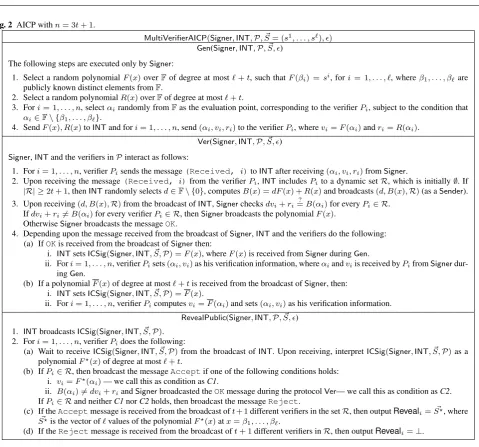
To enable the zero-knowledge interaction, Signer dis-tributes some additional information to INT and the veri-fiers during the generation phase. Specifically, in addition to F(x),Signergives toINTanother random polynomialR(x) of degree at most`+t. In parallel, to each individual verifier Pi,Signergives the value ofR(x)atαi. Now the specific details of the zero-knowledge consistency checking, along with the other formal steps of the protocolMultiVerifierAICP are given in Fig. 2.
We now prove the properties of the protocolMultiVerifier AICP. Before that, we prove the following two claims, which will be required to prove the properties of the protocol. Claim 1. LetF(x), R(x)be two polynomials of degree at most`+tand(αi, vi, ri)be a tuple such thatF(αi)6=vi andR(αi)6=ri. Then for a randomd∈F\ {0}, the
con-ditionB(αi)6=dvi+riwill be true except with probability
at most, whereB(x)def= dF(x) +R(x).
PROOF: We first argue that there existsonly onenon-zero d∈F, for which the conditionB(αi) =dvi+riwill hold, even though F(αi) 6= vi andR(αi) 6= ri. For otherwise, assume there exists another non-zeroe∈ F, wheree6= d, for whichB(αi) =evi+riis true, even ifF(αi)6=viand
R(αi)6=ri. This implies that
dF(αi)+R(αi) =dvi+ri and eF(αi)+R(αi) =evi+ri.
This implies that(d−e)F(αi) = (d−e)viorF(αi) =vi, which is a contradiction. Now since dis randomly chosen fromF\ {0}, the condition B(αi) = dvi+riholds with probability at most | 1
F|−1 ≈. 2
Claim 2. In the protocolMultiVerifierAICP, ifSignerand
INTare honest, thenSignerwill broadcast theOKmessage (and not the polynomialF(x)) during the protocolVer.
PROOF: Follows from the fact that ifSigner andINT are honest then F(αi) = vi andR(αi) = ri holds for every verifierPi ∈ R. Moreover,INTwill correctly broadcast the polynomialB(x)during the protocolVer, whereB(x)def= dF(x) +R(x)and sodvi+ri=B(αi)will hold for every
verifierPi ∈ R. 2
Lemma 1 (AICP-Correctness1)IfSignerandINTare hon-est, then in the protocolRevealPublic, each honest verifier
Pi∈ Pwill output Reveali=S~?=S~.
PROOF: From Claim 2, ifSignerandINTare honest, then Signerwill broadcast theOKmessage duringVer, asvi =
F(αi)andri = R(αi)will be true for each verifierPi ∈
Rand there are at leastt+ 1honest verifiers inR. Now duringRevealPublic,INTwill correctly broadcastICSig= F(x)(soF?(x) =F(x)) and each honest verifierP
i ∈ R will broadcast theAcceptmessage, as the condition C1, i.e.vi=F(αi)will hold for each of them. Hence each hon-est verifierPi ∈ P will eventually receivet+ 1Accept messages from at leastt+ 1verifiers inRand hence will outputReveali =S~?. Now it is easy to see thatS~? =S~. 2
Lemma 2 (AICP-Correctness2)If INTis honest and pos-sessesICSig(Signer,INT,P, ~S)at the end ofVer, then with probability at least(1−), each honest verifierPi∈ Pwill outputReveali =S~at the end ofRevealPublic.
PROOF: IfSigner is honest, then the lemma follows from Lemma 1. So we consider the case whenSigneris corrupted. We claim that in this case, except with probability, each honestverifierPi∈ Rwill broadcast theAcceptmessage duringRevealPublic, in response toICSig(Signer,INT,P, ~S) broadcasted by the honestINT. Now since there are at least t+1honest verifiers (and at mosttcorrupted verifiers) in the setR, it implies that each honest verifierPi∈ Pwill even-tually receive theAcceptmessage from at leastt+1 differ-ent verifiers inRand will outputReveali=S~. We consider the following two cases, depending upon whatSigner broad-casts duringVer:
1. Signerbroadcasts a polynomialF(x)duringVer: In this case, the above claim is true, asINTwill setICSig(Signer, INT,P, ~S) =F(x)as the IC signature and eachhonest verifierPi ∈ Rwill setvi = F(αi)as his verification information. DuringRevealPublic, the honestINTwill correctly broadcastICSig(Signer,INT, ~S,P) =F?(x) =
F(x)and so the conditionC1, namelyF?(αi) =viwill hold for each honest verifierPi∈ R.
2. Signer broadcasts theOK message duringVer: In this case,INTwill broadcastICSig(Signer,INT, ~S,P) = F?(x) = F(x)duringRevealPublic. Now we have the following cases depending on the relationship that holds between(F(x), R(x))held byINTand the tuple(αi, vi,
ri)) held by anhonestverifierPi ∈ R:
(a) F(αi) =vi: clearlyPi will broadcast theAccept message, as the conditionC1, i.e.F?(αi) =vi will hold forPi.
(b) F(αi) 6= vi and R(αi) = ri: Here also Pi will broadcast theAcceptmessage, as the conditionC2, i.e.B(αi)6=dvi+riwill hold forPi.
(c) F(αi) 6= vi andR(αi) 6= ri: In this case,Pi will broadcast theAcceptmessage, except with prob-ability at most, as the conditionC2, i.e.B(αi)6=
Fig. 2 AICP withn= 3t+ 1.
MultiVerifierAICP(Signer,INT,P, ~S= (s1, . . . , s`), ) Gen(Signer,INT,P, ~S, )
The following steps are executed only bySigner:
1. Select a random polynomialF(x)overFof degree at most`+t, such thatF(βi) = si, fori= 1, . . . , `, whereβ1, . . . , β`are publicly known distinct elements fromF.
2. Select a random polynomialR(x)overFof degree at most`+t.
3. Fori= 1, . . . , n, selectαirandomly fromFas the evaluation point, corresponding to the verifierPi, subject to the condition that αi∈F\ {β1, . . . , β`}.
4. SendF(x), R(x)toINTand fori= 1, . . . , n, send(αi, vi, ri)to the verifierPi, wherevi=F(αi)andri=R(αi).
Ver(Signer,INT,P, ~S, )
Signer,INTand the verifiers inPinteract as follows:
1. Fori= 1, . . . , n, verifierPisends the message(Received, i)toINTafter receiving(αi, vi, ri)fromSigner.
2. Upon receiving the message(Received, i)from the verifierPi,INTincludesPito a dynamic setR, which is initially∅. If
|R| ≥2t+ 1, thenINTrandomly selectsd∈F\ {0}, computesB(x) =dF(x) +R(x)and broadcasts(d, B(x),R)(as aSender). 3. Upon receiving(d, B(x),R)from the broadcast ofINT,Signerchecksdvi+ri=? B(αi)for everyPi∈ R.
Ifdvi+ri6=B(αi)for every verifierPi∈ R, thenSignerbroadcasts the polynomialF(x). OtherwiseSignerbroadcasts the messageOK.
4. Depending upon the message received from the broadcast ofSigner,INTand the verifiers do the following: (a) IfOKis received from the broadcast ofSignerthen:
i. INTsetsICSig(Signer,INT, ~S,P) =F(x), whereF(x)is received fromSignerduringGen.
ii. Fori= 1, . . . , n, verifierPisets(αi, vi)as his verification information, whereαiandviis received byPifromSigner dur-ingGen.
(b) If a polynomialF(x)of degree at most`+tis received from the broadcast ofSigner, then: i. INTsetsICSig(Signer,INT, ~S,P) =F(x).
ii. Fori= 1, . . . , n, verifierPicomputesvi=F(αi)and sets(αi, vi)as his verification information.
RevealPublic(Signer,INT,P, ~S, ) 1. INTbroadcastsICSig(Signer,INT, ~S,P).
2. Fori= 1, . . . , n, verifierPidoes the following:
(a) Wait to receiveICSig(Signer,INT, ~S,P)from the broadcast ofINT. Upon receiving, interpretICSig(Signer,INT, ~S,P)as a polynomialF?(x)of degree at most`+t.
(b) IfPi∈ R, then broadcast the messageAcceptif one of the following conditions holds: i. vi=F?(αi)— we call this as condition asC1.
ii. B(αi)6=dvi+riandSignerbroadcasted theOKmessage during the protocolVer— we call this as condition asC2. IfPi∈ Rand neitherC1norC2holds, then broadcast the messageReject.
(c) If theAcceptmessage is received from the broadcast oft+ 1different verifiers in the setR, then outputReveali=S~?, where ~
S?is the vector of`values of the polynomialF?(x)atx=β
1, . . . , β`.
(d) If theRejectmessage is received from the broadcast oft+ 1different verifiers inR, then outputReveali=⊥.
then there exists a unique, non-zero, randomd, for whichB(αi) =dvi+riwill hold. However, a cor-ruptedSignerwhile distributing the tuple(αi, vi, ri) to an honestPi ∈ Rduring the protocol Gen, has no idea (other than guessing) about the random d, which will be selected by the honestINTonly during the protocolVer(when(αi, vi, ri)has been already
delivered toPi). 2
Lemma 3 (AICP-Correctness3) If Signer is honest and
INTpossesses ICSig(Signer,INT,P, ~S)at the end ofVer, then the probability that an honest verifierPioutputsReveali =S~?at the end ofRevealPublic, whereS~?6=S~ is.
PROOF: First of all we have to consider acorruptedINT, as an honestINTalways correctly revealsICSig(Signer,INT,P,
~
S). Now in order that an honest verifierPi ∈ Poutputs Re-veali = S~? at the end of RevealPublic, whereS~? 6= S~,
it must be the case thatINTrevealed incorrectICSigduring RevealPublic. More specifically,INTmust have broadcasted an incorrect polynomialF?(x)duringRevealPublic, which when evaluated atx=β1, . . . , β`gives the elements ofS~? as the output. We now claim that ifINTdoes so, then except with probability, everyhonestverifierPi∈ R will broad-cast theReject message during RevealPublic. As there can beat mosttcorrupted verifiers in the setR(who may broadcast theAcceptmessage in response to the incorrect polynomial), no honest verifier in the setP will outputS~?. We consider the following two cases, depending upon what the honestSignerbroadcasts duringVer:
C2will not hold for any honest verifierPi ∈ R. So the only condition in which an honest verifierPi∈ Rwould broadcast theAcceptmessage is that the conditionC1, namelyF?(αi) = vi holds forPi. However,F?(x) 6=
F(x)and the corrupted INTwill have no information aboutαi, as both SignerandPi are honest. Moreover,
αi’s are randomly selected fromF\ {β1, . . . , β`}. So the probability thatINTcan ensureF?(αi) =vi=F(αi)is the same as the probability thatINTcan correctly guess αi, which is at most |F`+−`|t ≈2−Ω(κ)≈(sinceF?(x) andF(x)can have the same value for at most`+tvalues ofx).
2. Signerbroadcasts theOKmessage duringVer: This im-plies thatB(αi) = dvi+ri holds forallthe verifiers
Pi ∈ R, otherwise Signer would have broadcast the
F(x)polynomial. We show that in this case, the con-ditions under which anhonestverifier Pi ∈ Rwould broadcast theAcceptmessage (in response to the poly-nomialF?(x)6= F(x)) duringRevealPublicare either impossible or may happen with probability at most: (a) F?(α
i) =vi=F(αi): As discussed above, this can happen with probability at most.
(b) B(αi) 6= dvi+ri andSigner broadcasted theOK message duringVer: This case is never possible be-cause ifB(αi)6=dvi+ri, then an honestSignerwould have broadcastedF(x)duringVer, which is a
con-tradiction. 2
Lemma 4 (AICP-Secrecy)If Signerand INTare honest, then the information received byAdvtill the end ofVeris distributed independently of the secretS~.
PROOF: First of all notice that ifSignerandINTare honest, thenSignerwill broadcast theOKmessage duringVer. Now without loss of generality, let the verifiersP1, . . . , Pt ∈ P be under the control ofAdv. So at the end ofVer,Advwill know d and the polynomial B(x) = dF(x) +R(x), as they are broadcasted. In addition, Adv will also know αi andvi = F(αi), ri =R(αi), fori = 1, . . . , t. The adver-saryAdvcan also computeB(β1), . . . , B(β`), from which he getsdF(β1)+R(β1), . . . , dF(β`)+R(β`). However, the degree of the polynomialsF(x)andR(x)is at most`+tand the two polynomials are independent of each other. Now it is easy to see thatd, F(α1), . . . , F(αt), R(α1), . . . R(αt),
dF(β1) +R(β1), . . . , dF(β`) +R(β`)has distribution in-dependent of F(β1) = s1, . . . , F(β`) = s`. This is be-cause from the adversary’s point of view, for every possi-ble choice of theR(x)polynomial of degree`+t, which is consistent withr1=R(α1), . . . , rt=R(αt)anddF(β1) +
R(β1), . . . , dF(β`) +R(β`), there exists a unique polyno-mialF(x)of degree`+t, consistent withv1=F(α1), . . . ,
vt=F(αt)anddF(β1) +R(β1), . . . , dF(β`) +R(β`).2
Theorem 2 Protocol Gen requires a private communica-tion ofO((`+n) log1)bits. ProtocolVerrequires
broad-cast ofO((`+n) log1)bits and private communication of
O(nlogn)bits. Protocol RevealPublic requires broadcast ofO((`+n) log1)bits.
PROOF: In the protocolGen,Signerprivately sends `+t field elements toINTand three field elements to each ver-ifier. Since each field element can be represented byκ = O(log1
)bits,Genincurs a private communication ofO((`+
n) log1) bits. In the protocolVer, every verifier privately sends the message (Received, ?)to INT, thus incur-ring a private communication ofO(nlogn)bits (assuming that the identity of each party can be represented bylogn bits). In addition,INTbroadcasts the polynomialB(x) con-taining`+tfield elements, whileSignermay also broadcast the polynomialF(x) of degree at most`+t, thus incur-ring a broadcast of O((`+n) log1)bits. In the protocol RevealPublic,INTbroadcastsICSig, which is a polynomial of degree at most`+t, consisting of`+tfield elements, while each verifier inRbroadcastsAccept/Reject mes-sage. SoRevealPublicinvolves broadcast ofO((`+n) log1)
bits. 2
In the rest of the paper, we will use the following notations while using the protocolMultiVerifierAICP.
Notation 2 (Notation for Using theGen,VerandReveal PublicProtocols) Recall that Signerand INTcan be any party from the setP. We say that:
1. “PartyPigives ICSig(Pi, Pj,P, ~S)to partyPj” to mean thatPias aSignerexecutes the protocolGen(Pi, Pj,P,
~
S, ), consideringPjas anINTto givePi’s IC signature onS~ toPj.
2. “Party Pi receives ICSig(Pj, Pi,P, ~S) from the party
Pj” to mean thatPias anINThas completed the proto-colVer(Pj, Pi,P, ~S, )and finally possessesICSig(Pj,
Pi,P, ~S), wherePjisSigner.
3. “PartyPi reveals ICSig(Pj, Pi,P, ~S)” to mean thatPi as anINTexecutes the protocolRevealPublic(Pj, Pi,
P, ~S, )along with the participation of the verifiers inP to revealICSig(Pj, Pi,P, ~S)and henceS~, wherePj is
Signer.
4. “PartyPkcompletes the revelationofICSig(Pj, Pi,P, ~S) with output Revealk = S~? (resp.Revealk = ⊥)” to mean that Pk as a verifier has completed the protocol
RevealPublic(Pj, Pi,P, ~S, ), wherePjisSignerand
PiisINT, with outputRevealk=S~?(resp.Revealk =⊥).
5. “PartyPisuccessfully/correctly revealed ICSig(Pj, Pi,P,
~
S) (and hence S~)” to mean that every honest verifier Pk∈ PoutputsRevealk =S~ after completing the pro-tocolRevealPublic(Pj, Pi,P, ~S, ), wherePiisINTand
PjisSigner.
6. “PartyPifailed to reveal ICSig(Pj, Pi,P, ~S)(and hence
~
Revealk =⊥after completing the protocolRevealPub
lic(Pj, Pi,P, ~S, ), wherePiisINTandPjisSigner.
4 Asynchronous Weak Commitment (AWC)
We now present our AWC scheme. For the ease of presen-tation, we will first present an AWC scheme which allows to commit and decommit a single secret. This will be fol-lowed by the description of the modifications required to make the scheme to deal with ` secrets concurrently. We will then compare our AWC scheme with the existing AWSS and W-SVSS schemes. Finally, we discuss an important in-terpretation of our AWC for committing and decommitting polynomials, instead of committing and decommitting a se-cret. The interpretation will be very helpful when we use our AWC scheme for designing our AVSS.
4.1 AWC Scheme for a Single Secret
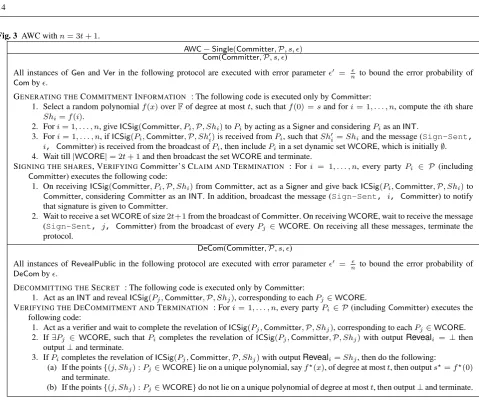
We present an AWC scheme calledAWC−Single, consist-ing of a pair of protocols (Com,DeCom), which allows a Committer∈ Pto commit to a secrets∈Fin a distributed fashion among the parties inP. The high level idea of the protocol is as follows: During the protocolCom,Committer com-putesnShamir shares [30] for the secrets, with thresholdt. Specifically,Committerselects a random polynomial of de-gree at mostt, subject to the condition that the constant term of the polynomial is the secrets. LetSh1, . . . , Shnbe then shares, which are the evaluation of the selected polynomial atnpublicly known distinct values. ThenCommittersends theith shareShi to the partyPi and also gives his IC sig-nature on Shi (as a Signer) to the party Pi (considering
Pi as anINT). On receiving the IC signature onShi from
Committer, the partyPi then himself acts as aSignerand gives backPi’s IC signature on thesameshareShitoCommitter (consideringCommitteras anINT). On receiving back2t+ 1IC signatures from at least2t+1parties,Committer broad-casts the identities of these2t+ 1parties (we denote these parties by the setWCORE) and every (honest) party termi-nates the protocolComon receivingWCOREfromCommitter. The interpretation is thatCommitterhas committed the se-cret to the parties inWCORE, where the committed secret is determined by the shares of the (honest) parties inWCORE. That is, the committed secret is the constant term of the polynomial, defined by the shares of the honest parties in WCORE. If the polynomial is of degree at mostt, then we say that the committed secret is fromF, otherwise⊥is the committed secret.
IfCommitterishonestthen the protocolCompreserves the privacy of the secrets; this follows from the privacy of the Shamir secret sharing with threshold tand the secrecy property of the AICP. Moreover,Committerwill eventually
broadcast the setWCORE, as there are at least2t+ 1honest parties in the setP who will give back their IC signatures on their respective shares toCommitterand so each honest party will eventually terminate the protocolCom. Further-more, the committed secretswill be fromF, as the shares of the honest parties inWCOREwill define a polynomial of degree at mostt. Now consider the case when Com is corrupted. In that case, he may not distribute “consistent” Shamir shares to the honest parties inWCORE. More specif-ically, the shares given to the honest parties in the setWCORE may not lie on a unique polynomial of degree at mostt, so the committed secret may be⊥. However, we will show that this will not cause any problem later in the protocolDeCom; that is, if the corruptedCommitterlater tries to decommit s? 6= ⊥, then no honest party will accept the decommitted value.
In the protocol DeCom,Committerreveals the IC sig-nature ofallthe2t+ 1parties in the setWCOREon their respective shares. So the participation ofCommitteris very crucial in the protocolDeCom, as otherwise, the honest par-ties will never participate in the protocolDeCom. This im-plies that ifCommitteris corrupted (and does not start re-vealing the signatures) then no (honest) party will participate (and hence terminate) inDeCom. Now if all the signatures (on the shares) are revealed correctly byCommitterand the 2t+ 1shares lie on a unique polynomial of degree at most t, then the constant term of the polynomial is output as the decommitted secret; otherwise the parties output⊥.
It is easy to see that if Committer is honest then in-deed every honest party will output sas the decommitted secret, whereswas committed duringCom. This is because Committerwill successfully reveal the IC signature of the 2t + 1 parties in WCORE, on the corresponding Shamir shares; moreover all these shares will lie on the original polynomial of degree at mostt. On the other hand, ifCommitteris corruptedands? is output as the decommitted secret then with high probability,s?was committed duringComamong the (honest) parties inWCORE. This is because a corrupted Committerwill fail to reveal the IC signature of anhonest partyPi ∈ WCOREon an incorrect shareSh0i, which was not given to theith party duringCom. So if at alls?is out-put as the decommitted secret, then it implies that during the protocolCom, the constant term of the polynomial defined by the shares of the honest parties inWCOREwass?.
Fig. 3 AWC withn= 3t+ 1.
AWC−Single(Committer,P, s, ) Com(Committer,P, s, )
All instances ofGenandVerin the following protocol are executed with error parameter0 = n to bound the error probability of
Comby.
GENERATING THECOMMITMENTINFORMATION : The following code is executed only byCommitter:
1. Select a random polynomialf(x)overFof degree at mostt, such thatf(0) =sand fori= 1, . . . , n, compute theith share Shi=f(i).
2. Fori= 1, . . . , n, giveICSig(Committer, Pi,P, Shi)toPiby acting as aSignerand consideringPias anINT. 3. Fori= 1, . . . , n, ifICSig(Pi,Committer,P, Sh0
i)is received fromPi, such thatSh0i=Shiand the message (Sign-Sent, i, Committer) is received from the broadcast ofPi, then includePiin a set dynamic setWCORE, which is initially∅. 4. Wait till|WCORE|= 2t+ 1and then broadcast the setWCOREand terminate.
SIGNING THE SHARES, VERIFYINGCommitter’SCLAIM ANDTERMINATION : Fori = 1, . . . , n, every partyPi ∈ P (including
Committer) executes the following code:
1. On receivingICSig(Committer, Pi,P, Shi)fromCommitter, act as aSignerand give backICSig(Pi,Committer,P, Shi)to
Committer, consideringCommitteras anINT. In addition, broadcast the message (Sign-Sent, i, Committer) to notify that signature is given toCommitter.
2. Wait to receive a setWCOREof size2t+1from the broadcast ofCommitter. On receivingWCORE, wait to receive the message (Sign-Sent, j, Committer) from the broadcast of everyPj ∈WCORE. On receiving all these messages, terminate the protocol.
DeCom(Committer,P, s, )
All instances ofRevealPublicin the following protocol are executed with error parameter0 = n to bound the error probability of
DeComby.
DECOMMITTING THESECRET : The following code is executed only byCommitter:
1. Act as anINTand revealICSig(Pj,Committer,P, Shj), corresponding to eachPj∈WCORE.
VERIFYING THEDECOMMITMENT ANDTERMINATION : Fori= 1, . . . , n, every partyPi∈ P(includingCommitter) executes the following code:
1. Act as a verifier and wait to complete the revelation ofICSig(Pj,Committer,P, Shj), corresponding to eachPj∈WCORE. 2. If∃Pj ∈ WCORE, such thatPicompletes the revelation ofICSig(Pj,Committer,P, Shj)with outputReveali = ⊥then
output⊥and terminate.
3. IfPicompletes the revelation ofICSig(Pj,Committer,P, Shj)with outputReveali=Shj, then do the following:
(a) If the points{(j, Shj) :Pj∈WCORE}lie on a unique polynomial, sayf?(x), of degree at mostt, then outputs?=f?(0)
and terminate.
(b) If the points{(j, Shj) :Pj∈WCORE}do not lie on a unique polynomial of degree at mostt, then output⊥and terminate.
We now prove the properties of the protocolAWC−Single.
Lemma 5 (Termination)Protocols(Com,DeCom)satisfy the termination condition of definition 3.
PROOF: It is easy to see that ifCommitter is honest then eventually every honest partyPiwill giveICSig(Pi,Commi
tter,P, Sh0
i)toCommitter, whereSh0i=Shiand there are at least2t+ 1such honest parties. So eventually,Committer will broadcast a setWCOREand by the properties of broad-cast, every honest party will eventually receive the set. More-over, the honestCommitteralso must have received the mes-sage (Sign-Sent, i, Committer) from the broadcast of every partyPi ∈ WCORE, before includingPi in the set
WCOREand so from the properties of broadcast every other honest party will also eventually receive these messages and will terminate the protocol Com. This proves the first re-quirement.
LetPibe an honest party who has terminatedCom. Thus
Pi has received the set WCOREof size 2t + 1 from the broadcast ofCommitter, along with the message(Sign-Se nt, j,Committer)from the broadcast of everyPj∈WCORE.
Now from the properties of broadcast, every other honest party will also eventually receive this set and the correspond-ing messages and will terminateCom. This proves the sec-ond requirement.
LetCommitter invokes the protocolDeCom. This im-plies that corresponding to eachPj ∈WCORE,Committer reveals the signature ICSig(Pj,Committer,P, Shj). Now eventually all these signatures will be revealed. That is, each honest partyPiwill complete the revelation of all these sig-natures with some output, which may be either⊥or some value. Now irrespective of these outputs (of the signature revelation), each honest party will either output a value from For⊥and terminate the protocolDeCom. This proves the
third requirement. 2
Lemma 6 (Correctness)Protocols(Com,DeCom)satisfy the correctness condition of definition 3.
broad-cast of every (honest)Pj ∈ WCORE. This further implies thatCommitterhas given the shares of the secret to the (hon-est) parties inWCORE; otherwiseCommitter will not re-ceive the signature of those honest parties on the correspond-ing shares and those honest parties would not have broadcast the corresponding (Sign-Sent, j, Committer) message. Now out of the2t+1parties in the setWCORE, at mosttcan be corrupted. We define the committed secretsas follows: if the shares of the honest parties inWCORElie on a unique polynomial of degree at most t, sayf(x), thens = f(0), otherwises=⊥. Note thatsis well defined, as there are at leastt+ 1honest parties inWCORE.
Now ifCommitter is honest, then during the protocol DeCom, Committerwill successfully reveal all the signa-tures corresponding to every party inWCORE, except with probability at most. That is, corresponding to everyhonest
Pj∈WCORE,Committer(as anINT) will successfully re-vealICSig(Pj,Committer,P, Shj); this follows from
AICP-Correctness1. On the other hand, corresponding to every corruptedPj ∈WCORE,Committer(as anINT) will suc-cessfully revealICSig(Pj,Committer,P, Shj), except with probability0 =
n; this follows fromAICP-Correctness2. As there can be at mosttcorrupted parties inWCORE, ex-cept with probability at mostt0≈, all the2t+1signatures (corresponding to the parties inWCORE) will be correctly revealed by Committer. Moreover, the points {(j, Shj) :
Pj ∈WCORE}will define the original polynomialf(x)of degree at mostt, selected duringCom. So each honest party will output s = f(0). Furthermore, it is easy to see that s=s, asf(x) =f(x). This proves the second requirement of the correctness property.
Now consider acorruptedCommitterand letPi be an honestparty, who outputss? ∈
Fin the protocolDeCom. This implies that corresponding to every Pj ∈ WCORE, partyPicompleted the revelation ofICSig(Pj,Committer,P,
Shj) with output Reveali = Shj. Moreover, the points
{(j, Shj) :Pj ∈WCORE}lie on the polynomialf?(x)of degree at mostt, wheres? =f?(0). We first claim that ev-ery otherhonestparty will also eventually complete the rev-elation of ICSig(Pj,Committer,P, Shj)with output Shj. This follows from the steps of the protocol RevealPublic. We next claim that except with probability, the polynomial f?(x)is the same as the polynomialf(x). This follows from the fact that except with probability 0 = n, a corrupted Committer will fail to correctly revealICSig(Pj,Committer,
P, Sh0j) on an arbitrary Sh0j, corresponding to an honest
Pj ∈WCORE(follows fromAICP-Correctness3). More-over, there are at least t+ 1 such honestPj’s in the set
WCORE. So except with probability(t+1)0 ≈, the signed shares corresponding to the honest parties inWCOREwhich are revealed byCommitterare the same shares which were given to those honest parties duringCom. Now there exists only a single polynomial of degree at mostt, consistent with
the shares of all the honest parties inWCORE. This proves the first requirement of the correctness property. 2
Lemma 7 (Secrecy)IfCommitteris honest then the infor-mation received byAdvtill the end of Comis distributed independently of the secrets.
PROOF: The proof follows from the properties of the Shamir secret sharing and theAICP-Secrecy. More specifically, with-out loss of generality, letP1, . . . , Ptbe under the control of
Adv. SoAdvwill knowtpoints (namely the shares) on the polynomialf(x), which is a random polynomial of degree at mostt. So from the view point of the adversary, for every possible secrets, there exists a unique polynomial of degree at mosttwithsas the constant term and which is consis-tent with hist shares and so all possible secrets are equi-probable from his view point. Moreover, the adversary will not get any extra information about the remaining shares (of the honest parties) from the instances of AICP, which are used to generate the IC signature on these shares. That is, corresponding to every honestPi, the adversary obtains no information about the shareShi=f(i)during the instances
Gen(Committer, Pi,P, Shi),Ver(Committer, Pi,P, Shi),
Gen(Pi,Committer,P, Shi)andVer(Pi,Committer,P, Shi), which are invoked duringComto generateCommitter’s and Pi’s IC signature onShi(this follows from Lemma 4). 2
Theorem 3 Protocols(Com,DeCom)is a(1−)-AWC scheme. ProtocolComrequires a private communication ofO(n2log1) bits and broadcast ofO(n2log1
)bits. ProtocolDeCom re-quires a broadcast ofO(n2log1
)bits.
PROOF: In the protocolCom, at most2ninstances ofGen andVer, each dealing with a single value are executed to generate the IC signatures. During DeCom, at most n in-stances of RevealPublic, each dealing with a single value are executed to reveal the signatures. The proof now follows from Theorem 2 by substituting`= 1and from Lemma 5-7. 2
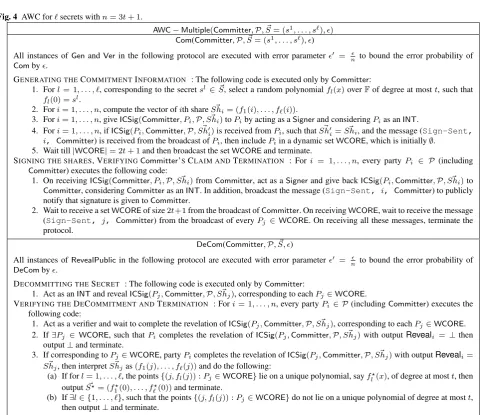
4.2 AWC Scheme for`Secrets
The AWC scheme presented in the last section allows to commit and later decommit a single secret. Now consider a scenario where a Committerwould like to commit and later decommit a vectorS~ = (s1, . . . , s`), consisting of ` elements fromF, where ` > 1. One simple way of doing this is to execute an instance of theComandDeCom proto-col on the behalf of each elementsl∈S~; this will require a private as well as broadcast communication ofO(`n2log1