Japanese Predicate Argument Structure Analysis
Exploiting Argument Position and Type
Yuta Hayashibe Mamoru Komachi Yuji Matsumoto Graduate School of Information Science
Nara Institute of Science and Technology 8916-5, Takayama, Ikoma Nara 630-0192, Japan { yuta-h, komachi, matsu }@is.naist.jp
Abstract
We propose an approach to Japanese pred-icate argument structure analysis exploit-ingargument positionandtype. In partic-ular, we propose the following two meth-ods. First, in order to use information in the sentences in preceding context of the predicate more effectively, we pro-pose an improved similarity measure be-tween argument positions which is more robust than a previous co-reference-based measure. Second, we propose a flex-ible selection-and-classification approach which accounts for the minor types of ar-guments. Experimental results show that our proposed method achieves state-of-the-art accuracy for Japanese predicate ar-gument structure analysis.
1 Introduction
The goal of predicate-argument structure analy-sis is to extract semantic relations such as “who did what to whom” that hold between a predicate and its arguments constituting a semantic unit of a sentence. It is an important step in many Natu-ral Language Processing applications such as ma-chine translation, summarization and information extraction.
Arguments are classified into three categories according to their positions relative to the predi-cates: intra-sentential arguments (those that have direct syntactic dependency with the predicates), zero intra-sentential arguments (those appearing as zero-pronouns but have their antecedents in the same sentence), and inter-sentential arguments (those appearing as zero-pronouns and their an-tecedents are not in the same sentence). We call themINTRA D, INTRA Z, andINTER respec-tively. Furthermore, we call these categories the
argument types. While the analysis of INTRA D
is comparatively easy, INTRA Z and INTER are more difficult. We consider that there are two rea-sons for this.
The first reason is the poverty of features for argument identification compared to INTRA D. While for INTRA D we have important clues such as the function word or directly dependency rela-tion, we don’t for INTRA Z and INTER.
The second reason is the limited amount of training examples. For example, in a Japanese newswire corpus, INTRA Z and INTER account for 30.5% and 12.4% of all the nominative (ga) cases, and 13.1% and 0.2% of all of the accusative (wo) cases (Iida et al., 2007).
In this paper, in order to solve these problems we propose the following two methods exploiting
argument positionand type.
First, we propose an improved similarity mea-sure between argument positions of two predicates that take semantically similar arguments. For ex-ample, someone possibly arrested can also surren-der him/herself, that is, objects of “arrest” and sub-jects of “surrender (oneself)” are occupied by se-mantically similar nouns. Gerber and Chai (2010) proposed analysis of English nominal predicates with this similarity to take discourse context into account. However, the similarity measure they used has drawbacks: it requires a co-reference resolver and a large number of documents. We improve their similarity measure alleviating these drawbacks by using argument position. We detail previous work on capturing discourse context in Section 2, and our proposal in Section 3.1.
Second, we propose a selection-and-classification approach. In this approach, in order to compensate for the relative infrequency of examples of INTRA Z and INTER, we select a candidate argument for each argument type independently. After selecting candidates, we use classifiers to choose the correct argument type. This allows us to flexibly design features for each
step and we can use pairwise features between the candidate arguments. We detail this in Section 3.2.
The experimental results demonstrated that our proposed method achieved the state-of-the-art of Japanese predicate argument structure analysis.
2 Related Work Capturing Discourse Context
2.1 Salient Reference List
Iida et al. (2003) used Salient Reference List (Nariyama, 2002) based on Centering Theory (Grosz et al., 1995), which explains the structure of discourse and the transition of topics in order to capture discourse context. The list has the follow-ing four ordered slots.
TOPIC (marked bywa-particle)
>SUBJECT (ga)
>INDIRECT OBJECT (ni) >DIRECT OBJECT (wo),
We check whether each candidate corresponds to any slots from the beginning of a document. If the candidate corresponds to a slot, we (over)write the slot with the candidate. We repeat this until we reach the predicate to analyze. We use the ranks of candidates in the list as a feature.
2.2 Argument Frequency
Iida et al. (2003) used a feature (CHAIN LENGTH) that stands for how often each candi-date is used as an argument of predicates in pre-ceding context. Imamura et al. (2009) used a sim-ilar binary feature (USED) that shows if each can-didate is ever used as an argument of predicates or not. However, they did not investigate the ef-fect of these features explicitly in their systems. Therefore we also investigate these in this paper.
2.3 Similarity between an Argument Position and a co-Reference Chain
In the study of implicit arguments1 for English nominal predicates, Gerber and Chai (2010) used similarity features between an argument position and a co-reference chain, inspired by Chambers and Jurafsky (2008), who proposed unsupervised learning of narrative event chains using pointwise mutual information (PMI) between syntactic po-sitions. This method stands on the assumption
1In short, this is equivalent to INTER.
that similar argument positions tend to have the ar-guments which belong to a common co-reference chain. For instance, co-referring arguments at such argument positions like hplead, ARG0i,
hadmit, ARG0i, hconvict, ARG1i, tend to take
semantically similar nouns as the argument posi-tions likehsentence, ARG1i,hparole, ARG1i.
They first automatically label a subset of the Gigaword corpus (Graff, 2003) with verbal and nominal semantic role labeling. They then iden-tify references between arguments using a co-reference resolver. They compute PMI as follows. Suppose the resulting data hasN co-referential
pairs of argument positions andM of these pairs comprisingEa = hPa, Aai, Eb = hPb, Abi, and
Ec = hPc, Aci. Pa, Pb, and Pc are predicates,
andAa, Ab, and Ac are labels such asARG0 or
ARG1.
pmi(Ea, Eb) = log
G(Ea, Eb)
G(Ea,∗)G(Eb,∗)
G(Ea, Eb) =
M N
With this similarity between argument posi-tions, they defined scores between an argument position and a co-reference chain.
3 Predicate Argument Structure
Analysis Exploiting Argument Position and Type
3.1 Similarity between Argument Positions using Distribution Similarity
Suppose we want to identify the argument of自首 した(surrendered) in Example (1). The argument is an antecedent of zero-pronounφ of the
predi-cate.
(1) 警察police wa-particleは 花子hanako wo-particleを 逮捕した.arrested
Police arrested Hanako.
I
私は(φが)自首したhad surrendered とthat 聞いた.heard
I heard thatφhad surrendered.
With Salient Reference List for “自首する (sur-rendered)”, the rank of “警察(police)” is higher
than that of “花子(Hanako)” and it is noisy
infor-mation for analysis. We also cannot distinguish them with argument frequency information, be-cause frequencies of both “花子(Hanako)” and “ 警察(police)” are 1.
1599 が 自首するga (surrender) 5651 が 逮捕するga (arrest) 82112 を 逮捕するwo (arrest)
136 -者person 702 署員PS staff 15285 人person
117 犯人criminal 698 警察police 8484 -者person
96 彼he 376 警察官police officer 5563 男man
68 人person 368 -署police station 2804 -名name
63 男man 230 県警prefectural police 1188 犯人criminal
36 -犯crime 177 -員-staff 1185 男性male
30 少年boy 153 府警prefectural police 763 -ら-s
[image:3.595.109.519.59.329.2]26 高校生high-scool student 137 当局authorities 671 おまえyou
Table 1: Argument distributions of each argument position (Sorted by frequency) chain, the similarity measure described in Section
2.3 has two problems.
One is the strong dependency on the accuracy of co-reference resolver system. In fact, the accuracy of Japanese co-reference resolvers is not accurate enough to create co-reference chains in good qual-ity.2 The other problem is the problem that it needs a lot of documents, because the method does not use any non co-referring nouns.
To avoid using an unreliable co-reference re-solver, we can suppose the same noun lemmas without pronouns in the same document are co-references. Pekar (2006) called the noun lemmas
anchorsand they supposed the similarity measure between syntactic positions. For example, there are two anchors: “Mary” and “house” in the sen-tences “Mary bought a house. The house belongs to Mary.” They extract two groups: {buy(obj:X),
belong(subj:X)}and{buy(subj:X), belong(to:X).
} Nevertheless, this method also requires many documents because noun lemmas without anchors are not used for the calculation.
In this paper, we propose a more robust simi-larity measure between argument positions which does not depend on unreliable co-reference anno-tations by the resolver.
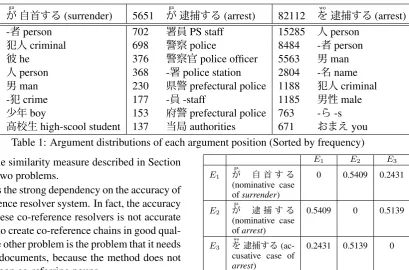
Table 1 shows the list of nouns that have direct dependency arcs in syntactic dependency struc-tures along with case markers がga (nominative
case),をwo (accusative case) andにni (dative case)
ex-tracted from theWEBcorpus described in Section 4. According to Table 1, the distributions of nouns of “自首する(surrender)” followingがga and “逮捕 する(arrest)” followingをwo look alike. We can
ex-pect that an arrested person is more likely to be a person who has surrendered than an arrestee. We define a novel similarity of two argument positions
2We implemented the method proposed by Iida et al.
(2005a), and the F-measure was 66%.
E1 E2 E3
E1 ga
が 自 首 す る
(nominative case ofsurrender)
0 0.5409 0.2431
E2 ga
が 逮 捕 す る
(nominative case ofarrest)
0.5409 0 0.5139
E3 wo
を 逮捕する
(ac-cusative case of
arrest)
0.2431 0.5139 0
Table 2: An example of similarities between argu-ment positions calculated withWEBcorpus. encoding such information as Jensen-Shannon di-vergence between argument distributions of argu-ment positions. A sample of the calculated simi-larities is shown in Table 2. This table illustrates the most similar argument positions are the nom-inative (がga) case of “自首する(surrender)” (E1)
and the accusative (をwo) case of “逮捕する
(ar-rest)” (E3). We will use these values as features of predicate-argument analysis in the experiments.
3.2 Selection-and-Classification Approach Considering Argument Type
In previous work, argument analysis was per-formed with common features regardless its argu-ment type. However, these methods have difficulty in distinguishing the marginal cases where two candidates have different argument types because of the difference of quantity by argument types. Thus we propose the selection-and-classification approach for Japanese predicate argument struc-ture analysis. This approach consists of two steps: theselectionstep and theclassificationstep.
[image:3.595.74.521.62.196.2]ex-Figure 1: Argument selection in the ‘Classifica-tion’ step from three most likely argument candi-dates
Label Arguments to make features a INTRA D hINTRA D, INTRA Zi
INTRA Z hINTRA D,INTRA Zi
b INTRA hINTRA D, INTERi,hINTRA Z, INTERi INTER h{INTRA D or INTRA Z},INTERi c HAVE-ARG h{INTRA D or INTRA Z or INTER}i
NO-ARG hINTRA Di,hINTRA Zi,hINTERi Table 3: Examples made for training. Italic texts
in (b) and (c) refer most likely argument which (a) and (b) selected respectively. Non-italic texts refer to the correct argument.
pression either true anaphoric or not with the most likely antecedent. They took this approach since there are almost no clues for a Japanese noun phrase to determine anaphoric or not by looking only at the noun phrase.
Similarly, in our approach, after selecting the most likely candidate of the argument, we classify it into either of INTRA D, INTRA Z, INTER or no argument.
The second is thetournament model(Iida et al., 2003) for zero-anaphora resolution. For all the candidate antecedents (virtually all noun phrases appearing in preceding context), the model repeats two-class classification: which candidate in the pair of candidates is likely to be the antecedent for the zero-anaphora. The advantage of the tour-nament model is that the model can use pairwise features of candidates. Similarly, in the classifica-tion step of our approach we select an argument comparing most likely candidates of arguments of each argument type.
A Method of Argument Analysis
Selection: At the first step, we select three most likely arguments of INTRA D, INTRA Z, and IN-TER for each predicate using any argument iden-tification model. We may use different features for models of different argument types.
Classification: At the second step, we determine which INTRA D, INTRA Z, and INTER is the correct argument or if there is no explicit argument appearing in the context. This step is composed
Gold Scope Example made for training NO-ARG (c)NO-ARG
INTER (b)INTER, (c)HAVE-ARG
INTRA Z (a)INTRA Z, (b)INTRA, (c)HAVE-ARG INTRA D (a)INTRA D, (b)INTRA, (c)HAVE-ARG Table 4: Examples made for training with human-annotated data. Generated examples depend on the argument type.
of three binary classification models illustrated in Figure 1.
(a) Judge which of INTRA D or INTRA Z is more likely to be an argument of the predi-cate.
(b) Judge which of INTER or the candidate se-lected at (a) is more likely to be an argument of the predicate.
(c) Judge whether the candidate selected at (b) qualifies as an argument of the predicate or not.
We show the example of analysis ofφin Exam-ple (1). We first select argument candidates of IN-TRA D, ININ-TRA Z, and INTER. Suppose the most likely argument of INTRA D is not selected and “
私(I)” and “花子(Hanako)” are selected as ones
of INTRA Z and INTER respectively in the ‘se-lection’ step. Because INTRA D is not selected, the classifier selects INTRA Z at (a). Suppose IN-TER is selected at (b) comparing “私” selected at
(a) and “花子”. Finally, “花子” is selected as the argument by the classifier of (c).
Furthermore, though we tried different orders for ‘Classification’ step in the preliminary experi-ment, this order was the best.
Training Method of Classifiers for the ‘Classification’ Step
We train each binary classifier in the order of (a), (b), and (c). We create training examples of classi-fiers with two argument candidates and a predicate as shown in Tables 3 and 4. The following argu-ments are used for training:
(a) the correct argument and the most likely ar-gument selected at the ‘Selection’ step (b) the correct argument and the most likely
ar-gument selected by (a) at the ‘Classification’ step
(c) the correct argument and the most likely ar-gument selected by (b) in the ‘Classification’ step
For instance, φ in Example (1) is “花 子
CHAIN LENGTH A frequency of being arguments in previous sentences (Iida et al., 2003)
USED Whether being arguments in for-mer sentences or not (Imamura et al., 2009)
SIM COREF Scores between an argument po-sition and co-reference chain calculated with the similarity which Gerber and Chai (2010) used (described in Section 2.3) SIM CS Scores between an argument
[image:5.595.77.287.61.216.2]po-sition and co-reference chain calculated with our proposed similarity
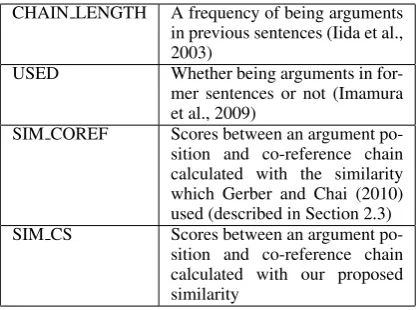
Table 5: Discourse context features used in the ex-periment
we generate two training examples: One is an ex-ample of (b) with the label INTER, “花子”, and
the most likely argument selected by (a) at ‘Clas-sification’ step. The other one is an example of (c) with the label HAVE-ARG and “花子”.
4 Evaluation Setting of Predicate Argument Structure Analysis Exploiting Argument Position and Type
We evaluate our proposed selection-and-classification approach by comparing it with other models and the discourse context features shown in Table 5 by adding them to the baseline features at Japanese predicate argument structure analysis of nominative case.
In the experiment, systems refer only nouns in co-reference chains which are intra-sentential arguments. In addition, we used human anno-tated data of co-reference and predicate-argument structure to make discourse context features. For SIM COREF and SIM CS, we used maximum, minimum and average scores of similarities.
4.1 Dataset for Similarity Calculation
We used two datasets for the calculation of sim-ilarities: the Newspapers (NEWS) and the Web texts (WEB).
NEWS: We used about 21,000,000 sentences in Mainichi newspapers published from 1991 to 2003 (excluded 1995). We part-of-speech tagged the data with MeCab 0.983and dependency structure parsed with CaboCha 0.60pre44. Both taggers used the NAIST Japanese Dictionary 0.6.35. We
3http://mecab.sourceforge.net/
4http://chasen.org/∼taku/software/cabocha/ 5http://sourceforge.jp/projects/naist-jdic/
extracted 27,282,277 pairs of a predicate and an argument.6
We also extracted 111,173,873,092 co-reference chains to calculate SIM COREF with the anaphora resolver which is our re-implementation of (Iida et al., 2005a). These chains include 2,280,417,516,455 nouns. We used 173,778,624 pairs of a predicate and an argument with the case makerがga,をwo andにni.
WEB: We used about 500,000,000 sentences which Kawahara and Kurohashi (2006) collected from the web. They are part-of-speech tagged with JUMAN7 and dependency structure parsed with KNP8. We extracted 1,101,472,855 pairs of a predicate and an argument.9
4.2 Training and Evaluation Dataset
We used NAIST Text Corpus 1.4β (Iida et al.,
2007) for training and evaluation. It is based on Kyoto Text Corpus 3.010 and annotated with predicate-argument structure, event noun struc-ture, and co-reference of nouns about 40,000 sen-tences of Japanese newspaper text. We excluded 11 articles due to annotation error.
We conducted five-fold cross-validation. In the experiments, base phrases and dependency rela-tions are acquired from the Kyoto Text Corpus 3.0 in the same way of related work.
4.3 A Model in the ‘Selection’ Step
In order to identify the most likely argument can-didate of each INTRA D, INTRA Z, and INTER, we used the tournament model. We emphasize that our proposed approach can use any argument iden-tification model to identify the most likely candi-date of an argument.
4.4 Baseline Features and Classifier
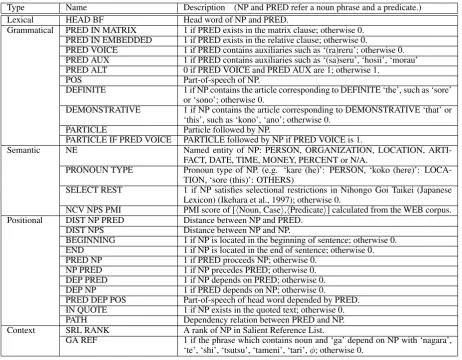
As baseline features, we employed features pro-posed by Iida et al. (2005a, 2007a) and Imamura et al. (2009) in addition to a novel one ‘PRED DEP POS’ shown in Table 6.
We used Support Vector Machine (Cortes and Vapnik, 1995) for each classification model with
6Unique total are; Verb: 31,012, Noun: 327,174, Pair:
7,071,627
7http://nlp.kuee.kyoto-u.ac.jp/nl-resource/juman.html 8http://nlp.kuee.kyoto-u.ac.jp/nl-resource/knp.html 9Unique total are; Verb:about 801 million, Noun: about
288 million, Pair: 15,994 million
Type Name Description (NP and PRED refer a noun phrase and a predicate.)
Lexical HEAD BF Head word of NP and PRED.
Grammatical PRED IN MATRIX 1 if PRED exists in the matrix clause; otherwise 0. PRED IN EMBEDDED 1 if PRED exists in the relative clause; otherwise 0.
PRED VOICE 1 if PRED contains auxiliaries such as ‘(ra)reru’; otherwise 0. PRED AUX 1 if PRED contains auxiliaries such as ‘(sa)seru’, ‘hosii’, ‘morau’ PRED ALT 0 if PRED VOICE and PRED AUX are 1; otherwise 1.
POS Part-of-speech of NP.
DEFINITE 1 if NP contains the article corresponding to DEFINITE ‘the’, such as ‘sore’ or ‘sono’; otherwise 0.
DEMONSTRATIVE 1 if NP contains the article corresponding to DEMONSTRATIVE ‘that’ or ‘this’, such as ‘kono’, ‘ano’; otherwise 0.
PARTICLE Particle followed by NP.
PARTICLE IF PRED VOICE PARTICLE followed by NP if PRED VOICE is 1.
Semantic NE Named entity of NP: PERSON, ORGANIZATION, LOCATION,
ARTI-FACT, DATE, TIME, MONEY, PERCENT or N/A.
PRONOUN TYPE Pronoun type of NP. (e.g. ‘kare (he)’: PERSON, ‘koko (here)’: LOCA-TION, ‘sore (this)’: OTHERS)
SELECT REST 1 if NP satisfies selectional restrictions in Nihongo Goi Taikei (Japanese Lexicon) (Ikehara et al., 1997); otherwise 0.
NCV NPS PMI PMI score of [hNoun, Casei,hPredicatei] calculated from the WEB corpus. Positional DIST NP PRED Distance between NP and PRED.
DIST NPS Distance between NP and NP.
BEGINNING 1 if NP is located in the beginning of sentence; otherwise 0. END 1 if NP is located in the end of sentence; otherwise 0. PRED NP 1 if PRED proceeds NP; otherwise 0.
NP PRED 1 if NP precedes PRED; otherwise 0. DEP PRED 1 if NP depends on PRED; otherwise 0. DEP NP 1 if PRED depends on NP; otherwise 0.
PRED DEP POS Part-of-speech of head word depended by PRED. IN QUOTE 1 if NP exists in the quoted text; otherwise 0. PATH Dependency relation between PRED and NP. Context SRL RANK A rank of NP in Salient Reference List.
[image:6.595.71.534.60.420.2]GA REF 1 if the phrase which contains noun and ‘ga’ depend on NP with ‘nagara’, ‘te’, ‘shi’, ‘tsutsu’, ‘tameni’, ‘tari’,φ; otherwise 0.
Table 6: Baseline features of classifiers in the ‘Selection’ step and the ‘Classification’ step.
a linear kernel. We used the implementation of LIBLINEAR 1.711with its default parameters.
4.5 Targets for Comparison of Predicate Argument Analysis Model
We evaluate our selection-and-classification ap-proach by comparing our baseline model with two previous approaches TA and IM.
TA: Taira et al. (2008) used decision lists where features were sorted by their weights learned from Support Vector Machine. They simultaneously solved the argument of event nouns in the same lists.
IM: Imamura et al. (2009) used discriminative models based on maximum entropy. They added the special noun phrase NULL, which expresses that the predicate does not have any argument.
Because previous work use different features and machine learning methods and experiment on different setting from ours, we also compare with a baseline model BL in order to analyze the effect
11http://www.csie.ntu.edu.tw/∼cjlin/liblinear/
of dividing a model considering argument type.
BL: This model has a single step in ‘classifica-tion’ step. In other words, ‘selec‘classifica-tion’ step in this model selects the most likely argument from all noun phrases preceding the predicate.
5 Discussion
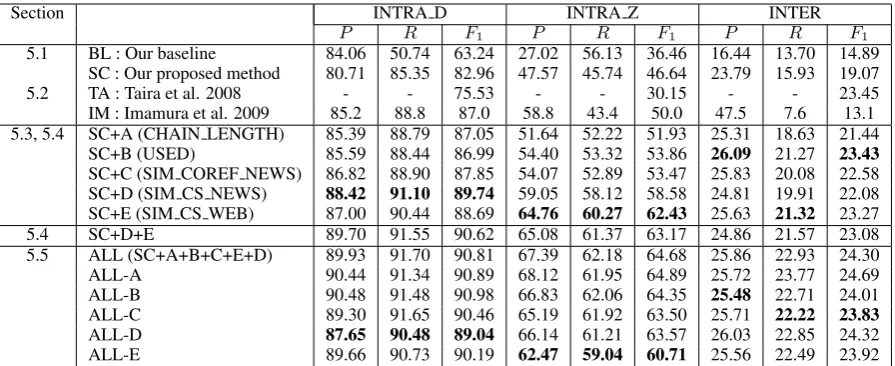
Table 7 presents the result of the experiments. Ac-cording to the bottom row in Table 7, we achieved the state-of-the-art of Japanese predicate argument structure analysis by combining all discourse con-text features (+A+B+C+D+E).
We investigate our result from five different standpoints.
5.1 Effect of the Selection-and-Classification Approach
Section INTRA D INTRA Z INTER
P R F1 P R F1 P R F1
5.1 BL : Our baseline 84.06 50.74 63.24 27.02 56.13 36.46 16.44 13.70 14.89 SC : Our proposed method 80.71 85.35 82.96 47.57 45.74 46.64 23.79 15.93 19.07
5.2 TA : Taira et al. 2008 - - 75.53 - - 30.15 - - 23.45
IM : Imamura et al. 2009 85.2 88.8 87.0 58.8 43.4 50.0 47.5 7.6 13.1 5.3, 5.4 SC+A (CHAIN LENGTH) 85.39 88.79 87.05 51.64 52.22 51.93 25.31 18.63 21.44
SC+B (USED) 85.59 88.44 86.99 54.40 53.32 53.86 26.09 21.27 23.43
SC+C (SIM COREF NEWS) 86.82 88.90 87.85 54.07 52.89 53.47 25.83 20.08 22.58 SC+D (SIM CS NEWS) 88.42 91.10 89.74 59.05 58.12 58.58 24.81 19.91 22.08 SC+E (SIM CS WEB) 87.00 90.44 88.69 64.76 60.27 62.43 25.63 21.32 23.27
5.4 SC+D+E 89.70 91.55 90.62 65.08 61.37 63.17 24.86 21.57 23.08
5.5 ALL (SC+A+B+C+E+D) 89.93 91.70 90.81 67.39 62.18 64.68 25.86 22.93 24.30
ALL-A 90.44 91.34 90.89 68.12 61.95 64.89 25.72 23.77 24.69
ALL-B 90.48 91.48 90.98 66.83 62.06 64.35 25.48 22.71 24.01
ALL-C 89.30 91.65 90.46 65.19 61.92 63.50 25.71 22.22 23.83
ALL-D 87.65 90.48 89.04 66.14 61.21 63.57 26.03 22.85 24.32
[image:7.595.76.524.61.244.2]ALL-E 89.66 90.73 90.19 62.47 59.04 60.71 25.56 22.49 23.92
Table 7: Comparison of predicate argument structure analysis of nominative case:P,R, andF1indicate Precision, Recall, and F-measure(β = 1), respectively.
5.2 Comparison between previous work
By comparing SC and TA, and SC+USED and IM12, the result of our proposed method is com-petitive or superior to others. Additionally, re-call is higher in any type; therefore we consider there is still much room for improvement by re-placing the argument identification model in the selectional step with other models.
5.3 Effect of Similarity Metrics
On comparing +A (CHAIN LENGTH), +B (USED), and +C (SIM COREF NEWS) or +D (SIM CS NEWS) in Table 7, similarity-based fea-tures are superior or competitive to frequency-based feature.
(2) 婚姻は毎年一万―四万組も増え、. . .
The number of marriages increases 10,000 to 40,000 couples annually . . .
. . .流行して. . .の引き金となったインフル
エンザが、
The flu thathas been going aroundand trig-gered . . . ,
For instance, the argument of “流行し(be going
around)” in Example (2) is “インフルエンザ(flu)”
of INTER and is not an argument of previous ar-guments. Though the topic changes between two sentences, A and B cannot take it into account this and output “婚姻(Marriages)” which is an
argu-ment of “増え(increase)” because the frequency-based feature is active. In contrast, C and D handle
12We compare SC+USED and IM, because IM used the
USED feature.
this because the similarity between the nominative case of “増え” and “流行し” is low.
On comparing +C (SIM COREF NEWS) and +D (SIM CS NEWS) in Table 7, our pro-posed similarity metrics work better than the co-reference-based metrics in INTRA D or INTRA Z by a large margin. This result shows the robust-ness of our metrics compared to the co-reference based similarity between argument positions.
5.4 Effect of In and Out-of-domain Data
On comparing +D (SIM CS NEWS) and +E (SIM CS WEB) in Table 7 respectively, the sim-ilarity measure using the newswire texts works better for INTRA D and one using the web texts works better for INTRA Z and INTER.
Additionally, the result of +D+E shows that combining proposed similarities calculated from different sources work complementary.
5.5 Ablation Features
Removing features one by one from ALL (Adding all of A to E), we inquire about features which have strong effect on ALL. Table 7 shows that the F-measures of INTRA D and INTRA Z fall by a large margin, by removing D and E respectively. Though the F-measure of INTER degrades by re-moving C, it makes little difference to other argu-ment types. This shows it is our proposed similar-ity that mainly contributes to the improvement of the F-measure of the overall system.
6 Error Analysis
6.1 Copula
In NAIST Text Corpus, the copula “だ”(In
En-glish, “be”) is annotated as a predicate.
(3) マンション価格が. . .下がってきた. . .。
The price of apartments is going down.
. . .(φが) 前年は五・八倍であった
φof last year was5.8 times higher than that
of this year.
However, the behavior of copula is different from other predicates, thus it is difficult to resolve them with the same model. To solve this problem, the model of copula should be separated.
6.2 Light Verb Construction
In this experiment, we regarded the predicate of “
する(do) + noun” such as “逮捕する(do arrest)”
as a single predicate. On the other hand, we re-garded the predicate of “する(do) + particle +
noun” such as “まかせにする” in Example (4) as
“する(do).”
(4) (φが) 分権を国 まかせ(relegation)にni す る(do)のではなく、. . .
φshould not relegate promotion of decentral-ization . . .
However, verbs like “do” in such examples do not play central roles, whereas the noun such as “
まかせ(relegation)” carries the main meaning of
the event. This phenomenon is called “light verb construction” (Miyamoto, 1999).
“まかせ” is the nominalized form of the verb
“まかせる (relegate).” Thus we need to calcu-late similarity with “まかせる” instead of “する”.
When the predicate is a light verb, we have to use the original verb to calculate the similarity.
6.3 Predicate Sense Ambiguity
A predicate may have several senses and hence have several argument distributions. For example, “詰める” has two senses at least: to pack and to
bring to a conclusion. “詰める” in Example (5) means the latter.
(5) (φが) 数字を早急に詰める必要性を強調
した。
They emphasized thatφshould be brought to
an conclusion as soon as possible.
The distributions of arguments of such ambigu-ous verbs tend to have a mixture of several distri-butions of arguments. Therefore this makes it hard to calculate the similarity of an argument position and a co-reference chain. Additionally, it is even more difficult when the predicate is more essential verb such as “持つ(have)” and “取る(take).” This suggests the close relationship between the word sense disambiguation and the predicate argument structure analysis. In fact, Meza-Ruiz and Riedel (2009) showed that the joint model for semantic role labeling and word sense disambiguation per-forms better than a pipeline system.
Since NAIST Text Corpus is not annotated with verb senses, we are annotating the sense of verbs to allow similar analysis.
7 Conclusion
We improved Japanese predicate argument struc-ture analysis exploiting argument position and
type. In particular, we proposed two methods: the improved similarity measure between argument positions and the selection-and-classification ap-proach considering argument type.
Experimental results show that our proposed method achieved state-of-the art accuracy for the Japanese predicate argument structure analysis. Proposed similarity between argument positions exploiting case maker is more robust than previous co-reference-based method that makes use of an unreliable automatic co-reference resolver. Fur-thermore, we proposed flexible approach which accounts for the minor types of arguments.
Future work includes four topics: (1) to distin-guish copula from other predicates; (2) to com-bine internal argument to take semantic argument into consideration if the verb is in light verb con-struction; (3) to perform word sense disambigua-tion before calculating similarity; (4) to conduct experiments not only on nominative case but also on other cases .
Acknowledgments
We thank Daisuke Kawahara and Sadao Kurohashi for providing the web texts and Joseph Irwin for his comments on the earlier draft.
References
Proceedings of Annual Meeting of the Association for Computational Linguistics-08 with the Human Language Technology Conference, pages 789–797.
Corinna Cortes and Vladimir Vapnik. 1995. Support-Vector Networks. Machine learning.
Matthew Gerber and Joyce Y. Chai. 2010. Beyond NomBank: A Study of Implicit Arguments for Nom-inal Predicates. In Proceedings of the 48th Annual Meeting of the Association for Computational Lin-guistics, pages 1583–1592. Association for Compu-tational Linguistics.
David Graff. 2003. English Gigaword. Linguistic Data Consortium.
Barbara J. Grosz, Aravind K. Joshi, and Scott Wein-stein. 1995. Centering: A Framework for Modeling the Local Coherence of Discourse. Computational Linguistics, 21(2):203–225.
Ryu Iida, Kentaro Inui, Hiroya Takamura, and Yuji Matsumoto. 2003. Incorporating Contextual Cues in Trainable Models for Coreference Resolution. In
Proceedings of the 10th EACL Workshop on the Computational Treatment of Anaphora, pages 23– 30.
Ryu Iida, Kentaro Inui, and Yuji Matsumoto. 2005a. Anaphora Resolution by Antecedent Identification Followed by Anaphoricity Determination. ACM Transactions on Asian Language Information Pro-cessing, 4(4):417–434.
Ryu Iida, Kentaro Inui, and Yuji Matsumoto. 2005b. On the Issue of Combining Anaphoricity Determi-nation and Antecedent Identification in Anaphora Resolution. InInternational Conference on Natural Language Processing and Knowledge Engineering, pages 244–249.
Ryu Iida, Mamoru Komachi, Kentaro Inui, and Yuji Matsumoto. 2007. Annotating a Japanese Text Cor-pus with Predicate-Argument and Coreference Re-lations. InProceedings of the Linguistic Annotation Workshop, pages 132–139. Association for Compu-tational Linguistics.
Satoru Ikehara, Masahiro Miyazaki, Satoshi Shirai, Akio Yokoo, Hiromi Nakaiwa, and Kentaro Ogura. 1997. Nihongo Goi Taikei :A Japanese Lexicon. Iwanami Shoten.
Kenji Imamura, Kuniko Saito, and Tomoko Izumi. 2009. Discriminative Approach to Predicate-Argument Structure Analysis with Zero-Anaphora Resolution. InProceedings of the Joint conference of the 47th Annual Meeting of the Association for Computational Linguistics and the 4th International Joint Conference on Natural Language Processing of the Asian Federation of Natural Language Pro-cessing, pages 85–88.
Daisuke Kawahara and Sadao Kurohashi. 2006. Case Frame Compilation from the Web using High-Performance Computing. InProceedings of the 5th International Conference on Language Resources and Evaluation, pages 1344–1347.
Ivan Meza-Ruiz and Sebastian Riedel. 2009. Jointly identifying predicates, arguments and senses us-ing markov logic. InProceedings of Human Lan-guage Technologies: The 2009 Annual Conference of the North American Chapter of the Association for Computational Linguistics, pages 155–163.
Tadao Miyamoto. 1999. The Light Verb Construction in Japanese: the role of the verbal noun. John Ben-jamins Publishing Company.
Sigeko Nariyama. 2002. Grammar for Ellipsis Resolu-tion in Japanese. InProceedings of the 9th Interna-tional Conference on Theoretical and Methodologi-cal Issues in Machine Translation, pages 135–145.
Viktor Pekar. 2006. Acquisition of Verb Entailment from Text. In Proceedings of the main conference on Human Language Technology Conference of the North American Chapter of the Association of Com-putational Linguistics, pages 49–56. Association for Computational Linguistics.