Method of Selecting Training Data to Build a Compact and Efficient
Translation Model
Keiji Yasuda†,‡, Ruiqiang Zhang†,‡, Hirofumi Yamamoto†,‡ and Eiichiro Sumita†,‡ †National Institute of Communications Technology
‡ATR Spoken Language Translation Research Laboratories 2–2–2, Hikaridai, “Keihanna Science City”, Kyoto, 619–0288 Japan
{keiji.yasuda,ruiqiang.zhang}@nict.go.jp {hirofumi.yamamoto,eiichiro.sumita}@nict.go.jp
Abstract
Target task matched parallel corpora are re-quired for statistical translation model train-ing. However, training corpora sometimes include both target task matched and un-matched sentences. In such a case, train-ing set selection can reduce the size of the translation model. In this paper, we propose a training set selection method for transla-tion model training using linear translatransla-tion model interpolation and a language model technique. According to the experimental results, the proposed method reduces the translation model size by 50% and improves BLEU score by 1.76% in comparison with a baseline training corpus usage.
1 Introduction
Parallel corpus is one of the most important compo-nents in statistical machine translation (SMT), and there are two main factors contributing to its perfor-mance. The first is the quality of the parallel corpus, and the second is its quantity.
A parallel corpus that has similar statistical char-acteristics to the target domain should yield a more efficient translation model. However, domain-mismatched training data might reduce the transla-tion model’s performance. A large training corpus obviously produces better quality than a small one. However, increasing the size of the training corpus causes another problem, which is increased compu-tational processing load. This problem not only af-fects the training of the translation model, but also
its applications. The reason for this is that a large amount of training data tends to yield a large trans-lation model and applications then have to deal with this model.
We propose a method of selecting translation pairs as the training set from a training parallel corpus to solve the problem of an expanded trans-lation model with increased training load. This method enables an adequate training set to be se-lected from a large parallel corpus by using a small in-domain parallel corpus. We can make the transla-tion model compact without degrading performance because this method effectively reduces the size of the set for training the translation model. This com-pact translation model can outperform a translation model trained on the entire original corpus.
This method is especially effective for domains where it is difficult to enlarge the corpus, such as in spoken language parallel corpora (Kikui et al., 2006). The main approach to recovering from an un-dersupply of the in-domain corpus has been to use a very large domain-close or out-of-domain paral-lel corpus for the translation model training (NIST, 2006). In such case, the proposed method effectively reduces the size of the training set and translation model.
Target language Target
language languageSource
Source language
Large out-of-domain parallel corpus Small in-domain parallel corpus
1. Train translation model
3. Calculate perplexity LMTarget LMSource
2. Train language models
TMin-domain
4. Select translation pairs based on the
perplexity
6. Integrate TMs using linear interpolation
5. Train translation
model TMselected
TMfinal
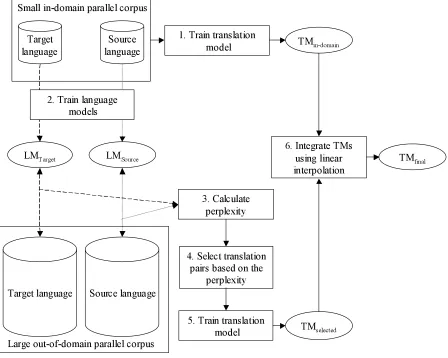
Figure 1: Framework of method.
2 Method
Our method use a small in-domain parallel corpus and a large out-of-domain parallel corpus, and it selects a number of appropriate training translation pairs from the out-of-domain parallel corpus. Fig-ure 1 is a flow diagram of the method. The proce-dure is as follows:
1. Train a translation model using the in-domain parallel corpus.
2. Train a language model using the source lan-guage side or/and target lanlan-guage side of the in-domain corpus.
3. Calculate the word perplexity for each sentence (in source language side or/and target language side) in the out-of-domain corpus by using the following formulas.
P Pe=Pe(Se)− 1
ne (1)
whereP Peis the target language side perplex-ity, andPeis the probability given by the target side language model.Se is the target language sentence in the parallel corpus, and ne is the number of words in the sentence.
We can also calculate the perplexity in the source language (P Pf) in the same way.
P Pf =Pf(Sf) − 1
nf (2)
If we use perplexities in both languages, we can calculate average perplexity (P Pe+f) by using the following formula.
Table 1: Size of parallel corpora
English Chinese English Chinese
In-domain
parallel corpus
40 K 40 K 320 K 301 K Basic Travel Expressions Corpus
Out-of-domain
parallel corpus
2.5 M 2.5 M 62 M 54 M
LDC corpus (LDC 2002T01, LDC2003T17, LDC2004T07,
LDC2004T08, LDC2005T06 and LDC2005T10) # of sentences # of words
Explanation
4. Select translation pairs from the out-of-domain parallel corpus. If the perplexity is smaller than the threshold, use translation pairs as the train-ing set. Otherwise, discard the translation pairs.
5. Train a translation model by using the selected translation pairs.
6. Integrate the translation model obtained in 1 and 6 by linear interpolation.
3 Experiments
We carried out statistical machine translation experi-ments using the translation models obtained with the proposed method.
3.1 Framework of SMT
We employed a log-linear model as a phrase-based statistical machine translation framework. This model expresses the probability of a target-language word sequence (e) of a given source language word sequence (f) given by
P(e|f) = exp
³PM
i=1λihi(e, f)
´
P
e0exp
³PM
i=1λihi(e0, f)
´ (4)
wherehi(e, f)is the feature function,λiis the fea-ture function’s weight, andM is the number of fea-tures. We can approximate Eq. 4 by regarding its denominator as constant. The translation results (eˆ) are then obtained by
ˆ
e(f, λM1 ) = argmaxe
M
X
i=1
λihi(e, f) (5)
3.2 Experimental conditions 3.2.1 Corpus
We used data from the Chinese-to-English trans-lation track of the IWSLT 2006(IWSLT, 2006) for
the experiments. The small in-domain parallel cor-pus was from the IWSLT workshop. This corcor-pus was part of the ATR Bilingual Travel Expression Corpus (ATR-BTEC) (Kikui et al., 2006). The large out-of-domain parallel corpus was from the LDC corpus (LDC, 2007). Details on the data are listed in Table 1. We used the test set of the IWSLT2006 workshop for the evaluation. This test set consisted of 500 Chinese sentences with eight English refer-ence translations per Chinese sentrefer-ence.
For the statistical machine-translation experi-ments, we first aligned the bilingual sentences for preprocessing using the Champollion tool (Ma, 2006). We then segmented the Chinese words us-ing Achilles (Zhang et al., 2006). After the seg-mentation, we removed all punctuation from both English and Chinese corpuses and decapitalized the English corpus. We used the preprocessed data to train the phrase-based translation model by using GIZA++ (Och and Ney, 2003) and the Pharaoh tool kit (Koehn et al., 2003).
3.2.2 Features
We used eight features (Och and Ney, 2003; Koehn et al., 2003) and their weights for the transla-tions.
1. Phrase translation probability from source lan-guage to target lanlan-guage (weight = 0.2)
2. Phrase translation probability from target lan-guage to source lanlan-guage (weight = 0.2)
3. Lexical weighting probability from source lan-guage to target lanlan-guage (weight = 0.2)
4. Lexical weighting probability from source tar-get to language weight = 0.2)
6. Word penalty (weight=−1.0)
7. Distortion weight (weight = 0.5)
8. Target language model probability (weight = 0.5)
According to a previous study, the minimum er-ror rate training (MERT) (Och, 2003), which is the optimization of feature weights by maximizing the BLEU score on the development set, can improve the performance of a system. However, the range of improvement is not stable because the MERT al-gorithm uses random numbers while searching for the optimum weights. As previously mentioned, we used fixed weights instead of weights optimized by MERT to remove its unstable effects and simplify the evaluation.
3.2.3 Linear interpolation of translation models
The experiments used four features (Feature # 1 to 4 in 3.2.2) as targets for integration. For each fea-ture, we applied linear interpolation by using the fol-lowing formula.
h(e, f) =µouthout(e, f) + (1−µout)hin(e, f) (6) Here, hin(e, f) and hout(e, f) are features trained on the in-domain parallel corpus and out-of-domain corpus, respectively. µout is the weight for the fea-ture trained on the out-of-domain parallel corpus.
3.2.4 Language model
We used a Good-Turing (Good, 1953) 3-gram lan-guage model for data selection.
For the actual translation, we used a modi-fied Kneser-Ney (Chen and Goodman, 1998) 3-gram language model because modified Kneser-Ney smoothing tended to perform better than the Good-Turing language model in this translation task. For training of the language model, only the English side of the in-domain corpus was used. We used the same language model for the entire translation ex-periment.
3.3 Experimental results 3.3.1 Translation performance
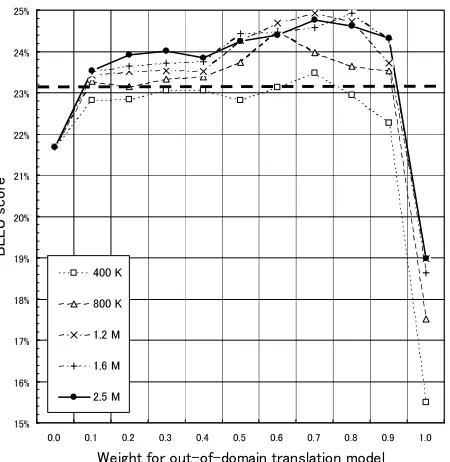
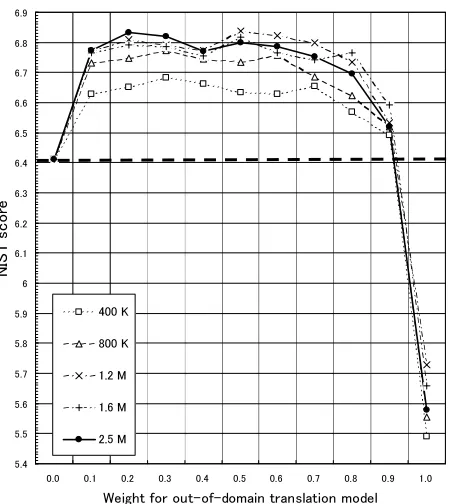
Figure 2 and 3 plot the results of the experiments. The horizontal axis represents the weight for the out-of-domain translation model, and the vertical axis
15%
Figure 2: Results of data selection and linear inter-polation (BLEU)
represents the automatic metric of translation qual-ity (BLEU score (Papineni et al., 2002) in Fig. 2, and NIST score (NIST, 2002) in Fig. 3). Thick straight broken lines in the figures indicate auto-matic scores of a baseline system. This base line sys-tem was trained on the in-domain and all of the out-of-domain corpus (2.5M sentence pairs). These data were concatenated before training; then one model was trained without linear interpolation. The five symbols in the figures represent the sizes (# of sen-tence pairs) of the selected parallel corpus. Here, the selection was carried out by using Eq. 1. For automatic evaluation, we used the reference transla-tion with a case unsensitive and no-punctuatransla-tion set-ting. Hence, higher automatic scores indicate better translations; the selected corpus size of 1.2M (×) indicates the best translation quality in Fig. 2 at the point where the weight for the out-of-domain trans-lation model is 0.7.
5.4
Weig ht for ou t- of-domain tran slation model
N
Figure 3: Results of data selection and linear inter-polation (BLEU)
Table 2: Size of integrated phrase tables
In-domain Out-of-domain
40 K 0 14 M
40 K 1.2 M 917 M 40 K 2.5 M 1.8 G
Size of phrase table (Bytes) Corpus size
(Sentence pairs)
3.3.2 Size of the translation models
Table 2 lists the sizes of the translation models of the baseline and optimum-size training corpus. The size of the phrase table is the uncompressed file size of the phrase table trained by the Pharaoh tool kit. As the table indicates, our method reduced the model sizes by 50%.
This reduction had a positive effect on the com-putational load of decoding.
3.3.3 Equations for the selection
The experiments described above used only target language side information, i.e., Eq. 1, for the data selection. Here, we compare selection performances of Eqs. 1, 2, and 3. Table 3 shows the results. The first row shows the results of using only the
in-domain parallel corpus. The second row shows re-sults of the baseline. The third row shows the rere-sults of using linear interpolation without data selection. Comparing the results for the three equations, we see that Eq. 1 gives the best performance. It out-performs not only the baseline but also the results obtained by using all of the (2.5M) out-of-domain data and linear interpolation.
The results of using source language side infor-mation (Eq. 2) and inforinfor-mation from both language sides (Eq. 3) still showed better performance than the baseline system did.
4 Comparison with conventional method
There are few studies on data selection for trans-lation model training. Most successful and recent study was that of (Lu et al., 2007). They applied the TF*IDF framework to translation model train-ing corpus selection. Accordtrain-ing to their study, they obtained a 28% translation model size reduction (A 2.41G byte model was reduced to a 1.74G byte model) and 1% BLEU score improvement (BLEU score increased from 23.63% to 24.63%). Although there results are not directly comparable to ours [??] because of the differences in the experimental set-ting, our method outperforms theirs for both aspects of model size reduction and translation performance improvement (50% model size reduction and 1.76% BLEU score improvement).
5 Conclusions
We proposed a method of selecting training sets for training translation models that dramatically reduces the sizes of the training set and translation models.
We carried out experiments using data from the Chinese-to-English translation track of the IWSLT evaluation campaign. The experimental results indi-cated that our method reduced the size of the training set by 48%. The obtained translation models were half the size of the baseline.
Table 3: Results of data selection by using Eqs. 1, 2, and 3
In-domain Out-of-domain
40 K 0 N/A N/A 21.68%
40 K 2.5 M N/A N/A 23.16%
40 K 2.5 M N/A 0.7 24.77%
40 K 1.2 M Eq. 1 0.7 24.92%
40 K 1.2 M Eq. 2 0.8 24.76%
40 K 1.2 M Eq. 3 0.6 24.56%
Optimal weight for
out-of-domain model
BLEU score Corpus size (Sentence pairs)
Selection method
We also compared the selections using source lan-guage side information, target lanlan-guage side infor-mation and inforinfor-mation from both language sides. The experimental results show that target language side information gives the best performance in the experimental setting. However, there are no large differences among the different selection results. The results are encouraging because they show that the in-domain mono-lingual corpus is sufficient to select training data from the out-of-domain parallel corpus.
References
S. F. Chen and J. Goodman. 1998. An empirical study of smoothing techniques for language modeling. In Tech-nical report TR-10-98, Center for Research in Com-puting Technology (Harvard University).
I. J Good. 1953. The population frequencies of species and the estimation of population parameters.
Biometrika, 40(3):237–264.
IWSLT. 2006. IWSLT: International Work-shop on Spoken Language Translation.
http://www.slc.atr.jp/IWSLT2006/.
G. Kikui, S. Yamamoto, T. Takezawa, and E. Sumita. 2006. Comparative study on corpora for speech trans-lation. In IEEE Transactions on Audio, Speech and Language Processing, volume 14(5), pages 1674– 1682.
P. Koehn, F. J. Och, and D. Marcu. 2003. Statistical Phrase-Based Translation. Proc. of Human Language Technology Conference of the North American Chap-ter of the Association for Computational Linguistics (HLT-NAACL), pages 127–133.
LDC. 2007. Linguistic Data Consortium.
http://www.ldc.upenn.edu/.
Yajuan Lu, Jin Huang, and Qun Liu. 2007. Improving statistical machine translation performance by training
data selection and optimization. InProceedings of the 2007 Joint Conference on Empirical Methods in Nat-ural Language Processing and Computational Natu-ral Language Learning (EMNLP-CoNLL), pages 343– 350.
X Ma. 2006. Champollion: A Robust Parallel Text Sen-tence Aligner. InProc. of international conference on Language Resources and Evaluation (LREC), pages 489–492.
NIST. 2002. Automatic Evaluation of Machine Trans-lation Quality Using N-gram Co-Occurence Statistics.
http://www.nist.gov/speech/tests/mt/
mt2001/resource/.
NIST. 2006. The 2006 NIST Machine Translation Evaluation Plan (MT06).
http://www.nist.gov/speech/tests/mt/
doc/mt06 evalplan.v3.pdf.
F. J. Och and H. Ney. 2003. A Systematic Comparison of Various Statistical Alignment Models.Computational Linguistics, 29(1):19–51.
F. J. Och. 2003. Minimum Error Rate Training for Sta-tistical Machine Translation. Proc. of the 41st Annual Meeting of the Association for Computational Linguis-tics, pages 160–167.
K. Papineni, S. Roukos, T. Ward, and W.-J. Zhu. 2002. Bleu: a method for automatic evaluation of machine translation. InProceedings of the 40th Annual Meet-ing of the Association for Computational LMeet-inguistics (ACL), pages 311–318.