Difficulty-aware Distractor Generation for Gap-Fill Items
Chak Yan Yeung, John Lee, Benjamin Tsou Department of Linguistics and Translation
City University of Hong Kong
[email protected], {jsylee,rlbtsou}@cityu.edu.hk
Abstract
Many computer-assisted language learning (CALL) systems offer gap-fill items, often with multiple choices in order to facilitate im-mediate feedback. Automatic distractor gener-ation can therefore be helpful in providing the multiple choices. While existing algorithms focus on proposing the most plausible distrac-tors, many realistic scenarios make use of dis-tractors at a variety of difficulty levels. This paper evaluates the use of a neural language model to rank distractors in terms of difficulty. Experiments show that BERT outperforms se-mantic similarity measures, in terms of both correlation to human judgment and classifica-tion accuracy of distractor plausibility.
1 Introduction
Many computer-assisted language learning (CALL) systems offer gap-fill items, also known as cloze or fill-in-the-blank items. A gap-fill item consists of a carrier sentence in which one word — called the key, or target word — is blanked out. Table 1 shows an example carrier sentence whose target word is ‘served’.
To enable automatic feedback, multiple choices are sometimes provided for filling the gap. As shown in Table 1, these choices include the tar-get word itself and several distractors. Judicious selection of distractors is important for generating effective items. A distractor should produce a sen-tence that seems plausible, yet unacceptable. Lan-guage pedagogy literature generally recommends that the target word and distractors belong to the same word class (Heaton,1989), and be semanti-cally related, ideally “false synonyms” (Goodrich, 1977). An empirical study confirmed that distrac-tors indeed tend to be syntactically and semanti-cally homogenous (Pho et al.,2014).
To reduce the manual effort and time needed for selecting distractors, there has been much interest
He as class representative for two years.
(a) served [target word] (b) acted [distractor] (c) brought [distractor]
Table 1: A multiple-choice gap-fill item consists of a carrier sentence with a blank, and choices for filling the blank. In this example, the choices include two distrac-tors and the target word (correct answer).
in developing algorithms for automatic distractor generation. Existing algorithms typically take a two-step approach (Jiang and Lee,2017;Susanti et al., 2018). The first step generates distractor candidates, typically in a list ranked according to measures of semantic similarity and collocation strength. The second step removes candidates that are acceptable answers, using n-gram and colloca-tion frequency or other criteria.
Evaluations on distractor generation tend to be limited to the highest-ranked distractors, for example the top-ranked or top three candidates only (Jiang and Lee, 2017; Susanti et al., 2018). Many practical scenarios, however, require not only the most challenging distractors, but distrac-tors across the spectrum of plausibility. When au-thoring test items, for example, it can be useful to generate items at various difficulty levels for com-prehensive assessment. In a CALL system, it can be effective to personalize distractor difficulty ac-cording to the user’s language proficiency.
nat-ural sciences (Liang et al.,2018;Gao et al.,2019). However, to the best of our knowledge, it has not yet been attempted for gap-fill items for language learning.
Language models provide a natural framework for this task by predicting how likely a word ap-pears in a gap within the sentence. This pa-per is the first attempt to apply BERT (Devlin et al., 2019), a state-of-the-art model trained on the masked language modeling objective, on the task of distractor ranking. Experimental results show that BERT outperforms semantic similarity measures, in terms of both correlation to human judgment and classification accuracy of distractor plausibility.
The rest of the paper is organized as follows. In Section2, we review related research areas. In Section 3, we outline our approach for distractor generation. In Section4, we report experimental results on ranking distractors for gap-fill items for learning Chinese as a foreign language. Finally, we conclude in Section5.
2 Previous work
For the target word in a carrier sentence, a distrac-tor generation algorithm aims to optimize two ob-jectives: the distractor should look plausible for filling in the gap; but it should also not produce an acceptable sentence. Reflecting the twin goals, most existing algorithms perform two tasks (Jiang and Lee, 2017; Susanti et al., 2018). The first, Candidate Generation, identifies all possible dis-tractor candidates. The second, Candidate Filter-ing, seeks to remove those candidates that are also acceptable answers, leaving only the distractors that are “reliable”, i.e., those that yield an incor-rect sentence.
Section2.1reviews existing approaches for the Candidate Generation task, which is the research focus of this paper. Section 2.2 then surveys re-lated tasks in computer-assisted learning that have adopted evaluation on candidate ranking.
2.1 Candidate Generation
In most approaches, a distractor needs to have the same part-of-speech (POS) as the target word (Co-niam, 1997). In addition, a number of features have been explored for ranking the candidates:
Word co-occurrence. Since a distractor should collocate strongly with a word in the carrier sen-tence (Hoshino, 2013), candidates are evaluated
according to their co-occurrence frequencies with other words in the sentence. Various definitions of co-occurrence have been used, including bi-gram counts (Susanti et al.,2018) and, more gen-erally, n-grams in a context window centered on the distractor (Liu et al., 2005); dependency re-lations (Sakaguchi et al.,2013); grammatical rela-tions in a Word Sketch (Smith et al.,2010); as well as pointwise mutual information (PMI) (Jiang and Lee,2017).
Learner error. Typical or frequent learner mis-takes can be effective as distractors. When gen-erating gap-fill items for prepositions, distractors based on learner errors were indeed found to be more challenging than those selected according to word co-occurrence (Lee et al., 2016). Dis-tractor candidates have been mined from learner corpora and further selected with a discriminative model (Sakaguchi et al.,2013).
Semantic similarity. The distractor should be semantically close to the target word. Similarity can be quantified by semantic distance in Word-Net (Pino et al., 2008; Chen et al., 2015), the-sauri (Sumita et al., 2005; Smith et al., 2010), ontologies (Karamanis et al.,2006), hand-crafted rules (Chen et al., 2006), and word embed-dings (Jiang and Lee,2017;Susanti et al.,2018). Other approaches have also explored synonym of synonyms (Knoop and Wilske,2013); and words that are semantically similar to the target word in some sense, but not in the particular sense in the carrier sentence (Zesch and Melamud,2014).
A study on gap-fill items for learning Chinese as a foreign language compared the quality of distractors generated by a number of criteria, in-cluding spelling, word co-occurrence and seman-tic similarity (Jiang and Lee, 2017). Experimen-tal results show that a semantic similarity mea-sure, based on the word2vec model (Mikolov et al., 2013), yields distractors that are signif-icantly more plausible than those generated by spelling similarity, and by word co-occurrence strength as estimated by PMI.
2.2 Evaluation on candidate ranking
gen-eration in the natural sciences, but not yet for lan-guage learning; furthermore, the focus has been on question-answering items, rather than gap-fill items.
Given a dataset of distractors and non-distractors, Liang et al. (2018) trained ranking models to rank the distractors higher. Experi-mental results suggested that random forest and Lambda MART performed best. However, the evaluation was restricted to pairwise prediction of distractor difficulty.
Gao et al. (2019) addressed the task of gener-ating questions from a paragraph. Using bidirec-tional LSTMs, their system classified questions as either “easy” or “difficult”. While their evalua-tion methodology was similar to the one advocated by this paper, it is applied to question generation rather than distractor generation.
3 Approach
Following most previous approaches, we adopt a two-step process for distractor generation: the first step generates distractor candidates, and the sec-ond step filters out candidates that constitute ac-ceptable answers. Our research focus is on the first step, to which we introduce a re-ranking process with a neural language model.
3.1 Baseline
Our baseline uses semantic similarity measures, which have been reported in previous research to yield the best performance in identifying plausible distractor candidates (Section2.1).
Word embeddings have been shown to be effec-tive in measuring word similarity and relatedness in a large range of NLP tasks, including distrac-tor generation (Jiang and Lee, 2017). We used word embeddings trained by Skipgram with neg-ative sampling on Baidu Encyclopedia (Li et al., 2018). Specifically, we calculated cosine similar-ity between the word embeddings of the distractor candidate and the target word, and obtained candi-dates with the highest scores.
3.2 Re-ranking
The appropriateness of a distractor may depend not only on the target word but also on the con-text of the carrier sentence. Consider the word servedas the target word. In the context of food being served at a restaurant, the wordbroughtmay be a plausible distractor since it is semantically
close to the target word. However, in the con-text of serving in a position, the wordactedwould be a more plausible distractor, for example for the carrier sentences in Table 1. Hence, we propose to re-rank the distractors in the baseline list (Sec-tion3.1) with a language model.
BERT (Devlin et al.,2019) is a state-of-the-art neural language model based on the Transformer architecture (Vaswani et al.,2017). The model is bi-directional, i.e., trained to predict the identity of a masked word based on both the words that precede and follow it. It has been shown to be ef-fective in a variety of natural language processing tasks. This paper is the first to apply it to distractor generation.
Using its PyTorch implementation1, we masked the target word in each carrier sentence and har-vested the words most highly ranked by BERT for the masked position. We then re-ranked the candi-dates in the baseline list according to their relative ranking in BERT.
An alternative to re-ranking would be to directly use the ranked list from BERT. We did not adopt this approach because the list can include distrac-tor candidates that are not semantically similar to the target word.
4 Experiments
We first present our dataset (Section4.1), and then analyze experimental results (Section4.2).
4.1 Data
We derived our evaluation data from the dataset compiled by Jiang and Lee (2017), which consists of 37 carrier sentences taken from a number of textbooks for Chinese as a foreign language. The target words include 37 distinct nouns and verbs.
To construct a pool of distractor candidates for the target word in each sentence, we intersected these two sets: the 20 words that are most similar to the target word according to the baseline algo-rithm (Section3.1); and the 50 most likely words for the masked position according to BERT (Sec-tion3.2).
Out of this pool, we randomly selected a total of 172 distractor candidates for human annotation. Five human raters, all native speakers of Chinese, independently annotated each candidate accord-ing to the scheme used in Jiang and Lee (2017).
Method Correlation Classification Pearson’sr Spearman’s rho accuracy
[image:4.595.154.446.62.119.2]Baseline -0.233 -0.263 42.52% Re-ranking -0.455 -0.487 60.63%
[image:4.595.71.287.175.304.2]Table 2: Evaluation of the baseline (Section3.1) and re-ranking (Section3.2) methods on correlation to human judgment on plausibility (left); and on classification of distractor plausibility (right).
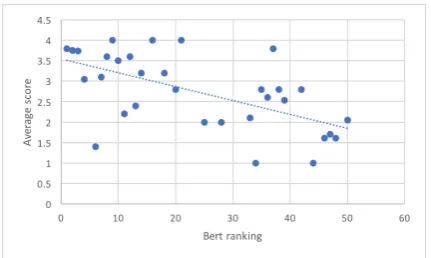
Figure 1: Correlation between human scores on the plausibility of the distractor candidates, and their rank-ing in BERT (Section3.2).
Figure 2: Correlation between human scores on the plausibility of the distractor candidates, and their se-mantic similarity ranking (Section3.1).
Each distractor candidate can be rated as “Obvi-ously wrong”, “Somewhat plausible”, “Plausible”, or “Correct” (and hence unacceptable as a distrac-tor). The pairwise Kappa for the five human raters was 0.420, which is considered a “Moderate” level of agreement (Landis and Koch,1977).
4.2 Results
Correlation with human judgment. Table 2 shows the level of correlation between the auto-matically produced distractor ranking and the av-erage human rating.2 A larger negative coefficient
2We assigned score 1 to the “Obviously wrong” candi-dates, score 2 to “Somewhat plausible”, score 3 to “Plausi-ble” and score 4 to “Correct” distractors.
indicates a higher degree of correlation, since dis-tractors with higher plausibility scores should have a smaller rank number. BERT achieved a Pear-son correlation coefficient of -0.455; visualized in Figure1, the correlation is statistically significant (p= 0.002). In contrast, the coefficient for the se-mantic similarity baseline was only -0.233; visual-ized in Figure2, the correlation is not statistically significant (p = 0.123). The trend was similar with Spearman’s rho, for which BERT achieved a coefficient of -0.487, which is statistically sig-nificant (p = 0.0007). The baseline obtained a coefficient of -0.263, which is not statistically sig-nificant (p= 0.081).
Generation accuracy. We generated distrac-tors by setting thresholds in the re-ranked list for different plausibility levels. We tuned the thresh-olds by leave-one-out cross-validation to optimize accuracy in classifying a candidate as “Correct”, “Plausible”3, or “Less Plausible”. The gold la-bel is the majority lala-bel out of the five raters. As shown in Table 2, BERT achieved 60.63% clas-sification accuracy, outperforming the similarity baseline, which achieved 42.52% by always pre-dicting the majority label “Less plausible”. For our dataset, the optimized thresholds for BERT were to classify candidates ranked 1 to 10 as “Cor-rect”; those ranked 11 to 39 as “Plausible”; and the rest as “Less Plausible”.
5 Conclusions
To support automatic generation of gap-fill items with distractors at a variety of plausibility lev-els, we have introduced distractor ranking as a new evaluation framework for distractor genera-tion. This study is the first to apply BERT to the task of distractor ranking. Experimental results show that it outperforms semantic similarity mea-sures in terms of both correlation to human judg-ment on distractor plausibility, and classification accuracy of distractor plausibility.
[image:4.595.71.288.363.492.2]Acknowledgment
This work was supported by the Innovation and Technology Fund (Ref: ITS/389/17) of the In-novation and Technology Commission, the Gov-ernment of the Hong Kong Special Administra-tive Region. We thank Ka Po Chow for his as-sistance. The first author completed this research at City University of Hong Kong and now works at Google.
References
Chia-Yin Chen, Hsien-Chin Liou, and Jason S. Chang. 2006. FAST: An Automatic Generation System for Grammar Tests. InProc. COLING/ACL Interactive Presentation Sessions.
Tao Chen, Naijia Zheng, Yue Zhao, Muthu Kumar Chandrasekaran, and Min-Yen Kan. 2015. Interac-tive Second Language Learning from News Web-sites. In Proc. 2nd Workshop on Natural Lan-guage Processing Techniques for Educational Appli-cations.
David Coniam. 1997. A Preliminary Inquiry into Us-ing Corpus Word Frequency Data in the Automatic Generation of English Language Cloze Tests. CAL-ICO Journal, 14(2-4):15–33.
Jacob Devlin, Ming-Wei Chang, Kenton Lee, and Kristina Toutanova. 2019. BERT: Pretraining of Deep Bidirectional Transformers for Language Un-derstanding. InProc. NAACL-HLT.
Yifan Gao, Lidong Bing, Wang Chen, Michael R. Lyu, and Irwin King. 2019. Difficulty Controllable Gen-eration of Reading Comprehension Questions. In Proc. 28th International Joint Conference on Arti-ficial Intelligence (IJCAI).
Hubbard C. Goodrich. 1977. Distractor Efficiency in Foreign Language Testing. TESOL Quarterly, 11(1):69–78.
J. B. Heaton. 1989. Writing English Language Tests. Longman.
Yuko Hoshino. 2013. Relationship between Types of Distractor and Difficulty of Multiple-Choice Vocab-ulary Tests in Sentential Context. Language Testing in Asia, 3(16).
Shu Jiang and John Lee. 2017. Distractor Generation for Chinese Fill-in-the-blank Items. In Proc. 12th Workshop on Innovative Use of NLP for Building Educational Applications, page 143–148.
Nikiforos Karamanis, Le An Ha, and Ruslan Mitkov. 2006. Generating Multiple-Choice Test Items from Medical Text: A Pilot Study. InProc. 4th Interna-tional Natural Language Generation Conference.
Susanne Knoop and Sabrina Wilske. 2013. WordGap: Automatic Generation of Gap-Filling Vocabulary Exercises for Mobile Learning. In Proc. Second Workshop on NLP for Computer-assisted Language Learning, NODALIDA.
J. Richard Landis and Gary G. Koch. 1977. The Mea-surement of Observer Agreement for Categorical Data. Biometrics, 33:159–174.
John Lee, Donald Sturgeon, and Mengqi Luo. 2016. A CALL System for Learning Preposition Usage. In Proc. ACL.
Shen Li, Zhe Zhao, Renfen Hu, Wensi Li, Tao Liu, and Xiaoyang Du. 2018. Analogical Reasoning on Chi-nese Morphological and Semantic Relations. arXiv preprint arXiv:1805.06504.
Chen Liang, Xiao Yang, Neisarg Dave, Drew Wham, Bart Pursel, and C. Lee Giles. 2018. Distractor Gen-eration for Multiple Choice Questions using Learn-ing to Rank. InProc. 13th Workshop on Innovative Use of NLP for Building Educational Applications, pages 284–290.
Chao-Lin Liu, Chun-Hung Wang, Zhao-Ming Gao, and Shang-Ming Huang. 2005. Applications of Lexical Information for Algorithmically Composing Multiple-Choice Cloze Items. In Proc. 2nd Work-shop on Building Educational Applications Using NLP, pages 1–8.
Tomas Mikolov, Kai Chen, Greg Corrado, and Jeffrey Dean. 2013. Efficient Estimation of Word Repre-sentations in Vector Space. In Proc. International Conference on Learning Representations (ICLR).
Van-Minh Pho, Thibault Andr´e, Anne-Laure Ligozat, B. Grau, G. Illouz, and Thomas Franc¸ois. 2014. Multiple Choice Question Corpus Analysis for Dis-tractor Characterization. InProc. LREC.
Juan Pino, M. Heilman, and Maxine Eskenazi. 2008. A Selection Strategy to Improve Cloze Question Quality. InProc. Workshop on Intelligent Tutoring Systems for Ill-Defined Domains, 9th International Conference on Intelligent Tutoring Systems.
Keisuke Sakaguchi, Yuki Arase, and Mamoru Ko-machi. 2013. Discriminative Approach to Fill-in-the-Blank Quiz Generation for Language Learners. InProc. ACL.
Simon Smith, P. V. S. Avinesh, and Adam Kilgar-riff. 2010. Gap-fill Tests for Language Learners: Corpus-Driven Item Generation. InProc. 8th Inter-national Conference on Natural Language Process-ing (ICON).
Yuni Susanti, Takenobu Tokunaga, Hitoshi Nishikawa, and Hiroyuki Obari. 2018. Automatic Distractor Generation for Multiple-choice English Vocabulary Questions. Research and Practice in Technology Enhanced Learning, 13(15).
Ashish Vaswani, Noam Shazeer, Niki Parmar, Jakob Uszkoreit, Llion Jones, Aidan N. Gomez, Lukasz Kaiser, and Illia Polosukhin. 2017. Attention is All You Need. Advances in Neural Information Pro-cessing Systems, pages 6000–6010.