Integrating a unification-based semantics in a large scale Lexicalised Tree
Adjoining Grammar for French
Claire Gardent
CNRS / LORIA Equipe Talaris, Bat. B 615, rue du jardin botanique
54600 Villers les Nancy France
Abstract
In contrast to LFG and HPSG, there is to date no large scale Tree Adjoining Gram-mar (TAG) equiped with a compositional semantics. In this paper, we report on the integration of a unification-based se-mantics into a Feature-Based Lexicalised TAG for French consisting of around 6 000 trees. We focus on verb semantics and show how factorisation can be used to sup-port a compact and principled encoding of the semantic information that needs to be associated with each of the verbal elemen-tary trees. The factorisation is made possi-ble by the use ofXMG, a high-level linguis-tic formalism designed to specify and com-pile computational grammars and in partic-ular, grammars based on non-local trees or tree descriptions.
1 Introduction
Whilst there exists large scale LFGs (Lexical Functional Grammar) and HPSGs (Head-Driven Phrase Structure Grammar) equipped with a com-positional semantics (Copestake et al., 2001; Frank and van Genabith, 2001), available Tree Adjoining Grammars remain largely syntactic.
One reason for this is that there has been, up to recently, much debate about how best to com-bine TAG with a compositional semantics. Should it be based on the derived or the derivation tree ? Should Feature-Based LTAG be used or should synchronous TAG? Many proposals have been put forward but only recently did sufficient consensus
c
2008. Licensed under the Creative Commons
Attribution-Noncommercial-Share Alike 3.0 Unported
li-cense (http://creativecommons.org/licenses/by-nc-sa/3.0/). Some rights reserved.
emerge to support the specification of a TAG based compositional semantics. In a nutshell, it can be achieved either by using a synchronous TAG (Nes-son and Shieber, 2006) (in this case, the grammar explicitely describes and synchronises syntax and semantics structures) or by using Feature-Based LTAG (in which case, the synchronisation between syntax and semantics is mediated by the unifica-tion of semantic indices associated with the FTAG elementary trees).
Another more practical reason for the absence of large scale TAGs integrating a compositional semantics is the lack of available computational frameworks. Up to recently, there has been no available grammar writing environment and parser that would support the integration of com-positional semantics into a TAG. One step in that direction is provided by the development of XMG(Duchier et al., 2004), a formalism which supports the specification of Feature-Based LT-AGs equipped with a compositional semantics `a la (Gardent and Kallmeyer, 2003).
In this paper, we report on the integration of a unification-based semantics into a Feature-Based LTAG for French which consists of around 6 000 trees. This integration is specified using XMG and we show how this formalism can be used to support a compact and principled encoding of the semantic information that needs to be associated with each of the 6 000 elementary trees.
The article is structured as follows. We start (section 2) by presenting XMG and showing how it supports the specification of Feature-Based LT-AGs equipped with a compositional semantics. We then present SEMFRAG, the FTAG grammar for French that we developed (section 3). In section 4, we show how XMG can be used to minimise the development cost involved in enriching such
a grammar with a compositional semantics. Sec-tion 5 compares the approach with related work and concludes with pointers for further research.
2 TheXMGformalism
The XMG formalism was designed to support the development and factorisation of computational grammars for Natural Language. Like PATR II it is theory neutral in that its use is not restricted to a single grammatical theory. Unlike PATR II however, the language provided by XMG allows the linguist to talk about the basic building blocks not only of rule based computational linguistic theories such as as HPSG (Head Driven Phrase Structure Grammar) and LFG (Lexical Functional Grammar) but also of tree based theories such as TAG (Tree Adjoining Grammar). As we shall see, this involves allowing for sophisticated node nam-ing and identification mechanisms. Other differ-ences between PATR II and XMG include a more general use of disjunction, the use of colours to control tree construction and a more natural encod-ing of trees and of semantic representation than is permitted byPATR II. A detailed definition of the XMGformalism is given in (Duchier et al., 2004). In what follows, we give an intuitive presenta-tion ofXMGemphasising the points that support a strongly factorised specification of grammars and in particular, of SEMFRAG. We start by presenting the basic building blocks XMGallows the linguist to talk about (2.1). We then go on to discuss the factorising mechanisms it supports (2.2). Finally, we introduce the several node naming and identifi-cation mechanisms it provides (2.3).
2.1 The basic building blocks
In XMG, the basic building blocks are CLASSES which may be specified along three dimensions : a syntactic dimension (SYN) which consists of a tree description whose node variables can be dec-orated with feature structures; a semantic dimen-sion (SEM) consisting of a flat semantic formula; and a syntax/semantic interface (INTERFACE) for synchronising semantic formulae and tree descrip-tions .
SYN. The syntactic dimension inXMGallows the linguist to specify tree descriptions i.e., trees that can be underspecified with respect to both domi-nance and precedence. The trees described may be either local or extended and their nodes may be decorated with either one or two feature structures
(two for TAG TOP and BOTTOM feature struc-tures).
SEM. Using the semantic dimension, the linguist can specify unification based flat semantic formu-lae in the sense of (Copestake et al., 2001) i.e., non recursive formulae describing first order for-mulae with lambda binders replaced by unification variables and where scope may be underspecified. Semantic schemas can also be specified in which predicates are replaced by unification variables that will be instantiated during lexical lookup. For instance, theSEM dimension may include the fol-lowing semantic formula and schema1:
(1) a. Every: l0 : ∀(X, h1, h2), h1 ≥ L1, h2 ≥
L2
b. Binary Relation Schema: l1 : P(E), l1 :
T heta1(E, X), l1 :T heta2(E, Y)
In (1a), the flat semantic formula associated with every underspecifies scope by stating that the scope handleh2scopes, directly or indirectly (≥), over (the labelL2 associated with) the scopal ar-gument.In (1b) on the other hand, underspecifica-tion bears on the predicate P and the theta roles
T heta1, T heta2 which are unification variables whose value will be provided by the lexicon. In this way, this binary relation schema can be used to represent the semantics of all verbs denoting a binary relation. The lexicon will then specify for each verb the relevant relation and theta roles.
INTERFACE. The third XMG dimension permits synchronising syntax and semantics. In essence, features that are used inSYNor inSEMcan be as-signed global names in theINTERFACEdimension and synchronised using variable sharing. For in-stance, given a feature-value pairF =X occuring in theSYNdimension and a semantic parameterY occuring in the SEM dimension, the following in-terface constraint permits both unifying (“synchro-nising”) X and Y and assigning them the global namesIDXandARGrespectively :
(2) IDX= 1 X,ARG= 1 Y
As we shall see in section 4.2.2, the interface al-lows for a natural and highly factorised means of stating syntax/semantics linking constraints (e.g., the subject constituent provides the semantic index for the first semantic argument).
1
2.2 Factorising mechanisms
An important feature of a linguistic formalism is that it supports a high level of factorisation thus facilitating grammar development, debugging and maintenance. InXMG, factorising can be achieved using disjunctions, conjunctions and inheritance of classes. As argued in (Crabb´e, 2005), classes dis-junction supports the description of alternatives, for instance, to describe the alternative possible re-alisations of a subject (see below). As usual, con-junction and inheritance of classes permits com-bining the content of two classes2.
2.3 Node naming and identification mechanisms
In combining tree descriptions, the linguist often wants to identify nodes across descriptions. One distinguishing feature ofXMG it that it supports a sophisticated treatment of node naming and node identification (Gardent and Parmentier, 2006).
Node naming. InXMG, node names are by de-fault local to a class. However explicitIMPORTand EXPORT declarations can be used to make names “visible” to children classes. AnEXPORT declara-tion makes the exported name(s) visible to all chil-dren classes. Conversely restrictive IMPORT dec-larations can be used either to block or to rename exported variables that are visible through inheri-tance.
Node identification. As we have just seen, IM-PORT and EXPORT declarations can be used to make names “visible” to children classes and thereby idendify nodes from different classes. For instance, if class C1 inherits from class C2, C1 refers to a node variableXandC2exportsX, then
Xdenotes the same node in bothC1andC2. However, this mechanism only works within a single branch of the inheritance hierarchy. Indeed in case of multiple inheritance (two classesC1and
C2 export the same variableX to a third class
in-heriting from bothC1 andC2), identification will fail (Xwill not be interpreted as denoting the same node in both C1 and C2). To remedy this short-coming, XMG allows for explicit node identifica-tions. Thus in the above case,X can be identified using the constraintC1.X =C2.X.
2The distinction between conjunction and inheritance has
to do with some intricate issues concerning node identifica-tions which we will not address here. See (Gardent and Par-mentier, 2006) for a detailed discussion on this.
This concludes our informal presentation of XMG. For a more precise definition of its syn-tax, semantic and compilation process, we refer the reader to (Duchier et al., 2004).
3 SemFraG
To illustrate the expressive power ofXMG, we now show how it can be used to specify SEMFRAG, a TAG for French which integrates a unification based compositional semantics. We start by pre-senting the grammar produced by theXMG speci-fication.
SEMFRAG is a unification based version of LTAG namely, based TAG. A Feature-based TAG (FTAG, (Vijay-Shanker and Joshi, 1988)) consists of a set of (auxiliary or initial) el-ementary trees and of two tree composition opera-tions: substitution and adjunction. Initial trees are trees whose leaves are labelled with substitution nodes (marked with a downarrow) or terminal cat-egories. Auxiliary trees are distinguished by a foot node (marked with a star) whose category must be the same as that of the root node. Substitution in-serts a tree onto a substitution node of some other tree while adjunction inserts an auxiliary tree into a tree. In an FTAG, the tree nodes are furthermore decorated with two feature structures (called TOP andBOTTOM) which are unified during derivation as follows. On substitution, the top of the substi-tution node is unified with the top of the root node of the tree being substituted in. On adjunction, the top of the root of the auxiliary tree is unified with the top of the node where adjunction takes place; and the bottom features of the foot node are unified with the bottom features of this node. At the end of a derivation, the top and bottom of all nodes in the derived tree are unified.
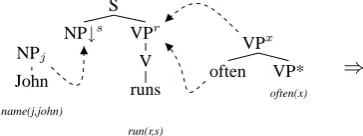
To associate semantic representations with natu-ral language expressions, the FTAG is modified as proposed in (Gardent and Kallmeyer, 2003). Each
NPj
John
name(j,john) S NP↓s VPr
V
runs
run(r,s)
VPx
often VP* often(x)
⇒
[image:3.595.327.509.633.701.2]name(j,john), run(r,j), often(r)
Figure 1: Flat Semantics for “John often runs”
representation. For instance, in Figure 1,3the trees for John, runs and often are associated with the se-mantics name(j,john), run(r,s) and often(x) respec-tively.
The arguments of a semantic functor are repre-sented by unification variables which occur both in the semantic representation of this functor and on some nodes of the associated syntactic tree. For in-stance in Figure 1, the semantic indexsoccurring in the semantic representation of runs also occurs on the subject substitution node of the associated elementary tree.
The value of semantic arguments is then de-termined by the unifications taking place during derivation. For instance, the semantic index sin the tree for runs is unified during substitution with the semantic indices labelling the root nodes of the tree for John. As a result, the semantics of John
often runs is
(3) {name(j,john),run(r,j),often(r)}
SEMFRAG describes a core fragment of French and contains around 6 000 elementary trees. It cov-ers some 35 basic verbal subcategorisation frames and for each of these frames, the set of argument redistributions (active, passive, middle, neuter, re-flexivisation, impersonal, passive impersonal) and of argument realisations (cliticisation, extraction, omission, permutations, etc.) possible for this frame. Predicative (adjectival, nominal and prepo-sitional) and light verb constructions are also cov-ered as well as subcategorising nouns and adjec-tives. Basic descriptions are provided for the re-maining constructions i.e., adverbs, determiners and prepositions.
4 Implementing SEMFRAG usingXMG
We now illustrate the power of XMG by show-ing how it can be used to produce a highly fac-torised specification of SEMFRAG, an FTAG of 6 000 trees enriched with a unification based compo-sitional semantics. Given the space constraints, we concentrate on the verbal trees (trees anchored by verbs). We start (4.1) by summarising the specifi-cation of SEMFRAG verbal syntactic trees given in (Crabb´e, 2005). We then (4.2) show how this spec-ification of the syntax of verbal trees can be en-riched with a unification based compositional
se-3
Cx/Cx abbreviate a node with category C and a top/bottom feature structure including the feature-value pair {index :x}.
mantics. We show in particular that this enrich-ment can be performed using only a limited set of general principles.
4.1 Syntax
The syntactic dimension of SEMFRAG was speci-fied in (Crabb´e, 2005). For the verbal trees, it can be summarised as follows.
First, tree families are specified as disjunctions of diatheses. For instance, the N0VN1 family4 is defined as :
n0Vn1 → ( dian0Vn1Active
∨ dian0Vn1Passive
∨ dian0Vn1dePassive
∨ dian0Vn1ShortPassive
∨ dian0Vn1ImpersonalPassive
∨ dian0Vn1middle
∨ dian0Vn1Reflexive )
(1)
Second, diatheses are defined as conjunctions of classes. For instance, dian0Vn1Active is defined as:
dian0Vn1Active → ( Subject
∧ ActiveV erbF orm
∧ Object )
(2)
Third, each grammatical function appearing in the definition of a diathesis is defined as a disjunction of classes, each class representing a possible real-isation of that function. For instance, the Subject class is:
Subject → ( CanonicalSubject
∨ RelativisedSubject
∨ W hSubject
∨ CleftSubject
∨ CliticSubject )
(3)
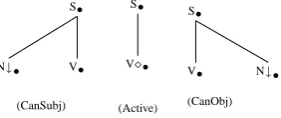
Fourth, each class describing a possible gram-matical function realisation specifies the adequate tree description. For instance, the fragments for
CanonicalSubject, ActiveVerbForm and Canon-icalObject are sketched in Figure 25.
In sum, the XMGspecification relies on a fairly intuitive use of classes disjunctions and conjunc-tions. Moreover, the basic leaf classes (i.e., the most deeply embedded disjuncts and conjuncts in the grammar specification) are defined by inheri-tance, the inheritance hierarchy encoding the shar-ing of tree description fragments and/or feature
4
In TAG, a tree family gathers all the elementary trees associated with verbs of a given syntactic type. Thus, the N0VN1 family contains all the trees describing the syntactic contexts in which a verb taking two nominal arguments (i.e., a transitive verb) can occur.
5
S•
N↓• V•
(CanSubj)
S•
V⋄•
(Active) S•
V• N↓•
[image:5.595.111.252.73.132.2](CanObj)
Figure 2: Tree fragments
structures between leaf classes. As a result, sev-eral thousand trees are specified using only a few hundred classes.
4.2 Semantics
Just like grammar engineering is a complex issue, enriching a computational grammar with a com-positional semantics is potentially time consuming and error prone. We now show that XMG permits this enrichment by means of a few general seman-tic principles thus minimising both work and the risk of errors. To enrich a purely syntactic FTAG with the type of unification based semantics de-scribed in section 3, three main changes need to be carried out.
First, trees must be labelled with appropriate se-mantic indices and labels. For instance, the sub-ject node of a verbal tree must be labelled with a semantic index.
Second, trees must be associated with appropri-ate semantic schemas. For instance, the trees of the
n0Vn1 family must be associated with a semantic
schema representing a binary relation.
Third, variable sharing between semantic schemas and syntactic trees must be enforced. For instance, the semantic index of the subject node of an active verb should be identified with the first semantic argument of the associated semantic schema.
We now provide anXMGencoding of this infor-mation. As for the syntax, we proceed top-down from the verb families down to argument realisa-tion and node labelling.
4.2.1 Associating trees with semantic formulae.
As indicated in the previous section, trees in TAG are grouped into tree families. We use this feature to associate in one fell swoop all the trees of a given family with the appropriate semantic schema. For instance, to associate transitive verbs with a binary relation schema, the syntactic
speci-fication given in (1) is modified to:
n0Vn1 → binaryRel ∧
( dian0Vn1Active
∨ dian0Vn1Passive
∨ dian0Vn1dePassive
∨ dian0Vn1ShortPassive
∨ dian0Vn1ImpersonalPassive
∨ dian0Vn1middle
∨ dian0Vn1Reflexive )
(4)
4.2.2 Linking constraints
Next the correct syntax/semantic interface con-straints must be specified for each diathesis. That is, the correct mapping between syntactic and se-mantic arguments must be enforced. This is done in two steps.
First, we define a set of INTERFACE constraints of the form
indexF =V, argi =V
which are meant to enforce the identification of the semantic index (indexF) labelling a given tree node with grammatical functionF (e.g., F = subject) with the index (argi) representing thei -th argument in a semantic schema. For instance, when combined with a classC containing a vari-able X named6 arg1 and a variable Y named
indexsubject, the SubjArg1 linking constraint indexsubject=V, arg1=V
ensures thatXandY are identified. Assuming fur-ther thatarg1is used to name the first semantic ar-gument andindexsubjectto name the value of the index feature labelling a subject node7, this con-straint ensures a subject/arg1 mapping.
Given such interface constraints, we then refine the diathesis definitions so as to ensure the correct bindings. For instance, the specification in (2) is modified to :
dian0Vn1Active → ( SubjArg1
∧ ObjArg2
∧ Subject
∧ ActiveV erbF orm
∧ Object )
(5)
whilst the passive diathesis is specified as:
dian0Vn1Passive → ( SubjArg2
∧ CagentArg1
∧ Subject
∧ P assiveV erbF orm
∧ Cagent )
(6)
6
As explained in section 2, interface constraints can be used to assign global names to values inside a class.
7
4.2.3 Labelling trees with semantic indices. The above scheme relies on the assumption that tree nodes are appropriately labelled with seman-tic indices (e.g., the subject node must be labelled with a semantic index) and that these indices are appropriately named (arg1must denote the param-eter representing the first argument of a binary re-lation andindexsubjectthe value of the index fea-ture on a subject node). As suggested in (Gardent, 2007), a complete semantic labelling of a TAG with the semantic features necessary to enrich this TAG with the unification based compositional se-mantics sketched in section 3 can be obtained by applying the following labelling principles8:
Argument labelling: In trees associated with se-mantic functors, each argument node is la-belled with a semantic index9named after the grammatical function of the argument node (e.g.,indexsubjectfor a subject node).
Anchor projection: The anchor node projects its label up to its maximal projection.
Foot projection: A foot node projects its label up to the root10
Controller/Controllee: In trees associated with control verbs, the semantic index of the troller is identified with the value of the con-trolled index occuring on the sentential argu-ment node.
As we shall now see, XMGpermits a fairly direct encoding of these principles.
Argument labelling. In the tree associated with a syntactic functor (e.g., a verb), each tree node representing a syntactic argument (e.g., the sub-ject node) should be labelled with a semantic index named after the grammatical function of that node (e.g.,indexsubject).
To label argument nodes with an appropriately named semantic index, we first define a set of classes encapsulating a node with an index and a name. We then identify this node with the appro-priate tree nodes.
More specifically, we define for each grammatical function F unction ∈
8Because of space constraints, the principles required to
handle quantification are omitted.
9
For simplicity, we only talk about indices here. However, to be complete, labels are also need to be taken into account.
10
The foot projection principle only applies to foot nodes that are not argument nodes i.e., to modifiee nodes.
{subject, object, cagent, iobject, . . .}, a se-mantic class F unctionSem which associates with an (exported) node called xF unction the feature value pair index = I and an interface constraint of the form indexF unction = I. For
instance, the class SubjectSem associates the
nodexSubjectwith the feature value pair index =
I and the interface constraint indexsubject= I.
subjectSem → [syn] :xSubject[index=I] [interface] : [indexsubject=I]
(7)
When specifying the tree fragments describing the possible realisations of the grammatical func-tions, the (exported) argument node is systemati-cally namedxArg.
Finally, we modify the specification of the gram-matical functions realisations to import the ap-propriate semantic class and identify xArg and
xF unction nodes. For instance, 3 above is
changed to:
Subject → SubjectSem ∧
xArg=xSubject ∧
( CanonicalSubject
∨ RelativisedSubject
∨ W hSubject
∨ CleftSubject
∨ CliticSubject )
(8)
As a result, all xArg nodes in the tree descrip-tions associated with a subject realisation are la-belled with an indexI feature whose global name isindexsubject.
Controller/Controllee. Value sharing between the semantic index of the controller (e.g., the sub-ject of the control verb) and that of the controllee (e.g., the empty subject of the infinitival comple-ment) is enforced using linking constraints be-tween the semantic index labelling the controller node and that labelling the sentential argument node of the control verb. Control verb definitions then import the appropriate (object or subject con-trol) linking constraint.
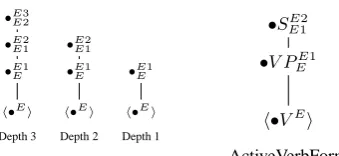
•E3
E2 •E2
E1 •EE21 •E1
E •EE1 •EE1
h•Ei h•Ei h•Ei Depth 3 Depth 2 Depth 1
•SE2 E1
•V PE1 E
h•VEi
[image:7.595.85.255.83.161.2]ActiveVerbForm
Figure 3: Anchor/Foot projection
projection class will deterministically be unified with those dominating the anchor or foot node of the trees being combined with. For instance, for verbs, the class specifying the verbal spine (e.g.,
ActiveVerbForm, cf. 2) will import a projection
class and equate the anchor node of the verbal spine with that of the projection skeleton. As a re-sult, the verb projects its index up to the root (mod-ulo the renaming made necessary by the possibility of an adjunction) as illustrated on the right inside of Figure 3.
4.3 Discussion
Arguably, the XMG encoding we provided to en-rich an FTAG with a unification based composi-tional semantics, is compact and principled.
It is principled in that it provides a direct and transparent formulation of the main principles un-derlying the integration in a TAG of the unification based semantics sketched in Section 3.
It is compact in that the number of modifica-tions needed to enrich syntax with semantics is rel-atively small: 76 class definitions and 498 class calls are sufficient to associate the required se-mantic information (sese-mantic schemas, sese-mantic indices and index projections) with roughly 6000 trees. Crucially, this means that the time involved in integrating the semantics in the grammar is small (roughly a week linguist work) and further that the maintenance, extension and debugging of the semantic component is greatly facilitated.
Both these points rely on the expressivity of XMG. More in particular, the encoding heavily re-lies on two specific features of XMGnamely,
gen-eralised classes disjunctions and the possibility to
use global names not only for tree nodes but also for feature values and semantic parameters.
Generalised classes disjunctions are used to as-sociate large sets of trees with semantic schema (section 4.2.1) and to label sets of tree frag-ments with the appropriately named index (section
4.2.3). Intuitively, generalised classes disjunction and conjunction permit factoring out the common operand of an enumeration (e.g., instead of enu-merating(a∧b)∨(a∧c)∨(a∧d)∨. . ., we can specifya∧(b∨c∨d) ). In practice, this means that the number of statements necessary to spec-ify the grammar can be greatly reduced. For in-stance, the association of several thousands of verb trees with a semantic schema is enforced by a total of 176 statements. In contrast, standard linguistic formalisms such as PATR IIor theLKBonly allow disjunctions over atomic feature values.
Global names in turn, were used to support a di-rect encoding of linking constraints (section 4.2.2). 37 linking constraints definitions and 255 linking constraints calls are sufficient to ensure the ap-propriate mapping between syntactic and seman-tic arguments in verb trees as well as adjectival and nominal predicative trees. More generally, the possibility to introduce global names not only for tree nodes as in e.g., (Vijay-Shanker and Schabes, 1992) but also for feature values and semantic pa-rameters allows for a simple and direct encoding of constraints applying to identifiers occuring “far apart” in a given tree (for instance, between the in-dex of the subject node in a controlverb tree and that of aPROindex of its infinitival argument).
5 Conclusion
Whilst the development of standard unification-based grammars is well supported by the design of formalisms such asPATR II, theXLEand theLKB, formalisms for developing Tree-Based Grammars have received less attention. XMGaims to remedy this shortcoming by providing a formalism that supports talking about trees, tree sharing and tree labelling.
Trees of arbitrary (finite) depth can be described using underspecified tree descriptions. Addition-ally, trees can be combined with further linguistic dimensions such as semantic representations and a syntax/semantic interface to form more complex linguistic units.
in-heritance or through the use of colours, a mech-anism not discussed here).
Finally, tree labelling can be expressed by as-sociating tree nodes with one or two (for TAG) feature structures. Importantly, feature values can be assigned global names thereby allowing for the specification of constraints on features that are “far apart from each other” within a tree.
In this paper, we have argued that these fea-tures of XMG are effective in supporting an en-coding of an FTAG with a unification based com-positional semantics which is principled, transpar-ent and compact. These features also markedly distinguish XMG from existing formalisms used to encode tree based grammars such as the non-monotonic encoding of TAG proposed in (Evans et al., 1995) (in contrast, XMGis fully monotonic) and the tree descriptions based approaches pro-posed in (Candito, 1996; Xia et al., 1998) where in particular, tree descriptions can only be conjoined (not disjoined) and where identification across tree fragments is restricted to nodes.
More in general, we believe that expressive for-malisms are necessary to allow not only for the quick development of symbolic tree based gram-mars but also for their comparison and for the fac-toring of several grammars be they different wrt to the language they handle (as for instance in the HPSG Delphin or in the LFG Pargram project) or in the semantics they integrate e.g., a glue se-mantics as proposed in (Frank and van Genabith, 2001), a lambda-based semantics as proposed in (Gardent, 2007) or as shown here, a unification based flat semantics.
References
M.H. Candito. 1996. A principle-based hierarchical representation of LTAGs. In Proc. of COLING’96,
Kopenhagen.
A. Copestake, A. Lascarides, and D. Flickinger. 2001. An algebra for semantic construction in constraint-based grammars. In Proc. of ACL, Toulouse, France.
B. Crabb´e. 2005. Repr´esentation informatique de grammaires fortement lexicalis´ees. Ph.D. thesis, Universit´e Henri Poincar´e, Nancy.
D. Duchier, J. Le Roux, and Y. Parmentier. 2004. The metagrammar compiler. In 2nde confrence
interna-tionale Oz/Mozart (MOZ’2004), Charleroi.
R. Evans, G. Gazdar, and D. Weir. 1995. Encoding lex-icalized tree adjoining grammars with a nonmono-tonic inheritance hierarchy. In Proc. of ACL.
A. Frank and J. van Genabith. 2001. Ll-based se-mantics for ltag - and what it teaches us about lfg and ltag. In Proc. of the LFG’01 Conference, Hong Kong. CSLI Online Publications.
C. Gardent and L. Kallmeyer. 2003. Semantic con-struction in ftag. In Proc. of EACL, Budapest, Hun-gary.
C. Gardent and Y. Parmentier. 2006. Coreference han-dling in xmg. In Proc. of COLING (Poster), Sydney, Australia.
C. Gardent. 2007. Tree adjoining grammar, semantic calculi and labelling invariant. In Proc. of IWCS.
Rebecca Nesson and Stuart M. Shieber. 2006. Simpler TAG semantics through synchronization. In
Pro-ceedings of the 11th Conference on Formal Gram-mar, Malaga, Spain, 29–30 July.
K. Vijay-Shanker and A. K. Joshi. 1988. Feature structures based tree adjoining grammar. In Proc.
of COLING, pages 714–719, Budapest.
K. Vijay-Shanker and Y. Schabes. 1992. Structure sharing in lexicalised tree adjoining grammar. In
Proc. of COLING 92, pages 205–211.